Thanksgiving Day and Turkey

Today is Thanksgiving and tomorrow Black Friday when American will literally be fighting with each other in very early morning queues to empty their purses and buy many things to satisfy their ego and fill the empty spaces of their houses. Shannon is going to attempt for that.

And I am watching a nice way of celebration at home. While on hand we shall be seeing the wonderful Turkey cuisine, on the other side some of us will be testing kheer, purees and chhole. This is the globalization in action.

Anand has researched some interesting information about Turkey, the word used for the bird that occupied the main place in the celebration of Thanksgiving Day in every American household.

The Hebrew term for turkey, transliterated as tarnagol hodu, literally translates to “chicken of India”.

And the Turkish word for turkey is “hindi.”

Does it relate any way to Bharat, India that we love? Did the ancestors of Americans get this gift of this important day every year on the last Thursday of November some way from India of east, the ancient country or is it just a chance to have some Indian words attached to the meaning of Turkey?

During the morning walk yesterday, we started discussing the issue. What could have been the historical reasons for the meaning of Turkey used in Hebrews and Turkish languages?

I tried to impress upon Anand that India was one of the most developed country when others were in Stone Age. And there were a lot of immigrations two. India might have been source country. I don’t know anyone can further elaborate on it.

But what should Indians in US do on Thanksgiving Day? I suggested Keshav, my eldest grandson who called me to wish for the day that he should celebrate it for giving thanks and expressing gratitude’s to all aged in the family. I didn’t know if it was the appropriate advice and if the others from India can also follow that.

Posted in Uncategorized | Leave a comment

Bihar: Agenda Next

Month long battle for getting into the ruling chair is getting over. It must be a gruelling task for the participants. With whatever appeared in digital media that I could access from my US abode, be it by the articles of Ashok V.Desai, Raj Kumar, Yogendra Yadav or NDTV 24×7 TV show with Pranay Ray, Soopariwala and Shekhar Gupta, I predict a win for Nitish Kumar. It will also mean a death of caste and confirmation of development based politics. He will get that one more chance he had been campaigning for. And naturally the million dollars question will then be;

What Next? Will it be the end of divisive politics?

Will Bihar be transformed to a prospered peaceful Bihar in next five years? Will the employees and the officers and their family members shun the lure of ‘upari aamdani’?

Can the sons of Kariman, a dalit, build his house next to Ram Chandra Singh belonging to socalled forward class?

Or will the wait never end?

Can Bihar do that inspite of any in the government?

Will Man Mohan’s government listen to Bihar’s need more positively?

And will Lalu and Paswan go out of the politics of Bihar and shift to New Delhi?

What will be Rahul Gandhi’s plan for Bihar if his party gets less than 20 legislators in new state assembly?

Mr. Nitish Kumar must come out a clear cut time bound agenda for the development and try to achieve what he promises by the end of the fourth year.

I have only single priority still.

Let Nitish get each and every Bihari literate, educated and skilled. Let him beg borrow or even steel to get that happen.

Update from US: Cary, North Carolina November 24, 4 AM
People of Bihar is going to return Nitish with thumping majority, Bihar has again proved its real core strength. It has left the caste behind in vote politics. The defeat of Rabri Devi from both the seats is the benchmark of transforming Bihari. Nitish and his team will have to work harder to meet the aspirations of the people, particularly young men and women. Taking Bihar in the league of the developed states will require innovative approaches along with hard work of bureaucrats that are still corrupt in Bihar as one report in Economist mentioned. I wish Nitish a success and wish he really confiscates the property of corrupt officers and politicians and uses it for educational institutes as promised.

Posted in bihar, economy | Tagged , | Leave a comment

The Chinese Way-Is there something for India?

Anand took me yesterday to Apple Shop for buying a lap top for Shannon. We reached the shop at 9PM. I had agreed to accompany Anand as I wanted to see the life at this late evening in the shops of US. For Anand and Shannon too, as they told me, it was one after many years. Surprisingly the shop was closing for the day and denying the fresh customers to enter, though Shannon had confirmed that it would remain open till 10PM. But when we explained our case, the manager who happened to hear us made us enter and buy the laptop, a $1400 commodity. For me it was a strange thing in US and that too with Apple’s own outlet.

I found both Anand and Shannon very happy with the purchase. As we came out of the shop, Anand and Shannon wanted to have some night strolling in the shopping complex. I asked them to allow me to get into the next door Barnes and Noble. It was open and pretty crowded even at that late hour. This is another indicator of the reading habits of the nation that differentiates it with India.

I love to glance through HBR as the first thing always.

I came across an article by Thomas M. Hout and Pankaj Ghemawat, ‘China vs the World: Whose Technology Is It?’ in Harvard Business Review December 2010. It’s a pretty good study on the changing Chinese strategy to take a lead in high tech manufacturing sector.

I am quoting some extracts from the article with wishes that India can draw some lessons from China and gets into manufacturing in a big way. It’s only manufacturing that can provide jobs for persons with all levels of skill. India must focus on facilitating some companies such as BHEL, BMEL, and even HMT Machine Tools Division to become global by providing more autonomy and bringing in the professional heads. If Obama’s visit has given opportunity, India must take advantage of it.

Can it encourage globally known names in high technologies such as GE and Boeing to gradually have its major manufacturing facilities in India that will create a lot of local enterprises of all sizes and provide employment?

Can the Indian companies with large number of collaborations for many years learn the way Chinese have done and independently be global companies?

China is quietly and deliberately shifting from a successful low- and middle-tech manufacturing economy to a sophisticated high-tech one, by cajoling, co-opting, and often coercing Western and Japanese businesses.

The Chinese government has deployed several strategies to help local companies acquire state-of-the-art technologies and break into the global market.

Beijing drives the process nationally in most capital-intensive sectors. Consider high-speed railway systems, now an estimated $30 billion a year market in China. In the early 2000s the superior equipment of multinational corporations such as Alstom, which built France’s TGV train system; Kawasaki, which helped develop Japan’s bullet trains; and Siemens, the German engineering conglomerate, gave foreign companies control of about two-thirds of the Chinese market. The multinationals subcontracted the manufacture of simple components to state-owned companies and delivered end-to-end systems to China’s railway operators. In early 2009 the government began requiring foreign companies wanting to bid on high-speed railway projects to form joint ventures with the state-owned equipment producers CSR and CNR. Multinational companies could hold only a 49% equity stake in the new companies, they had to offer their latest designs, and 70% of each system had to be made locally. Most companies had no choice but to go along with these diktats, even though they realized that their joint-venture partners would soon become their rivals outside China.

The multinationals are still importing the most-sophisticated components, such as traction motors and traffic-signaling systems, but today they account for only 15% to 20% of the market. CSR and CNR have acquired many of the core technologies, applied them surprisingly quickly, and now dominate the local market. In addition, they are cutting their teeth in the estimated $110 billion international rolling-stock market, moving into several developing countries where the Chinese government funds railway modernization projects. The combination of low manufacturing costs and modern technologies is helping them make inroads in developed markets too, with CNR recently winning contracts in Australia and New Zealand.
The Chinese government sometimes synchronizes its desire to accelerate growth in a particular sector with the imposition of new regulations on multinationals in that sector. For example, from 1996 to 2005 foreign companies held a 75% share of the Chinese market for wind energy projects. Then the government decided to grow the market dramatically, offering buyers large new subsidies and other incentives. At the same time, it quietly increased the local-content requirement on wind turbines from 40% to 70% and substantially hiked the tariffs on imported components. As the market exploded, foreign manufacturers were unable to expand their supply chains quickly and meet the increased demand. Their Chinese competitors, who had been licensing technology mainly from small European turbine producers, took up the slack rapidly and cost-effectively. By 2009 Chinese companies, led by Sinovel and Goldwind, controlled more than two-thirds of the market. In fact, foreign companies haven’t won a single central government–funded wind energy project since 2005.

Are there some lessons? Those interested may go through the article critically.

Posted in economy, governance | Tagged | Leave a comment

Corruption Crisis

It is corruption everywhere.India, the land of Gandhi, has become synonym of corruption. Some may be shedding crocodile tears, but not ready to fight this war that is holding the growth of the country and keeping India lose ground everywhere.

I don’t know if I can take the media reports as an indicator of a real rising revolts against corruption.

Ashok Chavan, the Chief Minister of Maharashtra had to resign. Kalmadi finally put in the paper. The first one did it for his involvement in Adarsh Housing scam and the second for the corruption related CWG. And Raja also could not stand against the demand of resignation for 2G scam even with the powerful support of Karunanidhi who might have been the biggest beneficiaries of the scam.

Whom should Indians give the credit for it? Is it Congress, Sonia, Man Mohan or media or court?

Sonia and Man Mohan may preach. But can they stand against the corruption? The court may embarrass even the Prime Minister, but will it expedite the process and convict the criminals fast?

Will the society boycott the criminals of corruption or honour them?

How many of the disciples of Baba Ramdev will go by his advise, ‘Shoot the corrupt’?

Posted in governance, indian politics | Tagged | Leave a comment

Obama’s Love for Reva and Nano

I don’t know how to rate Obama’s visit to India. If I go by the number of times the members of parliament including Man Mohan Singh and Sonia Gandhi burst into applause, it was certainly one that made the representatives excited and happy. I don’t know if there was any whip for the applause on certain indications from the party bosses.

I still love to talk about some cars that can make India go ahead of its competitor. I got my excitement from a White House press release on Saturday that said, (through their partnership,)

“Mahindra Reva and Curtis are advancing the commercialisation and adoption of clean vehicles in India and across the globe. The tiny wonder that made a debut on Bangalore roads is going places. It’s playing in the big league that is the domain of large auto manufacturers.”

Electric/Clean transport: Motor controls designed, built and exported by New York-based Curtis Instruments are a key technology in the Mahindra-Reva electric car. Through this partnership, Mahindra Reva and Curtis are advancing the commercialization and adoption of ‘clean’ vehicles in India and across the globe.

I also read that Anand Mahindra could impress upon Obama about the great potential of this partnership. Interestingly, Chetan Maini’s Reva is now in right company of Mahindra. With its price, it can certainly be in American homes, if not for a regular means of transportation at least as car to visit burger or Donut shops in locality. However, it will require a lot of marketing.

The story of Nano that appeared in media during Obama’s visit was equally interesting. The President introduced Mr. Ratan Tata to his wife as Nano-man. And Tata made arrangement so that the lady couldn’t miss seeing Nano physically before leaving Mumbai.

Tata Motors has expressed its intention of introducing it in Western world. At home, Tata Motors are busy in improving Nano and taking the fear out of the mind of the prospective customers.

According to Jairam Ramesh, SUV users are criminals. I agree with him 500%, particularly when I see a driver taking the gas guzzler to get a loaf of bread. I wonder how many of Nano will produce emission equivalent to a SUV. I only wish that Jairam Ramesh doesn’t ban someday the mass production of Nano making it an emission risk because of high numbers. I don’t want to name a brand as Jairam has done it. It will unnecessarily hurt the manufacturer.

However, the companies manufacturing Nano or Reva have hardly done a good marketing.

None has approached me to replace my Alto with their produce.

PS: I saw again a Smart when we stopped in a restaurant while coming back from Jamestown. Here are the photographs of Nano, Reva and Smart. (Use links) Can you tell me if my expectation to see Nano and Reva in US is unrealistic, if Indian manufacturers wish to be globally competitive.

Posted in economy, governance | Tagged , | Leave a comment

Man Mohan and Manufacturing

The world has certainly changed. In our life time, we have seen India looking to America to provide food grains to feed Indians and the machine tools to build its manufacturing sector and financing it. Indian Prime Ministers might have been showing the same indifference to America that American Presidents used to do to India. Every time Pakistan used to get an equal or better deal. I don’t remember any good news of yester years about close Indo-US relation but for a photo in media of Nehru Jacqueline Kennedy walking together.

In 2010, American President is touring India to get contracts signed to keep the left-out high tech manufacturing sector of American survive and running. As reported, “Several landmark” deals worth $10 billion (nearly Rs. 44,000 crore) have been reached between the two countries for creating about 50,000 jobs in the US Reliance Power will buy $750 million worth of power equipment from GE for 2,400 MW plants. Low-cost carrier Spicejet announced a deal to buy 33 new-generation 737 aircrafts from Boeing. And there will be many more contracts of Indian defence requirements going to America.

US expects India to open its retail sector. Indian companies are investing in US and providing jobs to Americans in US as well as in India. US treats India as equal partner to mutually benefit. And there is reason for excitement. For example, Mukesh has promised for making huge investments in the US and interestingly, according to him, the creation of one job in the US can lead to six jobs in India. It’s certainly a win-win situation, as Obama confirms.

It might not be very exciting for younger generations of Indians but for persons like me, it’s a great forward leap for India.
However, at least the meet has not announced any major US investment in manufacturing sector of India. Unfortunately, India will have to keep on depending on US and other developed countries or on China for high-tech industrial products. There are very few like Ratan Tata in India who can transform a truck manufacturing company into a globally respected passenger car enterprise. Bajaj Auto and M&M may also grow into full fledged auto manufacturing covering the whole range. I would have been happy if Anil or Mukesh would have entered in manufacturing in big way in areas of new technologies.

I fail to understand why India can’t have its own aircraft manufacturing when it can claim to build Chnadrayan and missiles of all sophistication. Why couldn’t HAL in all fifty plus years develop the capability? Why can’t the government wound up its venture like Air India and focus on HAL or encourage the private companies such as M&M or Tata to get into the sector in big way.

It is the same attitude and lack of foresight that has kept India still without electricity for all that should be the basic right of every citizen.

How could a country of India’s size depend on one company named BHEL for the manufacturing of power equipment, even though it is exceptionally better managed among the government companies? Why would have Anil Ambani ordered his requirement of power equipment worth billions of dollars to a Chinese company and now to GE Fortunately, with changes in the policy some reputed private companies such as L&T, and Bharat Forge have taken the plunge in the sector.

Obama considers India as a defining and indispensable partner of the 21st century. And we feel happy. I wish Man Mohan would have put his ambitions of making India a global manufacturing power in clear words and appealed to big and small business houses and entrepreneurs to go whole hog for it with the government removing all constraints for starting new businesses.

Let the Chinese not fill all the retail shops of India for general consumers with their cheap commodities and supply all the requirements of the Indian government departments with help of its money power and unscrupulous means alluring those who matter to get the contracts.

Let US companies set up its manufacturing facilities in India as they did in China. Let Man Mohan come out with those reforms that make it possible and for whom he is known.
——-

PS: Obama‘s Speech in Indian parliament and the joint statement on November 8, 2010

Posted in economy, manufacturing | Leave a comment

Obama’s US and My Expectations

Media in last few days had many advisers for the heads of the two great democracies of the world today, when they meet in New Delhi. I have my own views how Americans and Indians go ahead.

I started my contacts with USA with Prof Seyfarth of US in IIT days. It continued while working in Himdustan Motors too.

Interestingly, I never visited any manufacturing plants in US during those days. But I kept my personal contacts with many of the companies. There was no Internet and Google. The technical literatures provided by the American companies against my request through mail helped me immensely in making my articles interesting and informative.

I am of opinion that US and India must focus on manufacturing sector. Both can become complimentary too. American firms with its high technology R&D for manufacturing products must set up plants in India. Government in India must do everything to facilitate this. It will benefit both in creating and sustaining employment that the both wish to expand.

US and India must also go for collaborating in education and R&D more intensely. US innovators and intellectuals can learn from the challenges of educating the huge population of India and also from certain business experiments of providing healthcare facilities in India.

India must seek US assistance in achieving the crop yields and food processing sector. US still remains the largest producers of food grains. Indians must learn to make agriculture a business with marketing it as its important aspect.

During a recent visit to India, Mike Duke, Wal- Mart’s Boss, said that if India scrapped its restrictions on foreign retailers it could create 3 million jobs, cut food inflation and boost productivity. I agree to a great extent. It will be something like the boost provided to India’s auto components manufacturing sector that has come after the OEMs opened shops in India. One can see how the retail stores in US and western countries are flooded with the goods manufactured in developing as well as poor countries. Can someone imagine what happens if it ceases?

Unfortunately, the political concerns have prevailed over many decisions in India that can be solutions of the nation’s problems.

Posted in economy, management | Tagged | Leave a comment

US: An Afternoon in Barnes & Noble and HBR

I find the visit to a bookstore in US as the most interesting past time. It became more so on October 28 with Shannon’s tiffin box. It reminded me of the days, when I used to work in Harig.

Anand dropped me to the South Point store. I had not taken my regular nap after the lunch. I was suspecting some discomfort. But still I collected few latest magazines and could locate in a nice comfortable sofa.

Indians are making waves, be with the philanthropic gestures of few or by getting named as the most powerful woman of the world. Indians immigrated to US are all highly qualified. Most of them have completed their higher education in some of the best universities of US.

I started with Harvard Business Review, November 2010. It was interesting to go through a letter by Asit Gupta, Head of Strategic Planning, DDB, China: “Thousands of Indian graduates who moved to US for higher education after passing out of a learn-by-rote academic culture have been able to create new businesses and new ideas.” With a lot of on-going debate about making education to focus on learning and exploring the creativity of the students instead of only preparing them to succeed in the exmination, the issue raised by Gupta is pertinent.

Surprisingly, the November issue of Harvard Business Review that is considered a top class magazine of management has as many as three Indians as contributors of 11 main articles.

Raj Gupta, Rohm and Haas’s Former CEO has written the story of putting off the deal of selling the company successfully (?) to Dow Chemical in a down market. Bhaskar Chakraborti has discussed the way to find competitive advantage in adversity. Soumitra Dutta has cited the cases how one’s personal social media strategy succeeds.

Besides, the above mentioned main articles, it has the regular column of Nitin Nohria, the dean of Harvard Business School: ‘Wealth and Jobs-The Broken link’. A hedge fund trading billions of dollars needs far fewer people than would be a traditional bank.

While Guhan Subramanian has an entry on Mergers and acquisitions- A New Era for raiders, Neeru Paharia coauthors, ‘Capitalizing on the Underdog Effect’.

I went through these articles to appreciate the contributions made by Indians in the developed countries. Interestingly, Anaand P Raman is one of the two editors at large of HBR.

The information might not be very much exciting for the younger generation but I at my age get a kick of satisfaction. ‘What I wanted to do but I couldn’t’ is being done by some.

I wish US government could appreciate the role of the immigrants with higher qualifications in the US industry and arrange naturalization to those who wish that and not make them wait for years and work under duress and many a times with lesser remuneration. Instead, the US government, if it so feels necessary, must put a total ban on their admissions in the American universities. Let there be a fair competition at least with the educated lot in the so-called globalized economy.

Posted in education | Leave a comment

Harmony in Cary, North Carolina

It’s already more than a month that we are staying with Anand at 103 Alliance Circle, Cary.

A two lane road with landscaped tree-lined walking tracks and houses on both sides runs across Harmony community ending at a private property in the forest. I go for walk up to the private property every day almost three times to complete my 5 kms schedule. I see the time controlled sprinklers irrigating the grass. I find regularly some immigrant workers working to keep the grass trimmed and the area clean with their mowers and handheld equipment. And sometimes, I get the beautiful Sun view of the setting beyond the wood through the tall trees. Some colourful flowers at the entrance allure to get into the forest and explore. But I dare not get inside the attractive private property.

On the other side, the road connects North Carolina Highway 55 through Turner Creek Road. Normally, I walk on the right side till the pavement ends on Highway. I see the stream of vehicles of all sorts passing. I wait for a while before the return, rests for few minutes and watch the lone house on the other side with curiosity. I envy. But before that I come across the elementary school on the right side. It’s an all year school. In the morning, I find buses of North Carolina Public School, Wake County and the parents, sometimes the grandparent, in cars or on feet accompanying the kids to the school. The school has been one of the reasons for Anand and Shannon getting their house built in this community. I keep on dreaming of a day when I or even Yamuna may be with Emma and Zack going towards the school.
Unlike the sectors of Noida, there are no boundary walls and no security guards. And I see none but the utility men working on some construction site of the builder or calling in for servicing certain facility inside the community. Mails are put in and taken away from the letter boxes for each house and it remain open and no one, not even kids even touch them. The waste bins of every household get placed outside, emptied and taken away on every Tuesday, the recyclable ones every two weeks.
Unfortunately, there is no park in or near Harmony. Anand, Shannon and particularly kids miss that. And we do too. The house has a huge backyard and is fenced. Shannon and Anand have plans to create a track and a facility for entertainment for the kids.

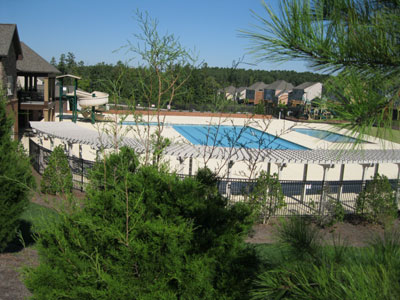
There is a club house or community centre beyond the backyard with a good swimming pool, a children corner, and courts for tennis and basket bal, and interestingly, a house owners association too that got elected recently.

The community appears to house the people with origin in different countries. Interestingly, many are from India too, though it hardly provides any solace of fellowship. Present generation with nuclear size and its responsibility for home and usually long hours at works can hardly socialize. It’s almost the same everywhere. The population of Indian origin persons appears to prove the overwhelming majority of those from South India. And Cary being a part of RTP (Research Triangle Park of Raleigh, Durham and Chappel Hill) with Cisco, IBM and many smaller IT companies, most of these young men and women, I guess, are the showpieces of India’s strength.

Both, Anand and Shannon work for Cisco.

But I can’t end it without mentioning one more thing. After many years we can see the moon and some bright stars from the Shanti Corner of the house where we invariably sit after our dinner in the night before going to bed. And how can I forget the mention of the wonderfully attractive red horizon with setting Sun from the backyard?

Posted in economy | Tagged , | Leave a comment

Smart, Nano and Jordan Lake

I had a nice experience this Saturday. Shannon and Anand had found out a nice location for a picnic in Cary. A day before, they had visited the place to ensure its worth for taking us over there.

It happened to be the picturesque Jordan Lake, the right place for persons like me to spend some quality time right with nature. While the speeding motor boats at some distance in lake were exciting, the mild but divine invitation from the sound from the waves in the lake was equally alluring. We went for a short walk on the walking track laid near the water front.

Zack and Emma demanded attention. But they also gave us immense happiness with their daredevil attempts and activities in play zone. I really enjoyed and liked Zach’s daring reaction to the stranger boy who was much older than him and wanted to prevail over Zach.

Finally, Shannon and Anand have found a good place to come sometimes for distressing which they are missing here in NC. Actually they knew what they would do on a week end in Pleasanton, California with a large number of places of attractions. They are still in exploratory mode in Cary, North Carolina. But Jordon Lake can certainly be one good place to visit with guests or kids.

And then suddenly I found another attraction for me. I saw a small car parked at a distance. I wondered how Tata’s Nano can be here. But on enquiry to Anand I could know that it’s the famous Smart to which Fareed Zakaria had mentioned in his article in Time that I read and referred in an earlier blog entry of mine too. He wrote:

Two weeks ago, I sat in a Nano, the revolutionary car being produced by Tata Motors in India. It’s a nice, comfortable midgetmobile, much like Mercedes-Benz’s Smart car, except that rather than costing $22,000, it costs about $2,400. Tata plans to bring it to the U.S. in two to three years. Properly equipped with air bags and other safety features, it will retail at $7,000. Leave aside the car itself, whose price will surely put a downward pressure on U.S. carmakers. Just think about car parts. Every part in the Nano is made to global standards but manufactured in India at about a tenth of what it would cost in America. When Ford orders its next set of car parts, will they be made in Michigan or Mumbai?”
-Fareed Zakaria ‘How to Restore the American Dream‘, Time Oct. 21, 2010


As Anand informed Smart has a niche market in USA with a fan group. As I researched, I found Smart as pretty good example of the way Americans can help in cutting down the energy cost because of its fuel efficiency, if they use it for short distance household tasks. However, it can be imposed on people. It requires a change in mindset for saving and reducing waste as defined by Japanese.

Shannon has promised to take me to Cary’s dealer for Smart that she has already located. She did also forward her research on it to me. As usual, I did also research and found even Smart Production Process. Here is some technical information on Smart.

The Smart runs on a 1.0-liter, 70-horsepower three-cylinder engine mated to a standard five-speed auto-manual transmission. Smart can have power steering too if required and it tops out at 90 mph. The fuel efficiency with 33 mpg in the city and 41 mpg on the highway certainly means a lot of saving.

I do also see some Mini Cooper in US but Smart is more than three feet shorter than a MINI Cooper at 106.1 inches long. The inside of Smart interestingly is quite roomy with 45.3 cubic feet of passenger volume. Almost everything one wishes to put in the car is possible to be done, naturally with add-on price. But Smart unlike Nano or Mini Cooper is for two, a coupe.

In not too distant years because of the energy consideration or change of the mindsets of college going Americans or retired couples, Smart, Mini Cooper or even Nano if Tata Motors so wish, may become the second car in American household. But as on today, it appears to be difficult. It requires a lot of marketing and the government encouragement too. But Shannon is very skeptical about these mini cars for Emma or Zach. She will expect to have a lot of steel around them when they get a car one day.

America still remains the second largest car market. I shall always wish that Nano invades the American market with all the features that can delight the customers sooner before the Chinese do that.

One day we may be seen near Jordan Lake in Nano.

Posted in Uncategorized | Tagged , | Leave a comment