India’s Endeavour to Become Knowledge Power

India has some very vocal ministers these days. One of them is Kapil Sibal. If one goes by his action plans, India is on the right track to become a knowledge power. He aims at increasing the India’s gross enrollment ratio (GER) at present at meager 12.4% to 30% by 2020. Of the 220 million children going to school, about 70 million children will be able to get into higher education as against the present figure of about 26 million. The Right to Education Act, 2009 will provide the necessary impetus.

And so are his plans to set up a large number of universities and institutions of higher learning and excellence: 30 new Central Universities, five new Indian Institutes of Science Education and Research, eight new Indian Institutes of Technology, 11 new Indian Institutes of Management and 20 new Indian Institutes of Information Technology.

Many foreign education providers will also collaborate with Indian institutions both in the private and public sector and set-up a variety of educational enterprises in India.

And over 140 million young students who do not pass Class XII would be imparted skills to match with the growing and diverse needs of the economy and its various sectors through community colleges, ITIs, polytechnics and other institutional frameworks that will have to expand exponentially.

Naturally, we all will wish and pray that the mission is achieved.

But the main thrust must go to rural India that constitutes and contributes the maximum in the number mentioned as target. Will it happen there? I say so as the rural India is hardly covered by the media as against the urban India. All the drawbacks and inefficiencies of the government targets and its failure for urban areas only get media coverage.

Most of the young students who drop out and don’t enter colleges for higher education are of the rural India. How do we make all the boys and girls of the rural India continue getting educated? How do we make the teaching a respectable and responsible profession? How do we make the poor and deprived parents interested in getting their wards educated? How do we ensure the parents that there can be no financial constraints if their wards take interest work hard and perform well in their classes?

I was talking to Harendra who recently came from a village in Bihar. According to him, even though his village has a school but the kids of the poor people hardly go to the school and continue? This is the case in most of the villages.

If Noida can have a significant number of children who don’t go the schools, how can we expect the remote village having ‘sarv siksha’ or universal education? Will the hundreds of kids of the unprivileged class that I see every day morning entering in the informal education facility of Sai Temple and Shakti Mandir in Sector 40 or the government school of many of the villages of Noida get the quality of education that Sibal and Prof. Yaspal are trying to provide to the children of the country with the passage of The Right of Education Bill 2009? How many of the students of the schools in the villages that I know such as Pipra, Samahuta, Madhukarpur, and many like them will carry education on till class 12 or continue thereafter? And I further doubt if the number of the students of Birlapur Vidyalaya or Hind Motors School of the big business houses such as Birlas who go beyond class XII is significantly higher than 10-12%? Why is it not happening?

Sibal, the ministers in the states and the authorities running the schools must focus on improving the existing schools along with the setting up of huge number of model schools, perhaps one in every block of the country, as it is being planned. Can the panchayats or municipalities be made accountable about its schools and its performance?

Can India become Knowledge Power without getting the education in rural India to the same standard as the best schools in urban India provide?

India can succeed in getting transformed into a knowledge power. And it can not only be the envy of many of the developed powers, but can also sustain a reverse brain drain from those countries.
Posted in economy, education | Leave a comment

After Living with Future Gen

We are going back to Noida today December 12, 2010 after about three months that I spent with our future Gen.

I have witnessed my grandfather’s intense love for children and I was fortunate to get the best of it. And many a times I thought it was an extension of his profession as teacher. But perhaps we all in the family have weaknesses for children that too when they are just kids. Among my five uncles, I found at least two having an exemplary fondness for kids of the family as well as for those from outside the family. Rakesh, Rajesh and Anand have the similar intensity of attachment with kids.

As I go down the memory lane, I think I missed the best time when I could have given more time and played with my own children. I was too busy with my professional assignments in Hindustan Motors with very long hours devoted for the same. Today no one can sympathize with me for that madness of mine.

As retired from active profession long ago and at this age of 71+ with nothing much to do, I am trying to get compensated the lost opportunity of the life. But here again the credit goes to my sons.

Rakesh visited us at Noida and Salt Lake when Keshav and Anvita were small kids for few days and permitted us to enjoy their short company. In 2005, we visited US and lived with Anand for almost 6 months. Rajesh’s son Svanik was just one year old. Rajesh’s apartment was nearby. We could enjoy memorable nice time whenever Svanik came with his parents to us. Soon thereafter, Rajesh visited us at Noida with Svanik. I could be in the company of Svanik.

In 2008, Shannon came to India with Emma. We moved around with Emma to Jaipur, Agra and Calcutta. Emma kept on entertaining us till they stayed. Shannon then invited us to live with them when she was expecting Zach Krish to arrive. We enjoyed the company with Emma and newly born Krish for almost two and half months in 2008.

Keshav and Anvita came to Noida last July for few days. They have grown bigger. English has created another barrier with the aged ones.

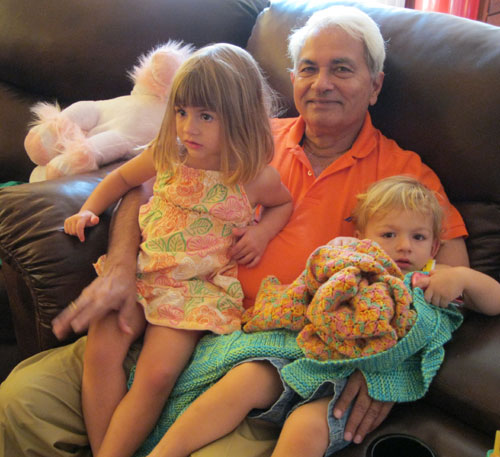
This visit to US was for Svanik, Emma and Zach. Shannon had invited us to be with Zach at his second birthday on September 25, 2010. Zach was the hero of this visit to US in 2010. I went very close to him. He is just wonderful. He likes to be pressed, hugged, kissed and loved still, when he is not in off mood.

Very soon after our arrival in Cary, I started bringing Zach down to our floor from his room on the first floor early morning. I kept attentively waiting for his waking up. After getting up, Zach starts talking to himself. After hearing his voice, I would go up. He would hand over his two blankets to me and raise his two hands to come in my hands. I would oblige. To start with, Emma kept a distance. But gradually she yielded and started coming closer. Evening was the best. After the dinner, we played with both, Zach and Emma. They run around and we would keep chasing them. Before going to bed, each will hug us and say goodnight. Zach was really so loving. I just can’t forget his kisses in plenty and his addressing me “Daa…Dooo…”. While I was packing, Emma came and sweetly asked me, “Can I do something for you?” I really miss them, sometimes very badly. I don’t know if we can rewind the time of a life.
When we reached New York, Svanik saw us and was hesitant to come closer. But I could gradually bring Svanik nearer. I designed a game for him. He comes moving towards me with a straight plastic sword and aims at the opening of the barrel of the toy revolver that I held in my hand at the other end. Mostly, he fails but he keeps on doing that. He always scores in millions that he himself decides. For last two three days, we are having sword fights after he comes back from the school.

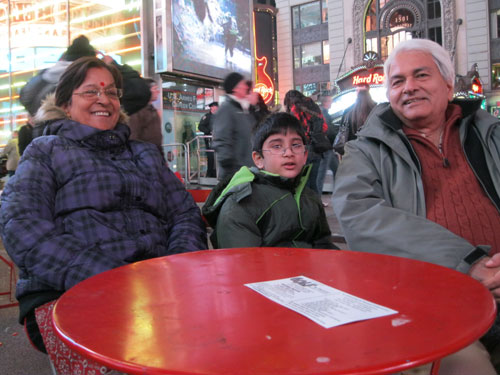
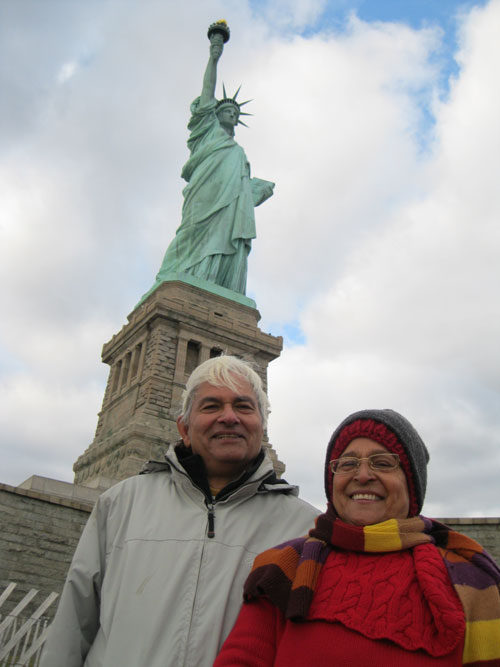
The visit to Statue of Liberty and yesterday to Times Square brought Svanik nearer.

It was a wonderful time with them but a Sayonara is a universal truth.

Posted in Uncategorized | Tagged , | Leave a comment

Ratan Tata: The Beginning of Battle

Tecom 2G allocation and scam connected with it is becoming murkier and murkier every hour, if not every minute. Many are trying to come out with their own estimates of spread and depth of corruption in India.

But it has become complex with the name of Ratan Tata getting into it. I just can’t understand why Tata’s head of operation can’t take care of lobbying that it had to be done by Tata himself. Why would have Ratan talked with a shady character such as Neeira Nadia, charged with various anti-national activities ?

But very lately, the name of Ratan is appearing a little too frequently. Once he had blamed the competition for putting wrong information in press about Nano car. I had thought that was a rare statement.

Ratan’s Nano got a good review from the media and experts all over the automotive world. Unfortunately, Tata have not been able to cash on that. It couldn’t produce the number. It couldn’t wipe out the bad perception of its safety. It’s not selling in millions.

At that time too, I didn’t like Ratan’s closeness to Budhha and caustic remarks for Mamta Banerji. Is it not prudent to speak less to avoid unnecessary conflict with a press friendly statement?

Why should Ratan try to go in the good books of Congress and naming BJP?

But one thing is sure that all the industrialists can do anything to take a lead in the business they operate in.

I don’t why but I expect the industrialists too to have some ethics and go out of the way to make the poor change, get out of extreme poverty, at least get skilled and educated.

I wish Ratan to innovate something like Nano in the area of universalizing education and at least providing one skill to every children of India.

And with the front that he has started with the revelation of some, he should work seriously to root out the corruption.

Posted in industry, management | Tagged , | Leave a comment

Media Scandal: Is Hope Lost?

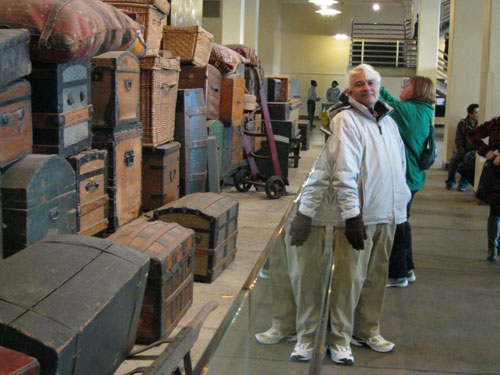
On Friday, December 3, Shephali had brought a copy of New York Times for me. However, I could go through it only today, December 5. We spent the whole of Saturday in visiting Statue of Liberty and Ellis Island and experiencing the cold windy climate of New York. But for the interferences of Rajesh and Shephali for putting on extra clothes, it would have been really difficult. I could realize that I have gone really old and cold too.

I bought a book on Ellis Island that cost me about $27 for keeping it with Svanik to read. When I told him that he was really very happy. I am trying to bring him closer at all cost and he is responding as Emma did.On that cold windy day too, all the visitors were very busy in photographing or getting photographed. I wonder why one should do it for record, Google has million or more of the images of the both.

Coming back to something serious I find American media a little more respectful in covering Indian stories. NYT has a well written article, ‘Indian state Empowers Poor to Fight Corruption’. It’s all about the way Andhra Pradesh government is trying to handle the issue of corruption in NREGA, the government programmes for the poor. I wonder what stops the other states to follow the model or some better models unless the ministry of the states and its bureaucrats, the elected representatives at grassroots level or the petty officers supervising the programmes along with some unscrupulous lazy beneficiaries themselves are interested in making it fail to serve the bigger purpose. Andhrites forming a large percentage of Indian immigrants in US would certainly feel happy to read the report.

After going through the article, I went to see my e-mails. Anand had posted a report from The International Herald Tribune, ‘The face of scandal in India ‘knowing my interest. It was about a scandal that revolves around Barkha Dutt of NDTV. I don’t like most of these distinguished reporters, be it Barkha Dutt, Rajdeep Sardesai, or even Karan Thapar. They appear to be arrogant. And a good journalist need not be that. Perhaps the best example is Pranay Roy, the boss of Barkha Dutt. Is Barkha really involved? Has this report resulted from the professional enmity or jealousy? How will Barkha Dutt react to this?

Most of the educated lots in India consider media as the last hope for a democratic India. I never thought them to be mischievous and involved in promoting business men so blatantly.

Should I change my opinion and give up the hope?

Posted in social issues | Tagged | Leave a comment

Why Didn’t Nitish Blog after Victory?

Nitish won election rather Lalu and Ram Vilash lost. Last week I have been scanning digital media. Impressive articles have come about the Nitish with expectations, suggestions, and cautionary advices. Columnists in national media such as Outlook, Hindustan Times, Times of India, Business Standard, Mint, Indian Express as well as many other individuals including this writer too have covered almost every issue.

I, for one wish the new government must make the bureaucrats work innovating ways and means to create real jobs in large number for the young generation with high expectations.

But I wish the focus is placed on quick informal education of the adults and women too that can make them honest working class.

While talking about Bihar from New York, I thought Nitish would have added a new entry in his blog that was so popular. I went to the site. Unfortunately, Nitish has not yet found time to thank those who voted and helped to build his image as followers of his blog. Is there a reason for this?

Bihar is today about regional pride with caste and community loosing its priority for voters who have been judged as enlightened lot preferring development. Will it be so in day to day affairs of the government departments too? Can Nitish and his team work and reinforce the perception of the change? Can Nitish bring the power and industry without an unprecedented all out support from centre and big business houses?

Can Premji consider Bihar as special case and help it through his foundation? Will Amit Mitra get some of his friends to invest in Bihar?

Posted in bihar, indian politics, management | Tagged , | Leave a comment

From Cary to New York

After many years, I was in a plane that normally scares me. As per plan, we were to leave Anand’s place positively at 5AM and we did. I had to dispense with my short night sleep that I go for at this age. Anand had come down much before I could give a wake call as promised and so did Shannon.

It’s really becoming more and more difficult to live with dear ones for some days and then get parted, and particularly if there is someone like Zach. He had become indispensable for me in these two or more months. Fortunately, both Emma and Zach were sleeping.

It’s GPS that made the drive the shortest bring us to Raleigh Airport in hardly 15 minutes when it had taken much more in a dry run a day before. Raleigh is a nice airport with all facilities. American security checks didn’t trouble us as we were mentally prepared. I only wonder if it can save a disaster if some insane brains with no heart really work for it. Are we escaping the repeat of 9/11 because of these insane checks, the fear of getting trapped, or the realization of its futility?

At JFK, I lost the way out path to ‘baggage claim’ because of messy management in Delta’s terminal and got nervous for few seconds with no gadgets in hand for communication. However, it was very short. We found Rajesh and baggage too.

After Svanik returned from school, it became all normal for me. He is no more that shy one and comes very close.

In evening, Anand came on Skype for getting us see and talk with Zach and Emma. I found Zach totally amazed. He didn’t utter a word. Ultimately he lied down on floor with his face down. It was just heart breaking. It’s just unbelievable.

It is really difficult to understand a child at Zach’s age.

But we have to keep moving. I don’t know if I will ever get back the same Zach as I didn’t in case of Emma. Perhaps I shall have to live by cherishing the memories of the last two months or more with Zach and all his acts that were so dear and enjoyable.

And I had written few days back

अच्छा लगता है इनका
बालसुलभ कलरव
और कभी कभी का जलजला

Posted in Uncategorized | Tagged , | Leave a comment

Thanksgiving Day and Turkey

Today is Thanksgiving and tomorrow Black Friday when American will literally be fighting with each other in very early morning queues to empty their purses and buy many things to satisfy their ego and fill the empty spaces of their houses. Shannon is going to attempt for that.

And I am watching a nice way of celebration at home. While on hand we shall be seeing the wonderful Turkey cuisine, on the other side some of us will be testing kheer, purees and chhole. This is the globalization in action.

Anand has researched some interesting information about Turkey, the word used for the bird that occupied the main place in the celebration of Thanksgiving Day in every American household.

The Hebrew term for turkey, transliterated as tarnagol hodu, literally translates to “chicken of India”.

And the Turkish word for turkey is “hindi.”

Does it relate any way to Bharat, India that we love? Did the ancestors of Americans get this gift of this important day every year on the last Thursday of November some way from India of east, the ancient country or is it just a chance to have some Indian words attached to the meaning of Turkey?

During the morning walk yesterday, we started discussing the issue. What could have been the historical reasons for the meaning of Turkey used in Hebrews and Turkish languages?

I tried to impress upon Anand that India was one of the most developed country when others were in Stone Age. And there were a lot of immigrations two. India might have been source country. I don’t know anyone can further elaborate on it.

But what should Indians in US do on Thanksgiving Day? I suggested Keshav, my eldest grandson who called me to wish for the day that he should celebrate it for giving thanks and expressing gratitude’s to all aged in the family. I didn’t know if it was the appropriate advice and if the others from India can also follow that.

Posted in Uncategorized | Leave a comment

Bihar: Agenda Next

Month long battle for getting into the ruling chair is getting over. It must be a gruelling task for the participants. With whatever appeared in digital media that I could access from my US abode, be it by the articles of Ashok V.Desai, Raj Kumar, Yogendra Yadav or NDTV 24×7 TV show with Pranay Ray, Soopariwala and Shekhar Gupta, I predict a win for Nitish Kumar. It will also mean a death of caste and confirmation of development based politics. He will get that one more chance he had been campaigning for. And naturally the million dollars question will then be;

What Next? Will it be the end of divisive politics?

Will Bihar be transformed to a prospered peaceful Bihar in next five years? Will the employees and the officers and their family members shun the lure of ‘upari aamdani’?

Can the sons of Kariman, a dalit, build his house next to Ram Chandra Singh belonging to socalled forward class?

Or will the wait never end?

Can Bihar do that inspite of any in the government?

Will Man Mohan’s government listen to Bihar’s need more positively?

And will Lalu and Paswan go out of the politics of Bihar and shift to New Delhi?

What will be Rahul Gandhi’s plan for Bihar if his party gets less than 20 legislators in new state assembly?

Mr. Nitish Kumar must come out a clear cut time bound agenda for the development and try to achieve what he promises by the end of the fourth year.

I have only single priority still.

Let Nitish get each and every Bihari literate, educated and skilled. Let him beg borrow or even steel to get that happen.

Update from US: Cary, North Carolina November 24, 4 AM
People of Bihar is going to return Nitish with thumping majority, Bihar has again proved its real core strength. It has left the caste behind in vote politics. The defeat of Rabri Devi from both the seats is the benchmark of transforming Bihari. Nitish and his team will have to work harder to meet the aspirations of the people, particularly young men and women. Taking Bihar in the league of the developed states will require innovative approaches along with hard work of bureaucrats that are still corrupt in Bihar as one report in Economist mentioned. I wish Nitish a success and wish he really confiscates the property of corrupt officers and politicians and uses it for educational institutes as promised.

Posted in bihar, economy | Tagged , | Leave a comment

The Chinese Way-Is there something for India?

Anand took me yesterday to Apple Shop for buying a lap top for Shannon. We reached the shop at 9PM. I had agreed to accompany Anand as I wanted to see the life at this late evening in the shops of US. For Anand and Shannon too, as they told me, it was one after many years. Surprisingly the shop was closing for the day and denying the fresh customers to enter, though Shannon had confirmed that it would remain open till 10PM. But when we explained our case, the manager who happened to hear us made us enter and buy the laptop, a $1400 commodity. For me it was a strange thing in US and that too with Apple’s own outlet.

I found both Anand and Shannon very happy with the purchase. As we came out of the shop, Anand and Shannon wanted to have some night strolling in the shopping complex. I asked them to allow me to get into the next door Barnes and Noble. It was open and pretty crowded even at that late hour. This is another indicator of the reading habits of the nation that differentiates it with India.

I love to glance through HBR as the first thing always.

I came across an article by Thomas M. Hout and Pankaj Ghemawat, ‘China vs the World: Whose Technology Is It?’ in Harvard Business Review December 2010. It’s a pretty good study on the changing Chinese strategy to take a lead in high tech manufacturing sector.

I am quoting some extracts from the article with wishes that India can draw some lessons from China and gets into manufacturing in a big way. It’s only manufacturing that can provide jobs for persons with all levels of skill. India must focus on facilitating some companies such as BHEL, BMEL, and even HMT Machine Tools Division to become global by providing more autonomy and bringing in the professional heads. If Obama’s visit has given opportunity, India must take advantage of it.

Can it encourage globally known names in high technologies such as GE and Boeing to gradually have its major manufacturing facilities in India that will create a lot of local enterprises of all sizes and provide employment?

Can the Indian companies with large number of collaborations for many years learn the way Chinese have done and independently be global companies?

China is quietly and deliberately shifting from a successful low- and middle-tech manufacturing economy to a sophisticated high-tech one, by cajoling, co-opting, and often coercing Western and Japanese businesses.

The Chinese government has deployed several strategies to help local companies acquire state-of-the-art technologies and break into the global market.

Beijing drives the process nationally in most capital-intensive sectors. Consider high-speed railway systems, now an estimated $30 billion a year market in China. In the early 2000s the superior equipment of multinational corporations such as Alstom, which built France’s TGV train system; Kawasaki, which helped develop Japan’s bullet trains; and Siemens, the German engineering conglomerate, gave foreign companies control of about two-thirds of the Chinese market. The multinationals subcontracted the manufacture of simple components to state-owned companies and delivered end-to-end systems to China’s railway operators. In early 2009 the government began requiring foreign companies wanting to bid on high-speed railway projects to form joint ventures with the state-owned equipment producers CSR and CNR. Multinational companies could hold only a 49% equity stake in the new companies, they had to offer their latest designs, and 70% of each system had to be made locally. Most companies had no choice but to go along with these diktats, even though they realized that their joint-venture partners would soon become their rivals outside China.

The multinationals are still importing the most-sophisticated components, such as traction motors and traffic-signaling systems, but today they account for only 15% to 20% of the market. CSR and CNR have acquired many of the core technologies, applied them surprisingly quickly, and now dominate the local market. In addition, they are cutting their teeth in the estimated $110 billion international rolling-stock market, moving into several developing countries where the Chinese government funds railway modernization projects. The combination of low manufacturing costs and modern technologies is helping them make inroads in developed markets too, with CNR recently winning contracts in Australia and New Zealand.
The Chinese government sometimes synchronizes its desire to accelerate growth in a particular sector with the imposition of new regulations on multinationals in that sector. For example, from 1996 to 2005 foreign companies held a 75% share of the Chinese market for wind energy projects. Then the government decided to grow the market dramatically, offering buyers large new subsidies and other incentives. At the same time, it quietly increased the local-content requirement on wind turbines from 40% to 70% and substantially hiked the tariffs on imported components. As the market exploded, foreign manufacturers were unable to expand their supply chains quickly and meet the increased demand. Their Chinese competitors, who had been licensing technology mainly from small European turbine producers, took up the slack rapidly and cost-effectively. By 2009 Chinese companies, led by Sinovel and Goldwind, controlled more than two-thirds of the market. In fact, foreign companies haven’t won a single central government–funded wind energy project since 2005.

Are there some lessons? Those interested may go through the article critically.

Posted in economy, governance | Tagged | Leave a comment

Corruption Crisis

It is corruption everywhere.India, the land of Gandhi, has become synonym of corruption. Some may be shedding crocodile tears, but not ready to fight this war that is holding the growth of the country and keeping India lose ground everywhere.

I don’t know if I can take the media reports as an indicator of a real rising revolts against corruption.

Ashok Chavan, the Chief Minister of Maharashtra had to resign. Kalmadi finally put in the paper. The first one did it for his involvement in Adarsh Housing scam and the second for the corruption related CWG. And Raja also could not stand against the demand of resignation for 2G scam even with the powerful support of Karunanidhi who might have been the biggest beneficiaries of the scam.

Whom should Indians give the credit for it? Is it Congress, Sonia, Man Mohan or media or court?

Sonia and Man Mohan may preach. But can they stand against the corruption? The court may embarrass even the Prime Minister, but will it expedite the process and convict the criminals fast?

Will the society boycott the criminals of corruption or honour them?

How many of the disciples of Baba Ramdev will go by his advise, ‘Shoot the corrupt’?

Posted in governance, indian politics | Tagged | Leave a comment