Has Bihar Changed?

With the month long election already started, Bihar has become a hot topic in media. Has the mindset of the people changed over the years when India has emerged as power to reckon with on global canvass? Will they vote for the development that is visible somewhat but not reached to all corner? Will the development be the focus for any political party coming in power?

I have another question running in mind. Does education make people broadminded or make them more attached to the traditional identities of caste or community? Many mails that I get or many views and opinions expressed on digital social network sites morose me. A minimal output of the right education must be a liberal personality. But unfortunately it doesn’t happen in India.

In the present election in Bihar, the voting pattern of some groups of people needs to be watched with interest. Will the so-called upper caste (by birth) vote against Nitish because of the fear of the land reform giving some right of land to the actual tillers? Some have created the bogey. I don’t think Nitish is brave enough to get that bill through. Moreover, the major shift in the ownerships of the land holdings towards OBCs may also be deterrent. It will not be prudent for him to do that. I have a view on the land reform. The land holdings have reduced over the years and become unviable for the profession of farming for living. The government should raise the ceiling limit. The farmers interested in retaining agriculture as profession must be free to buy land at market price. Secondly, if it is right to retain an additional urban property and earn rental for living, what should be the problem with sharecropping?

I will also watch to see how the minority that can play a decisive role in any election in India if it votes in block goes this time in Bihar. Nitish has done everything including bringing in a suspected character Tasalimuddin in his fold to win the minority votes besides offering many lucrative schemes exclusively for the community. I like some of the schemes such as ‘Hunar’ that trains the girls in some skills. I wish that would have been extended to all the girls and young women of the state. Can’t the skills of nursing and midwifery be trained to larger number of these girls to make a better impact on the overall health of the society? But will the minority vote in block or follow fatwa of Imams? I wish they don’t. Will they remain with Madarassa or go to the regular government schools and demand good and compulsory education up to class X? I believe the community has a DNA of highly sophisticated skill and it can never remain poor if that potential is nourished.

But the most interesting judgment of the voters to be watched will be about Rabri Devi. Will they vote for her just because she is of a caste, even when she has failed the state at large both as the chief minister and the leader of opposition?

Unfortunately, I am missing the excitement and I am to live on the information coming from digital media.
Posted in bihar | Tagged , | Leave a comment

US Stay Becomes Study Leave

Every time I visit US, it becomes a study leave. I remember I came to US in 1993 for the first time, when Rakesh was with American Airlines and Alpna was studying. It was a very short stay, perhaps of three days but the most enjoyable period of the stay for me was the hours spent in Alpna’s college library. I could dig out how some Japanese had translated a rare Henry Ford book on concept of manufacturing. Later on the same was re-translated in English.

The six months long stay in 2005 was a great study leave for me. I regularly visited Borders, and kept on reading books and magazines of my interests. I had not spent that much time in reading and taking notes even in the whole of my four years in IIT, Kharagpur. I went through many books on China that was the hot subject at that time.

Border was the interest for even the two and a half months stay in Pleasanton in 2008.

I and Anand kept on discussing the potential of Internet and video for teaching many times. As an interest, Anand digs out the material. He informed me about MIT course material on Internet.

However, it is only in this visit of mine to US that I could get some taste of the possibility by listening to some of the education videos that the various engineering institutes including our own IITs have put on Internet free for everyone. To find out the quality of the videos and to evaluate if it can be a means to teach the students, I went the courses on Manufacturing Processes. Interestingly, Professor AB Chattopadhyaya of IIT, Kharagpur has presented it. And I happen to know him since the days Rakesh was in IIT, Kharagpur. I had met him and later on I invited him to Hindustan Motors for conducting a course. I also addressed once the mechanical engineering students on re-engineering of engineering education curricula.

It’s pretty clear that knowledge has become free today courtesy Internet and many websites that have videos on covering all subjects.

Apple’s iTunes U has become one of the world’s largest educational catalogues for free educational material. Over 800 universities have their websites at iTunes U, including many of the top universities from the US, UK, France, Germany, the Netherlands, Singapore and so on. I have myself seen the videos on the courses on Introduction to Lean Six Sigma Methods, and heard to Pranav Mistry and Salman Khan.

Salman Khan’s Khan Academy (http://khanacademy.org) has a free educational site that covers mathematics, physics, chemistry and biology.Salman Khan is reportedly developing an open-ended set of material covering many subjects, and is a favourite among people like Bill Gates, and John and Ann Doerr. Fortune covered him. As reported, 200,000 students access this site every month. About 20,000 are also from India.

Interestingly, I have seen some videos on ‘you tube’ of my interest on car manufacturing in Audi, Mercedes plants and many on the manufacturing processes including engine and gear manufacturing that was the subject of one of my books.

Videos of the subject make the subject easily understandable.

I have some suggestions on the IIT course that I saw. I would have liked it if it could have taken the feed back from the industry as well as from the students and updated or modified through editing. I say so after seeing and comparing some of MIT.

It’s clear that broadband Internet with sufficient speed can help teaching almost any subject in the schools and colleges. It can compliment and supplement the role of teachers. Besides improving the teaching skills of the teachers, it can take care of the shortages of teachers too. However, I am afraid that India’s education systems will take some more time to take the maximum advantages of it. Digital infrastructure and accessibility must reach every household. Speed provided and its cost in India are discouraging and annoying.

And if Sam Pitroda can be believed, India is on the track.

———————-

PS: Innovation, Entrepreneurship, Lean Manufacturing, Toyota Production System, Problem Solving Tools, Total Quality M anagement, Manufacturing Management, and Manufacturing Technologies had been some of my favourite subjects. I was just amazed to find the potential of learning about them just on the website of YouTube. And there are hundreds of such sites on internet.

Posted in economy, education | Leave a comment

Voting Season: Whom Shall I Vote?

I WILL CERTAINLY NOT VOTE FOR A CANDIDATE JUST BECAUSE HE IS OF MY CASTE OR COMMUNITY.

I shall vote for the candidate who has a clean image and has been honest.

I shall vote for one who has been hard working and proficient in the profession he was engaged in before joining politics. If he was a teacher how good he was as teacher. If he was an advocate how successful he was as advocate based on the opinion of those who were his clients?

I shall vote for the candidate who has educated his girl child equally well and treated her equally with his male children. I shall certainly not vote for someone who considers his male child as the only successor of the family even if he is inferior to the female child.

I shall certainly not vote for someone who has produced a large number of children.

I shall certainly vote for a candidate who has outstanding educational and successful professional background along with other criteria.

I shall also vote for someone whose story is one of ‘from rag to riches’, who has gone through the misery of life and reached the top with his hard, and honest work and not through foul means.

I shall not vote for someone who has been only politician without any skill in any profession good enough to earn for earning for the living of the family, if he is out of politics.

I shall prefer someone who has been compassionate, was engaged in some social work and got the appreciation of the community.

I shall certainly give better weightage for a candidate who has worked for providing education and healthcare for the people in his community.

I shall vote for one who has been an entrepreneur who has provided employment and engagement to the people and has been paying justified remuneration. He is one who can create jobs for unemployed youth.

I shall vote for someone who can live, spend time with the people in his constituency and who travels by self driven car instead of hankering for an urban abode for the night and a helicopter to reach a village. I will certainly love to have a brave person as my leader who does not require special police protection.

I wish this list could have been comprehensive and illustrative enough to make it easy even for a lay man or an ignorant villager to help him in deciding the right candidate. Can someone help the people by providing them a means to decide the right candidate? Can there be an effective way to convince people against voting based on the caste and or community?

Why should a judgment decide the party whom someone votes? Why should someone vote a known hard criminal or corrupt just because he comes from his caste?

And finally why should the people from so called forward (upper) castes that are supposed to be more enlightened and educated, vote for some party as some one of their caste with clear vested interest has joined it and recommends that?

The present election in Bihar will also judge the people and the community of Bihar at large if they prefer development over backwardness and if they deserve a better governance and prosperity at least equal to the other developed states of the country.

I wish the media to help the people to make a right judgment by letting the people know the candidates without any bias. That will be the great service to the democracy.

Posted in indian politics | Leave a comment

Rediscovering India from US

I came across a good note- ‘Rediscovering Emperor Ashoka’ on the website of ‘Times of India’. You get nearer to your country and its history when you are in foreign land. I don’t know about others but it certainly happens with me. And the article can have heading as one I gave it by replacing ‘Emperor Ashoka’ by ‘India’. And with some tidbits about the heroes of Ashoka’s state (Bihar) appearing here and there in the digital media, the note became more relevant to me. I did my own research. And here is what Amartya Sen has written on Ashoka:

Is it indeed true (as claimed, for example, by Samuel Huntington) that “the West was the West long before it was modern”? The evidence for such claims is far from clear. When civilizations are categorized today, individual liberty is often used as a classificatory device and is seen as a part of the ancient heritage of the Western world, not to be found elsewhere. It is, of course, easy to find the advocacy of particular aspects of individual liberty in Western classical writings. For example, freedom and tolerance both get support from Aristotle (even though only for free men-not women and slaves). However, we can find championing of tolerance and freedom in non-Western authors as well. A good example is the emperor Ashoka in India, who during the third century BC covered the country with inscriptions on stone tablets about good behavior and wise governance, including a demand for basic freedoms for all-indeed he did not exclude women and slaves as Aristotle did; he even insisted that these rights must be enjoyed also by “the forest people” living in pre-agricultural communities distant from Indian cities. Ashoka’s championing of tolerance and freedom may not be at all well known in the contemporary world, but that is not dissimilar to the global unfamiliarity with calendars other than the Gregorian.
There are, to be sure, other Indian classical authors who emphasized discipline and order rather than tolerance and liberty, for example Kautilya in the fourth century BC (in his book Arthashastra-translatable as “Economics”). But Western classical writers such as Plato and Saint Augustine also gave priority to social disciplines. In view of the diversity within each country, it may be sensible, when it comes to liberty and tolerance, to classify Aristotle and Ashoka on one side, and, on the other, Plato, Augustine, and Kautilya.

Unfortunately, Indians, in general, particularly those with English education, start believing something worthwhile achievements of the ancient India only when someone from the western country write about it. Bruce Rich is an environmentalist and left-leaning critic of globalization and is not a historian by profession. He has a book ‘To Uphold The World’: A Call for a New Global Ethic from Ancient India’, which is all about Ashoka. Here is what Rich wants to convey.

Ashoka provides a unique example of a world ruler who tried to put into practice a state, secular ethic of nonviolence and reverence for life, which he also extended to international relations. His edicts, inscribed on rock faces and pillars all over India in the third century BC, declare even today for all to see religious tolerance and equal protection of the laws, and announce the establishment of nature reserves and protected species. His empire at the time was arguably the world’s largest, richest, and most powerful multiethnic state. Its trade and diplomatic links extended over most of what was then the developed world. If we take into account the slowness of land and sea travel 2,300 years ago, administering such a vast area was the equivalent to ruling the entire globe today.

Ashoka’s great ethical leap rested on the most paradoxical of foundations, a centralized government in all likelihood organized and codified by Kautilya, chief minister of Ashoka’s grandfather Chandragupta Maurya. One of history’s greatest political geniuses, Kautilya
wrote the world’s first treatise on political economy, the Arthasastra. The Arthasastra proclaims accumulation of material riches as the chief underpinning of human society, and recommends amoral realpolitik as an effective political approach.

Ashoka is a unique and revolutionary figure in history who not only renounced armed force, but also, in the words of Arnold Toynbee, made “a complete break with his dynasty’s and with every dynasty’s traditional policy.” But Ashoka did not abolish Kautilya’s administrative system; he tried to infuse it with a transcendent ethos of respect for life that encompassed every aspect of everyday activity and was strong enough to hold together one of history’s first multiethnic empires.

Why couldn’t India produce someone like Ashoka and Chanakya for thousands of years? Why should not the present political leaders take some lessons from that era? I wish they get some time to read these books or my blog entry. I have only one question for Nitish, Lalu and Ram Bilash: Did Ashoka or Chanakya talk or think anytime about getting the society divided among caste or communities to win the power? Did not Ashoka give equal weightage for the learned ones of all communities?

Let the winner be the one who develops the state and thereby contributes to the development of the nation.

Let the voters choose the right one who works for a place in the history that will be written tomorrow.
—-
PS: And I am on it. Anand has bought the book of Bruce Rich as e-book on my laptop. ‘To Uphold The World: A Call for a New Global Ethic from Ancient India, starts with Amartya Sen’s introduction. I affirm my advice for readingthe book.

Posted in Uncategorized | Leave a comment

कभी कभी

एक मास में,
एक रात के
पूर्ण चन्द्र की
स्निग्ध चांदनी
कितनी मनभाती हैं .
पर कितनी ऐसी रातों में
इसे देखने
हम बाहर होते हैं .
कभी कभी बारिस की
जब रिमझिम बूँदें
मोती बरसातीं हैं.
कभी कभी सूरज की किरणें भी
कितनी अच्छी लगती हैं
कितने हम में बाहर होते?.
कभी कभी उन गुलमोहर के पत्तों का
झर झर कर गिरना,
खुद अपने उन शोख रंग के
फूलों से मोसम में सजना
राह किनारे.
हरसिंगार के नन्हे नन्हे फूलों से
धरती का पटना,
और हवा को मदमाती कर
धीरे बहना,
और वंही मिट्टी में मिलना
कहाँ आज कुछ याद दिलाता?
प्रकृति सुंदरी का यह श्रृंगार
लोगों को अब नहीं लुभाता.
कभी कभी अच्छा लगता है
प्रात: प्रात:
नए शहर के मुख्य मार्ग पर
मुझे भटकना
और कभी यह अच्छा लगता
बिना निमंत्रण
उनका आना .
सभी व्यस्त हों
या वे मस्त हों
दरबो में या फिर महलों में.
हमें एक इच्छा है होती
मैं चिलाऊँ
‘बाहर आओ, खुश हो जाओ
देखो सूरज, महती धरती
और बहूत आगे बढ़ जाओ.’

Posted in Uncategorized | Leave a comment

Indians Getting Attention in US

If US wouldn’t have the bookstores such as Borders or Barnes and Nobles, perhaps it would have been difficult for me to enjoy my America’s long stays. Anand had taken me to Borders in Cary, but I didn’t find that to my satisfaction. On October 6, Anand took me to Barnes and Nobles. The collection and ambience both were to my liking. I went through some of the magazines and found Indians in the news that I shall like to share.

Fortune has a major article, ‘Touched by scandal‘ on Rajat Gupta, one of successful IITians. However, this one relates to a bad aspect about Rajat if it has any truth whatsoever.

Gupta has been the only non-Westerner to have served as managing director of storied management consulting firm McKinsey & Co., adviser to CEOs the world over. In a front-page article on April 15, the Wall Street Journal reported that the government was investigating whether Gupta had shared confidential information with his onetime friend and business partner Raj Rajaratnam, the hedge fund heavyweight whose $3 billion Galleon fund disintegrated in October 2009 after authorities announced sweeping charges of illegal trading. Between 2006 and 2009, Gupta picked up seats on the boards of five public companies — American Airlines parent AMR (AMR, Fortune 500), global outsourcer Genpact (G) (of which he is also chairman), Goldman Sachs, audio equipment giant Harman International (HAR), and Procter & Gamble. He also joined the supervisory board of Russia’s Sberbank and the board of the Qatar Financial Centre. Altogether, those positions paid him more than $3.2 million in 2009.


The same issue of Fortune has selected PepsiCo Inc chief Indra Nooyi as the most powerful woman in U.S. business for the fifth year in a row According to Fortune, “Nooyi completed the purchase of PepsiCo’s two largest bottlers, bringing revenues to a projected $60 billion,” Fortune said. “Now she’ll have to deliver the $400 million annual cost savings she promised. Investors seem assured: The stock is up 12 percent since September 2009.”

Technology Review has published its list of 2010 Young Innovators Under 35, a list of technologists and scientists, all under the age of 35, whose inventions and research TR find most exciting. Their works span medicine, computing, communications, electronics, nanotechnology, and more that are changing our world. Three of them are Indians.

<

b>Indrani Medhi, 32, Microsoft Research India

Based at Microsoft Research India’s Bangalore lab, Indrani Medhi has conducted field research in India, South Africa, and the Philippines to design text-free interfaces that could help illiterate and semiliterate people find jobs, get medical information, and use cell-phone-based banking services. And there are 774 million adults worldwide who cannot read
Medhi used symbols, audio cues, and cartoons that are specific to particular poor communities. They still did not fully understand how information relevant to their lives could possibly be contained in or delivered by a computer.
To overcoming this problem, Medhi offered a five-minute video dramatization when an application is launched, illustrating exactly how it is supposed to work. For example, the one that accompanies her job-search interface features an upper-middle-class couple that needs a domestic helper. The husband posts the requirements to a job website that is subsequently accessed by unemployed and illiterate women at a community center. The video ends with a woman being hired.
–Guy Gugliotta

Rikin Gandhi, 29, Digital Green
Rikin Gandhi, founder of the nonprofit Digital Green, has developed a pilot project that offers a solution: simple videos starring local farmers themselves. Gandhi demonstrated that for every dollar spent, the system persuaded seven times as many farmers to adopt new ideas as an existing program of training and visits.
Villagers produce the videos using handheld camcorders; workers from partner nongovernmental organizations then check the quality of the videos and the accuracy of the advice before screening them in the villages with handheld projectors. So far 500 videos have been made, but three times that number–which should reach four times as many villages–are currently planned. –David Talbot

Ranveer Chandra, 34, Microsoft Research
PROBLEM: Wi-Fi uses frequencies that can’t carry a signal more than a few tens of meters. TV stations, on the other hand, use a portion of the radio spectrum that lets signals travel long distances, and the end of analog television has opened up unused slices of the spectrum between stations. They could be used for wireless Internet service, but it has been difficult to take advantage of these so-called white spaces without causing interference, because the exact frequencies used by TV stations vary geographically.
SOLUTION: Ranveer Chandra made the Microsoft campus in Redmond, WA, his laboratory for the first large-scale network to demonstrate the potential of using white spaces to deliver broadband wireless. Links in the prototype network can span up to two kilometers. To avoid treading on the toes of TV broadcasters, his system uses GPS to determine its location; then it checks the Web to find out what stations are active in the area. Chandra’s devices can also listen for nearby transmissions from wireless microphones, which use the same bands. When a conflict is detected, they switch to a backup slice of unused spectrum on the fly.
Chandra’s prototype network has the potential for white-space signals to connect large rural areas with minimal infrastructure. –Tom Simonite

Interestingly, all the Indian scientists in TR 35 are connected with Microsoft Research in India.

Posted in Uncategorized | Leave a comment

Between Sandip, Nitish, and Lalu

The Nitish–Lalu Bihar War 2010 has been declared and will get fiercer in coming days before the final onslaughts. It will be all over before I return to my Noida home.

Lalu has declared the heir-apparent of his party. He also has selected the male child instead of the female one as Sonia did few years ago. But he has finally decided to keep the mother of the heir apparent also in the fray and that too she will be fighting from two constituencies to have a sure win.

I wonder if the electorates of Bihar will prefer to go for establishing the Lalu clan on the throne. One can imagine what can happen if by some chance Lalu wins the battle. Will there be no tussle between the father, mother or the son to occupy the throne?

But will these announcements from the horse’s mouth not help Nitish in winning the battle or the great voters of Bihar overlook this perpetuating of the family rule of the state that was faced already by the state for almost three decades?

Many including myself wish Nitish to return in absence of any better choice. Nitish might not have been aggressive enough to pull up the state from its bottommost position in all the rankings among the states of India. However, Nitish did make a beginning. The development has got on track. I wish he goes for a kill in the next tenure.

Nitish has indicated his intention of development for the next term in his latest blog. However, in the next three years Nitish must establish a thousand skill-building centres, that, if necessary, can be run in second shift or evening in at least one rural school in every panchayat. All the children of the rural Bihar before reaching 16 years must learn at least one skill for employability. Nitish must seek the assistance of all including the institutions such as Anji Reddy’s Nandi Foundation or individuals such as Ratan Tata, Anand Mahindra, or Mukesh/Anil Ambani. To start with, Nitish can use the locally available artisans and skilled persons for training.

Nitish must think of handing over the task of regulating and controlling the discipline and quality of school education to outside agencies such as Pratham abolishing the inefficient and corrupt government inspectors.

Nitish must encourage the private and government colleges to compete with the best of those in other states or to close if they can’t. Nitish must kill all the malpractices in education and examination system.

Nitish must get at least one hundred engineering colleges established in the state that must cater to the demand of the state and cut down the worries of the parents of the children getting exploited by the institutions in other states.

And if Nitish does not have a man to do that I can do it for him free.

One thing for sure I hate his banning of political leaders of his own alliance to campaign in the state. I also pity BJP to compromise on such a highly undemocratic and humiliating step of Nitish. I do not know if I can call it large-heatedness, magnanimity or cowardice act of BJP. I don’t know how the people of Bihar take it. How can Modi or Barun become untouchables, if BJP is not? I can take it as the statesmanship of Modi. It is strange that Lalu still prides himself of being the one to arrest Advani. Does not the Nitish’s act resemble or smell the same?

I don’t know how the people of Bihar will go in this election. But when I was just getting into a nightmarish mood so far away from my own country, I came across the news report related to Sandip’s unique innovation the folding bicycle.

For me Sandip is more important than Nitish or Lalu. And I wish I could be of any help to Sandip to make his dreams coming true. I wish Sandip could contact me. Or will Nitish, still the chief minister, the governor of Bihar or for that matter anyone help Sandip?

Posted in Uncategorized | Leave a comment

US, China and Emergence of India

Every time I have come to US, I found it getting more and more dependent on China. Most of the things in American household have Chinese level. Every doll that you see with kids is from China. Even medical aids and accessories such as massagers though of American design are those manufactured in China.

While buying the books for Puchchu’s collection such as the selected titles from Amar Chitra Katha and Mahabharata in comic form, I could not control my temptation to buy Raghav Bahl’s recently published book, ‘Superpower? The Amazing Race between China’s Hare and India’s Tortoise’. Raghav has really done good job. He is lucid, informative and forthright too. I don’t know why the government and the administration don’t take corrective action even when specific flaws are identified about which there can’t be any controversy. I have hardly found a book so well written. I wish the book is made a must reading for the officers who matter in the task of development of the country and even if India considers China not a competition but a benchmark.

In 2008, when I was here Anand had ordered a book by Robyn Meredith ‘The Elephant and The Dragon– the rise of India and china and what It Means for All of Us’ on my request with Amazon. It was waiting for me. I went through the same too after completing Bahl’s book. The data are older. China has moved ahead to become the second largest economy of the world. But her suggestions for US are still very prudent.

I have found a major change in views of the writers in America about China and India since 2005 when I came to US for a longer stay for the first time. Book shops and magazines in 2005 were full with China-related volumes. Over the period, India has emerged as an important economic power attracting authors of books and articles to write about it.

The Economist’s September 30 issue has a cover page with India represented by a tiger and some revealing articles.
A bumpier but freer road: Despite all the mess and chaos of India, the country’s business is booming.

Chetan Ahya and Tanvee Gupta of Morgan Stanley, an investment bank, predict that India’s growth will start to outpace China’s within three to five years. China will rumble along at 8% rather than double digits; India will rack up successive years of 9-10%. For the next 20-25 years, India will grow faster than any other large country, they expect. Other long-range forecasters paint a similar picture.

Previous Asian booms have been powered by a surge in the working-age population. Now it is India’s turn. The proportion of Indians aged under 15 or over 64 has declined from 69% in 1995 to 56% this year, says the UN. India’s working-age population will increase by 136m by 2020; China’s will grow by a mere 23m.

China’s growth has been largely state-directed. India’s, by contrast, is driven by 45m entrepreneurs.

In Dharavi, a Mumbai slum with perhaps 1m inhabitants has also Bhaskar Chaudhary’s tiny factory that works day and night turning out back pockets, which are whisked to a bigger factory, sewn onto jeans and exported to the Gulf.

India’s surprising economic miracle:The country’s state may be weak, but its private companies are strong.

India’s individualistic brand of capitalism may also be more robust than China’s state-directed sort. Chinese firms prosper under wise government, but bad rulers can cause far more damage in China than in India, because their powers are so much greater. If, God forbid, another Mao were to seize the reins, there would be no mechanism for getting rid of him.

Given the choice between doing business in China or India, most foreign investors would probably pick China. The market is bigger, the government easier to deal with, and if your supply chain for manufactured goods does not pass through China your shareholders will demand to know why. But as the global economy becomes more knowledge-intensive, India’s advantage will grow.”

The Economist had published an interesting article ‘Contest of the century‘ a month ago: As China and India rise in tandem, their relationship will shape world politics.

Every now and then one comes across the news report of the rising India. ‘India will replace the US as the world’s largest direct-to-home (DTH) market in the next six months.’ It gives hope. All the media mess on CWG didn’t deter the nations around the world. Not one of the 54 participating countries and 71 teams has backed out of the Games.

India has simply become too important a player in the world economy.

And the gala opening of CWG have proven every one wrong. Yes certainly, I wished India to repeat or improve the eerie precision of the Beijing Olympics, and the glitz of South Africa’s World Cup instead of the patented chaos of India. But there is nothing wrong to hope. So did on Thursday, Delhi’s lieutenant governor, Tejendra Khanna, when he said, “Many foreign delegates during their visit were so impressed with our facility that they have told me that we should bid for the Olympics now.”

Posted in economy, industry | Tagged , , | Leave a comment

Ajodhya Verdict: My Views from Cary

Let me confess something. I believe that Rama was born, may or may not be in the place in the Ajodhya conflict, as all of us were in some place. But then it was the creative minds of Valmiki, someone else, or later on Tulsidas that transformed him into incarnated Vishnu or Maryada Purushottam.

Perhaps, none but media in India wished or expected the verdict on Ajodhya’s land of lord to create so much of fuss. But the government and its law enforcing agencies did everything to avoid one.

Indian judiciary has shown wonderfully innovative maturity to steer clear the nation from some major expected communal troubles. And perhaps the verdict has a national interest behind it rather than just the legal one. It usher well for the countrymen.

Many have given their own verdicts on the verdict of the three judges. Editors have expressed their opinions. TV anchors as well as reputed journalists have commented in their own way. But what was this verdict? Was it only to decide who owns that 2.7 acres of land? But then why have the judges talked of archeological evidences and mentioned about the birth place of Rama?

Babri Masjid would have been in its place in the period when Tulsidas lived in Ajodhya and was penning down Ramcharitmanas. However, it must not then be considered as the site of birth of Rama, otherwise he would have been the most tortured person as poet and would have mentioned about it directly or indirectly. The conflict was created by some unscrupulous ones at a later date and then politicians took over. As reported, goons and criminals run a number of temples at Ajodhya. I know at least about one.

Time and again, the political and religious leaders of Hindus talk of building the grandest temple that will mean lot of money coming from different sources, mainly through charity. But who will manage it? Will it lead to another CWG like corruption story?

And should not the Indians try to know about the money collected by the organizers for building the temple in 90s? What happened to that? Should not the organizers come out with an audited report in media?

India has many wonderful temples. Rama does not need one more. Let the Hindus vote for building one International University, the best and largest in the world where the students and teachers from all over the world converge to get and expand the knowledge for the benefits of mankind.

Alternatively, can the professional architects of the country and the great ones from abroad be invited by Indians including Hindus to come out with an innovative creation that combines the themes of all world religions that make Ajodhya a place of attraction for every one coming to India?

Will the Hindus and Muslims of India be open enough for a change?

Posted in Uncategorized | Leave a comment

Raleigh and Gandhi

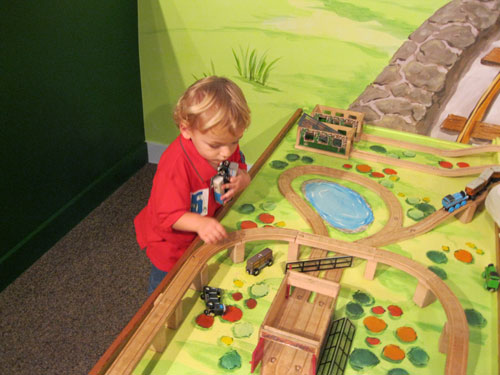
Saturday, September 25 was the birthday of Zach. It was an off day too for all. Zach is two now. Shannon had arranged a visit to Marbles Museum, a museum for kids in Raleigh that is the capital of North Carolina.

And you can see that on your own what the museum contains

.

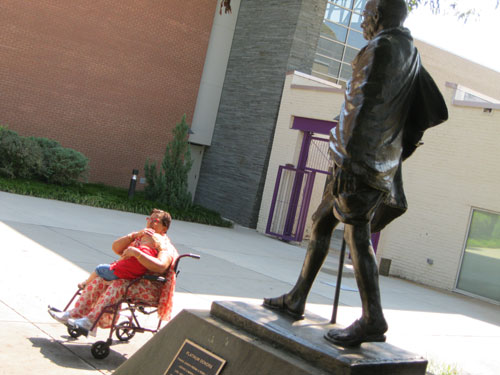
Shannon has arranged a wheel chair for Yamuna. And Yamuna could be wheeled everywhere in the museum. US is one of the most handicapped-friendly countries. Every facility that Americans design meets the basic requirements for the handicapped. One can have a feel of it on every footpath, street corner, mall or shopping centres.

I took the wheel chair up to the entrance, while Shannon and Anand were managing the kids and buying the entrance ticket. To my utter surprise, I came across Gandhi, the father of nation for all Indians. Some local enthusiasts got installed this statue of Gandhi. I stood in corner to take some photographs. I found from among the visitors none even was looking towards our Gandhi. After the camera clicking, I moved towards the gate and waited to see if Anand and Shannon notice Gandhi. Surprisingly, they also did not rather they got a surprise when I pointed towards the Gandhi there.

But the place was a real interesting one for the kids to impart a lot of knowledge about many things placed in different enclosures dedicated to various subjects and to get entertained too. Kids were free to handle the things placed there in whatever way they wanted. And those accompanying them could also try hand and refresh some knowledge. With an entrance fee of $5 per person, it appeared to be a commercially viable too.

Both Emma and Zach enjoyed everything they came across, be it the model ship or submarine, or the railway system. Shannon found it useful enough to get a season ticket of the place for the whole year.

And finally we returned. But I have been pondering still how the sponsorers of the statue of Gandhi could have done a better job. How could the kids could have noticed him and known his name?

Posted in usa | Leave a comment