Kautilya alias Chanakya: Getting Raw Deal

I was going through Times of India on November 19. I came across a news report that highlights the pathetic condition of working of the institutes of the country under the present governing system.

“A 450-year-old manuscript, the earliest available copy of Kautilya’s Arthashastra, written in 4th century BC, and preserved at Mysore’s Oriental Research Institute (ORI) is peeling off. According to the institute, “It is in great danger. There is not even a locker to keep it safe,” It is merely wrapped in a cloth and kept in a cabinet. In 1909, Rudrapatnam Shamasastry found the copy in a heap of palm-leaf manuscripts. Historians across the world then recognized that India had an enviable textual history. The Arthashastra and about 60,000 other manuscripts at ORI came close to be reduced to ashes during two fires caused by short circuit at the institute in 1996 and 1998. Yet, the manuscripts have not been secured in fireproof chambers. A fumigation machine, donated by the Ford Foundation to protect manuscripts from insects, fungi and algae, does not work. The Institute lacks fund to protect these national heritages.”

Interestingly, the newspaper had at least half a dozen ads from different ministries of the country to commemorate the birthday of Indira Gandhi. Perhaps the cost incurred to one media house for these advertisements would have been stuffiest enough fund that the Mysore’s Oriental Research Institute may be hankering for.

In evening I again tried to watch ‘Chandragupta Maurya’ on Imagine Channel to find if the director and producer have come out with some sensible episode. It was just disgusting. How are the Indians tolerating such serials? The historical heroes such as Chanakya and Chandragupta would not have been portrayed as the heroes of Chandrakanta Santati. I was wrong. Indian TV addicts, for whom the serial has been produced, would have hardly gone to school or read about Chanakya. It is pretty clear from some of views expressed and available on Internet. You get what you deserve.
.
It is interesting to know that Turner Broadcasting System based owns Imagine TV entertainment channel. Unfortunately, I see the channel propagating things such the importance of Sani Dev and making Sudama saying that every good Brahmin must beg.

Is it the reason for the poor deal to India’s historical heroes such as Chandragupta and more so of Chanakya. India certainly requires good content producing firms. It requires also some amount of regulation ensuring the quality, particularly for the stories related to historical and mythological characters. The serial producers may be asked to give references.

Interestingly, the famous Sagar Arts has produced the serial, Chandragupta Maurya. Should I assume that the younger generation doesn’t have the value and quality bias of the older Sagars?

PS: Let me clarify that I am only shore about the imaginary story and script of the serial and not the acting quality of the individual actors playing the role of either Chandragupta or Chanakya.

Is it the way to depict the life and time of Chandragupta Maurya, the greatest emperor India has ever known?

Posted in economy, governance, indian politics | Tagged , | Leave a comment

Migration-Why is it bad?

Rahul has again raised this controversy for political mileage. According to him, the chief ministers of UP and Bihar failed to develop their states fast enough. It made the people of the states go to Mumbai, beg for some jobs or find other avenues of engagements and face humiliation. “How long will you beg in Maharashtra (for work)? How long will you work as labourer in Punjab?”

Why is migration bad? Why are the politicians trying to discredit migration and stop it? Will it be good for the people? Reduction in migration rate has become a parameter of efficient governance. Rahul’s political party gives credit to its MNREGA policy that has reduced migration.

Anyone, be it Rahul or the fundamentalist Sena leaders of Mumbai, looking down upon the migrants must stop and ponder for a while. Everyone here in India is a migrant. Their ancestors were migrants. Migration many times gives more opportunities. Look at the migrants from the backward area of Bihar and other places in India to Mauritius many decades ago. The decedents of all those migrants are today affluent.

Whatever I achieved in life is all because my grandfather migrated to Bengal, fought through all odds and at least provided a better ambience for me to get educated and established in life. I provided employment to many in Hindustan Motors just as workmen. Almost all are better off and their children are better educated and placed.

Today in India all the educated and skilled persons from any corner of the country migrate and move around to explore the best opportunity. The government must provide quality education and vocational training to every young men and women of the country, particularly in rural regions, so that they can get matching employment and engagement anywhere in the country.

I feel bad to find a huge population in rural India not getting quality education, large percentage of the school going children from deprived class dropping out from schools before getting any vocational training or skill that can make them better placed for the existing vacancies of job in the country or abroad. Those who are their well-wishers must provide the education and skill. The endeavour to provide doles through schemes such as MNREGA can yield only little benefit to the deprived class and will not provide a satisfactory living.

Migration has made the world better. Let the politicians must not meddle in it.Many may agree by my views on migration and urbanization.

Posted in economy, indian politics | Tagged | Leave a comment

Bangalore Visit: Some Social Engagements

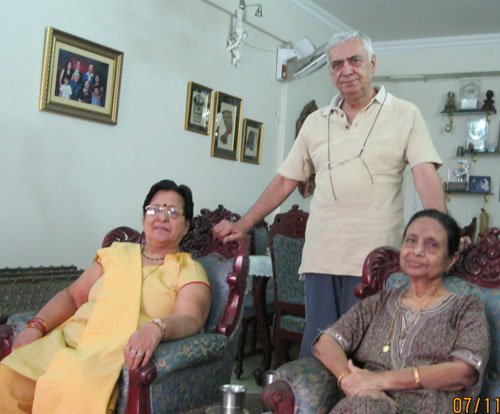
It was after many years that I visited Bangalore. Main pull was from OP Khanna who has been a great host as we know him closely from HM days. Prabha Bhabhi was in hospital for a checkup but returned in time to receive us on Nov 3.I never knew that our sweet Mini lives in the block across the road. I had never met Niranjan and Slok, the husband and the son of Mini. I was so happy to know that Mini has quit his job for some months, as Slok wanted her to be around him till he appears for his class X examination. Niranjan as usual these days remains engaged for long hours in his office. It was a pleasure to talk to Mini as well as Niranjan on various issues including Ramayana and the history and mythology related to Hampi.

Prabha really appeared sick. She is acutely diabetic. We feel the present life style may be one reason. With OP Khanna keeping himself excessively busy with his NGO works, she remains alone for most of the day. It must be torturous at this age. I tried to motivate her to be happy. I wish it could have been so easy. Mini certainly takes care of her when she needs that.

OP Khanna is doing wonderful work for the heart patients of the deprived class who can’t afford the costly heart surgery. He is also engaged in various professional bodies such as Institute of Engineers, Institute of Production Engineers and International Rotary Club. His house has become a museum with awards and various recognitions that have come to him.

OP and Prabha are organizing a unique get-together for the blood relations from the both sides in mid November to celebrate the birthday of Prabha. All the members will assemble in Bangalore. OP has arranged accommodations in the serviced flats of Diamond Districts. Then the group will move to a place on the border of Karnataka and Kerala, live and move around to various places of interests for two days and depart. Perhaps that can be the best way for keeping the family bond active and growing.

We could meet and visit Sarvesh Upadhyaya whom I had come to know only through my blog and face book through his comments. Sarvesh was good enough to arrange my place of stay and vehicle for our visit to Hampi. He knows many of my relatives and comes from a village known to me.It was very homely hospitality at his place with his wife preparing the dinner of our choice and the two little fairies of Sarvesh and Asha providing us with the sublime entertainment too. Another fan of my blog came to his place to meet me. And Sarvesh also could make me talk with Chandrakant Singh who has set up a tech savvy school in Gopalgunj Bihar.

It was only Sarvesh who could take us to the residence of Khushboo, the daughter of Dr. KrishnaTiwari, who is the first female engineer in our extended family and works in Bangalore with her husband. We could not have located it easily with cab driver. For some time now, Krishna is living in Bangalore for the treatment of his wife, Usha leaving his medical practice at Rishra. It was necessary to meet her, once we were in Bangalore. Usha appeared to be bearing with the treatment through chemotherapy pretty well. Krishna is hopeful and we all pray to the almighty to give Usha a long life. We could only say few moral boosting words. I could realize the agony of Krishna.

Though we wanted to meet many more close acquaintances, who are in Bangalore, it was not practically possible.

Posted in personal | Tagged , , , | 1 Comment

Hampi: My Experiences

The history book of high school had described the Vijayanagara and Bahmani empires of south. However, I don’t remember if there was any enthralling reference of Hampi that could make me visit Hampi during many a visits to Bangalore that I made during my professional career. Some years ago I read about Hampi in an article. The writer had referred to the Nobel laureate VS Naipaul’s critical comments on Hampi. “Look carefully and you can see scattered everywhere the crumbling wreck age of former greatness: “Palaces and stables, a royal bath … the leaning granite pillars of what must have been a bridge across the river. A long and very wide avenue, with a great statue of the bull of Shiva at one end, and at the other end a miracle: a temple that for some reason was spared destruction, and is still used for worship.”

Everyone whom I referred about my intention advised me to use overnight train from Bangaluru to Hospet. However, I decided to go by road. On Nov5, we started after a lovely breakfast from Mini, the daughter of my host and the friend since IITdays. Even at 9AM, it took almost an hour to reach Yashwantpur on NH4. Bangaluru has over grown its infrastructure development. Up to Chitradurg, the NH is part of the dream North-South Corridor. The hills around Chitradurg are dotted with huge number of wind mills something that we had seen in Tamil Nadu when we took a tour of its temples. The road between Chitradurg and Hospet is single lane but pretty smooth but for a small portion. It’s barren and rocky on both sides of the road and with little water resources. But the farmers grow sunflower and maize. One gets hardly any important township or rest place on this stretch. But as we neared Hospet and the huge water reservoir on the Tungabhadra River.


Suddenly, we found the land becoming very fertile growing good crop of sugarcanes and banana in around Hospet. A large number of steel mills appeared on the right side belching smoke as we neared Hospet and I got reminded of infamous Bellar, that is pretty near to Hospet.

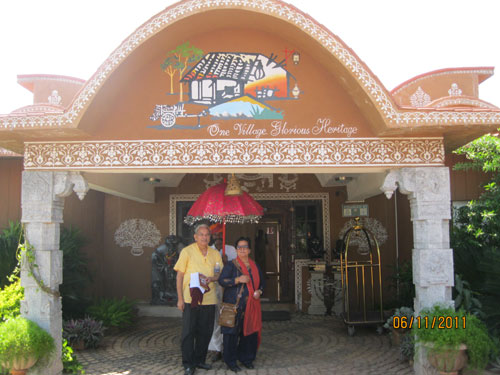
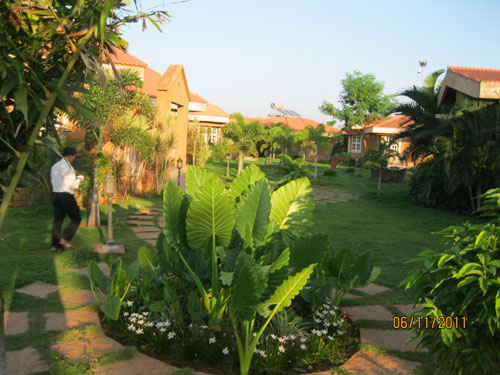
Hospet appeared to be very poor and dirty. I never expected it as Hampi the world Heritage site in just near it. I wish the tourism as well as urban development ministries of the state and centre would have made some planned nedeavour to improve it, as it as the entry for the millions of tourists coming for Hampi. But how can we hope for improvement of the quality of faculties when the corruption has gone so deep in our country in every state and town. However, I was really happy to find an oasis in Vijayshree Heritage Village resorts with wonderful facilities. We rested and in evening enjoyed Rajasthani entertainment: Jhummar dance, rope tricks, magic and many things and finally the Rajashthani cuisine in dinner.

Nov 6 was the day for seeing Hampi as it existed. We took the assistance of a middle aged guide. It was nice that our vehicle could go to all important destinations of interests. I divide the city and our visits to five types of the structures.

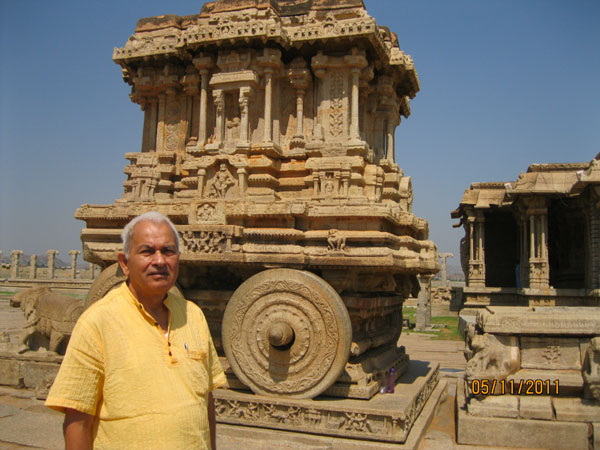
1. Hampi had some huge stone sculptures: kadalekalu Ganesh, Narsinmha, Siva Linga, Stone chariot that lies in Vitthal Temple courtyard.


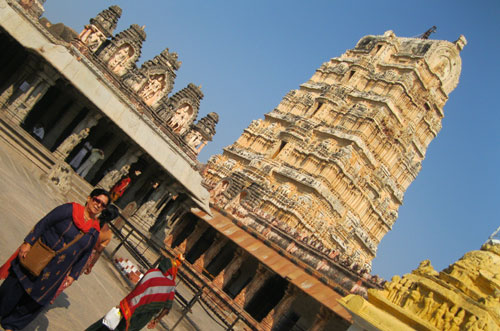
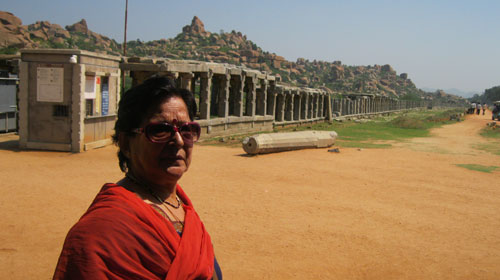
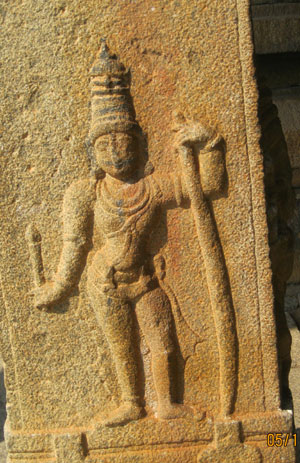
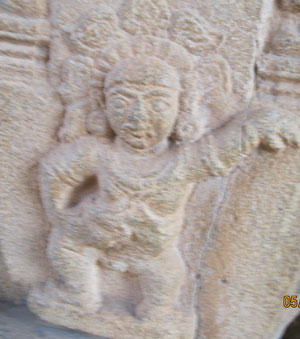
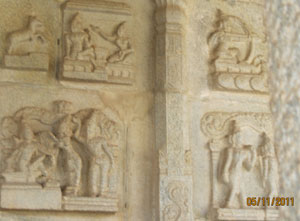
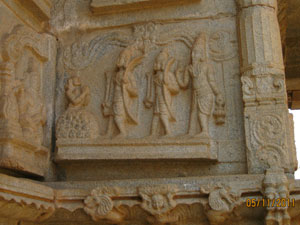
2. Hampi has a large number of temples built in different corners. The deity in main Virupaksha Yemple is still worshipped. Vittthal temple, Hazara Rama temple with thousand panels depicting incidences in Rama’s life and all other temples are in ruins. The deities are damaged but the decorative relief carvings, statues and panels in the temples and its various mandapas are intact. Many structures such as Gopuram and halls of dance are in good conditions. But main and unique feature of Hampi is the presence of well constructed and laid bazaars in front of the main temples. Vijaynagar was known of its trade that expanded up to Europe. I have not seen such combination in any other places. Perhaps this was the innovation of Vijayanagara’s kings, traders and architects. There are many temples in ruins worth seeing but with our limitation, we could see only the main ones.


3. The area that housed the palaces of the kings such as Harihar Rai and Krishnadeo Rai is huge and is lying in full ruins. I wish I would have visited this place when I was a little younger. Yamuna remained seated in the vehicle in most of the places. It further reduced my enthusiasm.

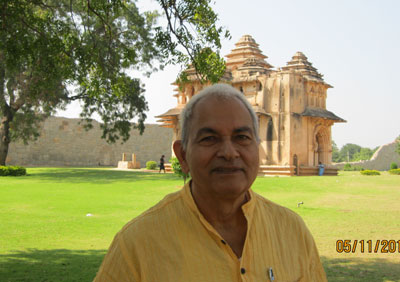
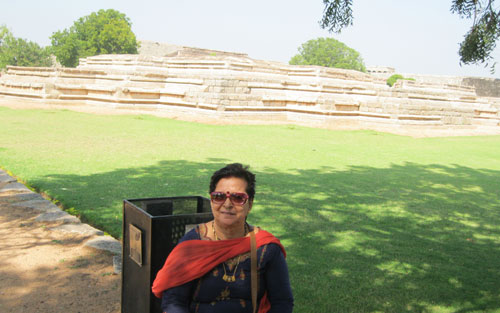
4. Zenana enclosure was for the queens. The main palace like others that were surprisingly made of wood has vanished after the whole city was burnt by the Muslim army of Bahamani Empire. But Lotus Mahal and the Queen’s Bath got spared and are intact as there were built in bricks. I couldn’t understand why the bath and dining halls of the queens were not integrally built but located at certain distance.
/

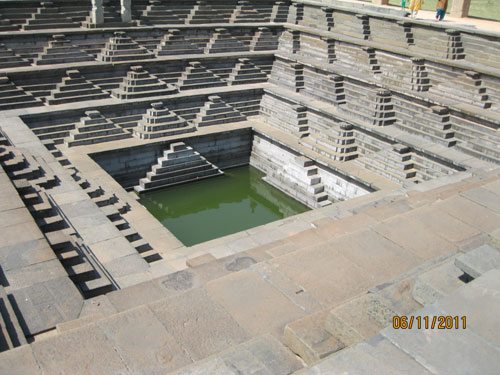
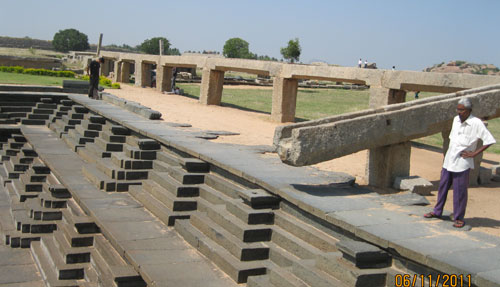
5. Royal enclosure is another impressive area. It has the beautiful step well, stone channels for carrying water from River Tungbhadra to different places. It had separate meeting places for royals with ministers and officers as well as with public.

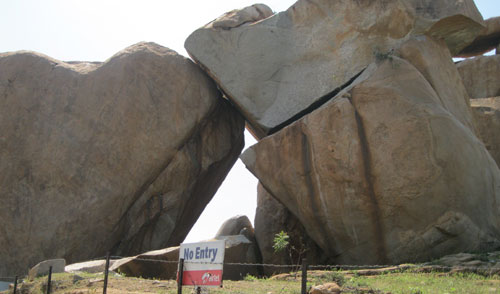
And finally the surrounding hills presenting different things with the varying sized and shaped bolders moved me. As someone has very rightly said,”If dreams were made out of stone, it would be Hampi.”

My last place of visit was the Kiskindha where Ram and Lakshman waited for Hanuman to bring the news of Sita being in Lanka. I saw a number of persons reciting Ramcharit Manas in the Rama Temple on the top of the hill. My imaginations flew few centuries back how Rama with Lakshman spent their time waiting.

But naturally after walking for six hours we were pretty hungry. I made somehow to Mango Tree Restaurant that has become famous among the tourists both Indians and foreigners. I had known about Mango Tree through a blog. Its popularity was evident from the crowd there. It was beautiful and clean and also provided good food too. Yamuna had some trouble in reaching the place but either she braved or the hunger made her walk though with few stops in between. And we returned to Village Resort.

Posted in Uncategorized | Tagged , | Leave a comment

IIT, Kharagpur: 1961 Batch Alumni Meet in Bangalore

I had not attended any alumni meet after the one in Calcutta many years ago. It was due to an initiative of Mr. P Parthsarthy. My batch mate RK Agrawal who worked in Heavy Engineering division was also there. I could talk with Prof SR Sengupta, director at our time. It was a different Sengupta. I could never dare to talk with him during the four years of IIT. He was in accessible.

I got invitation from the Delhi Chapter and then from the institute to attend the golden jubilee of our batch in IIT, Kharagpur in last January. I could never make it. But there was so much of a pull in O P Khanna’s plea for joining the meet in Bangalore that I could not resist it. Yamuna also agreed. I added a sideline visit to Hampi to make it more attractive. I did never dream of meeting so many of the batchmates, many for the first time after passing out.

I could see the first glimpse of the warmth of meeting of the batch mates at the stag party itself on Nov 3. OP Kanna and Shridhar Subramanian had arranged it in a hotel room in Diamond District itself. Russi, Anil, and M Sikka joined it beside OP and Shridhar. M Sikka was in Calcutta after IIT, Kharagpur when I was working in Hindustan Motors. It was he who had invited me to speak in a meeting of Institute of Production Engineers. It was the first time that I spoke on my subject in a gathering. GL Makhija joined the stag party after sometime just to meet me. Makhija was with me in RP Hall and in my group of Machine Design in the fourth year. We used to meet on airports. Once he had come with his mother, wife and son also in Hind Motors in 1980s. Makhija was leaving for attending a family marriage next day in Pune. Makhija has gone really religious with close relation with Radha Swami Sect. He even appeared to be an ardent supporter of Guru Ramdev. At end of the stag party, I could realize how the group was worried about the political bankruptcy and critical issues such as corruption of the country.

The Golden Jubilee Reunion for the 1961 batch came on Nov 4, 2011 in Bangalore Club. One by one some 29 of our batch mates joined most of them with their wives. N Sankar was with us for sometime in HM and then left for his M.Tech to IIT, Kharagpur. He had taken a book from me; he still remembers that and has kept that with him. CP Raman was in Calcutta when in Union Carbide. We had attended his son’s marriage with an American girl. S Ramanathan was in Calcutta as General Manager Eastern Railways and had attened the reception of Rajesh’s marriage in Salt Lake. I had met Krishan Khanna and his two daughters at the residence of BD Singh Bir who was then in Voltas.

I didn’t know many of them who were in different departments and halls but it didn’t reduce the warmth of the meeting. I was never very social any time.

Though most of them are having a retired life like me, some are still active. Ramanathan is assisting his relation in a manufacturing business of investment castings near Chennai. OP Khanna is busy with his NGO that helps arranging heart operations for needy rural poor. He keeps himself busy with active participation in the programmes of Institute of Engineers and Rotary Club. Krishan Khanna is busy in ‘Transforming India’ by empowerment of Indians through relevant education. N Mahalingam has created IDEK that produces innovative design educational kits for making learning for the kids in school easy. It’s all exhilarating. Most of them in 70s are still fit and appear to enjoy their life. It was very much clear when I heard the melodious songs from DP SenGupta, who had been in teaching in IISc, Bangalore.

Surpringly, neither Dr. Damodar Acharya nor Dr. Amit Patra though promised attend the meeting. I had few questions and suggestions for them. Though I spoke about at least one, I think the initiative would have come from them. I wish alumni of each batch who may be around 400 in number can create a fund for various purposes including the scholarships for the needy and meritorious through donations. With just 200 of them that is just 50% joining the group, the fund could be Rs 20 crore. BK Syngal has created one in memory of his parents by donating Rs 50 lakh that provides scholarships. That shows the great giving spirit.

And I could hardly realize how five hours of the session came to an end. We said ‘Bye Bye’ and parted with heavy heart and a hope for meeting again, but who knows if it will happen again.

Posted in education, personal | Tagged , , | Leave a comment

Hampi-Our Heritage: My Views

Every time I think about our history, I get morose to know that even today not much of research is getting done by Indians about our heritages. One can hardly find some good authentic historical and archaeological literature written by Indians or in Indian languages. I met a young educated Maharashtrian couple from Hyderabad in Mango tree restaurant along with their school going son. They were having ‘Hampi in Ruins’ and trying to understand the history of Vijayanagara. Why have Indian historians and writers even after 60 plus years not written anything that can be that good? While driving around in the ruins spread over miles in length and breadth, one can’t see a shop with good souvenirs and books except for some kids selling hardly reliable and poorly printed cheap picture books.


Our vehicle had to be parked at a distance from Virupaksha Temple. Yamuna couldn’t walk that distance. She had to sit on the door steps of the temple. Why can’t the authority provide some facilities where the tourists can sit or wait? The encroachers and occupiers of the ancient Bazaar along the whole of avenue in front of Virupaksha Temple could have been removed, and the area could have been kept clean.

Should we believe that nothing can be done in this politics ridden country? Can’t the people occupying the place be provided good alternative place and convinced to move there? I wish someone researches on the habitations and families that might be having ancient lineages.

Hampi is a wonderful historical site where a Sound and Light Show (Son-et-Lumière) could have been a great attraction for the tourists visiting it. It could make the world heritage site more attractive than many in world because of its spread and variety. In the months more suitable for visit, some locations in the hills could stage some well designed Indian music and dance shows in the evening. The story based on Ramayana may also become one theme. I wish the route followed by Rama could become popular Hindu pilgrimage. Kiskindha, Mathanga parvatham, Rishyamuka parvatham, and Pampa could become important destinations.

Taking clues from the bazaars in Hampi in its glorious days, a good bazaar can also come up for the trade of unique commodities and artifacts. Another addition must be of a craft training school that can produce replicas of wonderful reliefs and panels in the various temples of Hampi.


The archeology or tourism department can charge an entrance fee from tourists and similar development tax from the business enterprises such as village resorts and other organized shops. I don’t know if the tax that some local people demand and get as one for panchayat is legal or properly used. It might be going to some local goon.

Why doesn’t the Indian government take some grand projects to develop such sites to a world class standard? Many a times I feel like believing; it is because Hampi is associated with the strongest Hindu Empire of the South India. It is unfortunate that in name of secularism, the country can’t take care of sentiments of the people and provides excuses.

You can view Hampi’s grandeurs on YouTube:

More videos on YouTube

Posted in Uncategorized | Tagged , | Leave a comment

Promoters of ‘Made-in-China’

As reported recently, ‘From fancy lights, lampshades, Ganesha and Laxmi idols to crackers and other such sundry items, the market in India is surging with Chinese products and consumers seem to be making a beeline to buy these attractive and cheap items.’

And who are the promoters of this trade and threat for the local manufacturers, particularly the small ones, and artisans? They are the same unscrupulous traders who oppose Wal–mart and who opposed Reliance Retails to come up in Noida and other towns of UP. Unfortunately, the political parties are with them. Why do Indians become an easy prey to anything that is ‘foreign’? Here is an example.

IITs have created a brand and respected image even in US.

Instead of sustaining, developing and innovating an India brand and creating an exemplary image, a government panel of great educationists including some from IITs is visiting China to study their world class universities to improve IITs and its working.

I don’t envy China but I pity on Indian mindsets. Builders of Nalanda, Bikram Shila and Taxshila had not copied their models. India is already 60 plus years as Independent nation, perhaps older than China. How long will this inferiority complex of intellectuals of the country continue? Are these done for benefiting the nation or to serve petty personal interests of those involved, be it the traders or the professors?

And who all constitute this class of traders? They are the same traders who fake products, live saving drugs or adulterate food items. Do they not constitute those like that great professors of IIT Kharagpur who runs its own private institute from the famous campus?

While many like me keep taking pride in Presidency and IIT, those who can make it great try to damage it? How can India be a super knowledge power or great economies with most of those who matter have vested personal interest?

India can’t be a great nation by depending on the imported sanitary towels, papers and apples from China? It will have to manufacture and grow it in the country, as many are trying for it. Indians as consumers must support it and not go for those glittering and shining products in name of liberalization and globalization.

No one will rise against US or UK if they restrict entry of Indians and Indian goods in name of various restrictions because of its violations of the rights decided or framed by them. And again all those violations come from the same traders or the community of profit seeking leeches.

Why don’t some NGOs or rightists raise their voices against the trade practices that harm the artisans and local petty manufacturers, if they can do that against allocation of mines and acquisitions of land for building factories and roads?

Posted in manufacturing | Tagged , | Leave a comment

Halloween: Some lessons for Indian Farmers

Sunday was Halloween and Halloween all the day. Halloween means pumpkin. One can find all regions dotted with pumpkin patches. Yamuna had a query. Has it got something to do with farmer? She says she smells of a pre-diwali ritual in rural Bihar in Halloween. I can’t say anything affirmatively. Here is a statement from web.

“Long ago, the Celts of the British Isles used cross-quarter days to mark the beginnings of seasons. Winter began with Halloween, or as they called it, Samhain.”

“Halloween marked the transition between summer and winter, light and dark — and life and death. On that one night, according to folklore, those who had died during the previous year returned for a final visit to their former homes. People set out food and lit fires to aid them on their journey — but remained on guard for mischief the spirits might do.”


I started the day with putting a note in face book. It remembered my mother and her liking of pumpkin, Kumhra. She used to grow one or two plants in her courtyard using the roof for its growing. Output was so huge that she could go on giving them to all whom she liked or who asked for it. Some were sent to even relatives in other villages to serve the marriage party. There are many such plants that can sustain a small family. I don’t know why it is not grown and marketed in our poor country.


On Saturday, we visited a pumpkin patch and bought three pumpkins for $16. One can notice the ad in the photograph. A day before, Shannon had gone along with Emma to a farm. KID r Kid, the daycare school of Emma and Zach organized it. As I could understand, the farmer got paid $10 for each visiting person. Shannon was complaining that the farmer would have at least arranged for toilet facilities for those kids. With bus load of kids coming from three different schools, the farmer made good money may be up to $500-600, and the kids got firsthand knowledge of the farm, cattle, and perhaps farm equipment such as tractors. It is win-win for everyone. I am sure the farmer could have marketed some product of daily domestic use.


Farmers in India must also emulate and innovate on the potential for rural tourism and look for the guests who can add to their earning. It can create some employment too. The villages near the metros and other bigger cities with large number of rich private schools have this opportunity. There can be hundred and one ways to create some business activities in rural India that improves the engagements of the people there.

Someone can pioneer and create a museum of the evolution of the farming over the years in his plot of land with exhibits of say, various ways followed over years for irrigating the land.

Petty farmers in US as in India or for that matter of any country are poor. They look for adding to their earning. Here is a story.

Lafranchi runs a dairy in the tiny western Marin County hamlet, and fluctuating milk prices had put his livelihood at risk. So a little more than 10 years ago, he turned to an organic farmer to help convert a flat parcel of land into a field of pumpkins and other vegetables.

Every autumn, Lafranchi’s land bursts with the colors of the harvest and the sounds of happy children picking pumpkins, going on hayrides, getting lost in mazes and bouncing in an inflatable jumper.


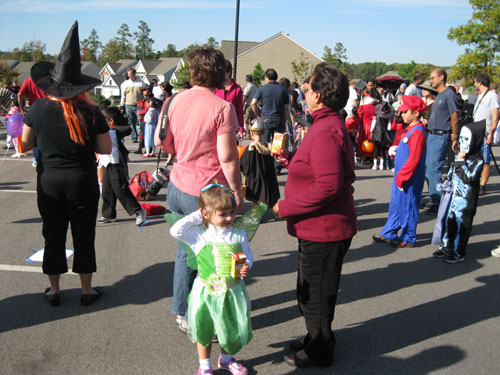
And in afternoon, the Harmony community had organized a Halloween Parade. I joined it with Emma and Shannon. Anand couldn’t as Zach was asleep at home. There was a good gathering, but unfortunately the function lacked organization. Someone would have taken lead and planned the function.

Surprisingly, a large number of those attending the function were from India. I met with few. But I don’t know why the Indian youths are hesitant to have social contacts. This was a good opportunity to have it, but I didn’t see anyone trying for it. Everyone was just mute spectator.

Posted in agriculture, economy | Tagged , | Leave a comment

How could IITs produce a Steve Jobs or a second CP Raman?

Since NR Narayana Murthy and Jairam Ramesh raised the issue of the falling quality of the graduates coming out of IITs, there had been many columnists who have referred to their comments. But the deterioration is almost widespread in every institution.

However, all these years I have pondered why Indian engineers have not proved themselves as great technocrats, great designers of products the world need in millions, why have they not set up their own private laboratories and design firms. A question just haunts me: How could IITs produce a Steve Jobs or a second CP Raman? Here are my observations on actions to be taken by IITs.

1. Set questions for entrance examinations where the coaching centres are not much of assistance and lose its ground. Discourage multiple attempts. Don’t insist for a minimum marks in every subject if a student is exceptionally brilliant in any subject of his interest. Insist on aptitude for science and technology. Let the system select real talented stuffs rather than marks scorers.

2. Take a bond from the students joining engineering courses that makes them to pursue the MBA only after at least five years of experience of working in industry and not straight from the college of engineering. Discourage the technocrats from preparing for UPS examination. Let that be for those from general humanity and science streams.

3. Provide either research or teaching assistantships to at least 30% deserving and willing students so that they start appreciating the importance of teaching and research. Emphasize on the industrial applications of the theoretical education of the subjects taught through design, manufacturing and quality control management in every branch of engineering.

4. Encourage, assist and keep the laboratories open 24 hours for the talented students who wish to experiment, innovate or create something new.

5. Make the student select final project selection in third year and encourage him to seriously pursue it to make the project a worthwhile research and some sort of innovation.

6. Tie up students with some companies of his interest and let him spend time in that. Discourage the engineering students with intense aptitude in technology and scientific work from joining certain unrelated industries just for a lucrative pay package, particularly the financial institutions.

7. Encourage those in industry with academic interest to visit, interact, even work with the institutions and if found really suitable encourage them to join the faculty even at higher grades.

8. However, most importantly the faculty must be encouraged to keep constantly building its quality level through research, and interactions with the latest trends in the industry and research labs. Appraise the faculty members on basis of the students’ ratings, research papers, and innovations or entrepreneurships.

One may agree or not with my views. But the country needs to make IITs contribute in technology in significant manner. It must act in that direction with no excuses.

Unfortunately, main weakness or the parameters of low quality of these new graduate engineers are related to their inability to communicate in English in desired manner and to take up the responsibility of corporate jobs assigned straight out of the college. While the former is due to the very poor standard of teaching of English in 12 years of schooling and the engineering college not taking up the task of making up the deficiency through special extra classes, the later can’t be overcome unless the industry participates extensively with the institutes. All the years the industry used to have a training period extending to two years for making the graduates learn what he is expected to do in the specific industry.

However, I am not concerned with that. The students when once enter an engineering college; they must learn the subjects of his branch of engineering well. That is the responsibility of the college. It’s hardly happening. Without the basic knowledge and the urge for knowing more and more of the subject, one can hardly contribute with innovations.

Posted in education, governance | Tagged , | Leave a comment

Ramayana: AK Ramanujan, Tulsidas or Camille Bulke<

Last fortnight a controversy got wide coverage in media. It related to an essay of AK Ramanujan, ‘Three Hundred Ramayanas: Five Examples and Three Thoughts on Translation’, that was part of undergraduate course in history of Delhi University. The university authority suddenly decided to drop it. It’s was not clear who behind this immature decision. Was it the rightist student union? Alternately, it might be a proactive decision of the university. I do agree that the teachers would have been consulted.

I read the essay on web. It is well written one with research and good intention to tell the readers about the various Ramayanas and some interesting stories therein. The essay is not meant for those who consider it just as a religious book and worship its characters. Some fundamentalists, who can’t appreciate the finesse of the commentary, may raise objections and even protest and even ask for withdrawing it.

It is unfortunate that while writing about Ramanujan’s essay, none of columnists be it Dileep Padgaonkar, Swapan Dasgupta, Pratik Kanjilal or Mukul Keswani has mentioned about the work of Father Camille Bulke. Interestingly, Ramanujan has referred to the work of Camille Bulke.

Perhaps the first time I read Camille Bulke, it was many years ago during my school days. I went through Father Camille Bulke’s on Ram Katha that was actually his PH.D research thesis. It was interesting to learn how the Rama Story, known to us till then as one written by Balmiki and then in Awadhi by Tulsidas, evolved since Vedic era of ancient India. Camille Bulke‘s book, ‘Râmakathâ, Utpatti aur Vikâsa’, got published first time from Allahabad, 1950. Bulke has provided the details of the Ramayana story in Vedic literature as well as in ancient Buddhist and Jain literature. Bulke has also mentioned extensively about the Rama’s story prevalent in the literature of other parts of India and South East Asia. Bulke’s book is even till today might be the best written research work on Rama story.

Interestingly Bulke was a Belgian but loved Indian culture, learnt Hindi, got master in Hindi and then PH.D from Prayag University. Till his death he was head of Hindi department of Ranchi University. For lovers of Ramayana, his book is to be a must read one. It is unfortunate that the book has not been translated and published in English. I wish Sahitya Akademi or some other institution does it.

Ramayana that most of North Indians read and know are of Valmiki who wrote in the Epic in Sanskrit and Tulsidas’s Ramcharitmanas that over the years the book became the most sacred religious book for every Hindu family, particularly in North India. However, I came across at least two more Ramayanas. With my education in West Bengal, I came to know of Kirtibas’s Ramayana in Bengali. We read and sang another very popular Ramayana in modern Hindi with Urdu words also. It was Radhesyam Ramayana and had many episodes totally different than those in Tulsidas’s Ramayana.

Tulsidas created an ideal character of Rama and Gandhiji talked of Ramrajya based on what Tulsidas had written. However, Tulsidas also has clearly mentioned about the numerous stories written about his hero, Ram- ‘Hari Anant harikatha ananta’.

I use the existence of this large number of the Ramayanas as the evidence of Rama being a historical figure rather than mythological one. I don’t think there is any other epic in any language that became so widespread.

According to Dileep Padgaonkar, many versions of Ramayana enriched the epic. I agree. A rational Indian must read every good literature that enriches our knowledge.

I wish DU reintroduce the essay.

Posted in education, social issues | Leave a comment