Thinkers from India: Business, Science, Technology, Management

While some Indians still keeps on priding in Venki‘s Nobel, though he might have disowned his pride in his India origin. Some others are busy in history of some Indians who missed the Nobel. I remember at least one name of Acharya Jagdish Bose. His story was quite a popular one in our school and college days. As the history says, Guglielmo Marconi received the Nobel Prize in 1909 for work on wireless telegraphy that relied on an invention by India’s Jagadish Chandra Bose. I never knew if Satyen Bose and Meghnad Saha also missed it as it appeared in one media report. But I had seen both of them as the celebrity alumni of Presidency College. Prof Satyen Bose visited IIT, Kharagpur too. Last year I had written about two Indians who are Nobel stuffs, but have missed. One was the economist Jagdish Bhagwati and the other the physicist, E.C. George Sudarshan.

And this year Narinder Singh Kapany, who was born in Moga (Punjab) and pioneered the science of transmitting light through glass fibres, missed it. The Royal Swedish Academy preferred to award of the 2009 Nobel physics prize for Shanghai-born Charles Kao for his work on transmission of light in fibres for optical communication and two others for their invention of an imaging semiconductor.

Hardly few in India know about these celebrity scientists. Why are they not known? Should not media devote some time on the people who work in the laboratories working to reveal something that can change the lives of the people? Among one of the reasons for the better success rates for the Indian scientists working in the laboratories of the developed countries is certainly the better equipment such as Synchrotrons that Venki has stated in his interview. But the scientists outside India are also having better exposure and get better working environment required for a breakthrough research too.

However, I was elated by getting a mail from Anand that had link that provided another reason for Indians for celebration. The names of five Indians appeared among the 50 best management thinkers (Thinkers 50) with CK Prahalad at the top. While three including Prahalad are Americans by now, the two are still Indians in every respect, and they are Ratan Tata and S. Gopalakrishnan, who co-founded Infosys Technologies Ltd. and has been its Chief Executive Officer and Managing Director since June 22, 2007 and President since August 21, 2006.

How many of Indians have known him and could appreciate his being named as one of the best management thinkers in the world? Has the media done sufficient to project him as belonging to the class that he has been recognized by a foreign agency?

Vijay Govindarajan and Rakesh Khurana are other two among ‘The Thinkers 50’. I shall agree to Venki when he has said in an interview, “… And then you need luck.”

And I request the media to let the people know about the great Indian scientists and technocrats who are doing wonderful jobs in India and abroad. Why should they waste writing columns after columns about the unscrupulous politicians, so called leaders and corrupt bureaucrats and officers and showing them on the hundreds of small screens in prime time over and over again all time?

Posted in education, management | Tagged | Leave a comment

Collapsing Empires: GM and now Toyota

I have been under an awful halo of the two giants. Reasons are obvious. I worked for the automobile industry and a company that had a long tie with General Motors. I had contacts with many from GM, US as well as its subsidiaries in UK (Bedford), Europe (Opel), and Japan (Isuzu) in my years of professional activism.

And though I never came anywhere near Toyota Motors at work, but Toyota was so impressive in developing its production system that I could remain passive about knowing it. Toyota Production System evolved as the most impressive system in operation management for manufacturing sector with Total Quality Control, Kanban or Just-in-time, Total Productive Maintenance, and many techniques for shop floor management.

The emergence of Toyota Motors as the largest automobile manufacturer of the world was the headline a year ago when it surpassed the US giant General Motors. And then the world saw the collapse of General Motors. Even after significant financial aid from US government, it had to resort to bankruptcy route for revival. Many opine that American giant will never be back to its old position. But still perhaps GM must be owning the maximum number of IPRs in auto technologies in the world.

And now comes the news, ‘Toyota Motor that earned $18.8 billion only two years ago is floundering’. Toyota expects a record loss of 450 billion yen ($5 billion) for the 2009 fiscal year that will end in March, on top of a similar loss for 2008. Some analysts are forecasting the company could again lose money in 2010.

Unfortunately, Toyota is not the same what it stood for-the company of total quality. The company underwent a spate of recalls in the middle of the decade. Has the scale betrayed its roots as a quality leader in auto business?

Last week, Toyota announced its biggest recall ever in the United States after a crash in August in which a California highway patrol officer and three family members were killed.As reported the trouble was with some floor mat.

Even till last year, I had been advising my children in US to go for Toyota. What has gone so much wrong?

As conceded in media, even in the domestic market, Toyota is no longer producing cars that excite the customers. Auto sales have fallen in recent years, partly because of a growing disinterest in cars among younger Japanese buyers. Can the auto leader come out something that can delight the next generation?

Both the giants provide some lessons for those aspiring for the top position. It’s difficult to remain at the summit. Can the premier management schools in world over provide the answer to get over the problems Toyota is facing or will it make these failures only their case studies? Will or can Toyota have confidence in their ability to suggest the reliable roadmap?

Interestingly, both, GM India as well Toyota Kirloskar India are planning big in India with significant amount of investment. Both are interested to be in small cars in India. GM India has gone for a tie up with Reva Electric for producing the green cars in big way.

India is doing great in auto manufacturing and if the sector gets sufficient government support, it can excel and go ahead of China in at least some segments.

Posted in industry, management, manufacturing | Leave a comment

Terah -Thirteen

‘Outlook’ has come out with an anniversary issue and many celebrities have written about 13*. I remember one of the finest interpretations of 13 from Manju Deshbir, the wife of my class friend, Deshbir Singh at IIT, Kharagpur for whom I worked between 1997-2000. She bought a car for me and went for its registration number whose digits added to 13 that sounds ‘terah‘ in Punjabi. Terah according her referred ‘Yours’ and that means to God Almighty. When I decided to retire, I had to buy a car that is Alto. By some chance without my asking for it, the registration number of 4621 that I got again added to 13.

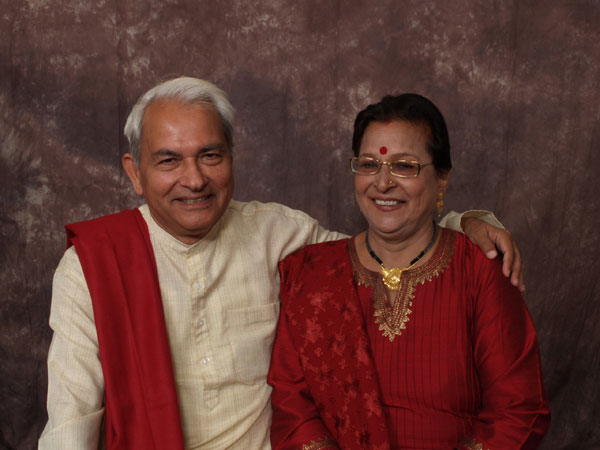
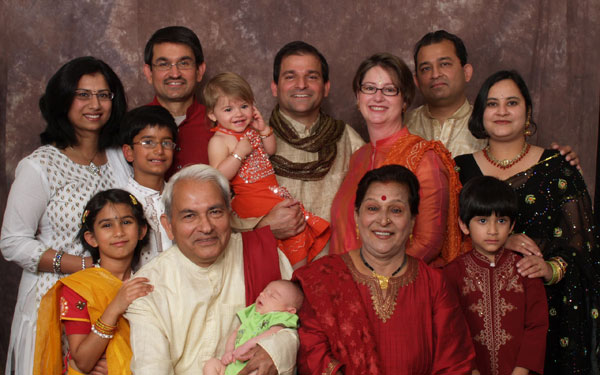
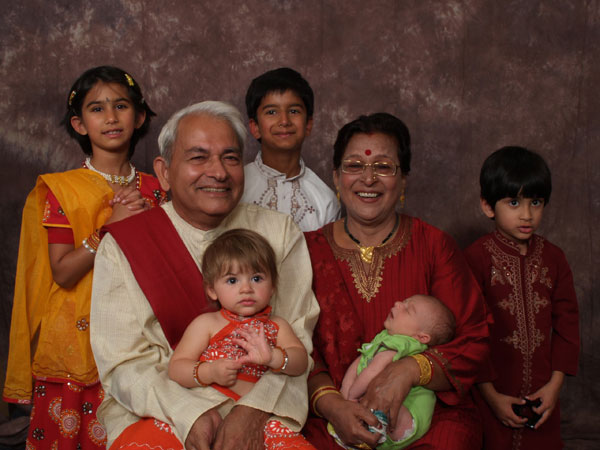
Last Sunday, when we were at Sears’ photo studio for photographs of the family, an initiative by Shannon, the photographer enquired about the total number in the group. There was a little bit confusion. How many are we now- 11 or 13? We are now 13. When we are in India, they are 11 here in US. That caused the confusion. This includes Krish who have arrived on September 25.


/

We are ‘Tera(h)‘.

Bestow all the kindness, keep us in peace and give all the happiness.

We were one of the luckiest to have all the three sons with their family within 30 minutes of driving time in Deville, Pleasanton and Santa Clara in California near San Francisco. But perhaps it can’t remain so for long. Shephali with her medical professional qualifications may have to move to East, and so ultimately Rajesh will have to join her. But that is the life.

During this US visit, it might be a good and rare opportunity for all the family members to be together for a family photographs. Though the innovations have made the distance irrelevant, it always remains a wish to live together or at least nearer.

* “13 is nothing more than a number, just one number in a harmless and immensely useful abstract system of counting and measuring developed by our ancestors.”- Sanal Edamaruku

Posted in Uncategorized | Leave a comment

Textex- My Dream e-Gadget

While reading and talking about e-readers, Amazon’s Kindle or Sony’s competitive version or for that matter many others including some from the Chinese that are getting into market or will soon be available, I always hope one day some entrepreneur cum innovator will produce Textex too.

Textex is to be similar gadget like e-reader that can store his text books as well as functions as exercise books for the students. One gadget with a weight less than net book will make the students free from the load that they are to carry every day. Based on the storing capacity, the students can also get additional reading materials and notes in the device. At the end of the academic year, the students can get the books of the next class loaded deleting the old stuff.

The gadget will have to be robust in design for the mishandling by the youngsters and cheap to be affordable. However, the market potential will be tremendous running into millions and billions in quantity, as it will be universally usable throughout the world. May be, many book lovers such this writer may love to possess one to load books of his choices and to keep writing the ideas generating while reading the books.

This is my dream e-Gadget. Many aspects of the specifications remain to be freezed. I wish someone who knows about some gadget that is near to my expectations will let me know. I also request those working in computer hardware to let their friends know about this dream of an old man.

Can’t some in IITs such as Ashok Jhunjhunwala help me in knowing about the viability of such a gadget and make an old man get some pleasure? I am sure the Indian government with a project to produce $10 laptop in competition with MIT’s $ 100 laptop is serious about the project.

As manufacturing manager, I had been pioneering flexibility in machine tools used for high scale of production to take up the challenges of changing product design cost effectively in automobile sector. I wish some technocrat to develop a single gadget that can impart knowledge and entertainment for the knowledge seeking masses.

And the gadget of my dream will reduce the global warming in real significant way by eliminating paper altogether from the education business.

Posted in education | Leave a comment

Media: It also serves

‘India Today’ and ‘Outlook’ are the two national weekly magazines that reflect the mood of the nation. With its vernacular editions, its circulation is large enough to have impact on the people too.

Both have covered one unique topic each this week, that made me think about its impact on the minds of the people of India. ‘Outlook’ has made the 14th Anniversary Special Issue of October 19, 2009 on ‘1984- 14 EVENTS FROM THE YEAR THAT CHANGED INDIA‘. Somehow I don’t like to remember 1984, a nightmare in India’s history. I don’t know why ‘Outlook’ and its management preferred to select that issue again at this time.

Ramachandra Guha in its lead essay ‘The Axis Year’ summarizes the year so rightly: “Marked by instability and conflict, by assassination and mass murder, it was in 1984 that the Republic of India came closest to being, as it were, a non-functioning anarchy.”

Fortunately for me and many like me, ‘India Today’ compensates. ‘India Today’s special issue of October 19, 2009 is on ‘Nation Builders, 40 builders of India’s growth machine’. Vinayak Chatterjee in his opening essay, ‘The Frame Work‘ introduces the significance and achievement in the infrastructure sector of the country.

The foundation of 21st century India lies in companies like Larsen & Toubro with over 37,000 employees and an annual turnover of Rs 34,000 crore that has to its credit projects like the world’s longest LPG pipeline, or Indus Telecom, a one-lakh tower company, the result of a partnership between three independent telecom operators.

It also lies in Hyderabad’s sleek Rajiv Gandhi International Airport with its 20,000 sq m of glass conceived by the man behind the Oslo airport, in BEST that transports 45 lakh Mumbaikars in 4,300 buses every day, in BHEL that generates 73 per cent of the total power in India, in ONGC, the world’s largest oil and gas company, and in Tata Steel that produces 6.8 million tonnes of steel.

The success is also in experiments like JUSCO, a private-public partnership providing urban services in Jamshedpur, Mysore and Kolkata and HCC, that has built the 4.7-km long Bandra-Worli Sealink and the Farakka Barrage in West Bengal.

All the stories as well as the essays are informative and inspiring for the optimistic lot of the country. Indus Towers with one lakh towers is the world’s largest independent tower company. And the idea of sharing the towers by the competitors to lower the cost is a model that got India’s innovative approach to telecom expansion appreciated by many globally. And JUSCO claim that ‘Japanese drink water directly from the tap in Jamshedpur’, makes one proud and confident and so does the information that India Post is the world’s largest postal network. Unfortunately, India Today is not available for the readers on website. One must buy it, if possible.

I am one who doesn’t believe in the old journalistic axiom that bad news sells better. I shall like to be with the editor-in-chief of ‘India Today’ and take pride in what we have achieved: “India is the fifth largest producer of electricity in the world, the second largest rail network under a single management and has also the third largest number of telephone subscribers the world over.”

With memories of 62 years of post independence India, I can only rejoice with hope. I wish the news magazines to cover the stories of many other achievers in its future special issues such as the great teachers/ scientists of the Institutes of excellence, the grassroots innovators from the rural India, and many who are striving in their own way to take India ahead in the race of development.

Posted in industry | Leave a comment

Sharecropping and Bihar

I came across two articles related to this highly debated subject recently, first on Bihartimes.com and the second in Business Standard.

The news reports in media about the Bandyopadhyay commission has again raised this sensitive subject. The commission on land reform going by its experience of West Bengal suggests the state government enact a new act to protect bataidars (sharecroppers), cap land ceiling and computerize land records. The government naturally will have to weigh every aspect of the recommendations before tabling it. It must not take a course of appeasing some vote banks because of the assembly election next year.

Many, particularly left leaning thinkers, do fix the responsibility of the growth of naxalism in Bihar to the overdue land reform. The share cropping issue has some similarity with the house property in urban India and the whole world that are put on rent by the owner. Many states have age-old laws that protect the tenants, even the rogue ones. The issue relates to the right of property for individuals. The share cropping is also an issue of the right of property.

I have been hearing about the issue of sharecropping since my childhood. Once my maternal grandfather lost his four well bred bullocks in a burglary. They were the envy of his neighbours. He stopped farming and switched over to sharecropping. And I closely followed the system that was so informal. He used to give the land for a year’s two crops. It was either a fixed amount of the paddy or on sharing basis that used to be 50-50 or 75-25 of the produce depending on the land quality and irrigation facility. The tenants used to take concessions with many excuses, but the relationships were never bitter unless some tenant cheated him. He used to look after the fields and suggested the actions required to the tenants. He quite often provided financial support too. After his death my parents took the responsibility and my mother played the main role as she knew all the tenants. I remember how she got a well built for a plot of land that lacked the irrigation facility. For all practical purposes, I took a leave and got that done to make her happy. Mother managed the landed property till she was alive, But after her death I found it unmanageable from a distance and I sold all the property. Perhaps that was the best option.

Later on the system changed to cash payment in advance, an amount depending on the quality of land. With the prices of produce increasing significantly, it has become a win-win for the both.

With the landholding reduced with divisions among the next generation heirs who decide to be independent, the farming is hardly profitable. Many small land holders who remain in farming occupation even lease the land of other smaller ones to make it viable. The myth that the sharecroppers are all from deprived class is totally false. According to me putting a low figure for land ceiling has caused the maximum damage to the business of farming. With increasing cost of the inputs and the use of machines in farming, the land holdings must be consolidated to a higher limit of ceiling. The divisions in the families of the land holders over years have hardly left few with land that the present land ceiling act allows. On average the landholding has come down to 5 bighas in the villages that I know. How can a 5-bigha farm sustain even a nucleus family?

It is not share cropping that is the issue. The issue is to find answer to make a farming of 5-bighas viable.

Posted in agriculture, bihar | Leave a comment

Can India Lead Through Innovations?

Many recent news reports about India and Indians make me ponder about if India can lead through innovations. The latest one giving hope came due to the person of Indian origin who shared the Nobel in chemistry this year. An interesting statement by Venky Ramakrishnan made after becoming Nobel Laureate reinforced my hope. “There are lots of good scientists in India but I notice the press is hung up about these Western prizes like the Nobel Prize instead of appreciating the excellent work they (scientists) are doing within the context of India.” Unfortunately, we hardly come to know about the scientists and their works, as the media hardly cover anything but those unscrupulous politicians and their activities. Why can’t the news magazines such as ‘India Today’ and ‘Outlook’ or business magazines come out with some special issues covering the innovations in India and the big players in innovation from industry as well as institutions of excellence?

As a routine subject of discussion that follows the announcements of Nobels every year, the media has many reporters and columnist raising the question ‘if Indians in India can win Nobel’ and providing their own answers.

Interestingly a new study became handy in time to emphasize and encourage Indians about the possibility. According to a study, conducted by British firm Thomson Reuters, and published as ‘Global Research Report: India’, “In the last decade, India has seen a substantial growth in its annual output of scientific publications. India’s research productivity will be on par with most G8 nations within seven-eight years and overtake them between 2015-2020.” But many well-wishers including NR Narayana Murthy are skeptical about the growth of innovations in India. Perhaps Mr. Murthy has sufficient reasons to be negative which is not. One reason may be the reports on the rankings of the Indian universities that hardly provide any hope. Even a recent ranking expressed the similar view. According to the QS/Times Higher Education rankings, ‘none of the Indian universities figure among the top 100 varsities of the world’. And naturally one of the pet excuses is the lack of funding.

However, I have some other reasons to be hopeful. At least few recent news reports about the technical capabilities of Indians working in the country support my hope. The news related to the finding of water traces on moon by Chanadryan-I was one. According to Chairman of the Indian Space Research Organisation (ISRO) G. Madhavan Nair, the Chandrayaan-1 detected water on the lunar surface as early as June 2009. The indigenously developed Moon Impact Probe (MIP), which crash-landed at a designated site on the lunar South Pole on November 14, 2008, picked up “clear signatures” of water during its 25-minute descent. Analysis of the data from a mass spectrometer on the MIP pointed to the presence of water. This finding was later “confirmed” by the Moon Mineralogy Mapper (M3), which was supplied by the United States.

Another landmark research related to genetics. It has revealed that nearly all Indians carry genomic contributions from two distinct ancestral populations. Following this ancient mixture, many groups experienced periods of genetic isolation from each other for thousands of years. The study has medical implications for people of Indian descent. Samir Brahmachari, a geneticist of repute and CSIR’s director-general says, “India is among the first country to do a diseases-specific, drug-response mapping on large populations which gives us risk analysis and benefits.”

Besides the facilities of CSIR and DRDO, the scientists and technocrats in huge number of research facilities of the country running in thousands are busy in their pursuits of innovations. But the potentials are still more. The rush of the multinationals to open its R&D centres in India and the performance of some who are already established are proofs of the talents of Indians and potentials.

It requires only course corrections with the necessary change in the mindsets. I wish PM could have a CTO for the country too. Perhaps, persons like Nandan Nilekani, Sam Pitroda, or someone would have been more suitable for this bigger responsibility.

Just to give one example of the potentials, each IIT must have ‘an Institute of Science’ integrated with it in its campuses to have basic researches in applied and pure science. On similar lines, the big business houses would have supported an independent R&D institute to serve the sector. Can’t Tata Steel or for that matter Anil Agrawal set up dedicated R&D facilities for metal related researches?

Innovations in every field can only take the country ahead. However, it requires synergy to show fast and effectively impressive results. I was going through an article about the grassroots innovations from the rural India. I am sure if the big industrial houses take interest in some of them and fine tune it, the result will be wonderfully unique and commercially successful products for even global market.

Posted in economy, industry, management | Tagged | Leave a comment

The Poor Indian Nobel Laureate

‘Venky‘, the Nobel winner does not own a car and rides a bicycle to work. “Asked what he would do with the money, he laughed and said he did not even own a car, but that he might buy a new cello for his son who is a cellist in New York.”

Three American Indians could manage Nobles in science, but none could do it while working in India after CV Raman. Sibal, his bureaucrats and the whole community busy in scientific and technology researches in perhaps hundreds of the research laboratories in the country must ponder and perhaps let the people of India know the reason for not been able to do that. Sibal had a mention of Nobel during the recent conflicts of IIT teachers for wages. He expected them to strive for Nobel instead.

But the nation expects some answers of the two simple questions:

Did Raman’s laboratory facility match with those of the scientists in the developed country?

Are the facilities in the laboratories in India are really not comparable with those in America’s laboratories? If the answer is yes, naturally the next question comes to my mind. With billions rupees budgeted for the laboratories, can’t some be selected to have the facilities at par with those in American laboratories?

As India celebrates another Nobel moment, science salutes the work of Venkatraman Ramakrishnan.

I was going through the New York Times news report about the 2009 Nobel Prize for Chemistry, and Venkatraman Ramakrishnan of the M.R.C. Laboratory of Molecular Biology in Cambridge, England; one of the trio who has received it along with Thomas A. Steitz of Yale University; and Ada E. Yonath of the Weizmann Institute of Science in Rehovot, Israel. I read the lines quoted above from media.

And then some feels Indians in general unnecessarily get excited about the achievements of persons of Indian origin. But I would like this special Indian characteristic to continue. With so many young men and women of Indian origin moving to all the corners of the globe for greener pastures including my own children, the excitement back in this home country on the exceptional achievement like getting a Nobel will inspire the rest to perform better. No one can take away my dream of one of my grandchildren becoming the president of US or a Nobel Laureate.

While the country is agog with the news and details about the new Nobel Laureate of Indian origin, some media reports focus on the ‘DNA of the ‘Indian’ Laureate- East or south?’And this shows the another aspect of India’s character.

Posted in education | Leave a comment

It’s same: Be it vulgar, indecent or greed

How much should one CEO get as compensation? Are the amounts most of the CEOs get vulgarly excessive? Even prime minister expressed his views on the subject, sometime last year. Now Salman Khursid and Montek Singh Ahluwalia have expressed their views against the huge salaries and perks that many CEOs are drawing.

The concern has origin in USA. Even Obama expressed his concern. According to the media, the industry in US has reacted positively to his concern. In India some CEOs such as NR Narayana Murthy did also express his views against this. But overall, none in the management liked the views of the government to have constraint on CEO’s compensation. The CEOs, or why not call them, de-facto owners of the companies or groups, don’t want any governmental control on their compensation. Perhaps no one suggests that. But can they introduce some sort of self-constraint themselves? How the employees feel about the top 1% taking away the most of the cost of the company on employees’ compensation account? It is shameful for them.

India follows capitalist West system of management in every respect and so in the fixing the benefits of CEOs too. The lavishness of few ministers gets noticed and reported in media, but the misuses of the shareholders money by the CEOs are hardly reported. So is the case with the corruption by the executives in private sector. Though many of the CEOs might own similar properties as was reported for Satyam’s Raju, the media hardly knows it or dare to cover it.

Officially, the business leaders felt executive pay was an issue best left to shareholders to decide. But everyone knows how the annual meeting of the shareholders is managed and how the members of the board of directors function. Are the voices of common shareholders heard?

The whole country is happy to read the news that India has crossed the $100 billion milestone in FDI through equity since 2000 up to July this year testifying the country’s increasing profile as a safe and sound investment destination in the midst of the global financial crisis. But as much as 44% of the money came through the Mauritius route. Are we sure that the money coming from Mauritius is not the Indian money re-entering the country in official way.

Let the CEOs listen to the warning bells. They may be able to manage for all the differentials they are living with as their right for some more time, but pretty soon they will have to change or the people working for them will force them to change.

I wish the media expose more and more of the many aspects of the bad and corrupt practices in the private sectors. Only hope may be in the educated executives from B-school’s coming up the ladder in the organization to find a sustainable model for compensation and certain acceptable norms to bring in some amount of equity depending on the responsibility.

Posted in social issues | Leave a comment

हम दो, हमारे दो घर

Hum Do, Humare Do Ghar

My craze for a good house perhaps has a root in my childhood. We had a huge house with as many as four big courtyards in the remote village, but that was not of bricks. The land around our village couldn’t produce brick. Even the house of my mother in her village was not of bricks.

When I started working after IIT, my dream of building a good comfortable house started taking shape. Naturally, as the first thing, I wanted to make my mother happy. I built a house on the outskirt of her village. It was single storied but modern designed with bedrooms for parents and kids and huge drawing room and a big toilet and bath too inside the house that was not very common in those days. I got a hand tube well inside the house in absence of tap water. The house had a big courtyard with a number of trees, including mangoes on one side. I used to enjoy my stay there during my annual holidays though it used to be few. My parents lived in the house till they came to live with me in Hind Motor. Unfortunately, I had to dispose of the property in 90s along with the house after the demise of my mother, as it was difficult to manage it with none in the family to take over the responsibility.

In 1982, I got the land in Salt Lake. My mother was alive and active. When she saw the plot, she was very unhappy. The area was hardly having any habitation. But one fine morning we decided to build it. The local architect got the sanction for a three-storied house, each floor as independent full-fledged flat with four bedrooms, as Yamuna wished for her three sons. My mother saw it getting built and was very happy. While the ground floor got completed in 1989, the year I lost my mother, but the whole house- its third floor, was finished in 1992. I named it AJIRA. We lived for some time. Last April we shifted almost everything from AJIRA and rented the whole premises to an educational institute.

In 1997 after the end of the full inning at Hindustan Motors, I joined Harig Crankshafts in Noida. Yamuna also joined me. For a year I lived in a rented house in Sector 30. But for Yamuna, it became difficult to live in that accommodation with unmannered landlord. Literally, she threatened to go back to Salt Lake, unless I buy a house of our own in Noida. The search started that ended on June 14, 1998 when we moved to this house that we shall love to live in till end even with many bitter experiences of burglaries. However, as I had to discontinue my job in 2000 because of my heart surgery and my disenchantment with the physical and mental stresses that it used to cause because of my workaholic nature, I gave up my ownership of my paternal property at my village home to my only surviving uncle to pay back some bank loans taken for the Noida house. Interest in those days on even the house loan used to be around 24%.

I have learnt many lessons from my life that can be an advisory for the Next Gen. The famous Indian slogan- ‘Hum Do Hamare Do’ should also have ‘Hamare Do Ghar’. It will provide the same security to the Next Gen that we enjoy also, even if each build just one house on own. Each will inherit one after the demise of the parents. We live in Noida house and AJIRA has been taking care of our meager monthly expenses. I don’t know if the advice is good enough for the new ambitious generation.

Posted in economy | Leave a comment