Manufacturing and Machining

In Hindustan Motors, I started as executive trainee, a new concept of building managers for the future because of the company’s close relationship with General Motors, the largest company in the world at that time. After a short over-viewing of various departments of the automobile giant in the country, I started working in machine shop as it was called in those days. I used to convince some easy going workmen and work on the machine tools as regular operator to learn the tricks of the trade. I learnt a lot that Prof (later on Dr.) Chandiramani couldn’t have helped. Those were the years when Hindustan Motors were indigenizing the manufacturing of the components and buying the most modern machine tools for the same. I got myself shifted to machine tools tryout department that used to prove the machines for the production engineering aspects and cycle time before handing over to the operation. It was a great learning. Later on I was shifted to the operation, and got the first promotion as ‘superintendent’ in Axle Plant. The designation soon became more civil with a change as ‘Area Manager’ and later just ‘Manager’. After a visit to Vauxhall Motors, UK, I was shifted to become Area manager of Engine Plant. Transmission came under me only when I got promoted as Manufacturing Manager, Mechanical. Thus all along, I remained close to machining.

At one time, the President suggested me to take over as the Manager, car assembly. I was forthright to reject his offer on ground of my interest in machining, though car assembly used to have more top management attraction with better prospect for career progress. Another reason of my rejection of the offer was the company politics in the area. I was never good at that.

Much later, as General Manager, Technical Services, I headed the technical aspects of the sheet metal division too that covered sheet-metal stamping, body welding, painting, and vehicle assembly along with the mechanical division that was primarily machining along with many other responsibilities. And the years in the assignment were really exciting as I could learn almost every aspect of manufacturing engineering of an industrial product such as automobile.

Unlike others in the industry, I was one who remained academic all along the career, and kept on writing what I learnt and experienced. Tata McGraw Hill published my Trouble Shooting Handbook-Machining. Later on I wrote ‘A Treatise on Automobile Manufacturing’ and ‘Latest Trends in Machining’ that are available on my website http://www.drishtikona.com under heading ‘my writings’. Unfortunately, I couldn’t place my book on gear manufacturing that became very popular in the industry, ‘Mr. Supervisor as Mr. Manager- a guide for supervisors’ and my collection of articles written for technical magazines on my website.

Though the manufacturing management was my professional assignment I remained passionately attached in knowing the latest in technologies of manufacturing and particularly machining and machine tools. During my interactions with the executives from the machine tools and equipment manufacturers from all over the world, my favourite question used to be, ‘What are the latest in technology? How will be the manufacturing some ten years from now?’ Even today, I get a kick if I come to know of something new about machining or manufacturing.

Posted in manufacturing | Leave a comment

IIT Professors and Sibal

Sibal is meeting with professors of IITs. I wish that all the malice between them will die. And the professors will return happier to their classes and will never have to teach with empty stomach. However, I do also wish both the parties to think over and act.

Sibal and his ministry must not interfere with IITs and for that matter all the institutes of excellence, and grant the necessary autonomy that can make them globally competitive in every respect.

IITs professors must build themselves on their own as the best and respected. Will they focus on producing a generation of engineers that take pride in their engineering skills and not hanker for getting into management institutes just for getting a better salary package? Will IITs be known for their innovations, researches, patents, and papers? Is it not a shame that India in last 62 years of independence has not produced any Nobel in science subjects?

India has hardly any internationally known product. Indians at large hardly know few professors of IITs by name. Are the laboratories of IITs lacking facilities? If the answer is yes from the professors, let Sibal provide that or let the professors come out with whatever they need publicly just as they did about their demands on salary and promotions. Let the people of India know why they can’t produce the best researches that the country needs.

And I request Sibal to change the system of awarding Ph.Ds in Indian universities, instead of branding some as third class. Sibal will be respected and remembered in the scientific community, if he can lay a system that can bring respect to all the degrees and awards offered in India. Have you heard of a third class in Ph.D? I have not. But Sibal has some in his mind when he said in an interview, “I can’t allow third class PhD holders to teach in IITs/IIMs.”

Let me convince the professors of IITs that they must work hard as they expect their students to do to keep the flag of IITs flying higher. And the route of that is through hard work, breakthrough innovations, and encouraging entrepreneurships what MIT and Berkley did.

And with a due respect for the professors, I wish Sibal appoints a reputed consultancy, say under Rajat Gupta of McKinsey, to survey the opinions of the present students, alumni, and executives in India about the professors of IITs and IIMs. Let me respectfully convey it to the teachers that many with whom I have spoken are not having very good opinion.

PS: IIT-Govt standoff resolved

Posted in education, governance | Leave a comment

Save India, Drop Caste Identity

Anything for ending the menace of the divisive caste system that has kept India in Stone Age thrills me. Unfortunately, in India the governments under different political parties have been the main culprit in perpetuating the caste system. It helps in protecting its vote banks and helping some vested interests. And who does bother about India?

As expected, while the ongoing session of the UN Human Rights Council in Geneva looks set to recognize caste-based discrimination as a human rights violation, India disgustingly readies to oppose. Interestingly, Nepal, a small and also almost economically insignificant on global map has emerged as the first country from South Asia- to declare support for the draft principles and guidelines published by UNHRC four months ago for ”effective elimination of discrimination based on work and descent” – the UN terminology for caste inequities. This is against the ground reality, as the region has untouchability traditionally practiced for ages.

However, Manmohan Singh who once compared untouchability to apartheid in South Africa remains insensitive, dumb, and inactive. He is too busy with his nuclear dreams and his image-building for posterity. He can’t even discuss the issue with his cabinet members because of its possible political backlash.

Even Human Resource Development Minister Kapil Sibal, who vows to bring in the international institutes and reputed foreign universities in India, also says, “Reservation laws as applicable to Indian institutes will be applicable to the foreign institutes. There will be no discrimination.” I wish the foreign universities boycott India on this issue. The mentality of even the new educated generation is clear from the story of separate food for separate caste in a canteen of a medical college. It’s clear that Sibal is afraid of the party’s backlash/

What can one expect when the politicians are hell-bent to divide the country based on caste? Even law minister suggests the 2011 census incorporate caste for the first time since it was last done in 1931as the data available data does not accurately reflect the true proportion of OBCs.

And how can India excel if IITs are instructed by the apex court against scrapping a weeding process they practice to expel weak students mid-course. Ultimately, it would mean that students, once admitted, would not be dismissed. IITs cannot “throw out” SC/ST students on the basis of poor performance.
I recall Ashis Nandy, Political psychologist making a statement, “How is what Jinnah demanded for the Muslims different from what everybody wants nowadays-like separate representation for Yadavs or Dalits?” The Hindu caste system is a blot and a curse on India.

Even Amartya Sen had said in Patna once, ‘the caste system just destabilizes the society and nothing will be more pertinent than to fight and conquer the caste system’. He was delivering a lecture on `Bihar: Past, present and future’

And in his new book, Sen comes back on the subject: “I think that caste policy has been driven by ‘neeti’: certain reservation of this kind and reservation of that kind and so on. We need a more ‘nyaya’-based perspective in dealing with caste distinctions in India. The focus does relate to a deficiency in Indian political thinking on this matter, mainly over concentration on neeti compared to nyaya.”

I and many don’t mind if the government and other agencies do anything in its capacity to bring those in reserved categories and wishing to get into the institutes for excellence at par with other students with best but free coaching facilities as Anand Kumar does in Patna or more to crack examinations to enter civil services and other government jobs. But don’t dilute anything further. Let there be reservation in promotion or passing the examination or for getting in to master courses or Ph.Ds. However, any reported cases of partiality against them must be dealt with severely and promptly in fast court.

Let the caste as identity end and the younger generation discard it against all odds.

Posted in social issues | Tagged | Leave a comment

China vs. India Again

As reported, an article ahead of the 60th anniversary of the People’s Republic, The Sunday Times mentioned: “Not everyone in Beijing speaks in the silky language of the foreign ministry. Curiously, the enemy most often spoken of is India.” I am sure, though Indians are more liberal and not so nationally sensitive in peace time, may be having restrained opinion about China. With changing time and context of global power balance, most of Indians even intellectuals, wish to focus on trade and improving the relations with China that is though very much vulnerable but is still fast moving to overtake USA in economy.

I do feel the same after writing so many times with the same caption in last four years in this blog. But I still remember of early 60s. I didn’t allow my friends to have any celebrations in the flat where we six were living in group. I did pen down a poem too.
यह लाल चीन
जन के लोहू से लाल चीन
यह शिष्य देश, कृतघ्न देश
Even according to Kaushik Basu is Professor of Economics and Chairman, Department of Economics, Cornell University, ‘for India, this is a time of great opportunity, and the possibility of India out-performing China is no longer the impossibility that it once seemed.” And he has some prescriptions too. “Instead of basing our policies on some grand theory of growth, we must work on the “small things”. We need to work on increasing government efficiency. India takes too long to clear the permits needed for an entrepreneur to start a business, it takes too many days to enforce a contract when one party reneges and it takes us longer than virtually any other country to allow a firm that has gone bankrupt to close down.”

India had an opportunity in Manmohan Singh, the economist Prime Minister, perhaps the only one to get Mr. Basu’s prescription acted upon, but unfortunately he has failed. Many including me are not very hopeful of his attaining that goal during the next four years of his tenure. India lags really pretty much behind on the index related to “doing business”.

According to Prof. Kaushik, “This does not happen because of any individual’s fault but because of the rules and regulations that history has handed down to us. To be able to cut down on these inefficiencies is to allow enterprise to flourish. It is important for government to work on this. This should be viewed as much as an investment as building bridges and roads.” Interestingly, according to report, Prof Kaushik will be joining the advisory group of Manmohan Singh. Can the country men hope to get his prescription administered?

Interestingly, it is not only IT and Pharma where India is considered superior to China. There is possibility of India getting ahead of China in many other areas today. I had written about it in one of my entries however, Aiyar also wrote about India doing better than China in the exports of cars in Sunday Times of India.

However, the biggest threat from China is its money power and India’s corrupt decision makers and business groups, who are making and will further facilitate the Chinese invasion of India market by flooding Chinese products of daily uses or high tech without any endeavour to get them manufactured in our country benefiting millions of people in employment and provide hundreds of excuses. I have been giving just one example time and again. Why and how can because of the inefficiency of one PSU BHEL, the Chinese power equipment manufacturers have entered power sector in that big way? Should not the country be ashamed of it? And I bet the Chinese will enter every sector. American may get up to resist the Chinese entries but not Indians.

Posted in economy | Tagged | Leave a comment

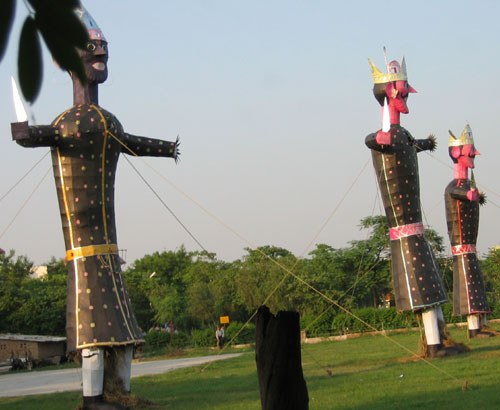
विजयदसमी और राम

हे राम कहाँ हो बैठे, आओ तुम फिर तो आओ
तुलसी बाबा हैं कहते
अवतरण तुम्हारा कारण
था अत्याचारी रावण.
फिर आज नहीं क्यों आते
रावण जब हर कोने में
अपहरण देश का करते.
और भाग बिभीषण जाते
हैं दूर देश में रहने
क्योंकि तुम यहाँ नहीं हो.
आना हो तो अब आओ
कुछ करतब तो दिखलाओ
बहुसंख्यक लोग खड़े हैं
कुछ आश लगाए भी हैं
तुम उन्हें सहारा देने
अपनी सेना में लेने
का कारण बन आ जाओ.. हे राम अब तो आ जाओ ..
पर अमित रूपधर आओ
और सब को सीख सिखाओ
तुलसी बाबा से जाना
रावण को मोक्ष दिए थे
पर मेरी यह मनसा है
न उसे मोक्ष मिल पाया
इसलिए तो फिर वह आया
और बहूत रूप में आया
इसलिए अमित हो आओ
इस बार करो जब बध तो
असली ही मोक्ष तुम देना
जिससे वह न फिर आये. हे राम तो अब आ जाओ
कमजोर देश के बन्दे
पुतले तीन जला कर
और नाम तुम्हारा लेते
सोचे रावण को जीते,
हे राम, रमापति आओ
हर मन के रावण मारो
उस मन में राम जगाओ, और अपना देश बचाओ
हे राम, तो अब आ जाओ

Posted in Uncategorized | Leave a comment

कुछ बचपन की यादें

कुछ बचपन की यादें, कभी हम न भूले, कभी हम न भूले
वह दादी की लोरी, और लोरी में चंदा
को उनका बुलाना
और चुपके से कोरे का मुहं में लगाना, कभी हम न भूले.
कुछ बचपन की बातें, वह चाचा से लड़ना,
और चाची का आकर फिर मुझको बचाना,
वह आँगन का झुला
वह बरसा के आँगन में,
गिर कर फिसलना,
फिर माँ की वह झिड़की, और दादी का आना
और गोदी उठाना, कभी हम न भूले, …
फिर सर्दी की रातें और दादी की गोदी
दुबक कर वह सोना,
फिर माँ का वह आना
और खाना खिलाना, कभी हम न भूले, कभी…
कोनहर का पानीभरी वह तलैया
फिर अपनी बनाई वे कागज की नावें
हवा के झकोरों से उनका वह चलना, कभी हम न भूले, कभी हम न ..
वह आँगन का सुगना और उसका फुदकना
वह काली सी बिल्ली
और मोटा वह बिल्ला
जो पहले डराए, पर फिर मन को भाए, कभी हम न भूले …..
वह बाबु से डरना, फिर दादा से हिलना
और दादी की गोदी में बचने को छिपना
वे दोहे सवैयें, फिर सोहर के गानें
वे बागों के झूलें और कजरी कहानी
और खेतों में रोपनी और रोपनी के गानें
उन बीते दिनों की कुछ सहमी सी बातें
वह दादा का चांटा और दादी का गुस्सा
और दादा पर रूसना, फिर उनका मनाना
सदा याद आते, सदा याद आते..

यादों के झरोखों से छन छन कर आती
बहूत सी हैं बातें. कंहा तक कहूं सब
उमर की डगर यह, उन यादों में कटती
यही शायद सच्ची है, जीवन कहानी

Posted in Uncategorized | Leave a comment

Sibal and IIT

While I have already expressed my views against IIT teachers’ resorting to strike, worst of all a hunger strike, for getting higher remuneration. I hate someone comparing the entry salary with those getting into the industry. Every industry or occupation has certain plus and minus points. An engineer going for R&D or production engineering or operation, never got the salary equal to those getting in marketing. Even in early sixty’s, the oil companies used to offer very high salaries, as is the case today with IT or financial sector. However, the salary must be respectable enough and certainly according to certain norms of performance. Naturally if Lovely Professional University pays more to its teachers, IITs will very soon get affected. Let a body of directors and some reputed alumni advise Mr. Sibal. The outright rejection of teachers’ demand will not usher well for the institutes of national importance. Moreover, Sibal must not expect the teachers to be dumb about their problems, if it is genuine.

I don’t agree with Sibal’s expecting IIT teachers to earn Nobel to get them higher pay or autonomy. And I dislike the way he has come on small screen and to media openly and talking the ill effects of this strike on the image of IITs. His statements were in bad taste and can certainly hurt the egos of some teachers, who are normally pretty sensitive. Why couldn’t he dialogue with the representatives of the teachers of IITs as well as the directors, who have failed to satisfy their faculty members, if they themselves have been sold out on the issues by the HRD minister?

According to report, Mr.Sibal has said, “I am ready to give them any autonomy they want.’’ Why can’t Sibal go through Narayana Murthy’s book and the cases of the working of IITs where he has recorded the interferences of the babus and how it has affected the institutes? Sibal would have been proactive and can get the autonomy of all the institutes of excellence guaranteed. As reported, even IIMs are also asking for the same. I have written about it and pitiable conditions at IITs many times. Why doesn’t Sibal talk with few of globally known IITs’ alumni and consider where the government has been wrong with IITs?

And this makes me doubt the intention of Mr. Sibal. Is Sibal trying to make IITs and IIMs global class institutes? Such issues, where the teachers have been forced to go for strike, would have been taken care of by the directors. If they have failed, either they are useless or they don’t have the autonomy.

Let the selection process and performance appraisal for the teachers be reviewed if it meets the present requirements and expectations of education at IIT. Teachers must inspire the students to get the best in them. Teachers must keep themselves in touch with the industry and the latest developments going on anywhere in their fields of expertise in the developed countries. They must research and publish their findings in world class journals and help the industry to innovate globally competitive products. How can good research work done by the teachers and their group get overlooked if it’s of worth. Let them not be content with the Ph.D that got him the job. They must go for path breaking researches. It may not be Nobel or patents only, but there are many other ways to get international recognitions, as the scientists of ISRO and CSRI are getting after many years.

Posted in education, governance | Leave a comment

Navaratra: Sapatami Celebration

For many years, I was very regular and carried out fasting and reading of scriptures religiously. I remember once I was in Goa in Navratra on a business trip, but still didn’t give up. However, one day I dropped it taking excuse of old age and heart surgery.

I am back on my old religiosity again in Navaratra (Nine auspicious nights) this year. My food is no cereal, no pulse, no garlic and onion and even one with ordinary salt. I live on milk, curd, vegetables cooked with rock salt and fruits. I took it, besides the religious angle, as a purification programme for my body and to certain extent for my mind too. I devote an hour or more on reading Tulsidas’ Ram Charit Manas and Durga Saptshati without any ritual. I am sure the Mother will take care of the rest. It gives a little peace. On my own I have added one more penance for me or I don’t know if it is an excuse of my laziness. I have not shaved for these days.

Sirohi was here with me the other day. According to him, the Navratra fast now has become real popular with younger generation too. Both his son and daughter-in-law are fasting. You are to see to believe how the market has got flooded with special snacks and food items for Navratra besides the items of gifts, and rituals. Even restaurants are serving special Navratra cuisine and special dishes. Eid, Dushehra and Durga Puja together mean celebration all over the country. Garba dance is becoming as popular as the Bhangra of Punjab.

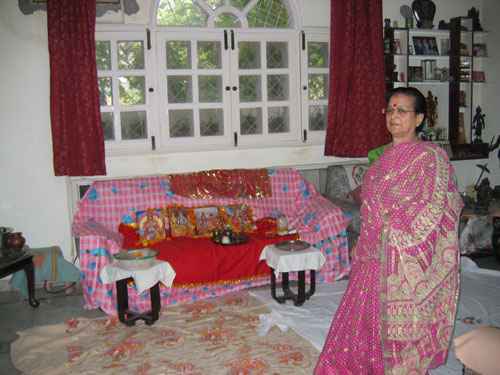
While my restricted fast will end on Sunday that in Navami, Yamuna and her party celebrated Saptami today with bhajans, and dance for the mother. The popularity of Garba dance originally of Gujarat is fast expanding, and becoming attraction of the festivity and also for tourists. Here are some snaps of Yamuna’s festivity.


I still remember how in my childhood in that remote village we used to go to every household in neighbourhood to touch the feet of elders for blessings and to get some sweets in return. In West Bengal, we enjoyed visiting pandals and seeing yatras, an open theatre, in night during Durga Puja. On Vijoya, every house used to offer sweets to the visitors. And in the offices and shop floors, I had to go for embracing my friends and foes too.

Let me wish the best for everyone on the occasion of these festiv

Posted in Uncategorized | Leave a comment

Can India Excel in Agriculture?

Agriculture is a big concern as well an opportunity for India. Unfortunately, while all the ministers holding different portfolios from agriculture to rural development, and naturally the finance, express their concerns. Sometimes, they shed crocodile tears also, particularly when the farmers resort to the extreme step of suicide. The word inclusive growth has become a fashionable expression for politicians too. None comes out with some real sustainable solutions. How does an Indian farmer household with an average of five persons to depend on the revenue of the landholding averaging 1.5 acres or 5 bighas get into affluence compared to even a lower middle class household in urban India with some employment in organized or unorganized sector?

Agriculture might be contributing to the GDP only about 17 per cent, but as per the data appearing everywhere in media, it still employs about 60 per cent of our population. Naturally, this 60% constitutes both agriculture dependent as well as those not dependent on agriculture. May be, half or one third of the 60% are farmers with some landholding of their own that averages 2 acres. Can the government experts guide the farmers to get the best from 2 acre-farm? What maximum can it yield if the best of the inputs, such as the seeds, fertilizers, and insecticides and water, are made available? What can be the best crop combination that provides the maximum revenues from the sale of the produces? Will it be Rs 1, 00, 00 per annum or twice of it? Can it suffice all the basic requirements of a family of five, such as the expenditures for medicines or hospitalization, or for those of festival time or for family functions such as a marriage and even demise in the family for being in line with the neighbourhoods? Can it make the family independent without needing any waivers or other doles? Unfortunately, in India most of these small land holders particularly from some communities of the society will never go to NREGA for adding to their revenues unless it faces a situation of starving.

Most of the farmers have hardly learnt anything in their formal education about farming techniques and practices. They are just following what they picked during their childhood from the parents or they learn from some of the successful farmers in the village or the neighbouring village. In many families, only the one who couldn’t get educated and go out, remains in farming.

However, someone in the government machinery must answer why the yield in two states say, Punjab averages a yield of 4,017 kg per hectare of wheat, whereas the Maharashtra’s yield is only just 940 kg per hectare. I don’t know how India competes with US or China. This inequity requires research, and education of the farmers of the lower yielding states. I had been asking this, whenever I meet my relative farmers in Bihar. Some claimed that they compete in paddy production but in wheat they are behind as they don’t get the seed and the amount of water required. Some even talked about the unaffordable cost of fertilizers that the farmers in Punjab do afford. They also complain about not lifting the produce at the government announced prices. Interestingly, they surprised me by revealing that the farmers from Punjab buy their produce to transport and sell to the government there. My friend in Kichha near Pant Nagar, who had been an agriculture engineer of repute and of my own batch from IIT, Kharagpur, agrees with the issues raised by the farmers of Bihar. West Bengal has been another case. During my school days in the rural areas of the state, the people considered farming as very shameful occupation. Today, the state is one of the surplus food producing states, rice and potatoes as main produces.

For example, as reported, ‘despite India being the largest producer of pulses in the world with 25 per cent of total production, 30 per cent of total consumption and 32 per cent of global acreage under pulses, productivity of pulses in India has been very low at 635 kgs per hectare, compared to best-in-class yields of around 1,900 kgs per hectare in Canada and USA.’ The main intervention is to be in these areas.

And the farmers, particularly the marginal ones, can’t do this improvement of the yield on their own.

I wish the government would have allowed land consolidation where a family of five interested in this profession as occupation can go for ownership of at least 20 acres. With the divisions in the joint families, the landholding goes on reducing with each generation, and that can’t sustain the next generation of farmers for long.

According to the United Nations’ Food and Agriculture Organisation, the world will have to produce 70% more food by 2050 to feed a projected extra 2.3 billion people and as incomes rise.

India has potential to feed the global shortages, but this will require a total change of mindsets of the bureaucrats, scientists, and politicians.

Posted in agriculture, governance | Leave a comment

IIT’s Gurus Can Do Better

In this country believing in ‘bhukhe bhajan na hohin gopala’, it is not strange that teachers in IITs are also going for a hunger strike on Thursday. However, they have assured that it will not affect the students, and they will take their classes. Some call it Gandhigiri. But are they serious? Will they really not consume anything for a day? Will it be 12 hours- or 24 hours-day? How can a person like me check it? Should I get into touch with my friends in IITs to find the real story? Will the students show sympathetic gesture by not attending the class by a hungry teacher? Or will they also go for hunger strike to boost the morale of the teachers? As such, if the food has remained the same that we got served in 1957, it will not be difficult to skip it.

The remuneration is, perhaps, the main issues, but the list of demand might show many issues. Promotion is one. Perhaps, the autonomy of the institution and very rightly so may also be in the demand. However, as it appears from the media report, the directors of IITs differ and consider the misunderstanding as the reason of agitation. But will they agree that autonomy is not the issue?

Interestingly, Dr. M Thenmozhi, a professor in the department of management studies at IIT, Madras (Chennai), heads the IITs faculty federation. I would have loved if the autonomy of the institute would have been the main demand, as that could have automatically settled all these issues. Unfortunately, the government’s interference is killing IITs’ brand image. Reservations and the resulting increase intake without the necessary preparations of infrastructure and faculty are badly affecting the excellence standard.

The teachers must get united to press for autonomy, as many such as NR Narayana Murthy also advocate strongly for this. And the autonomy ‘is about the freedom to decide on selection criteria and the size of intake for students and for faculty, syllabi, fees and scholarships for students, compensation for faculty, interaction with the best scholars and leaders from all over the globe, plans for growth and plan for adapting to a changing environment.’ How can a small hostel room accommodate three students? Why can’t the facilities in class rooms be of the world class? Why did not any of the professors express their opposition to the decision of the apex court to take away the right of expelling the nonperforming students from IITs?

The country expects a better way of protesting and for more important issues of the country by the professors of IITs. Dr. M Thenmozhi has been perhaps researching and writing about organizational capability, will she and her colleagues in federation will change the course of their action plans a little and do something to take IITs to the brand image comparable to MIT and other top ranking educational institutes of the world.

With a huge number of resourceful alumni, it can be an easier task than what skeptics doubt. The alumni can help in building the best facilities as well as provide the practical knowledge to the newcomers to the institutes that other institutes may not even dream of.

PS: 24.09.2009Sibal is open to having any kind of dialogue with them to discuss their demands, but ruled out world-class salaries due to lack of resources.

Posted in education, governance | Leave a comment