Recall Reaches India

Indians hardly had any experience of recalling. Maruti Suzuki has broken the record by announcing recall of 1, 00,000 of its A-Star cars manufactured before August 22, 2009 to replace faulty components that could cause fuel leakages. I knew about it yesterday from TV news channels.It seems India has joined global recall season.

Rakesh sent a mail today: “hmm..Not very good news for those of us interested in seeing India as a higher-end manufacturing hub.” Rakesh knew it through- ‘Maruti Suzuki Recalling 100,000 India-Made Cars’ in Product.

Media had talked loudly about A-stars at its launch, as it was the first car designed and developed by Maruti in India. And all the printed media has flashed the news of recalls too. I shall like to recall and remind that it is the same Japanese company, that didn’t think India fit enough to manufacture even transmission gears in India. However, today Maruti Suzuki has changed its strategy. Its revenue is more than the parent unit in Japan. It’s a huge R&D expansion plan for India.

As reported, the car manufacturer has replaced a faulty fuel pump gasket and an O ring in about half the 100,000 units. The two components cost about Rs 400 to Rs 500. It may not cause much financial burden on the company, but it raises questions about the quality level of its production. And the worrying part of recalls is going to be the doubt about India’s capability to produce worldclass cars. The recalls may include around 30,000 to 35,000 units of the A-Star sent to Nissan in Europe. Maruti contract manufactures the A-Star for Nissan, which is sold as the Pixo in Europe.

A friend of mine asked smilingly if the components were not imported ones from China for the reason of cheaper price. Media reports don’t reveal the identity of the vendor/s.

The other manufacturers of India must take lessons from Maruti Suzuki’s recalls and look back in the quality management system.

India’s auto sector, both OEMs and component manufacturers, have claimed itself better in quality than the Chinese counterparts. But the recalls are public admission of management failures and unfortunately the customers these days are in no mood of tolerating it.

Toyota, famous for its quality and unique management tools and TPS, Toyota Production System eulogized world over in manufacturing has got its image badly affected. It happened with Honda and VW too.

Even the winners of Deming Prizes and practitioners of Six Sigma can’t get excused, if they fail. Customers are ready to tolerate any failure anymore, and losses will be immense.

No complacence

Check, recheck, and ensure the quality system works.
Posted in management, manufacturing | Tagged , | Leave a comment

Finally, a Gadget that I Dreamt

I had been discussing and writing about my wished expectations from the e-books getting commercially introduced by many manufacturers. Perhaps the others also felt its need, and a gadget has come with the provision for changing the text, noting down the views and naturally highlighting the interesting portion. The news appeared in New York Times.

Macmillan, one of the five largest publishers of trade books and textbooks, is introducing software called DynamicBooks, which will allow college instructors to edit digital editions of textbooks and customize them for their individual classes.

Professors will be able to reorganize or delete chapters; upload course syllabuses, notes, videos, pictures and graphs; and perhaps most notably, rewrite or delete individual paragraphs, equations or illustrations.

While reading many books in last years on the contemporary subjects such as NR Narayana Murthy’s ‘A Better India, A Better World’, or Nandan Nilekani’s ‘Imagining India’, I felt the need of getting such books in e-versions but on a gadget with provision of editing and upgrading, so that I can change the data in the text of the books by the latest available or add my views at some point.

Fortunately, the manufacturers of the gadget can now integrate software as done by Macmillan. However, the customized inputs can come only from a service provider with commercial agreements with the publishers. With the hope of Indian Kindle and iPad appearing in the market, I wish some service providers do also appear.

One day very soon, a school child will go to school with just one simple, cheap, light weight, book size gadget that will have all the text books as well as blank exercise books on which he can take notes or solves the questions sent by the teachers for practicing the topic taught. And the device will reduce the load on the child carry every day. And the student will not have to pack the books while accompanying the parents going for a vacation. He will just carry his digital device.

Will the Indian techies innovate and develop the product of my dream and get into this lucrative business for the education sector with huge commercial potentials? Are the innovators of Pi and Adam listening?

The most important in the game will be the targeted price of the gadget. It must be based on Nano philosophy but for the large population needing it.

Posted in Uncategorized | Leave a comment

Power: A Unique Solution from a PIO

Here is the news report that made me really happy and brings hope. Without power, one can’t think of the development of any country. Source may be any. But it must be cheap and clean, particularly in India.

As I came on my laptop today, I got the news on K R Sridhar’s “Bloom Box” first from Anand’s mail.

The Bloom Box claims to be a game-changing fuel cell device consisting of a stack of ceramic disks coated with secret green and black ‘‘inks’’. The disks are separated by cheap metal plates. Stacking the disks into a bread loafsized unit, can produce 1 kilowatt electricity, enough to power an American home or four Indian homes.

As reported, a Bloom Box for the residential market could be out in five to 10 years for as little as $3,000 to produce electricity round the clock, round the year.

I am sure that most of the Indian middle class can afford a $3000 device very soon. But perhaps the time to be taken for the commercialization of the domestic units takes away my excitement. Can’t Dr. K R Sridhar get the assistance of the scientists and governments to expedite if it is a proven technology? Will not President Obama provide his patronage to get this clean device commercialized fast?

Dr K.R. Sridhar, 49, who founded Bloom Energy, was a professor of Aerospace and Mechanical Engineering as well as Director of the Space Technologies Laboratory (STL) at the University of Arizona. He is also, literally, a rocket scientist, having served as an advisor to NASA in the areas of nanotechnology and planetary missions. Sridhar initially developed the idea behind the Bloom Box while working with NASA, as a means of producing oxygen for astronauts landing on Mars.

Dr. Sridhar is a graduate in Mechanical Engineering from the University of Madras. He moved to in the 1980s to the U.S, where he earned an M.S. in Nuclear Engineering and Ph.D. in Mechanical Engineering from the University of Illinois, Urbana-Champaign.

Posted in industry | Leave a comment

Album and Autobiography-3

After his schooling in Arrah and then Sasaram government schools, my grandfather left the village to explore the world outside and find means of earning away from the village. As the eldest son, he could have remained in the village and lived on the farming, but perhaps he wished to find the worth of his education. He left his younger brother to help his father in the management of landed property or zamindari as it was called in those days. As he used to tell me it was really difficult even in those days to find a job.

After unsuccessfully trying with some so-called ‘kings’ in Bihar such as Tekari and Hathua, he came to West Bengal where some close relatives were working. I had met some of them in Calcutta where he took me in my school days. After working at different places for different assignments including one for an orphanage near Batanagar, he came to Birlapur, where Birlas had set up the first Indian jute mills.

My grandfather was the pioneer in starting formal schooling in the industrial town of Birlapur. He started the primary school in labour quarters on the bank of Hooghly that we knew as ‘magazine line’. Later on the company, Birla Jute Mills built the high school inside the company boundary.

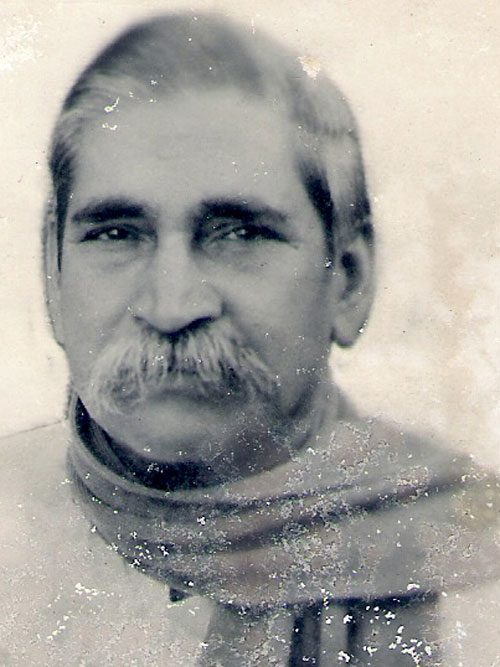
My grandfather, Lakshmi Prasad Ray was very popular among all classes of people from general manager to the sweepers in Birlapur. To many he was Ray Babu or Ray Saheb or more formally as LP Ray. He belonged to the era when a teacher was really respected in society. He had helped many senior executives in mills from Rajasthan or marwaris as we knew them to get privately educated, and even pass matriculation examination. Later on he taught their kids at home. But I saw his interest in educating some from the community of sweepers who had come from all the way from Rajasthan for that task that was considered very low in those days, and no local persons were available for that work. I remember one very smart person among them whose name was Babulal. He had taken the help of my grandfather to be literate. My grandfather did also believe and kept on talking of ‘simple living and high thinking’. He loved white and wore only white. And with his moustaches he looked really smart and impressive. He reminded many of Asutosh Mukherji, the great educationist of Bengal me.

I was the darling of my grandfather and I remember many sweet things of those days. I remember I used to lock the front door so that my grandfather would not leave the home without helping me in solving the home tasks from school. I do also remember how I used to go with him to some houses where he used to take tuition. I would fall asleep and he would carry me on his back in late night from the distant place. I used to sleep with him and even in sleep I kept on touching him to find if he was there. In case I didn’t find him, I used to make a lot of hue and cry even at late night. I do also remember how I went to bed very early. And then I would get up in late night and demand food, and my grandmother would give something.

My grandfather shared with me personal information about himself. In early years of the school, he was expected to teach even mathematics in higher classes. He was not proficient enough for that. On every Saturday he would go to Calcutta, sit with some teachers whom he knew and learn to solve the tough questions of mathematics to come back teach it to his students. Gradually, the school grew and became full- fledged up to class X during my days. He remained in the school but only as teacher in upper primary sections.

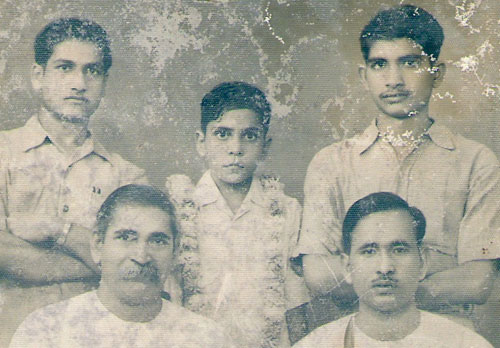
My grandfather always accompanied me be it the admission in Presidency College or IIT Kharagpur. He would regularly visit me in my hostel and keep on inspiring me. Many a times he helped me in taking right decision too. I have a group photograph for which my grandfather took us to a studio in Dharamtalla Street in my Presidency college days. My maternal uncle, Chandramani Tiwari and youngest uncle, Nand Kishore Rai are there in that.

Photo:Standing Nand Kishore Uncle on left and myself on the right
Sitting my grandfather on left and maternal uncle Chandramani Tiwari on right

He could not accompany me when I went to Hind Motor for an interview for getting in as Executive Trainee Engineer. Unfortunately, he got an attack of paralysis on the same day. On my return from Hind Motor, I found him on bed. He couldn’t speak. His right side had been affected. I remained at his bedside and nursed him for a month before I joined Hind Motor. His will power helped him to recover fast. I remember him asking me if it would help taking eggs for faster recovery. Actually, Durga Babu, the aged doctor of Budge Budge General Hospital had joked with him knowing that he had been a total vegetarian all his life.

In late 50s, my grandfather took retirement, perhaps so that Nand Kishore could get an honourable appointment as teacher in his place. But he continued teaching. He got started a school in another jute mill complex in nearby Kalipur whose General Manager was acquainted and happened to respect him.

Before retirement the school authority of Birlapur Vidyalaya wanted one big portrait of his to be placed in its prayer hall. I don’t know when and why that portrait was returned to the family. It is still on the wall of the residence of Pradip, my cousin who still works for one unit of Birla Jute Mills (presently Birla Corporation) at Birlapur. The photograph above is a copy of that.

My grandfather always wanted to see his sons in business and prosper. He tried many times. He started a milk business and bought two good buffaloes in Birlapur. He brought his second son, late Raj Kishore Chacha and Maloo, a helping hand from my village. But my uncle couldn’t work hard enough to make it a success. I remember when my grandfather wound up the business selling one buffalo and sending the other one to my village home by train. I saw tears in his eyes. My father used to narrate how he brought that buffalo from a distant railway station near Arrah to our village and the trouble he faced.

My grandfather didn’t get bogged down with the failure. He again invested in opening a hotel in Sasaram. But Raj Kishore Chacha again failed him. As the last attempt, my grandfather after retirement got started a rice and wheat grinding facility for my youngest uncle. I had also contributed the money that my mother had given me and was lying in the saving account at Sasaram for emergency. The uncle started well and it appeared that finally my grandfather would see at least one of his sons succeed. But some envious villagers created problems and the family had to go in long costly litigation, and the attempt failed again for the third time. My grandfather who went to live in the village had to go to Dalmianagar. He again started working in the high school of Shahu Jain Industries there. He was pretty popular there too. I had visited him there once. Yamuna too lived with him and my grandmother for some time. He lived there till last when he had a heart attack while he was going to the railway station with my mother to see her off.

And this was the end of the most important man in my life. I was at that time in Hind Motor.

Posted in Uncategorized | Leave a comment

India as global player in auto sector

With my whole professional life in the auto sector, it’s really amazing to see India gradually but consistently approaching towards becoming a relevant global player in auto sector in the next decade. It’s been heartwarming to see the evolution. A country producing just 30-40,000 cars annually in early 1980s is producing 1.8 million cars now. And as estimated, by 2015 India will be a country producing 4-5 million passenger cars.

It all happened in four phases:

Post Maruti Phase
: Hindustan Motors in its plant near Calcutta and Premier Automobiles in Mumbai manufactured respectively Ambassador and Padmini.

Maruti with Suzuki: Maruti 800, the small car in collaboration of Suzuki of Japan appeared and became the darling of Indian middle class.

South Korean Entry
: South Korean auto manufacturers, Daewoo and Hyundai entered India with Santro and Matiz, and Tata Motors went for its own indigenously produced Indica that was unique and remains the most popular as private taxis even today.

Floodgate of Global Players: All the global players in auto business realized the potential size of India’s market and its growing middle class, and started entering India. It started with the two American biggies, General Motors and Ford and followed by the Europeans and Japanese auto manufacturers such as Mercedes, BMW, VW, Honda and Toyota. It all started with collaborations with the local manufacturers but pretty soon preferred to free it to go on its own.

Frugally Engineered Nano: With Nano launched at Auto Expo in January 2008, Tata Motors brought in that new surprise about which the whole of auto world was doubtful. Nano has demonstrated to the world the capabilities of Indian engineers and the excellent combination of frugal engineering with world-class research and development. Nano, the Rs 1lakh ($2,500) “People’s Car”, is the world’s cheapest car, a car for India’s millions and with potential for many millions globally, an example of how innovation in the auto industry is shifting from the West to the East. As pronounced by some in Business Week recently, ‘the impressive aspect of the Tata Nano is its potential as a platform for new products and new markets. Ratan Tata and his colleagues can hope to conquer market opportunities not just in India but worldwide.’

The existing manufacturers in the market are planning to add 0.9 million units to the 2.6 million units capacity of the passenger vehicle segment by 2012.

Most of the late entrants among the global automakers are setting up the manufacturing facilities and using the local auto components to be more competitive with local players. In next five years, Indian passenger car manufacturers will invest over Rs 70,000 crore, even by a very conservative estimate.

More interestingly, most of the global auto makers have already set up or are in process of setting up its design studios and R&D centres to develop cars not only for Indian market but also to use the facilities for its global products because of India’s superiority in talent and cost advantages.

Global automakers are also outsourcing the components from the Indian manufacturers for its facilities all over the world.
Taking advantage of the economic slowdown in West, Indian auto manufacturers are hiring from the US, Europe and Japan, mainly for technical and design-related jobs in good number, where local talent is inadequate and often untrained.

Carlos Ghosn, CEO, Renault and Nissan is sold out on India’s strength of frugal engineering and management. I don’t know if the younger MD of Bajaj Auto will finally go for launching its ultra cheap car. But many of the global players are ready to make India as a hub for manufacturing its small compact cars that will be more in demand with the focus on pollution control and saving of energy.

I wish some of IITs and IIMs, the institutes of national importance start giving manufacturing and its management its due importance to make India a leading manufacturing nation. And the auto industry may lead the game.

Posted in industry, manufacturing | Leave a comment

Indian Kindle and iPad, But..

If I believe media, Indian techies have developed two products that can easily compete with Amazon’s e-reader Kindle and Apple’s tablet iPad. Unfortunately, I am not knowledgeable enough to rate them. I wish someone, who is expert helps me. I don’t know if the products would make the customers dance with excitement of satisfaction soon and invade the global market as the lead products- Kindle and iPad have done.

However, I welcome the developments because of my own reasons. Have the two got potential to become the useful gadgets that all educated persons will love to possess?

Many like me will like to use them as personal library that can be of use both at work station or during travelling or in bed room. For my professional work as manufacturing engineer and management I shall like it to store certain reference books such as all volumes of Manufacturing Handbooks, Production Engineers Handbook, and access to the technical magazines such as Manufacturing Engineering, Machine Shop, and American Machinist. For my off the job interest, I shall like to store in it, my most favourite books on Hindi poetry and short stories along with contemporary books such as one of NR Narayana Murthy’s ‘A Better India, A Better World’, Nandan Nilekani’s ‘Imagining India’, Gurcharan Das’s ‘The Difficulty of Being Good’, William Nanda Bissell’s ‘Making India Work’, Wendy Doniger’s ‘The Hindus-an alternative history’, or the books of management gurus such as Drucker, Porter, C K Prahalad, or Tarun Khanna.

Will some Indian agency provide that customized service for Indian customers of these gadgets Pi, or Notion Ink Adam? Can the service provider sell the idea of providing the e-books and e-magazines and news papers of my choice at a price affordable for me? It should be as simple as iTune for getting a favourite song in my laptop at a minimal cost. Will it happen? Will the publishers allow that to happen?

India is getting good at it. Example is the onslaught of telecom revolution in India that has provided the cheapest service as well as cell phones for millions.

I wish with Nano like price and frugal manufacturing, these gadgets Pi, or Notion Ink Adam get a brand name for Indian products globally and India’s potential for innovations gets recognized and accepted.

Posted in education | Leave a comment

Agriculture: Emulate Successful Practices

According to a media report, farmers in Haryana have registered a record yield of wheat production at 46.14 quintals per hectare in Rabi season of 2008-09 that is higher than that of Punjab that got a yield of 45 quintal per hectare in the corresponding year. And if we look into the reasons of the yield increase, they are

1. Farmers are buying certified seeds.

2. Farmers have introduced land levellers that has helped them getting a uniform produce and less requirement of water saving about 30 per cent-40 per cent of water.

3. Farmers are getting subsidy on rotavator, zero tillage seed driller and fertilizer machines that helped them raise their productivity.

Farmers of Haryana must target their yield to the yield of France that is at 6,700 kg per hectare. A taskforce comprising the progressive farmers and the scientists can visit France and find out how France is doing that and what Haryana farmers can’t do. Can the government help to bridge the gap?

The farmers believe there is scope for increase of 30 per cent yield with better variety of seeds and irrigation facilities.

However, I wonder why other states and particularly the region with facilities of irrigation and fertile land such as Bihar, UP and even West Bengal can’t attain the yield of Haryana.

Unfortunately, the state governments and even the scientists of the state agriculture universities are hardly interested in extending the helping hands to the farmers.

If Gujarat can bring the scientists and farmers on one platform, why can’t other states do that?

If Gujarat can give soil health cards to all farmers that carry the detail of the quality of land that helps in deciding the input amount and types of fertilizers and nutrients, why can’t other states emulate?

If Gujarat can have separate connections for irrigation pumps for ensuring uninterrupted power for agriculture purpose, why can’t other states also follow the practice?

If Gujarat can build almost a lakh check dams to raise the groundwater table, why can’t other states with water scarcity look into a similar or better solution?

The former President Kalam recently gave a detail roadmap for water management in Bihar that suffers from drought as well as flood.

I have suggested to Bihar Assembly to mitigate Bihar from the fury of the floods it will be essential to undertake the following measures.

(a) Recovering the all the water bodies from encroachments using satellite maps.

(b) All the village ponds be immediately de-silted along with clearance of inlet and outlet and revived in the Gangetic basin.

(c) Carrying out the dredging of the rivers from the center so that the riverbed is below the adjoining land area.

(d) Raising the protection wall for the wells slightly above the normal flood water level so that the debris does not fill the wells during floods and drinking water is available immediately after the floods.

(e) Creating check dams so that water can be retained in the drought prone southern Bihar.


If a government can’t act on Kalam’s advice, how can it act on some from me? Why can’t the state government get up from the Kumbhkaran-like slumber? When will the government understand that loan waivers, subsidies, and increasing minimum support prices of basic crops will not make farming viable? The government will have to put money in providing irrigation facilities and its management.

Posted in agriculture | Leave a comment

India Can Compete thru’ Innovations

While going through the must-read stories in technology on Techmeme, I hardly find any from Indian companies. Why have Indian companies lagged in developing some real cutting edge technological products? With all India’s image as global IT major power, why the biggies are nowhere near US tech companies such as Google, Amazon, or Apple?

The big Indian companies have failed to focus on R&D and real new products that can make mark globally. Only few such as Tata Motors and M&M have some clear strategies and acquired some design centres and research companies in developed countries to overcome the drawbacks. In last few weeks, I came across some stories of innovations that are inspiring though very few in numbers.

Nanotech to treat cancer
: The IIT-B, Tata Memorial Hospital, Mumbai and Apollo Hospital in Hyderabad have developed a nano-particle that could revolutionize treatment of retinoblastoma—a rare cancer of the retina, that mainly affects children under two years of age.

India’s answer to i-Pad: Hyderabad-based Notion Ink, a company of six IITans and an MBA graduates has developed the Adam tablet PC. The Adam tablet is the first device in the world to integrate two breakthrough power saving components – nVidia’s Tegra 2 chip and a PixelQi screen to achieve together twice the battery life and performance of the i-Pad. Adam’s 10-inch screen integrates many innovations. “The chip provides an edge over the i-Pad with its ability to play full high definition videos and Flash on the web browser. It can offer the performance of a computer with the power consumption of a cellphone.” s “It will offer everything from apps, books, video, audio, to magazines, newspapers and comics.”

India’s Kindle: Ahmedabad-based Vishal Mehta, a former employee of Amazon, has developed a product in India, which could challenge the hegemony of his former company’s Kindle in e-reading. Pi, as he calls the reading device, is lighter (180 gm) and thinner (10mm) than the i-phone.

However, Indian scientists in the fields of atomic energy, satellites, and missiles have developed many indigenous technologies without any external help and must be the benchmarks for the private sectors.

Fast Breeder Reactor: India’s first Fast Breeder Reactor (FBR) for commercial nuclear energy generation FBR would be commissioned in 2011. The reactor, when commissioned, would become the second-largest commercial FBR in the world after Russia’s BN-600 reactor. India embarked on a three-pronged path and has succeeded: First, natural uranium will fuel PHWRs (Pressurized Heavy Water Reactors). The second stage involves using FBRs based on plutonium that will be extracted from the spent fuel of the first stage. Finally, the country’s vast thorium reserves will be used to generate electricity. A small sized 13 MWe Fast Breeder Test Reactor (FBTR) is already successfully operating in the country since 1985. As reported, the FBR technology, which forms the second stage of India’s nuclear energy programme, has potential to allow the country’s nuclear power generation capacity to grow over 300,000 MWe in the long term, without any additional uranium, as it uses the spent fuel from the already installed PHWRs.

Indian Missiles: The recently tested newer versions of India’s Agni III missiles could strike the northernmost tips of China. Indian director of the project claimed that its missile’s accuracy is better than China’s DF 21. However, Chinese Rear Admiral Zhang Zhaozhong, a professor at the prestigious Chinese National Defence University, said India is still 10 to 15 years behind China in terms of missile technology. Without getting into controversy of the superiority with respect to China, the development is certainly a great morale booster for every Indian. India is set to test within a year an Agni-V nuclear- capable missile with a range of more than 5,000 kilometres.

India is having a large network of research laboratories and huge talent bank, mostly under government control. Unfortunately, the outcome from these laboratories have not been anywhere in proportion of the input of the resources. There is hardly any system to make the contributions of the scientists in these laboratories known to the people of the country.

Posted in management | Tagged | Leave a comment

Education through English vs. Mother Tongue

I am in total agreement with the views of Swaminathan Aiyar on the issue of medium of teaching at primary stage of education.

I don’t know why Pratham’s recent revelation that only 48.3% of Indian children in Class 1 could read the English alphabet, even in big capital letters, caused so much worry and furry for the educationists and administration. Modi’s Gujarat government, that doesn’t want to be left behind, proposes to teach English in Class 1. Other states will also like to follow. It hardly matters if the students in primary schools fail to recognize English alphabets.

Aiyar suggests rightly that the teaching in Class I should begin in the mother tongue of students, with English coming only later. Global research shows that children should learn reading and writing in their mother tongue first. Only after they can read fluently at a minimum of 45-60 words per minute can they absorb what they are reading. Such fluency is most easily achieved in the mother tongue. Once that is established, learning a second language becomes much easier.

The reason for the lack of proficiency of the students of English is because of the way English is taught and the very poor standard of the teachers who teaches English. If a teacher can’t pronunciate English words properly and speak fluently correct English, how can his students do that? Most of the one-teacher schools in rural India hardly know or has been trained in teaching English that can be good enough to teach.

One easy solution would have been to use audio and video aids in some sort of low-cost English language laboratory that can help in mastering the language. And the government will have to undertake the training of the teachers on footing. I don’t know why Pratham has not rated the proficiency of the mother tongue. Unfortunately, the students today are equally poor in mother tongue.

Let me confess I myself have not been able to build a good vocabulary of the two languages that I use. One is to work hard to have command of the language to have even fairly good communication in any language.

Even if a student starts English in class VI, with 7 years of learning English up to class XII, the student can easily attain good enough proficiency in English communication before joining professional courses for higher education if the teaching of English is right.

I wish the government and politician stop using teachers for political gains. It is necessary as the mass of the population and particularly the deprived class at the bottom of the pyramid still sends their children to the government schools only. Interestingly the private sector is entering education pretty fast, and do also provide much better education.

The enrollment is reaching the target, but the quality of teaching must improve and the percentage of dropouts must come down.

Let the India’s advantage of superiority in English not suffer.

Posted in education | Leave a comment

Toyota’s Recalls: A Shock and A Lesson

For every one who follows auto industry and particularly manufacturing technologies and practices, shocking news about the massive recalls of its vehicles including the prestigious hybrid Prius by Toyota has caused remorse.

Over decades Toyota became a benchmark for quality and manufacturing system for manufacturing. Toyota Production System became the bible for automobile engineers, particularly manufacturing engineers. The world learnt many new shop floor practices: Kanban, Pokayoke, Lean Manufacturing (Just-in-time),Total Productive Maintenance, Quality Function Deployment and many more Taiichi Ohno, Shigeo Shingo and Eiji Toyoda became known world over. And then the world saw Toyota overtaking General Motors to become the Number One producer of automobiles in the world.

The recent crisis raises question. Did Toyota fail to keep its system in place with its speed of growth and worldwide expansion? Many claim to have cautioned Toyota about it well in advance.

First, Toyota went for a worldwide recall because of sticky gas pedals and unintended acceleration, and then the reports appeared about the faulty brakes on the gas-electric hybrid, the prestigious Prius. As reported, the slow-moving brakes on the car might have caused a collision last July, just months after the third-generation Prius went on sale in Japan.

Toyota Motor Corp’s president has not only apologized for safety problems, but also declared that ‘the company would bring in outside an unusual action for a company that has enjoyed a reputation for high standards’.

Is it not the anti-climax for Toyota? As pointed out by Jeffrey Liker in Business Week, ‘failure to follow all the principles of the Toyota Way led to this crisis. The automaker should follow its quality precepts to find a way out.’ Was it the unmanageable over ambitions that resulted in the flaws forcing the recall?

Interestingly, Toyota is getting Prius in India next month.

Is Toyota’s failure caused by the complexity of the today’s car, as Nirvikar Singh, a professor of economics at the University of California, Santa Cruz propounds in one of his columns? As per Singh, “the automobile has become increasingly complex, with more and more electronics being built into the system, and software becoming an essential part of what makes a car run. Hybrid vehicles have added to this trend of greater complexity”. According to Prof Singh, Toyota’s problem can be seen as one of failing to keep up with complexity. I don’t agree with his opinion. The Japanese quality of manufactured goods evolved to that reliability based on the shop floor practices where many thought that practices such as Six Sigma becomes useless.

I personally think it’s a failing to assimilate the traditional values and strategies of Toyota while expanding organization globally. Perhaps, the new CEO from the family that started Toyota replacing the professional ones from the organization’s hierarchy might also be the reason.

The recalls might be signaling the limit to which the customers are cared in today’s world. And that must be the lesson for the manufacturing community.

However, I was shocked to read that Honda is also having a similar problem. Has the downfall of the Japanese manufacturing quality started? But I wonder if the Japanese will set example by solving the problem rather that enhancing the lobbying in Washington to overcome the problem.

Posted in industry, manufacturing | Tagged , | Leave a comment