Vinod Rai, CAG or Santosh Hegde: Will They Bring Change

How many in India knew Vinod Rai or Santosh Hegde even a year ago? Today the whole country knows them. Many are afraid of Vinod Rai. Many envy him. For some, he must be enemy number 1. Even a PM, who intends to be out of Lokpal Bill, is scared of CAG and warns him not to go beyond mandate. Every Indian must adore him. It’s also a proof that there are still some fearless admintrators in the government that can make the country change.

The political heads of the country on the other hand are still hesitant to take some steps that can change the destiny of the country a little faster. Land Acquisition and Rehabilitation Bill would have got the top priority as it is holding up the projects worth more than $150 billion. Just one example of South Korean POSCO steel plant in Orissa is good enough. It has not been able to start even construction and patiently pursuing since 2006. Can’t the politicians understand the consequences of not finalizing urgent national policies?

And that makes a person such as NR Narayana Murthy to make a statement on the issue such as working of the government with two power centres- the prime minister and the head of Congress party.

Why do the politicians not listen and act, or sometimes take an exit?

But coming back to the findings of Vinod Rai and Santosh Hegde, what happens, if no action is taken against the accused because of political reasons? Why the former chief minister of Karnataka, Yeddy and Reddys or if found guilty even Dixit, shouldn’t be barred from contesting the election? Why can’t people do something against those who are corrupt or inefficient?

Surprisingly, the government silenced Ramdev for raising a very important issue on black money for declaring the money stashed in foreign banks as national wealth. It has also been successful in making Anna’s fast threat for a strong Lokpal loose a lot of its steam. BJP is busy in making their presence felt only by getting parliament adjourned time and again.

Will the government in power be allowed to overrule every institution?

Will the opposition be allowed to be ineffective?

Posted in economy, governance | Leave a comment

Vinod Rai, CAG or Santosh Hegde: Will They Bring Change

How many in India knew Vinod Rai or Santosh Hegde even a year ago? Today the whole country knows them. Many are afraid of Vinod Rai. Many envy him. For some, he must be enemy number 1. Even a PM, who intends to be out of Lokpal Bill, is scared of CAG and warns him not to go beyond mandate. Every Indian must adore him. It’s also a proof that there are still some fearless admintrators in the government that can make the country change.

The political heads of the country on the other hand are still hesitant to take some steps that can change the destiny of the country a little faster. Land Acquisition and Rehabilitation Bill would have got the top priority as it is holding up the projects worth more than $150 billion. Just one example of South Korean POSCO steel plant in Orissa is good enough. It has not been able to start even construction and patiently pursuing since 2006. Can’t the politicians understand the consequences of not finalizing urgent national policies?

And that makes a person such as NR Narayana Murthy to make a statement on the issue such as working of the government with two power centres- the prime minister and the head of Congress party.

Why do the politicians not listen and act, or sometimes take an exit?

But coming back to the findings of Vinod Rai and Santosh Hegde, what happens, if no action is taken against the accused because of political reasons? Why the former chief minister of Karnataka, Yeddy and Reddys or if found guilty even Dixit, shouldn’t be barred from contesting the election? Why can’t people do something against those who are corrupt or inefficient?

Surprisingly, the government silenced Ramdev for raising a very important issue on black money for declaring the money stashed in foreign banks as national wealth. It has also been successful in making Anna’s fast threat for a strong Lokpal loose a lot of its steam. BJP is busy in making their presence felt only by getting parliament adjourned time and again.

Will the government in power be allowed to overrule every institution?

Will the opposition be allowed to be ineffective?

Posted in governance, indian politics | Leave a comment

Rajat, Dr. Rajat Singh: The boy from HM Colony

Late in the evening of August 4, Mrs. Lakshman Singh called us and informed that Hindustan Times, New Delhi, has some news about the research of her son, Rajat, now Dr. Rajat Singh on page 17. She wanted if I read HT. I don’t, but then I promised the excited mother that I would find out and inform. I could locate the news report: ‘Dieting can force you to eat more:
‘An Indian-origin scientist has come up with an explanation to one of the most sought-after questions of obese people why it is so frustratingly difficult to stick to a diet?’

Dr. Rajat Singh of Albert Einstein College of Medicine has been able to find the answer. I couldn’t understand the rest of it. However, the research has found mention in mediawirh many reports and blogs including one in Los Angles Times.

Rajat Singh, M.D., M.B.,B.S. is also Assistant Professor, Department of Medicine (Endocrinology) and Assistant Professor, Department of Molecular Pharmacology at Albert Einstein college of Medicine.

If you can understand, here is how it will be made possible. ‘The new findings in mice suggest that treatments aimed at blocking autophagy may prove useful as hunger-fighting weapons in the war against obesity.’

Rajat was born in Hind Motor Hospital and grew in Hind Motors colony. He was the second son of Mrs. Bina Singh and Lakshman Singh. Mrs. Singh was the senior most teacher in the HM’s Nursery school and Lakshman Singh was in Engine plant of M/s Hindustan Motors Ltd. at Hind Motors plant.

Rajat did his MBBS from Calcutta Medical College and MD from AIIMS, Chandigarh.

The success story of the children from HM Colony always provides me a nostalgic happiness. I wish I could get more such reports.
I can only request Rajat to find a usual obesity that is pretty common and related to having only big pot belly

Posted in education, personal | Leave a comment

Inflation- Some Lateral Dimensions

I don’t know why MPs in parliament are playing a friendly match on inflation. At the end they all will vote in favour of the resolution expressing concern over price rise. And they have played this game a number of times just to show the concern without taking any effective steps to curb inflation that affects the poorest the maximum.

Even with the average annual incomes having doubled to an estimated $1,664, the inflation has only worsened the quality of life for more than 70% of the population.

Over the years since I started working for a salary after my IIT with a dream of wonderful life style, I have experienced that. I hear nowadays, the salaries are pretty high, but I am sure the salaried persons must be facing the same agony.

As the price increases, a house wife or whosoever manages the budget of the house gets into only one exercise of cutting down on the quality of the commodity to switch over to that of lower prices or of reducing unit consumption. For example, one shifts over to coarser grains such as rice of lower unit price or reduces the amount of milk in tea or add some more water in it. These are areas that are under one’s control. But what happens if the price of the services get escalated that normally happens and that too without any notice? That is the lateral dimension of inflation. With the first report in media, the service provider increases his charges. The other day, Yamuna called someone from the nearby chemist shop to measure her blood pressure. Unfortunately, she is in trouble these days because of the age and it is very difficult for her to walk. After the young man did his work, I asked the amount I must pay. She said, ‘Please give Rs 10-20’. The young man intervened, ‘What can that money buy these days? Sir my charge is now Rs 50’. I gave Rs 40. Here at least I could give a little less. But I was totally amazed when we visited our general physician, when the lady at the counter asked me to pay Rs 400 instead of Rs 300 as consultation charges. When I expressed my surprise, she pointed her finger towards a computer-printed notice about the change. I didn’t dare to negotiate. We are to go there twice a month. Still, without telling the consultant the reason, we have started visiting him after 30 days instead of every 15 days.
Inflation shocks turn into a self-reinforcing price spiral. As reported, ‘the fee of most of the surgeries has doubled in the past five years.’ The experts attribute it to better and safer healthcare facilities. But where from one creates the resource to afford the care?

The worst thing of inflated price is that once increased, it never returns to the base value. The reduction if at all is just minimal. How do you control the price rise of service functions? How do you reduce the prices that once have been raised?

That makes me believe a report of the Asian Development Bank that said, ‘half-a-million Indians were pushed below poverty line because of the food inflation in the past three years’.

And the parliamentarians hardly bother. Most of them don’t shop themselves with the money they get as salary or allowance. Someone else or some agencies do that.

Unfortunately, today too, they didn’t come conclusively to some steps to curb inflation and a time frame for it. Why do they enact the drama in parliament? Perhaps it is only for the vote bank.

I will agree with the content of a very good and rare article from Jaswant Singh: One reason that Indian prices are rising is that infrastructure growth remains sluggish. Progress on roads, railways, and power projects – all of which could prevent food from perishing prematurely, and energy and commodities from being unnecessarily wasted – is essential to stabilizing prices.”

The government must ensure the supply side and remove the controls such as one that don’t allow free movement of agriculture produce from one state to the other.

Inflation above 3% is not acceptable for a poor India. Unfortunately, we are not seeing it coming.

Posted in economy | Leave a comment

Inflation- Some Lateral Dimensions

I don’t know why MPs in parliament are playing a friendly match on inflation. At the end they all will vote in favour of the resolution expressing concern over price rise. And they have played this game a number of times just to show the concern without taking any effective steps to curb inflation that affects the poorest the maximum.

Even with the average annual incomes having doubled to an estimated $1,664, the inflation has only worsened the quality of life for more than 70% of the population.

Over the years since I started working for a salary after my IIT with a dream of wonderful life style, I have experienced that. I hear nowadays, the salaries are pretty high, but I am sure the salaried persons must be facing the same agony.

As the price increases, a house wife or whosoever manages the budget of the house gets into only one exercise of cutting down on the quality of the commodity to switch over to that of lower prices or of reducing unit consumption. For example, one shifts over to coarser grains such as rice of lower unit price or reduces the amount of milk in tea or add some more water in it. These are areas that are under one’s control. But what happens if the price of the services get escalated that normally happens and that too without any notice? That is the lateral dimension of inflation. With the first report in media, the service provider increases his charges. The other day, Yamuna called someone from the nearby chemist shop to measure her blood pressure. Unfortunately, she is in trouble these days because of the age and it is very difficult for her to walk. After the young man did his work, I asked the amount I must pay. She said, ‘Please give Rs 10-20’. The young man intervened, ‘What can that money buy these days? Sir my charge is now Rs 50’. I gave Rs 40. Here at least I could give a little less. But I was totally amazed when we visited our general physician, when the lady at the counter asked me to pay Rs 400 instead of Rs 300 as consultation charges. When I expressed my surprise, she pointed her finger towards a computer-printed notice about the change. I didn’t dare to negotiate. We are to go there twice a month. Still, without telling the consultant the reason, we have started visiting him after 30 days instead of every 15 days.
Inflation shocks turn into a self-reinforcing price spiral. As reported, ‘the fee of most of the surgeries has doubled in the past five years.’ The experts attribute it to better and safer healthcare facilities. But where from one creates the resource to afford the care?

The worst thing of inflated price is that once increased, it never returns to the base value. The reduction if at all is just minimal. How do you control the price rise of service functions? How do you reduce the prices that once have been raised?

That makes me believe a report of the Asian Development Bank that said, ‘half-a-million Indians were pushed below poverty line because of the food inflation in the past three years’.

And the parliamentarians hardly bother. Most of them don’t shop themselves with the money they get as salary or allowance. Someone else or some agencies do that.

Unfortunately, today too, they didn’t come conclusively to some steps to curb inflation and a time frame for it. Why do they enact the drama in parliament? Perhaps it is only for the vote bank.

I will agree with the content of a very good and rare article from Jaswant Singh: One reason that Indian prices are rising is that infrastructure growth remains sluggish. Progress on roads, railways, and power projects – all of which could prevent food from perishing prematurely, and energy and commodities from being unnecessarily wasted – is essential to stabilizing prices.”

The government must ensure the supply side and remove the controls such as one that don’t allow free movement of agriculture produce from one state to the other.

Inflation above 3% is not acceptable for a poor India. Unfortunately, we are not seeing it coming.

Posted in economy, governance | Leave a comment

MPs! Beware of Restive People

I wish Anna or some other of his stature, may be Shri Shri Ravi Sankar go for fast and that too immediately. However, I want it for a different reason.

Parliament monsoon session has started. But even on the second day MPs didn’t work. Many urgent bills must go through fast because most of them are of national importance.

Corruption and land acquisition are two very important issues. The government and opposition must come out with the bill that sort out the problems that are holding up the growth of the country and damaging its image globally. Similarly, some other bills related to the accountability of judiciary, education sector and finance are also equally important.

Media has already made the Lokpal Bill, Acquisition and Rehabilitation Bill and Women Reservation Bill country wide known. Eleven education-related bills pending in Parliament include the Foreign Educational Institutions (regulations on entry and operation) bill, prohibition of unfair practices in technical educational institutions, medical educational institutions and universities bill, and the educational tribunal bill. Four important and pending finance-related bills are Banking Laws Amendment Bill, Factoring and Assignment of Receivables Bill, Pension Fund Regulatory and Development Authority Bill, Insurance laws Amendment Bill and Life insurance Corporation Bill.

Break the convention, let the parliament work for 16 hours and all days of the week till all the bills are cleared and that too in a manner that the experts don’t call it hasty junks. Let all those parliamentarians who can contribute must participate.
Can the parliamentarians for a change prove that they can work to efficiently and effectively?

If they are not ready to work and solve the problems that are so critical to the nation, let the people make them do that through any innovative way through Gandhigiri or hero of the parliament or even through mass fast.

Let the Prime Minister and the leader of opposition realize that the country men are not interested in knowing whose cupboards are having more skeletons or whose quivers are having more and sharper arrows. They want them and their colleagues in government and parliament to solve the gigantic problems the nation is facing. They want them to take the country ahead.

Let them appreciate they are not being paid by the nation for excelling over each other by being argumentative but to solve the bottlenecks of the country that is holding the country back to compete with other developed and developing countries.

People are getting restless. Please don’t test their patience any more.

Posted in indian politics | Leave a comment

Billions, Billions Worth Land Scams

Morning walk becomes enjoyable with someone to gossip, mainly on current topics. Some of the acquaintances, who accompany me mostly, are retired high ranking engineers, even chiefs from the departments of irrigation, PWD with roads, state electricity boards and even journalists. Corruption and black money has become the hot subjects. Due credits must go the movements of Anna, Ramdev and its coverage in media these days.

I have been hearing mind-boggling stories about the corruption in land and real estate deals in and around Noida. Perhaps every CEO of Noida till date had faced some or the other charges. And all the charges connected their involvement with Lucknow. CEO survived on the mercy of Lucknow.

The most asked question recently has been about the Noida land trouble because of media making it a regular feature in its reporting. Who got rich by Noida Land Scam? Farmers, builders, Noida Authority or politicians and administrators! People talk of the distribution of the loot in the land deal. But few talk about the huge money going to Lucknow.

For every square metre of the land, the farmer gets Rs 800; the Noida authority gets Rs 8000, but approximately Rs 8000 also move to someone in Lucknow. The farmers get paid by authority, the builders pay to the authority and Lucknow. Builders make up to Rs 20,000-30,000 or more. The authority gets it by cheques in white, but Lucknow gets in black or green cash. The builders get paid both in white by cheques as well as black in cash. In the process some few other minor or major players also get benefited mostly in black cash depending on his or her role.

No one talks about the Lucknow share that cumulatively will be the biggest scam of the world. According to one estimate, Lucknow collects Rs 600-800 crores every day from all the corners of the state. A parallel organization works for it and assures that every day’s target is achieved.

It is universally known fact that in any real estate deal in India, the black cash plays a significant part. The amount depends on demand and supply. What is that amount?

Even if the figure of Rs 8000 going to Lucknow in cash is discounted to Rs 1000, let us calculate the value of the scam. If I believe just one report, ‘over the past two years, Chief Minister Mayawati’s government forcibly acquired around 6,500 hectares.’ And the scam value of this will be Rs 6500 crores for 6500 hectares. But can you imagine what will be the amount if you calculate the scam for all the land deals for builders and industrialists going on in the whole of UP? GNIDA alone has acquired nearly 3,000 hectares of land in the villages. 8,700 acres of land spanning 18 villages has been acquired in Ghaziabad for a ‘hi-tech city. As reported, over 30,000 hectares of rich fertile agricultural land is going to private real estate developers along the unique projects of expressways in UP. And the number of such deals is in hundreds or perhaps thousands.

What will be the total cash going to Lucknow?

The same is the case when the entrepreneurs ask for a huge plot of land for setting up certain factories. With all my experiences for handling two big projects running in thousands of crores, I vouch for the fact that for any project the cost of land had been just puny compared to the cost of the total project. That had been one of attractions for private investments, even from the MNCs. Why should the entrepreneurs bother about paying the premium to any one in any form? One could just know the money involved in the land acquired for Anil Ambani for his dream mega power plant in Dadri that didn’t come up.

Till now the loot from the real estate business was shared by the politicians and administrators. The farmers have understood the game now and are now trying to squeeze the best that they can through protests.

Farmers of Noida had been not only unreasonable, but unscrupulous too. And everyone knows the conflict will end with more money in pockets of farmers.

But what is the justification of demolishing the construction already raised?

Political parties and local leaders with vested interest are solely responsible for these anarchic situation by farmers and they will get the maximum out of the trouble.

But say if the builders are made to demolish the constructions already made, what will happen to the black money paid to the builders by the investors, the persons who wish to have their dream house?

Can the government of day put a control on this scam that must be equivalent to the total revenue every year of the government of India?

Can the country produce a leader that can curb it? Will there be some incarnation for saving the country? Will the incarnated soul after its appearance also find Himself getting in the rut?

Posted in agriculture, economy | Leave a comment

Greening Noida: Maintain it too

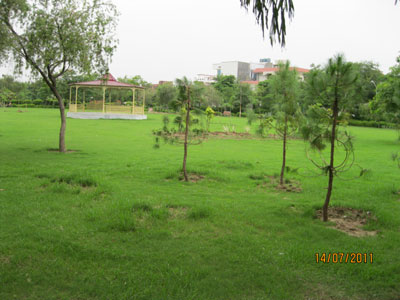
The sky remained over cast with cloud for the whole day but it didn’t rain. My neighbour, the younger sardarji told me that it rained heavily yesterday in New Delhi. Over the years I have firmed up my belief that Delhi perhaps gets more rain than Noida and that is because Delhi is greener than Noida. It has more forest coverage. Noida appears to be barren but for some area. Many parks and even the Botanical Garden that is going to be one of the largest, will take years grow its trees and plants.

Noida authority seems to have taken up the programme of greening Noida’s parks in big way. At least whatever is happening in the big park of sector 40 where I go every morning indicates that. Some estimated it to be a 4 crore project. It’s undergoing a massive landscaping and plantation. It has a peripheral walking track of 660 meters divided in four sectors again with a central round patch with fountains. Each sector used to be a green flat patch.

The park got first three well designed canopies perhaps as shelters for rain and summer sun. Now each sector has been landscaped in number of places rather a little too many places in such a way that the children from the residential complexes all around can’t use it anymore for playing cricket or football. The Authority, I don’t know why, has patronized plants of Champa and many varieties of palms and dates. Even the Karate clubs with lot of kids will no more find it usable. I am sure after few years if all plants grow the park will look more like a forest.


I don’t know who will be responsible for its maintenance after all the work gets completed. In the process, the walking track in at least two places has been damaged by the entry of the heavy truck they used to transport the plants inside. All around the periphery, there remain many shabby things that require maintenance and disposal. Even shrubs lining on the two sides of the walking tracks are not trimmed regularly. I wish the Authority outsource the maintenance to some efficient agency. Noida Authority is good at making one time big investments through tenders that must be gratifying some few in its office. But the maintenance is overlooked. The maintenance is poor and patchy. What is the point in investing so much in a project if it can’t be maintained? The park of sector 40 has recently got ten or more waste bins of guinea pig designs but one can see the waste and junk littered near the openings for cleaning of each of these waste bins. Recently there was a media report showing how a park of sector 62 that was the land mark of the area has gone shabby and littered with filth and stinking water body because of the lack of effective maintenance and care.

A large number of the residents regularly use the park. The Mother Dairy for milk and Safal for vegetables and fruits also located on the peripheral road make many to visit the place. However, I don’t know why the Noida Authority has not provided a good toilet complex with it. Noida Authority like all civic bodies in India is miser in incorporating and managing of the toilets in its planned township.

I am sure the effort of Noida Authority for greening the parks will make it look more beautiful too. With sector’s community centre, Shakti Mandir and Sai Temple, the greener park of Sector 40 will attract additional crowd.

Let the Noida Authority place a good maintenance system too.

Posted in Uncategorized | Leave a comment

Nitish’s Inferiority Complex or Ego

Over the years, I have kept updated on the news from Bihar. With Nitish, Bihar has seen almost a transformation from its dark age to a developing state. But the rate of growth could have been higher. And that is a necessity to change the prosperity level of the common man. I expected Nitish to become a little more aggressive. But I guess that Nitish Kumar suffers from some sorts of inferiority complex. He is egoistic and hardly accepts suggestions or advices from the deserving persons. He has failed to select efficient administrators in his cabinet.

If Narsingha Rao could select Manmohan Singh, and very recently Mamta selected Amit Mitra, why could Nitish bring some real efficient administrator for portfolios such as education and healthcare?

As everyone knows there had been many brilliant as well as honest IAS officers from Bihar. And many of them must be living a retired life. Given opportunity, they could have changed the speed of implementation of projects such as urban development. A missionary minister could have invited the best in education sector and business houses of the country to set up professional engineering and medical institutes in Bihar. Does not the engineer-chief minister realize the need for having at least hundreds of these institutes? Can’t Nitish appreciate that Tamil Nadu, Andhra, Karnataka, and even now UP that have developed because of the establishments of these institutes? Can Nitish get Patna as an important IT city without the manpower qualified and trained for the sector? This is when the boys and girls in thousands move every year to other education centres in other states and spend more than what they would have done if educated in their own state. Today even Orissa is better than Bihar. Many big investments are coming to Orissa for setting up universities.

If Modi can request NR Narayana Murthy to help him on IT centre and Mamta can appoint Sam Pitroda for the resurgence of West Bengal, why can’t Nitish Kumar do it?

If Mamta can ask her industry minister to personally contact Infosys executives to set up facilities in Kolkata, why couldn’t Nitish pursue with the industrialists to come to Bihar? If IT doesn’t come because of the absence of the infrastructure required, why couldn’t ITC and Sunil Mittal’s agriculture business have been persuaded to come in Bihar?

Some of the young entrepreneurs of Bihar have come out with excellent business models. Nitish Kumar and his government would have encouraged these young men to expand their businesses exponentially and serve the state. Kaushalendra Kumar’s vegetable business, Gyanesh Pande’s Husk Power and Chandrakant Singh’s Chaitanya Gurukul Trust are just three of them. I don’t know if Nitish Kumar would have asked them what help they expected from the government and provided it. Why can’t Kaushalendra’s business cover the major cities of the state? Why can’t he be helped to take up the production and export of vegetables? Why can’t Gyanesh Pandey set up the husk power generation facilities in every village of Bihar that have the agricultural waste to sustain it? Why can’t Chandrakant Singh’s model schools come up in every block of the state?

Nitish could focus on the ways and means to improve the education and skill level of the younger generations that would be joining the workforce. Nitish must investigate analyze all the successful models in other places, be it from a Chinese village or from the other states of the country, and try to emulate it after modification, if necessary, to suit local conditions. Let him not waste his limited energy to invent wheel again and again.

Nitish requires hundreds of excellent administrators for many projects that he requires to take up and complete in a time frame of next four years. He can’t do it alone. He must find them out.

PS: A real story from Bihar

Posted in bihar, economy | Leave a comment

On This Day 20 Years Ago

Manmohan Singh, then minister of finance, facing a balance-of-payments crisis, told parliament that “the room for manoeuvre, to live on borrowed money or time, does not exist any more.” He attacked the prioritisation of producers over consumers, and swept away tariffs and the mesh of licences used to micromanage firms. Mr Singh’s speech marked India’s entry into global capitalism. He ended by paraphrasing Victor Hugo: “No power on earth can stop an idea whose time has come.”

And the time came. The NDA under Bajpai kept the development in every area, be it road, telecom, electricity or ports, as major focus. The world noticed India emerging. It gave long due respectability to India.

The Economist has two special articles in the latest issue:‘The half-finished revolution’ and ‘One more push‘.

In 2004 when the destiny made Manmohan Singh the Prime Minister of India, many including the author celebrated it as a technocrat was at the helm of affairs of running India instead of politicians. But the last seven years of Manmohan Singh has dashed all the hopes.

Manmohan has been able to create only a record of becoming the first Indian from outside the Nehru clan to be on the crease for the maximum number of years, however, without scoring much.

Many call him by different adjectives. Some even call his team as the killers of the India’s dream. I would have loved if Manmohan would have focused on all the roadblocks in the fast track development in infrastructures. Indians certainly deserved to have surplus of power, water and good roads and some world class railway stations. It was doable. No one would have stopped him from creating storage facilities for the grains in absence of which millions of tonnes of life saving for some grains rot.

Unfortunately, Manmohan lost the opportunity. Many and I too will wish to see some miracle to happen in the period before Manmohan relinquishes his office. It may be after the next election or, who knows if the goddess so wishes, after next to next.

And now the economists say India is suffering from policy paralysis and there is hardly any hope, as no drug is available for the India variety of disease. All the Indian political parties lack a leader who can get the country out of the rut. And the people of India still keep on electing criminals and incapables from hundreds of political parties to represent them and don’t zero on two or three national political parties, and in turn, they are getting what they deserve.

However, the country would have celebrated the day as one of historic importance.

Posted in economy | Tagged | Leave a comment