How much does a small farmer make?

A 2005 cost analysis of a kharif crop grown by a marginal farmer from Basrahiya village in Lucknow district is revealing. The planning department of UP government did the study.

Land cultivated: 3 bighas (0.75 hectare)
Investment: Rs 12,200
Total returns expected: Rs 20,800
Labour input: 5-6 months of work by the farmer, his adult son and daughter-in-law
Net profit: Rs 8,600 or Rs 1,720 per month

Amount each of the three would have earned had they worked as wage labourers for 30 days: Rs 1,800 (at Rs 60 a day)

A higher landholding might have gone in favour of the farmers. But the with division of the land among siblings and the their siblings over time, the land holding is bound to reduce. The average landholding of 2.3 hectares in1971 has declined to 1.3 by 2001-02 and currently perhaps stands at around 1 hectare. It will be difficult to make it viable for leading a good living. Land consolidation must be encouraged with changes in existing laws of heritance as well as land ceilings. Land should go to the one who is interested and educated enough for proper farming instead of being equally divided among all siblings. Why can’t the minimum size of a holding be 10 acres for irrigated land, and 25 acres for unirrigated land?

Many political decisions such as free power resulted in excessive wasteful irrigation that has caused serious drop in water tables and so scarcity of power in many regions and demanding installation of extra powerful pumps. Use of sprinklers could have been more popular to save water requirement. Governments failed to go ahead with irrigation projects and river interlinking in significant way.

Excessive use of chemical fertilizers to improve productivity has caused a severe drop in the fertility of soil. Nothing has been done for rejuvenation of the soil through rotational practices in cultivation or to encourage natural biological manures.

Total return can only improve if the yield that is very low in India improves significantly through better inputs- quality or seeds and fetilisers or MSP is increased based on global market price.

Can the yield be improved significantly?

Why can’t the Minimum Support Price be enhanced significantly? If the food prices world over is increasing, why should the grower not get the advantages of that? If it can happen with oil producing countries, who have gone so rich with its oil reserve, why shouldn’t the farmers get that route to prosperity? If the oil coming out from mother earth can go to $117 per barrel last week from $10 a barrel nine years ago, why shouldn’t the farmers get the similar advantage? After all the Commission on Agricultural Costs and Prices has recommended a steep rise in MMSP, ranging from 25% to 94%, for most farm produce. It will certainly mean a steep increase in MSP of food grains also means inflation. Why shouldn’t it be acceptable by the more vocal and politically critical urban middle class? Will the top 25% be ready to sacrifice for the bottom 25% of the population through a differential pricing? As it appears it can’t be checked for long. Unfortunately, the farmers will not get benefited unless the intermediaries are removed from the system. Can the retailers pay a royalty to farmers with every increase in food grains price for the end consumers?

It is unfortunate that the governments- both center and state are still not ready to do anything in big way for improving the yield. For instance, many feel that Bihar is a sleeping giant in food grain production and can produce much more than what Punjab and Haryana has done with green revolution. Unfortunately, over the last 60 years nothing has been done for flood control followed by draught in North Bihar. No major projects were undertaken. Centre can’t live forever accusing the state government.

And every farming family must have some additional means of earning too. To cope up with the daily expenses of the family, the family can think of some easy means.
If it can keep cattle and spare some milk to the collecting agent, it can get a daily earning.
If it grows some vegetables on its rooftop, it can sell and get some money regularly.
If it grows some goats and sheep or poultry, it can sell periodically and earn.
If it plants some trees, that can become fixed deposit for the family.

Many in rural India require to be told these ways or to be trained in some skills that can earn them extra earnings.

All business associations such as CII and FICCI must discuss and find ways to provide extra earnings to the families of the rural India by outsourcing some of the tasks that can easily be done there with better physical and digital connectivity.

And the rural India can become a better place to live.

Posted in agriculture | Leave a comment

China, China and India, India

In 2005, when I was in US, the bookshop ‘Borders’ helped me enjoying my 6-months long stay. It was at that time that I could really understand how China has touched every American through its Wall-Marts. But it was some books that opened my eyes about the sprinting growth of China. I read many of them, but ‘China Inc’ was really impressive with details how the Chinese factories expanded its wings almost sweeping global manufacturing establishments of the developed countries, be it US or historically strong Germany and Japan. Anand also introduced me to the writings of Thomas Friedman and particularly his column in New York Times. But it was his book ‘The World is Flat’ that made him so dear to me and perhaps all Indians, including former President Kalam. Finally we did buy that book and went through it as Ramayana. That was the time when media and western columnists or academics were having only China to focus at. Friedman has made India known to west in a little different and respectable manner.

In last few months, I have been going through a number of books that have been written to document the emerging economies of India and China together. I came across the two most important ones that provide a comparative study of the rise of India and China: Tarun Khanna’s ‘Billion of Entrepreneurs‘ and Robyn Meredith’s ‘The Elephant and the Dragon’.

However, after reading Robyn Meredith’s book, I got shocked. How has a nation of a billion plus kept on clinging to Mao after all the massacres caused by his policies? As I understand even today none can talk anything against Mao unlike India where every Tom and Dick can come out with his or her views making Gandhi and Nehru a pygmy. Here are some excerpts from her book:

“Mao was determined to transform his nation into an industrial power. Peasants were required to hand over all private property- down to bicycles and cooking pots- first for redistribution from rich villages to poor villages, and later to be melted down in backyard furnaces. This nationwide archpelago of backyard furnaces was supposed to take China’s steel production beyond Britain’s. In some areas, good grain rotted in the fields because so many farmers were told to produce steel instead of taking in the harvest. Peasants turned into skeletons. Communal kitchens were serving only thin gruel, so farmers hunted for frogs or rats to eat. Eventually they ate grass and leaves and even stripped trees of their barks. Some starving families resorted to a practice called yi zi er shi: they traded a child for a neighbor’s child, then killed and ate the skinny youngster, with the sickening knowledge that their neighbors were devouring their own. Hundreds of thousands of peasants were dying. In some villages, whole families perished. In some counties, whole villages vanished. Mao’s policies created a nationwide famine in which between 30 and 40 million people starved to death between 1959 and 1962. Surprisingly, Military granaries were stuffed. While its people starved, China was exporting grain.”

“In addition to the massive human toll, books were burnt, Chinese art was destroyed, temples and monasteries were smashed, and contact with much of the outside world was severed. The nation’s universities closed their doors. For more than ten years, the only education allowed was the study of Communist Party propaganda and of Mao’s Little Red book.” Mao died in 1976. And he remains Gandhi for Chinese. Could Indians tolerate and then excuse if Gandhi or Nehru would have been responsible for that sort of tragedies in India after independence or handed over the country to Britishers?

The Chinese rise as world power can be appreciated only after understanding the consequences of that sort of breeding of a generation or two. Luckily Indians didn’t undergo any such mental agony. It is difficult to digest after reading about China’s economic gains, a para on the condition of working class. “Many factory workers are forced to work overtime long in to night without pay, left unpaid for months at a time, or even locked in factory compounds like prisoners.”

And let us look at another act of the Chinese government- the one-child policy, which began in 1979. “To enforce it, China formed a family-planning department with 300,000 workers nationwide. They are responsible for at least ten million coerced abortions and ten million sterilizations a year.” Did Chinese take some clues from Sanjay Gandhi’s family planning moves or Sanjay learnt some from the Chinese?

Very lately, India has started getting the limelight, perhaps because of its consistently high growth rate or West’s disenchantment with China. I came across a number of interesting books on the India’s story. It started with Edward Luce ‘In spite of Gods‘ that I bought. Anand brought Mira Kamdar’s Planet India. Then I read a review of Kamalnath’s India’s century and bought it along with ‘The Rise of India’ by Niranjan Rajadhyaksha. I came to know of Shashi Tharoor, when he contested for the post of Secretary General of UN. He failed but even the failing was impressive. I started noticing and going through his column in Sunday Times of India. And when his book ‘The Elephant, the Tiger, and the Cell Phone came out in print, I couldn’t resist buying it.

I agree with Shashi Tharoor that India can’t reach anywhere near the Chinese economic miracles and its growth rate that is even today in double digits even on a higher base. The disruptive democracy of India can’t generate an inertia to cross double digit growth rate with leftists pulling downwards perhaps to keep China always ahead and with the caste-based political parties of north bent on dividing the country’s great creative human resources that could push the growth to the desired height. We can only hope against hope that one day, one of the national political parties rather than alliances of two-dozen parties with varying interests, may again rule the country.

And many will keep on writing wonderful books on Indian success story of its transformation from poverty to prosperity.

Posted in Uncategorized | Leave a comment

Innovating India

It may be a coincidence that while ‘Business Today’ issue has published ‘India’s most innovative companies ‘, Business Week has special coverage of ‘The World’s Most Innovative Companies’. As very appropriately said, “the most innovative companies don’t do different things, they just do things differently. And that seems to make all the difference.”

‘Business Today’ list includes companies such as Deccan, Jet Airways, Mahindra&Mahindra, Tata Motors, Maruti Suzuki India, HDFC and ICICI Banks, Philips Electronics, Samsung India, ITC, Dabur, LG Electronics, Marico, Apollo Hospitals, Aravind Eye Care, Narayana Hrudayalaya, and SRL Ranbaxy, beside the IT trio of TCS, Infosys, and Wipro.

In today’s world, a country is known by its innovative power. India’s potential is being gradually recognized by the world. With all the problems and constraints from an obstructive system of democratic government of a complex alliance, Indian entrepreneurs have moved ahead, and Indian industry has proved its mettle.

Indian companies have found place in Business Week’s list of the world’s most innovative companies. As claimed by BW, ‘this year’s list of the world’s most innovative companies was decided by a respondent pool that was more global than ever’.

In the list of the 20 most innovative companies of Asian region, Tata group is at 4, and Reliance at 8. Apple, Google and Toyota Motors hold top three positions in all the regions.

In the list of the most innovative companies by industry,
· In Autos, Tata Group is at 3 with Toyota and GM at 1 and 2. Tata Group made a remarkable entry in passenger car market with Indica, andIndigo platform, its innovativeness made a mark with ACE, its mini-truck, but its launch of Nano in Auto Expo 2008 stirred the whole auto world.
· In Industrial and manufacturing, Tata Group is at 7 (Arcelor Mittal is at 5).
· In Retail, Reliance Industries is at 9.
· In Energy, Reliance Industries is at 6 and Suzlon Energy at 7.

There are many miles to go, but India is on right track. All the institutions of worth must join in this national endeavour to see that innovativeness and entrepreneurship become the main trait of the country. Can’t with all these achievements the politicians, particularly the leftists, take some lessons?

With some of the reforms such as one related to labour, disinvestments, and freeing some more sectors for FDI, the competition can make Indian enterprises more robust and innovative. Innovation today is not only the means of growth; it is also needed to survive. One is get over the myths to move fast aahead.

But let me end the entry with another successful innovation of India. IPL launched by Lalit Modi of BCCI is that product. Is there any doubt that after Kerry Packer’s successful bid to innovate day and night cricket matches of 50 over, IPL has brought in a product that may be the ultimate case of commercialization and globalization of cricket?
<

Posted in economy, education, industry, management | Leave a comment

Two Masters from Aam Adami

Every day morning I pass through the road with the Sai Temple and Shakti Mandir on one side. I stop for a minute on the road itself and try to repeat ‘Shradha’ (devotion, faithfulness) and ‘Saburi’ (patience) – the two words teaching of Sai Baba. One must be devoted to whatever he does. He must also have patience to get at the goal. Can there be any mantra simpler than this?

I keep on seeing the white imposing statue from distance. Many thoughts keep on coming and haunting me. He is Sai Baba of Shirdi. He was from among the Aam Adami, when there were no marketing tool available or used. But in a very short time after his samadhi, he has become so popular among the middle classes of the country. As I understand the number of Sai Temples have come up in almost all towns and cities of the country. People keep on wishing something, after the wish gets fulfilled keep on pouring in the promised cash or jewelry in temple’s ‘hundi’. The main temple is at Shirdi in Maharashtra. It is the second richest temple after Tirupati in Andhra.

As per recent news, the trust of the main shrine wanted to get some sort of share from all the franchise temples. I wish the temple focused on building the good schools and healthcare facilities for the poor in rural India instead of wasting the donation on many odd causes.

A similar saint from east did also impress me intensively. He is Ramakrishan Paramhans, the guru of Vivekanand. Ramakrishan has not become so popular. His power to get all the wishes fulfilled was not made the selling point. And though Ramakrishana Missions are in many towns, those are not rich and grand enough as Sai temples are. Perhaps his disciples never thought on that line. Since my earlier days, a visit to Belur or Dhakhineswar on the bank of river Hooghly gave a lot of peace to me. I could spend hours sitting there, when for sometime I used to live in Bally very near to the temple. Even today, whenever we get a chance, we go there when we are in Kolkata. However, Ramakrishna Mission also has done pioneer work in field of education and healthcare. Rakesh and then Rajesh got their plus two education after school final from RK Mission College at Narendrapur that was considered the best at that time. The institute did impress me whenever I visited it. We still relish the sweet memories and feel morose about our failings of the days.


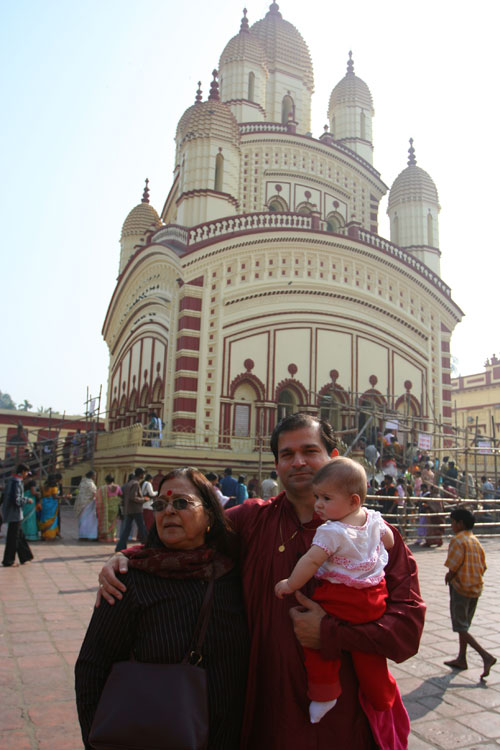
Anand in Dhakhineswar Temple with Emma

Let me confess I was not religious those days. However, I did take the route of penance negotiated, (?) when the promises got fulfilled. I remember going to Tirupati and putting some money in hundi. And I also took the barefoot journey of Tarkeswar, a distance of more than 24 kms too and that too twice. I don’t remember any of my peers doing that.

I keep on pondering over the two words, ‘Shradha’ and ‘Saburi’. Perhaps this keeps me going and gives me peace. But the rise of these two gurus of very recent past as people’s masters is motivating, as it provides simple solutions.

Posted in Uncategorized | Leave a comment

Surprisingly Exhilarating India

India’s GDP may grow 9.5% in 2008-09, if we believe the forecast of the Centre for Monitoring Indian Economy CMIE. The capacity additions will drive the surge in growth. Is it also a sycophancy of a sort, as projections by other analysts are pretty low with Lehman Brothers’ figure at 7.6% while HSBC at 7%, and JP Morgan at 7%?

It will be for industrial production and services to come out with some pretty consistent growth to achieve what CMIE predicts, and that is possible with many performing so wonderfully. Gems and jewelry export is growing fast even with all the rupee escalation. Madura Coats is doing well in textile. Many individual companies performing well through cost innovations instead of looking to government for assistance. More and more of the enterprises must learn to perform under difficult circumstances. The export target of $ 200 billion will appear feasible.

Auto sector, particularly the two wheelers, has set the example. Overall export of motorcycles went up to 7.76 lakh in 2007-08 against 5.45 lakh in 2006-07, a 42% rise. Bajaj Auto with its domestic loss of 20% achieved a 62 % increase in export totaling 4.81 lakh. Even TVS did better its export by 41%. Hero Honda remained behind and it was obviously because of the constraint from the collaborator. That’s where being indigenous becomes superior. And the Indian two-wheeler manufacturers are able to do all this against the tough competition from the manufacturing giants of China and Japan. Today’s challenge from strong competition in the face of free trade and globalization can be won only with superior quality, cost innovations and better management skills. And the commercial vehicle manufacturers were not behind. Indian commercial vehicles are outdoing those from Europe, Japan and China. Data from the Society of Indian Automobile Manufacturers (Siam) show India’s exports of commercial vehicles went up by a robust 19.10% during 2007-08 at 58,999 units against 49,537 units recorded in the previous financial year.

Even with all the slowdown in economy, the car sector could achieve a 12% growth in sales with annual figure of 12,03,531 in 2007-08 against 10,76,582 off 2006-07. In car sector, one may notice that the foreign companies such as Maruti Suzuki and Hyundai are leading the export business. Tata Motors and M&M are perhaps too busy in expanding its wing in global market with acquisitions. I do also feel that both are to do a lot of work to get an image of world class quality for its unique products such as Nano or Scorpio.

But many other developments are equally exhilarating. Even almost forgotten sectors are coming up with new ideas. Is it nice to hear that even defence shipyards are trying to get into gears and talking of collaborations with French shipbuilding giant, DCNS (Direction des Constructions Navales Services), for jointly setting up a cutting edge design centre for warships and merchant ships for both the Indian and the global markets? Will it not be great news for power sector that a private company such as L&T is joining hand with $ 63 billion Toshiba Corporation to end the monopoly of BHEL to manufacture turbines for large power plants for the upcoming mega power projects? And Tata is aspiring to get into aircraft manufacturing, while Toyota, the world’s biggest auto-manufacturer has finally decided to get into small car segment and set up the second plant in India.

It is high time when some leaders from Indian industry come with pioneering work to provide a model of manufacturing that gets decentralized up to every rural corner of India without damaging its serenity and simplicity. Without a ‘farming plus’ strategy, the rural India can’t be prosperous enough to be at par with the people of developed nations, nor the double digit GDP growth can be sustained.

Posted in economy | Leave a comment

Corporate India’s Doubtful CSR or Affirmative Actions?

Many a times, I wonder if the companies and the association representing them genuinely are concerned about the people’s woe or it shades only crocodile tears when pressed to comment. I am all against reservations. But there are always some jobs that can go to some really financially deprived class.

Some ministers were hell bent on bringing in a reservation for SC/ST in private companies. PM also emphasized rather appealed to do something for the deprived class. Industry’s representatives found a smart way of avoiding commitment on reservation and talked of affirmative actions on the line of American affirmative actions. Industry also agreed to take steps to create employment options for scheduled castes and scheduled tribes. It never wanted that to be legislated or made mandatory.

As reported, the promised affirmative action of the corporate India “hasn’t gone anywhere”. As even the big industrialists were involved, none of the ministers dare to displease them. According to the information known through press, even the group of ministers, formed five years back to look into it, hasn’t gone anywhere. Some says the group followed an approach- “let sleeping dogs lie.”

But I wonder why can’t the industry start some voluntary initiatives on its own under its CSR or philanthropic activities that it keeps on advancing through media.

It is unfortunate that only 579 out of about 7,000 CII members have adopted the self-imposed code. Out of Assocham’s 2,50,000 direct and indirect members, only 50 have signed up the code of conduct inked by CII-Assocham in October 2006. Let the industry understand its dangerous consequences with the changing social awareness. If one day something like food riots start in India, it will affect the industry most. And perhaps that is one of the reasons why small and big corporate houses are going for acquisitions abroad in such a big way.

The industry- almost all associations agreed for creating educational facilities, particularly related to skill development. Even in good old days, say sixties, many companies including Hindustan Motors (HM) where I worked and TELCO (present name Tata Motors) that I kept on visiting since my IIT days, had very good training facilities for apprentices in different trades though mostly those which were needed for the internal requirement of auto manufacturing.

The government thereafter started setting up the industrial training institutes (ITIs). And many companies employed the passing out candidates. It was a good initiative. But then with the slowdown in industry and complacency in the system, the skill standard of the institutes deteriorated. And very soon with the boom in economy today, it is difficult to find skilled persons. The industry faces an acute shortage of trained manpower. Even the construction industry faces today the shortage of skilled masons, plumbers, electricians and carpenters.

The industry in its affirmative action could have certainly taken up the task of skill building in big way from the rural level itself. All middle and high schools throughout the country could have the facility of trade training to build skilled manpower instead of creating a mass of just unskilled menial workers. Instead of providing charity to build dharamsala and temples, the industrialists could have taken of the task of building the institutions starting from the trade schools to engineering colleges. India requires at least 100,000 trade schools.

The Finance Minister has kept on mentioning about the up gradation and adoption of the Industrial Training Institutes by the private companies right from his 2004 budget speech. The industry has adopted only 300 ITIs, and the expected result is still uncertain.

Can one believe a CII report? “In the first year-22,580 candidates from the SC/ST communities (against the target of 10,000) have been trained to make them more employable, and 1,594 candidates are being trained to become entrepreneurs. And, in 2007, 531 scholarships were handed out to students in premier educational institutions.”

Is it not too little and too late too?

Sometimes, I wonder why a state such as Rajasthan could remain poor on human development index with the majority of industrialists and businessmen coming from the state. Should the industrialists be not ashamed of Rajasthan’s rating regarding education and healthcare?

Posted in industry, management | Leave a comment

India Today’s 60 Greatest Indians

It is enjoyable to read about so many great people in one go. The news magazine has done a wonderful job in planning this sort of special issue . Perhaps from marketing point, it has included persons from all walks of lives to cater to the interests of its readers at large.

It was interesting to read about the scientists and technocrats of the country that make us proud. Hardly some in younger generations may be knowing about the contributions of PC Mahalanobis, Homi Bhabha, SS Bhatnagar, JC Bose, CV Raman, Raja Rammanna, S Ramanujan, Vikram Sarabhai, MS Swaminathan and some more who are not in India Today’s list. Many of India’s scientists and economists made the developing world wonder how these scientists of India- a poor country then with so limited facilities, could do all that. The lack of the facilities becomes the excuse for the scientists of the present era to go abroad and work there. But how did those people manage it? Perhaps, they were more focused, more dedicated, more nationalistic, and more determined to prove the world wrong.

Sometimes, many and me too wonder why India doesn’t get any more the people of their caliber.

I wish India Today or other news magazine of all languages could come out with a special issue covering the most distinguished Indian management gurus, technocrats and scientists of present time working in India or abroad. Unfortunately, the media are too busy with the sensational community and political news. The educated middleclass keep waiting for the news of good work that are being done in the universities, laboratories and factories of the country that is making even the developed nations envious of India.

Posted in Uncategorized | Leave a comment

IIT and Reservation

I never wanted to visit this subject so soon. But there are two reasons for that: First, NDTV had in ‘The Big Fight’ yesterday debated the righteousness of 49. 5 % reservations based on the caste of the parent of the candidates. Second, some 3 lakh students are attempting to compete for IIT’s seats today through its entrance examination.

I wonder why those who decide and discuss about the IITs are all non-IITians even after about 57 years of the start of IITs. Why should the issue be not discussed and debated by the IITians?

I am an IITian, however, as an engineer from IIT one didn’t get any extra advantage such as a higher entry salary. Does an IITian get it today? Even during the professional career, I didn’t get my promotions or increments just because I was from IIT. I am sure it must be the case even today too. I can only advise all who aspire to be engineers to work hard, to be innovative, and different. It is many entrance examinations that one is to cross to succeed professionally almost everyday of active life.
It is only public sector or the government that can protect those who wish to cross today the barrier of right score at IIT-JEE by the birth certificate saying caste. Who but their own ability will help them in the life ahead, once they have chosen to be technocrats?

I am not sure if the reservations in long run will kill the brand image of IITs, as many such as Dr. Indersan, the former director of IIT, Madras predicts. However, I strongly consider the reservation as discriminatory and against human rights of equality. What is this reservation? It allows a student of reserved class getting the admission with a much lower score while one from unreserved caste is denied even after scoring much higher marks in the entrance examination. And the logic of reservation based on centuries of oppression of those castes by the higher castes is divisive and may perpetuate the hatred between the people of different castes. And it is all because of the politicians and their only mission to the vote bank in their favour. I wish the people of the country could realize that.

Today caste doesn’t indicate any prosperity level. If one visits the rural India, the difference becomes obvious. After many divisions over years, a landowner family of higher castes has got only half a hectare of land. Many of so-called lower caste do also own that. And going by the living standard, there is even more equity. Reserved castes are having better accessibility to education and other facilities such as subsidized food grain.

But let us leave all that for the time being. Why, instead of providing reservation and dilution of the standard of IIT for entry, can’t the government bear all the expenditure of the candidates of reserved categories appearing for the IIT-JEE Entrance Examination at the preparatory stages itself? Let the government create a funding and give whatever the candidates require and spend in coaching at school or at specialized institutes, say those at Kota.

Alternatively, the state or central government on its own or through PPP (Public-Private-partnership) establish special preparatory institutes to train some 20,000 best students from reserved categories to compete for the institutes of national importance such as IITs and IIMs. Even the IIT or IIM alumni belonging to the categories can come out with such preparatory institutes.

And I appeal even the intellectuals supporting reservations must also demand that instead of pleading entry with lower score. Let the merit, as criteria must not be compromised for the higher institutes and the jobs. Let there be system of clear grievance handling if some have genuine grievances of partial decision by individual or the system. Let the reservation not perpetuate heart burning and hatred among the people of the same country.

Posted in education | Leave a comment

India’s Manufacturing Prospective

I was talking to Babulal. At one time he worked for me. Today he heads a company in Kolkata that manufactures hardware and exports to US. I wouldn’t have believed it, if the source of information had been anyone other than Babulal. At one time, Kolkata used to be the manufacturing hub of India. But for many years manufacturing in the state had declined to almost nonexistent level. Budhha babu has focused on it again. With facilities of Tata Motors coming up at Singur for Nano, West Bengal is almost daily in news for good reasons. Tata Motors will be having a large cluster of auto components makers all around the main plant.

Tata Motors started from Jamshedpur, where it still continues the production of some models of commercial vehicles. However, it has moved out its manufacturing facilities to different locations. Latest one is Singur in West Bengal for ‘Nano’. The other major facility has come up in Rudrapur (Uttarkhand) for its very popular mini-truck ACE. Pune remains the head quarter.

Indian manufacturing is trying its best to make a mark globally. It is acquiring, investing and expanding domestic facilities in multi-locations. Beside Tata Motors, M&M, GM, and Honda are another automakers that are setting up new plant in different locations to add to its capacity. Tata Motors is investing Rs 6,000 crore to increase capacity in its Pune plant by about 40% to over 600,000 units a year. Tata Motors jointly with its partner Fiat is also investing $1 billion at the latter’s plant in Ranjangaon. Mahindra & Mahindra plans to invest Rs 4,000 crore in manufacturing capacities at Chakan near Pune. While GM is setting up another manufacturing facility in Maharashtra, Honda will have its second plant in Rajasthan.

Both Tata Motors and M&M are also acquiring manufacturing facilities in other countries to cater to those markets locally. Latest for Tata Motors was the prestigious Jaguar Land Rover deal. M&M in one of its latest acquisitions, has joined hand with ICICI Venture to buy Italian gear maker Italian gear manufacturer Metalcastello SpA that manufactures gears and shafts used in vehicle transmissions and drivelines.

Maruti Suzuki India (MSI) has gone in fast gear to expand it facilities at its second plant in Manesar and is investing Rs 2,500 crore to triple its annual capacity. The existing annual capacity at Manesar is 1,00,000 units, which will be scaled up to 1,70,000 units by the end of March, and to 300,000 units by the end of October this year as the part of the grand plan to manufacture 1 million cars annually. It will include the expansion of its diesel power train manufacturing too at the same plant. Suzuki Motors of Japan intends to source 30% of the three million cars it wants to sell worldwide from Maruti Suzuki in India. And Suzuki wants to make small cars exclusively in India for export to Europe.

Hyundai Motors India is another company that is sticking seriously to the government’s ‘India small car hub’ theory. It exports to over 90 countries and has recently shipped its half-millionth vehicle that primarily consisted of compacts like ‘i10’ and the ‘Santro’ along with some ‘Getz’ and sedan ‘Accent’.

Interestingly all the manufacturers are trying to set up the product design and development centers in India.

Suzuki Motor Corporation (SMC) is considering moving out its small-car design centre to India and is already investing Rs 6,000 to Rs 7,000 crore in its research and development (R&D) centre in India. MSIL is aiming to double the number of engineers from 480 to 1,000 by 2010.

Even in other sectors, manufacturing strength of the country is getting established. Korean consumer durables maker Samsung plans to double its total number of research and development engineers in India to 4,000 by 2010, to strengthen product development and introduce customised technology for the domestic market.

Indian companies too are trying to build its design strength by enhancing the domestic facilities as well as by acquisition. Mahindras has acquired an Italian design company. Another interesting development is the agreement forged between Pininfarwa, the Italian design firm specialising in cars, especially the luxury makes and the National Institute of Design (NID), Ahmedabad. It will certainly be a boost for the manufacturing sector of India.

Another development pushing manufacturing sector is the entry of the big companies in defence production and other specialty manufacturing. Tata Motors, M&M, L&T and Ashok Leyland are getting in defence manufacturing since the government has open the door of defence to the private manufacturers for a share of the Rs 2,00,000 crore of business that India’s Ministry of Defence (MoD) is likely to generate over the next five years.

Larsen & Toubro is cleared to export nuclear power generation equipment to the US and to Europe. L&T is getting into shipbuilding too. According to one estimate, the Indian shipbuilding industry is slated to grow at 30 per cent CAGR to $22 billion in 2020, from around $3.7 billion at present. India’s share in the global shipbuilding will jump from the present 1.17 per cent to around 15 per cent by 2020.

With the focus of the government for power sector and failure of BHEL to meet the demand, Larsen & Toubro (L&T) is also ramping up the manufacturing capacity of super-critical boilers and super-critical turbine generators to 4,000 Mw per annum through two separate joint ventures with Mitsubishi Heavy Industries (MHI) of Japan with an investment of Rs 1,500 crore.

Boeing while eyeing commercial and defence aircraft orders worth over $50 billion over the next ten years from India, has drawn up ambitious plans to source products and services from the country to stay “agile and competitive” in the global marketplace. In last one year, Boeing has inked five agreements with top information technology and engineering companies, which will result in key components for its civilian and military aircraft being manufactured in India. The most significant of these took place last month when Boeing signed a sourcing deal with TAL Manufacturing Solutions Ltd, a 100 per cent Tata Motors subsidiary, for floor beams made with titanium and composite materials for its 787 Dreamliner. After the first 100, all 856 Dreamliners Boeing will use these beams, as “Nobody else has this technology”.

Two Tata group companies – INCAT and Tata AutoComp – have entered into a strategic alliance to offer complete design and development service for global automotive manufacturers. The INCAT-Tata AutoComp alliance has already secured a major project for the complete design and development of a new vehicle platform for a leading Chinese automotive OEM. INCAT, a major in Engineering Services Outsourcing (ESO) and Product Development IT services, will provide comprehensive vehicle level integration expertise to the alliance, while Tata AutoComp will provide module integration for a full range of automotive components, said the release.

And the news of manufacturing marathon covers many sectors.

Diesel engine manufacturer Cummins is to invest Rs 850 crore to start plants at Phaltan in Satara district for manufacturing truck and bus engines, diesel and gas gensets and diesel engines.

Bharat Forge, based in Pune, already has manufacturing operations across 12 locations in six countries-four in India, three in Germany, and one each in Sweden, Scotland, the US, and two in China. It is setting up a plant for the non-automotive-component-making that will manufacture safety components for aerospace, marine, rail, power, energy, mining, and construction equipment.

And when the business gets going in fast gear, every one gets allured to reap its benefits. The cost of hiring for drilling rig works out $450,000 a day makes more business for a company such as Reliance industries to plan to manufacture these equipment on its own.

Nokia is expanding its manufacturing in India. Videocon is trying to acquire the mobile manufacturing of Motorola.

It is big plans everywhere from PSUs to private corporate house. India plans to undertake 70 space missions in five years, a nearly three-fold jump from the previous half-decade, as it seeks to address requirements and develop new technologies to meet future needs.

And will not it mean big business for manufacturing in high-tech sector?

Posted in industry, management, manufacturing | Leave a comment

Prospective IITians- An Appeal

It is yet another year for IIT-JEE aspirants. TV news channels are full with advisory programmes for those appearing for examinations. Special programmes have sponsorships from the mills at Kota that has become a town known to successfully provide the entry tickets to IITs. I don’t think any other country including China can compete with India on this count. Perhaps no country has so many engineering colleges at different locations under the same brand name. And so must be the case of the IIT-JEE. It must be the unique examination, may be one of the toughest too, for engineering college with so huge a number competing for it.

Come April 13, nearly 3.2 lakh students would appear at nearly 600 centres across the country for the Joint Entrance Examination (JEE) for admission of nearly 4000 students into the graduate courses in IITs at Kharagpur, Mumbai, Chennai, Delhi, Kanpur, Guwahati and Roorkee. It is an increase of about 70,000 candidates over last year.

Recent news of the proposed enhancement of IITs’ fee by 100% may be irritant but certainly not deterrent for the students. Many are having favourable of enhancement and many are differing. Most banks are ready to finance the IIT education, but the feel of an inferiority complex certainly crops up among Indian parents if they can’t afford the education of their children. The growing shortage of good faculty in IITs is certainly worrying. May be the innovative teachers of IITs will come out with easier solutions with e teaching.

However, the political pressure to increase the numbers of IITs is worrying. Many professors of IITs also have raised questions about the possible diluting of the brand ‘IIT’. I agree that the mushrooming of IITs is bound to be difficult to manage its brand image.

IITs must focus on preparing the high end technology specific manpower required in industry that is required for design and development, manufacturing, quality engineering, and engineering management. Let the market forces decide the preference of the candidate between engineering and management education. I hate IITians going for IIMs after the completion of their graduation. The Corporate India is certainly encouraging it. As such, IIMs must not admit fresher. It must put a condition of five years’ industry experiences for admission, as ISM does it.

I have an appeal for the prospective IITians. Please do not join IITs if you don’t have an aptitude and attraction for the engineering excellence in different fields of contemporary technologies. If you wish to join IIMs, why should you waste the resources of IITs? It is better for you to complete graduation in any other subject and go for MBA.

I have another appeal too. Be not get morose if not selected for IITs. Many private engineering colleges are equally good if not better. IITs may ensure a better entry salary, but not a better professional success ultimately. I have seen many cases of non-IITians, even from those private colleges that are looked down upon for their high capitataion fees, achieving much better in real life in India or in USA.

For IITs, I have a request too. It must re-engineer its curiculla. It must emphasize to develop creativity and entrepreneurships among the students. IITs can think of a 5-year course to award MS. Some IITs are already having a 5-year course integrating engineering management in it. However, it could have been appreciated if the directors would have been the alumni of IITs.

Posted in economy, education | Leave a comment