Is the Wolf Near?

Is slowdown a bogey created by media or by crazy economists? On a fine morning, the printed media report all the good news. Indians are shelling out more for entertainment. India’s IT, ITeS revenue is estimated to climb up to USD132bn by 2012. Many such as Torrent are focusing on building power generation capacity that is holding up India’s growth. Hinduja’s Leyland has brought in Sumantran of Tata Motors fame, and investing Rs 3,000 crore in its Uttarakhand plant and for a new engine plant. MIL is to invest Rs 2,000 crore in Rajasthan. BHEL goes ahead to double its expenditure in R&D to meet competition from the Chinese and others from the developed countries.

R-Comm net profit rises 71% to Rs 5,401 crore. And many have done equally good.

Investors at the Real Estate Investment World are talking of investing billions of dollars in India. The optimism comes at a time when according to media real estate companies are reporting a slow down in sales of new homes and there are fewer takers for large land deals. Australian firm Babcock sets its sights on India.

Dr Reddy’s buys BASF’s contract manufacturing business in US. Essar Steel offers $669m to buy a US company. Bombay Rayon plans to buy Italian retail business for Rs210 crore. Elecon Engineering plans acquisition in Europe, and US. Indian utility Reliance Power Ltd signed an agreement to acquire 100 per cent in three coalmines in Indonesia.

While Bajaj Auto bike sales jump 24%, Hyundai domestic sales up 36.7% in April. An uptrend is visible in the car market while the slumping two-wheeler sector has witnessed a turnaround.

Export touched $16 bn in March. Amid constraints including a persistently rising rupee that eroded the margin of exporters and high transaction cost, the country’s export during 2007-08 hit $155.5 billion.

Chennai is emerging as India’s Silicon Valley. According to a report, strong PE investments are likely in India.

India received $24.57 billion of foreign direct investment in 2007-08, an increase of 56.5% over $15.70 billion in the previous year; and sets an FDI target of $35 billion for the current fiscal.l India’s foreign exchange reserves were at $312.871 billion on April 25, 2008.

The latest ‘2008 Global Outsourcing 100´, compiled by the International Association of Outsourcing Professionals (IAOP) that features at least 20 Indian firms has five of them – Infosys (ranked 3), TCS (6), Wipro (7), Genpact (9) and Tech Mahindra (10) in the top 10.

A British Gas Petroleum Geosciences Research Laboratory at IIT Bombay has been inaugurated. Secretary Petroleum and Natural Gas M S Srinivasan expects IITs and other institutes in India to participate in the multi-billion exlporatory industry that is looking for talents.

How are all these happening? The stock market is discouraging. Inflation is nearing 8% (7.57% this week, a 42-month high) and affecting the people in real term, even after all the steps taken by the finance ministry such as increasing the export duties on exportable commodities such as even basmati rice and steel, and cutting down the custom duties from edible oil and pulses. Interest rates may rise, and cost of financing may also increase. Oil prices are still at around $110 a barrel. However, the food prices will certainly comedown. It is an advantage India has.

Can India avert slowdown for long? Perhaps, it can. Slowdown will keep away till we are having innovative and inspired entrepreneurs that enjoy taking risks. Innovations through an expanded participation from Indians in all fields and sectors can only scare the wolf.

India must have more of Kalams who even under all these odd circumstances dream big- India as superpower by 2012. As some said, “Keep the faith, India still rocks.”

And there is a reason, today India is profitable.

Posted in economy, governance | Leave a comment

Nitish Kumar and Bihar

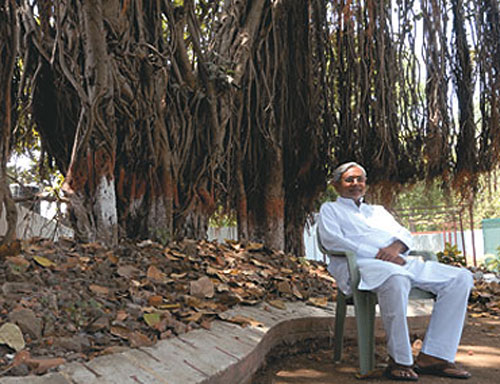
Nitish Kumar under the banyan tree where Lalu tied up a ghost to trouble Nitish.

Saba Naqvi Bhaumik in latest issue of ‘Outlook’ has written pretty highly about Nitish Kumar. Unfortunately, she has compared Nitish’s performance with one who damaged the total administration in Bihar by politicizing it. I wish the benchmark for the CM’s performance would have been some other high performing chief minister of one better performing state of the country. No one can doubt ‘from 10 am and till late evening’ hard working of Nitish Kumar. But then it must yield result visible through the development works all over the state.

It is good that Nitish ‘holds durbars where he himself scrutinizes public complaints and passes these on to the ministers and officials concerned’. But is it the best way of operating or can there be a better way? Can he use the gathering to pass on certain messages that relate to the responsibilities of the citizens of the state? Saba would have talked to more number of the intellectuals and elites as well as some people’s representatives to firm up the conclusions.

I feel Nitish must use the platform to spread the right messages to the people of Bihar and appeal to those present in ‘junta durbar’ to help the state in achieving its various people-oriented projects. They can make the Sarva Sikhsha Aviyan mission a success by sending all their children to schools. They can also help in family welfare planning. They can also see that whatever work is being done to provide a minimum amount of earning such as pond repair or road building, or plantation in NREGS are corruption free and useful on long term for the village. He must also appeal others to emulate some success stories such as one of the woman who is earning his living by growing mushrooms in Patna. The people must feel empowered and independent rather than dependent on unscrupulous officers for doles by sharing the government money with them.

Nitish Kumar has certainly taken up improving law and order in the state as top priority, and many dons are in jail after convictions by fast track courts. Unfortunately, a huge number of the followers of those dons are still freely carrying out the task. Can Nitish bring a change in the feudal mindsets of the people of Bihar that gets manifested in many horrendous incidents that are stilling getting reported in the media quite frequently?

But a lasting solution for all these social problems can come only through good education and through good disciplined and exemplary teachers, through creation of sufficient engagement for the young people of the state. Nitish will have to attract the entrepreneurs in big way in IT, ITeS, education, tourism, sugar, traditional textile and food processing sectors. He and his core team must find out why the industrialists are visiting him but not committing investment and starting business in the state. What are their apprehensions and how can that be removed? It happened the same way in the neighbouring West Bengal too. Till the time Jyoti Basu remained in power, no industrialists were looking towards the state. But one must credit Buddha Bhattacharya for creating an impression of positive and attractive change and his industry-friendliness. Nitish must at least emulate Buddha in attracting IT biggies by offering all that other sates are doing plus something more. It is the future of the state. It can bring a revolutionary change in living style. And for Nitish, it is doable. Let him create capacity in engineering colleges for an intake of 10,000 students. Let the universities prepare their science graduates too for the IT sector where they are in demand. Let the institutes focus on the quality of education along with the soft skill such as the ability of proficient communication in English language and basic computer knowledge. Nitish can certainly select able and missionary persons as cabinet minister and secretary for IT.

With not much of private investments and industries in Bihar, it is for the government to focus on projects that can lead to development, be it encouraging System of Rice Intensification, or inviting some entrepreneurs to start establishment such as ‘Dilli Haat’ for the state’s artisans or designers and craftsmen, or some thing like the village resort of Chokhi Dhani in Jaipur.Patna must attractions for the visitors to stay back and spend. But the government can certainly expedite the long pending distribution of government lands among the deprived class.

Many a times, I get confused and hurt when I hear the people from Bihar talking so casually. I lost my temper when someone said, “Nitish is least bothered. He can still be the chief minister after next election. And he would perhaps by tie up with Ram Vilash.” I shall be shocked if Nitish wishes to do that.

I still hope Nitish can find some miraculous ideas to bring Bihar at par of, if not ahead of, other high performing states, and shall like to be remembered for that in history of the state.

I wish he keeps a small group of advisors who can help him in providing the ideas and monitoring the key projects. And finally, I hope he gives up visibly painful confrontations with UPA ministers and try to use their services for the benefits of the states through the development projects that they can bring in for the state.

Latest: BJP may opt out and lend outside support to Bihar government

Posted in economy, indian politics | Leave a comment

BHEL- Another Case of Missed Opportunity

As on March 31, 2008, power equipment supplier and Navratna PSU, BHEL had orders worth Rs 85,500 crore, about four times its revenues for the year. BHEL missed its delivery promises time and again in past. It is a burning case of the failure of proactive planning by a ‘Navratna’ company. And it is because the company management works under constraints of government control and the failure to meet the targets promised is tolerated.

Since last one year, the company is trying to boost its capacity, and resorting to all avenues. BHEL is expanding its capacity from 10,000 MW per annum at present to 15,000 MW by December 2009. BHEL is investing Rs 4,200 crore in the 11th Plan period that it would have done earlier, as the constraints of capacity were known.

Bharat Heavy Electricals Ltd and NTPC Ltd has created a new JV that aims to manufacture power equipment such as turbines and generators too. There’s also a buzz about BHEL and Reliance Power forming a joint venture to manufacture power generation equipment. I don’t know how fast it will be in operation.

However, I still wonder if BHEL has tried all the ways to boost its capacity to cut down the delivery time to compete with the Chinese that are winning its prospective customers one by one. Can its own experts such as production and industrial engineers or, if necessary, the technical experts from the manufacturers of its bottleneck machine tools and operations validate that the cycle times of the bottleneck operations can’t be reduced to meet the desired capacity? Can its supply chain managers assure the nation if it has tried all the means of outsourcing of the components that is holding up the capacity? BHEL can try to explore many companies both in private and public sector in the country for outsourcing that may have unutilized manufacturing capacity. As I understand, many of the heavy component manufacturing companies, including those in defense, goes dry for orders quite often. Many have gone sick and are still waiting for orders. It may also outsource the components from abroad. Many IITians will expect Jairam Ramesh, the newly appointed junior power minister to assist and guide BHEL, so that the Chinese don’t succeed in taking over the sector. If it is not taken up seriously, it will be losing to the Chinese manufacturers forever. Adapting to some standard sizes of power plant equipment instead of highly customized demand of the ordering companies can also improve the manufacturing capacity of BHEL. It may require a marketing ingenuity and technical selling.

The bogey of poor quality of the Chinese equipment can’t deter many of the Indian entrepreneurs who hardly bother about it. If the case of poor quality is serious, Mr. Ramesh must sell it effectively through CII and FICII. BHEL must also look into pricing to compete with the Chinese. It should change its old mindset on pricing, when it didn’t face any competition. It must try to cut down its margin if it is excessive.

The Chinese unscrupulous means adapted to win the order must also be a thing to watch carefully, particularly in government orders. It can mean a havoc as Chinese are very good at that whereas BHEL will be totally handicapped in that because of the government controls.

L&T is another private company that is seriously trying to come up in manufacturing of power equipment manufacturing. Can the company join as source for the power plants fast enough? Can the Jairam Ramesh encourage some more established foreign power equipment manufacturers, such as ABB (Sweden), Ansaldo (Italy), Doosan (South Korea), Hitachi and Toshiba (Japan) or some known domestic business houses such as Kirloskars, Crompton Greaves, or Tatas to come in the country to set up manufacturing facilities for power equipment? The Chinese equipment manufacturers will certainly be handicapped in providing the cutting edge technologies so far pollution control and efficiency is concerned. It is heartening to hear from Jairam that BHEL is technically far superior, but it must compete on technology with the best in the world and not the Chinese. As it appears, BHEL is investing heavily for R&D. I wish all the research institutes including CMERI and IITs provide assistance and BHEL seeks that.

Hindujas, Thapars, JSW, Indiabulls, Videocon and many are trying to set up power plants to meet the power requirement of this developing country. Will BHEL fail them? Is it the cost of keeping single equipment manufacturing company by the government over the years?

Read Powering priorities

Posted in industry, manufacturing | Leave a comment

My Mother: Sacrifice Incarnated

On this ‘Mother Day’, something unique happened. I had completed the write-up in two sessions by 4.30 PM in the remembrance of my mother. But suddenly, it all got washed off. Does it indicate something? I got prejudiced and thought that perhaps my mother doesn’t wish me to write about her. But I am hell bent to pen that down.

I went with my mother to her village, Bodarhi at age of 2-3 years from our village Pipra. The last female member of the family had died in the epidemic. My maternal grandfather wanted my mother to come and take over the household affairs of the family. She was the only child among so many of the brothers of my maternal grandfather. But very soon, there was another epidemic and my maternal grandfather wanted me to be taken away. My grandfather came and took me away. Thereafter, I hardly spent any time with my mother. I went to Calcutta for education. My mother couldn’t say no, as she wanted a good future for her only son.

Till 60s, my mother mostly lived in her village till her last uncle died. My father then joined her there. In between she might have visited Pipra only to attend some marriages or other family functions. My mother did all that to make me the owner of the maternal property to ensure a prosperous life for my children and mine. The property of her village was additional to my share in parental property at Pipra.

But in late 70s I had to bring my father to live with us for treatment that continued till1989. My mother mostly lived alone, and used to come to be with us only for few days. It was in 1988 that we requested her to leave the management of her land in the village and lived with us in Hind Motors. I was worried about her failing health and couldn’t leave her alone in distant village with no means to be in communication in those days. As I was spending a lot on my father, she never talked much about her trouble. On February 28, 1989, she suddenly had cerebral attack. Fortunately, I was in factory. I rushed back home and almost literally carried on my arms to the hospital. Doctors tried to revive her, but very soon she went in coma and then the end came. I don’t know if it was peaceful.

Today I look back and try to assess if I did all that to my mother that she would have wished from me. Perhaps the answer will be in negative. I was so busy working long hours. But whenever, I returned I found her waiting for me with divine selfless love in her eyes. I could have taken her to the religious places that she would have certainly loved to visit. Yamuna had taken her once to Puri, one of the Chardham. I had once taken her to Varanasi. And on both the occasion, she was very happy. And she expressed that with the neighbours in her village. Even with the advanced age, she used to keep one fast regularly and wear the jiyutia for me. It was for Jimutbahan Vrata that is very tough and taken for the long life for the son.
Today, I ponder over those days and keep on thinking why can’t the life be put back in revere as we can do a film, so that we can correct some of the injustices done to our elders.

Mothers can’t be wrong. Perhaps, it is in bad taste that we Indians get poorly rated even when it comes to the treatment of the mothers too. Let the younger generation not do the same mistake and repent later on, as I do quite often.

Posted in Uncategorized | Leave a comment

India’s Middle Class

Vir Sanghvi has come out with some realistic and revealing findings in his weekly column in Hindustan Times on April 27, based on his exposures to the interviews of the participants for audition of Shahrukh Khan’s latest quiz programme ‘Kya Aap Paanchvi Pass Se Tez Hain?’ on Star Plus that is beamed at 8PM from every Friday to Sunday.

Religion: Surprisingly large number of Hindus in reply to give his religion wrote things like “humanist” or “agnostic”. It was almost as though they resented being asked. Are Hindus in general more liberal about the religion? Is it because of very much different rituals followed in different regions of the country? With so many gods and goddesses and very much flexible manner to remain religious, the rigidity of identification as Hindu is being manifested in their replies.

When contestants were asked what they would do with the Rs 5 crore if they won, some said they would give it to charity, but nobody mentioned a religious charity, a temple, a mosque or whatever. I still doubt that the candidates winning the prize will go for charity. I wish they donate to some education trust or open a good school. We have too many of these temples and mosques. I am sure Rs 5 crore can get a good primary school for deprived class at least with sufficient amount left for other wishes.

Indian secularism also seems alive and well among the middle class. Interestingly, where contestants were asked to list their close friends. Many Hindus listed Muslims and, oddly enough, Muslims tended to list mainly Hindus. In schools and colleges as well as in the workplaces, hardly anyone today bothers about the religion or caste before making friendships. Unfortunately, the younger generation still doesn’t stand up against those who behave and act as fundamentalists.

Communication: Nearly everyone under 30 had an e-mail id. Even those who looked as though they could not afford their own computers clearly had access to the Net, either at work or through Internet cafes. So Internet penetration is deeper than we may realize. It is very true. Most of the marriages are today through matchmaking web sites. Even a town like Sasaram that I considered as backward has many cyber café with going on rate of surfing at Rs 10 per hour.

Most surprisingly, everybody had a mobile phone. Not only did they have their own phones, but also they keep numbers for parents, friends, teachers and relatives. This was as true of people from small Orissa villages as it was of those who lived in Bombay. Mobile telephony seems to have achieved total penetration at all levels, all over the country. Many a times, I talk with my cousins or brother-in-laws in remote Bihar villages, when they are in fields.

Language: Television has achieved what decades of government policy could not. Hindi is now truly a national language. It surprised me how high the standard of Hindi was. There were regional variations (the Assamese could not get the soft ‘d’ and ‘t’ sounds; the Bengalis had a poor sense of gender; and the Andhra-ites mispronounced many words) but, overall, everybody seemed fluent in Hindi. This is in spite of all opposition of political parties. People of the country on their own have tried to find a common language of communication.

Standards of English, on the other hand, were dodgy. It could be that many of the younger people were first-generation English speakers, but a horrifyingly large number could not frame a grammatically correct sentence and nobody knew how to spell even the simplest words. Plus, there were made-up usages. A word that turned up again and again was ‘proudy’. As far as I could tell, this just meant proud (“they are thinking I am proudy”) but it cropped up in application forms from all over India. Also misused was “sporty” which did not mean athletic but meant ‘sporting’ as in “he is a good sport”. If we are going to boast about our prowess in the English language as one of our strengths in the global economy, then – judging by these auditions – we are in deep trouble. Basic causes are lack of good teachers for English, particularly at school stage and that also more so in rural schools; and the focus in its teaching that is more on rote for score rather than on developing the excellence of communication in the language.

Mood: This will come as no surprise but the mood of the middle class was cheerful and optimistic. Everybody looked forward to the future. There were few complaints of any kind in the interviews – nobody even bitched about politicians. People dreamt of buying their own homes. The unlikeliest contestants had ambitions of acquiring Ferraris. Nearly all of them were well dressed. Even the tapori boys who came in jeans and T-shirts managed to look prosperous. Asked about risks, nearly all said they were risk-averse though some (Gujaratis mainly) pointed to their stock market investments as evidence of courage. (A gallantry award in Ahmedabad is probably called a Param Veer Bonus Issue.) More and more people will do and say anything to appear on television. Indians have lost their old self-consciousness about TV. It is an integral part of our lives.

And icons for the younger generations are different class of celebrities. Is it not a great middle class that is growing fast in number and will soon like to thrust its opinion about the subject like integrity of politicians and corruption too? India has learnt to think big. Could one expect ISRO, a government organization to attain the marvel of putting 10 satellites in one go a decade ago?

Posted in economy | Leave a comment

Maturing Manufacturing Maneuvers<

Indian manufacturing sector is maturing. The story of Maruti Suzuki, that now is a Suzuki company after government’s exit, proves how it has moved from the phased manufacturing days to in-house design stage. Suzuki hesitated to use India- manufactured transmission gears in its power trains.

Maruti Suzuki India sold 7.11 lakh units in financial 2007-08 that is more than its parent Suzuki that sold 6.73 lakh units in Japan. The Indian subsidiary’s sales grew 11.9%. And the sales of parent fell 2.5% in Japan. Does it not signal the coming of age of the Indian automobile industry? Besides selling over 6.75 million vehicles. It includes 500,000 units of exports too. The company is investing further Rs 9,000 crore. And a new compact car ‘A-Star’ will soon be produced only in India, but sold globally. Indian R&D center will develop cars for the global market. And who knows within few years, with high labour cost of Japan and shortage of skilled talent, Maruti Suzuki India will lead.

Hero Honda, a joint venture of the Munjal family and Japan’s Honda Motor, has held on to the position of ‘World’s Number One two wheeler company’ on unit sales in 2007, for the seventh year in a row. It surpassed two-wheeler sales of Honda in home market Japan about a decade back.

As reported, Tata Motors may start commercial production of ‘Nano’ from its Rudrapur plant. Its Singur plant will soon thereafter add to the number.

After the $2.3 billion Jaguar-Land Rover deal, Ratan Tata is taking the next obvious step to partake in designing automobiles by picking stake in Italian design house Pininfarina, known for designing the likes of Ferraris. Tata Motors already does designing and styling for different companies in the world. Many companies in Tata Group such as Tata Consulting services, Tata Elexi etc. can add value to the business and technologies of Tata Motors and its products to make it better. Pininfarina would set up an R&D and engineering centre in Pune by the end of this year in which Tata Motors will have stake. It will help Tata Motors to expand its product line to global level and to upgrade its features and quality standards globally competitive.

Mahindra & Mahindra is hell bent on entering US, and other SUV market starting with Scorpio followed by its vehicles under development. M&M has also set sights on Italian automotive style company, Stile Bertone – famed for designing iconic models like the Alfa Romeo, Lamborghini, Aston Martin and Ferrari.

India’s potential as a reliable source of auto parts is already recognized by now world over. It is not only what well reputed Deming Prize winners are producing for exports, but also less known companies are equally contributing. For instance, BMW’s global sourcing arm has been procuring made-in-India horns for elite range of BMW 5 Series for years and that too for better performance.

Foreign companies are also setting up manufacturing facilities. For instance, auto component-maker ZF Friedrichshafen AG of Germany will invest Euro 20 million in setting up plant in Pune which will manufacture transmissions, shock absorbers, clutches through its newly formed 100 per cent subsidiary ZF India.

But it is again not automotive sector that is boosting the image of India’s manufacturing. In almost all sectors, there are activities that are indicators of India as a maturing manufacturing destination.

US major Motorola will start its manufacturing facility close to Nokia’s handset manufacturing unit in Sriperumbudur, that will eventually serve both domestic and international markets. Motorola is likely to eventually consolidate its global manufacturing facilities in India for cost benefits, with its manufacturing plant in Singapore being the first to face a ramp down. Nokia currently produces upwards of 80 million phones per year in India and has reportedly invested over $200 million. With many vendors Nokia’s manufacturing establishments cumulatively employ about 5,000 people. Spice manufactures handsets under its own brand in India. LG and Samsung will also join.

India will soon have a booming power equipment manufacturing industry too. With a huge target of power generation in Eleventh Plan by 2012, BHEL can’t meet the requirement even with all its projected capacity expansion. Surprisingly, 22 per cent capacity will come from Chinese companies for the plants being setup in the Eleventh Plan period. India feels uncomfortable with that. There are also concerns about the quality of the Chinese equipment, which typically manage capacity utilisation (plant load factor) of less than 60 per cent. Equipment from Indian companies like state-owned Bharat Heavy Electricals Ltd (BHEL) manages capacity utilisation of over 90 per cent. L&T will enter manufacturing of power plant equipment with JV with Mitsubishi and Toshiba. Many domestic and MNCs may also set up the manufacturing units.

India will no more be only the back office of the developed countries. It will also be manufacturing and then developing through its R&D the products for the huge domestic market and export. The growth of the organized retail sector will encourage the large-scale, low-skill, and low-cost manufacturing. But there will be high-end manufacturing too

Posted in industry, management, manufacturing | Leave a comment

BRT- A damager to IIT Image

The controversial Bus Rapid Transit (BRT) corridor has become the nightmare and if media is to be believed, it has created major upheaval in day-to-day lives of a large number of Delhites living in the affected areas where the trial run is getting carried out. Citizens’ groups, traffic experts and MPs forgetting party lines are raising the embarrassing questions for the government implementing it and even demanding immediate scrapping of the project. Even Supreme Court lawyers have joined the chorus. Perhaps soon enough it may reach SC through some PIL.

Interestingly, the persons behind the corridor concept are Dinesh Mohan and Geetam Tiwari from IIT-Delhi’s Transport Research and Injury Prevention Programme. I heard them once on TV channel. However, I don’t hear any more if they are with the taskforce on the road to see that the fiasco is sorted out fast enough so that their capabilities don’t come under questions. The IIT’s team should have taken this as a challenge and deployed all its resources to see that the design is robust taking all the failure and effect modes in view. All the issues and possible problems would have been studied and taken care of before starting the trail. After all, the name of IIT is at stake. Many like me must be feeling bad about it. Why couldn’t the concept and expected actions from the commuters using the corridor have reached them through media and pamphlets? Why should the road users lack the information about BRT and be taken for granted? Why couldn’t the sufficient number of smart marshals be trained in advance? Why shouldn’t signaling and signage be put in place? Why can’t issue of stray cattle be sorted out?

If the concept, as claimed, were supported by bus manufacturing majors Volvo and Tatas, I would have expected them to put their experts with the implementing task force to provide all assistances.

As I feel the preparations before starting the trial was not done using suitable management tools, and accountability was not fixed. I have also found some blaming the government for not using its own talent.

I wonder why we Indians fail in getting all the projects such as BRT implemented. It happened with expressway connecting Gurgaon to Delhi. It has happened now with BRT. I am sure the authorities will take care of the lapses, the commuters will soon learn and get acclimatized, and the people will forget about the fiasco created.

But I opine, IIT experts would have been more visible and vocal, when its design had some difficulties in implementation or drawbacks perceived or real.

Posted in Uncategorized | Leave a comment

Tulsidas and Modernity

Beside one’s expertise such as auto manufacturing and management for me, one must have some other interest too such as reading, writing or even painting. Over the years, Tulsidas and his Ramcharitmanas has been my companion. While many keep on criticizing him for being a little too anti-woman and too pro-brahmin, I find him real modern in his social approaches.

Many talk about at least three social taboos in Hindus- veil for women, large number of children per person, and unsociability.

Time and again, Tulsidas talked against untouchability. But the best is one as given below:

Ram sakhaa rishi barbash bhenta, Janu mahi luthat saneh sameta.
Ehi sam nipat neech kou nahn, bad basishth sam ko jag mahi.


This is beside Ram’s love for nishad and Sabari, the dalit woman.

Tulsidas specifically mentions of only two sons to each of the four brothers, once they start living in Ayodhyaya.

Dui sut sundar Sita jaye, Lav Kush Ved purananh gaye
Dui dui sut sab bhratnh kere, bhaye roop goon sheel ghanere


And then Tulsidas comes specifically against the veil. He makes Ram instruct.

Kah raghuvir kahaa mum manehoo Sitahi sakha payede aanahoo
Dekhahoon kapi janani ki nai bihansi kaha Ragunath gosain

Many a times, I get real lonely. With advancing age, it is getting agonizing, as for some time, nothing including TV or Internet get my emptiness filled. But Tulsidas’ Ram Charitmanas provides the answer and end my solitude. I adore the book and its creator. I keep on reading and getting many fresh ideas from this most respected book based on Valmiki’s epic Ramayana. I don’t think there is any fundamentalism in this.

While the mere thought of the law and order situation in Noida and the country makes us shiver, I get reminded of Tulsidas definition of Rakhashas. How nicely has he answered to the suspicion that he thought people of the modern India would raise about the real Rakhashas?

Badhe khal bahu chor Juara, Je Lampat pardhan pardara
Manhin matu pita nahin deva, sadhunh san karwahahin seva
Jinh ke yah aacharan bhawani, te janahu nisichar sab prani


Mayawati aspersions on vipra has become less frequent after her experiment and success of her brand of social engineering where so-called vipra have joined with dalits to make her win the last assembly election. Tulsidas mentions of vipras and Brahmins as one who inculcated good virtues and values such as learning, imparting knowledge and advice through lot of education and tapsya, and not as one born from Brahmin parent.

One may keep on thinking over these social issues and can get the way out for an equitable society living in peace mutually helping and respecting each other.

I wish I could have made all my dear ones read Tulsidas.

Posted in Uncategorized | Leave a comment

Inflation- Traders Laughing, Consumers Perplexed

Inflation is really affecting us, particularly the retired persons. I am sure it must be affecting most of the salaried employees too, as it happened with us in late sixties, when the inflation suddenly rose very drastically. I wonder who is making the money: the farmers, who grow, or the wholesalers, or retail traders. Should there be a relation between the prices paid to the farmers, and the prices charged by the wholesalers and the retail traders? Unfortunately, it doesn’t exist.

Since last few weeks, I find most of the daily newspapers of the national capital regions carrying an ad from Agricultural Produce Marketing Committee, Azadpur. As mentioned at the bottom of the ad, it is being ‘done in public interest’. The ad carries the wholesale rates of fruits & vegetables, food grains and pulses in regulated markets- Azadpur, Narela Mandi and in Naya Bazar on the previous day. The wholesale prices (in Rs. per kg.) are surprisingly low. For instance on 22.04.2008, potato was at minimum of 3Rpk and maximum of 4.75 Rpk, onion at minimum of 3 Rpk and maximum 5 Rpk, tomato with minimum at 2.5 Rpk and maximum at 8.75 Rpk, cabbage with minimum at 1Rpk and maximum at 5.75 Rpk, ladyfinger with minimum at 6 Rpk and maximum at 20 Rpk. Price at Narela for the wheat (Mexican) was at minimum of 10 Rpk and maximum of 10.25 Rpk, while price for dals Arhar and Gram at Naya Bazar were at Rs. 34 and Rs 31 per kg. respectively.

The ad aims at telling people the difference between the wholesale rates and the actual price the retailers or the vendors are charging from the customers.

One thing is sure that the farmers or the growers would have been paid much lower prices to have the wholesale price at the level in ad. The farmers are not getting the benefits of the high prices charged from the consumers. The local traders try to buy from the farmers his produces of wheat, rice, or pulses at less than the minimum support price (MSP) fixed by the government. Even the agents of the bigger private companies procure at as little as Rs 10-15 above MSP. Unfortunately, the farmers are neither that rich to resist the tirade of the traders nor as united as the traders are.

Now with the wholesale price known, what should be the prices of the commodities for the consumers that can justify the cost of transportation, other intermediary expenses, some amount of losses, and the margin for the retailers? Presently, the retailers are selling at nothing less than 2-3 times or occasionally even more of the wholesale prices to the consumers. Is it justified? Can something be done about it?

· The vendors in weekly market or permanent vegetable markets decide the retail prices to be charged from the consumers between themselves on day-to-day basis before starting the working day.
· The lone vendors pushing his cart through different localities charges the prices according to the opportunity he gets.
· The prices in organized retail outlets such as Shubhiksha or ‘aap ka bazaar’, or ‘food bazaar’ or even in ‘Safal’ outlets are also almost very much near to these vendors. It doesn’t appear that these organized retailers are buying storing, transporting and delivering using the best practices and selling at the least price to the consumers, as claimed.

As reported in media, even the reputed companies are cutting down the weight of the packages in such a manner that the consumers fail to know, to maintain the price for the consumers without telling the consumers. How can the poor consumers do? Is it any way different than under weighing by the vendors in weekly bazaar?

While the political pressures through protests of all kinds are going on, the situation at least in India demands solutions through a very efficient supply chain management and induction of a lot of investment in technology, warehouses and transportation system to cut down the delivery time and waste. But in this so-called free market economy, who will do that? The only hope can be big business houses that are entering the retail sector such as ITC, Reliance and Bharati and promising to pay the best to the farmers and charge the minimum from the consumers. It can happen if a competition such as one in telecom can evolve. Will it happen?
—
PS: The Indian retail market will grow to $637 billion by 2015 and modern retail, which presently accounts for 4 per cent of the total market, is likely to increase its share to 22 per cent by 2010.

Posted in economy, governance | Leave a comment

Bihar Cabinet Reshuffle- Caste or Performance

I have never found Times of India (Delhi edition) covering any news from Bihar so extensively. It didn’t report the Bihar’s only cabinet reshuffle as news. But on April 20, it carried a headline ‘BJP upset with Sushil Modi for playing into Nitish hands’ and then on April 21, ‘Rajnath approved of reshuffle: JD (U)’. I don’t know if it is beginning of the end of alliance or just a media masala to create a breach of trust between the two parties.

Unfortunately, in Indian model of coalitions, the head of the allied political party and not the prime minister or the chief minister decides the performance of an individual minister belonging to the party to decide for exclusion or inclusion. It is Karunanidhi who decided the exclusion of the smart Dayanidi Maran and the inclusion of D Raja. Even if Manmohan Singh would have liked to retain Maran, he could not have done that. It was against Indian alliance dharma (principle). Even if one minister is corrupt and the PM wishes to drop him, the PM can only persuade the minister’s party head, but can’t take a decision on his own. I wish after once a minister is installed, the PM should become his real boss for managing in better way.

During this reshuffle in Bihar, I was amazed to find media mentioning the name of ministers dropped or included mentioning their castes. According to media, if someone from a caste was dropped, the incoming person was from the same caste. I didn’t find even a sentence anywhere about the credentials of the ministers justifying their induction or about the performance of the dropped minister. How can one think of any development in the state with such a mindset prevailing in its people and media?

How long Bihar will live with its caste obstinacy? I remember Nehru who was contemptuous of caste. In a circular sent to the presidents of all the Pradesh Congress committees in 1954, Nehru said: “In particular, we must fight whole-heartedly against those narrow divisions which have grown up in our country in the name of caste, which weaken the unity, solidarity and progress of the country”. In last 60 years, the caste bias has accentuated in Bihar. Many thought that with education, it will die, but it never happened. Why can’t the people of Bihar, particularly the younger generation, understand its necessity for survival, respectability and progress of the state?

Another obvious inference appears to be the absence of persons, reputed in his area of expertise among the ministers. Should I infer that Bihar doesn’t have any person with an established record of performance in administration? He could have been brought in the cabinet to enhance the image of the government? I am sure Bihar has produced a large number of able people at least in education and healthcare sector. The CM could have invited them to join the ministry. Bihar requires improving upon education as well as healthcare as focus area. The education minister must be a dynamic person who could get large number of good secondary schools, trade schools, engineering and medical colleges established covering every block of the state. Why can’t the education network be as extensive as it is in Andhra Pradesh or Tamil Nadu?

I remember many years ago one doctor getting elected from Sasaram. He used to be a reputed eye surgeon attached to the then president. We all hoped that he would be the health minister. But he couldn’t be minister. A party man was quoted as saying, “He has already made so much of money as doctor, why should he be allowed to do that any more?” Perhaps that may be the hurdle in bringing in the outsiders.

Whatever might be the story of Bihar’s cabinet reshuffle, with the reshuffle in place, Nitish must now move fast. He has already gone past half of his tenure. Should the people of Bihar hope for a developed Bihar or forget to dream?

We keep on hearing good news, and better performance. But nothing is happening to take Bihar position from the bottom most to a respectable level. Bihar can always become the granary of the country. It can concentrate all its synergy on the flood control and irrigation projects in North Bihar. It can earn huge revenue and create employment if it focuses on tourism and food processing sector.

I wish Bihar’s politicians hear the voices from all around and start working on some great projects all around the state and not only around Patna.

Posted in Uncategorized | Leave a comment