Noida Sector 41- Election Time Again

It was election time again for the RWA of Sector 41 Noida. Community Centre presented a festival like scene on last Sunday. Two panels of contestants again fought the election.
The incumbents have held the office since last three terms. The challenging new panel talked of a change with no manifesto of work. The incumbents listed its performance, According to them, neither in past anyone has done what they did during their tenure nor any one can do that ever. However, even the incumbents didn’t talk of any new plans. With many years in office, naturally complacency sets in. They are running out of new ideas. Exactly for this perhaps, a change might have brought some new benefits for the residents.

Change is always with at least an expectation for better. In West Bengal, none other than the leftists have own election in last 30 years and more. Has it been the best for the people of the state? Is it the best state? West Bengal with all continuity of rulers remains a laggard state. Kerala changes its rulers in every election; it is one of the best states on human development index. The other developed states of Karnataka and Tamil Nadu also keep on changing the ruling party. In Bihar, Lalu ran for three terms and wished to run the government forever, and finally created such a mess that the people threw him out. And surprisingly it hurt his ego and perhaps that is the reason behind his providing the best performance in the cabinet today. The democracy never vouches for one party rule. Even in our constitution, for some of the position such as the head of the state, no one can hold the office for more than a term. In US, the president can go for two terms.

The incumbents appeared to be more resourceful. They put on costly visible, attractive posters. Their leaflets were better done. They appeared to be more professional in fighting election too. Both the sides used SMSs for campaigning. I wish next time it will be more digital using video-sharing websites such as YouTube to further their campaigns.

As it appeared, the new panel made up its mind pretty late in the election process and started hesitatingly. The leader was again an old retired person lacking the shrewdness and zeal to win. The three past presidents came out and appealed for the change. I feel their appeal went against the new panel. Some favouring the incumbent group also circulated an appeal signed by residents and pleaded that the known group is better than the new group, as it has consistently performed well. So the residents must vote for the incumbents.

And finally the incumbents won. Many talk many things about some unscrupulous means used to win the election, but it always happens for those in chair. I think it was a win of a good younger and manipulative leader, just as a good leader won the IPL final for a poorly rated team.

Many and me too have some views on this election.
1.Individuals should fight the election. The panel breeds animosity.
2.The president must have a small advisory group of knowledgeable persons in the sector for generating ideas that can benefit the residents. For instance, the sector must have a good library and reading room with separate provision for kids. A tie-up with one of the DTH services can be negotiated for cheaper services for the residents. Some competition must be brought in between the blocks to improve overall cleanliness and aesthetic aspect. There are many things that if implemented, can improve the quality of life and togetherness.
3.No one should go in election fray after remaining in office for two consecutive years. It should be voluntarily done to avoid malice and give opportunity to others till the constitution doesn’t provide it.
4.Alternatively, a concept followed in many institutions where the incumbent vice-president gets the president-ship and the incumbent secretary moves up as the vice-president in following years, can be thought of and adopted to avoid the malice between the panels.

Lastly, I have a question for the residents of sector 41. Will the residents like to live with the same executive panel forever? I feel the answer must not be ‘yes’, as it will be perpetuating a new definition of democracy- ‘by the few, of the few, and for the few’.

Finally, hearty congratulations to the winners with an expectation that they will carry out the task of better service to the residents!

Posted in Uncategorized | Leave a comment

IIT-JEE Topper

I find at least three headlines in Google News with three states associating them with IIT-JEE 2008 topper. “IIT entrance topper’s real roots in state of (Jharkhand)”, ‘Mumbai boy tops IIT-JEE 2008‘, and ‘Bihar boy tops IIT exams’.

Shitikanth, who ranked first in the IIT entrance test, has also topped in the recently concluded National Science Olympiad. He was felicitated today at Delhi and also given a gold medal and Rs 51,000 in cash.

Shitikanth was given the Proud of Bihar award along with Rs 1,00,000 in cash by the chief minister of Bihar for topping in the IIT entrance test.

Rajasthan government would also soon felicitate him. Shitikanth did his Class XII and coaching for IIT entrance examination from Rajasthan.

Shitikanth would also represent India on the scheduled International Science Olympiad competition at Vietnam on July 17.

After studying in Carmel School, Bokaro, Shitikanth shifted to St Michael School, Patna. He finished his Plus Two from Singhania School, Kota, and also got coaching in Bansal Institute for the IIT entrance test.

“I want to become a scientist. There is a lot to do research on,” said Shitikanth.

How does it matter if Shitikanth is from even US or Mauritius? In India, this is a favourite pastime for the media as well as gossipmongers. It is good that someone has still not written about his caste. On the same line, while Bansal Institute has printed the topper’s photograph, I found his photograph also in ad of some other coaching institute too. Every one wants to cash on his glorious achievement. All these brilliant students belong to this great country INDIA. Media must stop identifying them with a particular state. Life will pose many examinations almost every day when starts a career. On this day, I feel like remembering late RP Dhingra, my friend of IIT-Kharagpur. He had a brilliant career topping School Final as well as Intermediate Science in his board. He did equally well in mechanical engineering coming second in position. But the destiny cut his life short and didn’t go to the height we expected him to go in professional life.

I am happy that the topper wishes to be a scientist. I wish he stuck to his idea. I feel it’s an adhoc answer. His first objective must be to get President Gold Medal off IIT too. In long run, only the time will say if he also joins IIM or appear for UPSC examination to be a bureaucrat convinced by peers or parent.

Posted in Uncategorized | Leave a comment

Between Hopelessness and Hope

Gujjars damaging agitation upsets me. What a waste of the energy of a huge community to achieve something that does not give any thing- neither honour nor material benefits! Killing of Arushi, a sweet child of 14 years and that too by her father, while the mother keeps on sleeping, morose me. A totally irresponsible police utterances anger me. Cutting into pieces of the body of Neeraj Grover like a goat or sheep by Jerome Matthew and Maria Susairaj makes one realize that the humans have not evolved any better than beasts or rather perhaps have gone worse. But I can’t live under the weight of this hopelessness prevailing all around.

I try to find some venues and windows of hopes. And I do find in the story of India Inc getting into nanotechnology, the number of English medium schools increasing exponentially, Navodaya schools producing Nirmal Prakash, not only a name but in real sense, India growing as manufacturing nation, IT helping many organizations to bring a revolution of a sort, BPOs reaching rural India to make a difference in the lives of educated youth in villages, and many other good things happening.

India is innovating in every field of business activities. The IPL cricket is one such example. It is happening in factories and institutions, art galleries and fashion festivals. Virtus Techno Innovations, a company specializing in applied nanotechnology is trying to arrest the biological ageing process and to enable man to fight deceases better. While one company of the Tata Group is experimenting to use nanotech to make fertilizers efficacious, the other is working to make its vehicles lighter and stronger. M&M is working on developing windscreens that don’t need wipers, and Godrej Boyce Manufacturing Company is using this technology to its refrigerator compressor to greatly reduce its size without compromising with its functionality. IIT Bombay’s Prof Ramgopal Rao and his team have developed i-sens, a cardiac diagnostic device that uses nanotechnology for blood analysis to diagnose heart conditions, and, importantly, imminent cardiac attacks. Vimti Banerjee, Associate Professor, School of Biosciences & Bioengineering, IIT Bombay, has developed a drug for lung cancer that is inhaled in the form of nano particles through an aerosol spray. India is moving ahead to take the lead in nanotechnolgy soon through these little steps.

IT, the country’s strength is transforming India in big way to make it globally competitive in quality of services: a poultry firm is using IT to lower costs and get to the market faster; an eye hospital is handling a flood of patients with effective efficiency; an IT institute is carrying out all its core activities from entrance examination to semesters’ tests on line; and even an NGO is using DVDs to take quality instructions from the best urban teachers to village schools.

A survey by global consulting major, Capgemini, late last year suggested that India could challenge China and emerge as the next big manufacturing destination over the next three-to-five years. The sheer amount of activity taking place in smaller towns like Aurangabad (Wockhardt, Lupin, Nirlep, Garware, Videocon, Miller, UB and Heineken), a traditional manufacturing hub, to newer locations like Paradeep, where a large number of manufacturers are setting up shop and expanding at a breakneck speed, is mind boggling. Today it may be at Greater Noida in UP (LG Electronics India, Moser Baer, Yamaha, New Holland Tractors and Honda Siel), Manesar in Haryana (Maruti Suzuki, Honda Motorcycle & Scooter India, Denso and Munjal Showa), Chakan-Ranjangaon-Talegaon- Baramati near Pune (Bajaj Auto and Tata Motors), Nasik (ABB, Bosch India, Mahindra & Mahindra, L&T, Thyssen Krupp, CEAT and Siemens), Hospet in Karnatka (JSW Steel, Kalyani and Kirloskar Ferrous Industries), Sriperumbudur near Chennai (Hyundai Motor India, Nokia and Saint-Gobain), Tirupur in Tamil Nadu (Styleman Exports, Network Clothing Company and Royal Garments), Kalinganagar (VISA Steel, Neelachal Ispat Nigam, Jindal Stainless, Tata Steel’s proposed unit, Mesco), and Paradeep (Paradeep Phosphates, East Coast Breweries, Paradeep Carbon, IFFCO-Paradeep and Cargill India) in Orissa. But the growth of manufacturing hub will be exponential in coming year with SEZs and industrial corridors covering the length and breadth of the country.

And it is not only the growth of industrial enterprises. Education sector is booming. I find a group of central schools, Jawahar Navodaya Vidyalayas that are bringing a revolution in education for the underprivileged. Interestingly, these schools are located in India’s rural hinterland and serving children from largely disadvantaged backgrounds. As reported, JNVs have currently grown to 560 schools educating some 2 lakh, located in all the states and Union Territories of the country except Tamil Nadu, which has so far refused to accept the scheme for political reasons. I don’t understand when can the country stop doing politics with education at least.

And all that is going on all over India is impacting the country’s economy making many advanced countries respect and sometimes envy India.

India’s foreign exchange reserves rose to a record $316.171 billion as on May 23, from $314.081 billion a week earlier. Per capita income of Indians for the first time breached Rs 30,000 mark and has reached to Rs 32,299 during 2007-08 indicating their growing purchasing power. The GDP growth rate for 2007-08 was 9%. It has remained 9 % and above for the last three years. 8.1 per cent is a worrisome inflation, but it is not due to slowdown of supply. Perhaps it is more because people can afford to buy at higher prices. Perhaps service providers as well as traders wish to get their share of the money getting into the hands of highly paid people in organized sector and the government employees with the rise given by the sixth pay commission. It is certainly worrisome that the much-publicized pay packets offered to the graduates of IIMs and other institutes of excellence and national importance are becoming the benchmark for monthly take home earning for many self-employed persons too.

And with the growth, the prosperity has come unknowingly and unexpectedly to many farmers. A good number of them have become crorepati by offering their lands to the new projects. These instant crorepatis are sprouting across the countryside in Singur (Tata Motors), Tiruch (IT), Devanahalli (Airport), or Gurgaon (SEZ).

And the achievements of Indians in the country and abroad are mind-boggling too. While a son of bidi labourer clears UPSC examination, kids of Indian origin are topping the spell competition.

And it is not only Tata and Birla that are acquiring big firms of Western countries, The Indian enterprises, for instance Times Group has entered UK by acquiring Virgin Radio in UK for Rs 445 crore.

And I find another reason for getting happy. As reported, it is ‘for the first time in the history of Independent India that food grain production has crossed 227 million tonne, causing global rice futures to dip 26 per cent and wheat prices to come down from $360 to $250 a tonne.’ Is it not proof enough that India is not short of food against what it requires?

This is my way to find a ray of hope and get happy, when everything all around starts appearing hopeless. Do you agree with my route from hopelessness to happiness? If you don’t, you shall have to wait to get old as I am.

Posted in Uncategorized | Leave a comment

IIT and Bihar in News

My all optimism fails. The news coming from Bihar only shocks. I don’t think there is any one in Bihar who can lead it to a civilized society and a developed state status. A minister and his son throw a senior legislator from the allied party down from a dais. A kid gets beaten and dies, as she picked some rotten ‘lichis’ from a garden.

After many months or perhaps the first time, I find the New Delhi Edition of Times of India of May 31, 2008 has provided one full page for the unique of Bihar.

Shitikanth, son of Dr. Arun Kumar and Dr. Anita Barnwal from Exhibition Road, Patna has topped IIT-JEE 2008– 11 years after Abhinav Kumar did the same in 1997. Shitikanth went through St Michael’s High School for class X (93%)and XII (91%) CBSE examinations. As reported, he was in Kota’s coaching institute for last two years. And naturally, the whole Patna- his friends, relatives and even CM are all trying to bask under his achievement.

But more remarkable is the headline ‘It’s 30 on 30 for papad seller-turned tutor’. All the thirty students of Super-30 jointly initiated by Anand Kumar and IPS officer Abhayanand, succeeded in IIT-JEE 2008. Anand is “planning to select 500 IIT aspirants from across the country to coach them for next year’s JEE, and all of them would be from underprivileged sections of the society”. Another 39 students out of 70 coached at Kumar’s Ramanujan School of Mathematics have also cleared the IIT-JEE 2008. It’s certainly a great feat of dedicated endeavour. Can some one tell me how many students from Bihar gets into IITs this years or had been getting into IITs in last few years? With one more IIT starting in Bihar itself, attraction for IIT will further increase.

I am really excited with the news of Shitikanth as well as of Super-30. However, I don’t like students resorting to Kota’s coaching class for getting into IITs. I blame IITs for that. IITs would have devised ways and means to eliminate the need of coaching for succeeding in its entrance examination.

Further, most of these IITians would aspire to go to the management institutes such as IIMs or ISB to improve upon their entry salary offerings straight from the IITs and thereafter join financial houses or consultants. Why should they then train themselves in engineering and waste the national resources? If they don’t have the interest in and aptitude for technology and engineering, they must not join IITs.

Posted in Uncategorized | Leave a comment

Sane Indians! Get It Stopped

I have a rich Gujjar crorepati builder, with almost no formal education but very smart in personality as neighbour. Every time her wife with three sweet children comes in to meet Yamuna, I advise her for giving good education to the kids that we think they hardly have bothered till date. I can only say because of their complexion and cuts that they can’t be from schedule tribe.

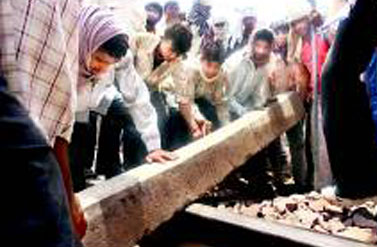
I am watching the Gujjar agitation closely. Today I saw the Gujjar protestors burning effigies and tires, pelting stones, shouting slogans, and blocking traffic on all the roads leading to New Delhi from the neighbouring states. As reported, the government engaged more than 35000 police and paramilitary personnel to avoid any major mishaps.

I am sure the scenes of Gujjar agitation on their TV scene must have shocked most of the Indians. How can uprooting of railway sleepers and lines be a part of democratic agitation? How can criminal bandits with guns in hands be part of the agitators? Why should kids and women form a protective wall? Can we call it the democratic means to attain what we want? What happened in last few days changed my opinion about the people of the region. Normally, I had experience of such violent acts in the agitation of West Bengal. The scene of a large number of tyres burning was really horrendous, and the agitators appeared to be enjoying the fun of the happenings with no fears of any sorts from the police force present in huge number. Is the police presence also the part of the politics? Why should the government not care about the commuters? If the government can’t assure the free movement, it must declare it in advance and provide advisory so that the people would not come out of their homes.

But more important is the reason for the agitation. Gujjars instigated by a leader K S Bainsla who claims to have worked in Indian armed forces want the community to be placed under Schedule Tribe category in Rajasthan.Gujjars see ST tag as ticket to development. Surprisingly, as reported, Gujjars of Jammu and Kashmir and Himachal got the tribal status way back in nineties. Why should it be done state wise, if it is to be done at all?

The great makers of our wonderful constitution did provide for a reservation for schedule caste and schedule tribes for just 15 years. The politicians kept it extending and expanding. With zamindari gone, there is hardly any difference among the economic conditions of different castes at grassroots level. If one takes the photographs of the Brahmins in some congregation, it will be difficult to find any difference between them and Gujjars or for that matter any other caste too. Any differentiation on basis of the caste is criminal and divisive. The country can’t pull on for long with such sorts of demands and such a waste of energy for useless issues.

Is it not insane act to think of such categorization after 60 years of Independence? Is it not because of the selfish motive of politicians who initiate such issues? I was amazed to see Gujjars from different parts of the country, as far as Ahmedabad in Gujarat protesting to show their sympathy with Rajasthan Gujjars.

Nothing can justify this sort of agitation that causes damages to the national assets and ceases the essential services causing so much inconveniences and loss of the individuals and the nation. Can these people not realize some of the mental agonies of the individuals stuck in this mesh? Can’t there be a consensus on the methodologies of agitation? Why should not they follow Gandhigiri?

Why can’t the leadership of the people of India appreciate the menace that they have created and once forever declare that the country will have no more quota and reservation based on caste and community? Every citizen will be provided what he deserves based on his ability and performance.

I wish Gujjars had concentrated on educating their children to make them Brahmins instead of degrading themselves for a S/T status.

Posted in Uncategorized | Leave a comment

Inflation Stuns Me Too

I followed the inflation rate figures, though I never understood its meaning and its affect. I was happy to find it around 3 – 4% last year. I could never realize it going up so fast. That is around 8% now. In late 60s, I experienced it, when for the first time I found that the salary that I received as manager in one of the high paying manufacturing companies of the day, was not sufficient enough to run a family. In 1967, I remember, it was difficult to get rice even if you had money. My uncle was kind enough to get permit to bring rice from Sasaram in Bihar to Hind Motor in West Bengal. I had to send some strongmen to Shrirampur railway station to bring the consignment safely up to our flat in Hind Motor.

I had another interesting memory of one of those days. One day Yamuna asked me to bring some pulses while coming home after the factory. I went to Babulal’s shop and asked for a kg of arhar dal. I gave him a currency note of Rs 20 and kept waiting for the balance. After some time, he asked, “Sir, do you require something more?” “No, I thought you shall be returning some money,” was my reply. I never knew the price had gone that high. Actually Babulal had charged a little less from me.

As a retired person for last 8 years or so, I had forgotten inflation. We were able to manage with the superannuation and some rental earnings. However, suddenly we experience the things going real costly and managing the finances becoming difficult. Without our knowledge, the expenses on vegetables, milk products, and groceries have gone high enough to add up to sufficiently unmanageable level and to make us feel short of money at month end. Other bills such as those of cells, landline telephone and Internet as well as electricity have added to the misery. Even essential maintenance cost is becoming higher on a pretext of inflation. Any one who provides even a nominal service, charges nothing less than a hundred rupees. Consultation charges of doctors are skyrocketing. I used to pay Dr. Bhalla Rs 300 per visit at Fortis Hospital. It has gone up to Rs 500. So are the prices of medicines. Why should the doctors bother about my capacity to pay? Almost all doctors these days prescribe a minimum five-six medicines and that too the costliest brands. Some friends tell me that they receive commission from the pharma companies. Even the Homeopath has enhanced his fee to Rs 80 from Rs 30 for consultation and sweet balls that he provides for a fortnight.

Coming back on vegetables and fruits, I don’t know how the sundry vendors decide the prices charged in Sunday Bazaar. They keep on shouting the prices of vegetables in ‘pau’ (perhaps 250 gms) instead of a kilogram. It is the psychological strategy of Indian origin. The opportunity prices of the vendors have no relation with the mandi prices in kilo published every day in all newspapers, perhaps for the benefits of the consumers. Even the prices at the Mother Dairy’s subsidiary Safal that sells vegetables and fruits have no relation with mandi prices.

I wonder why it be the case in India, a leading producer of fruits (32 million tonnes annually, that is 8 per cent of global production), vegetables (producing 71 million tonnes per year, a 15 per cent share of the world market), and milk (the highest in the world). While we pay about Rs 8 a kg for potatoes in Safal outlets, the farmers are going for distress selling in Agra about 200km away because of the bumper crop and no buyer because of the ban on the forward trading by the government. And then huge waste is common. As high as 40 per cent of the fruits and vegetables grown in India (that’s some 40 million tonnes-worth a staggering $13 billion) gets wasted that is enough to feed countries like Brazil and Vietnam. It is due to insufficient cold storage capacities (The current cold chain capacity in the organized sector is around 60,000 tonnes) in close proximity of farms, lack of temperature-controlled transportation and storage in the supply chain up to the retail stores.

Organized retail is certainly some answer, but excessive profit motive will hardly be helpful for the consumers or the producers. I find Biyani’s Big Bazaar as the best customer-friendly store for grocery, vegetables, and fruits. As claimed, if the organized retail outlets buy straight from the farmers, growers, and producers, it can price always lesser than the mandi. The inflation is making the consumers miserable with no gains for the farmers and producers. It is only the middlemen and traders who make money. Can the government or some effective regulator decide some relation between the price paid to the producers to the mandi price and the retail price considering sufficiently good margin for the business?

Strangely, the price gap between the MSP (Minimum Support Price) of wheat (about Rs 10 a kg) for farmers and the packed wheat (Rs 15 a kg) is not that high as other food items, say pulses. The subject requires some moral commitment from the traders, which I doubt to come. And the middle class households, particularly the lower group earning below Rs 2 lakh a year will always be under pressure to cut consumption or quality of the consumables.

I shall try that inflation does not shock me in future. It happens in every country. And one must learn to live with it, particularly when you are no more working with regular income.

Posted in economy, governance | Leave a comment

Bihar Must Improve Education

I have a special issue of ‘India Today’ on ‘India’s Best Colleges’ in my hand. The survey covers the colleges teaching arts, commerce, science, law, engineering and medicine. There is not even a single college from Bihar in this list. Should it not be surprising rather shocking as well as shameful for the educationists and intellectuals of Bihar claiming long glorious history of its many reputed and old colleges? Are they all content by sending their children to other metros or abroad? Earlier, the so-called affluent of Bihar made it possible with money from selling the landed property, dowry, or bribes earned in government jobs. Today with the facilities of banks providing the loans, it has become easier to finance the education.

Should they not do something to impress upon the heads of the educational institutes and the government to do something drastically different to improve the situation of higher education in Bihar as a necessity for its people?

With about half of the tenure of the present government gone, how can one be hopeful and confidant that some positive steps are underway to change the situations? With due respect to the heads of the educational institutions such as Patna Science college, Patna University, Patna Medical college, NIT, Patna, and many others in the list, they are the first to be blamed. With all the problems, if a head wishes, if he is dedicated and innovative, he can make his institution outstanding. As I know, even after all the political drags from leftists in West Bengal, Presidency College has remained one of the best institutes, because of the dedicated teachers and the principals. Bihar is what it is, because of the intellectually poor heads and teachers of the educational institutes. Will they take pride in their responsibility, go for a change in their mindset, and bring about a qualitative change for better perception about the education sector of Bihar?

It is high time that Bihar concentrates on adding (in hundreds) and upgrading its educational infrastructure in a big way. Even those who have been sending their children outside the state should hear the bell of warning. There will always be some Raj Thackeray to vomit venom against the people, including students, of Bihar to make the life difficult. But beside that, the practice is drain on the state economy along with some other social cost too. I am not sure, but the total amount of money being spent by the people of Bihar on education of their wards in the educational institutes of the other states must be running in hundred of crores. And the most of it is going to the 2-tier and 3-tier colleges that can easily be established in Bihar. Most of the students go out, because the capacity in the colleges for higher education such as engineering, medical, or even for pure science and humanities, is much less than required. And over the period, the quality and environment for good education in the existing colleges have deteriorated. There might be a solid reason such as low salary of teachers or its untimely payment, or more likely the hooliganism of the student community because of irresponsible guardians. But all that must get changed, if the state is to compete with the other states.

I quote Loknayak Jay Prakash Narayan. “People must avoid dependency on anyone else for their upliftment; once they endeavour to nourish themselves and their state, they will be taken care of.”

The present government has gone some steps ahead to get established the institutes of excellence such as IIT, IIM, IIIT, and Chanakya Law University, beside the revival of Nalanda University. But it must focus on improving the standard of all the existing colleges in the state. The CM must call a meeting of the heads of all the colleges and throw the challenge to excel and compete with the institutions in other states. The heads of the colleges must be encouraged to have tie ups with industrial houses and to involve its alumni. Alumni can contribute to the institutions in many ways. With the increasing demand of IT sector for the students of science and humanities, the institutions must accept the challenge to improve the standard so that its students are employed. Let the teaching community be more pragmatic to meet the requirement from the industry. Along with the basic education, it must focus on the applied side at all levels to make it interesting as well useful.

I wish, I found some colleges of Bihar in the list of ‘India’s Best Colleges’ next year or in year after that.

Posted in Uncategorized | Leave a comment

Advisory for Nitish Kumar

I wish Nitish Kumar were through with the troubles arising out of his recent cabinet reshuffle. All the dust of mistrust must have settled. I feel the lack of his constant communication with his ministers, be one from his own party or from the BJP, caused the trouble. As a good head of the state, he must keep the ministers fully busy on 3-5 mutually agreed important projects of their department to stop their minds to work as devils’ workshop. Once a minister, the person becomes an executive and he must perform. And there is no other way but hard work with much more engagement for getting the development moving on fast track. As a boss, the CM today must facilitate his minister to achieve the agreed development targets rather than taking all decisions himself. With the amount of work necessary in every field of development, how could the minister get time for political bickering?

As it appears, most of the projects that I come to know from media report are all getting located in and around Patna. This is not good for the overall development of the state. Nitish Kumar and his ministers must agree to develop anything between 6-10 towns covering broadly all the regions of Bihar that can be the showcases of the state. My list includes Gaya, Sasaram, Siwan, Motihari, Muzaffarpur, Vaishali, Darbhanga, Madhepura, Katihar, Bhagalpur, and Barauni. All these towns must have a master plan to be developed as urban hub for the region. These towns must have expressways connecting them, must have an university as education and knowledge hub, and an airport for fast connectivity, if not an SEZ that I don’t why Nitish opposes.

As I understand, Lalu has initiated a plan to build and operate locomotive plants at Marora as well as Madhepura. I presume Lalu is serious about the project and will see it through by using his political power at the center. He must also make it difficult for his successor to drop it, as it usually happens. If a rightly planned project as reported in media comes up, the whole region gets an economic boost because of the many vendors opening shops. Nitish Kumar government must facilitate and do all it can to get the projects expedited.

I am excited about some other projects that have taken root in the state that the state must encourage. If the model is emulated and expanded, it will bring prosperity to the area.

·Manoj Sinha and Charles Ransler, from Darden School of Business of Virginia University have started two pilot rice husk generators that are providing power to about 10,000 rural Indians with Gyanesh Pandey, an engineer to oversee the projects here in India. The business plan of Husk Power Systems plans to put the miniature power plants in hundreds more villages within a few years.

·Another project started by ITC’s rural initiative of its factory in Munger has a great potential. As in 2005, the four agribusiness centers cover 2,000 farmers. 500 women are involved in micro-enterprises and 1,000 households are provided with low cost health care. 1,500 children (age 3-14 years) are also accessing remedial education, libraries & computer-aided learning. ITC has a plan to increase the indicatives to cover the whole district by 2010. Nitish government must facilitate ITC and even other enterprises as well as NGOs to get the model expanded to other districts. I wish ITC could set up some trade schools in the region. Thee state must invite ITC to set up e- Choupal and Choupal Sagar along the Expressways running in the state.

·Another exemplary enterprise, Drishtee Development and Communications Limited, a private group, has started the Saurath BPOs under the name of Quiver Info-services Limited to generate employment among rural youngsters. It provides a model that is becoming popular in the BPO sector because of its inherent economy. BPOs can easily move rural and provide engagement.

Many more initiatives by genuinely interested local and outsiders will be required to transform Bihar’s poverty to prosperity. Will the government take up some big projects for the flood prevention and water conservation to boost the agricultural productivity and production of the state?

Let Bihar be not only known for the innovations in kidnapping business and institution such as Goonda Bank, but be known for innovations in unique development models too.

Posted in bihar, economy, education, indian politics | Leave a comment

West Bengal: Mam(i)ta(i) Vs. Budd(ha) and Nano

Politics of West Bengal is not comfortable for me. Congress unless merged with Mamta is not a force that the Left cares. Mamta Banerji is celebrating her party’s emphatic victory in all the zilla parishad seats in Singur and Nandigram. However, the victory is because of the local issues that didn’t extend to the rest of West Bengal that has remained in tact with leftists.

To be frank, I don’t like this lady. She is no better than Mayawati, if not worse. However, I appreciate her fighting spirit. She is the only one who can bring a political change in West Bengal that is essential for the state to get a necessary break from the leftists. However, her statement regarding Tata Motors’ project in Singur after her electoral win is dangerous for the country.

A visibly charged Trinamool Congress chief asserted on last Wednesday, “It is high time the Tatas wind up their car project in Singur. People of Singur have given a clear verdict towards our fight against the forcible land acquisition in Singur.” Is it a statement of a mature politician with aspiration to rule a state like West Bengal? And this is her problem. Why should a project like one getting set up for producing a globally acclaimed car that can change the world by Tata Motors, be affected? On a similar line, Maywati reversed all the decisions for many essential projects of Mulayam’s government. But it was not that Mulayam didn’t do the same when he had taken over from Mayawati.

I am not a fan of Buddha either, but I certainly back his mission of the rapid industrialization of the state. I love the aggressiveness of Buddha to bring out a visible change for development in West Bengal. It is the penance for all the wrongs the leftists and its union did in the state that made all key factories to close down and the industrialists to run away. And why shouldn’t I? I had some bad memories of West Bengal just because I was not born as Bengali. But I still adore the state where I spent my early childhood and the prime period of my career.

Mamta’s statement is just like one, the leaders of CPM in West Bengal used to make when in late 60s Congress was the ruling party there.

Unfortunately, Mamta don’t believe in taking advices from a group of experts and intellectuals that she must create to discuss key policy issues to be followed by her party. Mamta has been successful in creating a grassroots level cadre as the leftists have. But Mamta’s cadre will have to be stronger than that of leftists. Leftists will not allow Mamta to live in peace, as it is obvious with the violence against her party workers that the leftists have already started. And the leftists in power do also get the full support of the government machinery. For reaching the level-playing situation, Mamta must come in power at least for one term.

The entry in Writers’ Building is still a mirage for Mamta. But with her win in Singur, Tata Motors must have an alternative strategy for its manufacturing plant at Singur or must develop some strong informal link with her, if it is not having one. It will be essential to avoid the problems that may be created by her men, many times, even without her knowledge. I express my apprehension, as Nano’s success is very important for India’s manufacturing sector.

Let some good sense prevail on the lady and she stops causing obstruction to the industrial projects for a popularity gain.

Let Indians get its people car without political troubles at home, if not the flying autos of tomorrow.

Posted in indian politics, industry | Leave a comment

India Performs, PM fails

How does one rate the performance of the government? I was amazed rather amused to see some TV news channels asking some print media editors to rate the government and the prime minister for its performance of last four years in power on a scale of 10. The scores ranged from 3 to 6. I am of a little different opinion about the rating, particularly one for the prime minister. If we go by the projects and schemes for the benefits of the people, perhaps I find Bharat Nirman as one of the best one. However, NREGS is also equally revolutionary. The prime minister also appeared pushing Nuclear Deal to the ultimate end, but then meshed.

Unfortunately, the prime minister couldn’t set up machinery to make his administration accountable for implementation. On ground level, all the critical projects including the NHAI road network are hardly meeting the time schedule, though there are exceptions such as Delhi Metro and ISRO.

Again, the prime minister has failed to create a consensus on some national issues such as land acquisitions for the industrial projects. For instance, South Korean steel company Posco has not been able to start construction of its $12 billion steel plants in last four years. So is the case with many projects that could have changed the economy of many regions.

The prime minister has also failed to tone up administration to bring corruption down or to improve the competitiveness or human development indices of the country. While many of the reports may be shocking and depressing, there are quite a few, may be by default that keep the hope alive. IITians are returning back or getting into entrepreneurships. Many companies have come out with world-class innovations in products and processes. The developed world is taking note of India. Here are some of those:

Foreign Direct Investment into India has surged to over $ 25 billion in 2007-08 and the country’s Foreign Exchange Reserve crossed $ 341 billion.

Corporate India is doing fine. According to research firm Grant Thornton, corporate India spent over $40 billion on global M&As alone in the last two years. Tata itself has spent a total of $18.75 billion on 21 acquisitions including Tata Steel’s Corus for $12.1 billion, and Tata Motors’ $2.3 billion spend for Jaguar and Land Rover. It has enhanced the image of India. The Aditya Birla Group’s Hindalco paid $6 billion for Atlanta-based aluminium sheet maker Novelis in February, 2007, while Essar Steel forked out $3 billion for Canadian steel maker Algoma Steel, Minnesota Steel, and U.S.-based Esmark in one year. Indian information technology companies have been buying smaller IT service outfits in Europe, Latin America, and Asia to gain global customers and reduce the reliance on U.S. market. And companies in almost all sectors, be it a small e-Education company or Indage wine brewer, are trying to get into global market through acquisition. Giants in telecom and pharma, among others, are sinking big money into the promising market of Africa in a catch up endeavour.

Many MNCs are coming to India with big projects. India is no more considered untouchable for manufacturing enterprises. The world’s largest truck maker Daimler in partnership with Munjal’s of Hero group has now chosen to locate their commercial vehicle manufacturing unit in Oragadam, near Chennai with an investment of more than Rs 4,400 crore over a five-year period for a greenfield plant to produce a new brand of low cost vehicles for the Indian market, besides acting as a base for exports. Now there is almost unanimous agreement that India has potential to become global manufacturing hub.
General Electric Company is planning to manufacture windmills and gas turbines in India.

Indian companies are able to face global competition. Even SMEs are successfully changing their strategy to meet the competition. For instance, two years ago, Patel Brassworks, which earns 65 per cent of its revenues from exports, had the foresight to switch the currency in which it trades from the dollar to the euro. Since then, the dollar has depreciated against the rupee from 48 to around 40 while the euro has appreciated from Rs 52 to Rs 63. The company could have been sulking because of a 17 per cent lower realization had he stayed with the dollar, is now enjoying a 21 per cent higher realization.

India Inc is investing heavily. The new proposals that stood at Rs5,58, 333 crore, an impressive 90% increase over last year reflect the corporate sector’s efforts to expand manufacturing capacity. Electricity generation attracted maximum Rs2,05,088 crore worth of new investment proposals, which shows a robust 105% increase over Rs99,590 crore a year ago.

Many domestic and MNCs are rushing to invest in power sector that has been holding India’s growth. Surprisingly, the new investors are acquiring coalmines abroad from Africa to Indonesia to Australia to give up its dependence on domestic PSUs to get coal. Tremendous growth in real estate sector is visible all over the country. New private airports such Hyderabad and Bangalore have started getting commissioned.

And all these activities mean more for the people involved. According to a latest report, the explosive rate of growth in India has created a phenomenal demand for talent so much that wages are forecast to rise by 14.4 per cent during the year 2008 that is much more than other developing countries.The companies are adding to the headcount aggressively. Infosys is set to cross the one-lakh-employee mark, catching up with Tata Consultancy Services. The twosome together would be within kissing distance of worldwide headcounts at IBM or Accenture, the two global leaders. An interesting question is being asked, who is more American IBM or TCS.

Why should we get morose when the government is failing to score high ranks or the prime minister don’t meet the expectations of the people? Let the Indian entrepreneurs take the country take ahead.

Posted in economy, governance, indian politics | Leave a comment