On Father’s Day

I had a greeting card for the day waiting for me in my e-mail from Emma, Shannon, and Anand. India on the whole is fast adapting to the western customs. It was pretty clear after glancing through the newspaper full with many ads for this occasion. Fortis invites the children to spend for the discounted medical checks for their parents. Many enterprises have many things to offer.

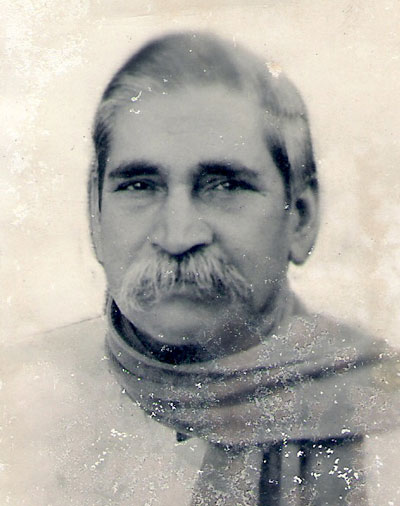
But the card from Shannon had a request to write about my father and grandfather. In my childhood, I lived mostly with my grandfather up to school. He planned and shaped my career. In Presidency College and even in IIT, Kharagpur, he used to come pretty often just to see me, and certainly to accompany me back home at the beginning of long holidays. Sometimes, it embarrassed me. One can’t appreciate his attachment and his worries with telecommunication completely absent in those days. I still remember one occasion of Presidency days, when I had gone out and he couldn’t meet me. He was so worried. He never allowed me to know anything about the household affairs, though perhaps I would have liked to get involved.

Unfortunately, I couldn’t do much for him. He went to our village after retirement with many dream projects. But very soon, he came to realize that my uncles did not like his ideas, as it meant hard work. Very soon, he started working again in High School at Dalmianagar. He remained busy till his last moment. He had fine sense of literature and music too. But he loved to meet people the most. I never came across any person who could become as loving and respectable as him.

For that matter, my father was the luckiest person on this earth. He never had to take any responsibility. In joint family, his uncle hardly asked him to do anything, but supported whatever he did. When he started to live in my mother’s village, he had hardly anything to do. When he got sick, I brought him to live with us. He lived a peaceful and contented life till last. Perhaps he never expected anything in life. Today, I really envy him.

But both my father and grandfather lived in a time, when they respected their elders, loved all the younger ones and got respected by their children. My father would have given anything he had to any one if he asked for it. My grandfather never raised his voice against anyone.

They were in era with no Father’s Day.

Posted in Uncategorized | Leave a comment

On This Day 53 Years Ago

On this day 53 years ago, we, Yamuna and myself got into this relationship that is the closest and divine as many say it is decided in heaven by Him. Even with the memory failing, I vividly remember the day in all details, the happiness of my mother, and all the other members of the family including my grandfathers and great grand mothers for the occasion, and all the rituals and functions. Life thereafter has been full of fun and festivities. The Great has remained so kind to us. We remain grateful to Him. We are sure He will be similarly kind to us till end. What more do we need?

Thanks a zillion SIR.

Posted in Uncategorized | Leave a comment

Bihar Getting Visible

I was shocked when I found a very poor reply from Prabhu Chawla to a question asked by one Rajeev on ‘India Today’ website. He said, “Nitish Kumar is also following policies which help certain castes and not the entire state.”

Many a times, I wonder why does Bihar get so poor media coverage, when as I guess quite a large number of the reporters, in print as well as digital media, are from Bihar. Can’t they make the reporting more meaningful by reporting some success stories too? As I have seen, quite a lot of work is going on at least on two central projects in Bihar related to rural road and electrification. While my own village has got the good roads from at least two sides, Yamuna’s village has got electrification. I hear and read similar news from different sources too. However, one hardly sees any coverage of these two projects in media. For our reporters, Lalu still remains the most favourite, be it his new blog or the 32-lb ‘garib rath’ cake on his birthday.

But I am happy that very lately Bihar is getting some good coverage on quite a few other developments. That too is not of lesser significances. Let us see some examples of good media coverage.

Bihar’s litti-chokha: ITDC is promoting Bihar’s litti-chokha. “Apart from being tasty, litti and chokha are rich in fibre and low on calorie. This will certainly suit the taste of those looking for a combination of tasty and healthy food.” Ashoka Group hotels are including litti-chokha in its menu and will served it at the international food festivals to be organized by ITDC in Germany and Hungary later this year.

Political: Another news that was widely covered related to the decision of the continuance of Sushil Modi as deputy CM of Bihar. BJP used a “secret ballot” to sort out the crisis. Many may differ with me, but I find the method as the best in a democracy. BJP proved its difference. I am sure it will now be the initiative of Sushil Modi and certainly Nitish to improve the fellowship with the disgruntled members of the cabinet and the assembly, if the alliance is to be effective and exemplary. Modi might have passed the test, but he must try hard to improve his man-management. Congress must take note.

Education: Another interesting news related to the unique institute Super-30 of Patna. The whole country watched with interest the superb performance of Super-30 of Bihar. The institute makes every person of Bihar feel proud. However, as anti-climax, Avayanand has disassociated himself from the institute. I wondered earlier how could he do that service with his demanding police assignment. However, I am unaware of the internal issues or politics if there is any. To the joy of many, Nitish promised to bear the entire expenditure of the education of those who got into IITs. The Chief Minister had earlier announced Rs. 50,000 cash reward for all successful students.

The media also covered the news of Chandragupta Institute of Management, Patna (CIMP), designed on the pattern of the Indian Institute of Management, Ahmedabad, which got inaugurated in Patna. Higher education is getting a boost in Bihar. The Chanakya Law School University on the pattern of the National Law School of India University, Banglore has already started operating and a small batch of students will also join IIT of Bihar. The establishment of these institutes will build some prestige. But it demands a very conducive and efficient infrastructure and educational environment that can attract the best students in Bihar. It also expects that Bihar government will be able to attract the biggies of the India Inc to set up enterprises in Bihar.

Bihar has also given top performance in cutting down the number of out-of school children in the age group of 6-14 to 10.10 lakh this year from a mammoth 21.19 lakh last year. Muslim, SC, and ST children have made the most remarkable contribution. Out of 33.06 of Muslim child population in the said age group, only 2.83 lakh were out of school in March 2008 as against 4.24 lakh in March 2007. In case of SC, only 2.71 lakh SC children are out of school in March 2008 as against 4.99 lakh in March 2007. Out of the 2.41 lakh ST children in the age group of 6-14, now only 25,901 out of a total of 2.41 lakh ST children in Bihar are out of school as against more than 45,000 in March 2007.

Economy: Bihar is in news for its record procurement of wheat, as Nitish Kumar demanded to arrange more procurement for the benefits of the farmers. Bihar has also urged the Centre to review a recent amendment to a rule that forbids producing ethanol directly from sugarcane juice without manufacturing sugar. It prevents investment in sugar industry in Bihar in which many industrialists are showing interest. Reliance Industries Ltd and Hindustan Petroleum Corporation Ltd have also renewed their interest in taking over three State-controlled sick sugar mills in Bihar.

Bihar is also in news for extraordinary telecom growth. According to an Assocham state-wise analysis of mobile subscription released last Tuesday, Bihar registered the maximum increase in annual telecom subscribers, marking a growth of 88.2 per cent in the fiscal 2007-08 as compared to the 51.1 per cent in 2006-07.According to aother news report, Bihar may get technical help from Israel to enhance the quality of litchi.

Governance: While Nitish Kumar endeavour to convict the ‘purane papis’ (old culprits) is showing result, I wonder if it can mellow down the ‘bahubalis’ (dons) and cut down the deep-rooted culture of corruption from Bihar. The news related to the ‘shortcut to babudom’ scam revealed the depth of corruption in high society of Bihar. It pains. But Bihar is to go many miles. It must get SEZs. It must cash on potential of tourism. It must capitalize the skill of its artisans. And Nitish must stop his fight with Ranghubans Prasad or declare that Bihar does need NREG scheme. According to an official performance report on the implementation of the National Rural Employment Guarantee Scheme (NREG) by state governments, Bihar is again at 25th position out of 27 states with Orissa at 26 and Maharshtra at 27, when Rajsthan tops.

Is it not a good going? Will the reporters of Bihar help in bringing out the best in Bihar?

Posted in Uncategorized | Leave a comment

Some Concerns, Some Trends

Many look at IITs for many reasons. Parents aspire to see IITs as the choicest target to be attempted by their children to get educated. The students start dreaming and preparing for IITs through IIT-JEE as soon as they reach class X. I have come across many alumni of IITs who hardly wish to remember the arduous days at IITs. Most of the alumni, however remember the IITs with a flash in eyes with respect and belongingness.

IITs as such have become a respected brand of India in industries all over the world. At least some smaller countries wish India to help setting up an institute on the line of IITs. However, in India the politicians wish to get IITs established for getting political mileage with the vote banks. The extension of OBC reservation to IITs was certainly one of the pure political moves for the same reasons without giving thought on its damaging effect on the quality of education and brand with not much of preparation to affect it. Now every state wishes to have an IIT, as if that will provide the answer to all its problems of technologies. As a political priority, at least some with forthcoming election in mind, 8 new IITs in eight states will start operating in this year itself without any prior preparation of infrastructure or faculty. Another exclusive IIT is being proposed for girl students without asking girl students if they require or like one. Surprisingly, the demand has come from the first lady President of the country.

I shall myself prefer IITs to franchise its course material and train, if possible the teachers, to make the right use of the material so that al the engineering colleges that wish, can avail it. If IITs can, it may adopt some engineering colleges.

I look at IITs with different hopes. I wish it must focus to bridge gap between industry and academia, when I try to remember of any outstanding innovations coming from IITs and find nothing great but a few such as a riksha designed by IIT, Gauhati and Prof. Ashok Jhunjhunwala’s Simputer. Even if I am wrong which I shall like to be, it is because media has hardly any coverage of the work at these great institutes of national importance.

It is funny that the minister of rural development of India wishes to take help of the students and faculty of IITs for monitoring NREGA in the country. The same politicians use the rural teachers for collecting census data and for conducting election. Students of IITs can only be used to impart technical knowledge and to train the farmers. However, that itself will require sufficient orientation of those students.

I get pain to know about the role of coaching industry for IIT-JEE and the way this industry is expanding to every small town with franchises. I don’t the number of poorly manned and fake ones. The way the coaching institutes keep on advertising, it appears to be nothing but just cheating. I wonder why can’t IITs innovate the system of the examination that can’t be coached.

Somehow I feel IITs have not been able to keep track of its alumni and through one of its management schools it could have undertaken a research project to understand the realistic influence of IITs on the professional achievement of alumni. Alumni could have been a source to create an endowment fund for each institute, and further could have served as visiting faculty too. In US, sixtytwo universities have endowments of over $1 billion each.

A media reported trend is certainly heartening. More and more IITians are staying back in India. Quite a few prefer for manufacturing instead of IT. IITians no longer prefer U.S. as job destination. Ph.Ds are getting better salary offers. Salary packages for faculty are getting significant increase, some say, 200%.

However, I personally don’t like the enhancement of fees of IITs at one hand, and on the other the preference of IITIans to get into IIMs and joining consulting and financial services straight from the colleges. I would have preferred them to come back to IITs or IIMs only after three to five years of experiences to specialize. Alternatively, the course can get extended to five years with the placements after three years, and the balance two years’ period divided between the employer and the institute.

Will the government come out and announce the ultimate number of IITs in India? Why can’t it create another brand or as many brands as the number of new institutes it establishes with open competition to excel?
——–
Read How Not To Build New IITs by SWAGATO GANGULY

Posted in Uncategorized | Leave a comment

Correction Course for Media of Instruction

A very pertinently important question must be bothering many parents, educationists, and perhaps psychologists too. What must be the best medium for instruction? Naturally the answer will always be in favour of the mother language. But will it provide the advantages and employability for professional career? It is for this reason that the country is switching over to an alien language as medium of education and instruction at an exponential rate. As reported recently based on data collected by the National University for Education Planning and Administration (NUEPA)*, ‘nationwide enrolment in the upper primary section of English-medium schools rose 74% during 2003-2006. In actual figures, this is a rise from 54.7 lakh students in 2003 to 95.1 lakh in 2006.’

The students from the English-medium schools will be far better in communication, not necessarily literary excellence in that language. Many believe they are smarter too. Naturally this puts to disadvantage all those students who are sticking to mother language as medium. What can be done about it? One simple question must be honestly answered by the English teachers responsible for that. How many years or hours of intense teaching is required to learn a foreign language to master it for communication, both spoken as well as written. Should the 14 (2+12) years of learning English as a subject not be sufficient enough for attaining proficiency? What can be done to get the equally good proficiency in English keeping it a second language for all, as it is now in most of the states? Perhaps, a little change in the mindset of the English teachers, their retraining, and making them use technologies as teaching aids will make the vernacular medium students also equally proficient in English. All the state governments must be serious about overcoming the situation. Some have started doing that by establishing finishing schools for the graduates. But it must be taken up at the school level itself. Most of the English teachers themselves are not proficient enough in English. They must undergo an intense training and develop the skill. With an interest and mindset backed by digital aids, it can’t take anything more than two months. Let them understand that it is never too late to learn and it is they who have been preaching this.

English as a medium for most of the business activities and computers as tools to provide efficiency and ease, are two basic skills that a student must acquire as early as possible for bringing in the equity in society and inclusive growth. The states that will falter will be left behind. As per the report, “the growth of English is more in non-Hindi speaking states, mostly the southern states which account for over 60% of the students enrolled in English-medium schools in the three-year period. English-medium also accounts for well over 90% of the enrolment in the northeastern states. In north, except in Punjab and Gujarat the growth of English has been sluggish.”

I have been visiting many of the private engineering colleges in and around Noida and talking to the students. I find that most coming from rural background can’t communicate in English even in their final year. Is it not a shame for the teaching system that even after 10+2+4 years of proximity with the language doesn’t make the student speak confidently in English?

Basically, the language teachers must get status but appreciate the key role they play, as without knowing the language, a student can’t understand the subject taught in English or by reading the books in that language.

Let Nitish and Mayawati move fast and take the corrective measures to come up to the standard of the South. Both the states must encourage good private players in education and spend on training its teachers and technologies, particularly one who is to teach English.
—————————–
*The total number of children enrolled in class I to VIII in 2005-06 in India is about 150 million. Only 9.5 million get education in English medium schools. Rest about 140.5 million are in schools of Hindi and various regional languages as media of instruction with Hindi at the top of 78.4 million.

Posted in education, governance | Leave a comment

Nuclear Deal Requires Guts

According to Anil Kakodkar, Chairman Atomic Energy Commission and Secretary Department of Atomic Energy, currently the nuclear power plants in the country were working at half their capacity nearly of 4,000 MW due to the fuel shortage. The Nuclear Power Corporation of India is currently working on four 700-mega watts nuclear power plants and once the fuel linkages are finalised then the construction would begin. The short supply of uranium due to the slow process in opening up of new uranium mines. Uranium Corporation of India will soon be constructing a mine and a mill at Tummalapalli in Andhra Pradesh with a capacity of 1,50,000 tonnes per annum. Likewise, mining and milling was being looked at in the states of Rajasthan Karnataka and Meghalaya. Is India pursuing its nuclear programme with the amount of seriousness and professionalism that it requires? Should it not be the first and top priority of the government instead of keeping itself busy in finding out how could it put blame on the misdeeds of NDA government that went out four years ago?

A majority of reputed columnists and economists have been writing in favour of the Indo-US Deal and its national importance. Last week, Gurcharan Das in his regular Sunday column strongly appealed to LK Advani, the prime ministerial candidate of BJP. “If Advani seizes the day and persuades his BJP colleagues, he will go into history as the “white knight” that saved India’s energy and security future.” Mr. Das dramatized his column by creating imagery what the historians would write after 100 years from now. “History will narrate that the nuclear treaty never compromised India’s right to Pokhran III. China and France did nuclear tests in 2020, which ended the CTBT regime. India was by then the world’s third largest economy, and it followed up with its own test. The Democrats in America, instead of throwing the CTBT at India, were relieved to see India balance Chinese power in Asia.”

As it appears, if Man Mohan Singh becomes shrewd enough to touch some emotional chord of the old man satisfying his ego, Advani can single handedly rescue the Deal. The time is running out fast. The Leftists will never back the Deal. It is unfortunate that Congress still wishes to remain clinging to leftists who have their own priorities. I don’t foresee any political advantages coming to Congress. Many a times it appears to be against the national interest. Perhaps Sonia has failed to keep the nation’s priority ahead of her party’s interest. Like a shrewd politician, she would have met Advani and tried to get his support for the Deal in the interest of the nation.

As reported, the existing nuclear plants of the country are running at much lower efficiency because of the shortage of uranium, the fuel. Some new nuclear plants getting ready will not be commissioned because of the lack of the uranium. And unless the Deal is through, no one including Russia, will supply the uranium. Why should Sonia not follow the advice of so many intelligent people? Simultaneously, India must look into the internal sources of uranium too. According to a report, it is lethargy of the administration that India has not been able to mine uranium from its internal sources that are enough to run all of India’s current and planned nuclear power plants for their entire lifetime of 40 years.

As K. Subrahmanyam reveals, the grim situation on the availability of domestic uranium was known from the late 1950s and early 1960s and hence Homi Bhabha’s focus on the three-stage plan which in the final stage would use thorium, available in plenty in India. However, “the mature thorium technology is at least some 30-40 years away and to reach that, India has to pass through the first phase of 50,000 MW of light water and heavy water reactors and the second phase of fast breeders. India cannot do this unless it signs the nuclear deal with the US, concludes the International Atomic Energy Agency (IAEA) safeguards and obtains a waiver from the Nuclear Suppliers Group (NSG).”

K. Subrahmanyam has also tried to emotionally enthuse Mrs. Gandhi to take some bold step to save the legacy of Rajiv Gandhi. “While the credit for conducting the tests may go to Atal Bihari Vajpayee, the father of both the military nuclear progamme and the renewal of foreign civil nuclear cooperation is Rajiv Gandhi. People all over the country understand that the decision on nurturing Rajiv Gandhi’s legacy of the nuclear issue rests wholly with Sonia Gandhi. Let her pause and reflect on her own. Rajiv Gandhi’s legacy is at stake.”

Prem Shankar Jha has already written the obituary of the Deal with Obama win over Hillary. “What may be good news for America and most of the world is bad news for India. For if the Indo-US nuclear treaty was dying before, it is well and truly dead now. Obama has said with his characteristic bluntness that ‘India has taken us to the cleaners’. As a result, even if the Manmohan Singh government musters the resolve to sign the safeguards agreement with the IAEA now, it is a safe bet that in the few months of the Bush administration that remain, no state department official will stick his or her neck out to push for a special meeting of the Nuclear Suppliers Group, much less exert American influence to make it lift the embargo on the supply of sensitive technology to India.”

With time running out, both Sonia Gandhi and LK Advani must hear the intelligensia of the country and save the energy crisis of the country forever. Simultaneously, the Deal will take out the scientists’ community of India out of ‘untouchable’ category created by the nuclear powers. Unfortunately, there is no reservation based on population for uranium by any global body that can keep India’s nuclear programme running.

Let Sonia and Man Mohan show the gut and Advani his statesmanship, or switch over to the obituary of the Deal with a prayer for some light in near future.

How shameful? Australia not to sell uranium to India
And PM does not have luxury to limit options of energy.

Posted in Uncategorized | Leave a comment

Sharvan Kumars Wanted

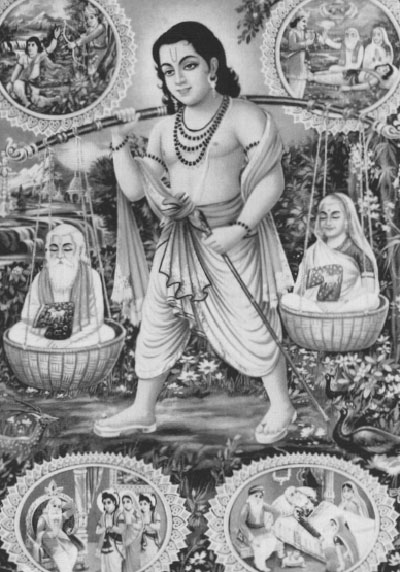
One of India’s most-celebrated tales of parental devotion relates to Sharvan Kumar, the character in the Ramayan. As I came to know recently, Sharvan Kumar died on the banks of a parched, neglected lake in village Sarvan, Unnao district of Uttar Pradesh, The village got its name from Shravan Kumar. According to locals, the place where Shravan died was named Sarvan. The spot where Dashratha shot his arrow came to be known as Sarwara and the place where Shravan’s parents died is called Samadha.

According to Munnu Lal Pandey, a former pradhan of Sarvan, the 19th century British Gazetteer states: “It is said that there lies a stone statue of Shravan Kumar and as he died of unquenched thirst, if water is poured into the navel of the stone figure, the hole never gets filled up.”

For the benefits of those who might not have read the story in Ramayan that influenced Mahatma very much in his childhood, it runs as follows:

While hunting in the forests of his kingdom once, King Dashratha heard a noise near a lake and unleashed an arrow, hoping to hit an animal. When King Dashratha reached near the lake to collect his kill, he found that his arrow had struck a boy instead of any wild animal. He was profusely bleeding. His end was near.

The boy was Shravan Kumar. He told Dashratha that he had come to the lake to collect water for his sick and aged parents, who were both blind and whom he had been carrying on a sling to make them visit various religious places.

Shravan Kumar requested the king to take water to his parents and quench their thirst. Shravan succumbed to his wounds. When Dashratha took water to his parents and told them of his tragic mistake, they were unable to bear the shock. Before dying, the old man cursed Dashratha to die because of the separation of his son. Shravan still remains a benchmark of a dutiful son in India.

When I went to Kaushiks to meet Singhs who were going to US. Their son Rajat and his wife made them visit US. I happened to remember this story of Sharavan Kumar. In present era, Sharavan Kumara need not use slings. They arrange air tickets and make their stay pleasant. With about a million Indians immigrated to US and other developed countries and working there, most of the children call their parents at least once and show them around. Aroras have gone for the second time to live with their younger son in Seattle. Rihanis have just returned from US after 6 months with their daughter in San Diego.

However, when I look around in India, I find most of the elderly parents grumbling about theirs children, particularly sons. Many live separately as long as they can to avoid worsening of relationship. Perhaps, the parents must learn to compromise with their expectations based on their perceived values. Sons, particularly daughter-in-law must learn to accommodate and tolerate.

Sharavan Kumars need not give up their careers, but try to find the way that can make the parents happy for as many years they live. However, these Sharavan Kumars must not have any expectations for themselves when they reach their parent’s age.

Posted in Uncategorized | Leave a comment

In Our Anti-People Democracy

Singhs sitting

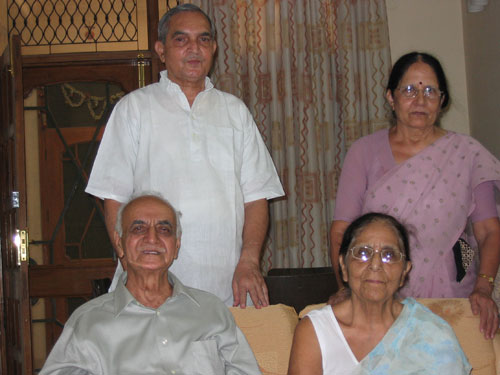
We saw off on Friday Laxman Singh and his wife, both serious citizens of above 70 years of age. They went for the first time to US to be with their son and daughter-in-law in New York. Rajat is research associate and Sushmita is pursuing her Ph.D.

Singh worked for me in HM, and his wife had been teacher all along. As their only son was disabled to certain extent, Yamuna had impressed upon her to have one more. And finally came Rajat. Yamuna takes its credit every time, we happen to talk abut them and rightly so.

Rajat did very well at studies, got into Calcutta Medical College and the AIMS, Chandigarh and came out with flying success. He married Sushmita before going to US. We played a small role in that marriage too. And after retirement, perhaps they are the only with whom we are in constant touch. We kept on insisting that they must visit Rajats in US. Finally they did it. They are on flight.

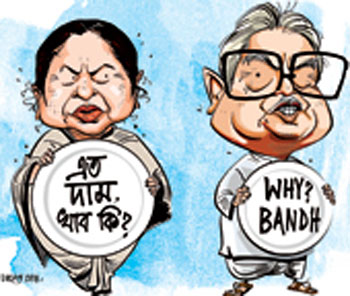
But as usual, the two back-to-back strikes more popular as bandh in Kolkata created some moments of suspense and worries for them. On Thursday, no flight took off from Kolkata. It was very uncertain for Friday too. When I talked with Mrs Singh, she was really worried and rightly so. However, I advised her to leave home at 4AM to avoid strikers on the road. I was sure that once leftists themselves had a successful bandh, they would not allow Mamata’s men to succeed. Though Mamata’s bandh succeeded but Singhs’ flight took off from Kolkata. It was great relief for them and me too. Many might have faced even worse on the day. Even for Singhs and us, the worries and suspense continued till they boarded the plane in the morning of Friday. One must iappreciate and agony of Singhs who were going for the first time abroad.

Though it is unfortunate, nothing much has changed in the way, the politicians and their followers behave in West Bengal. Buddha may be resorting to capitalist economy, but CITU and its cadre remains rogue. How can a government sponsor a bandh and create immense inconvenience for the people, some times very agonizing for some at least? But it happens in this democracy. How can a responsible opposition call back-to-back bandh freezing all the activities without having any consideration for its effect on the lives of millions of people? Why can’t the people of West Bengal throw these politicians out of their lives?

Perhaps it is not possible. And the people will have to live in this situation created by the poor leaders. And it is happening everywhere. On-going Gujjaras agitation in Rajsthan led by a person who was hardly known till recently has crippled the economy of the state. But this will happen as the country selected the democracy without preparing the people.

Posted in Uncategorized | Leave a comment

Rising Inflation Beyond Supply and Demand

In Hind Motors’ days, we observed that with general increment made known through the word of mouth, the rikshapullers used to increase the rates, and so did the shopkeepers, particularly vegetable sellers. It never used to be a supply problem.

The traders try to take the advantages of the surplus money available in the society. According to the economic outlook report of Organisation for economic Cooperation and Development (OECD) released on May4, 2008 report, India’s move to raise pay of the government employees and to write off $ 17 billion or more of farm debt will spur consumer demand and stoke inflation. Is there a way to tackle this mindset?

To provide the desired incentive to remain viable, the government has considerably increased the minimum support of wheat and has also declared to do that for paddy. And I am sure this is one of the main reasons for the rise in inflation rate. The traders want to suck all or its own share from the extra money that the farmers or the workers have earned by their hard work.

In rural India, the traders today perceive the BPL households as richer consumers because the assured 100 days earning through the NREGA.

With the perception of economy booming, and the pay packets of the freshers from IIMs and IITs known to every one through media, all the self-employed population such as doctors, advocate, and other service providers such as plumber, electricians, and even the maids try to enhance the fees and remunerations. In last few months, I have seen Fortis Hospital enhancing the fee from Rs 350 to Rs 500 for the out door consultation; Max Hospital raised it from Rs 300 to Rs 400. And once this is known all others follow the rule that has no answer. How can the government put a control on it and inflation?

I was shocked one day when a dentist told me that the same person who pays $2000 in US for a root canal operation doesn’t like to pay Rs 2000 here in India. With better mobility and media, the global rates are known and this is causing the rise of the prices too. When one comes to know that even poor quality rice costs Rs 50 a kg, his anger about the high price gets subdued.

And surprisingly, all these people keep on talking about the inaction of the government in controlling the inflation.

India produced record quantity of all the agricultural items wheat, paddy, coarse cereals, pulses, oilseeds, soyabeans, and even cotton this year. The price rise can’t be because of shortage of supply, as every item is available in plenty in many varieties and quality grades.

As reported in media, the government decided to ban future trading in potatoes. With very good production of potatoes in Agra region, the traders refused to lift the potatoes. Naturally, the farmers were ready to sell at any price. However, the price of potatoes for the general consumers remained around RS 10 a kg all over the country.

Unfortunately, today the middle class as in 60s of West Bengal hardly raises its voice and protests against the price rise. During my younger days, I have seen huge protest against even few paise fare rise for traveling in trams of Kolkata. A mindset, that nothing can be changed prevails.

Fiscal measures, such as interest rates and imposition of export duty or ban such done on food grains items including milk powder and Basmati rice may fail to control inflation in such cases. Rather these controls are just to show that the government is conscious of its responsibility and working on it. The worst is the measure of ban and export duty on steel and cement. Instead, it would have facilitated the fast execution of the major projects of steel and cement production to enhance the capacity in the country. A huge foreign exchange reserve does not permit a government to move so irrationally to encourage import by removing all duties and discourage export by imposing ban in adhoc manner to make the materials available in the market to control inflation.

The middle class really compromises with inflation. I remember early 60s. We started with very good basmati rice, but over the period settled with inferior varieties. The quantity of milk got reduced, so was the frequency of sweet dishes such as ‘gajjar ka halwa’ and pure ghee (butter oil). But my businessmen friends didn’t have to resort to that. They kept their margin managed.

It was apparent in the newspapers of the day. Among all the negative comments against the fuel price rise, no one promised to innovate ways to cut the cost so that the inflation doesn’t escalate.

Will the next generation live with inflation or forget the word?

Here is an advisory article from ‘Business Today’ to ‘fight against inflation’
————–
‘Price rise is a fact of life. You have to adjust’

Posted in Uncategorized | Leave a comment

Farmers Perform, Minister Takes Credit

‘India Today’ has an article on the outstanding performance of Indian agriculture in 2007-08. Sarad Pawar has tried to take its credit. This year’ record output has found a place in one full- page ad in all national newspapers too. It aims at perhaps telling the traders about the abundance to avoid creating artificial price rise. It might also win back some disenchanted voters to Congress or NCP. Unfortunately, there is no mention of sustained endeavours of millions of small and medium farmers. With the growth in economy and rising living standard in urban areas becoming known to the rural population through better digital connectivity, even the rural landholders are trying to come out of rut using various means- better practices and inputs. For instance, when the government fails to execute many irrigation projects such as river interlinking and canals that it plans and promises, the farmers go to deep boring and pump for irrigation. When it fails to supply electricity, the farmers switch over to diesel pumps. Should the country not be ashamed of its governments, as even after 60 plus years of independence also, 60% of the farmers still look towards sky and pray for rain for irrigation? This deprived community is expected to support and feed 620 million of the population.

All-time high food grain output

In 2007-08, India produced rice 95.68 million tonne (93.35), wheat 76.78 million tonne (75.81), coarse cereals 39.67 million tonne (33.5), pulses 18.54 million tones (17.5), oilseeds 28.21 million tonne (24.2), Soyabean 9.43million tonne (8.85). Figures in bracket show the production in 2006-07. Even cotton production increased to 23.19 million bales (170 kg a bale) this year from 22.63 million bales in 2006-07.

Some questions need to be answered.

The government has provided some assistance to the farmers, but as usual in every case it is very and very late. Its measures are short-term ones and short living too with one-point objective of getting votes. And that is the reason for the shrinking of the share of agriculture in GDP from 61 per cent in 1951 to 19 percent or less in 2008. The government doesn’t have a timeframe to cover 100 % of the cultivable land with means of irrigation or its alternatives.

The bureaucrats don’t mange by objective, but mismanage by inventing patent-able new excuses for not getting the projects executed in time. And the inaction results in situation such as the contribution of agriculture in GDP slipping to 2.5 per cent for a full 10 years. And the annual growth in food grain production at 1.2 per cent was lower than the 1.9-per cent growth in population.

Unfortunately, the farming in the country is mostly in hand of people with very little or no knowledge or formal training about the modern farming practices. No agency has made any effort to train the people involved in the task of farming. They have been expected to learn it from their elders. The farmers hardly appreciate the commercial aspect of the farming. To make the farming viable, it must give sufficient profit, the difference between costs in the farming and earnings from the produce. Should the farmers live the viability of his occupation to the almighty and keep on subsidizing the produce for influential consuming populace including the policy makers and resort to suicide himself?

Fortunately, in last few years some steps taken by the government have brought some hope and relief.

·Agricultural credit has more than trebled from Rs 86,981 crore in 2003-04 to Rs 2,80,000 crore for 2008-09.

·Interest rates on farm loans of less than Rs 3 lakh were cut from 9 per cent in July 2003 to 7 per cent in February 2006.

·Funding of seed production through universities helped enhance yield.

·The minimum support price (MSP) has gone from Rs 550 per quintal of paddy in 2004 to Rs 1,000 now and from Rs 630 to Rs 1,000 for wheat that fetched better returns for farmers. Farmers were paid Rs 2,800 per cotton bale and Rs 1,800 per quintal for soya.

Why should the Indian farmers get content with so low a price?

A price of Rs 1,000 per quintal for paddy of average quality translates into Rs 16.66 per kg for rice. With addition freight and other costs, the price for rice could touch Rs 20, post procurement. In comparison Thai rice is priced at Rs 52 per kg. With levies, the actual price comes to Rs 70.

In the PDS the government supplies grains to the very poor under the Antyodaya Anna Yojana at Rs 2 per kg and for BPL (Below Poverty Line) families at Rs 4 per kg. Those above the poverty line get grains at Rs 7 per kg.

The pricing of the food grains is certainly political and the voters oriented. Does it reach the actual beneficiaries? Is this not the reason for the massive theft and the leakage? Why can’t the beneficiaries with smart cards be given vouchers to permit them to buy it from any shop instead of the unscrupulous fair price shops? Against the coupons submitted, the shop can be paid the difference.

Should those above the poverty line not pay at least the cost price, if not the market price? Why should a consumer above the poverty line get rice at Rs 7 per kg when it costs the Food Ministry around Rs 20 and when the market price could be between Rs 18 and Rs 20?

Let the political parties agree to solve the food problem rationally using technology that can make its a transparent business. That will be in the interest of the nation.

Posted in agriculture | Leave a comment