China and Dam on Brahmaputra

China today is afraid of only one country and that country is India. And perhaps that is the reason that China keeps on doing something to irritate India, be it its intrusions in Indian territories or the dam over the Brahmaputra and perhaps to test its strength and strategy to deal with China’s extremely superior military power.

Alarming news appeared on last October 15 that said, ‘strong evidence has now emerged to suggest that China has begun constructing a dam on the river which it calls the Yarlungzangbo (better known as Yarlong Tsangpo to the Tibetans). The dam over Brahmaputra will certainly be extremely damaging for India. The National Remote Sensing Agency (NRSA) confirmed the start of construction at the Magnum site on the Brahmaputra.

Indian Prime minister raised the issue with his Chinese counterpart, but he denied any construction. And unfortunately instead of finding the actual position by its own sources, the Prime Minister of India believed the Chinese information. Isn’t the NRSA version reliable enough to pursue the matter further with the right international agency if it’s going to affect the economy of a region of the country? Why the government or the Prime Minister is keeping the whole country in dark on the issue? What has been the preparation of India as the news started appearing years ago on such possibilities? According to a report in 2007, ‘China was preparing to build a dam on the Tsangpo (Brahmaputra) to have twice the hydroelectric output as the Three Gorges.’

The whole of Himalayan range that feeds all the rivers of India is under China and Nepal. Should Indians be made to believe that if China wishes and develops a technical capability, it can demolish Himalaya and transform India into a desert?

The whole nation anxiously wants to know what the country’s strategy will be to face some serious situations if China resorts to what is reported. Is not the Prime Minister obliged to clarify it? Or should the country men wait till the water flow stops and some patentable excuses are discovered?

Posted in governance | Leave a comment

Bihar: My Expectations and Nitish

We don’t have electricity in my village, Pipra near Sasaram yet with all the drive in Bihar for rural electrification. And the village is waiting for it since 1967. We saw poles getting erected all around, but then they disappeared too. With news of thrust on infrastructure by Nitish government, I thought at long last we can have the electricity in the village. I have a plan to gift a computer setup for Alok, my cousin who heads the household affairs and get him the Internet connection. He is PG in agriculture and computer-literate too. I also had convinced my sons in US to donate some five computers to the village school. But it’s not possible yet. And talking about some healthcare facility in the village is perhaps distant or may be impossible dream for me. Why is it not happening? I think the present system doesn’t involve the people and its panchayat. The system can’t make the panchayat accountable for providing good education and healthcare even if it means beg and borrow. I shall still not recommend stealing.

Perhaps Nitish and his men are too busy with Patna and they just can’t think of anything beyond that. Nitish claims to have “made progress in e-governance in the last few years – from Remington typewriters to online access” and have even sought the help of Nandan Nilekani to expand the mission of e-governance that was started after an advice from the former President Kalam. Who can judge his performance about the e-governance in the state?

I am really shocked to know that Bihar doesn’t have yet an IT Policy and IT sector doesn’t have an industry status in the state. I can’t digest the engineer Nitish taking four years to just promise to go for it in the last year of his tenure. Who will ensure this policy continuance, if he doesn’t survive in the next election? I also don’t know what happened to the software park that was supposed to be set up in Patna.

I have some suggestion for simple things that he can get done, if IT and computer are something that he as engineer didn’t learn during his days in engineering college.

Let him participate in making India green. He must have been told about the alarming rate of the growth of emissions in India that, as estimated, could reach anywhere from 4 billion to 7.3 billion tonnes by 2031. Every Indian would have to plant about 18 trees a year to offset that damage, according to Carbonify.com’s carbon dioxide calculator. Can Nitish get his people in the state appreciate the cause and make them achieve the target? There has been some wonderful work in some pocket. Why can’t those be replicated in the whole of the state?

Nitish has been talking about his thrust on the primary education in Bihar. Why is he not involving the retired headmasters and teachers who are taking a lot of pension money to get over the scarcity of teachers?

In a recent article, ‘The future of Bihar’, NK Singh who leads the ‘Think Tank’ of Nitish appears to be optimistic about the Future of Bihar: “because given continued good governance; its demographic advantage, and improving agricultural productivity can make Bihar the granary of India and also an educational hub.” According to him, ‘the future of India is linked with the future of Bihar’. Does anyone in Delhi who matters believe that Bihar can do that?

I wish NK keeps focus on Nalanda International University. With a support from Manmohan, the project that is being financially supported by Japan and Singapore must get going. But as usual for any project, this one too will require a lot of push and luck too. Nalanda International University may become a showpiece of Bihar as a centre of modern education centre and abode of the students from China, Japan and other Asian countries. It will improve the brand image of Bihar.

I do believe that Nitish has tried his best to get the government machinery restarted that had almost stopped working. But Nitish has failed to make a real impact in any area. Bihar in last four years or so of his rule couldn’t improve any of its ranking. And I think Nitish will have to hire some outsiders to make a breakthrough. Let him and Modi not focus so much on the local talents that are rare in any field including the business initiatives.

Bihar needs hundreds and thousands of Kaushalendra, Irfans, Anita Kushwahas, Lalmuni Devis, Raj Kumari Devis, Subodh Guptas, Charles Ransler, and many who are the real change agents in the state. Can’t Nitish Kumar provide the encouragement to these young men and women and make other emulate them? Why can’t Nitish invite Dr. Devi Shetty and provide him with all that he wants to set up the first 5000-bed health city in Patna or near Boddh Gaya for the masses? Many entrepreneurs from Bangalore and Hyderabad may be interested in setting up rural BPOs in Bihar? Why can’t they be invited to do that? Why can’t Bihar focus on ITC and Airtel to get the best of its rural initiatives for Bihar? Bihar will have to take few very big projects in education and health care to show the country that Bihar can do anything that it needs. I still remember the blood donation by the people of Bengal to build Bakreswar thermal power plant when the centre was behaving funny with it.

Can Bihar and specifically Nitish Kumar do something recognizable by the people world over?

Posted in bihar | Leave a comment

Imagining The Enchanting Tamil Nadu Trip

Since our visit to Port Blair, Andaman in March, we had been contemplating to visit Rameshwaram to complete our Char Dham Yatra to ensure salvation as Hindu scriptures prescribe. Earlier I thought to go to Rameshwar via Bangalore. I took the assistance of my helping friend OP using car. I wanted to do Hampi too that is among dream plans. Unfortunately both of my friends who had been accompanying me in my trips usually failed me at the last moment. But then I came to know of this tour that is conducted by Tamil Nadu tourism department through an ad in TOI. I preferred it as it was a Delhi-to-Delhi package. The tour covers Chennai, Mamallapuram, Punducherry, Thanjavur, Rameswaram, Kanniyakumari, Madurai, Kodaikanal, Tiruchirapalli, Kancheepuram, and Tirupathi starting on Nov 21 from New Delhi railway station and returning on Dec 4. We shall be accommodated at Hotels of Tamil Nadu Tourism. For the total package for two I paid Rs 34,300 because of the discounts as senior citizens. The charge for woman tourist is further discounted.

I visited Chennai during HM days very frequently in connection with Mitsubishi Project. But after I left HM, I never visited Chennai. I am sure it would have undergone a total transformation with so many global companies making it a destination. I would have loved to visit Hindustan Motors Plant in Chennai that manufactures few Mitsubishi vehicles. Let me see if I can make it.Perhaps with the itinerary fixed well in advance, it may not be possible.

I have decided not to blog during my tour this time and shall be leaving behind the laptop at Noida to wait for the return of the old man safely to provide his story of the days. And I imagine, one need not even need a camera unless he/she wishes to himself/herself in the frame of pictures. I was surprised with the numbers of pictures that I could see on Google image (You can see yourself by clicking the place).

With failing health, I pray the trip goes well.

Posted in Uncategorized | Leave a comment

Kapil Sibal’s Arduous Task for Education Reform

An article in ‘India Today’ names Mr. Kapil Sibal as Mr. Loudspeaker. In his new role in UPA as HRD minister, Kapil had been hyperactive at least in announcements of his wishes. Every Indian will like all these reforms to get implemented in next five years. There can’t be any politics with education with its dismal condition.

Only about 12 per cent of the 220 million children who attend schools in India reach college level. Sibal has set a target to increase this to 30 per cent by year 2020. And that will require more than 27,000 additional institutions of higher learning that includes 14,000 colleges of general higher education, 12,775 additional technical and professional institutions and 269 additional universities.
Is it not a disgrace that only around 12 per cent of India’s 509 million young employed Indians are equipped with the right skills?

Further, India is ranked 102 out of 129 countries, immediately below Kenya and Nicaragua, in UNESCO’s 2009 Education for All Development Index that scores nations on the spread, gender balance and quality of primary education and adult literacy.

http://www.business-standard.com/india/news/shyamal-majumdar-when-mbas-aspire-to-become-clerks/376143/
According to Nasscom, software firms reject 90% of college graduates and 75% of engineers who apply for jobs because they are not good enough to be trained. Infosys increased its training of employees to 29 weeks, that’s seven months of training. Why do they need so much training? And why is the quality of applicants so poor? Many are skeptical about about the large number of MBAs and engineers that are passing out from a large number of mushrooming institutes in India..

Will Sibal be able to take care of the numbers as well as the quality demanded by the industry?

Sibal is trying to change everything and fast enough. Everyone will be with him if he could get it done. Many things are getting announced.

Will the passing of the Right of Children to Free and Compulsory Education Act make the change happen? Can a bill or act make the millions of children (an estimated 160 million), who are presently out of school, access to quality education possible? How does Sibal get 1 million good teachers and arrange about Rs 1.5 lakh crore for the project?

Will the whole lots of bills that Sibal is trying to get through significantly change the situation of education fast enough for him to see and the country to reap the benefits?

Sibal is putting a lot of efforts. Sibal visited USA recently and met the presidents and other functionaries of Harvard, Yale, Massachusetts Institute of Technology (MIT) and Boston University to invite them to India or to have active collaborations with Indian universities. But I doubt Sibal can dictate his terms to US universities.

Manmohan Singh and Sibal are talking loudly about new IITs, IIMs, Indian Institutes for Science Education & Research, Indian Institutes of Information Technology, world-class central universities, degree colleges in all educationally backward districts, and model schools in every block of the country.

But why are not institutes such as the BHUs, Aligarh Muslim University, or BITS, and BIT, Mesra getting set up in larger numbers? Why not the top 100 big business houses that are now headed by the younger and better educated CEOs participate in building one world class institute each? Why can’t the school complex in every village be made the place of pride for its residents? Why can’t the people at large participate in building and maintaining the school and other educational institutes?

Posted in education | Leave a comment

Noida – Can We Make Some Difference?

Noida and for that matter the whole of NCR are rich and full of educated households. The status of any government project implementation in the region can be a benchmark for the whole of nation. I wish it would have been true even with education.

My concern is about the basic education with minimum relevant knowledge and not only the ability to write or sign the name, for all including adults working in construction or menial assignment in factories, women and children in the integrated villages. The country or the society can’t achieve any significant progress without some knowledge-based education. And everyone understands that. Why should we expect the government to do everything in this regard? Should not we all do our best to spread education and provide knowledge to all finding the best way we can ourselves? Why has not the ‘sarv siksha aviyan’ been successful in the region?

It is great scene every day morning to see hundreds of kids lining up to enter Sai Temple in Sector 40 to get educated. They are the children of underpriviledged. There are many still loitering in every sector and the villages in Noida and don’t go to the school. Can’t the residents of Noida take some initiative to push those kids in the school system? Will it not give more satisfaction? Will it be not sin-eradicating than any of our religious or philanthropic acts? Why should we get satisfied by offering some alms to the beggars near around the temples? Why should we not think of putting them into right places where with all their inability they can be trained?

Every sector is having a temple or wishes to have one. Let us not make so many of them. We can all have a corner in our house that can be the temple.

Let us give all that we can to the cause of education of those who are deprived. Can we ask Sai Temple to let the residents know what they need to make the education that it is providing more effective and equivalent to the best that is given in a good school? Can Sai temple prepare its boys and girls to compete and get admitted in the private schools of the sector? Can the cause be supported financially or by providing extra classes or coaching by educated citizens, retired teachers voluntarily? Can the affluent residents with certain special skills start training the deprived lot in the region for that skill at their residences or some public places such as temples? There can’t be any better charity than the act of educating. Why should not Noida set an example for NCR to become 100% educated city? Let all residents’ associations and its confederation join this movement. Everything else will follow.

Noida is fortunate to have very influential celebrities. All of us see Prakash Singh and Prof Yaspal very often on small screens in our homes. I appeal to them and many like them to make Noida their workshops and laboratories to try out their ideas by making it the real knowledge city.

The region has a large number of engineering and management schools. Why should these celebrities not impress upon the government of India to have a central university for innovations established in Noida? Sam Pitroda has recommended the expansion of good libraries in Knowledge Commission Report as the basic requirement for building a knowledge society. Why should not each sector of Noida have a good well equipped library? Noida with its expansion mode need some very large library that can serve all section of the society. These libraries can become the nerve centre to provide knowledge required by organizing seminars and practical training courses.

Noida is getting the first metro of the NCR from November 12. Will it usher the beginning of many more projects that can make Noida the best place to live for the people of all ages?

Posted in Uncategorized | Tagged | Leave a comment

Vande Matram and Hindi

Media, be it the print or small screen channels, go in hyperactive mode with news created by Thackrays or any religious bodies these days. How can the singing of Vande Mataram that according to Indian constitution is the national song or using of Hindi for oath taking in legislature be a subject of controversy?

One of the most famed in Bengali literature, Bankim Chandra penned ‘Vanda Matram’ and later on used in his novel, ‘Anand Muth’. But the constituent assembly that had many celebrated members of the Muslim community too, besides other communities, selected the first two paras as national song. All controversy would have ended there itself. How can any organization raise fatwa and direct against its singing by Indians to which so ever community he/she belongs? Will some person become a better Muslim by not singing it? Is there a law that penalizes one if he or she doesn’t sing while the national song is sung? Singing the national song gives enjoyment, inspiration, and attachment.

Darul Uloom seminary at Deoband may issue a fatwa and call on Muslims not to sing Vande Mataram as doing so was violative of Islam’s faith in monotheism. The Jamiat Ulama-i-Hind may endorse it. But how can prohibit any one from expressing his gratitude to Mother India? Will they also object if someone quotes ‘Janani janmabhumshcha swargadapi gariyasi’?

Surprisingly, as reported, in the same state of Uttar Pradesh, Pandit Mufti Mohammed Sarwar Farooqui of Lucknow’s massive Nadwatul Ulema or Nadwa madrassa quotes the Quran and hadith (Prophet Mohammed’s sayings) with as much felicity as he does slokas from the Puranas. To him, Islam’s concept of monotheism is a reiteration of the Vedic principle ekam brahma dutia nasti (God is one and there is none except Him). “Even Prophet Mohammed once said he felt soothing breezes coming from India…” Is Farooqui a lesser Muslim? Will the Muslims who defy the fatwa become lesser Muslims or better Indians?

And a crazy Raj Thackray who calls himself ‘Marathi Manoos’ and true follower of Shivaji issues diktat that MLAs would not be allowed to take the oath in any language other than Marathi. Further his party legislators slap and kick Samajwadi Party MLA Abu Asim Azmi for taking the oath in Hindi on the inaugural day of the new Assembly. And the old man is worse in his reaction. Can any real Marathi take pride in this incident? If any takes either he is ignorant or one to be pitied? Will the action serve the interest of Marathi as language any better?

But the best thing is to skip these news reports. Unfortunately, these are with the boldest headlines in print media and repeatedly shown on TV channels with exciting wordings. Perhaps that is reason that the younger generations are getting totally disenchanted with both politics and the ritualistic religions?

Posted in education | Leave a comment

India- China’s Envy

“Chinese are big smugglers… suppliers of small arms. I am sure that the Maoists also get them.”
–G K Pillai, home secretary.

Any reference to China annoys me since 1962. China went a little too far and that was not expected from it when both the countries were in rebuilding mode. By being good to each other, both would have gained. The decision of China to invade India in 1962 was terrible. For all those like me who did face the humiliation, it is difficult to forget its unpredictability and get into ‘support and friendship’ mode. The relation can only be formal one. China is basically envy of India today for many reasons. Any media reports putting India along with China or above it trouble China. Here are some:

India is the home to 422 recognized think tanks. According to a study by the Think Tanks and Civil Societies Program at the University of Pennsylvania, India is second only to the US, which is home to over 2,000 such institutions that research and analyze important public issues. China would have been envy of these think tanks in India.

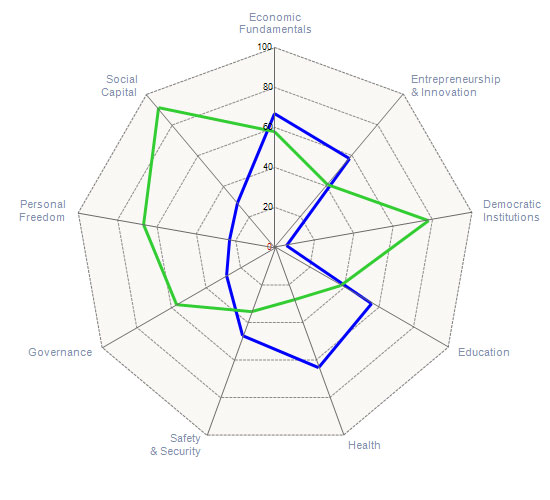
The Legatum Prosperity Index ranks 104 countries (covering 90 per cent of the world’s population), based on a definition of prosperity that combines economic growth together with measures of happiness and quality of life.

Though China outperforms India on several economic indicators, India’s overall ranking, according to the Legatum Prosperity Index, is superior. India performs superior in the critical non-economic factors such as personal freedom which encompasses freedom of speech and religion, national tolerance for immigrants and ethnic and racial minorities. India also ranks highly on measures of social capital, reflected in the percentage of citizens who volunteer, give to charity, help strangers, and who feel they can rely on family and friends. In this area, India ranks fifth in the world, ahead of the United States, the United Kingdom and Finland.

(Blue line is for China and the green for India)

In overall ranking in the Legatum Prosperity Index 2009, India is at 45, while China is placed at 75: Why India beats China. Is it not something for China to be envy of India?

Some more worrying reports are troubling China. According to one report, India currently has the lead over China in terms of foreign OEMs’ wholly-owned R&D activities. India for many years has been – and currently still is – cheaper than China for R&D in terms of wages and operational costs.

Further, according to one recent report, ‘India’s exports of minicars and hatchbacks gained 44% between January and July to 201,138. Total exports of cars, including vans, sport-utility vehicles and trucks, rose 18% to 229,809. In contrast, China’s exports slumped 60% to 164,800 between January and July, according to government data.’

India must and can develop fast, if it focus on its strengths, be it pharma or IT, auto or R&D and try to get into manufacturing in big way both for domestic consumptions and exports as many OEMs are on look out for a second source because of the trouble due to making China the sole vendor. With India’s indigenous capability in areas such as space, atomic energy, and missiles, India can be significant player in high tech manufacturing too. India must go for it.

India with its strength and prosperity can make China go for sustainable good relationship.

Posted in economy | Tagged | 1 Comment

ITC and Future of Farming in Rural India

ITC through its rural initiatives such as e-Choupal network has provided a way out to bring prosperity for the farmers that interestingly must be one of the main priorities of any government.

ITC’s e-Choupals today serve 40,000 villages and 4 million farmers, making it the world’s largest rural digital infrastructure. Each e-Choupal serves as information centre through its real time connectivity with the market with help of Internet and the computer.

ITC through e-Choupals sources commodity from farmers directly and perhaps provides a better price too because of the absence of the intermediaries.

Choupal Saagars are the one-stop shops catering to all the needs of the rural community.

ITC rural initiatives, be it e-Choupal or Choupal Saagars, provide a significant boost to farm productivity through extension services and research based agri-inputs-best farming practices, the optimum fertilizers and insecticides based on soil testing besides the competitive prices in different markets.

The e-Choupal Infrastructure also enables an efficient two-way flow of goods in and out of the villages. Apart from ITC’s FMCG products, almost 70 other companies also ride this unique channel to offer rural consumers a wide spectrum of choice in a cost-effective manner.

ITC’s initiatives like the ‘Choupal Pradarshan Khet’ bring sustainable agricultural best practices to farmers and have demonstrated significant productivity gains.

Recognizing the growing role of chemical free fertilizers in sustainable agriculture, ITC has launched organic based farm inputs for integrated farm management. The neem-based branded Organic manures such as ‘Wellgro Soil’, ‘Wellgro Crops’ and ‘Wellgro Grains’ have already gained wide acceptance for their superior efficacy in soil nutrition and crop management.

ITC has set up a dedicated state-of-the-art R&D Centre in Hyderabad with a focus on agri-sciences.

ITC’s Integrated Watershed Development initiative has helped create freshwater potential in water-stressed areas. ITC has also provided integrated animal husbandry services have reached out to over 3, 00,000 milch animals creating avenues for non-farm based livelihoods.

May be, it would have been on much larger scales and in many regions of the country that really remain in dark age, but ITC has provided a business model that if supported by the government and other companies can in real sense bring prosperity to the rural India. I wish the company focuses more to the goal and I pray some evil forces in the society and government don’t upset the dream,
http://www.itcportal.com/chairman_speaks/chairman-2009.html

Tele-farming: ITC plans to bring out e-Choupals Version 3.0 to add mobile phones to the existing channels of net-based computers and Choupal Saagaras to expand its reach to deliver personalized agri-services to individual farmers via the exploding population of mobile phones in rural India. ITC is tie-ing up with Nokia that has already ‘Life Tools’ meant for one way dissemination of farmer-related information from Nokia to the farmers. ITC aims to make the information flow two-way. May be, the idea is on the line of the process used for the tele-medicine. With expanding capability of the mobile phones, a farmer will provide information, say, the photograph or video of the soil or the crop, the date of sowing, the seed used to the company directly or through e-Choupals. The company experts process the information and provide the specific advice. And with all the best information available, why can’t the today’s farmers improve the productivity and get into an era of prosperity?

I wonder why the agriculture universities, its faculty and researchers can’t join the move of providing the best information to the farmers. Why can’t each institute reorganize itself to assist the farmers for whom they work and have a call centre to provide such services that he needs? What is the use of the hard work of these scientists if it can’t make the farmers produce more and be prosperous?

Either the government-funded universities and research organizations change themselves or many private enterprises will do their jobs.

I wonder the scope of tele-farming will bring about hundreds of innovations in mobile technologies that can change the farming all over the world. Will the scientists take the challenge?

Posted in industry, management | Leave a comment

India’s Scientific Heritage and Mathematics

Justice Markandey Katju, Judge, Supreme Court has deliberated wonderfully on ‘Sanskrit-Language of Science‘ providing a real insight into India’s scientific heritage and the great scientific achievements of our ancestors. I appeal every English-knowing Indian to read it and so I wish the readers of my blog to go through it. I am quoting below what he says about the contribution of our ancestors to mathematics:

The decimal system was perhaps the most revolutionary and greatest scientific achievement in the ancient world in mathematics. The numbers in the decimal system were called Arabic numerals by the Europeans, but surprisingly the Arab scholars called them Hindu numerals. Were they really Arabic or Hindu? In this connection it may be mentioned that the languages Urdu, Persian and Arabic are written from right to left but if you ask any speaker of these languages to write any number e.g. 257 he will write the number from left to right. This shows that these numbers were taken from a language which was written from left to right and not from right to left. It is accepted now that these numbers came from India and they were copied by the Arabs from us.

I would like to illustrate the revolutionary significance of the decimal system. As we all know, ancient Rome was a great civilization, but if one would have asked an ancient Roman to write the number one million he would have almost gone crazy because to write one million he would have to write the letter M which stands for millennium (or one thousand) one thousand times. In the Roman numerals there is no single number greater than M, which stands for one thousand. To write 2000 we have to write MM, to write 3000 we have to write MMM, and to write one million one has to write M one thousand times.

On the other hand, under our system to express one million we have just to write the number one followed by six zeros.

In the Roman numerals there is no zero. Zero was an invention of ancient India and progress was not possible without this invention.

One can read about the great contributions of our great mathematicians like Aryabhatta, Brahamgupta, Bhaskar, Varahamihira etc. by using Google. However, I may just give two simple illustrations in this connection.

The number 1, 00,000 is called a lakh in the Indian numeral system. 100 lacs is called one crore, 100 crores is called one arab, 100 arabs is called one kharab, 100 kharabs is called one neel, 100 neels is called one padma, 100 padmas is called one shankh, 100 shankh is called one mahashankh, etc. Thus one mahashankh will be the number 1 followed by 19 zeros (for further details you may see V.S. Apte’s Sanskrit English Dictionary on the internet by using Google). On the other hand the ancient Romans could not express any number larger than one thousand except by repeating M and the other numerals again and again.

Take another illustration. According to the Agni Purana, the Kaliyuga in which we are living consists of 4, 32, 000 years. The preceding Yuga is known as the Dwapar Yuga and is twice as long as the Kaliyuga. Preceding the Dwapar Yuga, is the Treta Yuga which is thrice the duration of the Kaliyuga. The Yuga preceding Treta Yuga is the Satyuga which was said to be four times longer than the Kaliyuga. One Kaliyuga, one Dwapar Yuga, one Treta Yuga and one Satyuga are collectively known as one Chaturyugi (or 43 lacs 20 thousand years). Fifty Six Chaturyugis are known as one Manovantar. Fourteen Manovantars is known as one Kalpa. Twelve Kalpas make one day of Brahma. Brahma is believed to have lived for billions or trillions of years.

When our people do the sankalp, which is to be done everyday by orthodox people, they have to mention the exact day, month and year of the Kaliyuga as well as the Chaturyugi, Manovantar and kalpa in which we are living. It is said that we are living today in the 28th Chaturyugi in our present Manovantar, that is to say half the Manovantar of our Kalpa is over, but the remaining Manovantar is yet to be completed. We are living presently in the Vaivasvata Manuvantar.

One may or may not believe the above system, but one can only marvel at the flight of imagination of our ancestors who could conceive of billions or trillions of years in history.

Aryabhatta in his famous book called the Aryabhatiya wrote about algebra, arithmetic, trigonometry, quadratic equations and the sine table. He calculated the value of Pi at 3.1416, which is close to the actual value which is about 3.14159. Aryabhatta’s works were later adopted by the Greeks and then the Arabs.

Is not it great reading? My knowledge of the subject is limited and I can’t even figure out if Honourable Justice Katju has been biased in providing the information. However, the information may help some Indians to shake off their inferiority complex and will also inspire some to repeat some to come out with their great performances in academic achievements such as Nobles that has become the ultimate ambitions of the present era.

Posted in education | Leave a comment

Bihar Science Congress: A Letter to Vikrmaditya

Dear Vikramaditya,

In the Bihar Science Congress perhaps a significant number of academics, intellectuals and other celebrities of the state will deliberate. With politicians engaged almost more than 100% in vote politics and in making themselves rich, can those at conference ponder over, deliberate and resolve how they improve the condition of Bihar in spite of the desired amount of support from the government? I firmly believe that it can be done. Can you get my views circulated and deliberated?

Can the educational institutes worth some name in Bihar take some more responsibilities without looking to the government? Each of the educational institute must aim to become Nalanda and Vikramshila on its own through its alumni and donations from the people and the rich. I am sure that many in Bihar still will like to donate for education that was the practice in good old days. I do also believe that like many other social movements, another social reform movement is a necessity. The movement must propagate to channel all donation and charity to temples and priests or expenditures for rituals to the educational institutes and that will provide the similar benefits and blessings from Gods and Goddesses. Further, can the institutes take up the following tasks on priority?

1.Can each educational institute have a very good website of its own providing all information and their researches, the video lectures of its best teachers, PhDs thesis, and other papers?

2.Will the institute make education more employment focused, have language lab, and computer based science courses. Will the institutes focus on honours courses in all applied science subjects, as it will be equivalent to engineering? Will the institutes encourage effectively the teachers and students with aptitude and interest to research?

3.Let every institute have an active association with its alumni and use the successful ones for guest lectures at whenever they visit the home state. Let a fund be created with their donation totally dedicated to advance education.

4.Will the educational institutes grow its interactions with rural India, make the rural issues as subject of study at post graduate and PhD level and propagate the need of education among the rural masses including the deprived classes?

5.Will the educational institutes encourage entrepreneurship and innovation in its curricula of all levels, focus on researches on new areas such as indigenous green technologies and rural use?

6.Can the educational institutes shun politics at least for next 10years?

7.Will the educational institutes at all levels build essential ethics, values, and soft skill essential for building a sound happy society?

8.Will the teaching community rethink on building its respectability in the people as the olden days where guru was respected more than even gods and goddesses?

9.Will the educational institutes go out of the way to focus more on the education of the girl students, adopt villages to eliminate illiteracy among the women?

10.Can some of the intellectuals help converting every temple of the state into a good school?

I am sure you and your core organizing group may further fine tune the issues mentioned in my list above. But you all will certainly agree that my appeal and request may make some impact on the state of education in Bihar. My only request to you is to get this circulated in all the educationists. They may be asked to contribute to make the list universally acceptable.
I wish the conference a great success.

Posted in education | Leave a comment