Sher Shah Provides Path

In last fortnight, I saw the name of Sher Shah mentioned many times, though in different contexts. Lalu Prasad compared Sonia with Sher Shah. What a sycophancy! But I excuse Lalu for his statement, as I don’t expect anything better. Lalu and for that matter all politicians must get some intensive tuition at home after getting elected. Another mention of Sher Shah came from JD (U) general secretary Shivanand Tiwary, who was once sycophant of Lalu and now, has come in Nitish camp: “Nitish is similar to Sher Shah as he has build infrastructure in his state.” Tiwary has gone a step ahead and compares Lalu Prasad with Shah Jahan: “Lalu has groomed his wife, a political rookie, to rule the state and has developed the Indian Railways around her Selarkala village. Thus, he is our Shah Jahan, who built the Taj Mahal to immortalize his wife Mumtaz.” Is this digestible by the people of Bihar? I am sure both the gentlemen and some other politician will bring the name of other great sons of Bihar to compare their godfathers and godmothers.

However, Amertya Sen also referred to Sher Shah while addressing the intellectuals and administrators of Bihar in Patna recently when he had visited Nalanda as mentor of Nalanda International University. “Bihar led the country in many areas including spreading the idea of democracy during the Ashoka period when the concept of democracy was not known in other parts of the world. Furthermore, it was Sher Shah in Bihar and Bengal that first embarked on the massive project of building roads and bridges to connect large cities.” However, interestingly and very rightly Dr. Sen warned people to not continue to dwell in the past but to use it to learn lessons from it.
Let me provide certain basic historical information.

Sher Shah could rule the nation for a very short spell of five years. He ascended the throne of Delhi in 1540 AD after driving away Humayun, the Mughal emperor and ruled till he met an accidental death in the fort of Kalinjar on 10th day of Rabi’ul Awwal, A.H. 952 or the 13th May 1545 AD.

Sher Shah’s most brilliant achievements were in administrative reforms. He carried out extensive agrarian and administrative restructuring laying the foundation for the administration which helped Akbar.
To check undue influence of the officers in their respective jurisdictions, the Sher Shah devised the plan of transferring them every two or three years.

Sher Shah also instituted the Subcontinent’s first effective law and order force. It is said about his rule that “a woman could travel with all her jewelry in his empire without being afraid of getting looted.”

Sher Shah’s greatest legacy is the modern Grand Trunk road which ran from Bengal to Attock. However some claim it ran right up to Kabul with “Baulis” and “Sarais”, the equivalent of Modern day Service stations all along the road. According to some, ‘Sher Shah only restored the old imperial road from Calcutta to Peshawar, built a road from Agra to Jodhpur and Chittor linking up with the road to Gujrat seaports and a third road from Lahore to Multan, the window for caravans going to West and Central Asia.’

However, Sher Shah was a brave and valiant soldier. He kept on expanding the empire by defeating smaller rulers to integrate the country. He died while leading from front. Will Lalu and even Nitish show some acts of brave and aggressive decisions that pull up the governance and get all the projects of the state implemented in time? We will expect them to fight with a ‘sher’ to save the weak and deprived. They can surely cut down the CAT force that keeps them guarded and engage them against criminals.

Sher Shah’s performance is to be emulated by all the administrators who keep on living on false promises by announcing projects or laying foundation stones. Sher did everything in five years (granted by the Almighty) and left an ever lasting impression on the Indian history for the posterity to judge. Why can’t the present politicians when in chair promise only what they can do in the five years granted to them by the constitution and facilitated by the people of India?
Posted in Uncategorized | Leave a comment

Salt Lake -I Love and I Hate

I am in Salt Lake for almost a month now. I sit in my balcony on the second floor sometimes. I enjoy the quietness and solitude and sometimes the real and rare beauty of the rising sun. Rarely, any car passes by. I hear almost everything that the passersby are arguing for while going to their destinations. There is hardly any smog. The tall trees lining the avenues present serene surroundings, but for the time when you receive something obnoxious from little birds on the trees without my knowledge. Some roads are bad but mostly the internal roads are smooth and clean. Even with the sand used as filling materials, the dust in atmosphere is less. May be it is because of the number of vehicles and lack of construction work.

But there are many reasons to hate Salt Lake. As I walk down the second avenue and then to the first one for my morning walk, the pungent smoke in the air from the oil fired stoves used by the roadside shabby snack shops sickens me. All along the administrative buildings, be it Unnayan Bhawan housing Kolkata Metropolitan Development Authority, or Bikash Bhawan, these eyesores to help poor way of creating employment pains me. Why can’t the government create well done Kiosks and hand over to the deserving vendors? Why should we, as residents of the area tolerate these mushrooming and chaos of these stalls? Perhaps India has such has not developed the right way of doing things that provides the delight of a better ambience. Perhaps all the citizens require a compulsory training in good housekeeping and Japanese workplace management tools Five S.

The political unrest over land acquisition that forced the West Bengal government to withdraw plans of a massive chemical hub in Nandigram and Tata Motors to relocate its main ‘Nano’-manufacturing plant from Singur to Gujarat has certainly taken its toll on wider scale including the development work in Salt Lake too. The stopped construction work of the school complex in front of my house or the rusting columns of the project on the way to central park with growing plantations around it shock me. I am sure the government could have developed the central park of the Salt Lake as a showpiece like Hyde Park. A huge plot of land around it is still lying idle. May be one day some project of commercial importance will get preference over the greenery. A cricket academy has already come up using a lot of land and the bus stand and stalls around it are already an eyesore. I hate the slow or no changing city. I used to tell my friends in other city that even after years when I visited Salt Lake, I could remember the brick left by some and lying on the walking route in the same place. In January 2008, I found Salt Lake changing fast, but surprisingly Salt Lake development but for the Sector V has frozen again. It is disturbing. I hate it. Even the much talked about Sector V needs a lot of work. The roads must get it footpaths. Shabby stalls must go. It must go Bangalore class, if it wishes to compete. I was surprised to find a traffic jam at the entrance to Sector V from the Karunamoyee side. Perhaps, a flyover under construction may ease the problem.

From Telegraph

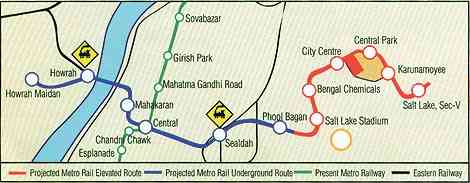
But before I could complete this writing on Salt Lake, I found a good reason to be happy. Yesterday, the chief minister along with the strong man of Congress, Pranab Mukherji laid the foundation of the 13.77 kilometer (km) long East-West Metro corridor that would run from Salt Lake Sector V up to Howrah Maidan. I wish West Bengal to prove that it can work under a promised time frame of completing it by 2014.

I and my sons who were born and brought up in West Bengal shall love to ride on it from Howrah to Karunamoyee that will be my station, according to the announcement.

I wish the authority would have shown a more futuristic insight and extended it to the new township of Rajarahaat and the Kolkata Airport.

Posted in Uncategorized | Leave a comment

HM: Mythological Motown

I could never think that HM would be news material worth a place as the main headline on the front page of Telegraph. Only yesterday, a worker from HM visited me hearing that we were here in Salt Lake. I got the information of the headline from him. But he was just surprised rather annoyed why the company is deducting Rs 400 from all the permanent workers. He is still temporary after working for more than 12 years. He still hopes that if the company executes the agreement with the union, he will be become permanent. And he gets work hardly for 15 days a month.

In January 2008, we visited the residential zone of HM. I saw it dying and barren. Whatever had been constructed with lot of fanfare is decaying in the ghost township. When I remember of 60s and 70s, I feel anguished. For the facilities for employees and their children such as the dispensary and the high school, the present workmen are to pay. Teachers in school are on contract and paid nominally. I wanted to go in the factory and take some photographs of the places where I worked for so many years. I talked with a senior executive of our time who still holds an important position. He, a civil engineer by profession, is local with political connections working as administrator is the main executer of the management’s labour related issues. However, I didn’t get a favorable response about my visiting HM. And I didn’t want to do that without permission that I could have.

With forced VRS, the employees were made to leave. Those who refused to accept VRS were transferred to far distant places to make them leave. The largest manufacturing unit in West Bengal has become unrecognizable. Heavy engineering division has been sold out. However, the company still produces some Ambassadors. Other products such as Contessa, Trekker and Hindustan Trucks have gone in history. I don’t know why the pundits in CII still talk of the labour reform. With militant unions in India, the only beneficiaries are the officeholders in union.

I don’t know but perhaps today’s story of the workers at Hindustan Motors (HM) having responded to a management appeal to join executives in accepting a pay cut is that of the reporter or planted by the management. Unfortunately, the reporter does talk about the pay inequity between the executives and workers. Most of the executives including the CEO with almost no responsibility because of no work going on inside the factory are very highly paid are all from the South. For long the CEO has started believing that the local executives can’t be that rough and tough with workmen. The union office bearers have colluded with the management to damage this industrial giant of the state. And the promoters have squeezed the best from it.

I feel bad only as the story has tried to paint the executives pay cut as exemplary to please Pranab Mukherji and the government that suggested the preference of pay cut over the layoffs. Even the name of Vikram Pundit of Citi Bank has been referred in the report. I don’t think there was any dialogue with the workmen at large with an appeal of pay cut, which is very much possible with the dwindled numbers of workmen now employed in the factory.

I don’t know why the media play in the hand of unscrupulous business houses.

Posted in Uncategorized | Leave a comment

Business Competitiveness, Bihar and Politics

Last issue of Business World was a special on the business competitiveness of the states of India. Maharashtra leads followed with Tamil Nadu, Gujarat, Punjab, Karnataka, Andhdra Pradesh, and Haryana among the larger states following it. Even among the prosperity level of the states, India has a huge gap. Interestingly, the per capita income of Maharashtra (Rs 48,171) is almost four times that of Bihar (Rs 10,286). However, I doubt if the per capita is based on truthfully provided data, and it has considered the contributions of migrant population of the state that one can find in every corner of the country perhaps more rightly the globe today, from Fiji to West Indies.

One clear cut reason for the gap appears to be the gross neglect of education by the state such as Bihar as it will be clear from the box below. Over the years, the state didn’t make any endeavour to create educational facilities as some of the other states, particularly of South did or today even UP at least in Western region is doing. A spark of hope appeared with many proposals for engineering and medical colleges appearing in the lists of investors, when the Nitish came to rule but nothing much has materialized. I don’t know why the investors are shy to invest in education in Bihar when the students from Bihar form a good percentage of the student population of the educational institutes in almost all states. Will some educationists of Bihar and its education ministry enquire into the reasons and the state take steps to remove the barriers for investment? I still feel the state must do serious and sincere introspection in the subject. Without creating sufficiently excessive capacity for professional education, the state can’t even dream of growth in per capita income. As I know most of the people from Bihar having acquired education get employment also outside the state and settle down there contributing to the domiciled state’s GDP.

I can understand Nitish Kumar’s agony when he expressed his displeasure for NRIs not investing in the state even after all the efforts made by him and his deputy. “The state government, as claimed, had spent millions of rupees on trying to attract NRIs for investments in the state, and also set up an NRI cell to facilitate investment in Bihar from expatriates. But till date, the state has not got a single big NRI investment.” Nitish must not lose heart. Indians are not the Chinese. Very few Indians are big entrepreneurs with sufficient cash to invest in India. The people of Bihar are mostly salary earners. With the breaking up of the joint family, the younger generation is not ready to part with their earnings even with family what for the state.

GDP per capita: Bihar’s GDP per capita is Rs 10, 286, the lowest among all the states of the country below even Orissa, Jharkhand, UP, and Chhatishgarh and the population is 91.63 million, the third highest after UP and Maharashtra.

Engineering graduates: Bihar produces hardly 6,376 engineering graduates per year that is lower than all the major states. Tamil Nadu produces the highest at 329,271 and even Orissa producing 45,357. Uttar Pradesh turns out 1, 03,573.

Road networks: Bihar has 81,655 kms, whereas UP has 248,481kms and Orissa 238,000kms.

Nitish Kumar has taken a lot many steps to pull up the brand image of Bihar against all odds, be it Lok Shahi (Rule of the People), by making public the mobile phone numbers of the chief secretary and a clutch of other top officials to make the officers more accessible to the people. But it goes to the officers how effectively they take it and make it effectively useful for the people. His scheme of loan to each agriculture graduate for setting up agriclinics and agribusiness centres is a great endeavour in right direction. But how will he motivate them to be master the subject that they are expected to advise the farmers with? The culture of getting certificate by any fair and foul means to prove once education standard and knowledge and getting the right for a job must improve if not end some day. Unfortunately, most of the employees in government consider getting job as their right once they get it and don’t consider taking the responsibility of the position as essential. Nitish must build in stick in the system and not provide only the carrot. Similarly, the idea of ‘the constructions of the so-called ‘e-bhawans’ at block levels in an attempt to improve the flow of information between the farmers and the government officials while offering other facilities to the growers including a soil test laboratory, conference room, phones and fax availability, internet connection and an information center’ is a wonderful one with lot of potential. I am sure Internet will reach each of the villages through some schemes such as e-Choupal. It will certainly make the technologies serve people.

Nitish Kumar has also announced the setting up at an agricultural university in Bhagalpur at an estimated cost of Rs. 350 crore to develop a vital research center in the state providing the farmers the kind of information that would help increase the production while at the same time raising the quality of the farm products. I only wonder it is not a political announcement for political gain in coming election.
Politics of development already has done a lot of harm to the state. Can the three biggies of the state politics shun that for some years? Let the people understand the close relationship between politics and economic outcomes.

I only wish the India Inc. or may be, the central governments don’t perpetuate the development apartheid of Bihar. The people of Bihar will not forgive that.

Posted in bihar, economy | Leave a comment

Bharat Nirman – The Trump card of Man Mohan Singh

Bharat Nirman has become the symbol of Man Mohan Government, if we go by the importance given to it in projecting the achievement of this through digital media including TV ads something on line of the shining India of NDA.

Man Mohan Singh must get credit to give a name to this rural development programme. I got excited as it had a time frame that was to end with the end of the mandate given by Indians to this government in 2004. Before the government changes for a new one in 2009, the targets of the six basic rural necessities under Bharat Nirman would have been attained.

Roads: +38,484 villages above 1000 population and all 20,867 habitations above 500 population in hilly and tribal areas would have got road connections with 1, 46,185 kms of road length constructed by 2009.

Telephone Connections: 66,822 villages without a telephone would have got telephone connection.

Irrigation: 1 crore hectare of agricultural land would have got irrigation facilities-6 million hectare from major and medium projects, 3 million hectare for ground water development and 1 million hectare from minor irrigation projects.

Drinking water: 55,067 uncovered habitations and 2, 16, 968 villages affected by poor water quality would have got potable water, beside providing the same to 2.8 lakh habitations that have slipped back from full coverage.

Housing: 60 lakh houses at the rate of 15 lakh houses each year to be built by funds allocated to the homeless through Panchayats.

Electrification: 1,25,000 villages were to get electricity by grid based supply or in remote and inaccessible areas through alternative technologies

It is interesting that Interim budget presented on February 16 mentioned only about the achievements of houses built: “In the period between 2005-06 and December 2008, 60.12 lakh houses have already been constructed.” For all other components of Bharat Nirman, the interim finance minister had only data of financial allocation increase and additional allocation amount but no hard figure. “During 2005-2009, the allocation to this programme has been increased by 261 per cent. For the year 2009-10, I propose an allocation of Rs 40,900 crore for this programme.”

And this has been the modus operandi of all the governments since independence and perhaps will remain so for the next one too. Can someone, and who can be better that Man Mohan or Montek, tell the people of India the year when all Indian villages will be electrified, connected by roads and have telephone and at least safe drinking water? Should not the parties going to election provide hard data rather than giving percentage increase in allocation in crores?

Indian expects from the government a time frame to reach universal education, ensured health care, total sanitation, and social security in case of layoffs such as the one that is becoming big alarming news.

Will the voters be educated to demand this?

Posted in economy, governance | Leave a comment

India’s Priority: temple, terror, or turbine

BJP has again revived the slogan to build a magnificent temple for Lord Ram in Ayodhya. Unfortunately, neither BJP nor its allied institutions such Vishwa Hindu Parishad talk about huge lot of money collected for the temple. Even the devotees are meek enough to raise this question. Who stops them to build a temple grander than Akshardham temple that has come up near Delhi and has become a must for all the visitors to Delhi? Why should it not come up on the bank of Gomti on a suitable location with all the inputs of the 21st century and become the land mark for Ayodhya that becomes a must for all visiting the country of Rama just as TajMahal? I am sure even the Muslims of the country will provide the helping hands. The project can integrate the countrymen. As such with so many temples in the country, I am not in favour of building some more. Instead, the resources can be used for building a grand university, perhaps the largest and the best in the world. Can BJP come out with some innovative ideas to achieve universal education and healthcare for all within four years of the rule if they win?

The fight to end the terror of all sorts, be it from jihadis, naxalites, or other regional groups is a national issue and all political parties must talk in one tone to wipe that out. If the country can’t assure the peace and keep on allowing the violent protests and agitations in name of democratic rights, India must forget to have a respectful place in the world economy.

And by turbine I mean the power. The government has completely failed this basic necessity to its citizens. How can a country think of moving ahead with this shortage of power? How can a country live with one BHEL to supply equipment? The NDA failed, and the UPA has been worse. Be it nuclear, thermal, hydro, or alternative sources such as wind or sun, the people must get electric power they need. And I don’t mean to waste by providing that free as the politicians do. Will the political parties come to a consensus that hereafter no power will be given free to waste? And this free power is wasting our water resources too by over irrigating.

But who will do that? India is still to search for its Obama who can at least instill some hope. India doesn’t lack talent. If the junior Ambanis can excel after the death of the legendary Dhirubhai, why can’t so many of the young MPs who got elected, but have never done anything remarkable enough to be noticed by all with hope and pride.

Posted in economy, governance | Leave a comment

Nitish Kumar: An Open Lette

I have been writing supporting the objective of your Vikash Yatra. However, I was shocked to hear a report on NDTV India today.(One ca see it on video on khabar.ndtv.com) It showed some farmers somewhere in Katihar and their produce totally spoiled by tractors to construct the camp for your Janata Darbar. Do you know that? Who will bear the loss incurred by those farmers? Is it the way to organize the meeting? Can’t it be avoided? Have you instructed your officers to minimize the inconvenience of any sort to the farmers? If it is being done in so poor manner, you must stop it immediately.

Every panchayat if not every village is having a lot of government waste land that historically served as grazing ground. Why can’t the waste land be used for your meeting and camp, if you can’t find some houses to accommodate your people? Even though you may be a chief minister, who has permitted you and your so-called arrogant and autocrat officers to spoil the cultivated farms?

I appeal and request to find out the affected farmers who were shown on the TV channel and get them immediately compensated sufficiently. You also must apologize for the faults of your officers. Please appreciate the misery of the poor farmers and don’t break their dreams based on the small little grains that he waits so long from harvesting to make his living. If the report of NDTV India is wrong, please be brave to drag it to the court for wrong reporting.

I request readers to respond to my letter and appeal. All the readers agreeing with me must write to the CM.

Posted in Uncategorized | Leave a comment

Vedic Mathematics to Vedic Management

I understand Dr. S Kannan, a Chennai-based Chartered Accountant, has written a new book ‘Vedic Management’. I had known only Vedic mathematics. One of my old friends, MK Sharma demonstrated once the ease with which one can solve big arithmetical problems using Vedic Mathematics methodology. Perhaps writing a book on Vedic management might be easier, as the management is not as exact a science as the mathematics. One can correlate the content of old scriptures easily with the present management problems and its solutions.

I have gone through some scriptures at least partially. In my school days, I had read the Hindi version of Mahabharata. It appeared to me as one of the most interesting stories that I came across. Ramayan was equally engrossing. Later on I came to know about Kautilya’s Arthashastra that can provide some tricks about corporate governance even today.

In Chapter I of Book XI, Kautilya’s Arthashastra, one can find some guidance as to how a chief executive should conduct himself: “The chief of corporations should endear himself to all the people by leading a virtuous life, by controlling his passions, and by pursuing that course of action which is liked by all those who are his followers.”

In Chapter XV of Book 1, one can find some advice to what can be considered board and audit committees: “All kinds of administrative measures are preceded by deliberations in a well-formed council. The subject matter of a council shall be entirely secret and deliberations in it shall be so carried that even birds cannot see them.”

Kautilya prescribed severe punishment for all who do not act as per these norms: “Whoever discloses counsels shall be torn to pieces. The disclosure of counsels may be detected by observing changes in the attitude and countenance of envoys, ministers, and masters.”

Will the managers today follow the lessons Kautilya prescribed in the 4th Century BC?

Dr S. Kannan’s ‘Vedic Management’ will be an interesting reading.

Both Ramayan and Mahabharata emphasizes about truth and righteousness. “Ravana and Duryodhana, though highly learned, powerful and wealthy, faced destruction finally when they went against dharma (righteousness). Harischandra suffered a lot but emerged finally victorious as he remained steadfast and upheld truth at all costs.”

The ancient Indian wisdom inspires to speak the truth and follow the path of righteousness. (Satyam vada! Dharmam cara! – Taittiriya Upanishad i-11).

The path of truthfulness is said to be supreme (Tasmat satyam paramam vadanti – Mahanarayana Upanishad lxxviii-1). Truth is the foundation of the earth (Atharva Veda Samhita xiv-1-1). Truth alone wins (Satyameva jayate – Mundaka Upanishad iii-1-6).

The Vedas talk about the following key values as very important: (a) Satyam – Truth; (b) Tapah – Austerity; (c) Damah – Sense control; (d) Samah – Tranquility of mind; (e) Dharmah – Righteousness; (f) Danam – Charity; (g) Daya – Mercy; and (h) Nyasah – Renunciation.

The Bhagavad Gita specifies twenty values (Chapter XIII -8 to 12), which are immensely relevant for any manager in the modern day corporate context as well:(a) Amanitvam – Humility; (b) Adambhitvam – Pridelessness; (c) Ahimsa – Non-violence; (d) Kshanti – Tolerance; (e) Arjavam – Simplicity; (f) Acaryopasanam – Service to the teacher; (g) Saucam – Cleanliness (internal and external); (h) Sthairyam – Steadfastness; (i) Atma vinigraha – Self-control; (j) Vairagyam – Renunciation; (k) Anahankara – Absence of ego; (l) Janmamrityu jaravyadhi duhkha dosa anudarsanam – Reflection of the sufferings of life-death, old age-disease, and distress; (m) Asakti – Non-attachment; (n) Anabhisvanga putradaragrhadishu – Detachment towards son and wife; (o) Nityam samacittatvam istanistopapattishu – Equanimity amidst pleasant and unpleasant happenings; (p) Mayi ca ananyayogena bhaktih avyabhicarini – Constant and unalloyed devotion towards God; (q) Vivikta desa sevitvam – Love for solitary life; (r) Aratir janasamsadi – Detachment towards company of people; (s) Adhyatmajnana nityatvam – Understanding the importance of self-realisation; and (t) Tattvajananartha darsanam – Philosophical search of the ultimate truth.
There are verses to encourage and motivate us to maximise wealth so that we can take care of those dependent on us. (Annam bahu kurveta! Tad vratam! – Taittiriya Upanishad iii-9). At the same time the Vedas guide us to earn wealth only through deeds of glory (Rig Veda Samhita vi-19-10). They advise us to take care of our wealth as well as welfare. (Bhutyai nappramaditavyam! Kusalanna pramaditavyam! – Taittiriya Upanishad i-11).

One shall not blame wealth and that’s the vow (Annam na nindyat! Tad vratam! Taittiriya Upanishad iii-7). They encourage us not only to possess wealth but also enjoy the same (Annavan annado bhavati! Taittiriya Upanishad iii-7). The rich have to satisfy the poor (Rig Veda Samhita x-117-5).

The Vedas insist on proper distribution of wealth. Wealth earned by 100 hands has to be distributed to 1,000 hands (Atharva Veda Samhita iii-24-5). They encourage us to give charity in plenty with utmost faith and humility (Sraddhaya deyam! Sriya deyam! Hriya deyam! Taittiriya Upanishad I-11).

The Vedas also inspire us to innovate and improve upon (Rig Veda Samhita i-31-8), and also to succeed in trade (Atharva Veda Samhita iii-15).

Importantly, the Vedas caution us to take care of the ecology and environment as well, in the process of development and growth.

In the Bhagavad Gita iii-21 it is said, “Whatever a great man does, others follow it.” (Yadyat acarati sreshtah tad tdeva itara janah. Sa tat pramanam kurute lokas tadanuvartate.)

One shall emulate the best practices of others (Yan yasmakam sucaritani! Tani tvayopasyani – Taiitiriya Upanishad i-11).

Action has to be done whole-heartedly without attachment to its fruits. (Karmanyevadhikaras te ma phaleshu kadacana – Bhagavad Gita ii-47).

Most of the institutions including my own IIT, Kharagpur (Yogah karmashu Kaushalam) gave importance to the old scriptures by using some phrases from there. I wish the institutions give importance to the values. It should not be discarded and neglected to prove our secularism. Ramayana, Mahabharata, Gita, Upanishads, and many other ancient books including the very important Arthshastra are full of such the self improvement tips for individuals and institutions of different sectors.

Let me end this with a sloka from Gita that talks of all the elements for success in any project.

Adhisthanam tatha karta karanam ca prthahvidham
Vividhas ca prthak cesta daivam caivatra panchamam Chapter 18-14

Posted in education | Leave a comment

Made in India: Car or Laptop

It appears Tata Motors will soon launch its most talked about ultra cheap car, ‘Nano’, the small car seen as a symbol of India’s expertise in frugal engineering. Some says it may be as early as on the next March 3. The media has been covering some unnecessarily negative coverage of the company. One such was related to the delayed payment to the vendors. That is not a usual thing in a period of such an unprecedented slowdown. Surprisingly, the vendors have denied that too. Perhaps, the media men are looking for some favours from the Tata management that it doesn’t offer.

Interestingly, another news regarding the launch in media talks of the celebrities whom Tata will offer Nanos. The list includes President Pratibha Patil, Prime Minister Manmohan Singh, Congress President Sonia Gandhi and Opposition Leader LK Advani. Buddhadeb Bhattacharjee, the chief minister of West Bengal, where it was to be made initially, and Narendra Modi, the chief minister of Gujarat, who was instrumental in attracting the Nano plant to Gujarat after it failed to take off in West Bengal may also get the offers. Is it Tata’s way to get the political support for Nano? How many of these politicians will be driving the car themselves? Tata Motors must offer the cars to those who drive themselves and seek their feedbacks.

Others preferred stars for getting Nano may be Sania Mirza, Sachin Tendulkar and Mahendra Singh Dhoni or actors Aamir Khan, Ajay Devgan and Kajol who endorse Tata products. I wish the stars don’t look down upon Nano because of the huge luxury cars they keep and take pride in driving.

But it is pretty clear that the company is in financial crisis. The customers will have to book Nano by paying Rs 70,000. It is a very high amount for a product that plans to sell at Rs 1, 00,000. Moreover, with limited production from the existing plant at Pantnagar, the customers will have to wait to get the cars. It is certainly not a very customer friendly decision for the lower middle class for whom it has been created. However, I still eagerly wait for the Nanos to be on the road.

Tata’s Nano is expected to be the best for the value plus a little more. Let the skeptics of the India’s manufacturing might be proved wrong. Let Nano be accepted all over the world as the second car in the house.

Tata Motors has been credited as the first automaker in the world to embrace the concept of design-to-value to some extent. Tata Motors gave a great deal of thought to what first-time car buyers in India were looking for as it designed Nano, Let its launch be outstanding in its category and tell a different story than one that the $10 laptop did.

The recent launch of India’s $10 laptop on February 3, at Tirupati has come to many as crude joke and to me as shock because of my emotional weakness regarding the achievements of the country’s young scientists and engineers. I still wish the technocrats associated with the project take up the challenge to solve all the queries raised by the users before the commercial launch to make the competition over the world cry in envy. Let the $10-laptop vastly undercut the cheapest laptops currently available, be it the Massachusetts Institute of Technology XO-1 or Taiwanese Asus’s Eee PC net books, or that anyone do plan in future. Let the no-frills laptop effectively act as Web portals rather than storage device. Let every Indian young man and women crave to have one. Let the $ 10 laptop not become ‘flop top’.

Posted in manufacturing | Leave a comment

Challenges of American Carmakers: Technology vs. Management

Many a times I wonder why US automakers have failed to maintain the leadership and remain contemporary in technology and management. Why couldn’t GM, Ford, or Chrysler, at least the former two, establish a brand GM Production System or Ford Production System that Toyota or Honda could do? Japan might not have the management schools of the ranking of Stanford, Harvard, or Wharton, but Toyota Production System (TPS) certainly has become something to envy for any global enterprise.

And perhaps Toyota’s built-in strength could make achieve what it did recently. As reported, ‘Toyota has surpassed GM to become number one in auto industry of the world. Toyota ended GM’s 77-year grip on the crown in 2008, according to numbers that came out on Jan. 21, and the Japanese juggernaut did it with authority, selling 8.9 million cars to GM’s 8.35 million. The margin of victory is two auto factories’ worth of production’.

Interestingly, it is not the same GM that had gone ahead of Ford in mid-1930s. Are the people associated with GM morose with the downfall of GM? At least I felt bad, as I was also nearer to GM because of my 37 years of professional career in auto sector with Hindustan Motors that had various collaborations with GM and its associates such as Vauxhall Motors, UK, GM Europe and Isuzu Motors, Japan. I had spent quite some time with the companies and learnt many things.

Surprisingly, Toyota also faced quality problems time and again, but overcame it fast and sustained it. The people working for Toyota develop the products using the inputs from the end users, techniques such as Quality Function Deployment and Quality Engineering. It has all the weaknesses of a big globally spread company, but it has overcome its problems successfully in time. Its response to the market requirements- be it style, price, technology, or quality– has been speedy enough to keep the spirit of continuous improvement alive at all the activity centres of the enterprise.

Its hybrid car Prius is the maximum sold cars with its leadership in the technology for fuel efficiency as well as emission.

It would have been an interesting comparative study if one could study in depth the production systems of Toyota, Honda, GM, and Ford.

Every auto enthusiast has a question today if the bailout to US car makers will succeed to bring them back on the right track. Unfortunately, the US automakers always resist and oppose the basic and necessary reform such as one by California’s emission norms for long years till it is imposed and the compliance is made mandatory. I am sure it must be having a demoralizing effect on the technocrats responsible to work for the reforms and to take proactive steps.

Ford has promised to raise its fuel-economy standards 26 percent above 2005 levels by 2012, and 36 percent above the same baseline by 2015. General Motors, for its part, has vowed fleet-wide fuel-efficiencies of 37.3 miles a gallon for cars, and 27.5 mpg for trucks, by 2012. Will they be able to comply with that? It will be interesting to watch if US automakers survive and lead or go down like the big US machine tools and equipment manufacturers.

Perhaps one sure way out for US with its superior R&D capability and great research institutions, may be through leading the innovation for powering autos through alternative sources of energy. Can Obama, the latest American hope, make US automakers change and win?

Posted in management, manufacturing | Leave a comment