Can India Lead Through Innovations?

Many recent news reports about India and Indians make me ponder about if India can lead through innovations. The latest one giving hope came due to the person of Indian origin who shared the Nobel in chemistry this year. An interesting statement by Venky Ramakrishnan made after becoming Nobel Laureate reinforced my hope. “There are lots of good scientists in India but I notice the press is hung up about these Western prizes like the Nobel Prize instead of appreciating the excellent work they (scientists) are doing within the context of India.” Unfortunately, we hardly come to know about the scientists and their works, as the media hardly cover anything but those unscrupulous politicians and their activities. Why can’t the news magazines such as ‘India Today’ and ‘Outlook’ or business magazines come out with some special issues covering the innovations in India and the big players in innovation from industry as well as institutions of excellence?

As a routine subject of discussion that follows the announcements of Nobels every year, the media has many reporters and columnist raising the question ‘if Indians in India can win Nobel’ and providing their own answers.

Interestingly a new study became handy in time to emphasize and encourage Indians about the possibility. According to a study, conducted by British firm Thomson Reuters, and published as ‘Global Research Report: India’, “In the last decade, India has seen a substantial growth in its annual output of scientific publications. India’s research productivity will be on par with most G8 nations within seven-eight years and overtake them between 2015-2020.” But many well-wishers including NR Narayana Murthy are skeptical about the growth of innovations in India. Perhaps Mr. Murthy has sufficient reasons to be negative which is not. One reason may be the reports on the rankings of the Indian universities that hardly provide any hope. Even a recent ranking expressed the similar view. According to the QS/Times Higher Education rankings, ‘none of the Indian universities figure among the top 100 varsities of the world’. And naturally one of the pet excuses is the lack of funding.

However, I have some other reasons to be hopeful. At least few recent news reports about the technical capabilities of Indians working in the country support my hope. The news related to the finding of water traces on moon by Chanadryan-I was one. According to Chairman of the Indian Space Research Organisation (ISRO) G. Madhavan Nair, the Chandrayaan-1 detected water on the lunar surface as early as June 2009. The indigenously developed Moon Impact Probe (MIP), which crash-landed at a designated site on the lunar South Pole on November 14, 2008, picked up “clear signatures” of water during its 25-minute descent. Analysis of the data from a mass spectrometer on the MIP pointed to the presence of water. This finding was later “confirmed” by the Moon Mineralogy Mapper (M3), which was supplied by the United States.

Another landmark research related to genetics. It has revealed that nearly all Indians carry genomic contributions from two distinct ancestral populations. Following this ancient mixture, many groups experienced periods of genetic isolation from each other for thousands of years. The study has medical implications for people of Indian descent. Samir Brahmachari, a geneticist of repute and CSIR’s director-general says, “India is among the first country to do a diseases-specific, drug-response mapping on large populations which gives us risk analysis and benefits.”

Besides the facilities of CSIR and DRDO, the scientists and technocrats in huge number of research facilities of the country running in thousands are busy in their pursuits of innovations. But the potentials are still more. The rush of the multinationals to open its R&D centres in India and the performance of some who are already established are proofs of the talents of Indians and potentials.

It requires only course corrections with the necessary change in the mindsets. I wish PM could have a CTO for the country too. Perhaps, persons like Nandan Nilekani, Sam Pitroda, or someone would have been more suitable for this bigger responsibility.

Just to give one example of the potentials, each IIT must have ‘an Institute of Science’ integrated with it in its campuses to have basic researches in applied and pure science. On similar lines, the big business houses would have supported an independent R&D institute to serve the sector. Can’t Tata Steel or for that matter Anil Agrawal set up dedicated R&D facilities for metal related researches?

Innovations in every field can only take the country ahead. However, it requires synergy to show fast and effectively impressive results. I was going through an article about the grassroots innovations from the rural India. I am sure if the big industrial houses take interest in some of them and fine tune it, the result will be wonderfully unique and commercially successful products for even global market.
Posted in economy, industry, management | Tagged | Leave a comment

The Poor Indian Nobel Laureate

‘Venky‘, the Nobel winner does not own a car and rides a bicycle to work. “Asked what he would do with the money, he laughed and said he did not even own a car, but that he might buy a new cello for his son who is a cellist in New York.”

Three American Indians could manage Nobles in science, but none could do it while working in India after CV Raman. Sibal, his bureaucrats and the whole community busy in scientific and technology researches in perhaps hundreds of the research laboratories in the country must ponder and perhaps let the people of India know the reason for not been able to do that. Sibal had a mention of Nobel during the recent conflicts of IIT teachers for wages. He expected them to strive for Nobel instead.

But the nation expects some answers of the two simple questions:

Did Raman’s laboratory facility match with those of the scientists in the developed country?

Are the facilities in the laboratories in India are really not comparable with those in America’s laboratories? If the answer is yes, naturally the next question comes to my mind. With billions rupees budgeted for the laboratories, can’t some be selected to have the facilities at par with those in American laboratories?

As India celebrates another Nobel moment, science salutes the work of Venkatraman Ramakrishnan.

I was going through the New York Times news report about the 2009 Nobel Prize for Chemistry, and Venkatraman Ramakrishnan of the M.R.C. Laboratory of Molecular Biology in Cambridge, England; one of the trio who has received it along with Thomas A. Steitz of Yale University; and Ada E. Yonath of the Weizmann Institute of Science in Rehovot, Israel. I read the lines quoted above from media.

And then some feels Indians in general unnecessarily get excited about the achievements of persons of Indian origin. But I would like this special Indian characteristic to continue. With so many young men and women of Indian origin moving to all the corners of the globe for greener pastures including my own children, the excitement back in this home country on the exceptional achievement like getting a Nobel will inspire the rest to perform better. No one can take away my dream of one of my grandchildren becoming the president of US or a Nobel Laureate.

While the country is agog with the news and details about the new Nobel Laureate of Indian origin, some media reports focus on the ‘DNA of the ‘Indian’ Laureate- East or south?’And this shows the another aspect of India’s character.

Posted in education | Leave a comment

It’s same: Be it vulgar, indecent or greed

How much should one CEO get as compensation? Are the amounts most of the CEOs get vulgarly excessive? Even prime minister expressed his views on the subject, sometime last year. Now Salman Khursid and Montek Singh Ahluwalia have expressed their views against the huge salaries and perks that many CEOs are drawing.

The concern has origin in USA. Even Obama expressed his concern. According to the media, the industry in US has reacted positively to his concern. In India some CEOs such as NR Narayana Murthy did also express his views against this. But overall, none in the management liked the views of the government to have constraint on CEO’s compensation. The CEOs, or why not call them, de-facto owners of the companies or groups, don’t want any governmental control on their compensation. Perhaps no one suggests that. But can they introduce some sort of self-constraint themselves? How the employees feel about the top 1% taking away the most of the cost of the company on employees’ compensation account? It is shameful for them.

India follows capitalist West system of management in every respect and so in the fixing the benefits of CEOs too. The lavishness of few ministers gets noticed and reported in media, but the misuses of the shareholders money by the CEOs are hardly reported. So is the case with the corruption by the executives in private sector. Though many of the CEOs might own similar properties as was reported for Satyam’s Raju, the media hardly knows it or dare to cover it.

Officially, the business leaders felt executive pay was an issue best left to shareholders to decide. But everyone knows how the annual meeting of the shareholders is managed and how the members of the board of directors function. Are the voices of common shareholders heard?

The whole country is happy to read the news that India has crossed the $100 billion milestone in FDI through equity since 2000 up to July this year testifying the country’s increasing profile as a safe and sound investment destination in the midst of the global financial crisis. But as much as 44% of the money came through the Mauritius route. Are we sure that the money coming from Mauritius is not the Indian money re-entering the country in official way.

Let the CEOs listen to the warning bells. They may be able to manage for all the differentials they are living with as their right for some more time, but pretty soon they will have to change or the people working for them will force them to change.

I wish the media expose more and more of the many aspects of the bad and corrupt practices in the private sectors. Only hope may be in the educated executives from B-school’s coming up the ladder in the organization to find a sustainable model for compensation and certain acceptable norms to bring in some amount of equity depending on the responsibility.

Posted in social issues | Leave a comment

हम दो, हमारे दो घर

Hum Do, Humare Do Ghar

My craze for a good house perhaps has a root in my childhood. We had a huge house with as many as four big courtyards in the remote village, but that was not of bricks. The land around our village couldn’t produce brick. Even the house of my mother in her village was not of bricks.

When I started working after IIT, my dream of building a good comfortable house started taking shape. Naturally, as the first thing, I wanted to make my mother happy. I built a house on the outskirt of her village. It was single storied but modern designed with bedrooms for parents and kids and huge drawing room and a big toilet and bath too inside the house that was not very common in those days. I got a hand tube well inside the house in absence of tap water. The house had a big courtyard with a number of trees, including mangoes on one side. I used to enjoy my stay there during my annual holidays though it used to be few. My parents lived in the house till they came to live with me in Hind Motor. Unfortunately, I had to dispose of the property in 90s along with the house after the demise of my mother, as it was difficult to manage it with none in the family to take over the responsibility.

In 1982, I got the land in Salt Lake. My mother was alive and active. When she saw the plot, she was very unhappy. The area was hardly having any habitation. But one fine morning we decided to build it. The local architect got the sanction for a three-storied house, each floor as independent full-fledged flat with four bedrooms, as Yamuna wished for her three sons. My mother saw it getting built and was very happy. While the ground floor got completed in 1989, the year I lost my mother, but the whole house- its third floor, was finished in 1992. I named it AJIRA. We lived for some time. Last April we shifted almost everything from AJIRA and rented the whole premises to an educational institute.

In 1997 after the end of the full inning at Hindustan Motors, I joined Harig Crankshafts in Noida. Yamuna also joined me. For a year I lived in a rented house in Sector 30. But for Yamuna, it became difficult to live in that accommodation with unmannered landlord. Literally, she threatened to go back to Salt Lake, unless I buy a house of our own in Noida. The search started that ended on June 14, 1998 when we moved to this house that we shall love to live in till end even with many bitter experiences of burglaries. However, as I had to discontinue my job in 2000 because of my heart surgery and my disenchantment with the physical and mental stresses that it used to cause because of my workaholic nature, I gave up my ownership of my paternal property at my village home to my only surviving uncle to pay back some bank loans taken for the Noida house. Interest in those days on even the house loan used to be around 24%.

I have learnt many lessons from my life that can be an advisory for the Next Gen. The famous Indian slogan- ‘Hum Do Hamare Do’ should also have ‘Hamare Do Ghar’. It will provide the same security to the Next Gen that we enjoy also, even if each build just one house on own. Each will inherit one after the demise of the parents. We live in Noida house and AJIRA has been taking care of our meager monthly expenses. I don’t know if the advice is good enough for the new ambitious generation.

Posted in economy | Leave a comment

Manufacturing and Machining

In Hindustan Motors, I started as executive trainee, a new concept of building managers for the future because of the company’s close relationship with General Motors, the largest company in the world at that time. After a short over-viewing of various departments of the automobile giant in the country, I started working in machine shop as it was called in those days. I used to convince some easy going workmen and work on the machine tools as regular operator to learn the tricks of the trade. I learnt a lot that Prof (later on Dr.) Chandiramani couldn’t have helped. Those were the years when Hindustan Motors were indigenizing the manufacturing of the components and buying the most modern machine tools for the same. I got myself shifted to machine tools tryout department that used to prove the machines for the production engineering aspects and cycle time before handing over to the operation. It was a great learning. Later on I was shifted to the operation, and got the first promotion as ‘superintendent’ in Axle Plant. The designation soon became more civil with a change as ‘Area Manager’ and later just ‘Manager’. After a visit to Vauxhall Motors, UK, I was shifted to become Area manager of Engine Plant. Transmission came under me only when I got promoted as Manufacturing Manager, Mechanical. Thus all along, I remained close to machining.

At one time, the President suggested me to take over as the Manager, car assembly. I was forthright to reject his offer on ground of my interest in machining, though car assembly used to have more top management attraction with better prospect for career progress. Another reason of my rejection of the offer was the company politics in the area. I was never good at that.

Much later, as General Manager, Technical Services, I headed the technical aspects of the sheet metal division too that covered sheet-metal stamping, body welding, painting, and vehicle assembly along with the mechanical division that was primarily machining along with many other responsibilities. And the years in the assignment were really exciting as I could learn almost every aspect of manufacturing engineering of an industrial product such as automobile.

Unlike others in the industry, I was one who remained academic all along the career, and kept on writing what I learnt and experienced. Tata McGraw Hill published my Trouble Shooting Handbook-Machining. Later on I wrote ‘A Treatise on Automobile Manufacturing’ and ‘Latest Trends in Machining’ that are available on my website http://www.drishtikona.com under heading ‘my writings’. Unfortunately, I couldn’t place my book on gear manufacturing that became very popular in the industry, ‘Mr. Supervisor as Mr. Manager- a guide for supervisors’ and my collection of articles written for technical magazines on my website.

Though the manufacturing management was my professional assignment I remained passionately attached in knowing the latest in technologies of manufacturing and particularly machining and machine tools. During my interactions with the executives from the machine tools and equipment manufacturers from all over the world, my favourite question used to be, ‘What are the latest in technology? How will be the manufacturing some ten years from now?’ Even today, I get a kick if I come to know of something new about machining or manufacturing.

Posted in manufacturing | Leave a comment

IIT Professors and Sibal

Sibal is meeting with professors of IITs. I wish that all the malice between them will die. And the professors will return happier to their classes and will never have to teach with empty stomach. However, I do also wish both the parties to think over and act.

Sibal and his ministry must not interfere with IITs and for that matter all the institutes of excellence, and grant the necessary autonomy that can make them globally competitive in every respect.

IITs professors must build themselves on their own as the best and respected. Will they focus on producing a generation of engineers that take pride in their engineering skills and not hanker for getting into management institutes just for getting a better salary package? Will IITs be known for their innovations, researches, patents, and papers? Is it not a shame that India in last 62 years of independence has not produced any Nobel in science subjects?

India has hardly any internationally known product. Indians at large hardly know few professors of IITs by name. Are the laboratories of IITs lacking facilities? If the answer is yes from the professors, let Sibal provide that or let the professors come out with whatever they need publicly just as they did about their demands on salary and promotions. Let the people of India know why they can’t produce the best researches that the country needs.

And I request Sibal to change the system of awarding Ph.Ds in Indian universities, instead of branding some as third class. Sibal will be respected and remembered in the scientific community, if he can lay a system that can bring respect to all the degrees and awards offered in India. Have you heard of a third class in Ph.D? I have not. But Sibal has some in his mind when he said in an interview, “I can’t allow third class PhD holders to teach in IITs/IIMs.”

Let me convince the professors of IITs that they must work hard as they expect their students to do to keep the flag of IITs flying higher. And the route of that is through hard work, breakthrough innovations, and encouraging entrepreneurships what MIT and Berkley did.

And with a due respect for the professors, I wish Sibal appoints a reputed consultancy, say under Rajat Gupta of McKinsey, to survey the opinions of the present students, alumni, and executives in India about the professors of IITs and IIMs. Let me respectfully convey it to the teachers that many with whom I have spoken are not having very good opinion.

PS: IIT-Govt standoff resolved

Posted in education, governance | Leave a comment

Save India, Drop Caste Identity

Anything for ending the menace of the divisive caste system that has kept India in Stone Age thrills me. Unfortunately, in India the governments under different political parties have been the main culprit in perpetuating the caste system. It helps in protecting its vote banks and helping some vested interests. And who does bother about India?

As expected, while the ongoing session of the UN Human Rights Council in Geneva looks set to recognize caste-based discrimination as a human rights violation, India disgustingly readies to oppose. Interestingly, Nepal, a small and also almost economically insignificant on global map has emerged as the first country from South Asia- to declare support for the draft principles and guidelines published by UNHRC four months ago for ”effective elimination of discrimination based on work and descent” – the UN terminology for caste inequities. This is against the ground reality, as the region has untouchability traditionally practiced for ages.

However, Manmohan Singh who once compared untouchability to apartheid in South Africa remains insensitive, dumb, and inactive. He is too busy with his nuclear dreams and his image-building for posterity. He can’t even discuss the issue with his cabinet members because of its possible political backlash.

Even Human Resource Development Minister Kapil Sibal, who vows to bring in the international institutes and reputed foreign universities in India, also says, “Reservation laws as applicable to Indian institutes will be applicable to the foreign institutes. There will be no discrimination.” I wish the foreign universities boycott India on this issue. The mentality of even the new educated generation is clear from the story of separate food for separate caste in a canteen of a medical college. It’s clear that Sibal is afraid of the party’s backlash/

What can one expect when the politicians are hell-bent to divide the country based on caste? Even law minister suggests the 2011 census incorporate caste for the first time since it was last done in 1931as the data available data does not accurately reflect the true proportion of OBCs.

And how can India excel if IITs are instructed by the apex court against scrapping a weeding process they practice to expel weak students mid-course. Ultimately, it would mean that students, once admitted, would not be dismissed. IITs cannot “throw out” SC/ST students on the basis of poor performance.
I recall Ashis Nandy, Political psychologist making a statement, “How is what Jinnah demanded for the Muslims different from what everybody wants nowadays-like separate representation for Yadavs or Dalits?” The Hindu caste system is a blot and a curse on India.

Even Amartya Sen had said in Patna once, ‘the caste system just destabilizes the society and nothing will be more pertinent than to fight and conquer the caste system’. He was delivering a lecture on `Bihar: Past, present and future’

And in his new book, Sen comes back on the subject: “I think that caste policy has been driven by ‘neeti’: certain reservation of this kind and reservation of that kind and so on. We need a more ‘nyaya’-based perspective in dealing with caste distinctions in India. The focus does relate to a deficiency in Indian political thinking on this matter, mainly over concentration on neeti compared to nyaya.”

I and many don’t mind if the government and other agencies do anything in its capacity to bring those in reserved categories and wishing to get into the institutes for excellence at par with other students with best but free coaching facilities as Anand Kumar does in Patna or more to crack examinations to enter civil services and other government jobs. But don’t dilute anything further. Let there be reservation in promotion or passing the examination or for getting in to master courses or Ph.Ds. However, any reported cases of partiality against them must be dealt with severely and promptly in fast court.

Let the caste as identity end and the younger generation discard it against all odds.

Posted in social issues | Tagged | Leave a comment

China vs. India Again

As reported, an article ahead of the 60th anniversary of the People’s Republic, The Sunday Times mentioned: “Not everyone in Beijing speaks in the silky language of the foreign ministry. Curiously, the enemy most often spoken of is India.” I am sure, though Indians are more liberal and not so nationally sensitive in peace time, may be having restrained opinion about China. With changing time and context of global power balance, most of Indians even intellectuals, wish to focus on trade and improving the relations with China that is though very much vulnerable but is still fast moving to overtake USA in economy.

I do feel the same after writing so many times with the same caption in last four years in this blog. But I still remember of early 60s. I didn’t allow my friends to have any celebrations in the flat where we six were living in group. I did pen down a poem too.
यह लाल चीन
जन के लोहू से लाल चीन
यह शिष्य देश, कृतघ्न देश
Even according to Kaushik Basu is Professor of Economics and Chairman, Department of Economics, Cornell University, ‘for India, this is a time of great opportunity, and the possibility of India out-performing China is no longer the impossibility that it once seemed.” And he has some prescriptions too. “Instead of basing our policies on some grand theory of growth, we must work on the “small things”. We need to work on increasing government efficiency. India takes too long to clear the permits needed for an entrepreneur to start a business, it takes too many days to enforce a contract when one party reneges and it takes us longer than virtually any other country to allow a firm that has gone bankrupt to close down.”

India had an opportunity in Manmohan Singh, the economist Prime Minister, perhaps the only one to get Mr. Basu’s prescription acted upon, but unfortunately he has failed. Many including me are not very hopeful of his attaining that goal during the next four years of his tenure. India lags really pretty much behind on the index related to “doing business”.

According to Prof. Kaushik, “This does not happen because of any individual’s fault but because of the rules and regulations that history has handed down to us. To be able to cut down on these inefficiencies is to allow enterprise to flourish. It is important for government to work on this. This should be viewed as much as an investment as building bridges and roads.” Interestingly, according to report, Prof Kaushik will be joining the advisory group of Manmohan Singh. Can the country men hope to get his prescription administered?

Interestingly, it is not only IT and Pharma where India is considered superior to China. There is possibility of India getting ahead of China in many other areas today. I had written about it in one of my entries however, Aiyar also wrote about India doing better than China in the exports of cars in Sunday Times of India.

However, the biggest threat from China is its money power and India’s corrupt decision makers and business groups, who are making and will further facilitate the Chinese invasion of India market by flooding Chinese products of daily uses or high tech without any endeavour to get them manufactured in our country benefiting millions of people in employment and provide hundreds of excuses. I have been giving just one example time and again. Why and how can because of the inefficiency of one PSU BHEL, the Chinese power equipment manufacturers have entered power sector in that big way? Should not the country be ashamed of it? And I bet the Chinese will enter every sector. American may get up to resist the Chinese entries but not Indians.

Posted in economy | Tagged | Leave a comment

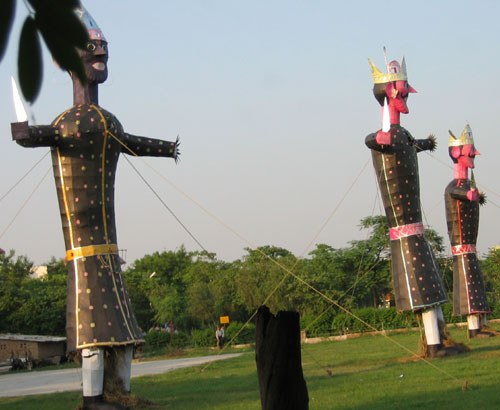
विजयदसमी और राम

हे राम कहाँ हो बैठे, आओ तुम फिर तो आओ
तुलसी बाबा हैं कहते
अवतरण तुम्हारा कारण
था अत्याचारी रावण.
फिर आज नहीं क्यों आते
रावण जब हर कोने में
अपहरण देश का करते.
और भाग बिभीषण जाते
हैं दूर देश में रहने
क्योंकि तुम यहाँ नहीं हो.
आना हो तो अब आओ
कुछ करतब तो दिखलाओ
बहुसंख्यक लोग खड़े हैं
कुछ आश लगाए भी हैं
तुम उन्हें सहारा देने
अपनी सेना में लेने
का कारण बन आ जाओ.. हे राम अब तो आ जाओ ..
पर अमित रूपधर आओ
और सब को सीख सिखाओ
तुलसी बाबा से जाना
रावण को मोक्ष दिए थे
पर मेरी यह मनसा है
न उसे मोक्ष मिल पाया
इसलिए तो फिर वह आया
और बहूत रूप में आया
इसलिए अमित हो आओ
इस बार करो जब बध तो
असली ही मोक्ष तुम देना
जिससे वह न फिर आये. हे राम तो अब आ जाओ
कमजोर देश के बन्दे
पुतले तीन जला कर
और नाम तुम्हारा लेते
सोचे रावण को जीते,
हे राम, रमापति आओ
हर मन के रावण मारो
उस मन में राम जगाओ, और अपना देश बचाओ
हे राम, तो अब आ जाओ

Posted in Uncategorized | Leave a comment

कुछ बचपन की यादें

कुछ बचपन की यादें, कभी हम न भूले, कभी हम न भूले
वह दादी की लोरी, और लोरी में चंदा
को उनका बुलाना
और चुपके से कोरे का मुहं में लगाना, कभी हम न भूले.
कुछ बचपन की बातें, वह चाचा से लड़ना,
और चाची का आकर फिर मुझको बचाना,
वह आँगन का झुला
वह बरसा के आँगन में,
गिर कर फिसलना,
फिर माँ की वह झिड़की, और दादी का आना
और गोदी उठाना, कभी हम न भूले, …
फिर सर्दी की रातें और दादी की गोदी
दुबक कर वह सोना,
फिर माँ का वह आना
और खाना खिलाना, कभी हम न भूले, कभी…
कोनहर का पानीभरी वह तलैया
फिर अपनी बनाई वे कागज की नावें
हवा के झकोरों से उनका वह चलना, कभी हम न भूले, कभी हम न ..
वह आँगन का सुगना और उसका फुदकना
वह काली सी बिल्ली
और मोटा वह बिल्ला
जो पहले डराए, पर फिर मन को भाए, कभी हम न भूले …..
वह बाबु से डरना, फिर दादा से हिलना
और दादी की गोदी में बचने को छिपना
वे दोहे सवैयें, फिर सोहर के गानें
वे बागों के झूलें और कजरी कहानी
और खेतों में रोपनी और रोपनी के गानें
उन बीते दिनों की कुछ सहमी सी बातें
वह दादा का चांटा और दादी का गुस्सा
और दादा पर रूसना, फिर उनका मनाना
सदा याद आते, सदा याद आते..

यादों के झरोखों से छन छन कर आती
बहूत सी हैं बातें. कंहा तक कहूं सब
उमर की डगर यह, उन यादों में कटती
यही शायद सच्ची है, जीवन कहानी

Posted in Uncategorized | Leave a comment