Sibal and IIT

While I have already expressed my views against IIT teachers’ resorting to strike, worst of all a hunger strike, for getting higher remuneration. I hate someone comparing the entry salary with those getting into the industry. Every industry or occupation has certain plus and minus points. An engineer going for R&D or production engineering or operation, never got the salary equal to those getting in marketing. Even in early sixty’s, the oil companies used to offer very high salaries, as is the case today with IT or financial sector. However, the salary must be respectable enough and certainly according to certain norms of performance. Naturally if Lovely Professional University pays more to its teachers, IITs will very soon get affected. Let a body of directors and some reputed alumni advise Mr. Sibal. The outright rejection of teachers’ demand will not usher well for the institutes of national importance. Moreover, Sibal must not expect the teachers to be dumb about their problems, if it is genuine.

I don’t agree with Sibal’s expecting IIT teachers to earn Nobel to get them higher pay or autonomy. And I dislike the way he has come on small screen and to media openly and talking the ill effects of this strike on the image of IITs. His statements were in bad taste and can certainly hurt the egos of some teachers, who are normally pretty sensitive. Why couldn’t he dialogue with the representatives of the teachers of IITs as well as the directors, who have failed to satisfy their faculty members, if they themselves have been sold out on the issues by the HRD minister?

According to report, Mr.Sibal has said, “I am ready to give them any autonomy they want.’’ Why can’t Sibal go through Narayana Murthy’s book and the cases of the working of IITs where he has recorded the interferences of the babus and how it has affected the institutes? Sibal would have been proactive and can get the autonomy of all the institutes of excellence guaranteed. As reported, even IIMs are also asking for the same. I have written about it and pitiable conditions at IITs many times. Why doesn’t Sibal talk with few of globally known IITs’ alumni and consider where the government has been wrong with IITs?

And this makes me doubt the intention of Mr. Sibal. Is Sibal trying to make IITs and IIMs global class institutes? Such issues, where the teachers have been forced to go for strike, would have been taken care of by the directors. If they have failed, either they are useless or they don’t have the autonomy.

Let the selection process and performance appraisal for the teachers be reviewed if it meets the present requirements and expectations of education at IIT. Teachers must inspire the students to get the best in them. Teachers must keep themselves in touch with the industry and the latest developments going on anywhere in their fields of expertise in the developed countries. They must research and publish their findings in world class journals and help the industry to innovate globally competitive products. How can good research work done by the teachers and their group get overlooked if it’s of worth. Let them not be content with the Ph.D that got him the job. They must go for path breaking researches. It may not be Nobel or patents only, but there are many other ways to get international recognitions, as the scientists of ISRO and CSRI are getting after many years.
Posted in education, governance | Leave a comment

Navaratra: Sapatami Celebration

For many years, I was very regular and carried out fasting and reading of scriptures religiously. I remember once I was in Goa in Navratra on a business trip, but still didn’t give up. However, one day I dropped it taking excuse of old age and heart surgery.

I am back on my old religiosity again in Navaratra (Nine auspicious nights) this year. My food is no cereal, no pulse, no garlic and onion and even one with ordinary salt. I live on milk, curd, vegetables cooked with rock salt and fruits. I took it, besides the religious angle, as a purification programme for my body and to certain extent for my mind too. I devote an hour or more on reading Tulsidas’ Ram Charit Manas and Durga Saptshati without any ritual. I am sure the Mother will take care of the rest. It gives a little peace. On my own I have added one more penance for me or I don’t know if it is an excuse of my laziness. I have not shaved for these days.

Sirohi was here with me the other day. According to him, the Navratra fast now has become real popular with younger generation too. Both his son and daughter-in-law are fasting. You are to see to believe how the market has got flooded with special snacks and food items for Navratra besides the items of gifts, and rituals. Even restaurants are serving special Navratra cuisine and special dishes. Eid, Dushehra and Durga Puja together mean celebration all over the country. Garba dance is becoming as popular as the Bhangra of Punjab.

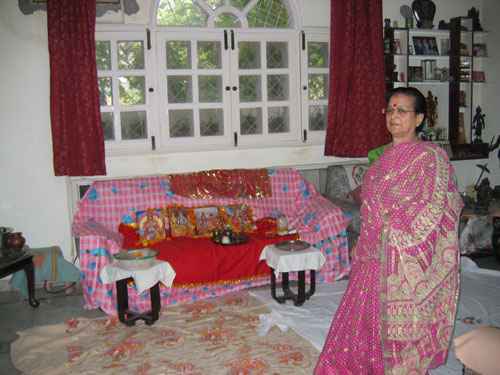
While my restricted fast will end on Sunday that in Navami, Yamuna and her party celebrated Saptami today with bhajans, and dance for the mother. The popularity of Garba dance originally of Gujarat is fast expanding, and becoming attraction of the festivity and also for tourists. Here are some snaps of Yamuna’s festivity.


I still remember how in my childhood in that remote village we used to go to every household in neighbourhood to touch the feet of elders for blessings and to get some sweets in return. In West Bengal, we enjoyed visiting pandals and seeing yatras, an open theatre, in night during Durga Puja. On Vijoya, every house used to offer sweets to the visitors. And in the offices and shop floors, I had to go for embracing my friends and foes too.

Let me wish the best for everyone on the occasion of these festiv

Posted in Uncategorized | Leave a comment

Can India Excel in Agriculture?

Agriculture is a big concern as well an opportunity for India. Unfortunately, while all the ministers holding different portfolios from agriculture to rural development, and naturally the finance, express their concerns. Sometimes, they shed crocodile tears also, particularly when the farmers resort to the extreme step of suicide. The word inclusive growth has become a fashionable expression for politicians too. None comes out with some real sustainable solutions. How does an Indian farmer household with an average of five persons to depend on the revenue of the landholding averaging 1.5 acres or 5 bighas get into affluence compared to even a lower middle class household in urban India with some employment in organized or unorganized sector?

Agriculture might be contributing to the GDP only about 17 per cent, but as per the data appearing everywhere in media, it still employs about 60 per cent of our population. Naturally, this 60% constitutes both agriculture dependent as well as those not dependent on agriculture. May be, half or one third of the 60% are farmers with some landholding of their own that averages 2 acres. Can the government experts guide the farmers to get the best from 2 acre-farm? What maximum can it yield if the best of the inputs, such as the seeds, fertilizers, and insecticides and water, are made available? What can be the best crop combination that provides the maximum revenues from the sale of the produces? Will it be Rs 1, 00, 00 per annum or twice of it? Can it suffice all the basic requirements of a family of five, such as the expenditures for medicines or hospitalization, or for those of festival time or for family functions such as a marriage and even demise in the family for being in line with the neighbourhoods? Can it make the family independent without needing any waivers or other doles? Unfortunately, in India most of these small land holders particularly from some communities of the society will never go to NREGA for adding to their revenues unless it faces a situation of starving.

Most of the farmers have hardly learnt anything in their formal education about farming techniques and practices. They are just following what they picked during their childhood from the parents or they learn from some of the successful farmers in the village or the neighbouring village. In many families, only the one who couldn’t get educated and go out, remains in farming.

However, someone in the government machinery must answer why the yield in two states say, Punjab averages a yield of 4,017 kg per hectare of wheat, whereas the Maharashtra’s yield is only just 940 kg per hectare. I don’t know how India competes with US or China. This inequity requires research, and education of the farmers of the lower yielding states. I had been asking this, whenever I meet my relative farmers in Bihar. Some claimed that they compete in paddy production but in wheat they are behind as they don’t get the seed and the amount of water required. Some even talked about the unaffordable cost of fertilizers that the farmers in Punjab do afford. They also complain about not lifting the produce at the government announced prices. Interestingly, they surprised me by revealing that the farmers from Punjab buy their produce to transport and sell to the government there. My friend in Kichha near Pant Nagar, who had been an agriculture engineer of repute and of my own batch from IIT, Kharagpur, agrees with the issues raised by the farmers of Bihar. West Bengal has been another case. During my school days in the rural areas of the state, the people considered farming as very shameful occupation. Today, the state is one of the surplus food producing states, rice and potatoes as main produces.

For example, as reported, ‘despite India being the largest producer of pulses in the world with 25 per cent of total production, 30 per cent of total consumption and 32 per cent of global acreage under pulses, productivity of pulses in India has been very low at 635 kgs per hectare, compared to best-in-class yields of around 1,900 kgs per hectare in Canada and USA.’ The main intervention is to be in these areas.

And the farmers, particularly the marginal ones, can’t do this improvement of the yield on their own.

I wish the government would have allowed land consolidation where a family of five interested in this profession as occupation can go for ownership of at least 20 acres. With the divisions in the joint families, the landholding goes on reducing with each generation, and that can’t sustain the next generation of farmers for long.

According to the United Nations’ Food and Agriculture Organisation, the world will have to produce 70% more food by 2050 to feed a projected extra 2.3 billion people and as incomes rise.

India has potential to feed the global shortages, but this will require a total change of mindsets of the bureaucrats, scientists, and politicians.

Posted in agriculture, governance | Leave a comment

IIT’s Gurus Can Do Better

In this country believing in ‘bhukhe bhajan na hohin gopala’, it is not strange that teachers in IITs are also going for a hunger strike on Thursday. However, they have assured that it will not affect the students, and they will take their classes. Some call it Gandhigiri. But are they serious? Will they really not consume anything for a day? Will it be 12 hours- or 24 hours-day? How can a person like me check it? Should I get into touch with my friends in IITs to find the real story? Will the students show sympathetic gesture by not attending the class by a hungry teacher? Or will they also go for hunger strike to boost the morale of the teachers? As such, if the food has remained the same that we got served in 1957, it will not be difficult to skip it.

The remuneration is, perhaps, the main issues, but the list of demand might show many issues. Promotion is one. Perhaps, the autonomy of the institution and very rightly so may also be in the demand. However, as it appears from the media report, the directors of IITs differ and consider the misunderstanding as the reason of agitation. But will they agree that autonomy is not the issue?

Interestingly, Dr. M Thenmozhi, a professor in the department of management studies at IIT, Madras (Chennai), heads the IITs faculty federation. I would have loved if the autonomy of the institute would have been the main demand, as that could have automatically settled all these issues. Unfortunately, the government’s interference is killing IITs’ brand image. Reservations and the resulting increase intake without the necessary preparations of infrastructure and faculty are badly affecting the excellence standard.

The teachers must get united to press for autonomy, as many such as NR Narayana Murthy also advocate strongly for this. And the autonomy ‘is about the freedom to decide on selection criteria and the size of intake for students and for faculty, syllabi, fees and scholarships for students, compensation for faculty, interaction with the best scholars and leaders from all over the globe, plans for growth and plan for adapting to a changing environment.’ How can a small hostel room accommodate three students? Why can’t the facilities in class rooms be of the world class? Why did not any of the professors express their opposition to the decision of the apex court to take away the right of expelling the nonperforming students from IITs?

The country expects a better way of protesting and for more important issues of the country by the professors of IITs. Dr. M Thenmozhi has been perhaps researching and writing about organizational capability, will she and her colleagues in federation will change the course of their action plans a little and do something to take IITs to the brand image comparable to MIT and other top ranking educational institutes of the world.

With a huge number of resourceful alumni, it can be an easier task than what skeptics doubt. The alumni can help in building the best facilities as well as provide the practical knowledge to the newcomers to the institutes that other institutes may not even dream of.

PS: 24.09.2009Sibal is open to having any kind of dialogue with them to discuss their demands, but ruled out world-class salaries due to lack of resources.

Posted in education, governance | Leave a comment

Education- Some Issues Require Sibal’s Attention

Sibal has become the darling of media. As many surveys show, the countrymen expects him to succeed to reform the education sector that has remained prisoner under some very biased ministers for almost a decade or more. Here are some points that as individual, I would like him to include in his agenda for education sector:

Can Sibal get the education system rid of tuition and coaching that is spreading as monster in the country? Today almost 90% of the students of all levels take tuition and the trade, with many poorly qualified providers is flourishing unchecked in every corner of the country. And this tuition is only for passing or excelling in the examinations without much learning, the basic purpose of education. If the teaching is right, why should there be need of it?

Can at the school stage Sibal get rid of the load of backpack carried by the school going children creating even sometimes long term physical ailments? Why can’t the school have lockers?

Can Sibal see that any project work to be done at home will not be such that it becomes a project work for the parents or one will have to get it outsourced to professionals doing it?

Can Sibal and his government working for $10 laptop develop a device that can store the text books and serve also as exercise books for the students? For the next class, the students will have to get the text books of the new class loaded at some cost, but the hardware remains same.

Can Sibal assure of having more labs, creativity centres, presentation halls, playgrounds, studios, gardens and music rooms in every school? Will the model schools have them? India may need a million of them. Why the school should be permitted in residential areas with constraints of sufficient land?

Can Sibal get a basic course on agriculture at the secondary level as most of the drop outs from the rural area going to agriculture hardly get any formal knowledge of agriculture science and farming practices?

Can Sibal ensure that all students passing out class X are skilled in one basic trade, be it of mason, carpenter, electrician, barber, or cook?

Can Sibal get IITs and other government professional institutes to have sufficient capacities in its hostels to have single occupancy room? How can he justify a small room being shared by three persons?

Can the thesis for graduate, postgraduate and Ph.D be made less voluminous, original and compulsorily put on a web? Can he eliminate the professors taking undue advantages from the Ph.D candidates?

Can aptitude for teaching and research be made one of the main criteria for selection of candidates for M.Tech course in professional education?

Can Sibal advocate and arrange for a good enough differential in remunerations for the entry level for persons with M.Tech and Ph.D in comparison of those with just B.Tech qualification in the industry?

Can IITs and other institutes of excellence admit persons from industry with experience if they wish to get admitted instead of the regular way of admission through entrance tests?

Can Sibal improve the affectivity and efficiency of teaching? There is certainly some basic flaw in teaching that can’t make student speak, write, or understand English after learning it as a subject from class I to class XII or even up to BA standard. Similarly, ineffective teaching is keeping the students poor in the learning other subjects too, be it Hindi, science, or math.

India must aim to reform its education significantly at the grassroots, and those in authority to do that must first get ready to change their mindsets.

Posted in education | Leave a comment

Nitish’s State and Nitish

The outcome of the recent bye-election went against Nitish and so against his priorities in governance of the state and his vote-bank politics. Voters sent a warning signal to the rulers: They can’t be taken for granted. Naturally, I was a bit morose as it appeared the people of Bihar again trying to bring back the worse ones. Instead, they would have decided not to elect any one. Unfortunately, the provision is still missing in Indian democratic process or the voters are not mature enough to do that.

But with the latest ‘India Today’, the special issue on the ‘state of the states’ in hand, I got another bad news going against Nitish that pains me more than his losing few seats. He and his government have not been able to change the state of his state in last four years. Is a time period of four years not good enough to bring changes improving the state’s ranking on different parameters? I would not have written if Nitish would have shown a will and aggression to change the conditions.
Bihar has remained at the bottommost in the overall rankings of 20 big states since last six years and this year too. Interestingly, Bihar is at the bottom of the table in six of eight categories, and even in agriculture, where it has natural advantages, it is in the bottom five. Even in the rankings of the 13 small and big states of eastern zone, Bihar is at the bottom in the same way.

Is it not due to the failure of Nitish to get a breakthrough in developing his state? Does it not speak of the ineffectiveness and inefficiency of his team that he has selected on his own without many problems even from his alliance? Can I dare to further conclude that Bihar doesn’t have the political or administrative stuffs that can perform aggressively to bring the state from the shameful situation?

The per capita income in Bihar is measly Rs 11,403, the lowest. I kept on hearing about Nitish’s thrust on education, but only one out of three children over 10 completes studies. One household out of five owns TV set in Bihar.

As reported, Bihar has been the worst performers in the demand-driven programme like the prime minister’s rural roads programme and Grameen Vidyutikaran Yojna. And still the people of Bihar do read only the news about the cruel differences between the Nitish, his ministers, and the central ministers. Bihar didn’t use even its NREGA effectively and provided only about 23 days of work against the provision of 100 days.

Even with all these bad news and rankings, Nitish gets an award from Economic Times outsmarting New Delhi’s chief minister. As reported in ET, ‘Bihar chief minister Nitish Kumar, who has managed a remarkable turnaround in the state, is ‘the Business Reformer of the Year’. Nitish Kumar was unanimous choice of the panelists. The jury members felt that Nitish Kumar was a much better candidate given the tough conditions prevailing in that state and the obstacles that he was facing.’ As evident from the profiles presented for Nitish, he has been impressive performer. Unfortunately, the jurists, some among them are industrialists too, have not helped Nitish Kumar. As reported, Nitish Kumar got also invited by the International Growth Centre (IGC) to attend the Growth Week Programme 2009 being held at the London School of Economics (LSE). But all these achievements hardly help the state and its people.

Nitish has got a list of investment proposals for the state running in hundreds, hardly few has seen any daylight in last four years now.

Unfortunately, Nitish has pretty rigid mindset apparent from his opposition to SEZs and urbanization. Perhaps like most Bihari intellectuals, Nitish is pretty introvert too; neither could he get a good liaison man to help him getting closer to the industrialists. NK Singh couldn’t deliver. He is pretty good in vote-politics and many have understood it with his gestures for mahadalits or Muslims. But Nitish is not aggressive enough to create a better leadership for attracting entrepreneurs. Nitish could have certainly delegated each of his district collectors to set up an education hub in each district head quarters, super specialty hospitals or housing complexes that could have boosted economy and provided employment. Nitish could have asked the professionals and experts of State Agriculture Universities to go in field and improve the conditions of rural population with new ideas as many states have done. What is wrong in emulating the good ideas from other states? What is wrong in employing a reliable and proven consultant to improve the investment in the state? What is wrong in calling an all-party meeting to discuss and find consensual ways and means to improve the investment climate of the state? Why can’t Nitish resort to some experts’ body to find a permanent solution to Kosi menace? Unless the people of the state participate, the state will remain where it is for the next few decades, if not a century.

Posted in bihar | Leave a comment

राम से अनुरोध

हे राम !
एक पक्षी के बियोग का दृश्य
पिघला दिया था कवि ह्रदय
जन्म हुआ तुम्हारा
अवतरित हुए धरा पर
प्रिय हुए जन मन में
पूजित हुए सबसे ..
क्या तुम्हें ठीक याद है
वह जगह
जंहा तुम पैदा हुए
वह अयोद्ध्या का कक्ष नहीं था
एक कवि की कुटिया थी
क्यों नहीं समझ पाते
नासमझ
क्या यही है कलि प्रभाव .
अब आओ, हो जाओ द्रवित
दुखित हैं नारी पुरुष
तुम्हें गलत समझ,
घट घट वासी हो,
मिलते हो सबसे तुम एक संग.
आओ फिर एक बार,
फूंको एक मंत्र सबके कानों में
‘तुम एक हो
तुम इनके हो, तुम इनमें हो
अयोद्ध्या में नहीं रहते अब
न बनायें ये तुम्हारे
तुम्हें छोटा इतना
आओ अभी, न देरी करो
कंही देरी में जल न जाये
तुम्हारी यह कर्मभूमि,
तुम्हारी स्थापित मर्यादाएं.

Posted in Uncategorized | Leave a comment

Amartya’s Story on ‘The Idea of Justice’

A story quoted by Amartya Sen in his just published book The Idea of Justice has become very popular.

It first came to me from my poet friend Pravat Pandey from Kolkata. I didn’t have the book by the time. What he sent was as follows:

This is to illustrate the three different arguments put forth by three children – Anne, Bob and Carla – vis-à-vis their claim for getting the flute for which they are quarrelling.

Anne claims the flute on the ground that she is the only one of the three who knows how to play it (the others do not deny this), and that it would be quite unjust to deny the flute to the only one who can actually play it.

If that is all you knew, the case for giving the flute to the first child i.e. Anne would be strong.

In an alternative scenario, it is Bob who speaks up, and defends his case for having the flute by pointing out that he is the only one among the three who is so poor that he has no toys of his own. The flute would give him something to play with (the other two concede that they are richer and well supplied with engaging amenities).

If you had heard only Bob and none of the others, the case for giving it to him would be strong.

In another alternative scenario, it is Carla who speaks up and points out that she has been working diligently for many months to make the flute with her own labour (the others confirm this), and just when she had finished her work, ‘just then’, she complains, ‘these expropriators came along to try grab the flute away from me’. If Carla’s statement is all you had heard, you might be inclined to give the flute to her in recognition of her understandable claim to something she has made herself.

Having heard all three and their different lines of reasoning, there is difficult decision that you have to make.

I would request you to kindly spare some time for this situation – the three children quarrelling for getting the flute based on their respective arguments, and favour me with your opinion as to (a) who of them should get the flute and (b) why? Please note to elaborate your answer to this ‘why’ putting forth your arguments.

And I replied as follows:

As I could understand it is Carla who has made the flute and with hard work, it is up to her to decide if she wishes to give it to one who knows to play or one who is deprived enough not to have any toy to play. Carla may also retain it with herself and learn to play.

As flute is not a toy, Bob can get it only and only on compassionate ground.I wish he would have shown interest in learning it from the one who has the knowledge.

I don’t know if I understood the story well. My views may be wrong.

But then as usual I tried to find what all information is available on Google. I printed my search, ‘The Idea of Justice and the story of flute’ and got 416,000 entries. If you go through some entries, you can appreciate how the idea of justice is perceived differently by different persons. Perhaps this might be satisfying the writer of ‘The Argumentative India’. I have now started worrying and wondering if it helps our judiciary system positively where millions of cases of justice are pending.

Posted in education | Leave a comment

India’s Engineering Challenges

The winner of the next century will be the nation that decides and focuses on the engineering challenges that can make it the leader among the developing nations.

As reported, a high powered diverse committee of experts, including some of the most accomplished engineers and scientists of USA, met and proposed the following 14 grand engineering challenges for US in the 21st century

” Make solar energy economical
” Provide energy from fusion
” Develop carbon sequestration methods
” Manage the nitrogen cycle
” Provide access to clean water
” Restore and improve urban infrastructure
” Advance health informatics
” Engineer better medicines
” Reverse-engineer the brain
” Prevent nuclear terror
” Secure cyberspace
” Enhance virtual reality
” Advance personalized learning
” Engineer the tools of scientific discovery

While the challenges zeroed on by US are very much acceptable by other countries too, but each nation has its own priorities and so India must have its own areas of focus. Can Indian technocrats, engineers, managers, and scientists decide the engineering challenges for India for the century and even the next, as it will have to lay down the strong and well designed foundation for meeting the challenges?

Kapil Sibal’s hyperactive dynamism provides hope about the availability of human resources for the task, though the country will have to wait to see the executions of the Sibal’s reforms. The considerable quantitative progress through sarv shiksha aviyan and mid-day meal getting extended to secondary level, the private sectors’ interest in education in (K-12) as well as the professional higher education along with the reforms for an early entry of reputed foreign university are all inspiring. But in R&D, India is to move many miles still. It is not the question of the number of persons involved in the activities, but basically the mindsets of a large number of researchers and the administrators require drastic change. I consider the number of students engaged in Masters in science subjects, in engineering graduates and post graduate courses in all the first class institutes, and also the MBAs are the first group of potential innovators on which the government, the academic faculty and the heads of India Inc must focus. Unfortunately as on today, the standard is pretty poor.

But still a large number of people will remain unskilled with only12% or so get into the courses for higher education and that too with majority in humanity subjects and so the development of modern technologies that work efficiently with a large labour component will remain a priority for India. And as already recorded, India does have a huge potential with hundreds of grassroots innovators. Perhaps, the success of Amitabha Sadangi’s International Development Enterprise (IDE) and its treadle pump= a foot-operated water-lifting device to irrigate small plot of land and also its drip irrigation kits provides example that also require appreciation. Can some researchers provide solar-powered water pump in rural India so that the power outages don’t affect the crop? Even the end-users must cooperate and discuss the problems that must get solutions on priority.

The industrial leaders such as Tata who created a wave in auto-world with Nano must focus on R&D and new breakthrough innovations for which they don’t lack the resources, but certainly the priority and mindset. All household devices such as washing machines and dish washers that require a lot of water need research, and so are the needs of researches for a change in the power source of the refrigerators, air-conditioners, and other electronic devices such as TV, and computers from the electricity from the regular plants to the power from solar or wind. The scientists and technocrats must focus on the researches of battery for electric cars that are going to be the main means of transportation. The rural India requires similarly cheap effective equipment for the water filtration that go to every household.

Most of the laboratories in the institutes of excellence in India are to use its resources in the most efficient manner and use its synergy to reach the goal.

When can the Indians know the choices of its engineers and scientists about the nation’s 20 engineering challenges for the century?

Posted in industry, management | Leave a comment

Education- A Friend’s Institutes of Engineering Sciences and Management

I know Gehlot, an alumnus of Roorkee Engineering College for some time now. He retired from UP’s PWD after serving as chief engineer. Gehlot and five others have established a trust that has set up an institute of higher education in Ghaziabad, one of engineering and the other for MBA course affiliated to UP Technical University. The initial intake is of 300 students, 240 in four branches of engineering and 660 in MBA.

Is it not exciting that persons like Gehlot after retirement are going to invest in education sector instead of investing in his own area of specialization such as consultancy in the booming road sector or starting a venture in infrastructure sector. And as it appears many Gehlots are entering education sector. Has the sector become the golden goose? Is it philanthropy or business? With mushrooming of private professional institutes and forthcoming government regulation of mandatory accreditation for improving quality, how many of them will survive? Will it be the survival of the fittests to meet the demand generated for India’s demographic dividend or the politicians will find a way to bypass it?

As reported recently in ‘Business Today’, the market for engineering education is around $5.85 billion, while that of MBA is around $731 million. It is surprising that some of the bigger entrepreneurs in education sector will touch $1 billion in revenue per annum soon. According to an estimate, the revenue of Amity University in Noida is around Rs 600 crore, and that of Manipal University, ICFAI, and VIT University are respectively Rs 800, 700, and 500 crore. And beside many politicians including stalwarts such as Sarad Pawar, even people from totally different background such as Mittal of Lovely Professional University have invested in education sector in a big way, and are trying to build a brand image even to attract students from foreign countries. And as it appears Sibal will also get the doors for reputed foreign universities opened in India soon.

Mushrooming of these engineering and MBA institutes almost all around in the country excites me but simultaneously shocks me too. I could see a glimpse of that, when I visited Ghaziabad yesterday. And a manager I wished to know the investment required in setting up of these institutes. Naturally, today the cost of the land is the major constituent, and every entrepreneur tries to get big enough area for the future expansion, some with intention of moving to the next stage to get university status. According to an expert in education sector, an MBA institute spread over 1.5 acres with a capacity of 240 students would require an investment of around Rs 15 crore. An engineering college with a capacity of 1600 students spread over 10 acres of land would require an investment of Rs 100 crore. With a lot of black money in financial system and support of banks both private and public, it has become a way of easy entry to tap the demand from the rising number of students because of rapidly increasing aspirations of even the families at the bottom of the pyramid. Gehlot and his partners have spent around Rs 30 crore for this phase, as I was told by someone close to the project, when I was there yesterday as chief guest on the inauguration day.

Interestingly, the education boom that started in south has touched almost all the states but some unfortunate ones such as Bihar, East UP, North-East states, and J& K. For example, ‘Indore has gone in the past 15 years from one management institute to 64 management institutes. The state of Madhya Pradesh has gone from seven engineering colleges 15 years ago, six of which were government-run, to 150 engineering colleges today.’

I wonder that many of the institutes might not have the sufficiently equipped laboratories, libraries and faculties. I wish the institutes in a particular location get into a cluster and create some common facilities to be shared on rotation. Another solution can come from technologies. For each of the subject, the best professors can be hired to get the course lectures videoed and made available on CDs or on a website. The faculty becomes facilitator.

However, I was happy to see the students of the first batch starting at the institute. I guessed most of them were from the rural background. I wished to succeed and fulfill their dreams. However, I wish to visit them again and interact with them.

Posted in education | Leave a comment