In The Wonderland of ‘Aam Adami’

Harendra works with us. Harendra gets Rs 2,500 per month as salary. His employer bears all his expenditure food, clothes, and even haircuts. The total cost for Harendra to his employer must around Rs 5,000 or more. I don’t know if as per the government definition of BPL (Below Poverty Line), Harendra comes under BPL category.

But the most amazing was the cost of a service that the central government provides. He sent his money to his father in a village in Bihar. The village is having a post office too with a PIN Code. Harendra paid Rs 125 for sending Rs 2,500 at rate of five percent. And Harendra doesn’t know how much time the postal department will take to hand over the money to his father. He is worried as he to return some of money to his moneylender in time otherwise he will have to pay for an additional month. The post master has promised the disbursal to take 10 days or so.

Naturally there are two pertinent questions on this system of money transfer that the government must answer. It requires attention, as it is the poor and mostly people under BPL category, the ‘aam aadami’ who use this system of money transfer.

Why should the government or its postal department charge so high for the money transfer? It must not be anything more than 1 percent, if not 0.5 percent.

Why should a money transfer between New Delhi and a village in Bihar in this digital era of mobile phones be taking anything more than 1-2 days for the money transfer? Its shame that the post department can’t get the money transfer made fast and cheap.

It is unfortunate that the government including the Prime Minister has some excuse for every issue one raises. Look at the publicly heard reply of the Prime Minister for the LN Mittal’s remarks that India is not ready for megaprojects: “I recognize the frustration well wishers feel when they lament why things don’t work faster or why well formulated plans and policies don’t get implemented as well as they should be. It is probably true that we are a slow moving elephant but it is equally true that with each step forward we leave behind a deep imprint.”

Many times I think of shunning writing about the system mesh, but then I recover from the gloom and decide to go on doing it. And I am sure there are many such people.

Posted in economy | Leave a comment

Between Scientist and Administrator

I came across today an article by a professor of IIT, Delhi that has raised a very pertinent issue: Why a scientist doesn’t remain content with his work and achievement as scientist and starts looking to get into the chair of the administrator?

It will be very hard to find a well-known scientist in India who did not become an administrator – particularly in the past few decades. However, of the 27 Nobel laureates in physics of the last 10 years, only seven hold any major administrative post. This reflects a basic difference in how science and scientists are viewed in our society and how they view themselves, as compared to the situation in the scientifically advanced countries.

When a scientist does good work and is recognized globally, the best way the government and the civic structures seem to reward the person is by giving an administrative title and role, so he becomes a ‘big administrator’ who will rub shoulders with the ‘powers-that-be’. Not only is the thinking of administrators and government like this, this is the nature of thinking of scientists and academics also – after an individual has achieved some name in science, he starts looking for ‘elevation’ as an administrator.


And in the process, quite often, the country may be loosing great scientists and getting a poor manager or administrator that has its own larger and negative consequences.

I experienced the same even in corporate world. The engineers as supervisors in operation hardly used much of the technical knowledge but got better opportunity for getting promoted as managers at higher levels, ultimately even as CEO or as the second man only to CEO with wider responsibilities and fatter packs of compensation. A person with similar experience who joined, say R&D, production engineering, or industrial engineering required better technical knowledge and knack. But the scope of promotions used to be limited and naturally the perks were not that lucrative.

There are always some staff functions and some managerial ones in every organization. Each function is equally important for the performance of the organization and requires its employee to give their best. However, the aspirations of people are different. Some get job satisfaction in the work responsibility of staff function and some enjoy managerial function better. Unfortunately, US came out with MBA education and made it appear as much superior to engineers and technocrats. Indian business as usual opted for the same practice. MBAs from IIMs are today getting better placements and compensation than the best possible technocrats trained in IITs. Even the society has started giving more honour to MBAs from IIMs. I fail to understand this disparity.

However, human aspirations are different. One can’t judge an individual by a particular type of achievement. A professor may be a very good teacher but not interested in research or publishing books of his subject. Can one be branded better or more successful than other?

Posted in education, management | Leave a comment

Arpit is appearing for class X CBSE examination this year, and his sister, Anisha is in class VI. None of them has any of the national languages as subject of study in their course. Arpit has German as second language while Anisha has French. I was under impression that Hindi would be a compulsory subject up to Class X in CBSE. I was amazed that it is not like that. Beside English that is the main language and medium of instruction too, they have taken one another European language and not Hindi. This is the next generation’s choice. I mean the choice of our kids. Is this choice of the second languages meant for providing better prospect in professional career? Is not almost similar to Keshav and Svanik in USA? They will learn English and Spanish in their schools and not Hindi. Why is this allergy in India against our own language? I don’t know if it is happening in Southern states too.

I was shocked to hear from Arora that all the scripts in Bollywood are written in Roman script for Hindi pictures. Even a person such as Amitabh Bachchan, son of the famous Hindi poet of his time is to work with this constraint that he finds very difficult for him. A news report in Hindustan Times confirmed my apprehension. A story appeared on the subject. As reported, the 67-year-old star insists that Hindi dialogues be written in Devnagiri script.

English medium for schooling is expanding fast, because of the demands from the parents. The second highest number of students in India today goes to English medium schools. A report of English ingress in rural Madhya Pradesh says, ‘over time, most villagers have started sending their children to English medium schools in nearby Mhow’. And many get their children admitted in a boarding school as that is the only way to ensure the child’s proficiency in English.

I personally prefer every kid to be taught in his mother tongue at least up to class VIII. The kid can absorb and assimilate the subjects better.

English should certainly be a major language in school starting pretty early in life, and taught using new innovative methods to make every student proficient in it for all types of communication-reading, writing, and speaking.

Unfortunately, because of the lack of knowledge and skill of English, the students even after 10-12 years of training hardly learn the language well enough for the desired communication skill.

Thrust for improvement must be on this aspect of teaching that relates primarily with teachers. They require regular training and practice more than the students they teach.

However, the younger generation parents must think seriously over on their apathy against the culture and languages of the country. And if they decide to switch over totally to western languages, life styles, values and culture, let them go ahead.

Posted in education, governance | Leave a comment

Changing Bihar: The Heroes?

Bihar, till yesterday was India’s Somalia: a failed state; a metaphor for India; or the state of anarchy. Bihar, as reported, has certainly become a miracle economy.

The CSO data and the news reports will certainly satisfy and encourage Nitish and his government, if they have honestly worked hard. There is already a whisper for proponing the assembly election to cash on the mood. It may be possible for a different reason: A torrential rain and flooding of Kosi may drown Nitish and his dream.

However, few shall doubt some visible changes happening in Bihar. My own village is better connected by road and after 62 years we are having electricity too. The school building has got a facelift and boundary wall now. The village may soon have a primary hospital too. And this a widespread phenomenon reported from all corner of the state. And with electricity and road, as usually observed, the GDP goes up by 1-2 %.

Lalu and Ramvilash have not yet come out with their reactions. I assume they must be in consultations with their advisors and consultants. And it’s not only Times group, but a noted economist such as Bibek Debroy considers Bihar’s performance as clear break from backwardness. However, some are still skeptics in the era or paid news in media.

But who are the heroes? Who are making this happen? Unfortunately, there is hardly any manufacturing and industry in Bihar. But some aggressively futuristic and innovative farmers are firing on all cylinders. They cumulatively must be providing a big contribution to raising the GDP. One such exemplary story comes from scores of villages in Bihar’s Vaishali district who produce cauliflower seeds. These completely organic seeds are sold across Bihar, Rajasthan, Madhya Pradesh and Maharashtra under an exclusive brand called Vaishali under various names like satya beej, green seeds and jawahar seeds. Some locals term it ‘Yellow Revolution’. “Farmers sow cauliflower plants in July and sell the vegetables -grown in two-thirds of their land -by November-December, leaving one-third of the crop for growing cauliflower seeds. The seed is harvested during February and March. A katha (1361 sq ft) yields 7-8 kg of seeds. High-quality seeds get sold for up to Rs 4,000 per kg, and reach across the country.”

Many areas in Bihar are observing some radical changes in the productivity in agricultural produce with new practices of multi-cropping combining commercial crops too. Potential is huge. Alok, Pintoo, and Rinkoo, the younger generation in our families have made the same landholding produce many times more than we saw it in past.

I wish the state’s bureaucrats could have worked harder and innovatively as they would have been done for their competitive examinations in good old days. I don’t expect much from the politicians of the state.

Posted in bihar | Leave a comment

Next Decade 2010-2020: Some Predictions/Expectations

Many exciting predications have appeared in media about India in 2020. I may doubt if I shall be able to witness the achievement of India by 2020. But these predictions are also something that makes persons such as me aspire and provide strong will to live longer. And perhaps that is the reason that any prediction that relates to 2030 such as one by London-based Legatum Institute doesn’t make me exhilarated, though it predicts India to be the world’s most important economic power by 2030.

Is it not exciting when the prime minister of the country declares the decade 2010 as the “Decade of Innovations”? And it is clear it shall not happen in the final year. One can see and feel it happening in the whole period. And how good as an Indian I shall feel seeing the wishes of Raghuram Rajan, Professor of Finanace at University of Chicago’s Booth School of business and Honorary Economic Advisor to the Prime Minister getting realized? He has said, “If India has to take its rightful place among nations, every sixth CEO of a Fortune 500 firm should be an Indian. Every sixth Nobel Prize winner should be an Indian.” Perhaps similar was the target set by C K Prahalad, one of the topmost management thinkers of the time.

I have been writing so many times about India vs. China. And every news report of China excelling India by manifold, I confess, makes me envy. So will I not be really excited to see India overtaking China as Swaminathan Aiyar and many predict?

However, I find T N Ninan of Business Standard giving some factual details and that makes morose.

India in all probability will continue to achieve economic growth at an annual rate of 9 per cent. India’s GDP will go up from about $1.3 trillion (Rs 60 lakh crore) today to 2.2 times that figure a decade from now in 2020, at just under $3 trillion at today’s prices and exchange rates.

The number of households with a monthly income of Rs 25,000 and more should more than treble, from about 30 million today to 100 million by 2020. The spending power of the middle class will multiply six-fold. Some markets will grow tenfold in the next decade.

However, per capita income will have doubled to become a little better than where Sri Lanka’s is today!

India’s share of global GDP will be only slightly better than 4 per cent even in 2020 – well short of the 24 per cent that prevailed more than three centuries ago, and not much better than the 3.8 per cent of 1952!

2010=20 will certainly be the ‘deciding decade‘ for India. It requires continuously rising saving and consistently maintaining investment booms. But more important will be the priority for massive quality education programmes and health care measures rather than the present gimmicks of loan waivers and innovations for winning the elections.

And those who shall get it happen must realize that 2020 is less than ten years away. But this is doable.

Posted in economy | Leave a comment

Bihar’s Miracle May Make Other States Envy

Bihar is India’s new miracle economy. It was one of the main news headlines on the front page of Sunday Times of India. Swaminathan S Anklesaria Aiyar’s column in Economic Times was the reason for this headline.

If I go by my inbox e-mails, the news has excited many well-wishers of Bihar. I did also get a kick. Only recently I had gone through some articles based on the panel discussion organized by Business Standard Hindi in Patna that had made me morose and so I wrote ‘Bihar’s Bad Luck’. Let us see what Aiyar says:

“The best news comes from Bihar, historically the biggest failure. From 2004-05 to2008-09, Bihar averaged 11.03% growth annually. It was virtually India’s fastest growing state, on par with Gujarat (11.05%). That represents a sensational turnaround. Nitish Kumar deserves an award for the most inclusive revolution of the decade.”

I have also gone through the recently published progress report for the last four years of Nitish rule. As usual, that is so poorly drafted by the babus that one hardly gets enthused to complete it. Why can’t the officers who go to all sorts of management training bring some freshening changes in their presentations and working?

The state will have the next election for the state assembly this year itself. Lalu and Ram Vilas are camping in Patna and consistently teasing and obstructing Nitish to make the people of Bihar notice their presence. Will Aiyar’s certificate matter in bringing the election result in Nitish’s favour? I doubt as it will hardly reach to those who matter in these elections.

However, the news will certainly help in changing the image of Bihar overall. Nitish has certainly worked hard to reach the people. His achievements have been many. I have been regularly writing about my expectations. But I wonder why Nitish doesn’t involve the people more. Why can’t he appeal to the rich business people of India to help him in providing education facilities, say at least 100 Higher Secondary Schools and 50 engineering and medical colleges, even if necessary on their terms in Bihar? Why can’t he involve the educationists of the state to scale up the quantity of intake and the quality of teaching in its existing science and commerce colleges? Some of them might wish to become entrepreneurs themselves. If it can be a lucrative business in other states, why can’t it be so in Bihar? I am sure some in his government itself are not the obstructionists. I wish he would have wound up different state school boards and got all schools affiliated to central boards to bring better equity at national level.

I would have loved to see a healthcare centre in any of the village- my own, maternal one or one from where my wife comes. I myself and my sons in US would have loved to contribute as much as we could. In my own village, I would have given my land for it. I can also contribute the investment required for a Knowledge Centre with computer and Internet facilities on pattern of ITC’s e-choupal for my village. But there is no such initiative at work.

But I am really happy with the findings of Mr. Aiyar. It certainly highlights that Bihar has a huge potential to get out from its laggard status. And the industrialists must come forward and invest there. Nitish must get his due reward and the people must elect him again and not the suspect black sheep.

And as Aiyar wishes, ‘Let us celebrate the emergence of Bihar’ and pray that Bihar gets it due from centres and business community to make it a respectable and prosperous state.

Posted in Uncategorized | Leave a comment

Bihar’s Bad Luck

Yesterday I happened to talk to Alok, my cousin in village. I wanted to know about the health of my uncle. And he informed that uncle was in other village, Samahuta where cycles were getting distributed to students of Girls High School. I felt good. Nitish government has done good work on rural roads. At least, the girls will use the cycles.

As it appears, the next state assembly election is pretty near. All the news reports from the state indicate that. Each of the troika is busy in doing everything to grab the state or at least to remain relevant in state politics.

While incumbency may be against Nitish, his performance in the last four years has made a big change in perception of Bihar in the country and makes him the best choice for the next time too. The Bihar government has come out with its exhaustive performance report of the last four years that it completed on November 24, 2009 on PatnaDaily.com today. The reports are in part I, II, and III and present pretty rosy picture. I don’t how many will go through it and will it influence the people who matter in the next election. It is a special edition with Nitish portrait on cover and declaring him as Person of the Year- 2009.

Unfortunately, even with a real improvement in law and order confirmed by many independent observers, Bihar has failed to attract significant number of big private entrepreneurs. Nitish thinks without the centre granting the status of “special category state” to Bihar with exemption of taxes, it will not be possible. Even the hope of revival of sugar industry is almost dead: “There just isn’t enough sugarcane to feed the mills, investors say. Set up the mills and the sugarcane will follow you, Kumar counters.”

Unfortunately, even with a real improvement in law and order confirmed by many independent observers, Bihar has failed to attract significant number of big private entrepreneurs. Nitish thinks without the centre granting the status of “special category state” to Bihar with exemption of taxes, it will not be possible. Shaibal Gupta, Economist and Member Secretary, Asian Development Research Institute, Patna endorses the view. Even the hope of revival of sugar industry is almost dead: “There just isn’t enough sugarcane to feed the mills, investors say. Set up the mills and the sugarcane will follow you, Kumar counters.” Some suggests that Bihar will have to look for its own entrepreneurs for investments. Is it prudent? Could Bengal get entrepreneurs even with better indigenous resources of raw materials and trained labour till Buddha took some personal initiatives? Interestingly, according an industry estimates, local entrepreneurs have invested close to Rs 1,500 crore in the recent past. But Bihar needs huge investment and it can come only from the bigger established houses.

Perhaps for the first time Business Standard has published some pretty balanced views on Bihar’s problems in its issue of January 2, 2010, based on a roundtable discussion arranged by its Hindi edition. The centre has been negligent to Bihar. And for many of its ills, it must take responsibility. And TN Ninan has been very forthright: “It is not possible to solve the problems of Bihar by forcing Biharis to go to Mumbai; they need options in their own state. Once again, it is public policy that has failed. The surprising truth is that fiscal transfers from the Centre to the states have worked against the poorest states; if Maharashtra got the same per capita fiscal transfers that Bihar did, the story in that state would have been the same as in Bihar (as the Thackerays should be told). As in so many other things, the starting point has to be public investment.”

Lalu and Ramvilash have been busy only in negative politics. Even during the period when both were senior ministers in the UPA-I, they did anything concrete to pull up the fortunes of unfortunate people of Bihar. None of their projects is going to see daylight. Discarded by Congress after the 2009 parliamentary election when they lost the mandate from the people of the state, they reached Patna and started making the life of Nitish miserable. I am sure they could have done some positive work with so big a following. At least, they would have taken intensive tour of the state and convinced the people to send their children to schools. But as I understand, they wish to keep them ignorant as that can only help them.

But Nitish with all the good work done can’t escape my criticism.

Unfortunately, Nitish lacks good advisors, and has fewer aggressive implementers in his team.

Nitish would have encouraged many more entrepreneurs such as Kausalendra, if required through his personal mentorship to exploit the potential of Bihar for enhancing the production of quality vegetables that would have brought prosperity and happiness to a large number of petty farmers of Bihar.

Nitish would have taken personal interest in getting private educational institutes for higher education set up in every district, if not in every block of Bihar to stop Bihar’s huge money going out of the state.
Nitish did also fail to make the poor owners of the trees that they plant under NREGA on government land. Nitish could have certainly distributed the land available with the government to needy without fearing the reaction in some circle.

Nitish did not take any initiative to encourage private entrepreneurs to build planned new cities on the two express ways- Golden Quadrilateral and East West Corridor passing through the states. Bihar could have 20 such cities. It would have certainly boosted the state economy and provided employment too. Perhaps his socialism is stopping him from taking such a bold step.

Will Congress Party at centre change its attitude and come out with the special status for Bihar? Will Rahul Gandhi interfere in case of Bihar too as he did for Bundelkhand? Can some young men from Bihar impress upon Rahul its necessity for winning over Bihar at least to some extent? Will Nitish change his present alliance partner with Congress? Will it win Bihar to bring Bihar back on the path of prosperi

Posted in Uncategorized | Leave a comment

2009: The Year that it was

The year saw a general election, where one old man lost, while the other one own. A deserving Indian owned an Oscar. A person of Indian origin got a Nobel. Indian Chandrayan detected water traces on moon. Indian cricket came to the top. India kept on improving its image at various global meets. However, I want to think back on personal front here today.

Some year in personal life appears to be more satisfying. 2009 is one such year. In early months we had been to Salt Lake, Kolkata and in the concluding months, we took up the tours of Tamil Nadu. The main task at Salt Lake was to explore the possibility of disposing off the property there but only at my target price. It didn’t happen, but then we found it prudent to wind up its establishment that we were maintaining. We rented the whole house. It meant disposal, gifting and shifting of a huge lot of items collected in about forty years while working for Hindustan Motors. However, we could sell the land at Hind Motor that Yamuna had bought for setting up some commercial units if not by me, perhaps by one of three sons. We got a fair price, but there was no pint in waiting with some prospective crook to trouble.


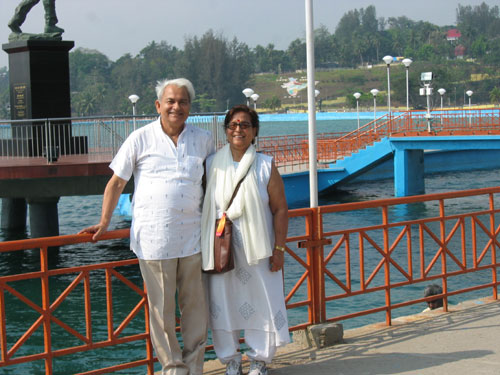
From Salt Lake, we went for a short holiday to Andaman. That was just fantastic outing. I had never thought it to be so charming. Both these trips this year were little different too from the ones undertaken in last few years after coming to Noida, as we did get any other friend or family members to go with us. I think Andaman has not got the attention it deserved over the years; otherwise it could have been envy for many and could compete with Hongkong or Singapore. During my stay at Salt Lake, we visited Birlapur and spent some quality time with Pradip’s family. Pradip is the link of the legacy in Birlapur that my grandfather started. His portrait in Pradip’s residence reminded me of many things of the past.

Tamil Nadu tour was highly informative but very extensive and tiring. Temples of South are just wonderful. Every temple has something unique and special. Meenakshi was certainly the best. And over the years these temples have kept the idea of one India survive. As a good Hindu, one is expected to visit the religious places. Though the purpose is to get rid of one’s sins, but most probably that was the fear feature introduced by the saints to make the people visit different places in different part of the country and see the outside world. The concept of Char Dhams-Badrinath, Puri, Dwarka, and Rameswaram on the four sides of the country, certainly confirms that. And it is happening since ages, when there were no railways. The pilgrims used to take leave from the family members before embarking upon these pilgrimages because of the uncertainly about the returning. I remember my first journey to Chennai and the pilgrims that I met on the station and their problems particularly because of the language. My great grandmother who had visited Rameswaram must have undergone the same agony. Why can’t the politicians understand that and avoid linguistic discouragement against Hindi? Fortunately, with the visit to Rameswaram, we have completed the Char Dham.

My only anguish was the loss of my camera in Tirupati and with it all the photographs in it.

We pray for the next year to be better.

Posted in Uncategorized | Leave a comment

नए दशक की आशा

एक नया दशक
दस्तक देता
दरवाजे पर.

खोलो कपाट
आये बयार
बदलो जहान
सबकी जय हो.

कुछ नए स्वप्न
कुछ नए लक्ष्य
कुछ नए गीत ले नए छंद
छू, छू ओठों को जाते हैं.

पर मन बिद्रोही कहता
है ललकार लिए-

रे ! नहीं प्रलय की बात करो
न हिम गलने की भ्रान्ति भरो
हम सभी सजग हो जायेंगे
धरती को हमीं बचायेंगे
यह दशक बड़ा न्यारा होगा
सब जीर्ण शीर्ण मिट जाएगा
हर ओर ज्ञान धरा होगा
जो हर मन को हर्सायेगा
यह धरती हरी भरी होगी
नदियाँ कलकल बहती होगी
सागर का नाद मधुर होगा

पर सोच वहीँ रूक जाती है
एक प्रश्न उभर ही आता है
‘क्या लोभ, काम मिट जायेगा?’ <

Posted in Uncategorized | Leave a comment

Last Decade (2000-09) and Changing India

The Last Decade has been the best for Indian economy. Per capita GDP has more than doubled from Rs 15,625 in 2000 to Rs 37,490 in 2009; Foreign Reserves have risen nine-fold from $ 34 billion to $286 billion in the same period; Outbound FDI rose from $750 million in 200-01 to $16.7 billion in 2007-08 with global acquisition from $10 million to $12 billion; Tax mop-up trebled; the Bombay Stock Exchange’s market capitalization has soared from $184 billion to over $1.2 trillion; investment’s contribution to GDP overtook consumption’s; industry (20%) overtakes agriculture (17%); Indian households save more than the Chinese; while the GDP reached one trillion mark making redistribution growth increase stupendously possible; number of “middle class” households grew 15 times since 2001. Here are some figures:

Cellular Phones: The number of subscribers that was 1.4 million in 1999 is 488 million in 2009 that is 500-fold rise and makes India number 2. Calls cost roughly Rs 4 a minute in 2000 and as on today calls cost 20 paise a minute.

Property Boom: In March 1999, outstanding housing loans were worth a total of Rs 11,404 crore, but by March 2009, the figure reached over 20-fold to Rs 2.77 lakh crore. Loans to households increased rapidly- from roughly 12 percent in 1999, the share of retail loans in aggregate bank loans went to over 25 percent in 2008.

And Malls: In 1999, India had just four malls in three cities of a total of 1.6 lakh sq feet and but by 2009, the number reached 210 malls in 37 cities with 5.36 crore sq ft.

Indian students in foreign universities: Some 50,000 Indians were studying abroad in 1999; the figure has gone up five-fold to 2.54 lakh in 2009, about 103,000 in US alone.

ATMs: From just 1,280 in 1999, the number of ATMs in India will be going up to almost 50,000 by the end of 2009.

Indians Going Abroad: The number of Indians going abroad for business and pleasure steadily rose from 4.1 million in 1999 to 10.7 million in 2008, and Indians are no more penurious but big spender.

Laptops: According to IDC India, 23,038 notebook PCs were sold in 1999, while almost 22 lakh have been sold in the 12 month-period ending September 2009. Some 19 million Indians have signed on one or the other social networking site, and the estimate about the number of Indians writing blogs may anywhere between 200,000 to 500,000.

Between 2000 and 2009, the price of gold or the fee of IIMs increased manifold. Gold price of 10 gm that was Rs 4,475 has reached Rs 18,000, while the tuition fee at IIM-A has gone up from Rs 1.8 lakh to 12.9 lakh.

But mobile phone that was priced at Rs 10,000 in 2000 is at Rs 3000 with better features. Perhaps similar is the fall in prices of branded PCs, TVs, Air conditioners, and for many such home appliances and services such as airfare and internet.

And the next decade

And the next decade will be better for India. Indian economy will be $3 trillion in just 10 years.According to several projections, India will overtake China as the world’s fastest growing economy by 2020, and be the world’s third largest economy by 2025. According to another prediction, the number of households earning Rs 200,000 to Rs 1 million a year will have risen to 583 million from the current 50 million.

But

Interestingly but, at the end of the decade, I buy both a kilogram of moog dal and a litre of refined oil Saffola Gold at the same price of Rs 110. I never dreamt this to happen. Is it man-made providential of due to globalization?

And because of poor execution of the projects, and so even with trillion-dollar economy India is the one of the most illiterate and malnourished nation with some 100 million families without water at home, and over 150 million households without electricity. Will the next decade wipe out the poverty from India?

====
And Read The Decade that was India’s
Calling it ‘The Decade That Was India’s’, Wall Street Journal. a leading US daily says India’s ability to make the success of the last 10 years the norm across regions and industries, ‘could well pave the way for an Indian century.'</

Posted in economy | Leave a comment