The Decade (2000-09) and Arriving India

Swaminathan S Anklesaria Aiyar in his weekly column in Sunday Times of India, December 27, 2009 has summarized India’s emergence or arrival.

“In the 2000s, business and knowledge process outsourcing followed the lead of computer software to become globally competitive. India proved that its main advantage lay not in cheap labour but cheap skills. Professor Vivek Wadhwa said Indian companies “have climbed the value chain to become outsourced providers of critical R&D in sophisticated areas such as semiconductor design, aerospace, automotive, network equipment and medical devices. This is happening as multi-nationals set up their own R&D operations in India and partner with local shops. Both the Palm Pre smartphone and the Amazon Kindle, two of the hottest consumer electronics devices on the market, have key components designed in India. Intel designed its sixcore Xeon processor in India. IBM has over 100,000 employees in India. A large number of these are building Big Blue’s most sophisticated software products. Cisco is developing cutting edge networking technologies for futuristic ‘intelligent cities’ in Bangalore. Adobe, Cadence, Oracle, Microsoft and most of the large software companies are developing mainstream products in India.”

“Cheap skills enabled Tata Motors to produce the Nano, the cheapest car in the world. Bharat Forge is set to become the biggest auto forgings company in the world. Reliance has created the largest oil refinery complex in the world at Jamnagar.

Instead of being swallowed by MNCs, Indians went on a global acquisition spree. Tata Steel acquired several foreign plants including Corus, and now gets 65% of its revenue from global operations. Every top pharma company has become a multi-national. Economist Arvind Subramanian says India has beaten China in terms of overseas investment as a percentage of GDP.”

William Dalrymple, the popular writer on India related stories, sees India as follows:

“India is changing but I don’t think India is losing its soul or changing so fast that it’s unrecognizable. You go a few kilometres outside Gurgaon and you can see a bullock cart.” “In soft power, India is way ahead. At all levels, Indian culture is dominant. And the Chinese can’t compete with that at all. China is turning India’s neighbours into its satellites. This is a lesson for India.”

Why can’t India leverage its soft power that can make it noticed and respected? Will India take the lessons? And India must. If China can build the highest speed train in record time, why can’t India complete its rail project to Kashmir Valley even in a decade? When will India learn to plan, design and build some landmark projects?

However, some reports appearing in foreign journals are exciting and hopeful about India. According to ‘Business Week‘, ‘urban consumers in India will likely drive more global business than their Chinese counterparts while India’s rural development far outpaces China’s.’ Domestic consumption accounts for two-thirds of the Indian economy, compared to less than a third of China’s. An approximately 300-million-strong middle class-compared with China’s 100 to 200 million, depending on how one defines “middle class”-is overwhelmingly independent of the government.

Some think,India is closer to catching China than many believe.

Can it happen in the decade that is ahead?

Posted in economy | Leave a comment

Birlapur: Down the Memory Lane

After many years I visited Birlapur when I was in Salt Lake early this year. Birlapur, the industrial township that was born around the first Indian jute mill that was set up by GD Birla, is gasping. It reminded me of a similar or worse condition of another Birla company and its township, called Hind Motor. Unfortunately, I spent a good time of my life in both the places.

I lived in Birlapur in my childhood for schooling with my grandparents and other family members at different time. I witnessed its growing brick by brick. Many manufacturing facilities beside jute got added. Infrastructure also grew fast. One of them was the market complex that had large number of shops all around, separate shades for vegetables, fish and mutton etc. It had a big courtyard that was used only for weekly bazaar. I remember this court yard used to take a great festive look during Durga Puja. A huge pandal used to come up where various professional groups performed Bangali Yatras.

I still have the nightmarish memory of the football ground where I met with the major accident when my left ankle got fractured under a manual pulled road roller. Our headmaster had instructed the students to bring that for a show by a body builder who was going to put that heavy roller on his chest. I still remember the nuisance that I had created for my grandparents with my pain on the first night. I had to go the Calcutta Medical College where the ankle and a portion of my leg got plastered. For a long time I could not go to school. BK Sarbajna, my headmaster, started calling me as ‘Khoda’ (lame) after I joined class with plaster on.

Our headmaster had a great personality, pretty tall, and with impressive moustaches just like Sir Asutosh Mukherji. He always put on hand washed white dhoti and kurta. As I remember, he had authored books in English. One of those relating to the lives of great Indians was a rapid reader in class VII. I started in this school, Birlapur Vidyalaya, as regular student from class VI in 1950. I remember many of the teachers: Mullica Babe was my class teacher in class VI. I topped that year itself and continued to do that till the test examination conducted by the school for sent up. My class teacher Shri Tarak Nath Mandal of class X gave so much marks in Bengali to my friend Tapobrata Sarkar that made me second. Tarak Babu was the private tutor of Tapobrata. Tarak Babu checked the answer books of the two papers of Bengali language. For my Hindi papers, Shri MBL Shrivastava, the assistant head master was the scorer. Naturally, he would never have expected that. Curtsey Tarak Babu, Tapobrata scored above 80 in language papers. I had felt very bad when Tarak Babu as class teacher announced the rank. But in the High School Board examination, Tapobrata scored far less than me. I could never forget the partisan act of Tarak Babu.


I do also remember my Pandit Mosai who taught Sanskrit. I scored pretty high marks (in 70s) in Sanskrit in School Final examination of West Bengal Board. He wanted me to join in humanities for higher education instead of joining science stream. I took tuition for some time in class X from Shri Kisori Mohan Roy Chaudhry for mathematics, my favourite subjects. I used to go to his residence. For some time, Aditi Sardar who was one year junior to me in school used to be there during tuition. I don’t know if my score of 94 in School Final made him happy.

I remember few more interesting incidents. I participated in recitation and acted in dramas. While playing as Ajay in ‘Mewar Patan’ of D.L.Roy, when my toy pistol didn’t work, I made a pistol-like sound from my mouth. The whole auditorium burst into big laughter. I was of 12 years at that time. I was never good in sports but when I was in class X, I played volleyball some time. And once my friends, who respected me for my scholarship took me in team too, when they went to play against Batanagar High School.

I got selected to represent the school in one outstation camp of the students from various schools for a week in Ghatsila. I remember it as Kailash Nath Katju, the then governor of West Bengal had come to see us off at Howrah Railway Station. He talked to me in Hindi and asked me to do the best in career. My grandfather was also present at time. He felt very happy about my interactions with His Excellency Katju.

During school days, one of my favourite places after school hours was the jetty of the jute mills. I used to sit near a crane and kept on seeing the river flowing. I was shocked to see its condition. Perhaps, the mode of transportation has changed.


Jetty, Birlaline,Hospital and Calcium Carbide Unit

A huge library was housed in a big hall in residential complex for senior executives, where the chief engineer of the mill, ML Sengupta had his residence. He was not only respected for his engineering skill, he was also a great actor. I still get reminded of his acting as Chanakya in D.L. Roy’s ‘Chandra Gupta’. He was just superb. I read almost all the quality books of Hindi from the library. I also kept on reading Hindi books from the personal library of Shrivastava. He wondered why I am not focusing on the impending School Final Board Examination. I used to read those, as I was really bored with the text books by the time.

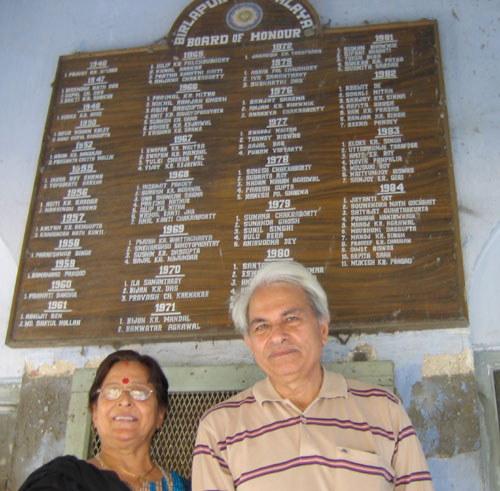
The visit to Birlapur this year was a travel down the memory lanes for me. I visited the factory, the school, and the residential areas. In school, I was excited to see the Board of Honours that has my name still in that. I got back to my school days and could remember the class rooms that I attended. I remembered how Srivastavaji used to teach me Hindi as the lone student in a class room. I wish some ex-student takes initiative to organize the old boys meet. I would love to go to my school and talk to the students and teachers. Unfortunately, I couldn’t meet any, because it was holiday for school.

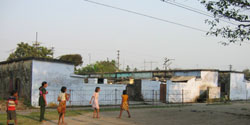
The residential units of Birlapur are in bad shape. While visiting Birla Line where I lived with my grandparents, I got reminded of many sweet memories. I used to sit on the grass or swing in the lawn very often. I still vividly remember the day after my School final Examination result was out. I was sitting there alone. Suddenly I saw Mr. Ramlal Thirani, the General Manager and Mr.S. Mishra, Chief of Personnels coming towards me. Mr. Thirani embraced and congratulated me.

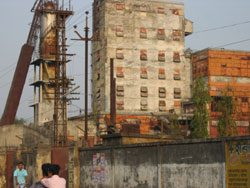
The factory is in bad shape. Units that produced Linoleum, staple fibre, and calcium carbide are closed. Even the market and the hospital appeared to be deserted and abandoned.

Birlapur and Hind Motor are the case examples of family enterprise that flourishes and declines with the man who establishes it. The decline of the destiny of Birlapur and Hind Motor started after the death of MP Birla and BM Birla respectively.

Posted in personal | 7 Comments

Rural India Changing Harvest

Inflation of the prices of the fruits and vegetables has been alarming. Who is responsible and who gains out of this inflation? Unfortunately, the farmers don’t. As good news, the Indian farmers are trying to work against all odds such as water scarcity and government impertinence to sustain the livelihood from the gradually diminishing landholding due to family fragmentation.

Many enterprising farmers are taking bold steps and switching over to the crops that have better market and better return. With improving road connectivity, it is getting easier to reach the markets.

I get reminded of my grandfather in our remote village. He used to advise to take some grapes for keeping fit during college days. The grapes were really costly and scarce in those days. In summer, one could not find milk in Sasaram even with villages all around it. Things have changed. Many in villages are keeping good breed of cows, supply milk regularly to the collection centre and get a regular extra income. Even the state governments are trying to emulate the successful enterprises of the other state. As reported, Bihar is planning to set up a large number of mini-dairies.

I was talking to Pintoo in his village in Bihar today morning. He was in his fields irrigating his wheat field. I was surprised when he started talking about sprinklers and drip irrigation. With roads reaching his village, he with his cousins is trying to have some commercial crops such as peppermint. May be pretty soon, they switch to vegetables and fruits too.

A farmer with small landholding up to 10 acres can’t be reasonably affluent unless he switches to produce vegetables, fruits, and have commercial plantations for additional earning. He will have to adapt the best possible farming practices too.

And the good news is that it is happening in many states. The urban Indian consumers today get exotic strawberries, kiwi fruit all the year round and celery, cauliflower and green peas in summer. As reported, fruits and vegetables are being grown on nearly twice the land as in 1990-91. I can get broccoli, baby corn and many varieties today in Noida’s shops that I used to see in the western countries. The apples coming from the local producers are as juicy as one from California. Mushrooms and soybeans have got into Indian cuisines.

Maharashtra has showcased what can be done on the fruit front, particularly bigger, seedless grapes. Scientists are also helping to develop high yielding better crop varieties.
The Rajasthan Olive Cultivation Limited with a tie up with an Israeli company grows olives and dates. Orange cultivation is already transforming the landscape in Jhalawar. Rajasthan cultivates chillies, coriander and other cash crops such as cumin, fenugreek garlic, fennel and ajwain. Interestingly, Gujarat is trying to grow apples.

With frequent drought and growing shortage of water, the farmers are switching over to new practices that require much less water. Many rice producing states are experimenting with a new technique of direct dry seeding for paddy. Interestingly, the environment gets less methane with this practice. And all this is with no loss of yield. Companies such as PepsiCo and ITC are assisting the farmers in different states. Punjab has developed a new machine that drills the seeds directly into the ground.

Indian farmers at least majority of them still need a lot of handholding, easy availability of quality inputs such as seeds, fertilizers, and insecticides, electricity and timely credits from banks, besides the knowledge about the new scientific developments that is useful for him for improving the yield productivity.

Can the governments focus on these aspects rather than offering only the waivers and subsidies that hardly reach to the deserving lots?

Posted in agriculture | Leave a comment

Desis that Make News

With increasing Indian immigrants’ presence in all major countries, the news of their success stories regularly appearing in local or foreign media invite different reactions. Some please rather excite, some make morose, and some even pain badly. But here I mention some that are really inspiring ones.

Forbes has done a story on the most successful CEOs of Indian origin. For many years Indian young men and women are immigrating to US. Normally, they complete their masters or PhDs and take job in US, some in big MNCs. Some reach the top position. PepsiCo chief executive Indra Nooyi inevitably tops the list of what Forbes calls “Eight Indian-Flavoured CEOs” who lead US corporations with revenues of at least $2 billion. Others in the list are Dinesh Paliwal of Harman International, Vikram Pandit of Citigroup, Francisco D’Souza, 40 of Cognizant Technology Solutions, Shantanu Narayen, of Adobe Systems, Surya Mohapatra of Quest Diagnostics, Jai P. Nagarkatti of Sigma-Aldrich, and Abhijit Talwalkar of LSI. However, Forbes very rightly concludes that the number of immigrants who are leading corporate America is still a tiny fraction.

Chidanand Rajghatta based in US has been writing about the Non- Resident Indians for long. His book ‘The Horse that flew‘ was inspiring. I sent a copy to Rakesh. It might have inspired him to switch over to business with Zyom.com.

A Chidanand Rajghatta’s recent article in Times of India- Cresent ‘Desis in DC‘ deals with the success stories of Indians in administration. According to him, there has been an incremental increase in the profile of Indian-Americans in the administration, politics, and public life in successive presidencies from Clinton to Bush to Obama, in keeping with their rising numbers (2.5 million now). Pakistani ambassador to Washington Hussain Haqqani produced 26 as the number of Indian-Americans serving in Obama’s administration. Obama’s has more Indian-Americans in senior positions than any US government – at least a dozen at last count. Two of Obama’s most significant choices were Aneesh Chopra to be the First Chief Technology Officer and Vivek Kundra as the Federal Chief Information Officer, appointments which endorsed the Indian presence in the technology sector. And I feel like agreeing with Chidanand, one day one of the PIOs (persons of Indian origin) could turn out to be a future desi Obama.

The persons of Indian origin are also doing equally good in many fields, be it finance, legal, education and science. To give just one example, 13.7 percent of international patents applications had an inventor or co-inventor with an Indian-heritage name. Many of Indians are doing good work as teachers. CK Prahalad, the management guru, is one such name.

I have been very ambitious and keep on dreaming even now. With eight in family of eleven by now American citizens, I wish one day one of them or some from the next generation will hold an office of importance in US that may bring big name to this family too.
—–
PS: TOP INDIANS IN THE OBAMA ADMINISTRATION
Rajiv Shah, USAID administrator; Richard Verma, Assistant secretary for legislative affairs at the state department; RO Khanna, Deputy assistant secretary for domestic operations of the US and Foreign Commercial Service, International Trade Administration; Vivek Kundra, Federal chief information officer; Aneesh Chopra, First chief technology officer; Arun Majumdar, Director of the Advanced Research Projects Agency – Energy in the US department of energy; Preet Bharara, US attorney for Southern District of New York; Neal Katyal, Principal deputy solicitor general; Rajesh De, Deputy assistant attorney general, US department of justice; Sonal Shah,Deputy assistant to the President, director, Office of SICP, Domestic Policy Council; Farah Pandith, US special representative to Muslim communities; Anju Bhargava, Member, faith-based advisory council; Rajen Anand, Executive director, policy, USDA Center for Nutrition and Promotion

Posted in usa | Leave a comment

Poverty Alleviation through Recounting

According to the FAO 2008 report, ‘India accounted for 252 million of the 873 million under-nourished people all over the globe in the period 2004-2006. That’s almost 30% of the world’s undernourished population, a share larger than sub-Saharan Africa and twice China’s. More worryingly, the population of the undernourished has increased significantly. India had 210 million undernourished people at the beginning of the 1990s.’

And even under such a dismal situation, the government has been busy in researching about a right estimate of the population below the poverty line (BPL) and a definition of BPL. Arjun Sengupta, Tendulkar, Saxena or World Bank all have provided a different of the percentage of the Indian population living below poverty line. The latest that came from Suresh Tendulkar last week is 37.2 per cent that may sound a lot less pessimistic than the 78 per cent figure of Indians living on less than Rs 20 per day put out by Arjun Sengupta. NC Saxena put the figure at around 50 per cent some months ago. And at 42 per cent, the World Bank has yet another number! But are the figures reliable? Is this not shocking?

And the governments of the states’ level have are busy only in contesting the number. They will be happy if it reaches more than 100 Percent, as it will mean more for the men who matter in the ruling party. Some wish to keep the affected people busy in emotional issues, be it a separate state or the neglect of the local language. One Chief Minister hopes to do that by erecting statues of dalit icons.

Some of the governments are taking some concrete steps too but halfheartedly and ineffectively. Some companies are also trying to reach rural India and assist the people there. But even the successful model such as e-Choupal gets hardly any special support from the government to expand it all throughout the country.

The solutions of this national problem are known but the sincerity to solve lacks.

The farmers need the facilities of irrigation, without which India can’t improve its food production significantly. It is clear from the data. In India, 56 per cent of food grains are produced from 47 million hectares of irrigated land while the rest 44 per cent comes from 95 million hectares of rain-dependent land. Thus, the irrigated land is about two-and-a-half times as productive as land dependent on rain. An adequate irrigation itself can boost production that is desired. But this is not the top priority of the governments.

The public distribution system needs is to be effective but over the years there has been any sincere effort to make it fool-proof and transparent, though since Rajiv day the figures appear about the percentage actually reaching to the beneficiaries. Now everyone is looking to Nandan Nilekani to provide the solution with his smart card.

The marginal farmers need independence from the middle men and traders for getting the best price of their produce, but the government has hesitated to take some concrete steps. A report appearing in media about the recent inflation of the vegetables tells the same story that I have been writing for months.If cauliflower, for instance, is being sold by dealers at Rs 5 a kg at the mandi, by the time it travels a few miles to the vendor its price is Rs 20-25 a kg. The poor farmer gets just Rs 3 from dealers at the mandi, despite his toil and risks.

With the most innovative minds in trade and bureaucracy that find or help a way to unscrupulous lot to corrupt any system, can there be a hope?

Unfortunately, the states can afford demanding higher and higher number of BPL figures. The people must also demand from their leaders a time frame for eradicating the poverty by creating more employment with education, skill training, population control, project implementation and industrialization, particularly bringing in the manufacturing. They must not believe and listen to their political excuses.

Posted in economy | Leave a comment

Contagious Corruption

Invariably every day in morning walk, the discussions of the veterans converge pretty soon on the corruption in the system. For some time in past weeks, the main headlines went to Madhu Koda who had become the chief minister of Jharkhand by default. As reported, Koda siphoned some Rs 4000 crore. The police finally have arrested Madhu Koda, 38, on the instruction of India’s Enforcement Directorate which investigates economic crimes.

The other recent important corruption news relates to Karnataka High Court Chief Justice P.D. Dinakaran. The process of impeachment has started against him. As reported, Justice Dinakaran has grabbed land and accumulated wealth beyond known sources of income during his tenure as judge of the Madras High Court. Dinakaran has decided not to hold court sittings till he is cleared.What can be the future of justice in India if even delay gets a price.

One of the two most important factors affecting India’s future growth, according to the survey by the London based think tank Legatum Institute is the contagious corruption.India has earned notoriety for its widespread corruption, and its rating is dismal among the countries of the world. In another story reported last week in Kolkata Telegraph, the CBI arrested a senior scientist of the Central Institute of Mining and Fuel Research for allegedly accepting a bribe of Rs 75,000 from the representative of a Calcutta-based mines safety equipment manufacturing company. And almost every other day, one read some news related to corruption and also some survey report that reveals how contagious corruption has become.

Estimates by Outlook magazine suggest that the total amount swindled by politicians, bureaucrats and private companies since 1992 is around Rs 73 lakh crore. And by now India According to another report, a staggering 300 Bihar government employees earning modest government salaries are crorepatis. Surprisingly enough, all but two of the sleazy 300 continue to hold on to their secure as also, no doubt, lucrative – government jobs despite long stints in jails.

I feel morose when some friends in the morning naturally with their experiences from government jobs feel that the corruption today is not the issue of any consequence today. Some even opine that corruption has become the built in lubricating feature of the system without which the machinery will cease to work.

I have been concerned only because the society at large hardly reacts against it though it is getting contagious. Almost everyone who gets opportunity goes for it without hesitation. Perhaps for many, corruption is becoming essential to live with equity and respect. Otherwise the poor scientist would not have hankered for it. And the Chief Justice would not have been taking shelter against his identity related to his birth in deprived class.

But I have different question: Why are the person or the company offering the bribe not severely punished? Are the people trying to buy the vulnerables not the real culprits? Are they not exposed and excused as they are from the most powerful section of the society? When can be an equally severe punishment given to those real culprits? Can some effective voices will support my viewpoint?

Posted in governance, social issues | Leave a comment

Dham Yatra and Thereafter

According to a tradition, after a Dham Yatra one must give up one thing that the person used to like. What should I give up? With the loss of my camera, why should I not stop photography to which I had been madly attached to for many years even after losing cameras many a times? After all why should not I give up this? What’s worth? With thousands of photographs in albums and now flicker, I hardly ever look into them. I don’t think anyone else does that. After all I have not become that big a celebrity whose photographs are sought after by many.

The wish and eagerness to get photographed is pretty old. It started perhaps when I came to Birlapur with my grandfather for schooling. Even he loved to be photographed. It got satisfied to professional ones or through the courtesy of friends for many years before I went to UK in 1966 and bought my box camera Yasica from Geneva.

During IIT days my friend GL Makhija took a number of my photographs and in the early days of Hind Motors, it was OP Khanna who got many of my photographs. During my Jaipur visit and the first visit to Agra it was one Chander Prakash who had photographed me.

But then started my official visits to Japan in 1982 and I kept on buying cameras though mostly auto focus ones and kept on clicking. It remained quite a costly hobby with development of films and printing costing a lot.

It was Anand who got me introduced to the digital camera first. It took away the hassle of development and printing. It became an essential item when Anand got me in to the writing my blogs. Last one that I lost had a capacity to hold some 1000 frames. I felt bad when I lost it in the bus that brought us from Thirumala to Tirupati on December 1, 2009. I thought I shall be able to trace back with the help of the officers and guide of Tamil Nadu Tourism who had arranged the visit and the grace of Balaji. But perhaps I am hoping against the hope and I must forget about that. Then why should not I stop photography all together? Perhaps I can manage without it now at this age of 70+.

Let the photography be one thing that I shun after the completion of Char Dhams in the process of gradually detaching myself from the worldly things.

Posted in personal | Leave a comment

Tamil Nadu Tour: The Group

We were 29 tourists in the bus. We travelled across the enchanting Tamil Nadu from Chennai right up to Kanniyakumari and back. We moved together, visited the places of interest, be it temples or market, dined and stayed together in Tamil Nadu Tourism Hotels for ten nights.

A poorly-paid but very co-operative guide Chnadrasekaran accompanied us and was always ready to help for everything we wanted. He arranged all temple visits that are really messy with greedy priests. Some thought Chandrasekaran operates though some who pay some commission. Similar was the views whenever he took us to some shops at Madurai, Kancheepuram, or Chennai. Madurai is his home town. His working wife and younger daughter came to meet him. The young girl wishes to be an engineer. Her elder sister is also in engineering college.

The oldest man in the group was an 87 years army man, widower for last 32 years but very fit and fast. He was always the first in everything. The youngest was Dr. E Mittal at 39 who accompanied her parents. UKMittal, an engineer from Roorkee had passed out in 1960, one year ahead of me but still is at 66, and after serving whole life in SAIL still works with Jindal’s steel company. GK Pandey was another person who drew my attention. Pandey is a senior officer in defence. He is knowledgeable and a booklover. An undersecretary was also part of the group whose wife hardly joins his frequent outings. And how can we forget three extra exuberant sisters in the group who were accompanied by the husband of one sister who was a PH.D in history and a teacher in a Faridabad school? Husband was connected to the hospitality sector and is now consultant.

The group truly represented the aspiring Indian middle class. They have all worked hard in life or are still working. They have attained whatever they wanted. They provided good education to their children and have got them settled. They have built houses and created some wealth that can sustain them in their retirement. They are financially sound to live well. They don’t look towards their children for supporting them. Some of them such as Dixits and Chaudhrys are have their children abroad and they go and live with them quite frequently. But the best was the story that Gaur told me. Gaur retired as electrical foreman from IIT, New Delhi. His son who is now in USA had married an American girl. It reminded me of Anand. Every member of the group has a unique story of his own. It all excited me.

Here is a new India.

Posted in Uncategorized | Leave a comment

Tamil Nadu Tourism: Some Suggestions

We undertook its ‘10-days rail-cum-road tour’ starting November 21, 2009 from New Delhi and returning here on December 4. Most of the co-passengers were from and around Delhi. With some improvements, the tour could have been a memorable one for the rest of the life. Here are some suggestions. I wish Tamil Tourism takes it positively and seriously and implement it.

Facilities of Internet: Though some Tamil Tourism Hotels such as one at Mamallapuram or Thanjavur were having Internet facilities, on enquiry it was found as not working. In this era and when some or the other member of every family of the tour group remain on-line, the Internet is essential to keep in touch and for sharing ideas and experiences. Why can’t a developed state such Tamil Nadu and its tourism department provide this essential communication facility for social networking in its hotels? It can always outsource the facility to a private party if it can’t maintain it on its own.

Franchise restaurants
: Some Tamil Nadu Hotel doesn’t have restaurants of its own. The worst experience was that at Tiruchirapalli. Tamil Nadu Tourism must have approved franchised restaurants or hotels on the way that must provide clean safe food for breakfast, lunch and tea and ensure to maintain clean toilets and washrooms for gents and ladies. It must cater at least snacks such as dosa, idli, upma, aloo paratha, and sandwitches of good quality at all time. How hotels worth any name can’t provide sandwiches in any place that the guide took us in the tour? Tamil Nadu Tourism must plan and specify the name of these hotels or restaurants in the tour plan provided. It should never leave it to sweet will of the guide who can be unscrupulous to dictate and decide the restaurant.

Alternatively, the Tamil Tourism must provide packed breakfast and lunch instead of using roadside hotels that may cause food poisoning as it happened with me. And Tamil Nadu government must create restrooms on the routes of its tour plans.

Language Training: Tamil Tourism must initiate a language training programme for all its employees as well as those working in restaurants. They must be conversant with both English and Hindi. It will go a long way in improving the national integrity. But the main intention is to make the client tourists feel at home and convenience. In some places, it was really difficult to carry on. One feels miserable in his own country. Even the accompanying guide must be trained one with good knowledge of the places and its history.

Transportation: Tamil Nadu Tourism would have used its own Volvo coaches for the tour. For a journey above 3-4 hours at stretches the commonly used buses tire the passengers badly. Naturally, it’s more so for elderly persons, particularly when the tour is of more that 3-4 days period. 10 days period was too long. It was highly undesirable for Tamil Tourism to use a private company bus that had not paid its taxes and that caused the passengers to get stranded for hours. Tamil Nadu Tourism would have checked all its documents well in time. Further, we had to change to Volvo coach while going from Kanchipuram to Tirupathi, as the bus had not paid Andhra Pradesh tax.

Tour Design: This tour must have an additional rest day at Kodaikanal dropping Tirchy all together. Sightseeing such as Bryant’s Park and the poorly maintained Lake was unnecessary and waste of time. Even Tirupathi could have been made optional.

Finally, I wish Tamil Tourism would have arranged an evening with typical cultural programme with South Indian dance and music to make the tour enchanting in real sense.

Posted in Uncategorized | Leave a comment

रामेश्वरम के अग्नितीर्थ में


है अग्नितीर्थ सागर में
यह सोच था मन हरसाया
दर्शन की आश लिए फिर
मैं जर्जर तन से आया.

यह एक अरब का भारत
अपने पापों से
तेरे जल को
काला कर देता
और पापमुक्ति की शक्ति
पर प्रश्नचिन्ह उठ जाता

फिर तट पर खड़े अकेला
एक स्वप्नलोक पा जाता
वह रूप तुम्हारा मनहर
अनंत लोक तक फैला
मन को पुलकित कर जाता

मेरी आँखों के आगे
फिर दृश्य बहूत से आते
गर रामायण सच है
फिर राम यहीं थे आये
और आकर मिले बिभीषण

हे अग्नितीर्थ,
उस दिन से कितने अरबों
को तुमने
पापों से मुक्त किया फिर
तेरे तट को कलुषित कर
क्यों लोग चले हैं जाते.
तेरे जल में डुबकी को
था मेरा मन घबराया
पर आँख बंद कर हमने
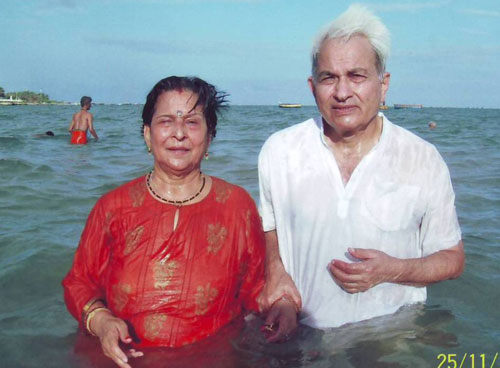
फिर पॉँच बार कर डाला.

Posted in Uncategorized | Leave a comment