Meeting Old Friends and Missing Some

IITians in Bangalore / South are holding the Golden Jubilee Meet of the 1961 batch Alumni in Bangalore on 4th November, 2011. OP Khanna has invited me and I am going to join them on the day.

However, while I shall meet some after many years, the very thought of IIT, Kharagpur 1961 batch mates and many with whom I got acquainted and developed friendship, are no more among us, makes me sad too. They played their destined innings and left for the final abode a little premature.

RP Dhingra had joined Hindustan Motors. For initial years before the marriage, we lived together. Even after he moved to Delhi, I was in touch with him. Every time I visited Delhi, I talked to him or met him. Either I would go to his place or call him in my hotel He had once visited us in Hind Motors too along with a friend and stayed with us for a night while going to Assam for some official work. We came to Noida in 1997, and as usual I called him. I was shocked to hear that he was ill and succumbed to some illness few months ago.

I was surprised one day, when I saw AK Mukherji in Bansal’s chamber in Hind Motor. Mr. Bansal was from the first batch of IIT, Kharagpur. We didn’t talk much on the day. Later on, Bansal told me that Mukharji was working in CK Birla’s Nigeria unit. One day after many years, KM Agrawal who was a senior from IIT itself and had worked in Nigeria with Mukherji and had returned, informed me that Mukherji was killed in Africa by the local police mistakenly when a group of burglars had attacked the colony where the Indians lived.

Ravi Mukherji and Nazimuddin Ahmed from electrical worked for TELCO Jamshedpur. I met Ravi in some conference in Calcutta. He was unhappy about the company promotion policy. Thereafter, I kept information about him through some friends in TELCO. Lastly, he headed the important department of industrial engineering and was happy. And then one day I heard that he was no more.

I met Nazimuddin when he had called me without knowing that I was from his own batch for conducting a two days training course on gear manufacturing for the managers and supervisors. And later on I heard the sad news of his demise one day.
Shrikant Singh and I had one thing in common. Maternal uncles of both practiced in the Sasaram court when we were in IIT, Kharagpur. He was in mining and RK Hall. Sometimes we used to meet and talk. For his rural background and simplicity, I liked him. One day I heard from someone that he was no more. It really shocked me.

PK Singh was also from mining, but a little snobbish. He was from a place near Arrah. In Rajesh’s marriage he was an invitee of Janardan Sharma, Rajesh’s father-in-law in Sitarampur near Asansol. I met him for the first time after the IIT days. Interestingly, Janardan was also in mining. One day Janardan informed me that he was no more.

Deshbir Singh invited me to work for Harig Crankshafts after I retired from Hindustan Motors. During IIT days, he always used to be in our group because of the proximity of letters in our surnames. After my by-pass surgery I left Harig, I started living between Noida and Salt Lake. And then one day a colleague at Harig came and told me about his untimely death.

And yesterday when I was going through Times of India- Crest, I came to know that Praveen Chaudhry who was from metallurgy and did brilliantly at IBM, USA, is no more.

I have not been great in maintaining the contacts with my friends, acquaintances and even relatives. But I loved their company whenever it was possible. TR Mulrlidhar visited us early this year with his wife and so did Dr. Kailash Narayan Singh of Agriculture department. I keep on talking with Dr. BB Pandey of Civil who is still with IIT, Kharagpur. Pandey lost his wife this year. Jialall Sharma, GR Gupta and Shikhar Jain are in Delhi, but we hardly talk or meet. It has become so difficult to move out at this age.
Deshbir, Shikhar, Kailash and GR Gupta tried to get into business and succeeded to a great extent. Dr. Pandey got the Distinguished Alumnus Award 2011. But many just worked in private or public sectors and have settled down for a retired life.

We know so little about our friends. How many of us know the pioneering work done by some such as Dr. Praveen Chaudhari who engineered the rewritable compact disc (CD), but wrote out the patent for IBM for a fraction of the billions Big Blue, Sony, Phillips and other corporations got from the invention.

We were told to believe in ‘Yogah Karmashu Kaushalam’ and we did our karma following the Bhagavad Gita’s advice karmanyevadhikaraste, maa phaleshu kadaachana (do your duty without regard to rewards).

Can’t we think some way to keep the memories of 1961 batch mates alive for the future generations?

But the memory of the four years at IIT, Kharagpur is still one of sweetest. One can’t just relive it again.

Posted in personal | Tagged , | 1 Comment

Manmohan Losing Lustre

Sonia Gandhi had to undertake the arduous task of mediating between Chidambaram and Pranab at wrong time when she is still convalescing from a surgery. Both are the part of administration where Manmohan Singh is boss.

What sort of Prime Minister is Manmohan if he can’t manage two stalwarts of his own cabinet? Could not Manmohan postpone the visit to earthquake affected Sikkim for a day when bringing the truce between Chidambaram and Pranab was so urgent? Doesn’t the image of the country get tarnished with so senior ministers fighting? Have any of them got his image enhanced because of the ego war? Why was Manmohan not proactive in stopping it or does the infighting help him keeping his chair in tact?

One can very well understand when Sonia handles the party men or the alliance to assist Manmohan. Why did then Manmohan not try to get the statement from Pranab what Sonia could get? Actually the note of Pranab implicates even Manmohan. Manmohan couldn’t have convinced Pranab to do that. Pranab had been Manmohan’s boss and even today he is defacto Prime Minister. Chidambaram is a better subordinate towing Manmohan’s line. So Manmohan requested Sonia to help him, which she did by calling Pranab, discussing the subject in presence of Antony and Patel and almost ordering for a truce as soon as possible And Manmohan made himself unavailable by visiting Sikkim. The two warring ministers met him in end only for a formality.

How can Manmohan escape the fallout of 2G scandal when he was informed at every stage? Moreover, as the head of the government Manmohan would have taken the responsibly of so huge a loss to the nation because of corrupt means used, and as clear from the note prepared by so many of the ministries together after so many meetings.

As clear from the body language of the cabinet ministers, there seems to be intense internal politics in the cabinet ministers some siding with Prime Minister against Pranab who would have been a better alternative to Manmohan at this stage in the national interest.

Unfortunately Sonia Gandhi is still not ready to accept the end of ineffective Manmohan regime for a change, as Rahul is not ready.

Manmohan, on his own will not like to exit? Why should he sacrifice himself for someone to replace? After all Manmohan is working for some sort of record? But should Manmohan be compared with other Prime Ministers of the country? He can’t not be called anything but a CEO appointed by the largest party chief.

Posted in governance, indian politics | Leave a comment

Do Bigha Jameen

In 2020, about 98 % of the farming family will have a shrunk holding of only ‘do bigha jameen’. Normally, today a farmer gets around every year Rs 20,000- 30000 worth of grains from an acre of land that is a little less than two bighas. This is when the farmer family remains with the traditional farming of wheat and paddy. Naturally, the revenue will not be sufficient to feed a family of five. What can be the way out for the family to generate better revenue and earnings to sustain the family? Two possible routes will be one through increasing the minimum support price of the grains by the government and the second, by improving the yield from the farm that must be aimed to reach the yield of the best in the country and then that in the world.

The 2010-11 acreage and production numbers suggest that the average wheat productivity surged perceptibly to 2.94 tonnes a hectare, from 2.83 tonnes in 2009-10. At this level, India’s average wheat productivity is comparable with that of the US’ at 2.6 tonnes, though it is far below China’s at 4.7 tonnes.

The farmers and also the concerned government agencies in other state such as Bihar must at first try to achieve the productivity in wheat production to the level of Punjab removing all the constraints and then draw a roadmap to reach the productivity of the farmers in China. The government must facilitate and motivate the farmers to enhance the productivity levels of the production of various grains, be it paddy, pulses or oilseed.

Many are exploring to improve upon the productivity and earning through various means. Farming needs the knowledge of its science, management and business approach. The farmers today can’t compete or grow without a new approach.

As reported, Anju Srivastava has been able to explode productivity by introducing high-value, low-water use crops and modern farming techniques. When Srivastava tweaks traditional cropping pattern, swapping jowar and bajra for herbs and salads, converting to drip irrigation to save gallons of water and bring down electricity bills, using composting and other sustainable farming techniques to conserve and improve soil, she gets exponentially higher output of already high-value produce.

Srivastava, through these techniques, has managed to get ’12 lakh per acre per annum, thus creating wealth. “My farmer’s family incomes have gone up from ‘20,000 to ‘3 lakh per annum,” for every acre of land they continue to own.

Fortunately, many are trying to experiment on the ways and means to make farming as professional interesting and profitable.

Contract farming, improved irrigation facilities, progressive farming practices besides the better seeds from right sources do bring many miracles that were not known earlier.

The state agriculture universities must shake off their laboratories-centric mentality and take their innovations to the farmers. The state government must make it happen. Nitish Kumar wishes to send the farmers to China. I wish the farmers from all over the country must start learning from the best achieved in the country. There must be extensive exchange visits among the farming community.

The scientists must go for intensive research to make ‘do bigha jameen’ productive enough to sustain a small family

Posted in agriculture | Tagged | Leave a comment

Modi and Bihar’s Leaders

As far as I know, Modi has never expressed his wishes for becoming the prime minister. Neither his party has declared his candidature for the high post. Why are then the political leaders of all hue and cry have come out with all the weapons against Modi? One could expect nothing but the opposition on this notional issue from Congress, but why should Shriman Yechury of CPM be so hasty to write against Modi’s fast? But I feel just pity when the so-called sycophants of Nitish vomit venoms against Modi? Has Gujarat deported any Muslim poor from Bihar who has gone to Gujarat for earning his livelihood? JD (U) and Nitish Kumar had already insulted Modi against all norms of decency from a chief minister to a chief minister just for keeping the opinion makers of a vote bank satisfied.

Why can’t the leaders like Sharad, Sadanand, Lalu and Ram Bilash keep their mouths shut on national issues? Whenever, they speak, be it in Parliament on Anna’s fast or now about Modi’s fast in Ahmedabad, they annoy others unnecessarily. It only harms the people of Bihar. None of them could build institutes of higher education or created jobs in Bihar. The people of Bihar today go all around the country for higher education and in search of jobs. Bihar no more contributes in the polity of the country. In none of the political parties, the leaders from Bihar hold responsible position neither are they respected for some serious inputs as Rajendra Prasad or Jai Prakash Narayan and to a certain extent Babu Jagjivan Ram were treated. The people all over the country as well as the intellectuals respected them and gave weightage to their views.

What right the present politicians of Bihar have to speak against Modi who has provided thousands of Biharis employment in his state? Perhaps, it is because of the presence of the people of Bihar in labour force in Bihar that Ram Bilash plans to contest all the seats in assembly election of Gujarat next year. Is it not a mockery of democracy for a person who couldn’t get elected in his own state using all his resources and who has hardly any member of his party in the assembly of Bihar? Who is going to finance his election expenditure? Why should not election commission stop a blanket ban on such endeavours?

What has Sharad Yadav done himself to improve the lot of poor people of his own state, his own district and even of his own village to express so much concern such as “Half the population in India does not get a single decent meal a day.”

What is the credential of Sivanand Tiwari to judge Modi about his Rajdharma, once the party don’t care to abide by the Alliance=dharma?

I wish the leaders to focus on the real development work in Bihar where 80% of the population still lives in villages in pitiable condition, with no healthcare, sanitation and electricity. The state must improve the quality of higher education and bring its colleges, universities up to a respectable level in imparting knowledge and researches and shun to be known only for having caste clashes, when the students of other states start coming for studies in Bihar. Let the state ensure that whatever big named institutes are coming up reach the same level of excellence as their counterparts in other states by providing all the infrastructure and facilities.

How can these leaders talk so big when they can’t provide even the minimum facilities for the Hindu Indians coming from all over the world in Pitri-paksha to Gaya? Many a times, it appears perhaps the government is afraid of taking any such initiative to keep its secular character intact.

How many of these leaders have transformed even their own village and made the quality of living there better?

Even Nitish Kumar must be bold enough to take non partisan approaches. Who stops him from taking steps that ensures education to 100% of the minority children? Can his government take this challenge and make the state a unique one?

Posted in bihar, governance | Tagged , | Leave a comment

Nalanda: Prestigious Project and My Views

The issue raised by ‘Bihar Times’ about the VC of NIU, Dr. Gopa Sabhrawal and her team that has started operating from New Delhi, must be worrying to many who dreamt of the institute as the revival of the glorious past of Bihar in a grand manner. As I have written earlier I and many wished NIU to have score of autonomous International Schools for teaching, researching, and contributing in the knowledge domain of various subjects from humanities, law and medicine, to science and technology. The head of each of the autonomous school would have been the most respected person in the subject. Even the ancient Nalanda was not restricted to only Buddhist studies. May be that each participating country could have set up a school on a subject best developed by the country. Just for example, I wished Japan to set up a world class school for manufacturing and Japanese system of management. The university would have grown as one and only unique institute in the world attracting students and teachers from all over the world. I had person such as Jagdish Bhagwati in mind to head it as its first Vice Chancellor. I am sure there would have been other Indians and other nationals with worldwide accepted capability who would have been requested, if necessary, by the economist Prime Minister and the engineer Chief minister to help in setting up the institute and ensured of free hand and all support.

As the name includes International, I wished NIU to have the Vice Chancellor and heads of the schools selected from among the best in the world. However, Bihar Times’ question, “Did not Amartya Sen find anyone from Bihar, which has proven fertility in case of academics and scholarship?”is shocking. I wish the Bihar Times would have researched and suggested some names too.

The first Vice Chancellor of an institute such as NIU is certainly a very important person and would have been selected more prudently. Perhaps, the mentor group came to the decision a little too fast in a hurry.

I wonder why Nitish Kumar, who showed so much initiative and enthusiasm to get the project initiated and his protégé NK Singh could not take care of the long term interest of Bihar and the institution. The speed with which the land for the university was acquired and handed over was exemplary. Why is he shirking off the responsibility now?

After my blog on the subject, one of the two persons whose name was in media for VC wrote to me about his fear about the project.

“What will deter people from Nalanda is not hard work (anybody good works 20 hrs a day) or the conditions in Nalanda. It is that it is not clear that the basic plan of the University is well conceived or that there will be support for all the things that are necessary to make it a success. Money is not an issue. But the Mentor group did not understand Indian conditions and what should be in place for the Univ to be a success, and neither does the government.”

The communication highlights the apprehensions of the intellectuals about the government projects of national importance. The governance in the country will still take many years to mature to get the confidence of the people in its intention and support.

I fear the reports of the controversy in media are getting uglier. It should not name person/s and should point at the weakness of the system for such a prestigious project.

I had dreamed also of an international city growing around Nalanda International University on line it has happened over the years around many other universities. Will the government come out will the necessary clarifications to remove the clouds from around the project to see it executed fast.

Posted in bihar, education | Tagged , | Leave a comment

Inflation, Government and Growth

Inflation remains high.

Following set rules, RBI has increased the Repo rate. That is the only solution known to them to curb inflation, though it has not happened after so many of the increases in last few months. For a change, why can’t RBI stop increasing the repo rate and instead reduce it and see what happens?

The interest rates on home and cars will increase. And it will also increase many other rates. Companies from auto to real estate, infrastructure and fast moving consumer goods have expressed their angst against the RBI’s hike.

The oil companies have increased the price of petrol by Rs 3 per litre to maintain their profit margins. Transportation sector has started enhancing the rates. Travel agencies will also increase the price. The government agencies add salt onto the wound. And person such as the deputy chairman of planning commission calls the rise of petrol price rise as good news. Mother Dairy has increased the milk price again. All vegetables have gone costlier. The government would have increased the price of cooking gas too. The heat of the people’s anger has postponed the decision on the hike of the cooking gas price.

Government can’t reduce its taxes on crude or petrol that will reduce its collection that are channeled to the schemes such as MNREGA and food subsidies not because the common people will get affected but because the intermediaries will lose their earnings.

Allies of the ruling Congress government as well as the main opposition and its partners have opposed the rise of the petrol price. BJP went in protest march on the streets of the capital.

But will it make the government roll back the petrol price?

The situation has pushed the key manufacturing sector of Auto to go in slower lane. Investments have stopped. Some vested interests are also fanning labour troubles on irrational ground. As usual neither the central nor the stale governments are taking proactive steps to kill the problem. The major car manufacturer has stopped production. The trouble looks like spreading from North to south. Where is the governance? The real estate sector will also slow down.

The indecisiveness on land acquisition is already holding up many projects and thus industrial development. How many months will it take to the promised bill?

Helpless Indians want this inactive government to go but don’t know how. Anna and his team can protest for a notional utopia but can’t rise in revolt for such anti-people move. Can they do it?

The government knows following the practice of democracy and constitution the people will have to wait for two and a half years to change the present government. And those in the government are sure of their Aladdin’s lamp doing some miracles to make people forget the injuries inflicted on them.

Perhaps this was the time when the economist Prime Minister with his command of the subject would have come out with some innovative solutions to curb the inflation. But he talks on everything else but the inflation and slow down of the economy.
The main opposition is busy with Modi’s publicity festival. The left is engaged in organizing labour unrest. Can the person like Anna and his team get them involved in removing the miseries of the people? Or are they also the members of the millionaire club running the government and hardly realize its necessity for the common men and women in million?

Posted in economy, governance, industry | Leave a comment

Nalanda International University: Brawl over VC

I have been writing about NIU for a long time. My only wish was that Bihar would get an international university grand and academically excellent enough to attract the best brains of the world both as teachers and students as the ancient Nalanda did.

I expected NIU to have schools of many contemporary subjects along with some dealing with the ancient philosophy, culture and religion. I never expected that the university will focus and specialize on the Buddhist studies that even other institutes existing in India can do. The ancient Nalanda was also the seat of studies of various branches of humanity, science and mathematics.

The news of the controversy raising question about the qualification and suitability of the Vice=Chancellor Gopa Sabharwal and her associates was just shocking and disturbing. It may delay the project and tarnish its image. As I could understand, Ram Chandra Guha and Bhanu Pratap Mehta didn’t join the university simply because it would have demanded a hard long hours of work and that too in a remote place such as Nalanda that may not have all the basic infrastructures for them to keep in touch with the type of lifestyle they are used to. I get reminded of Sir JC Ghosh, the first director of IIT, Kharagpur and the sacrifice he would have done to station himself in Kharagpur, far away from Calcutta.

I was amazed to know about the salary drawn by the new Vice Chancellor and even her associate. I am sure that the remuneration fixed for the Vice Chancellor by the Nalanda Mentor Group could not have been deterrent to attract the best available candidate. As reported, Dr Gopa Sabharwal draws a salary of Rs 5,06,513 per month as Vice chancellor and Dr Anjana Sharma, an Associate Professor in Delhi University, who has been picked up as the Officer-on-Special Duty (OSD) draws Rs 3.30 lakhs.

A blogger questions, “How come Dr Gopa Sabharwal, a Reader of Sociology in the Lady Shri Ram College (Delhi University), who heads a department of three teachers, and has two published books to her credit got catapulted to the position of Vice Chancellor is a secret best known to the Nalanda Mentor Group (NMG) or its head viz. Amartya Sen.” A website of Bihar has also raised the issue.

I could not understand why the Nalanda Mentor Group did not explore the possibility of finding the right candidate from participating Asian countries or from the institutions abroad, if it failed to get one in the country, and also why Nitish Kumar and his man in the Mentor group couldn’t notice the drawback in the selection of the present Vice Chancellor if it was not right as now claimed by some today. It hurts me and so must it many who wanted to see a great institution taking shape to commemorate the past glory of Nalanda and Bihar. Instead, media smell a scam right at start. The refusal of Kalam who was one of the initiator of the idea of establishment of the NIU, to be associated any more with the university makes one like me suspicious.

I myself don’t know about the Vice chancellor much beyond what is available in public domain. She was a head of the sociology department of a college in Delhi. Has the controversy been born of personal envy of some individuals with vested interest or is it a real serious issue requiring consideration and solution? As reported, ‘the governing council of the Nalanda International University has given a “free hand” to vice-chancellor Gopa Sabharwal in making the institution operational by next year’.

I wish Amartya Sen, the head of the Mentor Group, clarifies on the controversies. It is again unfortunate that he is associated with many projects of importance including one of Presidency University, Kolkata.

But I appeal to the intellectuals living in Patna and New Delhi or anywhere in the world to take interest in NIU and facilitate in getting the dream project take shape with positive contributions.

Posted in Uncategorized | Leave a comment

Braj Bhusan Pandey: IIT, Kharagpur, Distinguished Alumnus

I was surfing few days ago and suddenly came across a news item on website of Times of India: ‘Bihar teacher gets award from PM’. The news was from Patna. I never knew that it was about my friend, Braj Bhusan Pandey.

‘A Bihar professor, B B Pandey, received Distinguished IIT (Kharagpur) Alumnus Award 2011 from PM Manmohan Singh for his contribution to innovation in transport infrastructure development.’

Interestingly, Pandeyji must be the first from our batch of 1961as much as I know to receive the distinguished alumnus award. It’s something worth appreciating.

Braj Bhusan Pandey and I came on the same day in IIT, Kharagpur for the interview in 1957. He was with his father and me with my grandfather. They were staying in the room next to ours that night. His father was at that time the principal of Teachers Training School in Sasaram. With that first meeting, Braj became and remained friend for the whole life.

Braj had come to Birlapur once and came to know a secret of mine. I requested him not to reveal that. And he did. After Kharagpur, Braj though civil engineer decided for teaching instead of joining lucrative government jobs such as one in PWD. After a brief spell at Bihar College of Engineering (now NIT-Patna), Braj came back to IIT, Kharagpur and is still continuing as Emeritus Professor.

Braj had come once to HM with his wife. Thereafter in one Durga Puja when we were going to Orissa for holidaying for a week with all our kids, we stayed for a night with Pandeys.

In 1989, I with Yamuna went to Kharagpur again. Rakesh was to undergo his counseling at IIT, Kharagpur. Interestingly, Manish, the son of BBPandey too entered IIT, Kharagpur the same year.

Braj has developed low cost technology for maintenance-free roads for villages and design guidelines for concrete and asphalt roads. At one time I suggested Bihar government to use the experience of Braj in building rural roads of the state and use his expertise to ensure the quality of the state road building. As usual, Bihar government didn’t respond.

There is something unique with Braj. He has remained the same in every respect even after more than five decades. His simplicity is just exemplary.

I still wish Bihar with an engineer as chief minister could have used and honoured the persons of the state better.

Unfortunately, Pandey lost his wife this year. I really feel bad about it. However, nothing much can be done about it. IIT, Kharagpur can retain his services for longhand perhaps that will be the best award for a person like BB Pandey.

I still have anguish. Even the institutes like IITs and IIMs are not able to detect and squeeze the best out of the dedicated lot of teachers and researchers. Further, the institutes hardly try to make the distinguished teachers known to the people of the country. How little we know about the best teachers in the higher education field?

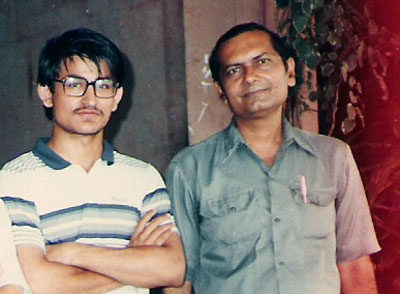
PS: I was searching for a photograph of Pandeyji, as I addressed him all these years. I got one from 1989 with Rakesh.

Posted in education | Tagged , | 1 Comment

Hindustan Motors: Auto Maker or Realtor

Hindustan Motors has become a non-player in auto sector since long. Long back again, its management gave up the lead of one time or its pioneer role with entry of Maruti Udyog. It would have at least tried to remain a major player. The management never wanted to do that rather it decided to give a walk over. It believed in making money out of other incomes as a typical old time business house rather than surviving with innovations and risk taking. It kept on investing but without a long term strategy. It would have preferred a small car from Mitsubishi rather a compact bigger car. No manufacturer can think of remaining in that sector without the capability to go on changing the model.

Uttarpara plant could have been restructured in separate companies that could have become three four independent separate units supplying the major components for all the major automakers.

Years ago, a friend of mine in Noida enquired if the WB government would permit Hindustan Motors to sell its land. My friend, as I came to know later on, had some shares of the company and he wanted to sell them, but was told by his broker to wait till the government permitted to sell the land. The broker expected the share price to rise after the permission.

The management of Hindustan Motors had long been working as Real Estate Company rather an automobile manufacturer. We were very happy when HM went for a 50:50 venture with General Motors when General Motors set up its Halol plant. Hindustan Motors perhaps got its share in equity out of cost of the land and building facilities that it had created in mid 90s for a truck plant in collaboration with Isuzu Motors of Japan. Later on, Hindustan Motors also sold its manufacturing plants in Hosur and Chennai, naturally along with its land.

Hindustan Motors also had a plant in Pithampur with a lot of land. The major part of the plant also has changed hand.

The news in ‘Business Standard’ didn’t surprise me and confirmed my proposition. The company had approached the state government in 2003 to raise funds by selling the excess 314 acres so it could revive it, as its plant is built on 427 acres of land out of the total 741acres or it possessed once. How could a company which didn’t use the land for five or more decades sell it to survive?

BS reports, “In 2006, the company got an approval from the Left Front government to sell the land. HM declared Rs 85-crore projected revenue for the sale of this excess land. However, an internal audit done by the state government last November found that HM had sold the land to Bangalore-based Shriram Properties for the development of an integrated IT township at a price of Rs 285 crore in 2007. The state believes that, as the money was not ploughed back into the company, it should be returned to the government as it was the owner of the plot.”

As reported, the net profit of Rs 17.20 crore in the first quarter of the current financial year came from selling of land in Gujarat’s Halol that generated an earning of Rs 47.63 crore. Naturally, one can question even that sell, as the state agency offered the land for setting up the plant and not for selling it as real estate at any later date.

It hurts me when I hear that the company has already sold most of the machinery and equipment. Many of its empty sheds have tattered ceilings. Hardly a little more than thousand workers are left with almost no engineering staffs. It manufactures few thousands Ambassadors. But the company keeps on coming in press with tall plans of some foreign company proposing to buy stake in it, or its plan for introducing new models or to increase production by five fold.

Is it not an intentional misdemenour of a company and a business house that the company can afford with the politicians and bureaucrats with it? Should it not be considered as corruption or does it not involve corruption?

Usually all land deals involve corruption? Does the nation require an n Anna Hazare for this type for activities of responsible business house? What percentage of the business houses are involved in such unscrupulous deals”

I feel bad as I had decided to work for such a company early in my life and I remained there for whole of my life. It was too late when I realized my fault.

Posted in industry, management | Leave a comment

Auto Sector: India Still Attractive

Indian auto sector faces rough ride today. Reasons are many but naturally the rise in the fuel prices and the interest rates are the major ones. Rising inflation is another moral deterrent.

Recent monthly sale figures for almost all manufacturers are going down. However, the domestic manufacturers are performing worse. ‘Tata Motors witnessed the steepest fall, with numbers crashing by 33%. The company sold 16,829 units in the month against 25,212 units in the same month last year. Alarmingly, the cheapest car, Nano could manage sales of only 1,202 units, 85% lower compared to August last year.’ All the companies are offering heavy discounts to push sales. With festival seasons drawing nearer, will the sales improve?

A New Manufacturing Hub: Surprisingly, the bad news of slowing economy, particularly the auto sector is not dissuading the foreign auto majors to enter India. Left outs are rushing. Sanand, the unknown to any one even in India before the decision to relocate Nano plant from Singur in West Bengal, is rapidly growing as a new manufacturing hub for automobiles.
http://www.business-standard.com/india/news/psa-peugeot-re-enters-india/447828/ French automobile major, PSA Peugeot Citroen has recently announced its plan to set up a vehicle manufacturing facility near Sanand at an investment of Rs 4,000 crore ($650 million) with an initial capacity of 165,000 vehicles a year, that can be expanded to 340,000 units. Ford India had earlier announced investment of Rs 4,000 crore to locate its second plant in Sanand with a capacity to produce 240,000 units a year initially and an engine plant with an initial annual capacity of 270,000 engines. Is it an encouraging indication?

Nissan Motor Co that was late to join the race, has already launched its Micra and has started producing Sunny sedan too in its Chennai based manufacturing plant. The good news is that Nissan will source as much as 85% of the parts for the Sunny from vendors in India. Interestingly, Renault Nissan Alliance India is credited with producing one lakh petrol engines in a record period of 15 months.

I am of an opinion that the government now starts discouraging any left out global entrants to make the already manufacturing ones to stabilize the facilities and grow for domestic as well as export market so that indigenization increases.

Maruti Suzuki India Ltd (MSIL) has found a way out to cut down the cost through increasing the overall indigenization level from 75% at present to 90 per cent in two years. A strong auto component sector goes as advantage for the foreign auto majors to find India attractive besides its big enough market.

Maruti- Suzuki at one stage was not ready to indigenize gears has a diesel engine and transmission-producing joint venture company, Suzuki Powertrain India. It’s working to develop an all-new diesel engine range, the technology where Suzuki is not strong. Suzuki Powertrain India exports engines to Suzuki’s European operation, had recently expanded its capacity by 25 per cent to 300,000 engines per annum. It certainly improves the potential for manufacturing.

Additionally, India has its auto component industry growing significantly that was by 34 per cent last financial year taking the total turnover to $39.9 billion. Unfortunately, while exports grew by a robust 54 per cent to $5.2 billion, imports increased by 30 per cent to $8.5 billion. I wish the OEMs would have encouraged the auto component sector with R&D support. Still major complex components such as one for automatic transmission remain on import list. The component industry invested close to $2-2.5 billion on capacity expansion projects in 2010-11. As estimated, the auto component industry is expected to double its workforce to four million workers over the next two years.

I get pleasantly surprised and excited to know that a minor company Amul has already entered the Business of 5’Cs namely Connecting rods, Crank Shafts, Cylinder Blocks, Cylinder Heads, and Cam Shafts for the Automotive & Engineering Industry.
The presence of a mature auto component industry in India makes its more attractive for OEMs to come to India without much hesitation.

However, the labour unions have started troubling the auto manufacturers. The state governments as well as the central government must intervene to get a positive way out to avoid the layoffs and lockouts. It’s must be taken seriously on proactive manner, otherwise all the dreams of developing India as global hub of small compact cars will remain dream only. Particularly, the HR heads of the MNCs will be on test to match the management policies of the parent companies with the local conditions without creating abrasions.

Posted in economy, management, manufacturing | Leave a comment