A Senior’s Appeal to Arvind Kejriwal

AAP must be a nationally accountable and responsible party, if it wishes to be a party with difference with sole vision of serving the common people. AAP must also be more democratic and inclusive in real sense.

The differing statements on formation of government in Delhi made by Prashant Bhushan and Kejriwal is confusing and may make Kejriwal look authoritarian to the people pretty soon.

Kejriwal on one hand, appeals to good people of all organisations to join his party, on the other hand he is not ready to take support of eight MLAs of Congress Party. If he is a strong leader, he must accept them and be able to change those eight individuals as true followers of his philosophy and policies. These eight individuals are hardly interested in Congress and its policies. They are just people leaders who have won on their own merits.

If Kejriwal wishes to be a political force, he will have to be realistic and decisive. He will have to be ready to join coalition. He must be confident enough to change the mindset of the MLAs or the political party who wish to join him or whom he joins. Further, Kejriwal and his colleagues must show their administrative capability. People want to see that. When he is not ready to support BJP or accept Congress support to form government, he is not showing the responsibility that the people of Delhi wish him to take. Further, has he taken a feedback from those who voted about his decision to not form government with support from the two major national parties?

On national level, Kejriwal must not confuse the younger generation, if he is not sure of winning outright majority in parliament and if he is not ready to take part in a coalition government. Let him also understand that many of his voters were to vote for BJP. And he should not be so sure that the reelection will make him win with clean sweep. Voters of the country are very much unpredictable. His own leaders were not sure about the numbers of winning candidates even a day before the result.

Posted in Uncategorized | Leave a comment

Reimagining India: Election 2013

I have been reading a book ‘Reimagining India-unlocking the potential of Asia’s next superpower’, a compilation of views of many stalwarts from different fields from India and abroad since I returned from US last month. The globally known consultants McKinsey & Company have edited that. As I was going through it, I was sceptical if with the present political leadership it was possible to bring the country on the right track.

Results of Election 2013 give a great hope. It has revealed that the messy democracy is getting mature enough to go above petty politics of populism, so called vote bank politics. It is aggressively seeking a change, and the the younger generation can fight against the traditional political system and bring a change that the country needs.

As quite clear, the people of all castes and communities are voting for a change for the good governance to cater to the aspirations of the common people and particularly those joining the job market in millions. The clear message to the opinion builders in the communities and caste blocks is to get united to serve the interests of the nation and its people rather than to serve the interests of the political families that have grown up in every state.

The leaders in India Inc must also listen to the message that their funds can’t keep the parties with poor governance and corruption in power. The political parties can switch over for getting funds and using it in transparent manners rather than spending it in purchasing votes.

The people of Delhi have shown a distinct preference for a new party that has been born out of a movement against corruption. It reminds me of a similar party born led by young men and women, perhaps students, in Assam a number of years ago.
Unfortunately, pretty soon the party crumbled.

AAP must go slow to have a major role to play for years ahead. It must not be hesitant to participate in governance with certain strong honest set rules. Even as opposition party, it can serve the people of each and every constituency effectively and prove that its members are different even when at work.

I still feel that the people of India must vote for a national party giving it a very clear majority in general election 2014 and shun the regional parties who just exploit their support emotionally and make the government at centre lame and ineffective for bringing about the reforms necessary to make every people of the country feel proud to be an Indian.

Posted in Uncategorized | Tagged , | Leave a comment

Manufacturing India: Some Despairs, Some Hopes

Indian manufacturing is at its lowest point in the last 10 years, but top executives think its long-term prospects are robust, according to a report released by lobby group Confederation of Indian Industry (CII) in partnership with Boston Consulting Group (BCG).The share of manufacturing in the gross domestic product was 15.1% in the 2013 fiscal year, the lowest in a decade. The UPA government had started well with setting up of National Manufacturing Competitiveness Council, and the last year came out its manufacturing policy with many good ideas to boost manufacturing sector. However, it didn’t pursue it the way it would have been done.One hardly notice any significant trends that can make this country a manufacturing power. India is far behind in manufacturing even in comparison with countries such as Thailand and Malaysia.

However, 70% of top executives surveyed by BCG still expect manufacturing to grow faster in the next five years as compared with the last five. Companies are also more confident about exports. There has been a 16% increase in exports compared to 2012, adds the report, titled ‘Powering Past Headwinds- Indian Manufacturing: Winning in an era of Shocks, Swings and Shortages’. The country targets to achieve its export target of $325 billion in the current financial year.

It is good that in the present slowdown, many companies are initiating strategies to export. As a good balancing practice, 30 percent of revenue should come from export.Some companies are on the way to do that. For example, more than two-fifths of Crompton Greaves’ consolidated sales come from the international business.

MNCs in India are also gradually realising the need of making India its export base. US-based auto maker Ford Motor is looking to make India its global manufacturing hub for small cars and low displacement engines. Ford India will export to 50 countries from the present 37 once the Sanand facility is ready. Ford is investing $1 billion at Sanand in Gujarat.

Swedish commercial vehicle giant Volvo plans to sell Eicher-branded trucks across various markets in south-east Asia and Africa using its sales network and has made India a global hub for sourcing medium-duty engines for trucks and buses. Volkswagen India is also exporting Ventos to Mexico.

Renault exported 6,358 units of its compact SUVs Duster to eight countries between April and September, and Ford exported 4,500 EcoSport units, according to the Society of Indian Automobile Manufacturers (Siam).

Even small Indian companies are getting into global market through acquisition route. In the year 2008, Symphony Ltd acquired Mexico based Impco Air Coolers, a cooler manufacturing company that patented the cooling technology called ‘evaporative cooling’ and one of the largest global manufacturers of industrial and commercial air coolers.

Some foreign manufacturing companies are also setting up or expanding their manufacturing facilities in India.

Shanghai Hitachi, a JV between China-based Highly Group and Japanese firm Hitachi AP, leading air-conditioner (AC) compressor manufacturers commissioned India’s largest air-conditioning compressor plant in Ahmedabad which has been set up at an investment of $72 million (Rs 450 crore).

American conglomerate General Electric Company (GE) is planning to make India a manufacturing hub, “but for the world.” India can be the best manufacturing destination in the world, especially in hitech items like aviation, gas and steam turbines. GE is setting up a manufacturing facility at Chakan near Pune with an investment of $200 million. The plant will locally manufacture a host of different aviation and turbo machinery components and wind turbines.

The Auto component industry has a lot of potential to expand its exports. It must diversify and focus on high value added items such as electronics component. Exports in 2012-13 were at $10 billion while imports were higher at around $13 billion. However, almost 80 per cent of the exports was to the global original equipment manufacturers (OEMs).

The companies in auto components are working hard for keeping itself competitive and building its basic strengths. Rane Brake Lining Ltd won the Deming Grand Prize 2013, the highest award in Total Quality Management. Seven from India to have won this prize.

One can easily see the future of manufacturing sector improving significantly with the Industrial Corridors such the Delhi Mumbai Industrial Corridor that is already under implementation. A proposal to set up the Amritsar-Kolkata industrial corridor is also under consideration.

The Delhi Mumbai Industrial Corridor (DMIC) “plans” to develop seven greenfield future cities in six states and integrate them with the Indian Railways’ dedicated freight corridor. By 2017, the 1,483-km dedicated freight corridor is expected to transport goods from the north to the ports on the western coast within 12-13 hours, a task which currently takes 12-13 days.

Bajaj Auto and Hero Motocorp are examples of success of Indian manufacturing sector. They keep on surprising the market with new policies and products.

The world’s largest two-wheeler maker Hero Motocorp shocked the market by announcing a five-year warranty across its motorcycles/scooters purchase (five years or 70,000 km in case of motorcycles and five years or 50,000 km for scooters) against the norm of offering a year or two of warranty on a two-wheeler. Rajiv Bajaj has kept Bajaj Auto on right track with blessings from his father legendary Rahul Bajaj.

While the launch of Manglayan and its successful progress towards Mars has been a moment of pride for India, it also tells a story of the strength of India’s manufacturing sector. A number of private and public manufacturing companies provided its parts.

Pune based Walchandnagar Industries Ltd (WIL) had manufactured the rocket motor casings and nozzles for the 44.4 meter Polar Satellite Launch Vehicle (PSLV) that carried the spacecraft Mangalyaan into the space. Many other critical components and hardware, nozzles as well as PS0XL motor cases were also manufactured at WIL.

A new generation of manufacturing companies creates hope in the future of manufacturing sector.
NTL is today the largest maker of electronic drivers and ballasts that run modern lights. It has around 5,000 employees. NTL also contract manufactures CFLs for Indian lighting brands.

Some Indian mobile phone manufacturers are working on the business model of Apple of US. Micromax is one that one day may be a top player for Indian consumers.

Interestingly, some Indian manufacturing companies are trying to get into China too.

CRI Pumps would manufacture and also market its select range of products in China and aim for a considerable market share backed by its strong manufacturing and advanced technology. CRI is the first pump manufacturer from India to have its 100% wholly owned subsidiary company in China intended for manufacturing and marketing specific products. CRI will manufacture few select ranges of High end energy efficient pumps in its China Facility.

And one can and must really appreciate the amount of wealth that comes to even poor due to industrialisation and manufacturing that creates employment.

Manufacturing must be the main stay of the country’s growth.

Finally, Indian manufacturers must appreciate the necessity of innovations and invest prudently for it. That only can make it compete with global players effectively.

Posted in Uncategorized | Leave a comment

Manufacturing India: Some Views from US

I wrote in one of the earlier entries how I could lay hand on only a small note book the Anand’s house in Cary, NC that had a tag of ‘Made in India’. While in Austin, one day during my morning walk I discovered a good number of manhole covers that have been sourced from India with ‘Made in India’ tag.

20131106-080127.jpg
I saw a number of paintings and furniture items coming to to the house of Rajesh. Both have developed good tastes for decorating the residence. Rajesh surprisingly, revealed that one set of side tables are having ‘Made in India’ tags. ( on the left side of the photograph below, the stool, the two steel side stands)
20131108-144352.jpg

And while writing this, I came another item with a ‘Made in India’ tag. The cover shown below of an Yamaha flute bears the tag of ‘Made in India’ for the cover.
20131108-144405.jpg

Wherever I have gone for shopping with Anand in Cary or with Rajesh in Austin, or earlier in New York or places in California earlier, be it big retail shops of Walmart, Target, Macy’s or the seasonal shops selling items for Halloween, or outlets of Home Depot or Bath, Bed and Beyond, I find the overwhelming presence of household products sourced not only from China but also from many developing countries including Southeast Asian countries and South American or African countries. The presence of ‘Made in India’ has been just rare. Why are Indian manufacturers so visibly absent from American market?

Though only few in India dares to enter in manufacturing enterprises, but there are exceptions too. Many have succeeded in making a breakthrough.Mithun Chittilappilly had taken V-Guard Industries, an electrical appliances manufacturing company founded by his father Kochouseph Chittilappilly in 1977, to a new height.

Some though small have gone even global. Even big business houses are diversifying in high tech manufacturing and even in defence production, though the PSUs such as HAL are not gearing itself to its user requirements.

It is really interesting read a news report. “Several containers of packaged food products carrying imported chocolates, crispies, gourmet cheese, olive oil, biscuits, noodles, pasta, jams, honey, oats and sauces, etc, have been recently blocked at various ports and airports across the country, in the absence of a clearance from FSSAI. About 50-55 per cent of packaged food imports in India happen during the festive season, since it is utilised mainly for gifting, apart from consumption.Government sources indicate packaged foods worth Rs 750-1,000 crore was stuck at various ports and airports across the country.” With a critical CAD (Current Account Deficit), are such imports justified? Unfortunately, in the name of free market the government has become so liberal for importing almost everything and has forgotten the old policy of phased local manufacturing policy that the Chinese pursued to get into manufacturing sector in big way.

Let India take lessons from Germany and Japan and focus on the manufacturing sector rather than emulating wrongly England and US:
“Germany possesses a strong and well-developed mechanical-engineering industry with a solid tradition and foundation and enjoys a leading status in technology development, again with strong support from the government.”

India needs more and more industrialists and entrepreneurs of the breed of Brijmohan Lall Munjal and Anand Mahindra.

Posted in Uncategorized | Leave a comment

Indian History: Learning during US Visits

After retirement, my only past time has been reading a lot and a very little writing too, including this entry too. But whenever I am in US, it is more intensive and purposeful.

During my almost six-months stay in 2005, I regularly spent about four-five hours of afternoon in ‘Borders’, the bookshop in San Jose. Anand used to leave there after my lunch and pick me while coming back from his office. Later on Borders got closed. In Cary, where Anand shifted in 2010, the location of Barnes and Noble is not convenient. However, I did go for few days. I preferred these bookstores rather than the local libraries, as I could access the latest books and particularly magazines and journals, and thus keep on tracking the latest views on the subjects of my interest.

This year with almost perfect eyesight after the cataract operations of both the eyes, I focused on few books that were available with Anand in Cary and Rajesh in Austin. In Cary, I went through two of John Keay’s history books- ‘India: A History’, that I had brought here in 2010. I got his another very revealing book, ‘India Discovered’ that I purchased through Amazon this time. The book reveals how the history of ancient India was written after various revelations by the officers of East India Company and other Europeans through deep archeological studies, explorations and excavations. None but just one Indian archeologist, and historian, Rakhal Das Banerji had any mention in the book.

Alexander Cunnigham, the Archeological Surveyor, while touring the Punjab in the winter of 1872-3 investigated Harappa ruins (now in Pakistan). But by that time, more than a hundred miles of track had been ballasted with bricks from Harappa by the railway contractors of Lahore-Multan line.

It was R. D. Banerji, ‘one of Sir John Marshall’s Indian recruits’, discovered Mohenjo-daro and the famous seal and recognised it as belonging to the same class as those on the Harappan seals. Marshall himself, descended on Mohenjo-daro for the 1925-6 season and was impressed by its drainage system. The houses, which were unexpectedly roomy, had each its own well and bathroom, from where a waste pipe connected with covered conduits which ran the length of every street and alley. They were built of finely chiselled brick ‘ laid with a precision that could hardly be improved upon’. This implied a ‘social condition of the people much in advance of what was then prevailing in Mesopotamia and Egypt’.”

Surprisingly, even now Noida where I live in India, most of the drains are open.

In Austin, I have gone through a book on World WarII that Rajesh would have bought for Svanik. Let me confess I hardly knew anything about the war that changed the face of the world. It is strange to even think how Japan could have gone for a war with US, and a man from Germany could massacre the whole of Europe and particularly the Jews.

Presently, I am going through DK’s ‘History‘ with Adam Hart Davis as editorial consultant. I shall like to share some of the things:

“Flint tipped dental drills, found in Indus Valley, date back as far as 7000 BCE. Teeth in remains found nearby showed signs of a skilful drilling to remove rotten dental tissue…….

The Valley (with the most notable Neolithic culture, starting C.7000BCE) ranked among the first great civilizations, in the company of Mesopotamia and Egypt.

Mohenjo-Daro and Harappa were probably the world’s first planned cities with broad avenues and narrow side streets lined with spacious town houses, all set out in a well defined grid pattern. Remarkably, Indus cities thousand of miles apart were laid out in a similar way.

Some Indus Valley artifacts, most famously the jewelry, have been found at sites as far as in Mesopotamia and Iran indicating widespread trading links. It indicates advances made in methods of transportation, especially in boats suited to long distance travel along sea routes. The Indus people seem to have been among the first to develop a precise weights and measures system.

Herbalism is also central to Ayurvedic medicine, which originated in the Vedic period of India shortly before 1000BCE……The Ayurvedic system is typical of the approach to science and technology that began to emerge in India during the 1st millennium BCE. People began to think rationally, organise their thoughts, discuss them with others, and derive theories. This approach led not only to an encyclopaedic knowledge of human anatomy and of a vast range of diseases, but also to well thought out systems of diagnosis and treatment- the basis of modern medicine. (Page 52)
The Ayurvedic system flourished across the Indian subcontinent. Its main exponent was Sushruta, whose 6th- century BCE work Sushruta Samhita describes more than 100 surgical procedures. Many historians of medicine refer to him as the ‘Father of Surgery’.”(page 53)

All these readings make me proud of our heritage and will also do that to many countrymen.

It is interesting that even today most of the research works about Harappa and Mahenjo-daro has shifted from the historians in UK to those in US.

Posted in Uncategorized | Leave a comment

US Visit 2013: some experiences

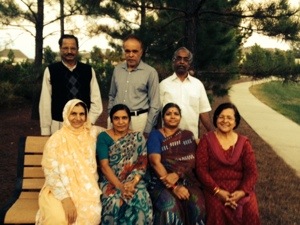
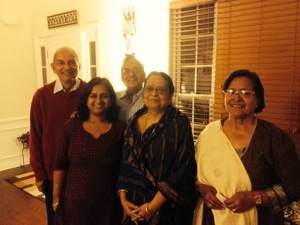
This visit to US has been very exciting till now. We completed a stay of more than two months with Anand at Cary. We are now in Austin with Rajesh. In Cary, we met many parents from India and one couple from Pakistan too. Here below is a group photo.

20131009-111956.jpg
In ‘Harmony’ community, Cary, the number of Indians owning the properties is pretty significant. Families from Andhra Pradesh are in majority. It was pleasant to see even the women from rural Andhra driving big utility vehicles. And it is because of these youngsters that so many parent are visiting US every year which they could not have dreamt otherwise.

Interestingly, these Indian young men and women have expertise and engagement in varied professions. I found one young Andhra woman running two pre-school centres. Some are working as doctors. But I was excited to meet the mechanical engineer from Andhra who works in the quality control of John Deere manufacturing facility here. However, the majority of young Indians are in big and small units in IT sector that are in TRP such as CISCO and IBM.

I can’t but write about the Pakistani couple- Mohamad Akbar and Suraiya. They are very simple ones from rural background and with very little formal education and knowledge. Suraiya got her eyes operated for cataracts here in Cary. They kept on talking about the very high cost of the operation. Lately, we used to go in evening to a meeting point created by the Housing association by fixing up two benches in one corner. I used to call Suraiya as Jodhabai. It was through Suraiya that we got acquainted with each other. Actually, Suraiya one day had lost her way to her daughter’s house. We had helped her to get back to the right place. She was almost crying and was helpless because of her inability to communicate in the languages the people here knew. (On left side in the photograph)

I met a family from Kolkata too. I used to meet Balay Chaudhry while going to drop Emma to her elementary school. One evening we visited the house of his daughter, Sukanya and her husband Surya.It was because Balay had invited us.We went for some adda, typical in Bangal and had tea too. Both Sukanya and Surya are from Indian Statistical Institute, Baranagar, Kolkata. Surya teaches in the university and Sukanya works for some consultant firm.

20131009-112640.jpg
It was a great evening.

Posted in Uncategorized | Leave a comment

Manufacturing India : Despair or Hope

Even with all the gloom of Indian slowdown affecting, India has some attractiveness and India story is tact for some. As reported, “The rupee’s drop is making India a more attractive destination amid rising wages in China and labour strife in Bangladesh. To benefit from the currency advantage, India will have to ease rules and reduce bureaucratic delays.”

Honda, the Japanese carmaker has started a feasibility study for building a third plant and is considering Gujarat (Sanand) as a base, even before its second new plant in Tapukara, Rajasthan, begins production by early-2014.

Media reports confirm it. “Emerging markets will be the headquarters to thousands more of the world’s largest companies — as many as half — in the next decade or two, a study published by the McKinsey Global Institute said Thursday.” “The world’s competitive landscape will be transformed over the next 10 to 15 years by the rise of a formidable new breed of large emerging-market companies.”

India must shake off its lethargy, think big and go all to take advantage of the situation.

The good news is that some manufacturing companies such as Bharat Forge, JK Tires are diversifying and expanding their manufacturing activities.

According to the 2013 Global Manufacturing Competitiveness Index (GMCI) report, prepared by the Deloitte Touché Tohmatsu Limited (DTTL) Global Manufacturing Industry Group and the Council on Competitiveness, India dropped two spots in rankings, falling from second to fourth since 2010. However, the report also expresses its hope that India can become again the world’s second most competitive manufacturing nation in the next five years behind China. One of the good news is that India’s manufacturing exports grew at a CAGR of 17.1 percent between 2006 and 2011.

However, India with huge rural population in farming with very poor productivity is far behind in manufacturing in real term. It will be worthwhile to look into few comparative data of the GMCI report about some developed and emerging nations:

Comparing Manufacturing GDP CAGR for 2005-10, India has a rate of 8.5 percent, whereas the figures for China is 11.9, while the manufacturing GDP percentage of total GDP in 2010 for India was 14.2 percent against that for China being 32.4, for Germany 20.7, South Korea 30.5, even Japan 19.4. As the new National Manufacturing Policy of India expects to boost the share of manufacturing from 16 percent of GDP in 2009 to 25 percent by 2022, the nation has still many more miles to go to reach the goal.

When we compare manufacturing exports percentage of total export in 2011, India figure was at 50.3, whereas that for China was 93.2, Germany 82.7, US 64.3, South Korea 85.3 and Japan still 88.

There are many things to improve:

Logistics cost in India that is pretty high at 13-14 percent of GDP compared to 7-8 percent in developed countries.

In R&D, though the number of MNCs operating its technologies centres are significant, but domestic companies are far behind in getting in innovating new products that can earn global brand status. The figure of researchers per 100 of population is dismal.

India still has the advantage of labour cost that is at 0.9 US dollar in comparison with that in China that is at 2.8 in 20011 and Brazil at 12. However, perhaps the productivity of the labour in India is very much low. India must focus on the quality of education in big way. Instead of declaring the majority of population of billion plus as poor and doling money, the government in power must focus on quality education and training in skills in demand.

And fortunately, India has its built-in strength. Is it not exciting to learn that’India tops the global chart of remittances with a whopping $71 billion in remittances in 2013, just short of three times the FDI it received in 2012,’ according to a revised World Bank forecast? It leaves behind many nation including China that gets$60 billion as remittances.

Manufacturing must become the main focus for the new governments that will rule the states and centre after the next elections.

Posted in governance, manufacturing | Leave a comment

Ramanujam and Satyendranath Bose

I knew only the story of Indian mathematician Ramanujan and Prof. Hardy, and how Prof Hardy introduced Ramanujam and his works on number to the entire world:

“Indian mathematician who was self-taught and had an uncanny mathematical manipulative ability. Ramanujan was unable to pass his school examinations in India, and could only obtain a clerk’s position in the city of Madras. However, he continued to pursue his own mathematics, and sent letters to three mathematicians in England (which arrived in January of 1913) containing some of his results. While two of the three returned the letters unopened, G. H. Hardy recognized Ramanujan’s intrinsic mathematical ability and arranged for him to come to Cambridge.” (Refer)

Here is the other story of Satyendranath Bose.

Albert-Laszlo Barabasi, the foremost expert in the new science of networks in US, in his book, Linked, has a chapter, ‘Einstein’s Legacy’ that has an interesting mention of Satyendranath Bose. I happened to go through the portion in the book last weekend while travelling to Boone with the family. It excited me as I have seen Bose during IIT’s days, when he visited Azad Hall and got an opportunity to talk with him. During my years in Hindu Hostel of Presidency College, I had also heard the stories about the academic competitions between Satyendranath Bose and Meghnath Saha while they were still students.

“In June 1924 Albert Eintein received a letter and a brief manuscript, written in English, from an unknown Indian physicist from Dacca named Satyendranath Bose. Unknown to Einstein, the manuscript had been recently rejected by the ‘Philosophical Magazine of the Royal Society’ in London. Einstein liked the manuscript so much that he set aside his own work and translated it into German, arranging for its publication in ‘Zeitschrift fur Physik’. He even added a praising note:”In my opinion, Bose’s derivation of the Plank formula signifies an important advance. The method used also yields the quantum theory of an ideal gas as I will work out in detail elsewhere.”
—– ——-
“Bose’s paper was still at the publisher when Einstein appeared at the Prussian Academy to present his own rebuts, titled ‘Quantum Theory of Single-atom Gases’, in which he extended Bose’s method to gas molecules. Six months later he was ready with yet another publication, the ‘Second Treatise’. In these papers Einstein predicted a very strange phenomenon, known today as ‘Bose-Einstein condensation’.

“At ordinary temperatures gas atoms bounce into each other at different speeds. Some are fast, others are slow. In the language of physics, some of them have high energy, others have low. If you cool the gas all the atoms slow down.To bring them to a halt, you would have to cool the gas to absolute zero, an attainable temperature. Einstein predicted that if a gas made of indistinguishable atoms is sufficiently chilled, a significant fraction of the particles will settle to the lowest energy. That is, atoms can be forced into their lowest energy state at a critical temperature above absolute zero. When particles reach this state, they form a new form of matter called a Bose-Einstein condensate.”
—–
“Then in 1995 a group from the National Institute of Standards in Boulder, Colorado, led by Eric A. Cornell and Carl E. Weiman, cooled rubidium atoms to low enough temperatures to form a Bose-Einstein condensate.”

“According to a July 2012 New York Times article in which Bose is described as the “Father of the ‘God Particle'”, the scientist’s interests wandered into other fields, including philosophy, literature and the Indian independence movement. He published another physics paper in 1937 and in the early 1950s worked on unified field theories. Several Nobel Prizes were awarded for research related to the concepts of the boson and the Bose-Einstein Condensate. Bose was never awarded a Nobel Prize, despite his work on particle statistics, which clarified the behavior of photons and “opened the door to new ideas on statistics of Microsystems that obey the rules of quantum theory,” according to physicist Jayant Narlikar, who said Bose’s finding was one of the top 10 achievements of 20th-century Indian science.”

And 2013, Nobel ….
Why doesn’t Mother India produce sons such as Raman, Ramanujan or Satyendranath Bose?

Posted in education, Uncategorized | Leave a comment

Manufacturing India:manufacturing competitiveness?

So finally, I got at least one item in Anand’s household that has a ‘Made in India’ tag. It is a small memo book with 80 sheets of 3×5 in size. Why are the Indian manufacturers not aggressively in competition with other countries that are exporting to America and other developed countries?

As rightly “>reported, “India has one of the lowest costs of labour and “on paper” a competitive price of power. In reality though, labour productivity is very low and power is unavailable for up to two shifts a day in many industrial clusters – forcing them to use inefficient diesel generator sets – that nullify any factor cost advantage. India’s road and port infrastructure are still far from ideal. Our port turnaround times are upwards of 80 hours – roughly five times that of Sri Lanka. The average truck speed in India is 35 to 40 km per hour roughly half of that in China.” India can’t be anywhere unless it improves the fundamentals for enhancing interest in manufacturing. The favourable exchange rate for export is hardly advantageous and matters on long term.

Even a country such as US is refocusing its policies to keep manufacturing growing. India must learn some lessons.

A 2012 report had predicted that United States would slip to fifth place from third in manufacturing competitiveness in the next five years as India and Brazil race ahead.

However, as recently reported, “US manufacturing competitiveness has steadily increased over the last decade in comparison with key peers. Analysts at Boston Consulting Group have been in the forefront of these predictions, estimating in 2011 that the US would largely reach parity in terms of effective manufacturing costs with the Eastern regions of China by 2015 – an observation a number of other consultants and analysts have also made.”

Some US manufacturers are moving production back to US soil or deciding to stay here rather than moving offshore.

And as BCG predicts, increasing US competiveness with China and advantages over most other developed economies is likely to lead to an export surge and a growing number of badly needed American jobs.

As “a result of its increasing competitiveness in manufacturing, US will capture $70 billion to $115 billion in annual exports from other nations by the end of the decade. About two-thirds of these export gains could come from production shifts to the US from leading European nations and Japan.”

While some agree, some though doubt the BSG’s prediction and opine that BCG fails to meet the burden of proof required to back up the numbers in its report, and even that the BCG analysis doesn’t seem to take into account rising Chinese productivity.”

Manufacturing still matters for the US and its companies. Obama government has given a new push for manufacturing in US. And even the company such as Apple though getting manufactured its iPhones and other products in Asian countries have started rethinking.

India must move ahead and I wish the big business houses encourage manufacturing sector by getting into the manufacturing of high-tech items, while India’s organised retail sectors must also encourage manufacturing in rural India through innovative means rather than selling only imported goods.

Posted in manufacturing, Uncategorized | Leave a comment

Manufacturing India: Manufacture and Export

“Unless India gets back to encouraging manufacturing, sees growth in manufacturing, it is critical as manufacturing ultimately creates the biggest jobs. We thought we could leapfrog that era and move directly to the digital era. That is not going to happen we need to promote manufacturing and promote exports.”
Anand Mahindra

While in US, I keep on wondering why India can’t export all those that the American households get from the Chinese source. I find every shops small or big in malls of cities such as New York or towns such as Cary of North Carolina flooded with the China manufactured items, where I hardly find any trace of similar items with ‘Made in India’ tag.(Even though I do see even the tags with the names of Bangladesh and Honduras). And the manufacturing technologies of these items for the American households are not some that are not known to Indian manufacturers, business persons or traders.

America is the world’s richest country and largest importer. In 2012, the US bought US $ 2.334 trillion worth of imported products.

Here are the top 10 US imports from China that cost America $ 444.4 billion and constitute only 19% of the total US imports.

1. Electronic equipment: $113.3 billion
2. Machines, engines, pumps: $102.2 billion
3. Furniture, lighting, signs: $24.8 billion
4. Toys, games: $23.1 billion
5. Footwear: $17.9 billion
6. Knit or crochet clothing: $15.6 billion
7. Clothing (not knit or crochet): $15.3 billion
8. Plastics: $13.2 billion
9. Iron or steel products: $10.1 billion
10. Vehicles: $10 billion

Interestingly, India’s exports to America only amounted to $41.9 billion and are only1.8% of overall US imports.
1. Gems, precious metals, coins: $7.2 billion
2. Pharmaceuticals: $4.3 billion
3. Gums, resins: $3.6 billion
4. Oil: $3.3 billion
5. Machines, engines, pumps: $2.3 billion
6. Organic chemicals: $2.2 billion
7. Other textiles, worn clothing: $2 billion
8. Clothing (not knit or crochet): $1.9 billion
9. Iron or steel products: $1.6 billion
10. Electronic equipment: $1.5 billion

The same is the case when one studies the exports of China vs. that of India to almost all the rich countries of the world such as Japan or UK.

India’s exports to Japan amounted to $7 billion or 0.8% of overall Japanese imports, while China’s exports to Japan amounted to $188.4 billion or 21.3% of overall Japanese imports.

India’s exports to the UK amounted to $9.3 billion or 1.3% of overall UK imports, while China’s exports to the UK amounted to $56.3 billion or 8.2% of overall UK imports.

It will require a total change in the mindset of the institutions and individuals who matter in making manufacturing the mainstay of the business thinking.

Is it not a shame to read a story in Economist, ‘300m menstruating Indian women eschew sanitary pads in favour of rags, dry leaves, straw or newspapers.’ Can’t the country that claims to innovate and manufacture the cheapest car of the world produce affordable pads and the governments and political parties distribute it free instead of handing over laptops or TV sets to the girl students and families? Will it not provide employment to many of the poor women in rural India and if executed properly can even be exported?

Why can’t micro spinning enterprises be established in every Panchayats in cotton producing areas of the country which in turn can provide employment too in rural India? Why does India show interest in exporting raw cotton or iron ores to China with no value addition?

Indian manufacturing will have to innovate and manufacture all types products required by the global market. Many more entrepreneurs, small and big, must get into manufacturing.The established ones must scale up the production, improve the quality, and reduce the life cycle cost and globally compete. The government and the institutions engaged in R&D must orient for encouraging manufacturing sectors.

A dawn of manufacturing is a necessity for India. It can come by developing export. Every establishment of the country must export, be it big ones such as Tata Motors and Mahindra and Mahindra or SAIL and BHEL or BMEL or HAL, and must change its strategy of surviving with government support in local market.

A ray of hope comes from a futuristic statement, “India should dream of exporting defence equipment instead of importing them.”

Finally, India must take lessons from the Walmart story in US and must safeguard the small manufacturing sector of the country from Walmart and global retail giants coming in India from selling all the goods from their Chinese sources that they have taken pain to develop. I give only two data for consideration:
1. Between 2001 and 2007, the value of products that Wal-Mart imported from China grew from $9 billion to $27 billion.
2.According to the Economic Policy Institute, trade between Wal-Mart and China resulted in the loss of 133,000 manufacturing jobs in the United States between 2001 and 2006.

MNC retailers must be encouraged to develop Indian manufacturers to produce the quality products for its outlets around the world and also to market the unique Indian produces.

I wish Manmohan Obama forthcoming meeting in US brings good news of US collaborating with India for manufacturing many items jointly rather than discussing only the deals of purchasing and selling of some military wares.

Posted in industry, manufacturing, Uncategorized | Leave a comment