Grand Canyon- An Interesting Addition


We visited Grand Canyon while in US in 2005. It excited me. The nature with time has created this fascinating wonder that can keep alluring the people visiting it. I just loved to just have the wonderful views in the evening and the morning of the day.

The news of the creation of a massive glass-bottomed walkway to the edge of the Grand Canyon is a great for the tourists.

A private developer has constructed the $30 million Skywalk in hopes of luring tourists to the region. It will open to the public later this month, charging $25 per person in addition to other entry fees. I really envy those who shall get this opportunity to see the bottom from the Skywalk. Some of the engineering aspects of the project are interesting too.

“At 490,000 kg the Skywalk is about as heavy as four Boeing 757 jets stacked on top of each other. It was perched at the canyon’s edge using an elaborate system of pulleys connected to four tractor-trailers.

Underneath, hydraulic “shoes” lifted it above a cement track, rolled it across a bed of metal rods, and set it onto four steel anchors that were drilled deep into the canyon rock. Workers then welded the walkway to the anchors.

While it was pushed out, the walkway was not anchored to the canyon wall. To keep it from tipping over the side, engineers loaded the back end with a half-million pounds of steel cubes as counterweight.

The Skywalk extends about 70 feet over the rim and about 4,000 feet over the canyon floor. It is designed to withstand 160 kph winds and has shock absorbers to keep the walkway from wobbling.”

I don’t know if the Skywalk is an encroachment on the natural creations at Grand Canyon, but it will certainly provide the visitors another attraction to visit it.

Posted in Uncategorized | Leave a comment

Engagement and Employment- We Must Emulate

The Story of Mariam Ram

Edward Luce in his recently published bestseller ‘In Spite of the Gods’ has this story.

“Mariam Ram is the wife of N. Ram, the editor and owner of ‘The Hindu’. Her company TNQ typesets, formats, stylises and edits some of the world’s most complex scientific journals and other, non-scientific, academic publications. Mariam began from scratch in 1998 with fifteen employees, now she has more than six hundred. In 2005 TNQ produced 300,000 pages; her target is a million pages a year. Apart from some of the university publishers in the United States, which still tend to keep their editing in-house, Mariam and her competitors are hovering up the academic-journal work that used to be done on site in Europe and elsewhere. TNQ edits at about three dollars a page, compared to the going rate of at least ten dollars in Europe. Mariam’s company requires its employees too have at least a post-graduate degree in their respective subject field. About a tenth of her employees have Ph.D.s. Publications such as Cell, Tetrahydron, Semantics Today, Medieval History and Polymer sit on the shelves of the company’s office in Chennai.
The business model looks robust, and India still seems to be in the relatively early stages of offshoring revolution in services.

Wherever possible, Mariam hires women- about half of her workforce is female- and she favours people from lower castes and other minorities. Most were in their mid-twenties, and majority were the first women in their families to have formal jobs.”

And the story of Lal Muni Devi is on the web. She has become famous by now with a very good coverage in media. It convinces me that land or no land, if a skill is imparted and there is a will to work hard for improving the living condition, one can do that today easily.

The Story of Lal Muni Devi

Lal Muni Devi the poor, uneducated woman from Azad Nagar village in Patna district used her dank, thatched house to grow mushrooms. A photograph of Lal Muni and the story of her achievement have been put on the website of CIMMYT, a well-known Mexican institute engaged in research for improvement of maize and wheat crop.

Lal Muni Devi finds mention as an inspirational farmer among 25 from seven Asian countries. Till four years back, Lal Muni used to work for other farmers as a daily labourer. Then instructors from Indian Institute for Agricultural Research (ICAR) brought together 25 women from the village and taught them how to grow mushrooms. Lal Muni says what made her happy was that she did not need any land to grow mushrooms, a plant she had never even heard of till the ICRA training. It also helped that market was easily available in nearby Patna city.

The Story of ladies behind Lijjat Papads

The story of the entrepreneurs behind the hot and crispy ‘Lijjat’ papads roasted or fried in many Indian kitchens every night is another such that requires to be emulated to take the millions of the families out of poverty?

It all started on a bright sunny day on the terrace of one of the chawls of Girgaum, Mumbai in 1959, when seven middle-aged Gujarati housewives gathered, to roll out ‘papads’ for their families. ‘Jashwantiben Popat, Parvatiben Thobani, Navalben Kundaliya, Bhanuben Tanna, Labhuben Gokani, Jayaben Vithlani and Ujamben Lakhani decided to use their skills to start a business on a borrowed capital of merely Rs 80.’
In 1966, the Shri Mahila Gruh Udyog was born that has grown into an organisation for women, of women and by women with 42,000 members across India rolling out papads, khakhras, rotis, and other products. Its annual turnover today is Rs 350 crore that includes exports worth Rs 15 crore to the UK, US, Middle East, Thailand, Singapore, Hong Kong, Holland, Japan and Australia. Lijjat products include spices, ‘wadi’, detergent powder, cakes and other bakery goods prepared in 69 branches across India.

The unique management system has become the subject matter of the case study at the best management school of the world. It has many laurels in its kitty: the Economic Times ‘Businesswomen of the year 2001-02’ and ‘Best Brand Equity Award’; and ‘Best village industries award’.

There must be many more known and unknown stories of the individual’s or group’s enterprises to get inspiration. I wish, the school started telling these stories to the younger generations. With limited job creations by the organized sector, these initiatives can only bring engagement and prosperity to millions.

I request my readers to contribute the stories known to them through the comments.

Posted in Uncategorized | Leave a comment

Can Organised-Retail Sector Control Inflation?

All these days, I had been writing about how the organized retail enterprises, particularly the one of bigger business houses such as Reliance and Bharati or MNCs such as Wal-Mart will improve the things for the both- the producers as well as the consumers. As indicated in the mission statements of the Reliance Retails and others, farmers were to get the fairest price and other technical and financial support for farming inputs from the retail enterprises, and the consumers were to get the commodities at the lowest prices with the many intermediaries in the system getting eliminated. If the mission truly gets translated in real business model, the inflation can be in check. However, in the present system, the traders and the other intermediaries (and their godfathers who may be politicians or mafia dons) are getting all the benefits. With continuously increasing prices of all the essential commodities of daily use, the majority of the consumers are stressed. The producers of the commodities don’t get any share of the extra price charged from the consumers.

If the big retailers buy vegetables and fruits and other agricultural produces from the farmers, they can contain the prices too unless they become too greedy to get the maximum from the consumer to fatten the bottom line. If they pay the farmers the best price, the majority of the ‘aam aadmi’ in rural India could think of a good living. However, I don’t know if it is happening. ITC buys its wheat straight from the farmers through its Choupal network. I don’t know how much they pay to the farmers. But I don’t find the ITC’s ‘Aashribaad’ atta any cheaper than other brands.

Media is talking of the spiraling prices of the essential commodities. Politicians are concerned and so is the government as the ruling party has already lost two states where it was in power. It is to face election in some more states soon.

Normally, the government cuts import duties to facilitate supply improvement at cheaper price, and bans exports to improve the supply. The government has done that. It also has slashed fuel prices this time as it is considered as the major reason of high transportation cost. And yet the price of almost every commodity has risen.

Naturally, it becomes difficult for a democratically run government to contain inflation if the trading community and the organized producers become unscrupulous. Unfortunately, many a times, one gets that perception in this country.

How can the price of onion go on increasing in Delhi (around Rs 20 per kilo) where most of the people can’t have satisfaction of a good meal without onion, when the farmers producing the onion in Nasik are hardly paid a remunerative price (as low as Rs 2 per kilo)? Can the transpiration and the margin for business cost so high to account for the difference? Every now and then, I find the rates of Azadpur mandi of New Delhi published in media. However, as consumer, I find the retail price of each of the vegetables from local vendors at least three times more that that of the mandi. Why is it so? Is it not because of the cartel of the petty traders?

And the reality of the price rises for some of the essential items, as reported, are: “the price of moong dal have shot up 118 per cent from Rs 22.50 to Rs 49 and those of urad are up 82 per cent. Wheat is up 33 per cent while atta is up 44 per cent. The onion prices shot up 186 per cent. In urban homes, the expenditure on just food and groceries has gone up by as much as 25 to 40 per cent.”

If I go by what Reliance Retails and Shubhiksha promised, the prices could have been in check without causing such a worrying situation. Nothing has happened in last one year to cause the steep price rise of the commodities mentioned above.
——————————————-
Read ‘Runaway inflation’

Posted in economy, governance | Leave a comment

Somnath- Fascinating History

Somnath- Fascinating History>r this place to get rid of the curse of his father-in-law that made him suffer from leprosy. But more horrifying were

In my school days, I had read the famous novel- ‘Jai Somnath’ written by Shri KM Munsi. The story of the loot of Somnath by Mahmood Gaznavi was also in the school history. It left a lasting impression on my mind somewhere. I had a desire to see the temple reconstructed because of the initiative of Sardar Patel, the Iron man of the country. It materialized during this visit to Gujarat.

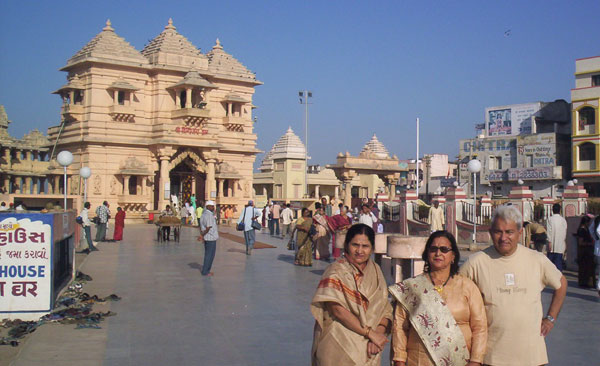
From Dwarka, we reached straight into the premises of Somnath via Porbandar. Unlike all other Hindu pilgrimage, The Somnath Temple is a modern one without the pandas. Its location right on the seashore adds to its grandeur. Unfortunately, photography is not allowed. After attending the evening aarati, while we were going around the temple we saw the platform created out of the remnants of the old temples that were destructed. It reminds the past. I came to know from the light and sound programme later, that the first temple, as per mythology and Skand Puraan was constructed by God Moon who worshipped Lord Shiva somewhere nea the stories of the various destructions that the temple underwent. The first one was by Mahamood Gazanvi 1026 AD. Why couldn’t he get satisfied by the huge booty of the loot of the time and spared the temple? Every time the temple got destructed and the Shivalinga damaged, the people of the country rebuilt it. Alluding Khijli destroyed Somnath again in 1298AD. Mahmood Tughlak again enacted the destruction. Jaffer Khan did the destruction next time. Mahmood Begda destroyed Somnath again in 1490 AD. Aurangzeb also issued the order to demolish Somnath in 1704 AD, but unfortunately died before his orders could be executed. What a sad story of a shrine that may not be having another parallel!

Somnath appears to me a memorial of the endevours of the people, who believed in reconstructing it after destruction everytime by some evil minds. It is also a reminder of India that became weak because of fragmentation. Somnath also tells the nation to remain united and strong to safeguard our cultural heritage.
———————————————————
HABITS DIE HARD
India has more billionaires than Japan

Posted in Uncategorized | Leave a comment

Mahatma Gandhi- Kirti Mandir to Sabarmati Ashram

From Dwarka, we drove to Somnath. Earlier we had a plan to have a night halt at Porbandar- the birthplace of Mahatma Gandhi. But when we found that except for the ancestral house of Gandhiji, we drop the idea and decided to have the stop over in Somnath.


Mahatma’s great grandfather, Shri Harjeevanji Raidas Gandhi, had purchased the house, where Mahatma Gandhi was born from a local lady about 200 years ago. Kirti Mandir has been built as a memorial keeping the old house intact. While going through the small plain empty rooms in the house, one gets a nostalgic feeling. Nothing of those days is there, unlike you see in the houses of Western celebrities such as William Shakespeare at Stanford-on-Avon that I visited in 1982. But the very thought that the great Fakir spent his childhood in these rooms is exciting. It was the great effort of Shri Nanjibhai Kalidas Mehta and his wife that Kirti Mandir could be built. The property was bought from the members of the Gandhi family who were living in that house at that time. And even Gandhiji sold and registered the property to Shri Nanjibhai. We moved in and out many times. I was trying to evaluate if this was the best that the nation could have done for the place that it is. In the lane outside, it is just the typical of a small town in the region.

The memorial is a national heritage. I wish Indian government had set up a monument suited to the stature of the greatest human being and leader that the country and the world has produced in the last few centuries.

While in Porbandar we also visited the temple named after Sudama, the famous friend of Krishna. Perhaps the temple appeared to me as the anti-climax of the golden palace of Sudama that was built by Viswakarma on the instruction of Lord Krishna overnight, while Sudama was enjoying the hospitality of his friend in his palace in Dwarka.

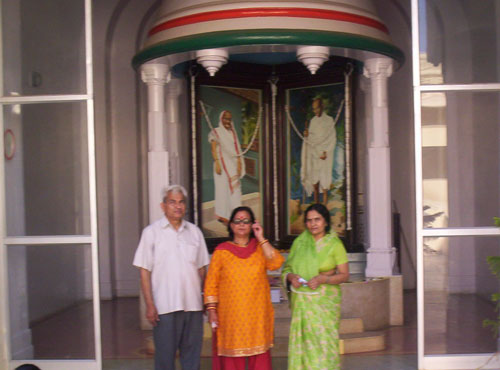
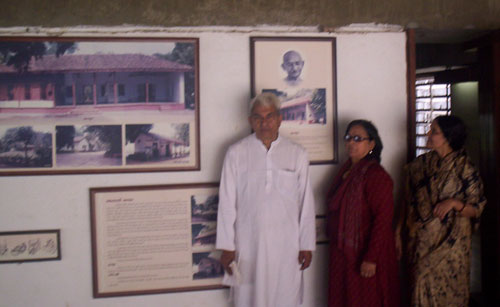
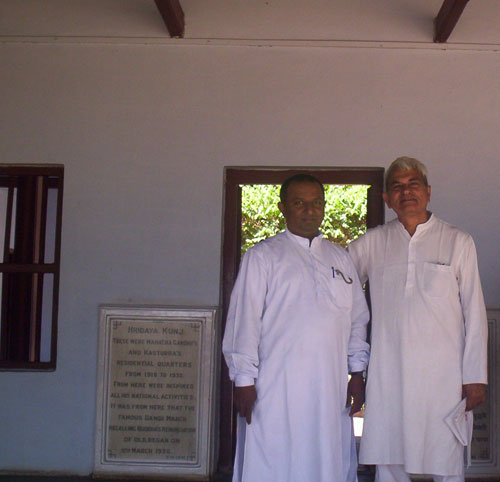
In Ahmedabad, on the last leg of the tour we went to Sabarmati Asharma, the place from where Mahatma Gandhi led his Dandi March for salt making. We would have returned after going through the exhibition hall that has been built without seeing the house where Gandhi and Baa lived, but for the timely appearance of the gentleman in Khadi in the photograph. His great grandfather, as he claimed, trained Mahatma in operating the spinning wheel for Khadi. Three of his family members accompanied Gandhi in Dandi March. He has participated in two of the marches to Dandi. It is nice to hear the stories and ponder over how the sacrifices of some could bring the independence of this country. It is more exciting when you are standing in the courtyard of the place where Gandhi lived for many years and led the national movement. And then you start thinking of all great men of the country and also of the world, who had visited this place during the time Gandhi lived here and thereafter too to pay homage to the great son that the mother earth produces very rarely.


Here again, I wonder why the nation can’t perform better in making this place worth Gandhi’s stature.

Posted in Uncategorized | Leave a comment

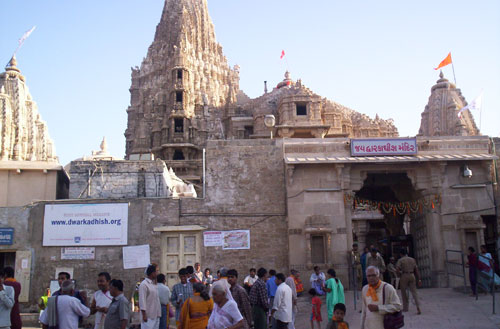
Dwarka- The Krishna’s Capital City


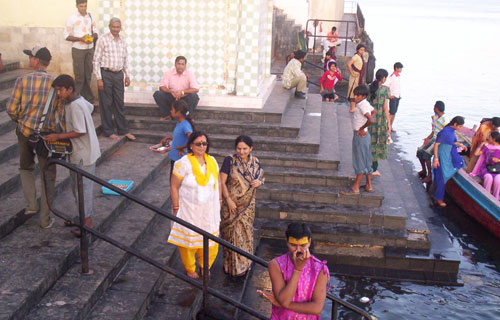
While visiting Dwarka, we heard two clearly different mythological stories that are the two aspects of the regional economy. Each story is unique in itself. All the priests and pandas in Dwarka talk of the curse of Durbasha Muni resulting in the infertility of the land in the region and the resulting poverty of the farmers. They give this story and ask for all sorts of charity from the pilgrims of different categories to help the people, particularly the Brahmins of the region. The higher the charity in cash or kinds, the better will be the gain. It is just the clear exploitation of the poor believers from all parts of the vast country. However, I assume the land has gone infertile because of the salinity of the seawater that floods the region regularly. It requires a specialised R&D initiative from agricultural scientists to help the farmers to plant the right types of plants, trees, and to have special breeds of animals including cows and buffaloes.


I heard the other story too from the police officer accompanying us in ‘Bhent Dwarka’. According to him, Krishna himself came to attend the marriage of the daughter of his devotee Narshi Mehta. When the in-laws of the daughter wished for some dowry, Krishna did a miracle and gold rained from the heaven for an hour. All present could collect the gold as much as they wanted. Though it may not appear to be so from the overall appearance, every womenfolk in the region owns gold worth more than 3-4 lakh at home. Gujaratis in general are pretty rich. Gujaratis have been migrating to all parts of the world from ages. Today, Gujaratis control the majority of hospitality industry in US and the diamond business of Antwerp, Belgium. Migrant Gujaratis have also contributed to tranform the regional economy through their charity and philanthropic work of building schools, hospitals, and other religious institutions.


For ages, the region has been the nerve center of Hindu cultural history. Surprisingly, I was told, 75% of the Bhent Dwarka island population is Muslim. Most of the shopkeepers serving the gods and goddesses of the temples by making their dresses and other utilities are also Muslims.

While returning from Bhent Dwarka, we visited Rukamini Temple. Rukamini was one of the main queens of Krishna. Rukamini had to spend some times living alone away from Krishna because of the curse of Durbasha. The temple is having a lot of vacant land around it. If some individual or institution takes entrepreneurial initiative, the place can easily be transformed into a wonderful tourist destination. Why can’t the BJP-run government do it? Is its love of Hindutva is limited to Ayodhya temple? Perhaps they too wish to decide their all action plans as secular, however necessary it may be for the people or the economy of the region. As I hear Modi has changed the Gujarat in more than one way. However, there is no perceptible change in the conditions of these places of religious importance. His government must take lessons from Tirupati and Vaishno Devi. An imaginative investment in religious tourism can create employment and bring prosperity to the region. And I am sure he will not relish the crowd of the beggars near all these places. I am giving below one that we saw at RukaminiTemple.


Main Dwarka temple is elegant and a showpiece of architecture too. Its location on seashore further adds to its scenic beauty. It could have attracted all the affluent Hindus from far and near for religious tourism. But encroachment right up to the boundary of the temple conceals the temple to great extent. Perhaps, it can no more be possible. However, the government, the temple trust, or local bodies must do some serious work using some consultants to make the place attractive. Dwarka can earn a lot of revenues from tourism.
—————————–
Read ‘the season for business marriages in India’

Posted in Uncategorized | Leave a comment

Pilgrimage – Some Experiences

We are back after almost 10 days and for all these days I have not written any thing. But naturally, while I was moving along visiting places of religious pilgrimage, and some times the places of historical importance, my mind was very active. I shared some of my views with my brother Ashok, his wife, Bibha and Yamuna and now I shall like to write about at least some.

Why is the government of India so indifferent in doing something to keep these places clean and tidy so that the religious tourists who are the aam aadmi in majority can have feel of an healthy safe ambience in these places? Is it because the government tries to prove itself secular by allowing the religious leaders, priests, and pandas do whatever they wish to do to exploit the common illiterate millions of India? Why can’t the departments of tourism of the state and centre provide at least good clean toilets and some eateries that provide healthy food and water? ‘Bhent Dwarka’ is considered as the residential portion of Dwarkadhish Krishna with temples or residences dedicated to all His major queens and a place dedicated as the meeting place of His friend Sudama with Him. It is just filthy infested by unscrupulous pandas telling all sort of stories to the believers, mostly the lowest in the society and persuading them to part with the maximum to get rid of all the sins committed and to get easy access to heavenly abode. At least the leadership of RSS, BJP and VHP, who claim to be the protectors of Hindu religion and culture, the Sankaracharyas, and other religious heads, must do something about it. They must appreciate the requirements of the younger educated, intelligent, and affluent Hindus too who are interested in visiting the places. It will also be financially much more paying to those leaders. Can’t these institutions provide at least some well printed authentic brochures and literature about the places for the pilgrims?

I wish they took these steps before the younger generation that matters gets disenchanted.

During this period, Laluji presented his railway budget too and has become the hero for the turning around the railways with huge profits. I do also congratulate him along with others. But can’t the railway stations be made more ‘aam aadmi’-friendly? How can the old persons go through the steep stairs to go to the different platforms? How do the disabled persons do it? We hear hundreds of the railway stations are getting modernized to world-class standard. Why can the department start with the railway station in NCR that is visited by many foreign visitors? I found the Nizzamuddin Railway Station as one of the filthiest one with almost missing provision for taxis and other public transport.

How long the government and the bureaucrats go on making promises with nothing visible happening on the ground level? Let them come out of the offices and do something positive to change the things to help the people.
——————
Read an interesting features:
‘The 50 Most Important People on the Web’

‘Generating the Big Idea’
Strategy guru C K Prahalad on the ‘pyramid’

Posted in Uncategorized | Leave a comment

I Am Away And Leaving “My Friend” Behind

The people of our age have been directed by the scriptures to visit places of religious importance that perhaps can get them a suitable place in the heavenly abode, if there is one. And with that sort of incentives, religious tourism has flourished over years. Adi Sankaracharya re-established Hinduism, and for the community created four dhams at four corners of the country- Badrinath in the north, Jagannath Puri in the east, Dwarka in the west, and Rameshwaram in the south. And this feat by him established the integrity and the span of the nation at that point of time.

We have been to Jagannath Puri in Orissa, and Badrinath in Himalayas of Uttaranchal. This time we shall be visiting only one in the west, Dwarka in Gujarat. We are leaving for Vadodara on 22.02.2007. Ashok is posted there in RPF as assistant commissioner. We shall stay with them, and visit Dwarka from there .

Dwarka has another significance. It is the capital of a kingdom where Krishna shifted to avoid Jarashandha of Magadha (present Bihar) who kept on attacking Mathura.

We shall cover Somnath, the temple of Shiva that Mahmood Gazanavi demolished and looted, and from then onward India started slipping in the hands of invaders who established empire and rules, because of the lack of one strong central power in the country and disunity in the Indian kings. Our next stop will be Porbandar, the place made famous for Mahatma Gandhi. After visiting Gir Forest, that is the only where one can see the lions, we shall return back to Ahmedabad and Gandhinagar, the capital of Gujarat. We may go to Sabarmati Ashram, established by Mahatma Gandhi, from where Mahatma led the Independence movements. And then we return to Vadodara.

Vadodara was the place where HM established its truck plant at Halol in collaboration with Isuzu Motors of Japan. I used to visit the place quite regularly in those days as General Manager, corporate project planning. It was for explaining the project to the people from financial institutes, or for discussing the project and equipment planning with the Japanese technical teams. Isuzu truck project didn’t go along for long because of high yen value. I consider the abandonment of the Isuzu truck project was a loss to the commercial vehicle sector of India. Isuzu was a great name in trucks those days. By that time, Tata Motors didn’t have commercial vehicles of world-class designs, the reason that made it acquiring Daewoo Commercial vehicle plant in South Korea. Later on, Birlas transferred the property built to GM when it entered India. Unfortunately, none of the old people from HM are there, neither I know anyone in GM plant. I wish I could visit the GM plant.

While at Vadodara, we shall also be visiting a world heritage site at Chmpaner about which I read in newspapers, though I might have gone to the place in those days. Really I don’t remember. We shall celebrate Holi with the family in Vadodara, and on 4.3.2007 we shall leave for Delhi.

Perhaps, it will not be possible to blog during the period. I shall miss something, but I can’t help. I don’t wish to inconvenience myself andYamuna while in holidaying mood.

Posted in Uncategorized | Leave a comment

Some Recommendations oF National Knowledge Commission

Sam Pitroda is credited with bringing about the telecom revolution in India. He heads the National Knowledge Commission initiated by UPA government. Some of the remarks of Pitroda, as chairman of NKC, about the reservations for OBC in higher education got a lot of media attention. Recently, the commission submitted its report to the Prime Minister. Among many recommendations, the three related to library, translation, and importance of English interested me. We have been traditionally book lovers. My grand father and then my uncle created some library at home and helped the younger generation to get into the habit of reading good books. I remember in the sixties and seventies, the government provided some assistance too. I envied American counties when I visited their libraries. It serves all age groups of the society, Interestingly, Santa Clara library had some Hindi books and VCRs of Hindi pictures too. Here are the commission’s views on library.

1.Library and information services are fundamental to the goals of creating, disseminating, optimally utilizing and preserving knowledge. They are instrumental in transforming an unequal society into an egalitarian, progressive knowledge society. Developments in information communication technology (ICT) have enabled libraries to provide access to all, and also bridge the gap between the local, the national and the global. It is imperative that all libraries (public, academic, research and special) change gear and develop at an accelerated pace. NKC recommends a permanent National Commission on LIS in not more than three years, to become an important part of the development process.

I expect all the metros and towns such as Noida to take some initiative and establish good libraries with all facilities such as a cyber café and a children’s creativity corner besides books and magazines.

On translation, the NKC has some excellent studies regarding its potential to create employment.

2.There is an urgent need to expand the quantity and improve the quality of translation of different types (human, machine-aided, or instant) and in different domains (literary, scientific c, technical, business) that would provide greater access to knowledge across the country. There is inadequate dissemination of good quality translations, which would provide a benchmark and create incentives for more private activity in this area. This therefore requires some amount of public intervention as a set of measures to kick-start a process of encouraging private initiative so that the large commercially viable provision of high quality translation in different areas becomes feasible. The direct and indirect employment generation potential of translation activities is very high, and could absorb a substantial part of educated unemployed youth. Translation can easily develop as an industry in the country. Going by the experiences of other countries, in a country like India with its many languages, as well as the huge potential for foreign language translation, the entire translation industry has the potential eventually to employ between 200,000 and half a million people.

Unfortunately, in absence of good translation of the literatures of the Indian languages, the authors are not getting the recognition as those writing in English are getting.

3.On language, NKC considers that ‘an understanding and command of over the English language is a most important determinant of access to higher education, employment possibilities and social opportunities. And those who do not know English well enough find it exceedingly difficult to compete for a place in our premier educational institutions. This disadvantage is accentuated further in the world of work, not only in professional occupations but also in white-collar occupations overall.
English is beyond the reach of most of our young people, which makes for highly unequal access. Indeed, even now, no more than one per cent of our people use it as a second language, let alone a first language.

NKC recommends to teach our people, ordinary people, English as a language in schools. Early action in this sphere would help us build an inclusive society and transform India into a knowledge society. In just 12 years, it would provide the country’s school-leavers with far more equal access to higher education and, three to five years thereafter, much more equal access to employment opportunities.

NKC recommends that the teaching of English as a language should be introduced, along with the first language (either the mother-tongue or the regional language) of the child, starting from Class I in school. This phase of language learning should focus on using both languages to create meaningful learning experiences for the child without disproportionate emphasis on grammar and rules.

English should also be used to teach some non-language, content subjects, starting from Class III in school. It would also help reduce the divide between English medium schools and regional language-medium schools.

The nearly four million school teachers all over the country, regardless of their subject expertise, especially teachers at the primary level, should be trained to improve their proficiency in English through vacation training programmes or other short-term courses.

The classroom needs to be equipped with appropriate supplementary audio-visual and print material. Resource libraries could be set up in every classroom, comprising of a collection of books, magazines, newspapers, audio-visual material and posters, appropriate to the age of the students, on a variety of subjects.

Language learning opportunities should also be created outside the classroom through specific bi-lingual radio and TV channels, which could be introduced for formal and informal teaching and learning of English. Knowledge clubs could be formed to discuss and disseminate knowledge as well as extend the use of English outside the classroom.

With China going in big way to teach English to every citizen of the country, India must move forward without any bogey or politics of culture and tradition.

Posted in education | Leave a comment

Indian Power Shortage A Management Matter

Around 56% rural households and 12% urban households still do not have access to electricity. The power ministry has a plan to provide power to all by 2012. Has it something to do with the lack of generation capacity created over the years? Most of the people in India think that as the main reason of the shortages. And even a consultant such Boston Consulting thinks, ‘nowhere is India’s weak infrastructure more obvious than in power’.

Surprisingly, the peak power shortage hovers around 12.5% since 2001. According to India’s ministry of power, in the previous financial year up to March 31, peak demand exceeded supply by about 10,500 megawatts, or 11.6%. In China, electricity demand in the first six months of the current year exceeded supply by 700 million kilowatt hours, according to the China Electricity Council. And to overcome this unreliable supply, many Indian enterprises invest in their own power generation plants. About three-fifths of Indian manufacturing is supplied by such power, compared to less than a fourth in China.

But let us look at where does India’s generated electricity go?

For every 100 units of power generation, consumers pay for only 60 units. According to the planning Commission, power theft in 2005 was 20% of the total power generated in India. And in money value, it was over Rs 22,500 crore.

Technical loss is also 20% because of transmission at low voltage over long distances instead of at high voltage. The central Electricity Authority estimates that T&D losses should be 10%. And for every one percent reduction in T&D loss, International energy agency estimates that India can save an additional capacity of 800MW. That will be sufficient to fulfill the total requirement of a state like Himachal Pradesh.

Every one percent increase of PLF can result in additional capacity addition of around 1300MW. As per an estimate, about 30,000 MW of thermal capacity needs renovation, which can generate 5,000 MW of additional capacity. Power Load Factor- the measure of the performance of power station-in 1997 PLF was around 60% that should have been around 80%. Some central and private plants have improved to around 72% but the state-owned plants have dipped further below 50%.

So basically, India can leave behind its power shortage jus by three actions:

1.The authority concerned must be ruthless and cut down the theft.

2.Power ministry must heavily invest in high voltage power transmission on priority to reduce T&D loss.

3.All the existing plants must follow strict maintenance and refurbishing plans to keep PLF high.

However, additional generation capacity is necessary. Every Indian household must get electrified and must get the demanded power. An average Indian consumes 520 kgoe (kg of oil equivalent) of energy against a world average of 1688 kgoe. The Chinese consumes double 1090 khoe and the American over 15 times 7835kgoe.

India must go for a GDP growth much higher than 9% that it is attaining today. And it will be manufacturing and services sectors only that can make that happen. The planners must see that no enterprise and entrepreneur get constrained because of the shortage of power.

According to the International Energy Agency (IEA), for every 1 percent rise in GDP growth rate, India’s power sector needs to register a growth of 1.5%. India needs to multiply its energy supply by 5 to 7 times today’s consumption to attain even a growth rate of 8% over the next two decades. For the higher target, the energy supply must increase many more times.

Potentials are abundant.
Hydro:                Present 32,326 MW; Potential 1,50,000 MW
Wind: Present 5,300MW;                Potential 45,000MW
Biomass:     Present 381 MW;                Potential 19,000MW
Solar PV: Present 110 MW;                Potential 20MW/sq. km
Geothermal: Present 20kw-1MW; Potential 2000 -10,000MW
Ethanol:                Present 1 mtoe/year; Potential 10 mtoe/year

According to the power ministry, the 11th plan will have the capacity addition of 68,870 mw. Besides, inter regional transmission capacity would be increased to 37,000 mw by 2011-12 from 16,500 mw (end of 10th Plan).

Government plan of power to all by 2012 will require an investment of $100 billion (Rs 4,50,000 crore).

But the past history of the implementation of the power projects has been discouraging. Capacity addition as percentage of 5 year Plan target has been dismal at 54, 47, and 42 for VII, IX, and X plans respectively.

We can only hope it will improve in XI plan. And the way out for this will be the cutting down of the administrative delays and political interferences; and using dynamic project managers with total autonomy and accountability. Can the Indian Power Industry Repeat the Performance of Telecom Firms?

Posted in economy, industry | Leave a comment