Sharvan Kumars Wanted

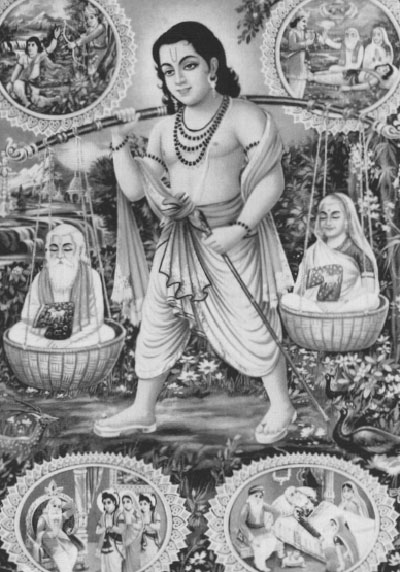
One of India’s most-celebrated tales of parental devotion relates to Sharvan Kumar, the character in the Ramayan. As I came to know recently, Sharvan Kumar died on the banks of a parched, neglected lake in village Sarvan, Unnao district of Uttar Pradesh, The village got its name from Shravan Kumar. According to locals, the place where Shravan died was named Sarvan. The spot where Dashratha shot his arrow came to be known as Sarwara and the place where Shravan’s parents died is called Samadha.

According to Munnu Lal Pandey, a former pradhan of Sarvan, the 19th century British Gazetteer states: “It is said that there lies a stone statue of Shravan Kumar and as he died of unquenched thirst, if water is poured into the navel of the stone figure, the hole never gets filled up.”

For the benefits of those who might not have read the story in Ramayan that influenced Mahatma very much in his childhood, it runs as follows:

While hunting in the forests of his kingdom once, King Dashratha heard a noise near a lake and unleashed an arrow, hoping to hit an animal. When King Dashratha reached near the lake to collect his kill, he found that his arrow had struck a boy instead of any wild animal. He was profusely bleeding. His end was near.

The boy was Shravan Kumar. He told Dashratha that he had come to the lake to collect water for his sick and aged parents, who were both blind and whom he had been carrying on a sling to make them visit various religious places.

Shravan Kumar requested the king to take water to his parents and quench their thirst. Shravan succumbed to his wounds. When Dashratha took water to his parents and told them of his tragic mistake, they were unable to bear the shock. Before dying, the old man cursed Dashratha to die because of the separation of his son. Shravan still remains a benchmark of a dutiful son in India.

When I went to Kaushiks to meet Singhs who were going to US. Their son Rajat and his wife made them visit US. I happened to remember this story of Sharavan Kumar. In present era, Sharavan Kumara need not use slings. They arrange air tickets and make their stay pleasant. With about a million Indians immigrated to US and other developed countries and working there, most of the children call their parents at least once and show them around. Aroras have gone for the second time to live with their younger son in Seattle. Rihanis have just returned from US after 6 months with their daughter in San Diego.

However, when I look around in India, I find most of the elderly parents grumbling about theirs children, particularly sons. Many live separately as long as they can to avoid worsening of relationship. Perhaps, the parents must learn to compromise with their expectations based on their perceived values. Sons, particularly daughter-in-law must learn to accommodate and tolerate.

Sharavan Kumars need not give up their careers, but try to find the way that can make the parents happy for as many years they live. However, these Sharavan Kumars must not have any expectations for themselves when they reach their parent’s age.

Posted in Uncategorized | Leave a comment

In Our Anti-People Democracy

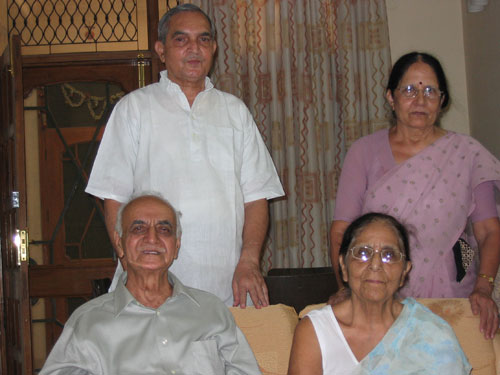
Singhs sitting

We saw off on Friday Laxman Singh and his wife, both serious citizens of above 70 years of age. They went for the first time to US to be with their son and daughter-in-law in New York. Rajat is research associate and Sushmita is pursuing her Ph.D.

Singh worked for me in HM, and his wife had been teacher all along. As their only son was disabled to certain extent, Yamuna had impressed upon her to have one more. And finally came Rajat. Yamuna takes its credit every time, we happen to talk abut them and rightly so.

Rajat did very well at studies, got into Calcutta Medical College and the AIMS, Chandigarh and came out with flying success. He married Sushmita before going to US. We played a small role in that marriage too. And after retirement, perhaps they are the only with whom we are in constant touch. We kept on insisting that they must visit Rajats in US. Finally they did it. They are on flight.

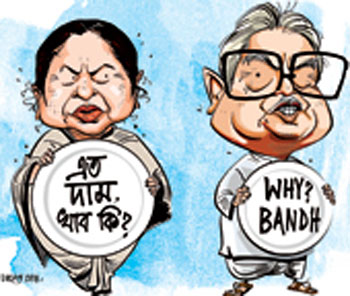
But as usual, the two back-to-back strikes more popular as bandh in Kolkata created some moments of suspense and worries for them. On Thursday, no flight took off from Kolkata. It was very uncertain for Friday too. When I talked with Mrs Singh, she was really worried and rightly so. However, I advised her to leave home at 4AM to avoid strikers on the road. I was sure that once leftists themselves had a successful bandh, they would not allow Mamata’s men to succeed. Though Mamata’s bandh succeeded but Singhs’ flight took off from Kolkata. It was great relief for them and me too. Many might have faced even worse on the day. Even for Singhs and us, the worries and suspense continued till they boarded the plane in the morning of Friday. One must iappreciate and agony of Singhs who were going for the first time abroad.

Though it is unfortunate, nothing much has changed in the way, the politicians and their followers behave in West Bengal. Buddha may be resorting to capitalist economy, but CITU and its cadre remains rogue. How can a government sponsor a bandh and create immense inconvenience for the people, some times very agonizing for some at least? But it happens in this democracy. How can a responsible opposition call back-to-back bandh freezing all the activities without having any consideration for its effect on the lives of millions of people? Why can’t the people of West Bengal throw these politicians out of their lives?

Perhaps it is not possible. And the people will have to live in this situation created by the poor leaders. And it is happening everywhere. On-going Gujjaras agitation in Rajsthan led by a person who was hardly known till recently has crippled the economy of the state. But this will happen as the country selected the democracy without preparing the people.

Posted in Uncategorized | Leave a comment

Rising Inflation Beyond Supply and Demand

In Hind Motors’ days, we observed that with general increment made known through the word of mouth, the rikshapullers used to increase the rates, and so did the shopkeepers, particularly vegetable sellers. It never used to be a supply problem.

The traders try to take the advantages of the surplus money available in the society. According to the economic outlook report of Organisation for economic Cooperation and Development (OECD) released on May4, 2008 report, India’s move to raise pay of the government employees and to write off $ 17 billion or more of farm debt will spur consumer demand and stoke inflation. Is there a way to tackle this mindset?

To provide the desired incentive to remain viable, the government has considerably increased the minimum support of wheat and has also declared to do that for paddy. And I am sure this is one of the main reasons for the rise in inflation rate. The traders want to suck all or its own share from the extra money that the farmers or the workers have earned by their hard work.

In rural India, the traders today perceive the BPL households as richer consumers because the assured 100 days earning through the NREGA.

With the perception of economy booming, and the pay packets of the freshers from IIMs and IITs known to every one through media, all the self-employed population such as doctors, advocate, and other service providers such as plumber, electricians, and even the maids try to enhance the fees and remunerations. In last few months, I have seen Fortis Hospital enhancing the fee from Rs 350 to Rs 500 for the out door consultation; Max Hospital raised it from Rs 300 to Rs 400. And once this is known all others follow the rule that has no answer. How can the government put a control on it and inflation?

I was shocked one day when a dentist told me that the same person who pays $2000 in US for a root canal operation doesn’t like to pay Rs 2000 here in India. With better mobility and media, the global rates are known and this is causing the rise of the prices too. When one comes to know that even poor quality rice costs Rs 50 a kg, his anger about the high price gets subdued.

And surprisingly, all these people keep on talking about the inaction of the government in controlling the inflation.

India produced record quantity of all the agricultural items wheat, paddy, coarse cereals, pulses, oilseeds, soyabeans, and even cotton this year. The price rise can’t be because of shortage of supply, as every item is available in plenty in many varieties and quality grades.

As reported in media, the government decided to ban future trading in potatoes. With very good production of potatoes in Agra region, the traders refused to lift the potatoes. Naturally, the farmers were ready to sell at any price. However, the price of potatoes for the general consumers remained around RS 10 a kg all over the country.

Unfortunately, today the middle class as in 60s of West Bengal hardly raises its voice and protests against the price rise. During my younger days, I have seen huge protest against even few paise fare rise for traveling in trams of Kolkata. A mindset, that nothing can be changed prevails.

Fiscal measures, such as interest rates and imposition of export duty or ban such done on food grains items including milk powder and Basmati rice may fail to control inflation in such cases. Rather these controls are just to show that the government is conscious of its responsibility and working on it. The worst is the measure of ban and export duty on steel and cement. Instead, it would have facilitated the fast execution of the major projects of steel and cement production to enhance the capacity in the country. A huge foreign exchange reserve does not permit a government to move so irrationally to encourage import by removing all duties and discourage export by imposing ban in adhoc manner to make the materials available in the market to control inflation.

The middle class really compromises with inflation. I remember early 60s. We started with very good basmati rice, but over the period settled with inferior varieties. The quantity of milk got reduced, so was the frequency of sweet dishes such as ‘gajjar ka halwa’ and pure ghee (butter oil). But my businessmen friends didn’t have to resort to that. They kept their margin managed.

It was apparent in the newspapers of the day. Among all the negative comments against the fuel price rise, no one promised to innovate ways to cut the cost so that the inflation doesn’t escalate.

Will the next generation live with inflation or forget the word?

Here is an advisory article from ‘Business Today’ to ‘fight against inflation’
————–
‘Price rise is a fact of life. You have to adjust’

Posted in Uncategorized | Leave a comment

Farmers Perform, Minister Takes Credit

‘India Today’ has an article on the outstanding performance of Indian agriculture in 2007-08. Sarad Pawar has tried to take its credit. This year’ record output has found a place in one full- page ad in all national newspapers too. It aims at perhaps telling the traders about the abundance to avoid creating artificial price rise. It might also win back some disenchanted voters to Congress or NCP. Unfortunately, there is no mention of sustained endeavours of millions of small and medium farmers. With the growth in economy and rising living standard in urban areas becoming known to the rural population through better digital connectivity, even the rural landholders are trying to come out of rut using various means- better practices and inputs. For instance, when the government fails to execute many irrigation projects such as river interlinking and canals that it plans and promises, the farmers go to deep boring and pump for irrigation. When it fails to supply electricity, the farmers switch over to diesel pumps. Should the country not be ashamed of its governments, as even after 60 plus years of independence also, 60% of the farmers still look towards sky and pray for rain for irrigation? This deprived community is expected to support and feed 620 million of the population.

All-time high food grain output

In 2007-08, India produced rice 95.68 million tonne (93.35), wheat 76.78 million tonne (75.81), coarse cereals 39.67 million tonne (33.5), pulses 18.54 million tones (17.5), oilseeds 28.21 million tonne (24.2), Soyabean 9.43million tonne (8.85). Figures in bracket show the production in 2006-07. Even cotton production increased to 23.19 million bales (170 kg a bale) this year from 22.63 million bales in 2006-07.

Some questions need to be answered.

The government has provided some assistance to the farmers, but as usual in every case it is very and very late. Its measures are short-term ones and short living too with one-point objective of getting votes. And that is the reason for the shrinking of the share of agriculture in GDP from 61 per cent in 1951 to 19 percent or less in 2008. The government doesn’t have a timeframe to cover 100 % of the cultivable land with means of irrigation or its alternatives.

The bureaucrats don’t mange by objective, but mismanage by inventing patent-able new excuses for not getting the projects executed in time. And the inaction results in situation such as the contribution of agriculture in GDP slipping to 2.5 per cent for a full 10 years. And the annual growth in food grain production at 1.2 per cent was lower than the 1.9-per cent growth in population.

Unfortunately, the farming in the country is mostly in hand of people with very little or no knowledge or formal training about the modern farming practices. No agency has made any effort to train the people involved in the task of farming. They have been expected to learn it from their elders. The farmers hardly appreciate the commercial aspect of the farming. To make the farming viable, it must give sufficient profit, the difference between costs in the farming and earnings from the produce. Should the farmers live the viability of his occupation to the almighty and keep on subsidizing the produce for influential consuming populace including the policy makers and resort to suicide himself?

Fortunately, in last few years some steps taken by the government have brought some hope and relief.

·Agricultural credit has more than trebled from Rs 86,981 crore in 2003-04 to Rs 2,80,000 crore for 2008-09.

·Interest rates on farm loans of less than Rs 3 lakh were cut from 9 per cent in July 2003 to 7 per cent in February 2006.

·Funding of seed production through universities helped enhance yield.

·The minimum support price (MSP) has gone from Rs 550 per quintal of paddy in 2004 to Rs 1,000 now and from Rs 630 to Rs 1,000 for wheat that fetched better returns for farmers. Farmers were paid Rs 2,800 per cotton bale and Rs 1,800 per quintal for soya.

Why should the Indian farmers get content with so low a price?

A price of Rs 1,000 per quintal for paddy of average quality translates into Rs 16.66 per kg for rice. With addition freight and other costs, the price for rice could touch Rs 20, post procurement. In comparison Thai rice is priced at Rs 52 per kg. With levies, the actual price comes to Rs 70.

In the PDS the government supplies grains to the very poor under the Antyodaya Anna Yojana at Rs 2 per kg and for BPL (Below Poverty Line) families at Rs 4 per kg. Those above the poverty line get grains at Rs 7 per kg.

The pricing of the food grains is certainly political and the voters oriented. Does it reach the actual beneficiaries? Is this not the reason for the massive theft and the leakage? Why can’t the beneficiaries with smart cards be given vouchers to permit them to buy it from any shop instead of the unscrupulous fair price shops? Against the coupons submitted, the shop can be paid the difference.

Should those above the poverty line not pay at least the cost price, if not the market price? Why should a consumer above the poverty line get rice at Rs 7 per kg when it costs the Food Ministry around Rs 20 and when the market price could be between Rs 18 and Rs 20?

Let the political parties agree to solve the food problem rationally using technology that can make its a transparent business. That will be in the interest of the nation.

Posted in agriculture | Leave a comment

Noida Sector 41- Election Time Again

It was election time again for the RWA of Sector 41 Noida. Community Centre presented a festival like scene on last Sunday. Two panels of contestants again fought the election.
The incumbents have held the office since last three terms. The challenging new panel talked of a change with no manifesto of work. The incumbents listed its performance, According to them, neither in past anyone has done what they did during their tenure nor any one can do that ever. However, even the incumbents didn’t talk of any new plans. With many years in office, naturally complacency sets in. They are running out of new ideas. Exactly for this perhaps, a change might have brought some new benefits for the residents.

Change is always with at least an expectation for better. In West Bengal, none other than the leftists have own election in last 30 years and more. Has it been the best for the people of the state? Is it the best state? West Bengal with all continuity of rulers remains a laggard state. Kerala changes its rulers in every election; it is one of the best states on human development index. The other developed states of Karnataka and Tamil Nadu also keep on changing the ruling party. In Bihar, Lalu ran for three terms and wished to run the government forever, and finally created such a mess that the people threw him out. And surprisingly it hurt his ego and perhaps that is the reason behind his providing the best performance in the cabinet today. The democracy never vouches for one party rule. Even in our constitution, for some of the position such as the head of the state, no one can hold the office for more than a term. In US, the president can go for two terms.

The incumbents appeared to be more resourceful. They put on costly visible, attractive posters. Their leaflets were better done. They appeared to be more professional in fighting election too. Both the sides used SMSs for campaigning. I wish next time it will be more digital using video-sharing websites such as YouTube to further their campaigns.

As it appeared, the new panel made up its mind pretty late in the election process and started hesitatingly. The leader was again an old retired person lacking the shrewdness and zeal to win. The three past presidents came out and appealed for the change. I feel their appeal went against the new panel. Some favouring the incumbent group also circulated an appeal signed by residents and pleaded that the known group is better than the new group, as it has consistently performed well. So the residents must vote for the incumbents.

And finally the incumbents won. Many talk many things about some unscrupulous means used to win the election, but it always happens for those in chair. I think it was a win of a good younger and manipulative leader, just as a good leader won the IPL final for a poorly rated team.

Many and me too have some views on this election.
1.Individuals should fight the election. The panel breeds animosity.
2.The president must have a small advisory group of knowledgeable persons in the sector for generating ideas that can benefit the residents. For instance, the sector must have a good library and reading room with separate provision for kids. A tie-up with one of the DTH services can be negotiated for cheaper services for the residents. Some competition must be brought in between the blocks to improve overall cleanliness and aesthetic aspect. There are many things that if implemented, can improve the quality of life and togetherness.
3.No one should go in election fray after remaining in office for two consecutive years. It should be voluntarily done to avoid malice and give opportunity to others till the constitution doesn’t provide it.
4.Alternatively, a concept followed in many institutions where the incumbent vice-president gets the president-ship and the incumbent secretary moves up as the vice-president in following years, can be thought of and adopted to avoid the malice between the panels.

Lastly, I have a question for the residents of sector 41. Will the residents like to live with the same executive panel forever? I feel the answer must not be ‘yes’, as it will be perpetuating a new definition of democracy- ‘by the few, of the few, and for the few’.

Finally, hearty congratulations to the winners with an expectation that they will carry out the task of better service to the residents!

Posted in Uncategorized | Leave a comment

IIT-JEE Topper

I find at least three headlines in Google News with three states associating them with IIT-JEE 2008 topper. “IIT entrance topper’s real roots in state of (Jharkhand)”, ‘Mumbai boy tops IIT-JEE 2008‘, and ‘Bihar boy tops IIT exams’.

Shitikanth, who ranked first in the IIT entrance test, has also topped in the recently concluded National Science Olympiad. He was felicitated today at Delhi and also given a gold medal and Rs 51,000 in cash.

Shitikanth was given the Proud of Bihar award along with Rs 1,00,000 in cash by the chief minister of Bihar for topping in the IIT entrance test.

Rajasthan government would also soon felicitate him. Shitikanth did his Class XII and coaching for IIT entrance examination from Rajasthan.

Shitikanth would also represent India on the scheduled International Science Olympiad competition at Vietnam on July 17.

After studying in Carmel School, Bokaro, Shitikanth shifted to St Michael School, Patna. He finished his Plus Two from Singhania School, Kota, and also got coaching in Bansal Institute for the IIT entrance test.

“I want to become a scientist. There is a lot to do research on,” said Shitikanth.

How does it matter if Shitikanth is from even US or Mauritius? In India, this is a favourite pastime for the media as well as gossipmongers. It is good that someone has still not written about his caste. On the same line, while Bansal Institute has printed the topper’s photograph, I found his photograph also in ad of some other coaching institute too. Every one wants to cash on his glorious achievement. All these brilliant students belong to this great country INDIA. Media must stop identifying them with a particular state. Life will pose many examinations almost every day when starts a career. On this day, I feel like remembering late RP Dhingra, my friend of IIT-Kharagpur. He had a brilliant career topping School Final as well as Intermediate Science in his board. He did equally well in mechanical engineering coming second in position. But the destiny cut his life short and didn’t go to the height we expected him to go in professional life.

I am happy that the topper wishes to be a scientist. I wish he stuck to his idea. I feel it’s an adhoc answer. His first objective must be to get President Gold Medal off IIT too. In long run, only the time will say if he also joins IIM or appear for UPSC examination to be a bureaucrat convinced by peers or parent.

Posted in Uncategorized | Leave a comment

Between Hopelessness and Hope

Gujjars damaging agitation upsets me. What a waste of the energy of a huge community to achieve something that does not give any thing- neither honour nor material benefits! Killing of Arushi, a sweet child of 14 years and that too by her father, while the mother keeps on sleeping, morose me. A totally irresponsible police utterances anger me. Cutting into pieces of the body of Neeraj Grover like a goat or sheep by Jerome Matthew and Maria Susairaj makes one realize that the humans have not evolved any better than beasts or rather perhaps have gone worse. But I can’t live under the weight of this hopelessness prevailing all around.

I try to find some venues and windows of hopes. And I do find in the story of India Inc getting into nanotechnology, the number of English medium schools increasing exponentially, Navodaya schools producing Nirmal Prakash, not only a name but in real sense, India growing as manufacturing nation, IT helping many organizations to bring a revolution of a sort, BPOs reaching rural India to make a difference in the lives of educated youth in villages, and many other good things happening.

India is innovating in every field of business activities. The IPL cricket is one such example. It is happening in factories and institutions, art galleries and fashion festivals. Virtus Techno Innovations, a company specializing in applied nanotechnology is trying to arrest the biological ageing process and to enable man to fight deceases better. While one company of the Tata Group is experimenting to use nanotech to make fertilizers efficacious, the other is working to make its vehicles lighter and stronger. M&M is working on developing windscreens that don’t need wipers, and Godrej Boyce Manufacturing Company is using this technology to its refrigerator compressor to greatly reduce its size without compromising with its functionality. IIT Bombay’s Prof Ramgopal Rao and his team have developed i-sens, a cardiac diagnostic device that uses nanotechnology for blood analysis to diagnose heart conditions, and, importantly, imminent cardiac attacks. Vimti Banerjee, Associate Professor, School of Biosciences & Bioengineering, IIT Bombay, has developed a drug for lung cancer that is inhaled in the form of nano particles through an aerosol spray. India is moving ahead to take the lead in nanotechnolgy soon through these little steps.

IT, the country’s strength is transforming India in big way to make it globally competitive in quality of services: a poultry firm is using IT to lower costs and get to the market faster; an eye hospital is handling a flood of patients with effective efficiency; an IT institute is carrying out all its core activities from entrance examination to semesters’ tests on line; and even an NGO is using DVDs to take quality instructions from the best urban teachers to village schools.

A survey by global consulting major, Capgemini, late last year suggested that India could challenge China and emerge as the next big manufacturing destination over the next three-to-five years. The sheer amount of activity taking place in smaller towns like Aurangabad (Wockhardt, Lupin, Nirlep, Garware, Videocon, Miller, UB and Heineken), a traditional manufacturing hub, to newer locations like Paradeep, where a large number of manufacturers are setting up shop and expanding at a breakneck speed, is mind boggling. Today it may be at Greater Noida in UP (LG Electronics India, Moser Baer, Yamaha, New Holland Tractors and Honda Siel), Manesar in Haryana (Maruti Suzuki, Honda Motorcycle & Scooter India, Denso and Munjal Showa), Chakan-Ranjangaon-Talegaon- Baramati near Pune (Bajaj Auto and Tata Motors), Nasik (ABB, Bosch India, Mahindra & Mahindra, L&T, Thyssen Krupp, CEAT and Siemens), Hospet in Karnatka (JSW Steel, Kalyani and Kirloskar Ferrous Industries), Sriperumbudur near Chennai (Hyundai Motor India, Nokia and Saint-Gobain), Tirupur in Tamil Nadu (Styleman Exports, Network Clothing Company and Royal Garments), Kalinganagar (VISA Steel, Neelachal Ispat Nigam, Jindal Stainless, Tata Steel’s proposed unit, Mesco), and Paradeep (Paradeep Phosphates, East Coast Breweries, Paradeep Carbon, IFFCO-Paradeep and Cargill India) in Orissa. But the growth of manufacturing hub will be exponential in coming year with SEZs and industrial corridors covering the length and breadth of the country.

And it is not only the growth of industrial enterprises. Education sector is booming. I find a group of central schools, Jawahar Navodaya Vidyalayas that are bringing a revolution in education for the underprivileged. Interestingly, these schools are located in India’s rural hinterland and serving children from largely disadvantaged backgrounds. As reported, JNVs have currently grown to 560 schools educating some 2 lakh, located in all the states and Union Territories of the country except Tamil Nadu, which has so far refused to accept the scheme for political reasons. I don’t understand when can the country stop doing politics with education at least.

And all that is going on all over India is impacting the country’s economy making many advanced countries respect and sometimes envy India.

India’s foreign exchange reserves rose to a record $316.171 billion as on May 23, from $314.081 billion a week earlier. Per capita income of Indians for the first time breached Rs 30,000 mark and has reached to Rs 32,299 during 2007-08 indicating their growing purchasing power. The GDP growth rate for 2007-08 was 9%. It has remained 9 % and above for the last three years. 8.1 per cent is a worrisome inflation, but it is not due to slowdown of supply. Perhaps it is more because people can afford to buy at higher prices. Perhaps service providers as well as traders wish to get their share of the money getting into the hands of highly paid people in organized sector and the government employees with the rise given by the sixth pay commission. It is certainly worrisome that the much-publicized pay packets offered to the graduates of IIMs and other institutes of excellence and national importance are becoming the benchmark for monthly take home earning for many self-employed persons too.

And with the growth, the prosperity has come unknowingly and unexpectedly to many farmers. A good number of them have become crorepati by offering their lands to the new projects. These instant crorepatis are sprouting across the countryside in Singur (Tata Motors), Tiruch (IT), Devanahalli (Airport), or Gurgaon (SEZ).

And the achievements of Indians in the country and abroad are mind-boggling too. While a son of bidi labourer clears UPSC examination, kids of Indian origin are topping the spell competition.

And it is not only Tata and Birla that are acquiring big firms of Western countries, The Indian enterprises, for instance Times Group has entered UK by acquiring Virgin Radio in UK for Rs 445 crore.

And I find another reason for getting happy. As reported, it is ‘for the first time in the history of Independent India that food grain production has crossed 227 million tonne, causing global rice futures to dip 26 per cent and wheat prices to come down from $360 to $250 a tonne.’ Is it not proof enough that India is not short of food against what it requires?

This is my way to find a ray of hope and get happy, when everything all around starts appearing hopeless. Do you agree with my route from hopelessness to happiness? If you don’t, you shall have to wait to get old as I am.

Posted in Uncategorized | Leave a comment

IIT and Bihar in News

My all optimism fails. The news coming from Bihar only shocks. I don’t think there is any one in Bihar who can lead it to a civilized society and a developed state status. A minister and his son throw a senior legislator from the allied party down from a dais. A kid gets beaten and dies, as she picked some rotten ‘lichis’ from a garden.

After many months or perhaps the first time, I find the New Delhi Edition of Times of India of May 31, 2008 has provided one full page for the unique of Bihar.

Shitikanth, son of Dr. Arun Kumar and Dr. Anita Barnwal from Exhibition Road, Patna has topped IIT-JEE 2008– 11 years after Abhinav Kumar did the same in 1997. Shitikanth went through St Michael’s High School for class X (93%)and XII (91%) CBSE examinations. As reported, he was in Kota’s coaching institute for last two years. And naturally, the whole Patna- his friends, relatives and even CM are all trying to bask under his achievement.

But more remarkable is the headline ‘It’s 30 on 30 for papad seller-turned tutor’. All the thirty students of Super-30 jointly initiated by Anand Kumar and IPS officer Abhayanand, succeeded in IIT-JEE 2008. Anand is “planning to select 500 IIT aspirants from across the country to coach them for next year’s JEE, and all of them would be from underprivileged sections of the society”. Another 39 students out of 70 coached at Kumar’s Ramanujan School of Mathematics have also cleared the IIT-JEE 2008. It’s certainly a great feat of dedicated endeavour. Can some one tell me how many students from Bihar gets into IITs this years or had been getting into IITs in last few years? With one more IIT starting in Bihar itself, attraction for IIT will further increase.

I am really excited with the news of Shitikanth as well as of Super-30. However, I don’t like students resorting to Kota’s coaching class for getting into IITs. I blame IITs for that. IITs would have devised ways and means to eliminate the need of coaching for succeeding in its entrance examination.

Further, most of these IITians would aspire to go to the management institutes such as IIMs or ISB to improve upon their entry salary offerings straight from the IITs and thereafter join financial houses or consultants. Why should they then train themselves in engineering and waste the national resources? If they don’t have the interest in and aptitude for technology and engineering, they must not join IITs.

Posted in Uncategorized | Leave a comment

Sane Indians! Get It Stopped

I have a rich Gujjar crorepati builder, with almost no formal education but very smart in personality as neighbour. Every time her wife with three sweet children comes in to meet Yamuna, I advise her for giving good education to the kids that we think they hardly have bothered till date. I can only say because of their complexion and cuts that they can’t be from schedule tribe.

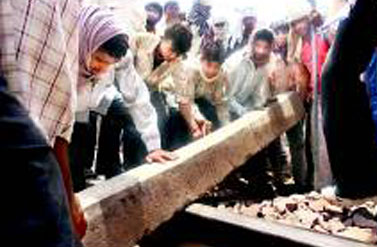
I am watching the Gujjar agitation closely. Today I saw the Gujjar protestors burning effigies and tires, pelting stones, shouting slogans, and blocking traffic on all the roads leading to New Delhi from the neighbouring states. As reported, the government engaged more than 35000 police and paramilitary personnel to avoid any major mishaps.

I am sure the scenes of Gujjar agitation on their TV scene must have shocked most of the Indians. How can uprooting of railway sleepers and lines be a part of democratic agitation? How can criminal bandits with guns in hands be part of the agitators? Why should kids and women form a protective wall? Can we call it the democratic means to attain what we want? What happened in last few days changed my opinion about the people of the region. Normally, I had experience of such violent acts in the agitation of West Bengal. The scene of a large number of tyres burning was really horrendous, and the agitators appeared to be enjoying the fun of the happenings with no fears of any sorts from the police force present in huge number. Is the police presence also the part of the politics? Why should the government not care about the commuters? If the government can’t assure the free movement, it must declare it in advance and provide advisory so that the people would not come out of their homes.

But more important is the reason for the agitation. Gujjars instigated by a leader K S Bainsla who claims to have worked in Indian armed forces want the community to be placed under Schedule Tribe category in Rajasthan.Gujjars see ST tag as ticket to development. Surprisingly, as reported, Gujjars of Jammu and Kashmir and Himachal got the tribal status way back in nineties. Why should it be done state wise, if it is to be done at all?

The great makers of our wonderful constitution did provide for a reservation for schedule caste and schedule tribes for just 15 years. The politicians kept it extending and expanding. With zamindari gone, there is hardly any difference among the economic conditions of different castes at grassroots level. If one takes the photographs of the Brahmins in some congregation, it will be difficult to find any difference between them and Gujjars or for that matter any other caste too. Any differentiation on basis of the caste is criminal and divisive. The country can’t pull on for long with such sorts of demands and such a waste of energy for useless issues.

Is it not insane act to think of such categorization after 60 years of Independence? Is it not because of the selfish motive of politicians who initiate such issues? I was amazed to see Gujjars from different parts of the country, as far as Ahmedabad in Gujarat protesting to show their sympathy with Rajasthan Gujjars.

Nothing can justify this sort of agitation that causes damages to the national assets and ceases the essential services causing so much inconveniences and loss of the individuals and the nation. Can these people not realize some of the mental agonies of the individuals stuck in this mesh? Can’t there be a consensus on the methodologies of agitation? Why should not they follow Gandhigiri?

Why can’t the leadership of the people of India appreciate the menace that they have created and once forever declare that the country will have no more quota and reservation based on caste and community? Every citizen will be provided what he deserves based on his ability and performance.

I wish Gujjars had concentrated on educating their children to make them Brahmins instead of degrading themselves for a S/T status.

Posted in Uncategorized | Leave a comment

Inflation Stuns Me Too

I followed the inflation rate figures, though I never understood its meaning and its affect. I was happy to find it around 3 – 4% last year. I could never realize it going up so fast. That is around 8% now. In late 60s, I experienced it, when for the first time I found that the salary that I received as manager in one of the high paying manufacturing companies of the day, was not sufficient enough to run a family. In 1967, I remember, it was difficult to get rice even if you had money. My uncle was kind enough to get permit to bring rice from Sasaram in Bihar to Hind Motor in West Bengal. I had to send some strongmen to Shrirampur railway station to bring the consignment safely up to our flat in Hind Motor.

I had another interesting memory of one of those days. One day Yamuna asked me to bring some pulses while coming home after the factory. I went to Babulal’s shop and asked for a kg of arhar dal. I gave him a currency note of Rs 20 and kept waiting for the balance. After some time, he asked, “Sir, do you require something more?” “No, I thought you shall be returning some money,” was my reply. I never knew the price had gone that high. Actually Babulal had charged a little less from me.

As a retired person for last 8 years or so, I had forgotten inflation. We were able to manage with the superannuation and some rental earnings. However, suddenly we experience the things going real costly and managing the finances becoming difficult. Without our knowledge, the expenses on vegetables, milk products, and groceries have gone high enough to add up to sufficiently unmanageable level and to make us feel short of money at month end. Other bills such as those of cells, landline telephone and Internet as well as electricity have added to the misery. Even essential maintenance cost is becoming higher on a pretext of inflation. Any one who provides even a nominal service, charges nothing less than a hundred rupees. Consultation charges of doctors are skyrocketing. I used to pay Dr. Bhalla Rs 300 per visit at Fortis Hospital. It has gone up to Rs 500. So are the prices of medicines. Why should the doctors bother about my capacity to pay? Almost all doctors these days prescribe a minimum five-six medicines and that too the costliest brands. Some friends tell me that they receive commission from the pharma companies. Even the Homeopath has enhanced his fee to Rs 80 from Rs 30 for consultation and sweet balls that he provides for a fortnight.

Coming back on vegetables and fruits, I don’t know how the sundry vendors decide the prices charged in Sunday Bazaar. They keep on shouting the prices of vegetables in ‘pau’ (perhaps 250 gms) instead of a kilogram. It is the psychological strategy of Indian origin. The opportunity prices of the vendors have no relation with the mandi prices in kilo published every day in all newspapers, perhaps for the benefits of the consumers. Even the prices at the Mother Dairy’s subsidiary Safal that sells vegetables and fruits have no relation with mandi prices.

I wonder why it be the case in India, a leading producer of fruits (32 million tonnes annually, that is 8 per cent of global production), vegetables (producing 71 million tonnes per year, a 15 per cent share of the world market), and milk (the highest in the world). While we pay about Rs 8 a kg for potatoes in Safal outlets, the farmers are going for distress selling in Agra about 200km away because of the bumper crop and no buyer because of the ban on the forward trading by the government. And then huge waste is common. As high as 40 per cent of the fruits and vegetables grown in India (that’s some 40 million tonnes-worth a staggering $13 billion) gets wasted that is enough to feed countries like Brazil and Vietnam. It is due to insufficient cold storage capacities (The current cold chain capacity in the organized sector is around 60,000 tonnes) in close proximity of farms, lack of temperature-controlled transportation and storage in the supply chain up to the retail stores.

Organized retail is certainly some answer, but excessive profit motive will hardly be helpful for the consumers or the producers. I find Biyani’s Big Bazaar as the best customer-friendly store for grocery, vegetables, and fruits. As claimed, if the organized retail outlets buy straight from the farmers, growers, and producers, it can price always lesser than the mandi. The inflation is making the consumers miserable with no gains for the farmers and producers. It is only the middlemen and traders who make money. Can the government or some effective regulator decide some relation between the price paid to the producers to the mandi price and the retail price considering sufficiently good margin for the business?

Strangely, the price gap between the MSP (Minimum Support Price) of wheat (about Rs 10 a kg) for farmers and the packed wheat (Rs 15 a kg) is not that high as other food items, say pulses. The subject requires some moral commitment from the traders, which I doubt to come. And the middle class households, particularly the lower group earning below Rs 2 lakh a year will always be under pressure to cut consumption or quality of the consumables.

I shall try that inflation does not shock me in future. It happens in every country. And one must learn to live with it, particularly when you are no more working with regular income.

Posted in economy, governance | Leave a comment