Sonia -The Unhappiest Woman

Many a reputed foreign magazines have elected and put Sonia as one of the most powerful women of the world. I wonder if she is one of the happiest one too. In normal course, she would have been one with her two children- a beautiful daughter and a young son. But the task of heading one of the two major political parties of a country of billion plus populations with infinite number of diversity must be killing for her. In her moment of solitude, she must be finding herself very much helpless, totally agonized and tormented.

Perhaps, her denunciation of the primeministership in 2004 was her first mistake. With a party that wishes to have only a member of Nehru as head, it was still a poor decision. Even if she wished she couldn’t give total autonomy to Man Mohan, as many feels she has been wrong. If she had done, her party men would have disintegrated. As many of the power seekers could access her, the system is working. But this system of informal governance can’t give the result expected today. Expectations of people have gone high. It requires accountability of governances for providing the expected best response time for delivery. The model created by her emotional zeal in 2004 has failed.

Jemima Khan, the glamorous ex-wife of Pakistan’s cricketer-turned-politician Imran Khan, might have a deep fascination for rising India and may adore Sonia Gandhi and wonder about the political future of her children Rahul and Priyanka. But it can hardly make Sonia happy. With her preference for Rahul over Priyanka, she followed the traditional inheritance system. But will the transition from Sonia to Rahul be so smooth and a source of happiness for Sonia as well as Rahul? For instance, when Rahul becomes the prime minister, will he like to operate as Man Mohan who has been clearly subordinating to Sonia? And for a moment think of a married Rahul. Will the wife of Rahul be having the same wavelength with Sonia that Sonia maintained with Indira Gandhi?
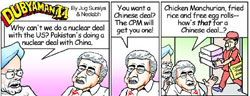
Curtsey Times of India

The controversial Indo-US Nuclear Deal is one example of her many issues to torment. What should she do is the question for her? She is the only who could have helped Man Mohan Singh and saved the Deal that has support of almost all outside the politics in India, be it Barjesh Misra, K. Subramamanayam, Meghnad Desai, or RK Pachouri. US and it leadership, be it Bush or Obama or McCain, was never so eager to assist India. And let Sonia Gandhi understand that it is not because of leftists assisted UPA. USA is bending forward for the rising and unstoppable India of billion plus people and not one of Karat or Yachuri. Pranab Mukherji has tried his bets to sell it to leftists. National security adviser MK Narayanan tried to appeal too. But Prakash Karat is the boss and he is as tough (and even rough) as Mao with his how-does-it-matter mindset. Even the news of almost all nuclear plants running below capacity, the Chinese collusion with Pakistan, and its prickly incursions on the border, hardly disturb the leftists. Naturally, the leaders of other smaller parties, regional in nature hardly wish to go against the cat with the required vengeance. Why should they? The fear of early election and the lack of confidence to face the people are deterrents. Can Sonia be apolitical and favour Man Mohan? It will be only her physical and personal performance that will be on test in he next election. Does she like the situation year after year, though that may be her own creation? Why could not she create the second line of political leaders that can win election for her? Why does she want as mother only her son to succeed her instead of allowing the bests in billion to come in forefront? Can she depend on Rahul (or Priyanka) to take off her burden? How much unhappy she may be finding herself sometimes with the pressure of leftists on hand and none to take on them? How miserable she must be finding herself with the party infighting, sometimes even the violent one even in her presence? Can she enjoy such an incident? Doesn’t she get extremely unhappy? Will she be able to take a decision in favour of the Deal even after some allied parties supporting it?

Sonia’s stand on the Deal is the manifestation of her confidence in the issue of national priorities over short-term politics. More than anyone else Sonia Gandhi is on test. And this must be making her the unhappiest woman of the world, if she is even minimally emotional at heart.

Posted in Uncategorized | Leave a comment

10 Top Challenges and India

When I was documenting ‘Unstoppable India’, I came across a report of the economists Jim O’Neill and Tushar Poddar of Goldman Sachs* and Co.that recommends 10 things India needs to do to achieve a per capita GDP of at least $20,000 (Rs8.58 lakh today) by 2050. India could be 40 times bigger by 2050, and may also have the potential to be larger than the US by that time. It’s a must reading for everyone with a dream to see India developed or a giant economy and may be, superpower. The 10 top challenges are:

1) Improve governance
Better governance, delivery systems and effective implementation will be essential to educate its citizens, build its infrastructure, increase agricultural productivity and ensure best result of economic growth. A large gap between physical access to services and the quality of services provided is leading to a citizen satisfaction gap.

2) Raise educational achievement

Raising India’s educational achievement is a major requirement to help achieve the nation’s potential. A vast number of India’s young people receive no education. A number of initiatives, such as a continued expansion of Pratham and the introduction of Teach First, for example, should be pursued.

3) Increase quality and quantity of universities

At the other end of the spectrum, India should also have a more defined plan to raise the number and the quality of top universities. The likely numbers seeking higher education can be expected to grow by three of four times by 2020 from the current number of around 10 million. The National Knowledge Commission recommended an increase in the number of universities from 350 today to 1,500 by 2016. 15% of the18-24 age group must be educated to university level from 7 to 15 per cent.

4) Control inflation

India’s currently rising in inflation is a worry and challenge. A formal adoption of Inflation Targeting (IT) would be a very sensible move to help India persuade its huge population of the (permanent) benefits of price stability. Greater independence for the Reserve Bank of India and the abolishment of all FX controls are recommended.

5) Introduce a credible fiscal policy

India should introduce a more credible medium-term plan for fiscal policy. Targeting low and stable inflation is not easy if fiscal policy is poorly maintained. It would be helpful to develop some ‘rules’ for spending over cycles. India’s gross fiscal deficit remains one of the highest in the world and, recently, government liabilities have been increasing at an alarming rate. The situation will further accentuate due to a large debt-waiver for farmers, a big wage hike for civil servants, increasing fertiliser and oil subsidies, and higher exemptions on income tax. At such high levels, government borrowing crowds out private-sector credit, keeps interest rates high, adds to already high government debt, and becomes a key source of macro vulnerability. Expenditures must be directed towards much-needed areas such as health, education and infrastructure, which could enhance growth-but rather on wages and subsidies. A medium-term strategy for fiscal policy, which reduces the overall deficit to a sustainable level, is critical for India.

6) Liberalise financial markets

India’s financial sector is dominated by the state, holding 70 per cent of banking assets, a majority of insurance funds and the entire pension sector. Total credit, at 50 per cent of GDP remains well below that of its Asian neighbours (an average of over 100% of GDP) and especially compared with China (111% of GDP). Within this, consumer credit remains abysmally low (at 11% of GDP) compared with an Asian average of over 40% of GDP. Household savings tend to be in physical assets and gold, and risk diversification channels are not available. India needs to pursue financial reforms to channel savings effectively into investment, meet funding requirements for infrastructure and enhance financial stability.

7) Increase trade with neighbours

India currently accounts for no more than 1.5% of global trade. India still ranks below the average of all developing countries. India takes just 1.93% of China’s exports and provides just 1.46% of its imports. Total trade with the US in 2007 was just $42bn. For comparison, total US trade with China in 2007 was $405bn. Similarly, total Indian trade with China was just $37bn.If India can be encouraged to think increasingly ‘global’, the virtuous benefits of trade with other emerging giants with large populations could be a source of considerable upside surprise for India.

8) Increase agricultural productivity

Increasing agricultural growth is critical. Currently, 60% of the labour force is employed in agriculture, which contributes less than 1% of overall growth. India’s agricultural yields are a fraction of those of its more dynamic Asian neighbours. For instance, rice yields are a third of China’s and half of Vietnam’s. Agriculture must be treated as a great opportunity for India. Better specific and defined plans for increasing productivity in agriculture are essential.

9) Improve infrastructure

India’s constraints in infrastructure are well known, be it the clogged airports, poor roads, inadequate power, delays in ports. Indian companies on average lose 30 days in obtaining an electricity connection, 15 days in clearing exports through customs, and lose 7% of the value of their sales due to power outages. Incremental demand for infrastructure will continue to increase due to economic growth and urbanisation. India needs almost to double its ports, roads, power, airports and telecom in the next five years to sustain growth.

10) Improve environmental quality

India’s high population density, extreme climate and economic dependence on its natural resource base make environmental sustainability critical in maintaining its development path. India must move to take care of the effect of urbanisation, industrialisation and ongoing global climate change on India’s environment. Achieving greater energy efficiencies and boosting the cleanliness of energy and water usage would increase the likelihood of a sustainable stronger growth path for India.

It is not that nothing is being done, but the speed is slow and irritating. It is not happening in all regions. South is racing ahead, but the North is still not development- oriented. While Delhi Metro completes project ahead of time, NHAI has gone laggard and is still years behind in completing its expressways- GQ and NSEW corridors. Taj Expressway is still at land acquisition stage. Bihar has done wonderful in reducing the number of children out of school in 6-14 age group, but UP is slow. Few IAS officers are performing excellent, but many still work for self. While IT and telecom is racing ahead, many sectors are slow to emulate. 8 IITs may start operating by next year, but why should not the state review the performance of many of its existing educational institutions that have gone abysmal? Gujarat has made India the largest producer of milk, why can’t other states follow the same? What stops the states make its agriculture universities reach villages and improve the productivity that requires only change in practices? Can all politicians and the babus make these 10 challenges their priorities?
*Goldman Sachs Global Economics paper no 169: Ten Things for India to Achieve its 2050 Potentials
———
Read “The I in BRIC”

Posted in Uncategorized | Leave a comment

Unstoppable India

The global slowdown fear is on horizon. US economy is indicating trends of impending recession. Inflation is causing a concern all over the world, at least for all the middle class and below. However, I have my reasons to believe that Indian growth story will be unstoppable. Inflation in India is not due to supply constraints but because the traders wish to make their cut in the disposable money available with the people at large. My conviction is also based on the rising India and the stories of the aspiring Indian entrepreneurship. It is not because Tata, Birla, or Reliance is thinking big with expansion in domestic domains and global acquisitions. But the urge to excel and create wealth has spread quite widely in entrepreneurs in different fields all over the country. And that is behind Ramakrishna Karuturi becoming the world’s largest rose producer. By December 2009, his ‘Karuturi Global’ will be thrice as big as the second-largest rose producer. It is the same aspiration that makes Mukund Choudhury’s Spentex, with 5.70 lakh spindles, the world’s largest yarn manufacturer. Sylvania today is the fourth-largest lighting company with manufacturing facilities across the world. Even smaller companies, be it Coimbatore-based compressor manufacturer Elgi Equipments or textile machinery maker Lakshmi Machine Works are aspiring to go global including setting up facilities in China. As reported, over two-thirds of the M&A transactions involving Indian businesses were by SMEs in 2007. According to a M&A report by consulting firm Avendus, in 2007, there were 79 outbound transactions totaling €13.7 billion (Rs 89,100 crore, excluding the Tata-Corus deal), while the 72 inbound transactions totaled €15.2 billion (Rs 98,800, excluding the Vodafone transaction). Is this not a Rising India?

And it is happening even in the fields and farms, plains and hills. Leaving the leisurely life of good old days behind, ‘one finds farmers in Himachal tending terraces of zucchini and swathes of red lettuce interspersed with fennel.’ Himachal Pradesh is fast becoming a hub for gourmet foods production to the immense potential, which the state’s temperate climate and geography offers. In the nondescript town Paonta Sahib, Manmohan Singh Malik is making tonnes of mozzarella cheese in the authentic Italian way from high fat buffalo milk and exporting all to the US and European markets. With an Italian mozzarella cheese-maker, named Raffaele Cioffi to supervise operations, his Himalayan International Ltd now produces 600 tonnes of mozzarella annually. Simultaneously, he also grows vegetables like red cabbage, jalapenos, broccoli and herbs on around 150 acres of land through contract farming. Among his export list are hugely popular herbal samosas stuffed with herbs and mozzarella, jalapenos also stuffed with cheese, and baby potatoes in jackets, boiled, stuffed and frozen for US supermarkets. In addition, some 2,000 tonnes of frozen mushrooms too are exported annually. Today, almost 500 farmers spread across dozens of villages grow asparagus, pakchoi, joichoi, snowpeas, leeks, cherry tomatoes, fennel, celery, coloured bell peppers, zucchini, broccoli, and a variety of lettuces such as lollorosa, radicchio and romaine. And more and more farmers are joining the aspiring group.

A similar endeavour in Uttar Pradesh is helping India to become the largest producer of menthol mint oil in the world, overtaking China. With a production of about 17,000 tonnes, the country now commands a 78 per cent share of the annual global output of menthol mint oil. About 300,000 farmers in Uttar Pradesh, Uttaranchal, Punjab, Haryana, Bihar, and a few other states are working hard over three-to-four months every year to grow the herb, that brings additional Rs 30,000 or more per acre without sacrificing the main crop. As I wrote earlier, it is becoming very popular with the farmers around Madhukarpur in my district that is Yamuna’s village. Her nephew, Rinkoo tells me it is all because of Barabanki.

And the wasteland is getting used to grow a shrub-like tree called jatropha to produce the alternative oil that is the fuel for all the cars of government officials (including the Chief Minister) in Chhattisgarh. India is trying to launch one of the world’s biggest jatropha bio-fuel projects in order to bolster its energy security.

And there are many reasons to believe India will keep on growing its GDP at a good rate around 9.5%. According to CMIE CapEx Service, projects worth Rs 340,000 crore (Rs 3400 billion) are scheduled for commissioning in FY’09 that would be the highest ever completion of investments in the Indian history.

It is difficult to predict what will take India ahead and who will ride India’s next wave. At least, one programme can give a useful hint. In February this year, some 250,000 students across 360 educational institutes took part in National Entrepreneurship Network’s EWeek (entrepreneurship week) where they took part in group discussions and met investors and successful entrepreneurs. They also spent three days on an “Rs 50” game, where they had to devise out-of-the-box businesses (with an investment of Rs 50) in three days and prove their viability. These businesses ranged from dog washing to salsa classes, printed T-shirts and costume jewellery. At Bangalore’s Mount Carmel College, students baked a cake for Rs 50 and sold one slice of that cake for Rs 20 and used the surplus to bake more products and make a handsome profit.

The entrepreneurs in million and their innovations will make India unstoppable.

Posted in economy | Leave a comment

Chinese Invading, Leftists Colluding, and Traders Enjoying

Pakistan may again come closer to India and the people may start living as they were in pre-independence united India, but China will always remain headache. It will compete, challenge, prick, bark, and if necessary in their interest bite India too. Even reports from the border suggest that. Many a times I strongly feel most of the problems of Maoists (Nepal) or terrorists (Bangla Desh) in the neighbouring countries have been there because of instigation and financial support from China to keep India engaged. China with vast financial resources and meanness of one party authoritarian rule can easily maneuver small countries and its corrupt leadership that matters. However, the worst for India is its own leftists that lobby and work in China’s interest. Even the leftists’ governments are encouraging China to enter in India in industry and trade forgetting its own opposition to free trade and globalization. Can there be a better and loyal internal ally than the leftists and that too with all the clout of supporting the government and the best possible relationship with the defacto ruler, Sonia Gandhi?

While the people of India prefer close relation with USA, the leftists are fighting tooth and nail so that India doesn’t go nearer to US as in Indo-US Nuclear Deal that is so vital. After many years, US have understood the importance of India. And so Rice writes in an article in the latest issue of Foreign Affairs magazine published by Council on Foreign Relations, a Washington think-tank so favourably about India. “…The United States has a vital stake in India’s rise to global power and prosperity, and relations between the two countries have never been stronger or broader.”

Unfortunately, leftists don’t like this closeness. And the reason is clear. G Parthasarathy opines very rightly, ‘the communist parties appear determined to make India a client state of China.‘ The real reasons for Chinese opposition to the Indo-US nuclear agreement were voiced in an article in the August 2007 issue of the influential Renmin Jiabao magazine, which stated: “The US-India nuclear agreement has strong symbolic significance (for) India achieving its dream of becoming a powerful nation…In fact, the purpose of the US to sign a civilian nuclear agreement with India is to enclose India into its global partners’ camp. This fits in with India’s wishes”. ‘The CPM finds fault with the India-US nuclear agreement for precisely the same reasons as China. The CPM joins the Chinese in expressing opposition to missile defence systems. Does the party want Indian population centres to be defenceless against attacks of nuclear-tipped missiles? Have CPM leaders ever voiced concern about the Pakistan-China nuclear and missile nexus to their Chinese comrades during their visits to the Middle Kingdom?’ ‘What our communist comrades fail to realise is that wittingly or unwittingly, their recipes for foreign policy and national security fit in beautifully with Chinese long-term objectives of isolating India by strengthening their own growing ties with the US, while getting others to undermine India’s relations with the United States.”

Leftist states are promoting Chinese import even through clandestine route and encouraging the state’s industrial units and the government department to have better tie-ups with Chinese enterprises knowing full well about the Chinese quality problems. And the Chinese are well versed in using the weakness of corrupt officers to get their interest served. It is not that the Chinese are not ahead in manufacturing, but the Chinese blatant subsidy also creates an advantageous condition for its manufacturers. Why can’t leftists come out with encouragement to India’s own manufacturing sector?

For instance, some of the West Bengal power plants have gone to Chinese suppliers instead of BHEL. BHEL is having its problem of capacity, but the quality of the Chinese manufacturers in many sectors including power equipment as well as cement machinery have been poorer. Some experts with many years of experiences from the sector allege about the poor quality of power generation equipment supplied by Chinese manufacturers such as Dongfang Electric Corp., Shanghai Electric and Harbin Power Equipment Co. Ltd. The Central Electricity Authority (CEA) has formed an internal group to conduct a technical audit of such equipment. With the support of some champions of globalization and free economy, and a tacit backing pf the leftist state government and some new, may be unscrupulous, private companies entering power sector, it will be difficult to stop the Chinese, though the problem is known to the Chinese authority too.

China will have its own problems. But India must concentrate on its growth story, particularly of its manufacturing sector. If we go by media, there is an effort but India is to go many miles to do a catch up. It is only the economic, technical and physical strength of India that can even keep China’s irritants on borders in check.

Posted in Uncategorized | Leave a comment

On Father’s Day

I had a greeting card for the day waiting for me in my e-mail from Emma, Shannon, and Anand. India on the whole is fast adapting to the western customs. It was pretty clear after glancing through the newspaper full with many ads for this occasion. Fortis invites the children to spend for the discounted medical checks for their parents. Many enterprises have many things to offer.

But the card from Shannon had a request to write about my father and grandfather. In my childhood, I lived mostly with my grandfather up to school. He planned and shaped my career. In Presidency College and even in IIT, Kharagpur, he used to come pretty often just to see me, and certainly to accompany me back home at the beginning of long holidays. Sometimes, it embarrassed me. One can’t appreciate his attachment and his worries with telecommunication completely absent in those days. I still remember one occasion of Presidency days, when I had gone out and he couldn’t meet me. He was so worried. He never allowed me to know anything about the household affairs, though perhaps I would have liked to get involved.

Unfortunately, I couldn’t do much for him. He went to our village after retirement with many dream projects. But very soon, he came to realize that my uncles did not like his ideas, as it meant hard work. Very soon, he started working again in High School at Dalmianagar. He remained busy till his last moment. He had fine sense of literature and music too. But he loved to meet people the most. I never came across any person who could become as loving and respectable as him.

For that matter, my father was the luckiest person on this earth. He never had to take any responsibility. In joint family, his uncle hardly asked him to do anything, but supported whatever he did. When he started to live in my mother’s village, he had hardly anything to do. When he got sick, I brought him to live with us. He lived a peaceful and contented life till last. Perhaps he never expected anything in life. Today, I really envy him.

But both my father and grandfather lived in a time, when they respected their elders, loved all the younger ones and got respected by their children. My father would have given anything he had to any one if he asked for it. My grandfather never raised his voice against anyone.

They were in era with no Father’s Day.

Posted in Uncategorized | Leave a comment

On This Day 53 Years Ago

On this day 53 years ago, we, Yamuna and myself got into this relationship that is the closest and divine as many say it is decided in heaven by Him. Even with the memory failing, I vividly remember the day in all details, the happiness of my mother, and all the other members of the family including my grandfathers and great grand mothers for the occasion, and all the rituals and functions. Life thereafter has been full of fun and festivities. The Great has remained so kind to us. We remain grateful to Him. We are sure He will be similarly kind to us till end. What more do we need?

Thanks a zillion SIR.

Posted in Uncategorized | Leave a comment

Bihar Getting Visible

I was shocked when I found a very poor reply from Prabhu Chawla to a question asked by one Rajeev on ‘India Today’ website. He said, “Nitish Kumar is also following policies which help certain castes and not the entire state.”

Many a times, I wonder why does Bihar get so poor media coverage, when as I guess quite a large number of the reporters, in print as well as digital media, are from Bihar. Can’t they make the reporting more meaningful by reporting some success stories too? As I have seen, quite a lot of work is going on at least on two central projects in Bihar related to rural road and electrification. While my own village has got the good roads from at least two sides, Yamuna’s village has got electrification. I hear and read similar news from different sources too. However, one hardly sees any coverage of these two projects in media. For our reporters, Lalu still remains the most favourite, be it his new blog or the 32-lb ‘garib rath’ cake on his birthday.

But I am happy that very lately Bihar is getting some good coverage on quite a few other developments. That too is not of lesser significances. Let us see some examples of good media coverage.

Bihar’s litti-chokha: ITDC is promoting Bihar’s litti-chokha. “Apart from being tasty, litti and chokha are rich in fibre and low on calorie. This will certainly suit the taste of those looking for a combination of tasty and healthy food.” Ashoka Group hotels are including litti-chokha in its menu and will served it at the international food festivals to be organized by ITDC in Germany and Hungary later this year.

Political: Another news that was widely covered related to the decision of the continuance of Sushil Modi as deputy CM of Bihar. BJP used a “secret ballot” to sort out the crisis. Many may differ with me, but I find the method as the best in a democracy. BJP proved its difference. I am sure it will now be the initiative of Sushil Modi and certainly Nitish to improve the fellowship with the disgruntled members of the cabinet and the assembly, if the alliance is to be effective and exemplary. Modi might have passed the test, but he must try hard to improve his man-management. Congress must take note.

Education: Another interesting news related to the unique institute Super-30 of Patna. The whole country watched with interest the superb performance of Super-30 of Bihar. The institute makes every person of Bihar feel proud. However, as anti-climax, Avayanand has disassociated himself from the institute. I wondered earlier how could he do that service with his demanding police assignment. However, I am unaware of the internal issues or politics if there is any. To the joy of many, Nitish promised to bear the entire expenditure of the education of those who got into IITs. The Chief Minister had earlier announced Rs. 50,000 cash reward for all successful students.

The media also covered the news of Chandragupta Institute of Management, Patna (CIMP), designed on the pattern of the Indian Institute of Management, Ahmedabad, which got inaugurated in Patna. Higher education is getting a boost in Bihar. The Chanakya Law School University on the pattern of the National Law School of India University, Banglore has already started operating and a small batch of students will also join IIT of Bihar. The establishment of these institutes will build some prestige. But it demands a very conducive and efficient infrastructure and educational environment that can attract the best students in Bihar. It also expects that Bihar government will be able to attract the biggies of the India Inc to set up enterprises in Bihar.

Bihar has also given top performance in cutting down the number of out-of school children in the age group of 6-14 to 10.10 lakh this year from a mammoth 21.19 lakh last year. Muslim, SC, and ST children have made the most remarkable contribution. Out of 33.06 of Muslim child population in the said age group, only 2.83 lakh were out of school in March 2008 as against 4.24 lakh in March 2007. In case of SC, only 2.71 lakh SC children are out of school in March 2008 as against 4.99 lakh in March 2007. Out of the 2.41 lakh ST children in the age group of 6-14, now only 25,901 out of a total of 2.41 lakh ST children in Bihar are out of school as against more than 45,000 in March 2007.

Economy: Bihar is in news for its record procurement of wheat, as Nitish Kumar demanded to arrange more procurement for the benefits of the farmers. Bihar has also urged the Centre to review a recent amendment to a rule that forbids producing ethanol directly from sugarcane juice without manufacturing sugar. It prevents investment in sugar industry in Bihar in which many industrialists are showing interest. Reliance Industries Ltd and Hindustan Petroleum Corporation Ltd have also renewed their interest in taking over three State-controlled sick sugar mills in Bihar.

Bihar is also in news for extraordinary telecom growth. According to an Assocham state-wise analysis of mobile subscription released last Tuesday, Bihar registered the maximum increase in annual telecom subscribers, marking a growth of 88.2 per cent in the fiscal 2007-08 as compared to the 51.1 per cent in 2006-07.According to aother news report, Bihar may get technical help from Israel to enhance the quality of litchi.

Governance: While Nitish Kumar endeavour to convict the ‘purane papis’ (old culprits) is showing result, I wonder if it can mellow down the ‘bahubalis’ (dons) and cut down the deep-rooted culture of corruption from Bihar. The news related to the ‘shortcut to babudom’ scam revealed the depth of corruption in high society of Bihar. It pains. But Bihar is to go many miles. It must get SEZs. It must cash on potential of tourism. It must capitalize the skill of its artisans. And Nitish must stop his fight with Ranghubans Prasad or declare that Bihar does need NREG scheme. According to an official performance report on the implementation of the National Rural Employment Guarantee Scheme (NREG) by state governments, Bihar is again at 25th position out of 27 states with Orissa at 26 and Maharshtra at 27, when Rajsthan tops.

Is it not a good going? Will the reporters of Bihar help in bringing out the best in Bihar?

Posted in Uncategorized | Leave a comment

Some Concerns, Some Trends

Many look at IITs for many reasons. Parents aspire to see IITs as the choicest target to be attempted by their children to get educated. The students start dreaming and preparing for IITs through IIT-JEE as soon as they reach class X. I have come across many alumni of IITs who hardly wish to remember the arduous days at IITs. Most of the alumni, however remember the IITs with a flash in eyes with respect and belongingness.

IITs as such have become a respected brand of India in industries all over the world. At least some smaller countries wish India to help setting up an institute on the line of IITs. However, in India the politicians wish to get IITs established for getting political mileage with the vote banks. The extension of OBC reservation to IITs was certainly one of the pure political moves for the same reasons without giving thought on its damaging effect on the quality of education and brand with not much of preparation to affect it. Now every state wishes to have an IIT, as if that will provide the answer to all its problems of technologies. As a political priority, at least some with forthcoming election in mind, 8 new IITs in eight states will start operating in this year itself without any prior preparation of infrastructure or faculty. Another exclusive IIT is being proposed for girl students without asking girl students if they require or like one. Surprisingly, the demand has come from the first lady President of the country.

I shall myself prefer IITs to franchise its course material and train, if possible the teachers, to make the right use of the material so that al the engineering colleges that wish, can avail it. If IITs can, it may adopt some engineering colleges.

I look at IITs with different hopes. I wish it must focus to bridge gap between industry and academia, when I try to remember of any outstanding innovations coming from IITs and find nothing great but a few such as a riksha designed by IIT, Gauhati and Prof. Ashok Jhunjhunwala’s Simputer. Even if I am wrong which I shall like to be, it is because media has hardly any coverage of the work at these great institutes of national importance.

It is funny that the minister of rural development of India wishes to take help of the students and faculty of IITs for monitoring NREGA in the country. The same politicians use the rural teachers for collecting census data and for conducting election. Students of IITs can only be used to impart technical knowledge and to train the farmers. However, that itself will require sufficient orientation of those students.

I get pain to know about the role of coaching industry for IIT-JEE and the way this industry is expanding to every small town with franchises. I don’t the number of poorly manned and fake ones. The way the coaching institutes keep on advertising, it appears to be nothing but just cheating. I wonder why can’t IITs innovate the system of the examination that can’t be coached.

Somehow I feel IITs have not been able to keep track of its alumni and through one of its management schools it could have undertaken a research project to understand the realistic influence of IITs on the professional achievement of alumni. Alumni could have been a source to create an endowment fund for each institute, and further could have served as visiting faculty too. In US, sixtytwo universities have endowments of over $1 billion each.

A media reported trend is certainly heartening. More and more IITians are staying back in India. Quite a few prefer for manufacturing instead of IT. IITians no longer prefer U.S. as job destination. Ph.Ds are getting better salary offers. Salary packages for faculty are getting significant increase, some say, 200%.

However, I personally don’t like the enhancement of fees of IITs at one hand, and on the other the preference of IITIans to get into IIMs and joining consulting and financial services straight from the colleges. I would have preferred them to come back to IITs or IIMs only after three to five years of experiences to specialize. Alternatively, the course can get extended to five years with the placements after three years, and the balance two years’ period divided between the employer and the institute.

Will the government come out and announce the ultimate number of IITs in India? Why can’t it create another brand or as many brands as the number of new institutes it establishes with open competition to excel?
——–
Read How Not To Build New IITs by SWAGATO GANGULY

Posted in Uncategorized | Leave a comment

Correction Course for Media of Instruction

A very pertinently important question must be bothering many parents, educationists, and perhaps psychologists too. What must be the best medium for instruction? Naturally the answer will always be in favour of the mother language. But will it provide the advantages and employability for professional career? It is for this reason that the country is switching over to an alien language as medium of education and instruction at an exponential rate. As reported recently based on data collected by the National University for Education Planning and Administration (NUEPA)*, ‘nationwide enrolment in the upper primary section of English-medium schools rose 74% during 2003-2006. In actual figures, this is a rise from 54.7 lakh students in 2003 to 95.1 lakh in 2006.’

The students from the English-medium schools will be far better in communication, not necessarily literary excellence in that language. Many believe they are smarter too. Naturally this puts to disadvantage all those students who are sticking to mother language as medium. What can be done about it? One simple question must be honestly answered by the English teachers responsible for that. How many years or hours of intense teaching is required to learn a foreign language to master it for communication, both spoken as well as written. Should the 14 (2+12) years of learning English as a subject not be sufficient enough for attaining proficiency? What can be done to get the equally good proficiency in English keeping it a second language for all, as it is now in most of the states? Perhaps, a little change in the mindset of the English teachers, their retraining, and making them use technologies as teaching aids will make the vernacular medium students also equally proficient in English. All the state governments must be serious about overcoming the situation. Some have started doing that by establishing finishing schools for the graduates. But it must be taken up at the school level itself. Most of the English teachers themselves are not proficient enough in English. They must undergo an intense training and develop the skill. With an interest and mindset backed by digital aids, it can’t take anything more than two months. Let them understand that it is never too late to learn and it is they who have been preaching this.

English as a medium for most of the business activities and computers as tools to provide efficiency and ease, are two basic skills that a student must acquire as early as possible for bringing in the equity in society and inclusive growth. The states that will falter will be left behind. As per the report, “the growth of English is more in non-Hindi speaking states, mostly the southern states which account for over 60% of the students enrolled in English-medium schools in the three-year period. English-medium also accounts for well over 90% of the enrolment in the northeastern states. In north, except in Punjab and Gujarat the growth of English has been sluggish.”

I have been visiting many of the private engineering colleges in and around Noida and talking to the students. I find that most coming from rural background can’t communicate in English even in their final year. Is it not a shame for the teaching system that even after 10+2+4 years of proximity with the language doesn’t make the student speak confidently in English?

Basically, the language teachers must get status but appreciate the key role they play, as without knowing the language, a student can’t understand the subject taught in English or by reading the books in that language.

Let Nitish and Mayawati move fast and take the corrective measures to come up to the standard of the South. Both the states must encourage good private players in education and spend on training its teachers and technologies, particularly one who is to teach English.
—————————–
*The total number of children enrolled in class I to VIII in 2005-06 in India is about 150 million. Only 9.5 million get education in English medium schools. Rest about 140.5 million are in schools of Hindi and various regional languages as media of instruction with Hindi at the top of 78.4 million.

Posted in education, governance | Leave a comment

Nuclear Deal Requires Guts

According to Anil Kakodkar, Chairman Atomic Energy Commission and Secretary Department of Atomic Energy, currently the nuclear power plants in the country were working at half their capacity nearly of 4,000 MW due to the fuel shortage. The Nuclear Power Corporation of India is currently working on four 700-mega watts nuclear power plants and once the fuel linkages are finalised then the construction would begin. The short supply of uranium due to the slow process in opening up of new uranium mines. Uranium Corporation of India will soon be constructing a mine and a mill at Tummalapalli in Andhra Pradesh with a capacity of 1,50,000 tonnes per annum. Likewise, mining and milling was being looked at in the states of Rajasthan Karnataka and Meghalaya. Is India pursuing its nuclear programme with the amount of seriousness and professionalism that it requires? Should it not be the first and top priority of the government instead of keeping itself busy in finding out how could it put blame on the misdeeds of NDA government that went out four years ago?

A majority of reputed columnists and economists have been writing in favour of the Indo-US Deal and its national importance. Last week, Gurcharan Das in his regular Sunday column strongly appealed to LK Advani, the prime ministerial candidate of BJP. “If Advani seizes the day and persuades his BJP colleagues, he will go into history as the “white knight” that saved India’s energy and security future.” Mr. Das dramatized his column by creating imagery what the historians would write after 100 years from now. “History will narrate that the nuclear treaty never compromised India’s right to Pokhran III. China and France did nuclear tests in 2020, which ended the CTBT regime. India was by then the world’s third largest economy, and it followed up with its own test. The Democrats in America, instead of throwing the CTBT at India, were relieved to see India balance Chinese power in Asia.”

As it appears, if Man Mohan Singh becomes shrewd enough to touch some emotional chord of the old man satisfying his ego, Advani can single handedly rescue the Deal. The time is running out fast. The Leftists will never back the Deal. It is unfortunate that Congress still wishes to remain clinging to leftists who have their own priorities. I don’t foresee any political advantages coming to Congress. Many a times it appears to be against the national interest. Perhaps Sonia has failed to keep the nation’s priority ahead of her party’s interest. Like a shrewd politician, she would have met Advani and tried to get his support for the Deal in the interest of the nation.

As reported, the existing nuclear plants of the country are running at much lower efficiency because of the shortage of uranium, the fuel. Some new nuclear plants getting ready will not be commissioned because of the lack of the uranium. And unless the Deal is through, no one including Russia, will supply the uranium. Why should Sonia not follow the advice of so many intelligent people? Simultaneously, India must look into the internal sources of uranium too. According to a report, it is lethargy of the administration that India has not been able to mine uranium from its internal sources that are enough to run all of India’s current and planned nuclear power plants for their entire lifetime of 40 years.

As K. Subrahmanyam reveals, the grim situation on the availability of domestic uranium was known from the late 1950s and early 1960s and hence Homi Bhabha’s focus on the three-stage plan which in the final stage would use thorium, available in plenty in India. However, “the mature thorium technology is at least some 30-40 years away and to reach that, India has to pass through the first phase of 50,000 MW of light water and heavy water reactors and the second phase of fast breeders. India cannot do this unless it signs the nuclear deal with the US, concludes the International Atomic Energy Agency (IAEA) safeguards and obtains a waiver from the Nuclear Suppliers Group (NSG).”

K. Subrahmanyam has also tried to emotionally enthuse Mrs. Gandhi to take some bold step to save the legacy of Rajiv Gandhi. “While the credit for conducting the tests may go to Atal Bihari Vajpayee, the father of both the military nuclear progamme and the renewal of foreign civil nuclear cooperation is Rajiv Gandhi. People all over the country understand that the decision on nurturing Rajiv Gandhi’s legacy of the nuclear issue rests wholly with Sonia Gandhi. Let her pause and reflect on her own. Rajiv Gandhi’s legacy is at stake.”

Prem Shankar Jha has already written the obituary of the Deal with Obama win over Hillary. “What may be good news for America and most of the world is bad news for India. For if the Indo-US nuclear treaty was dying before, it is well and truly dead now. Obama has said with his characteristic bluntness that ‘India has taken us to the cleaners’. As a result, even if the Manmohan Singh government musters the resolve to sign the safeguards agreement with the IAEA now, it is a safe bet that in the few months of the Bush administration that remain, no state department official will stick his or her neck out to push for a special meeting of the Nuclear Suppliers Group, much less exert American influence to make it lift the embargo on the supply of sensitive technology to India.”

With time running out, both Sonia Gandhi and LK Advani must hear the intelligensia of the country and save the energy crisis of the country forever. Simultaneously, the Deal will take out the scientists’ community of India out of ‘untouchable’ category created by the nuclear powers. Unfortunately, there is no reservation based on population for uranium by any global body that can keep India’s nuclear programme running.

Let Sonia and Man Mohan show the gut and Advani his statesmanship, or switch over to the obituary of the Deal with a prayer for some light in near future.

How shameful? Australia not to sell uranium to India
And PM does not have luxury to limit options of energy.

Posted in Uncategorized | Leave a comment