China Masterly Surprises World

Be it Lenovo’s takeover of IBMs PC business, Huwaei’s competing and winning business from Cisco, magnificent and flawless management Beijing Olympics Games, or the space walk, the Chinese has kept the world surprising. With the global financial meltdown with epicenter in US, today the whole world is seeing China with awe and respect. “At the moment China can only save itself and thus be a certain stabilizing factor in Asia,” said Joerg Wuttke, president of the European Chamber of Commerce in China.

McKinsey has listed seven ways China might surprise the world in 2009. Each might make us see China and its future in a new light. However, I have selected three of them that every one can appreciate.

China announces that by 2020, half of the cars in the country will be electric. It invests tens of billions of dollars in R&D toward achieving that goal. And thus China becomes the leader in the automotive technology of the future. Shanghai Automotive Industry Corporation (SAIC) or newcomer BYD Auto have potential to become the Ford Motor of the 21st century, propelled with technology-much as Ford did with the internal-combustion engine at the start of the 20th century.

The Chinese government buys a 50-year lease on an entire geographic region of Mexico, enabling Chinese companies to build factories there to supply the North American market more easily. Chinese companies would then become the undisputed leaders in outsourced production. No longer constrained by geography, they could bring their expertise in low-cost manufacturing to Mexico, greatly expanding their reach and overcoming obstacles-such as maintaining supply chains across the Pacific-that still hinder their growth.

A leading Chinese company tries to buy an iconic US technology firm (or two). A major deal could be worth 10 or 100 times Lenovo’s $1.35 billion purchase of IBM’s PC division. If the US government blocked the sale, the acquisition’s failure could herald an era of renewed corporate nationalism in China. One could expect an aggressive increase in domestic R&D spending as the country focused on homegrown technology. A successful deal, by contrast, could create a truly global company, unlike anything seen before, with a multinational culture superseding any sense of national origins.

All the three surprises or similar ones are possible and if the Chinese leadership picks up the clue from the globally reputed consultancy firm, it can happen sooner than predicted. Let me assure that the Chinese have built their technical, financial and managerial strengths on a foundation that may not be sustainable as per western thinkers, but the Chinese may surprise West even in that. Today many thinkers have started to believe that China can attain whatever it wishes. The news of China’s plan to avert rain during Olympics was a show of its willpower. China could also go ahead successfully against the doubt about pollution level to make Olympics happen. Thomas Friedman’s latest book ‘Hot, Flat, and Wired’ has a chapter ‘Can Red China Become Green China?’ And with all its problems, it is perhaps only China that can reasonably attain a green status.

India does also surprise world in more than one way since Winston Churchill expressed his doubt if the country will last to be recognized by the world. We keep on celebrating our win in cricket; be it over Kenya, Bangladesh, or champion Australia. We celebrate the sole gold medal in 300 plus events in Olympics sports. Unfortunately, in the name of democracy we keep on trying to conceal all our inefficiencies and non-performance. No one doubts about the potential of India. But who will get over its disruptive way of achieving in some areas, and remaining at the bottom in poverty or other parameters of human development. It can’t be but the lack of political leadership that can take it to the summit of global power game.

Posted in manufacturing | Tagged | Leave a comment

Halloween and Pumpkin

Since the time we are in US, the pumpkins have been the most visible drawing our attention. It is so, as it is Halloween time. On Saturday, October 25 Shannon took us to one Halloween Patch in nearby fairground. Patch is something like a mini-fair. The main purpose of the patch is to sell pumpkins and along with that, some fun rides make it more attractive for the kids. Family visits it for fun and to see the kids enjoying it. With Rajesh joining us with Svanik, Emma enjoyed the rides and we got the experience of a small ‘mela’ (fair) in this distant place, Pleasanton.


Every family in US buys one or more pumpkins to add to the decoration of the Halloween. Each pumpkin costing anything between $ 2 to $18 is a good business for the farmers with million of pumpkins getting sold in pumpkin patches or roadside showrooms that come up in this time of Halloween. I don’t know how much of the money must be going straight to farmers.
Pumpkin carving is a routine exercise for Halloween. The most recognizable and popular symbol of Halloween is a pumpkin carved into a jack-o-lantern. When I tried to find entries on Pumpkin and Halloween on web, I got 10,700,000 entries. Images were 1,290,000. (I request readers to glance through the links.)

One of the entries says, “Halloween is a night for dressing up, telling ghost stories, having spooky parties, trick-or-treating. Pumpkin carving is an essential part of Halloween. Halloween is actually based on an ancient Celtic holiday known as Samhain (pronounced “sow wan”), which means “summer’s end”. It was the end of the Celtic year, starting at sundown on October 31st and going through to sundown November 1st.” l Malls and shops are full with Halloween specific items. And most of items are from China. It is an experience to appreciate how the Chinese have penetrated and taken advantages from the American consumerism for creating the work for their manufacturing sector. Why can’t Indian manufacturers get into it?

In India, pumpkin is a cheap vegetable. My grandfather considered it bad for health, whereas my mother grew it and liked it too. A single plant can produce a ton or more of crop. She used to plant some seeds in courtyard that would grow on the roof of the house. I remember my mother gifting it to many families, particularly for making vegetables in marriages.

Interestingly, the same website provides some more information about pumpkin in US too: “Pumpkins have been grown in America for over 5,000 years. Native Americans called pumpkins “isquotersquash.” And “pumpkins are not a vegetable – they are a fruit! Pumpkins, like gourds, and other varieties of squash are all members of the Cucurbitacae family, which also includes cucumbers, gherkins, and melons.”

I think some well-wishers of farmers would have promoted Pumpkin Patches and its popularity has grown with the prosperity of the country. It may appear funny, but it is a part of consumerism.
While I was discussing about the pumpkin- vegetable or fruit, Yamuna reminded me the love of my mother for this vegetable. Even in Hind Motor, whenever the servant or I myself would be going for buying vegetables, my mother would ask us in her own typical manner to bring a small portion of the pumpkin (called kumhara) too.

Will Indian society create similar farmer oriented festivals that becomes a national one? Surprisingly, Halloween has not become popular like many other festivals of western origins in Ind

Posted in Uncategorized | Leave a comment

NUMMI Auto Plant in Fremont

It is almost after a decade that I visited an auto plant on Friday, October 24 and that also in Silicon Valley. When we were here in 2005, we had seen the plant from a distance and perhaps I had wished to visit the plant. Anand would have mentioned that to Shannon, when our programme to come to US got finalized. And knowing my automobile background and interest, Shannon arranged and fixed up the date for the NUMMI (New United Motor Manufacturing Inc.) plant tour.

It was my first tour of an auto plant in USA that was of interest to Anand too, as he grew up in the residential facilities of Hindustan Motors, where I worked for almost 37 years. Around 20 persons had come to see NUMMI plant that started at around 8.30AM. The middle-aged lady who conducted the group was a real typical American. She had humour in every sentence and gesture of her. She devoted quite sometime to explain why she would not be showing paint shop. Cleanliness is of prime importance in the area and even any deodorant and spray on the body of the visitors may affect quality. Let me impress on the readers; that is a fact and not a joke.

I had known NUMMI, as a model of collaboration between the two auto giants of the two countries- General Motors of USA and Toyota Motors of Japan: both were and are still number one in its country. Perhaps American wished to learn the Japanese manufacturing system or more specifically Toyota Production System. In the small hall where the video on NUMMI plant was shown had at least four distinct posters of MUDA, KANBAN, JIDOKA, and KAIZEN. The lady tour operator kept on referring to these tools during the conducted plant visit too. I firmly believe, the knowledge and practice of all the tools and techniques of TPS can find application in every sector including our day-to-day living, and must become part of the curricula in education starting from school.

I was amazed when the lady informed that the wages for production and maintenance workmen were respectively $ 20 and $ 30 an hour. Perhaps it happened, as United Auto Workers was also a partner in the agreement. Other wise as much as I know the wages in GM and Ford are very high and that is cited as reason for their becoming uncompetitive. As claimed in website, “NUMMI has worked hard to create a unique corporate culture that borrows from Toyota, General Motors and the nearby Silicon Valley environment. NUMMI’s collaborative partnership with the United Auto Workers has been the topic of numerous labor relations studies.”

The plant is pretty old starting in mid-80s. .php However, the cleanliness is superb. It manufactures select models of passenger cars and small trucks of both GM and Toyota brands such as Toyota Corolla, Toyota Tacoma and Pontiac Vibe on its two flexible assembly line. The manufacturing facility includes plastic molding, stamping, body weld, paint, and assembly and the plant is on the property of approximately 380 acres with an annual production capacity of approximately 250,000 cars and 170,000 trucks. It gets mechanicals such as power units from other plants in US. NUMMI gets parts from 3,600 North American suppliers along with 1,000+ California suppliers (total number of jobs supported by NUMMI, approximately 50,000). So California is not only Silicon Valley with IT. And perhaps that is the reason that Fremont is known for maximum ‘desi’ (Indians) population. To me the population at NUMMI appeared to be of pretty mixed nationalities.

I again wonder why Tata Motors needed 1000 acres of fertile land in Singur, West Bengal or now in Sanand in Gujarat for a volume of 3,00,000 of ‘Nano’ that is a much smaller car. Is it is the lust of owning huge land property at cheap price?

As expected, the visit didn’t add much to my knowledge, but it was interesting. I wish before deciding the layouts, the plant designers incorporate the consideration of plant tour for people too. Though I have visited Tata Motors, Pune and Maruti Udyog also, but I wonder if the companies conduct plant tour for general visitors.

Posted in industry, manufacturing | Leave a comment

Smart Farming And Educational Institutions

I am not an agricultural engineer, a farmer or a scientist. However, I have my root in the villages of India that appears at this age pulling my mind to think about it. I keep on writing about my viewpoints of rural India and farming that interest me.

Surprisingly, some of the totally urban-centric magazines have started taking interest in rural India and farming. Farming is even getting discussed in the big conference halls of Metros and becoming the subject matter of the panel discussion such as one on “Smart Farming-The Promise and the Problems” organized by the Business Today-DuPont Sustainability Forum in New Delhi. With 60% or more population of the country dependent or living in rural India, it deserves more attention rather mandatory coverage from media.

As reported, the new generation in farming community is getting disenchanted with this dirty arduous job. “Global estimates suggest that by 2020, we will have about 400 million people going out of farming.” Naturally, the main reason is the low earning out of farming. “For a farmer who is cultivating rice on one hectare of land, at the current minimum support prices, he gets about Rs 20,000 to Rs 30,000 per hectare. If one were to deduct the inputs costs that he incurs, then the farmer is left with barely Rs 4,000-5,000. This for an average family of 5-6 members is not sustainable.” Can science and technology reverse the trend and provide the solution to this disenchantment? Will the technology be able to drive increased productivity in a sustainable manner, and to meet the demands that the world has placed on agriculture?

Can a clear focus on working towards doubling or tripling productivity out from a specified amount of land with intelligent use of the same or less amount of inputs, energy and environmental impact yield the desired result? As the first requirement, every farmer and grower must be able to get and use the high quality seeds and the right inputs to realize its full genetic potential.
Unfortunately in present condition, most of the farmers who are generally marginal are not able to do that. Neither they have the necessary resources, nor have they been educationally prepared. Most of them even after 60 + years of Independence follow the agricultural practices inherited. Some so-called progressive ones try to copy some success story from neighbourhood coming through the words from mouths. They require some sort of handholding. The government, NGOs, hundreds of scientists and teachers in agriculture-related institutions and corporate India must come out in planned manner to improve the situation.

As reported, ITC’s paperboard division has improved the lot of some 75,000 farmers, mostly tribals, through plantations. ITC provides best samplings and all necessary input requirements. ITC is today not dependent on any forests for pulp. Is it not a real win-win story?

How do we ensure that the next generation remains attracted and retained in agriculture? Agriculture must get back the old social status ‘Uttam Kheti’ (Farming is the best). India Inc and the government are to work out a systematic strategy for that.

Technology and the best management practices along with the government support must be the core, making it challenging. Biotechnology and nano-technology must overcome yield fatigue. Schools in rural areas must cover the subject of basic agriculture: science involved, good practices for soil health, conservation of water and yield. How can the farming remain manned by people with absolutely no knowledge of the modern farming?

India has a large number of educational institutions teaching the subjects related to agriculture. Unfortunately, its interactions with the rural problems are minimal. All these institutes must evolve an integrated action plan to improve the lot of rural masses and agriculture in particular. Every institute worth name must adopt one or more villages.

Some of the higheragricultural research institutes must concentrate on agricultural fundamental researches such as need to stretch the life of plant nutrients and to produce organic manures and insecticides to replace the chemical and inorganic ones. Every farmer must be encouraged to keep a small area for experimenting the new seed, fertilizer or practice. Once the technology is known, the seeds and organic fertilizers and insecticides must get produced locally.

Some new developments* such as “conservation agriculture” must get into practice. The system involves basically the use of novel concepts: minimum or zero tillage; planting of crops on raised seedbeds; meticulous leveling of land with the use of laser technology; and improved methods of irrigation, such as drip and sprinkler irrigation.

*Some New Developments

Direct seeding of rice Unlike the traditional transplanting of saplings, paddy is directly seeded on to the field. Direct seeding cuts water usage by up to 35 per cent and reduces methane emissions by as much as 43 per cent. As claimed, direct seeding can help reduce global warming. PepsiCo is piloting and planning to introduce direct seeding across 1,000 acres in Punjab, Rajasthan, Tamil Nadu and Karnataka this year. Rice growing techniques are undergoing major transformation.

Sulfonylurea Technology, a DuPont proprietary, is a low-use rate/ high-efficacy herbicide technology used to produce the herbicides that leave a minimal environment footprint-they are applied at rates as low as 8 gm per acre against the current industry use rate of 500-1,000 gm per acre of other herbicides for growing wheat, rice and soyabean across India.

New Breeding Technology: Molecular breeding and other advanced plant genetics tools like Quantitative Trait Loci (QTL), enable higher yield, higher disease and insect tolerance. An example is hybrid rice.Hybrid rice cultivation are now used in UP, Bihar, Chhattisgarh, and Jharkhand. It can increase yield by 15 to 20 per cent, and means thus more production using same area of land and reduced use of water, chemicals and fertilizers.

More and more of the corporate sector need to work with the farmers on the line of ITC or in a better way. And India Inc must take up the responsibility without any further delay. Very soon they will realize that this is a good business proposition too.

Farming has remained the family profession. However, the farmers must change their mindsets to take agriculture as serious business. It needs dedicated workers and must attract the best talent to help it.

Posted in agriculture, education | Leave a comment

IITians’ Lust to Join Unscrupulous Gangs

Years ago while working for the HM projects at Pithampur near Indore and Vadodara, I had to work with Mukherji. Mukherji was a graduate from IIT, Kharagpur. He had done his MBA in finance and was working with IFC-Washington. He confessed that he has forgotten everything of engineering. The other day I got amazed when Anand told me how his senior of REC, Kurukshetra and Arizona State University went to MBA. I had already known Sanjay who graduated from IIT, Kharagpur in Chemical engineering and is now working in US with an MNC entertainment company after his MBA in finance.

Most of the IITians rather engineering graduates from all types of colleges in India are hankering to get MBA with specialization in finance, as it offers the best money. As the jobs in financial institutions and enterprises offer the best packages, it attracts the best brains too.

As such following the American management practices, the top few in any enterprise try to grab the most of the advantages out of the outstanding performance of a company. Remunerations of the CEOs are better than the Kings and head of the states of the countries. And among them, the CEOs of the financial institutions are the best paid. Naturally these CEOs have nothing else to do but to innovate ways and means, right or wrong ways to make money for the company even at the cost of the people at large or the country’s interest in which they operate.
The recent US financial catastrophe is the burning example of the end results of the innovations of the so-called CEOs and experts in finance. Even out of the bailout packages from the taxpayer’s money, instead of working overtime to correct the messy situation, these executives try to entertain themselves in Spa to get a break from their routine and monotonous work. And that is the reason that both the presidential candidates have come out so heavily against these executives and their pay packages.

It is unfortunate that IITs have not included an aptitude test in JEE. Is the qualification of engineering just a graduation degree? Is the expenditure on educating and training the engineers intensively and extensively justified, if they join financial services in hordes?

Founders of IITs never intended that. Engineers must basically be working in engineering and technology sector. Engineers must help in making country produce the best and globally competitive products. They must excel in designing products and processes that could claim world recognition. Even the corporates, the society, and the government must create climate and provide remuneration incentive to use these best creative brains in areas of engineering and technologies instead of using them to devise lucrative financial products complex enough for the majority of the people to understand before getting into the traps. Are these schools of management, and financial companies not involved in a social sin by attracting the graduate engineers in their folds? Who were the brains behind the design of the fast and loose mortgage product that has caused the mess that has now blown into a perilous global crisis of confidence? Is the Americn financial catastrophe not the result of such products? Why should the engineers become part of this machination? Is it not simple greed, greed, and greed? Why is this lust to join unscrupulous gangs in banks, financial institutions and companies?

IITs are gradually getting into the business of breeding the entrepreneurs through incubators and other programmes. It will enhance the entrepreneurship among the fresh engineers. I only wish some industries group together to create fund for entrepreneurship in manufacturing too. The entrepreneurial endeavours in design and engineering services will be just like IT and can easily find investment. Industries are still hesitant to get into collaborating with IITs for technology related innovations or problem solutions in big way. Industries must come out with specific areas with business prospects, where they require assistance from institutes and its graduates and organize exhibitions. NGOs and other bodies can provide a list of requirements in the market. Engineers must take the opportunity available today to manufacture and market for the billions of middle class consumers globally instead of only robots and gliders. Salary packages in manufacturing too are improving fast. Engineers need not join the unscrupulous gangs.
————-
Please look at this comment:
Former U.S. Federal Reserve Chairman Paul Volcker articulated one such observation during a recent chat he had with PBS’s Charlie Rose. “It seems to me what our nation needs is more civil engineers and electrical engineers and fewer financial engineers,” Volcker said.

Posted in education | Leave a comment

America-The Superpower

Fareed Zakaria’s book ‘The Post-American World’ has a chapter on ‘American Power’. It is interesting to know about some statistics about the power of America. It may serve a roadmap for the other prospective emerging economies to firm up its road map to reach the so-craved super power status.

The US economy has been the world’s largest since the middle of 1880s, and it remains so today.

The US has accounted for roughly a quarter of world output for over a century (32% in 1913, 26% in 1960, 22% in 1980, 27%in 2000, and 26% in 2007), while in the late 1940s and 1950s, America’s share rose to 50%.

The American military spends more than the next fourteen countries put together, accounting for almost 50 % of global defense spending.

The US spends more on defense research and development than the rest of the world put together.

GDP growth, the bottom line, has averaged over 3% for 25 years, significantly higher than Europe (Japan averaged 2.3%).

Productivity growth, the elixir of modern economics, has been over 2.5% for a decade now, again a full percentage point more than the European average.

The US is currently ranked as the most competitive economy in the world by the World Economic Forum and has remained constant since 1979, the year the ranking started.

The US has issued more patents for nano-technology than the rest of the world combined, highlighting America’s unusual strength in turning abstract theory into practical products. A full 85% of the venture capital investments in nano-technology went to US companies.

In biotechnology, American companies performed similarly and excelled at turning ideas into marketable and lucrative products. US biotech revenues approached $50 billion in 2005, five times greater than those in Europe and representing 76% of global revenues.

Even in manufacturing, for many branded products, USA gets the maximum share of the price that the consumers pay, though some of the activities including the actual manufacturing might have been outside the country. For instance, iPod is manufactured mostly outside the US, but Apple, Inc. in California captures the majority of value-added. Apple made $80 in gross profit on a 30-gigabyte video iPod retailed for $299 in late 2007. Its gross profit was 36% of the estimated wholesale price of $224. The total cost of parts was $144, and Chinese manufacturers, by contrast have margins of a few percent on their products.

Higher education is America’s best industry. With 5% of the world’s population, the US absolutely dominates higher education having about half or more of the world’s top fifty universities. US invests 2.5% of its GDP in higher education that is more than Europe (1.2%) and Japan (1.1%). A list of where the world’s 1,000 best computer scientists were educated shows that the top ten schools are all American. US spending on R&D remains higher than Europe’s, and its collaborations between business and educational institutions are unmatched anywhere in the world. For instance, in India, universities graduate between 35 and 50 Ph.D.’s in computer science each year; in America, the figure is 1,000.

Chinese are racing fast to go ahead of US. It is to be seen how soon China does it. Many Indians as well as India sympathizers do also consider India to be on the road of becoming a superpower.

However, India will have to transform or upgrade the standard of its politicians who decide the destiny of the country. It will be difficult to be a super power with disruptive politics such as one observed recently against setting up of the Nano project in Singur. Even petty politicians and activists are holding up many huge projects that could have brought prosperity in many regions of the most backward states such as Orissa and Jharkhand. The protest and agitation in name of democratic rights are proving to be test of perseverance for many entrepreneurs. India will have to establish hundreds and thousands of manufacturing units for creating employment.

India has another route of knowledge sector to excel globally. And every day, I see a ray of hope when I read news of one or the other company from developed countries opening an R&D center in India in my Google alert. The increasing number of institutes of higher professional education is also the inspiring feature of the country’s economic strength. However, India is to sustain the growth. The recent turmoil in financial market and prospect of slowdown raise doubt about the sustainability.

Posted in Uncategorized | Leave a comment

Ratan Tata and His Open Letter

After making a decision to move Nano project out of West Bengal, Ratan Tata had come out with a very strong statement naming Mamta Banerji responsible for pull out. I had considered Ratan Tata as one of the most mature industrialists of the country. I couldn’t understand why Ratan Tata named her. Once Tata moved out and courted Modi, what was the need of talking about a ‘good-M’ and ‘bad-M’ (“I hope there is a bad-M and a good-M”). And now Ratan Tata has come out with an open letter. What is the purpose of the open letter in some newspapers of West Bengal appealing to the youth of West Bengal and bringing the same name in that again? Many thought it sponsored or worded by CPM party. Does Tata wish to side with Buddha or to give a clean cheat to CPM in Singur episode? Tata would have also taken note of Modi’s letter addressed to the people of West Bengal. All these may create problem for the unfortunate ‘Nano’. Who can predict if no insane of Gujarat may get himself incarnated as saviour of Sanand and induce the people there to take the maximum advantage from the newborn golden goose?

Many intellectuals have already appealed those youth who can be swayed by such appeals. But these youths don’t control the politics in West Bengal. Neither are they interested nor bold enough to do that. They are not the part of the crowd that emboldens the politicians for agitations and protests.

Right from the beginning of Tata’s decision to come to West Bengal, I have been writing about the person who is advising Tata wrongly about West Bengal. Tata had all the information, but still he plunged in setting up the Nano factory in Singur. He would have known that one single person, even if he chief minister in India, can’t run a state, and a police force can’t get a manufacturing plant running. HM had similar support from Dr. BC Roy in early 60s, but couldn’t run HM till its CEO took all union men in his hand at a cost. Ratan Tata must keep his image apolitical and keep himself unattached with politicians. He must leave politics for other businessmen to do. Ratan Tata, through his latest open letter, has unnecessarily given Mamta an opportunity to show as if she can take head-on even Tata. Mamta has threatened to legal action against Ratan Tata for making “defamatory comments” against her*. She will try to politically cash the open letter in her favour. Even without the open letter, the youth of West Bengal knew what Tata wished to tell. All this could have been avoided.

Tata may be having a fancy for Buddha, but Buddha is not above CPM, the cadre-based party that completely spoiled the work culture of West Bengal. Mamta perhaps wrongly has decided to follow the route devised by CPM and its wings to come to power and be in power. Many a times it appeared that Mamta days are over, but it never happened. She has been lucky as well as strong enough to survive till this date. I am a sympathizer of Mamta for her solo fight against leftists; though she is another Mayawati who doesn’t want to get a second man grow in her party.

I wish Tata avoided any more naming of politicians with big mouth-Mamta, Mayawati, Amar, Modi or Yechury.

*Excerpts from Tata’s open letter

“Unfortunately, the confrontative actions by the Trinamool Congress led by Ms Mamata Banerjee and supported by vested interests and certain political parties… have caused serious disruption to the progress of the Nano plant…”

“Would they like to support the present government of Mr Buddhadeb Bhattacharjee to build a prosperous state with the rule of law, modern infrastructure and industrial growth, supporting a harmonious investment in the agricultural sector to give the people in the state a better life? Or would they like to see the state consumed by a destructive political environment of confrontation, agitation, violence and lawlessness? ”

—-
Another viewpoint
Is Ratan Tata a Marxist?

Posted in governance, industry | Leave a comment

Bihar- why do I get morose and angry?

For quite some time I have not written about Bihar. Basically, there has been nothing that could excite me to write. But a news item in Times of India made me convinced that the present government in Bihar has hardly any aggressive plans to change the State. It has a bunch of intellectually poor minister and totally sycophants as secretaries. Bihar has a glorious past with an established culture. In any book of history of India, Bihar comes first because of Chandra Gupta, Chanakya, and Ashok, who established one of the most prosperous empires of the sub-continent, perhaps the world in those days. However, today one of its minister and secretary has nothing in their agenda but to promote rat meat and establish that rat meat is healthy. It appears the government wishes to compete with Lalu in everything that he does or did. I remember his promoting ‘litti and chokha’ became a news in those days.

News such as one given above, pains me. It tells the poor standard of the people who are in the charge of building the destiny of an unfortunate state whose people are so good and hardworking, and whose potentials are immense. According to some experts in agriculture, Bihar is the sleeping giant with water in plenty (Over 1,000 tonnes of water is required to produce one tonne of grain.), and its fertile land.

As usual I try to find some solace through the story of some good work that is being done by some individuals in Bihar. One such story appeared in Outlook Business recently about Satyajit Kumar Singh and how he won over hesitant farmers, and intrusive traders to make ‘makhana’ farming a means of honest and sustainable livelihoods. Singh offered around Rs 100 a kg directly to the farmers as against Rs 50-60 a kg offered by unscrupulous traders, and recently he hiked the prices to Rs 140 a kg. I got really impressed with his business model. His firm ‘Shakti Sudha’s turnover is nudging Rs 50 crore. Singh hopes to expand to 126 blocks, reach 40,000 farmers and touch a turnover of Rs 100 crore by 2012.’

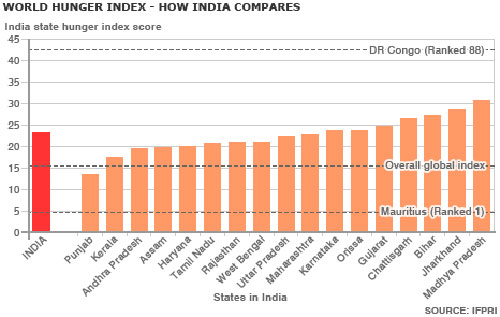
Should I not, here in US, be happy with this news rather than brooding about the ministers who keep on giving big figures and does nothing in field, and most of the administration doing overtime in sycophancy business? However, I feel pity about them and angry too when I find the position of Bihar in recently published hunger Index at the bottom among the Indian states. Isn’t my anger justified?

Posted in bihar | Leave a comment

Final Presidential Debate and Education

I got amazed with the concerns of US about the education in US. I liked the responses of the presidential candidates the best on the issue yesterday evening. It will be interesting for the people and politicians in India to appreciate education. That is the reason I had been writing to concentrate totally in one Five-Year Plan only on education. The sooner we do, thebetter it will be. Here is the relevant portion from the debate:

SCHIEFFER: The U.S. spends more per capita than any other country on education. Yet, by every international measurement, in math and science competence, from kindergarten through the 12th grade, we trail most of the countries of the world. The implications of this are clearly obvious. Some even say it poses a threat to our national security. Do you feel that way and what do you intend to do about it?

OBAMA: This probably has more to do with our economic future than anything and that means it also has a national security implication, because there’s never been a nation on earth that saw its economy decline and continued to maintain its primacy as a military power. So we’ve got to get our education system right. There’s been a debate between more money or reform, and I think we need both. Early childhood education, which closes the achievement gap, so that every child is prepared for school, every dollar we invest in that, we end up getting huge benefits with improved reading scores, reduced dropout rates, reduced delinquency rates.

I think it’s going to be critically important for us to recruit a generation of new teachers, an army of new teachers, especially in math and science, give them higher pay, give them more professional development and support in exchange for higher standards and accountability.

And I think it’s important for us to make college affordable. Right now, I meet young people all across the country who either have decided not to go to college or if they’re going to college, they are taking on $20,000, $30,000, $50,000, $60,000 worth of debt, and it’s very difficult for them to go into some fields, like basic research in science, for example, thinking to themselves that they’re going to have a mortgage before they even buy a house. And that’s why I’ve proposed a $4,000 tuition credit, every student, every year, in exchange for some form of community service, whether it’s military service, whether it’s Peace Corps, whether it’s working in a community. If we do those things, then I believe that we can create a better school system. But there’s one last ingredient and that’s parents. We can’t do it just in the schools. Parents are going to have to show more responsibility. They’ve got to turn off the TV set, put away the video games, and, finally, start instilling that thirst for knowledge that our students need.

MCCAIN: It’s the civil rights issue of the 21st century. There’s no doubt that we have achieved equal access to schools in America after a long and difficult and terrible struggle. But what is the advantage in a low-income area of sending a child to a failed school and that being your only choice? So choice and competition amongst schools is one of the key elements that’s already been proven in places in like New Orleans and New York City and other places, where we have charter schools, where we take good teachers and we reward them and promote them. And we find bad teachers another line of work. And we have to be able to give parents the same choice, frankly, that Senator Obama and Mrs. Obama had and Cindy and I had to send our kids to the school — their kids to the school of their choice. Charter schools aren’t the only answer, but they’re providing competition. They are providing the kind of competitions that have upgraded both schools — types of schools. Now, throwing money at the problem is not the answer. You will find that some of the worst school systems in America get the most money per student. So I believe that we need to reward these good teachers.

MCCAIN: We need to encourage programs such as Teach for America and Troops to Teachers where people, after having served in the military, can go right to teaching and not have to take these examinations which — or have the certification that some are required in some states. As far as college education is concerned, we need to make those student loans available. We need to give them a repayment schedule that they can meet. We need to have full student loan program for in-state tuition. And we certainly need to adjust the certain loan eligibility to inflation.

SCHIEFFER: Do you think the federal government should play a larger role in the schools? And I mean, more federal money?

OBAMA: Well, we have a tradition of local control of the schools and that’s a tradition that has served us well. But I do think that it is important for the federal government to step up and help local school districts do some of the things they need to do. So what I want to do is focus on early childhood education, providing teachers higher salaries in exchange for more support. I doubled the number of charter schools in Illinois despite some reservations from teachers unions. I think it’s important to foster competition inside the public schools. And I also agree on the need for making sure that if we have bad teachers that they are swiftly — after given an opportunity to prove themselves, if they can’t hack it, then we need to move on because our kids have to have their best future.

MCCAIN: Now as far as the No Child Left Behind is concerned, it was a great first beginning in my view. It had its flaws, it had its problems, the first time we had looked at the issue of education in America from a nationwide perspective. And we need to fix a lot of the problems. We need to sit down and reauthorize it. But, again, spending more money isn’t always the answer. I think the Head Start program is a great program. A lot of people, including me, said, look, it’s not doing what it should do. By the third grade many times children who were in the Head Start program aren’t any better off than the others. Let’s reform it and fund it. We need to have transparency. We need to have rewards. It’s a system that cries out for accountability and transparency and the adequate funding. And I just said to you earlier, town hall meeting after town hall meeting, parents come with kids, children — precious children who have autism. And we’ll find and we’ll spend the money, research, to find the cause of autism. And we’ll care for these young children. And all Americans will open their wallets and their hearts to do so. But to have a situation, as you mentioned in our earlier comments, that the most expensive education in the world is in the United States of America also means that it cries out for reform, as well. And I will support those reforms, and I will fund the ones that are reformed. But I’m not going to continue to throw money at a problem.

With all the problems and issues of education debated, US still remains the best for education, particularly for higher education and R&D. Even the school education system has produced the best result so far. Fareed Zakaria in his book ‘The post-American World’ mentions: “While the American system is too lax on rigor and memorization- whether in math or poetry-it is much better at developing the critical faculties of the mind; which is what you need to succeed in life. Other education systems teach you to take tests; the American system teaches you to think.”

Will we in India- politicians, education managers, and even the parents try to learn from the different issues raised in the debate and contribute in improving the education and taking it to every child of the country? This is the only reason India is behind in competition. This is the only way India can win the competition.
—————————
PS: They can also laugh- McCain, Obama Compete for Laughs at Traditional Political ‘Roast’ -a unique feature of presidential election

Posted in education | Leave a comment

R&D- Some Priority Areas for India

Abdul Kalam, the former president, is the most visible and respected among the scientists and technocrats in India today. Some of the future tasks for the scientists and technocrat that Kalam suggested recently are:

· Evolution of a Unified Field Theory, which may be the ultimate of physics, by revealing how the universe is born and how we are born;
· Evolution of an alternate habitat for mankind by the scientific community of today and tomorrow;
· Evolution of an Earth-Moon-Mars complex to bring to the earth new material like Helium-3 for the generation of solar power;
· Evolution of a clean atmosphere by replacing fossil fuel with cost-effective renewable energy systems, leading to energy independence;
· Exploring the human body, particularly gene characterization through the proteomics project for developing gene-based drugs;
· Enhancing the foodgrain output from the present nearly 230 million tonnes to 380 million tonnes with reduced land, water and number of people working in farms through the use of technology;
· In the area of communication, a big revolution is setting in. High-bandwidth mobile wireless is in the offing. This will result in mobile phones becoming a convergent system for multimedia applications for meeting the needs of communication in office, home and on the move.
· Rural development through the provision of urban amenities in rural areas (science and technology as the focus);
· Generation of nuclear energy through Thorium-based reactors.

While there is nothing to disagree to Kalam’s list, I think India must take up the innovations as a means to be competitive globally. There must be clear-cut emphasis for a large number of researchers in India to help out with designing and developing products that some entrepreneurs can easily manufacture and sell to billions of the consumers of the world. If India is to be in competition with China, it must think in that way. Even with $1 or Re 1 as margin for some unique product that is essential for each household, one can imagine the business with billion or more who would buy it in the world. Can India’s innovators and or entrepreneurs take such challenge?

Some priorities may be:

· Biodegradable plastics or finding a eco-friendly substitute to do away with the plastic bags popularly used that is damaging the environment and causing damage to many living beings too.
· Anything to enhance the efficiency of the renewable energy-solar, wind, biomass: very large scale solar thermal to steam as the answer to coal fired plants for generating electricity, and storage to keep providing electricity at night.
· Add-on clean technologies to remove pollutions for existing plants
· To cut down energy requirement in appliances used by the households, be it computers, water purifiers, air conditioners, heaters, or microwave ovens or electric ovens.
· Improving fuel efficiency of all the engine driven mechanical prime movers used, be it diesel pumps, tractors, cars, commercial vehicles, a lawn mower, or diesel generators used for domestic or industrial requirement including railway engines.
· Washing machines, dish cleaners, toilets that consume minimum or no water.
· Battery technology to replace fossil fuel effectively in cars and two-wheelers

There can be many areas for innovations. For instance, rural women get exposed to hazardous toxic emissions and smoke from burning biomass like wood, crop waste and animal dung during cooking. As reported, Envirofit International, a US-based non-profit organization, has introduced a range of clean burning biomass cook stoves that reduce toxic emissions by as much as 80%, while using 50% less fuel and reducing cooking cycle time by 40%. The stoves are now being made available in more than 700 villages in Karnataka and 300 villages in Tamil Nadu. Should it not be considered a great innovation?
As Thoman Friedman says in his new book- ‘Hot, Flat, and Crowded‘, the country that can innovate the most in the areas for clean energy can lead the world. With a total of $148.4bn investment in clean energy companies and projects worldwide during 2007, it is but very true. Indian innovators do have this opportunity to establish their leadership globally, if they can come out with breakthroughs.

Another area for innovation is the waste elimination or reduction in every thing that we produce and consume. Innovators are to make a breakthrough with some nanotechnolgies that can produce parts from reconfigurable atomic parts that can be easily recycled or transformed to some other products if so wished.

The list of the products that received ‘Popular Mechanics’ Breakthrough Awards are the examples of what are being wished by the consumers and the society at large. Thousands of Indian researchers working in colleges, workshops, and laboratories will have to emulate such an innovative instincts and interests.

· The M-Spector Digital Inspection Camera, from Milwaukee Tools, is designed to give people trying to do home repairs a way to see behind walls without cutting holes first. It costs $259.
· The Livescribe Pulse Smartpen allows its owner to take notes on special paper while simultaneously recording audio. By tapping on a specific section of notes on the paper, users can get a playback of that section of audio. It can also perform simple language translation as well as other functions.
· Potenco’s PCG1 power generator allows anyone to power up small devices like mobile phones with their hands. Pulling on the unit’s cord for two minutes provides 40 minutes of power-up.
· Intel’s Atom processor with a low-power chip that is designed to give high-performance capabilities to mobile devices and light laptop computers.
· The Craftsman Nextec Multi-saw gives buyers a combination jigsaw and reciprocating saw. A 12-volt lithium-ion battery that can drive the unit to cut in a variety of places difficult to reach by any single tool, powers it.
· Microsoft’s Photosyth, free software from Microsoft that allows users to create a browsable 3D model based on a series of related photographs. The software stitches the pictures together, creating the model based on overlapping elements of the images.
· Amazon’s Kindle, the e-book reader from the famous online bookseller, the Kindle allows users to read books, newspapers and other documents on a thin, light digital device. It is sparking innovation in e-readers.
· Infiniti’s Around View monitor, designed to give drivers a 360-degree view around their cars while parking. The system features a series of ultra-wide-angle high-resolution cameras that produced images that are aggregated to give the driver a top view of the car and the area around it.
· The Caroma Profile dual flush toilet that pipes gray water from a bathroom’s sink into the toilet’s tank, cutting down on water wastage.

Two of the individual awards have gone for real useful works of innovation for the deprived class. Amy Smith, a senior lecturer at MIT won the Breakthrough Leadership Award for research into water purification and both boosting the quality of medical care and reducing daily work burdens of rural women. According to Popular Mechanics, “she is leading a movement to tackle complex problems with simple technology.” I wish more and more professors in engineering and management institutions devoted significant time on research and development that helps the majority of the people in society to improve their quality of living. Water purification is certainly one such item. An affordable appliance must be available in every household in India that provides safe water.

Rudy Roy, Ben Sexon, Daniel Oliver, and Charles Pyott, the co-winners of the Next Generation award are the graduates of Caltech and the Art Center College of Design. The four have made names for themselves with a technique that makes wheelchairs for residents of third world countries out of inexpensive bicycles. One major benefit of their innovation is that the wheelchairs can be repaired in any bike shop, unlike normal chairs.

I end this story with two simple mechanical household implements that I find in Anand’s house. One is the toilet cleaning brush and the other a picker for Bart’s shit. I find them innovative and useful for every household. Hundreds and thousands of simple mechanical and electrical appliances and other products are being developed and sold all over the world that makes good business. For winning the game of global competition, Indian in thousands, may be millions, must be entrepreneurs and innovators. Indians will have to be manufacturers. India must manufacture and not go for importing everything from China-the global factory, as US is doing. If China can do, India can also do with the advantage of similar huge domestic market. And the education at all levels must help Indians to go that way.

R&D for ‘Create no waste, reduce waste, use waste’.

Posted in education, governance | Leave a comment