Indian Farming Remembered

Food security is going to be more serious threat and so agenda to the nations than even the terrorism. As reported, India too is talking to countries like Myanmar and Paraguay to grow pulses and oilseeds. I remember once telling Anand while driving through California that Man Mohan should request Bush to lease out land in US for farming to India farmers.

Based on the International Assessment on Agricultural Science and Technology for Development (IAASTD), sponsored by the UN, the World Bank and the Global Environment Facility (GEF) involving about 400 global experts over three years, India needs to synthesize the old and the new, and focus on the economics of the small farm. The International Food Policy Research Institute (IFPRI), headed by Ashok Gulati in India suggests the directional shift with the focus to high-value agriculture, followed by commercial crops, based on consumption patterns that suggest that the typical Indian is eating less of cereals and more of fruits, vegetables, milk, eggs and poultry, across “all income classes.” A 10% decline in cereals and pulses expenditure as a proportion to the total food expenditure has been recorded in “both urban and rural areas.” Food grains will no longer drive Indian agriculture. An accelerated and more pronounced shift towards high-value agriculture can only help yank a bulk of India’s farming population out of poverty.

Many farmers in India, small and big, illiterate and educated, with NGOs are pushing for newer crops and techniques, better yields and fresher, more remunerative methods of selling. Here are some stories from the latest ‘Outlook Business’ that is a special issue on farming.

1.Urban Farming
Kolkata’s wetlands and garbage farms near around Dhapa produce fish and vegetables estimated at Rs 86 crore. The Dhapa has ribbons of wastewater canals for irrigation, and on the plots of garbage-enriched land between these water bodies, over 10,000 urban farmers grow vegetables. 279 fisheries that operate in these waters produce enough fish, around 13,000 tonnes a year, to meet 15% of the fish requirement of Kolkata. The yields from these garbage farms are around 370 tonnes per hectare a year. Aquaculture and vegetable farming secure the livelihoods of over 26,000 people in the city. Each family farming on these wetlands earns around Rs 3,875 a month. The government doesn’t charge any lease rent.

2. Crop intensification technique in Uttarakhand
Intensification is popular with paddy cultivation. Adapted to wheat, this method promises to at once triple output despite using just one-third of the seeds needed in the conventional method. It’s practiced in cultivating other crops such as sugarcane, and finger millet too.

3. Biotechnology, or Bt cotton in Gujarat
The farmers of Gujarat have adopted Bt cotton farming and so spend less on insecticides and pesticides-a reduction in input costs. Bt cotton does not adversely affect the fertility of the soil. The productivity is higher, rising by 74% between 2002 and 2007. The prices of Bt cottonseeds have also gone down. A recent study by the Maharashtra Hybrid Seed Company, or Mahyco, has shown that India could benefit to the tune of Rs 22,000 crore by using Bt cotton.

4.Hybrid maize or corn
Today 42% of the country’s maize production comes from hybrid seeds. Conventionally, an acre of land requires over 20 kg of desi seeds, costing Rs 40 per kg. On the other hand, the same area requires only 10 kg of hybrid seeds. Though its cost is Rs 100 per kg-or 25% more, the returns justify the higher outgo. Beyond the quantity of output, the quality too is distinctly visible. The hybrid crop is highly responsive to inputs and is disease-resistant.

India is the world’s largest producer of mango, banana, litchi, papaya and pomegranate, but the farmers continue to lead a life of penury with little or no ability to tap the lucrative export market. A 2007 World Bank study shows that the farmer receives only 12-15% of the price at which produce is sold to the consumer at a retail outlet. Nearly 30-35% of the fruits and vegetables produced in the country are destroyed or damaged in transit owing to the woeful absence of proper transportation, warehousing and cold chain facilities, as well as processing units and organized retail.

5. The story of Makhana
Makhana, a ready-to-eat snack grows in the ponds and lakes of northern Bihar. Satyajit Kumar Singh and his Patna-based company Shakti Sudha Industries have done pioneer work for getting a successful business model out of it. Singh made the government agree to a nine-year lease period instead of usual 11 months. He persuaded a public sector bank to get involved too. Makhana payments are now credited directly to the farmers’ accounts and the bank has promised Kisan Credit Cards. Singh has set up office-collection centre-godown in each of the panchayats. This functioned like a one-stop window for all issues on makhana. CFTRI, Mysore is developing Makhana popping machines. Shakti Sudha’s turnover is nudging Rs 50 crore. Singh hopes to expand to 126 blocks, reach 40,000 farmers and touch a turnover of Rs 100 crore by 2012.

6. Tamil Nadu government’s Uzhavar Sandhai
Uzhavar Sandhai is Tamil for ‘farmer market’. The market cuts out the middleman in the trade of vegetables, bringing the seller face to face with the consumer. Interestingly, the registered farmers can transport their produce free of cost on government buses. Also, they don’t have to pay rent or money for the scales. A small farmer with even one kilo of vegetable can come there and sell. And he gets paid instantly-something that’s not guaranteed in wholesale markets. 68% of the sellers at farmer markets were small and marginal farmers (those holding between 2 and 5 acres of land). The Agricultural Marketing Officer at Hosur has to be up early to find out the prevailing wholesale and retail prices of all fruits and vegetables. Prices are fixed at 20% above the wholesale rate and 15% below the retail market rate. That is a conscious strategy to lure farmers away from wholesalers. By 9 am, the rates are up on its website, http://www.uzhavarsanthaihosur.in

7. Safal- India’s oldest food and vegetable supply chain
Safal with 400-odd exclusive retail outlets across India is a unit of Mother Dairy Foods Processing, a wholly owned company of Mother Diary Fruit & Vegetables. Safal’s turnover has grown from Rs 2.7 crore to over Rs 300 crore at present. Almost 85% of its revenues come from the sale of fresh fruit and vegetables, while the rest is from processed foodstuff. Safal is also expanding its portfolio of frozen, packed and cut vegetables. Its entire supply chain that has been online since inception is now being upgraded with a new enterprise resource planning software. It will connect Safal’s various units; and the village collection centres. Safal claims to offer the best prices-lower than market rates for customers and higher than mandi rates for farmers. Safal sells over 125 fruit and vegetable varieties with 735 direct procurement sources, 12,000 associate growers and more than 100,000 footfalls at its outlets everyday,

8. Outsourced contract farming
A growing tribe of 4,000-odd farmers across Punjab and Rajasthan sell their produce directly to buyers, at competitive market rates. It means prompt payments and the absence of middlemen for the farmers. For instance, UB Group is offering them a 75-80% premium (over the government-mandated minimum support price) for growing barley for the brewing industry. Pepsi has 23,000 acres under paddy cultivation in Punjab and Rajasthan, and plans to add another 4,000 acres, with a major thrust on the direct-seeding method (Read Experimental grain). Bharti Del Monte is working with over 200 farmers in Punjab, Rajasthan, UP and Maharashtra for baby corn and sweet corn cultivation. Mahindra Subhlabh Services is playing a key role in offering extension support and marketing services that help grape growers tap the European markets.

9. Empowering Adivasis
The Dhruva programme, implemented by the BAIF Foundation, has helped adivasis in Valsad, Navsari and Dang districts to transform their wadis (backyards) into a steady source of income. Among other things, the Dhruva project has been providing land-owners with mango and cashew saplings, and assisting them with advice on sowing patterns, use of fertilisers, intercropping and so on. Each family cultivates these fruits on the wadis, which ranges in size from 0.4 to 1.4 acres. Wadis produce cashews and mangoes, as well as the vegetables and paddy grown between the trees. It takes four to five years for the trees to bear fruit, and in the interim, the wadi owners derive their income from vegetable intercrops. Across many states, tribals numbering in excess of 100,000 have the means to earn Rs 25,000-30,000 a year.

Many individuals and groups are putting their entrepreneuring skills to uplift the rural India. India Inc. is also participating in their endeavours. But many more must emulate the ways following which the other succeeds to contribute in the growth story of the country and to make India great. India Inc and IIMs must use the rural villages to experiment their ideas and innovate ways to make it prosperous and look beautiful too.

Posted in agriculture | Leave a comment

Presidential Debate- Something to Emulate

Perhaps the most important aspect of my US visit this time is my exposure to presidential election process. With Anand and Shannon very positively involved in politics, it has become more interesting and informative.

I am just sold on the importance of the debates of the presidential candidates that is the one important feature and watched with interest globally. I have watched 3 of the four till now. Every one of it has enhanced my interest and deepened my faith in its necessity to reach to so vast a number of electorate.

Senators John McCain and Barack Obama debated for 90 minutes last Tuesday night before a nation in economic crisis, each promising anxious Americans that he had the better plan and vision to lead the country through the most dire financial situation since the Great Depression.

While Obama wishes to go for regulations to control the malaise created by those in Wall Street, McCain still is votary of deregulation. McCain proposes more rebates on the health insurance, while Obama wishes to provide more for whatever is being paid as premium and make it easy for the rest to join the insurance net. Obama will go to tax the top business enterprises and give tax cuts for the small ones and middle class that constitutes the 95% of the total. Obama wants go for action against Iran via a dialogue. McCain outright rejects any talking with Iran.

At least some aspects were revealing. The moderator was at his best, brief but sharp and to the point remarks intermixed with good humour. The love for the numbers appears to be intensive. Let us see some: Obama: “What McCain doesn’t mention is he’s been there 26 of them and during that time he voted 23 times against alternative fuels.”

Another interesting feature of the debate was the way the candidates talked about Wall Street and multinational companies and their executives. It is missing in Indian politics.
McCain: “Fannie and Freddie were the catalyst, the match that started this forest fire.”

Obama: “And that means strong oversight. It means that we are cracking down on CEOs and making sure that they’re not getting bonuses or golden parachutes as a consequence of this package. And, in fact, we just found out that AIG, a company that got a bailout, just a week after they got help went on a $400,000 junket. And I’ll tell you what, the Treasury should demand that money back and those executives should be fired.”

Both want to help for homeowners so that they can stay in their homes and to help state and local governments set up road projects and bridge projects that keep people in their jobs.
Can LK Advani or Sonia Gandhi name their finance minister during debate if any? See what McCain replied: “I like Meg Whitman [former CEO of eBay and current McCain campaign adviser], she knows what it’s like to be out there in the marketplace. She knows how to create jobs. Meg Whitman was CEO of a company that started with 12 people and is now 1.3 million people in America make their living off eBay.”

I wish Indian politicians talked so emphatically about the national priorities such as the health care, energy, and education as well as land policy that is holding back so many projects.

Can the media or the intellectuals induce or encourage to the prime-ministrial candidates to a debating platform in India? Can the TV channels shun commercial advetising during a serious debate? Will the moderators in India interfere and talk a little less?

Posted in governance | Leave a comment

Deepawali in US

It was my first Deepawali in US and unique in some respects. After perhaps two decades or more, we were with our three sons on this day that celebrates the win of righteousness over devil powers. The last one must be in some year around 1988 when the three were in high school and living with us in Hind Motors. The family now has grown to thirteen.

Shannon had invited Rakesh, the eldest and Rajesh, with their family. Only Shephali couldn’t join us. She had gone to New York for her externship at Jamaica Medical Center. However, the digitally she got in touch. Every one in family could exchange greetings and talk. Anand’s laptop and web camera was the medium.

With a large number of Indians living in US, some in Pleasanton too, Yamuna could get all that she wished for rituals of worshipping the Goddess of wealth. Some of the items such as the sweets were even better packed that what we use in Noida. Shannon had taken the services of a company with expertise in home cleaning. Its three women workers that were Mexicans took less that two hours in cleaning and wiping the whole house and billed $175. Yamuna thought it to be too costly. I think in this busy life style this can be the best solution.


We had our Puja as usual and then the dinner and sweets, but the most important were the memories of the yester years that kept my mind busy and excited. Perhaps we at the fag end of life can no more think of living together in a typical joint family style. It is perhaps neither practical nor desirable, even if all would have been in India. But such meetings, once in a year or two are possible. Rajesh came out with suggestion to have it outside somewhere. It reminded me of one of my old days wishes that I used to talk quite often. Shannon suggested New Zealand. Perhaps they took it lightly.


I only expressed my one wish to all the elder members of the family. They must take an initiative and organize once a function in India, preferably in our village near Sasaram, in which they invite all the close relatives too and meet them. I don’t know if it would happen.

Posted in Uncategorized | Leave a comment

Maha-ashatami in US

Having spent the majority of the life in West Bengal, it is but natural to feel bad to miss Durga Puja and visiting pandals. It started at Birlapur in West Bengal, where I had my schooling since 1948. What I remember of those days of Durga Puja was the yatras, the open stage theatre that used to go on for a fortnight or more. Yatras based on good historical and social subjects in those days were good entertainment. With school closed in a long vacation, I with my uncle used to enjoy the yatras. It used to start late in evening and go up to almost early morning. We had learned good enough Bengali by then to appreciate the dialogues and story.

At Hind Motor, Durga Puja again became interesting when we had our sons. I remember of at least two Durga Pujas. In one, Seshar Singh, my Hanuman managed a car from Mathews, one of my colleagues in Hindustan Motors, and who was a senior from IIT itself. We started around 10 PM and went to many good Puja pandals in Calcutta with all the three kids. My main task was to manage the kids in the crowd, particularly with separate queues for men and women. Calcutta is still at its best during Puja. I wish India and West Bengal had marketed it to attract foreign tourists. We remember one of the Pujas’ days, when a servant of one of the neighbours took Rajesh, my second son who was about five-six years old then, to see Puja pandals outside our residential area and we got worried. Those were the turbulent days of the factory. I had a bad name as production manager and had many enemies in unionized workers. We went on a search and even got the cinema show at Deepak stopped to find him out. But very soon we found Rajesh coming with the servant on the road. The servant got some thrashing from me.

At Salt Lake, with sons away, the Puja became a routine affair with community Puja getting organized in the park of our CJ block. We had to pay huge subscriptions, as I used to work for a reputed company. I hardly went out and visited any other pandal.

In Noida now, Yamuna organizes a ‘kumari puja’ on Ashatami, and we go to either the pandal in Sector 26 or that in Sector 50 where Bengali community organizes Puja.


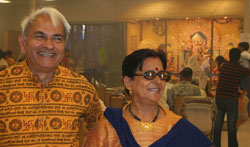
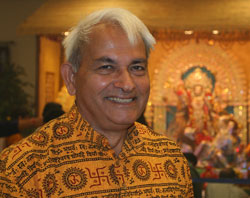
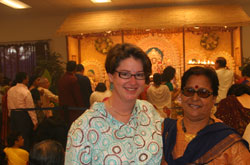
This year we are in US during Puja and it was a unique opportunity to visit a Durga Puja pandal in US on Maha-ashatami. Anand took us to Livermore Hindu Temple. We had been to this temple in our last visit to US too in 2005. It is a special place for Anand and Shannon, as they got married here. Anand had also proposed Shannon in front of goddess of wealth in the temple. Last week also we visited the temple. Its large number of mini-temples, under the main roof, presents a great example of integrating the Hindu Gods and goddesses.


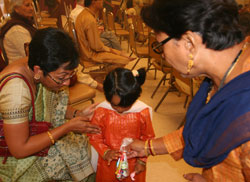
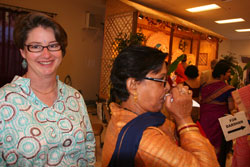
According to the wishes of Yamuna for this Ashatami on Tuesday, Shannon had made the packets of candies to be given to girls as the part of ‘kumari puja’. Yamuna was very happy to find her in a totally Bengali surrounding there. She blew the conch shell and mixed with the Bengali ladies. Shannon was all the time with her and then Anand also joined, when I came out to look after the two kids-Emma and Krish. It was difficult to keep the kids inside because of the smoke screen created by the burning of essence that is seen in photo. More than hundred people- men, women, and kids, mostly Bengalis constituted the crowd in the hall where the priest was carrying out rituals of worshipping Durga in traditional Bengali manners including some ‘ulur dhwani’. Tuesday being a working day, young men were few in number. Quite a large number in the crowd appeared to be those visiting their children in US. A gentleman who was from Tollygunze, Kolkata started talking to me. He has come to his son who works in San Francisco somewhere. They had driven to come to Temple on this auspicious day. Shannon and Anand had some ‘prasad’ that is available here on all days. Yamuna and myself were on fast.

It is a very fascinating experience of Maha-ashatami of Durga Puja in US for us, so far away from home.

Posted in personal | Leave a comment

Nano Project: From Singur to Sanand

Tata Motors has really moved fast. It has not only dropped the Singur as the mother plant for manufacturing its prestigious Nano cars, but also quickly taken the decision to shift to Gujarat and signed the Memorandum of Understanding with Gujarat government too.

Modi has given Tatas 1,000 acres of land in Sanand, 30 kms from Ahmedabad. It’s a land of Anand Agriculture University. Uttarankhand has also given the land of GB Pant Agricultural University to Tata Motors and other automakers in Rudrapur. Naturally, one can have few questions. Why was the university allotted so big land initially? Was it not for experimentation of agricultural innovations originating from the researchers at the universities? Why has it gone access? Was it access without any proper planning initially itself? Have the universities become complacent rather ineffective in its task of researches for the Indian farmers who feed the nation or export? Or do the political leaders, be it Tiwari or Modi force the universities to spare the fertile land of agricultural experimentation to attract the big businesses? Unfortunately, I don’t have answers for these questions and those who can provide will not do that at least in the interest of the nation.

Let me confess that I am pretty happy with Tata Motors’ choice for Gujarat (Sanand). I consider myself one of the first to perhaps suggest Gujarat as possible location in one of my writings, when the dispute at Singur started troubling Tata Motors’ dream project. There are some more reasons for my happiness. I was one of the key players for an automobile plant near Vadodara that Hindustan Motors set up to produce trucks in collaboration with Isuzu Motors of Japan. I cherish many good memories of those days when I used to visit the place quite often with Japanese technical staffs, executives and bankers. Hindustan Motors failed to produce Isuzu trucks from Vadodara plant as it took a lot of time and in the process yen appreciated high enough to make the project unviable. The untimely death of Mr. NK Birla, an aggressive executor and mishandling of the project implementation by the executives hired by the management from TELCO (present Tata Motors) were also the reason to suspend the project after producing few hundreds from the CKDs. Ultimately, Hindustan Motors handed over the plant to General Motors when it entered India to produce cars. I still wonder why GM selected Vadodara as location for manufacturing cars. Vadodara didn’t have any infrastructure in those days required for car industry. GM has gone for its second plant that it is setting up in Maharashtra.

Interestingly, Hindustan Motors had initially started automobile assembly operation near Okha Port in Gujarat in early 40s. In late 40s, it got shifted at Hind Motor near Calcutta. Some one has called Tata Motors’ selection of Gujarat for location of Nano mother plant after driving out of Singur that is so near to Hind Motor as a sweet revenge for Gujarat. However, I don’t agree to that.

I still repeat my appeal to the plant engineers and industrial engineers as well as senior executives to innovate on the concept of the buildings for a car manufacturing and go up in height with multi-floors or with any other concept that minimizes the land requirement. Land resources of the country are limited. Can they educate the country with some benchmark figures from auto plants of similar scale of production in Japan and South Korea? I remember my recommending Buddha Babu to request Birlas to give its 743-acre plant at Hind Motor that is almost dead and most of its land has now been sold to some realtor. I don’t know if Birlas paid for the land to the then West Bengal government, and if at all it did how much.

However, West Bengal must create a condition so that Tata Motors can have an assembly plant in the buildings already constructed at Singur. For cars planned at extra low cost, East India that will have to grow fast will be the best market. And the 1- million or more volume projected for Nano and various models based on its platform may require a number of assembly plants, perhaps one in each zone.

I wish Tata Motors could do a faster work at Sanand with neither monsoon nor Mamta to trouble. Let Bengalis for the time being be happy with the outsized model of Nano, the ultra-cheap car from Tata Motors at the Durga Pooja festival in Kolkata this year. Let Modi win over Mamta and her rival Buddha, more so over Bengal.

Posted in industry, manufacturing | Leave a comment

Workers, Politicians, Management, and Goons

With the expansion and spontaneity of digital media, the sad news of Lalit Kishore Chaudhry of Greater Noida reached all corner of the globe. It may appear amazing but that’s the change the world has undergone in the Friedman’s famous flattening process.

Rakesh knew it through manufacturing.net and Rajesh through huffingtonpost.com here in USA. All my sons who are now in profession have bitter memories and consequences of labour agitations at Hindustan Motors, West Bengal. While it shocked my sons, and me, I was also shocked with the reactions rather conclusions from individuals and institutions. While the remarks of Oscar Fernandez and Amar Singh pained me, the police as usual unnecessary came out with some irresponsible remark. The leaders in India Inc. may be right in denouncing the minister’s remark but must have some introspection. Over the years, the bigger units with good HR embedded in system have improved the labour relation. However, there are many smaller and medium size industrial enterprises with effective heads that hardly believe in learning and changing and have remained feudal and consider themselves masters instead of fathers or facilitators of the workforce at the bottom of the pyramid. The salaries and perks of the people that constitute the majority have been kept poor. Basic facilities are neglected. Training and education is considered unnecessary and drain on revenue.

On the same line, the leadership of the union goes very often in irresponsible hands. Either the goons can win the union election or many a times the management gets its preferred candidates in. With goons in union, both the parties loose and sometimes heavily in long run, while the second situation makes workers feel helpless. Let the managers no more consider workforce as foolish lot and use it as assets. Management and its executives must build a good system for grievance handling and be in constant dialogue with the workforce. Training for hard professional skills as well as soft skills of problem-solving, team-building, value improvement and lifestyle management must be a regular affair along with other tools and techniques to involve all the people at work in the company’s goals of all types. The prime task of the executives must not only be to please and satisfy the boss, it must equally relate to benefit the peers and those who work at the bottom of the organizational pyramids.

With politicians already exploiting the workforce in name of democratic right, India Inc must take the responsibility to manage its people more humanly and rationally. It must not come out with the traditional way of solving an odd situation such as slowdowns with cutting down of the compensation and remuneration that are still very poor in comparison with even many developing countries. It must not go for downsizing. It must honestly try to use them with innovations in useful activities and diversified businesses. It must cut cost in other places improve quality and innovate new products and services.

Further, the CII or FICII must work for training the executives and heads of the smaller and medium size companies in sound and well-proven management practices. It must take up with the government more forcefully the cases when inter-union rivalry or support from outside unions may be trying to wrest negotiations that can spoil the situation and result in violent outcomes. It must threaten and force the government and its machinery to work in time.

Management must not shirk this responsibility. Let me tell the India Inc emphatically something. They can’t any more run the company through in mean manner. They can’t exploit the prevailing poverty for long. They can’t resort to illogical hire and fire. They will have to bring up contract labour at par with regular employees or very near to that. They will have to take care of the aspirations of the workforce that constitutes quite a large percentage of somewhat educated youth of the country.

It is unfortunate that some of the MNCs coming in the country also follow the tricks of the local companies. Why can’t they set better examples?

Posted in indian politics, management | Leave a comment

Manufacturing Miracle

Yesterday, when I was visiting the electronics’ store to see the latest gadgets, Anand had mentioned of the Apple’s Brick and its manufacturing process. As reported, Apple will build the notebook out of a single piece of carved-out aluminum-a brick.

A radically different production method might well boost costs, at least at the outset. However, the savings from the change are clear too. An analyst at market research firm says, “If you’re working with one single unit of metal, you’re reducing a lot of the materials costs and also a lot of labor time on assembly.”

The advantages may be following:
– Carving out of aluminum eliminates the need to bend the metal and create weak spots or microfolds and rifts.
– There are no seams in the final product, so it is smooth.
– Screws aren’t needed to tie the products together.
– The shell is one piece of metal so it is super light, super strong and super cheap.
– You can be a whole lot more creative with the design if you don’t have to machine it.

Apple and its chief executive, Steve Jobs wish to keep its lead and remain distinctly different.

But coring out a block of aluminum, while fairly common in some products is a slow process. As the analyst says, “The issue for Apple, which would presumably be doing it millions of times, would be speed.” “It’s very time-intensive.” Presumably, Apple has brought in the innovation aimed at streamlining the manufacturing process.

While some call Brick a revolutionary manufacturing process, some doubt.

The manufacturing engineers keep on using processes to provide better quality and reduced cost. Years ago, Boeing started making aluminium frames from solid aluminium blocks cutting down the number of parts and reducing the assembly errors. Before Tata’s Nano was launched, there were many rumours about some revolutionary manufacturing processes going in its making.

Perhaps Apple Brick may reconfirm the might of innovative America. Why should it not remain leading the manufacturing? It must start the renaissance of American manufacturing.

I am sure the dream of the future cars with 100 miles or more a gallon can come out of some similar innovative approaches in manufacturing.

If India is to take a lead, it must take manufacturing more seriously. Its prowess in IT will make it easy to excel in manufacturing. I wish those who matter will listen to the call.

Posted in industry, manufacturing | Leave a comment

Chinese Quality- Myth or Reality

I have a respect for the Chinese, the way they have gone in manufacturing. This time, I find, American stores and households having almost everything manufactured in China. The other day Anand and Shannon bought a frying pan. After a careful observation at home, they found its cover not matching because it was deshaped at periphery. But as usual, no American bothers about the poor quality of the Chinese products. Anand went and got it changed. However, I never had any idea that China has been exporting processed food products that also milk-based ones too. The reports about the Chinese ‘killing milk’ have appeared from New York Times to Business Week.

The Chinese didn’t traditionally used milk extensively as it is done in India. But with the splendid GDP growth of China, the Chinese farmers had taken up dairy farming for extra earning in big way and china was exporting milk products too. As it appears from recent milk contamination reports in media, more than 20 countries have banned the Chinese dairy products.

The stories of poor quality products and dangerous fakes from China are pretty popular with Western media persons. I had come across that last time too. Nothing much has changed in China or US since then. US and for that matter almost the world have become dependent on the Chinese in many ways. With all the problems of quality or piracy, the Chinese share in trade of every commodity has kept on increasing.

Is the concern in Western media really genuine? Perhaps Americans at large don’t bother much? They keep on buying, returning or trashing the Chinese products without much concern. For them, there are no alternatives to this.

A recent report talks about the counterfeit, defective computer components from China are getting into U.S. warplanes and ships that may be dangerous to the country’s security. But perhaps US can even afford that. Many like Yasheng Huang, a professor at Massachusetts Institutes of Technology keep on coming out with their doubts about the Chinese story, but China keeps on gaining remarkable heights in every field of activities, be its Olympics or the space walk. And one can’t and mustn’t doubt its quality of education, governance or manufacturing.

Posted in manufacturing | Tagged | Leave a comment

Tata Motors’ Final Ta..Ta.. To Singur

Ultimately Buddha looses his brave war against Mamta. Tata Motors has finally abandoned Singur, the place that could have become the Detroit. Ratan Tata rightly refused to work under police protection promised by Buddha. It is not practically possible, as Tata claimed, because of ‘the continued aggression and agitation by the Opposition led by Mamata’. I am sorry for the region that could have become prosperous and the young men who could have been employed. I am really surprised and shocked to read what Tata said at the briefing, “If someone had put the gun to my head I would not move away but I think Banerjee has pulled the trigger.” I consider Tata as a wonderfully great gentleman. What made him say so?

Unfortunately Mamta is still not sorry about it and considers Tata’s decision as ‘a part of the joint game plan of the CPM and the Tatas’. Will the people affected keep on tolerating such political terrorism?

The people and leadership of Bengal must take it seriously. They must say ta..ta… to their unique invention years ago of violent agitations of different forms in name of democratic protest that has spread all over the country now, otherwise the entrepreneur will dare not come to West Bengal to get run its establishment on the dictate of party or union goons. The government at the center must also look into the land policy and labour laws more seriously and on top priority, otherwise it can’t stop the industrialists to go for investments in foreign acquisitions rather than trying to come up with Greenfield projects of large scale inside the country. The national interest must be above the crazy political principles.

Tata Motors did a smart job by removing the dies and dedicated equipment meant for Nano manufacturing in time from the plant site. Perhaps it was possible with the government of West Bengal on its side. Otherwise the agitators would have obstructed that operation that could have made the production of Nano difficult. Perhaps Mamta would never have dreamt it. After all, she has never been that intelligent.

I get a veiled joy. I have been writing on the subject for a long time. Right in the beginning I expressed my utter amazement to Tata’s decision to come to Bengal. I had also written against excessive amount of land demand by Tata. That was on my first hand experiences of West Bengal. Bengal has hardly changed. The name of the political party taking the lead might have changed. I still get scared when I see red flags fluttering high in large numbers, wall full with posters of all kind of agitations even in Sector 5 of Salt Lake that houses prestigious IT companies, or processions of people in the streets carrying all types of banners all over the years.

However, I still feel Tata Motors and for that matter all the industrial plants must try to keep the requirement of land at the minimum even for the greefield locations. Plant designers must innovate. They must go high. The plant must preferably not take fertile land to locate large plant. Tata Motors in Pantnagar is also on a very fertile land that was taken away from the GB Pant Agricultural University.

I still think Tata Motors should keep Singur plant with it and have an assembly plant of Nano in it some day sooner or later. East India with Bihar, Orissa, Assam and Northeastern states must and will certainly grow fast and will be a good market for Nano.

Overall the Singur episode is a black spot on the country’s endeavour to get ahead in manufacturing sector. Nano is a prestigious product with potential to get globally accepted. Politicians have again failed India.

It is great that Tata still promises to try to be as close to the deadline as possible for the production launch of Nano.
————–
PS May 18, 2006 – October 3, 2008
···Latest Nano Story
Views ofGURCHARAN DAS When everyone lost
Views of prem shankar Jha Whose brakes failed?

Posted in indian politics, industry | Leave a comment

Transforming India -2

Some views of the Indian intellectuals about the ‘Transforming India’ in special Issue of ‘India Today’ are as follows:

Ajimji Premji The day when the local government school is able to attract children from across the social spectrum, that will be the day we can proudly proclaim that India is on the threshold of transformation.

Rajat K Gupta The nation should focus on providing preventive and promotive medicine, which can help people avoid illnesses before they occur; on delivering timely access to primary care, which can treat medical problems in their early stages and encourage a holistic view of health; and on strengthening health education, which must train a larger workforce to apply advanced methods of promoting healthy living.

Dipankar Gupta If there is one big idea we can pursue, and pursue realistically, then that is to put our might, mouth and money where R&D is. All our ideas about modern knowledge come primarily from the West, and often do not suit our demands. We have millions who are sick and ailing, but we are yet to conduct appropriate research that could help them. Endogenous growth takes place when R&D is locally produced and applied.


LN Mittal
has set up the Mittal Champions Trust (MCT) targeted at improving our medals haul at the London Olympics in 2012. We need a supreme national and individual effort to improve our results across all sports. We need to start now. It won’t be easy, but we have the talent and determination to do it.

Narayan murthy talks of his experiment Special Training Programme. The solution to the problem of social injustice is not reservation, as it will damage the psyche of the youngsters permanently. The solution is to invest heavily in producing high-quality, committed teachers and create incentives for them to provide special attention to the disadvantaged children right from primary schools.

RK Pachauri Just like Japan treated the energy crises of 1973-74 and 1979-80 as an opportunity, India is in a similar position to gain competitive advantage in a world whose future rests on low carbon technologies, products and processes. India can within a period of 10 years emerge as a leader in a range of technologies and equipment to exploit the abundance of energy from the sun.

Tarun Khanna Dusty public sector laboratories and universities are returning to life aided by unexpected visitors- business development managers from multinationals, students and researchers from international universities, young local entrepreneurs from startups and the who’s who of global private equity. India’s government-funded space and satellite programme generates world-class research. Herbal medicine is another area of heartening scientific developments-between 1976 and 2003, the Council of Scientific and Industrial Research (CSIR) was granted 33 US patents in this area, the highest in the world.

E. Sreedharan Any city with a population of more than three million and where any transport corridor sees a density of more than 8,000-10,000 people per hour per direction of traffic needs a metro system. The economic rate of return and benefits to society from a metro system are evident within five years of its inception. Phase one of the Delhi Metro has taken 39,600 vehicles off the roads, slashed the consumption of petrol, diesel and CNG by 57,800 tonne and saved Rs 288 crore on road maintenance and traffic management. The aim is to bring a metro station within half a kilometre of each person’s residence and workplace, which will discourage the use of private vehicles. It has been credited with following a work culture setting it apart from other government bodies by focusing on transparency, professional knowledge and punctuality. Re-inculcating a forgotten value system is the only way to root out corruption.

C.K. Prahalad If we stop thinking of the poor as victims and start recognizing them as resilient and creative entrepreneurs and value-conscious consumers, a whole world of opportunities will open up. The focus should be on dealing with social inequities as a business and not through charity. Worldwide, aid and subsidies have proven to be mostly ineffective. Most importantly, subsidies create dependence and rob people of dignity. Without a long-term, self-sustaining solution that reduces poverty, we are likely to create higher levels of inequality.

Anuradha Joshi The creation of mechanisms for the easy dismissal of public officials is nessary. The process of firing bureaucrats should be kept out of the hands of politicians. Control over transfers and promotions by politicians have made public officials more responsive to political considerations than the rule of law. In a country where politicians are not part of the process of selecting candidates for public service, there is no reason for them to be part of the process of dismissing them.

It is necessary that India take up the task of transformation seriously, when it knows the hurdle in the process of transformation. India Today has done an immense service to the nation by bring in the thoughts of so many celebrities in one issue.

Posted in economy | Leave a comment