Our Great Minority: An Appeal

I had some friends of minority community in IIT, Kharagpur. I adored their friendships. They were very courteous. I learnt many things from. They were from background similar to mine. They did pretty well in IIT. We all dispersed after IIT. I met them later on too. They were very helpful. But there was one difference at our time. The main political party of the country had not gone for appeasing minority just for vote with gimmicks.

It pains when you find the political parties on one hand talking about the necessity of integration of the country and on the other hand doing everything so blatantly to appease the minority for a single purpose of getting their votes. It hurts even the most liberal in majority community. It doesn’t also help the minority at large.

How can the establishing of an extension centre of Aligarh Muslim University in Kishangunj at a cost of Rs 200 crore will help Muslims of Bihar? Can’t the purpose be better served by more number of good science colleges, polytechnics, and higher secondary schools with hostel facilities and scholarships for poor students from minority?

Aligarh Muslim University has lost its reputation rather has earned lately bad name. Its extension centre will hardly make any impact for improving education in the community. AMU must bring back its image before it plans for extension centres in every part of the country. Instead, the central and state governments must encourage some educationists from the community to set up new educational institution or university as the founders of AMU and BHU did in those days.

I appeal to the minority to let their children join the mainstream education and go for courses and curricula that makes them employable. Let the minority demand and allow their children to sit with the children of the rest of the communities in the same schools and compete.

No religion is going to lose its identity because of modern education in international standard schools or by studying in English medium schools.

Posted in indian politics | Tagged | Leave a comment

Free Education and Fund

I agree it is difficult for Bihar and Nitish to allocate Rs 27,000 crore for providing free and compulsory education to all the children in the age group of 6-14 years in the first year itself, when the total annual budget of the state is around Rs 50000 crore only.

Many chief ministers have posed the problem of funding almost in similar manner. However, the bill must be considered as one of absolute necessity. Without universalized good education, we can’t survive in globalizing world with so huge a population and we shall not be able to cash on the demographic dividend.

I wish the states would have shown a positive will to go out of the way to find innovative way to arrange the fund. I am saying so as in the same country funds meant for education remain unspent. Here is a report:

“After lying unspent for three years, the money collected from the proceeds of higher education cess would now be utilized for several schemes, including setting up of a finance corporation and for strengthening IITs and IIMs. Government has collected Rs 8,334 crore so far as secondary and higher education cess from April one, 2007.”

Can someone investigate and find out how much more of similar funds are lying unspent under some heads that can be easily brought in for education?

Can the education cess rate be continued for long or the rate enhanced in the interest of the nation that aspires to be a knowledge leader?

I got another thought that I shared on my face book that certainly requires assertion by the community for the interest of the community: Should the government spend Rs 941 crore as in 2008-09 on assistance for the minority to go to Haj or similar provision for other communities such as one for Mansarovar Yatra or should it be spent on educating and skilling the children of the community? Should not the community agree for this?

Should not the community force the authorities of the temple boards to use the wealth of temples for education? Should not the religious and social leaders declare the donations to the educational institutes at par to the charity to the temples and consider the building of educational institutes as building of temples?

It is a shame and unfortunate that the big business houses still prefer to construct huge temples instead of taking up some big projects to help the rural India in getting educated properly. And wherever they have initiated, the educational projects are for profit and located in tier-I cities. Tata Sons have similar plans. If just 100 topmost business houses just decide to set up the good education facilities in rural India, the scenario of education in rural India will change. And it will be a cheaper option too.

I shall again request the chief ministers to appeal to the people of the state for contributing to the fund for free and compulsory education. I remember the leadership of the leftist parties in West Bengal appealing for donation for setting up state power plants in the state when it thought the party at the centre was not cooperating with the state. And the people came out to support the cause, may be as token gesture. Some even contributed by giving their blood.

Even the institutes can create a fund for itself through donations from alumni.

My whole emphasis is for the leaders, all social, religious, and political who must change their mindset and exhibit the strong will power to make free and compulsory education act implemented.

And many will consider the allocation of fund by the central government for education as a better decision than the allocation for loan waivers or other similar ‘aam aadami’ programmes that are more for appeasing voters.

Let the nation not miss this chance.

Posted in education | Leave a comment

Girls: The Only Hope of Bihar

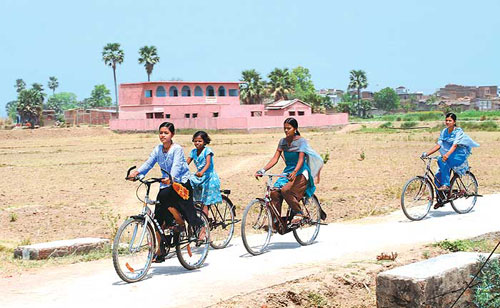
Nitish Kumar has started blogging. And interestingly, his first entry is about the cycles given to school going girls under ‘Mukhyamantri Balika Cycle Yojna’ that have changed their lives, more so their dreams. And Nitish’s blog has got a good response. I found a lot of comments. However, I don’t know why the comments get published only after a review by I don’t know whom. I am sure it is not Nitish who would have doing it personally.

With most of the rural habitations in Bihar having nothing more than a primary school, if the girls are to continue schooling at least upto class X, perhaps the cycles can only make it happen. Parents will have at least one excuse less for not educating the girl child. I wish all schools are connected with all weather roads too and panchayats take some steps for security.

I wonder if all these girls could teach their mothers and aunties at home in return of the gift of the cycles from the Chief Minister. CM may think of giving a monthly stipend of Rs 200 to all such girls.

Further, I request CM to get his ‘hoonar’ plans for minority extended to all girls without any barriers. At least one hoonar (skill) must be compulsorily imparted to all the girls going to the schools for classes above six. His education minister will have to provide the facility. The school can easily use the local talents, if available for training the girls at least.

I only wish if Nitish could make an additional appeal to all his party men and voters during the campaign for the forthcoming assembly election: ‘Send all the kids below 14 to schools’ and do everything to see that ‘sarv shiksha’ becomes a reality in Bihar.

And I can tell for sure, I am hopeful. A story in Outlook confirms that.

Last month, Anil Kumar Singh, a schoolteacher, decided to sink all his savings and start an English medium private school in Sikaria in Jehanabad even though there’s a government school not too far away. And in keeping with the new mood, the school has been named Ahimsa Vidyalaya by its proud owner. Indeed, Sikaria has become symbolic of the changes sweeping through what were once “the killing fields of central Bihar”.


I wish, many more teachers in Bihar with resources and passion for education must become entrepreneurs in education sector. It can be a social work with mission as well as money in time to come.

Education and skill training can only save Bihar. Let the potential be cashed by all who can.

Posted in education, social issues | Leave a comment

IITs: Teachers’ Shortage and Technologies

If I consider the written reply of the HRD minister of state in Lok Sabha on April 21, 2010 as correct, despite an attractive pay structure, good accommodation and other perks, IITs are facing acute shortage of faculty members.

IIT Kharagpur has a maximum vacancy of 299 posts, followed by 222 in IIT Bombay, 194 in IIT Roorkee, 138 in IIT Madras, 78 in IIT Delhi, 69 in IIT Kanpur and 65 in IIT Guwahati. The vacancies have increased from 877 in the seven old IITs in 2008-09 to 1,065 in 2009-10. The vacancies in these institutions in 2007-08 were 971.

How should the country take the news of the shortages of teachers at all levels? Should we shed tears and keep on blaming the government for all these problems? Why can’t the IITs overcome or reduce the effects of the shortages through technologies? Why should not Kapil Sibal who wishes to bring in technologies to even in primary school, ensure at least IITs to use the technologies to the best with its mastery of the task?

As John Chambers, chairman and CEO of CISCO suggested in recent India Today Conclave in New Delhi, let IITs get a different category of teaching assistants to manage the class with videos, where as the best teachers are engaged to prepare the videos for each subject. The task of course preparation may even be outsourced to the best teachers or the universities in the country or abroad. As reported, CISCO has already done it for Duke University and it can exhibit the technology used in its Bangaluru complex.

For number of years Anand had been discussing with me about the use of technologies in teaching. MIT and IIT courses are already available for many subjects in videos with best of teachers delivering the same.

However, the mindset of the directors and deans of the institutes must change for the video teaching. I was talking to a former director of one of the CSIR research institutes, who has a doctorate in his kitty and experience of both private as well as government sector. He has joined a private university in Greater Noida and perhaps in charge to set up its mechanical engineering department. I got into the subject as his wife started talking about his working excessively for long hours at that old age for preparing for the classes. When I asked why can’t he promote and use the technology in teaching, that is, available video materials. He got annoyed, ‘How can teaching be done by videos? If it’s so, everyone can do that.’

As I remember IITs have done a lot of work in this regards. A conference discussed Education 2020: Role of IITs’ in Improving Quality and Reach.:

As I know, former president Dr. A P J Abdul Kalam intiated a project of connecting India with all 53 countries of the African Union with a satellite and fibre optic network for sharing India’s expertise in education and health care. And it got commissioned too.The Project aims at providing tele-education services to 10,000 African students to undertake Post-Graduate, Under-Graduate, PG Diploma and Diploma and skill enabling certification courses in subjects such as Business Administration, IT, International Business, Tourism and Finance. Amity University, Noida; University of Madras, Chennai; Indira Gandhi National Open University (IGNOU), New Delhi; Birla Institute of Technology and Science (BITS), Pilani; University of Delhi; IIT Kanpur and Indian Institute of Science (IISc.) Benguluru participated in the project. Why can’t the same technology be used to overcome the shortage of teachers in IITs or for that matter in all the institutes. It will mean optimum use of the available human resources available within the institute and ultimately in the country.

I wish some spokesman of IITs or HRD ministry reveals to the nation the status of the use of technology in IITs that can also generate revenues for IITs if commercially done with many private institutes using the facilities. The same time zone in the country can also ease the task.

Posted in education | Tagged | Leave a comment

Innovative Indians: Emulate, Innovate, Scale up and Grow

Many countries-Japan, South Korea, and then China have followed the route to get into the league of developed nation. They started with emulation of the practices and systems of the developed countries, be it one from Europe or US, copied rather pirated their products. Very soon they started improving on their own with locally innovated ideas, scaled up the production cutting the cost and started competing.

India failed to do that. Some did try but perhaps halfheartedly and without improving and scaling up the capability to manufacture. Industrialists from Punjab, for example, made many machineries copying from the foreign products. Even today many of the agricultural machineries such as harvesters have reached all over the countries and making a good business, but it couldn’t innovate and upgrade to compete with the products from the industrially developed countries even the Chinese ones. However, things are changing.

As revealed by BSG ‘Innovation 2010: A Return to Prominence – and the Emergence of a New World Order’ report, the companies are increasing their innovation spending and that their satisfaction with the return on innovation spending has climbed. But companies remain somewhat cautious, keeping a close eye on the cost of their innovation activities.

Among the Asian countries, there are five companies from Japan, another five from China and Taiwan, three from South Korea and just two from India.

About 89% of executives in India said innovation was key to economic growth, while in the US only 72% said innovation was important.

In the list of world’s 50 most innovative companies, the Tata Group is placed as the world’s 17th most innovative compared to Mukesh Ambani-led RIL’s 33rd position globally.

However, the recent issue of ‘India Today’ with a special coverage on innovations in India may provide an interesting reading and gives hope of a brighter India. It carries reports in brief about the work of the 20 innovators who are changing our lives. Innovations relate to varied technologies: Ankit Mehta’s Netra, an unmanned aerial vehicle, Nalinaksh Vyas’s nano satellite, Jugnu, Kusumba Sridhar’s online digital signage service, Vishal Mehta’s Infibeam Pi, Puli Ravi Kumar’s car that can run on air, Ashok Jhunjhunwala’s Indradhanu, an automatic weather monitoring system, Kranthi Kiran Vistakula’s temperature controlled apparel, and Amin Ismail Almel’s fake currency detector. It also includes Bhargavan Mohanlal’s very innovative gearbox to go with marine diesel engine, Peesapati Narayana’s edible cutlery, Gandhi Gopalakrishnan’s eco-friendly bricks out of rice husk ash, Virendra Kumar Sinha’s generator’s accessory for cleaning exhaust, Remya Jose’s mechanical washing machine, Dr. Dilip Shrinivas Vilaskar’s rapid thrmbocheck test kit, Ajit Narayanan’s Avaz, a communication device for those with cerebral palsy, Dharamveer Kamboj’s multi-purpose food processing machine that extracts juice as well as serves as pressure cooker, Madhav Sawant’s light emitting energy-saving tiles, Prajapati Mansukhlal Raghavji’s refrigerators and filters out of clay, Dr. Aarti Kinikar’s indigenous nasal bubble and Madhabananda ray’s new tasar yarn reeling machine.

It has another interesting listing of ‘Top 10 innovations of the last decade‘ picked by IIM-Bangalore professor and author of From Jugaad to Systematic Innovation, Rishikesha T. Krishnan. I don’t know if I should agree with that.

BAJAJ PULSAR, 2001: gave India’s youth a blend of style, power and fuel economy.
REVA, 2001: leads the market in “clean” automobiles
ADVANCED LIGHT HELICOPTER, 2002: from Hindustan Aeronautics Limited.
FUNGISOME, 2002: A liposomal anti-fungal drug developed by Lifecare Innovations.
EDGE, 2002: The world’s slimmest consumer watch by Titan.
PLASTIC BODY INVERTER, 2002 by Su-kam.
AVADIS, 2005: this data analysis software for biologists by Strand Life Sciences
ETHERNET TRANSMISSION ON OPTICAL NETWORKING, 2005 by Tejas Networks
MAHINDRA SHAAN, 2006 with in-built trolley and new design features
TATA NANO, 2009: the world’s best “value for money” car

But I quote India Today’s article that must understood by every Indian.

“The Economist Intelligence Unit’s 2007 ranking placed India 57th and China 58th on the innovation scale but predicted, that at the present rate, by 2012, China would be 50th while India would move up only one rank. China, in particular, has overtaken India in technology intensive manufacturing that includes high-tech semiconductors and microchips to become the largest producer of electronics in the world.”

But it can’t be just the enhancement of expenditure on R&D that can bring result. If one looks into the stories of the innovations in India, one can easily find that Indian innovators have not been able to cash on their innovations. Neither Nano nor any of the products have seen mass production anywhere to compete with similar innovations of other countries. Good innovations require excellent manufacturing facilities of world class and scale as well as marketing too. I was shocked to know that Remya Jose’s washing machine couldn’t find market and she is looking for job in UAE. What a shame!

Posted in education, management | Tagged | Leave a comment

CK Prahlad and His Dream of India

C.K. Prahalad died on last Friday. To me, who knew him only through his writings, his books and articles in magazines, through the writings of others about him in media, and through his speeches on small screens, the news was shocking. The media in India particularly covered the sad news pretty well. Arun Maira and many in industry have mourned the loss of CK and what it means for India. All these years, I have kept on saying why some of the professors of IIMs or other institutions didn’t become as popular as CK in the industry.

Very few thinkers are so much obsessive about the potentials of India as CK was and those with a clear and realistic roadmap for India’s growth as of CK are even scarcer.

CK had a dream to see India at top among the nations. He wanted that India must become the manufacturing hub for the world, creating innovative products with innovative processes in innovative forms of enterprise. As reported, in recent years CK had devoted himself to developing a manufacturing strategy for India built on its core competences.

His visions for India@75 were remarkable and can be read at http://www.indiaat75.in/. I had written India @75 too, as CK Prahlad dreamt and shared with the who’s who of India.
CK also had clear ideas about the weakness of India. CK was one who fixed up the cost of corruption to India and declared that it could exceed Rs 250,000 crore. It stunned those in power.

Prahalad had an immense confidence in the capability of individual Indians and Indian companies:

For example, “your friendly neighbourhood kirana store owner knows exactly what your needs are; your database is in his head. He knows whether you are creditworthy, whether you have upgraded your soap brand; how many family members you have and their eating habits. He is the ultimate CEO. I want this incredible personalized service to be combined with the efficiencies of mass production. That’s co-creation.”


CK could talk profusely about the success stories of Indian business models. Aravind Eye Hospital, Bank of MaduraAmul and ITC’s E-Choupal were few of his all-time favourite brands. CK helped in building many Indian brands through his speeches at different national and international fore and his writings and books- “The Core Competence of the Corporation” (Harvard Business Review, May-June, 1990), “Competing for the Future” (with Gary Hamel), 1994, “The Future of Competition,” (with Venkat Ramaswamy), 2004 and “The Fortune at the Bottom of the Pyramid”.

Amul distributes seven million litres of milk sourced from 2.2 million suppliers every day. In a unique way, farmers are being linked to global markets. It is a classic example of personalized globalization, something you won’t find anywhere in the world.

I shall agree with those who say that making his vision of India, particularly India @75 a reality will be our greatest tribute to CK, the patriot.

Posted in management | Tagged | Leave a comment

Album and Autobiography-6

My father had many names, as it used to be in the rural landlord family of those days- Bachha, Sanmukh, and ShivPujan Rai. ‘Bachha’ was a very popular word used for kids by elders. I remember my grandmother telling me an incident of my birth. I was born around 10PM in the night. In villages, it is pretty late hour in remote rural area and was more so in good old days with no electricity. There was a meeting going on the ‘garh’ of our village. My grandfather was also attending the meeting. And the messenger came and announced, ‘bachha ho, bachha ka bachha bhaeel ba’. First bachha was for my grandfather, the second for my father and third one for me.

My father hardly talked to me ever in my early childhood. In those days in a joint family, the fathers never showed their love with their sons. It was the task and responsibility expected from the grandfathers, uncles and all the lady-folks of the family. I don’t remember any instance of my interaction with my father of those childhood days. I remember one such instance of a later date. For the marriage of Raj Kishore chacha, we were going to Taraon, another village about 20 kms from Pipra. I was in a bullock cart with late Dukhi as driver. Dukhi was one of our farm workers who used to work in our fields on annual contract basis. While crossing a river bed, the cart overturned. It was not a serious thing. My father was in another cart. I remember his enquiring Dukhi “Is my only son safe?” I would not have talked to my father even for few minutes in total before he came to live with my mother in Bodarhi.

I remember some of his some unique habits. He used to bath with at least 20 tumblers of water drawn from well, spend about an hour or more to put on dhoti, also used a lot of water in washing his hands after taking food. He loved to put on a number of black strings around his neck. I remember conniving once with my advocate maternal uncle and his brother-in-law to put a garland of bells and beads meant in those days for bullocks around his neck. He took it laughingly. But then we heard of a fire in one of the almirahs where we had our books. He said that it was only because we made fun of him.

My great grandfather died early. My grandfather had already started working in Calcutta. Jamuna baba, the younger brother of my grandfather took over the affairs of cultivation. My father started assisting him and living at the nearby village Rampur, when he was pretty young. Most of our land was nearer to Rampur and going up to the next village Pipri in north. We had a house also at Rampur. My father had expertise in riding too. When we got a horse, its overall care was his responsibility. He looked after all the cattle in the family, bullocks, buffaloes, and the horse. He also arranged manpower required for paddy transplantation or harvesting the ready crops.

My mother left for her village to take care of her father and uncle after the death of my grandmother, when I was perhaps a kid of two-three years. And later on my maternal grandfather got a cerebral attack and paralyzed. And my mother had to stay back as a unique thing in those days, perhaps to inherit and get the property of the family that didn’t have any male heir. Her father died but her uncle lived a long life. She stayed back perhaps to get the total landed property of the family for me, her only son. It was her supreme sacrifice for me. My father never liked her village. His father or uncle also didn’t insist for his going to my mother’s village. My father came to Bodarhi only after her uncle expired and my grandfather insisted that my father must go to Bodarhi and live with my mother who was left alone.

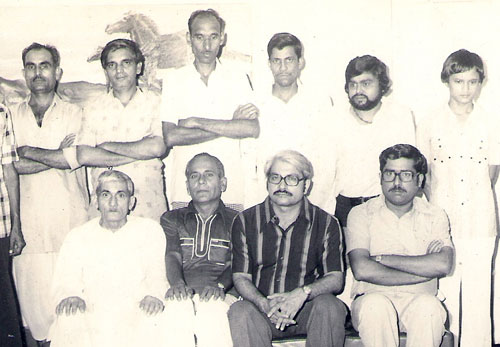
I started going to Bodarhi thereafter for my holidaying. But as soon as I would reach Bodarhi, my father would leave for our paternal village that was not possible otherwise. I have a photograph of my father with my father-in-law, Late Sitaram Misra who could visit and eat at our place after the birth of his grandsons with his daughter. There was one thing common with both- my father as well as my father0in-law. Both used to smoke that was one thing that I hated. During my father’s absence, I took care of the cow that my mother kept, hoping that her grandson would visit her. My father had a unique skill of getting his all types of work done by his acquaintances without annoying any. His charitable nature was also exemplary. He would give even his own belongings to any one in need. He had a strong will-power. He left smoking for ever when he started living with us.
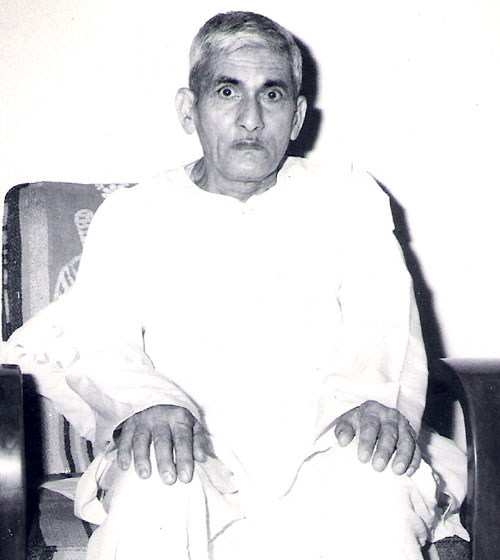
It was in early part of 1980s that I had to bring my father to live with us in Hind Motor. He was terminally ill, as he had damaged his lungs and my mother couldn’t have taken care of him in village. My mother would visit and live with us in between for some time. It was so as she was not ready to leave her farmlands.

Living with us was socially difficult for him but he managed well. I managed to arrange some persons who were employees of HM and from similar rural background to keep him entertained. His grand sons, particularly Anand was very close to him. He was very humorous and even with not much formal schooling; he was very much knowledgeable and kept on asking questions to know more. I don’t know about his schooling. But Yamuna asked him jokingly a number of times. ‘Babuji, as I heard, you were brought to Birlapur for schooling. When babaji (my grandfather) insisted you to go to school, you said instead you would jump in River Hooghly. You went back to the village.’ Babuji would laugh heartily and said, ‘nahin beti, yah jhuthi baat hai’ (no daughter, that was wrong).

In 1989, my mother died of cerebral attack. It was difficult for him but he was very bold. He lived a normal life though with a lot of medication. Every time I used to go out of station on company’s assignments that were quite frequent in those days, my anxiety for him will trouble me all the time. I remember once when I was in Hannover for a week for attending the machine tools fair, I couldn’t sleep well any night. Any telephone for Rath, my colleague who was in the attached room would make me wake up and keep suspecting that it must be about some bad news about my father but Rath was concealing it to avoid my worries.

He lived for almost 12-13 years with us in Hind Motors. He never went outside the residence. But he remained content and happy. Every day on return from the work I would peep in his room and ask about him. He will smile and raise both the hands in blessing posture. Whenever, I went out of station, as Yamuna informed, he kept on enquiring about me.


His presence was fulfilling till he lived. He left the world on September 24, 1989.

Posted in personal | Leave a comment

IIT Entrance Examination Getting Messy

I never knew that IITs set the question papers of the entrance examinations in Hindi too. Why should it be in Hindi when the subjects of tests are physics, chemistry and mathematics? Is the decision a political one or one necessary for selecting the best students for admitting in IITs giving due considerations for rural and underprivileged students, as some claim?

About 472,000 students across the country appeared for the IIT-JEE 2010 for admission to the Indian Institutes of Technology for 10,000 seats in 15 IITs, IT-BHU, Varanasi and ISM, Dhanbad. How may opted for the question papers in Hindi and do they answer it too in Hindi?

As reported and agreed by IIT’s authority in charge of the entrance examinations, the instructions of the Hindi version of the question papers were having errors that may cost students 48 marks. “The Hindi version of the papers also carried wrong instructions. As per the English version of the paper, there were certain questions carrying 48 marks. However, the Hindi versions presented the same questions with wrong instruction that they carried 18 marks. Besides, certain questions were not printed in the Hindi version.”

I don’t if IITs set the question papers in any other language also. Naturally the problems would have multiplied.

The prestigious Super 30 has appealed for re-examination. I am shocked to know the views of the Super 30 of Patna. It has got a global recognition for its unique performance and as it is free and meant for the deprived class. I wonder why it can’t train and prepare its students to take the examinations of science subjects in English. After all, for understanding the questions of the science subjects, the knowledge of English required is just minimal. An intelligent student with future career in mind in contemporary situation can be expected to learn the language that will be the medium for the years in IIT and the career thereafter. Mr. Anand Kumar must train his students to take the examinations in English.

The chairperson of IIT-JEE organizing committee assured the candidates that these mistakes would not affect their performance and would be taken care of during evaluation of papers.

I wonder if the candidate can believe it. Very lately, the IIT entrance system is in question and under legal scan many a times.

It’s unfortunate that the performance of a student in the IIT entrance examination in recent years depend more on the coaching centre/s the student uses. It’s a great business for the thousands of coaching centres spread all over the country and many of them are unscrupulously pick pocketing the students even without providing any significant assistance for the success. No doubt, the coaching centres never fail to take all credit of the success of each and every student. Interestingly, many a times, more than one institute takes credit for the wonderful performance of an individual student. I wonder why can’t IITs’ great academic innovate and find a way so that the intervention of the coaching centres is eliminated, unless IITs itself is involved in the profitable business.

Kota has become a household name for preparing for IITs. Many startups have come up with online facilities too.

But today my question is different. Will the foreign universities expected to open their establishments in India as expected by Kapil Sibal have to have use Hindi in its entrance examinations?

Why the language of the entrance examinations for the higher education can’t is only English? Perhaps the best way out may be the basing of the selection for IITs on the scores in science subjects in the board examinations that will have common curricula.

Posted in education | Tagged | Leave a comment

Free and Compulsory Education for All: Mr. Sibal can do it

Kapil Sibal has given the nation an unprecedented opportunity to see the whole lot of children between 6-14 years of age properly educated and made the government responsible for it. I have a request for Mr. Kapil Sibal.

I know if I talk of the successful implementation of the Right of Education Act in the whole country including 6 lakh villages, some remote ones, perhaps many may consider it as a Utopian task. However, Mr. Sibal can set an example by attempting to implement the Act in few metros of the country where the stakeholders are better enlightened and empowered too and to see his dreams getting realized.

The country can give him a smaller geographical zone, say, New Delhi, and or if he likes, he can include NCRs to prove his plans. Why can’t Mr. Sibal persuade and use the army of junior ministers, secretaries, officers and staff members in his Human Resources ministry to supervise the implementation of the Act? With his own political party ruling the capital state and he himself being one of the MPs from one of the major areas, Mr. Sibal can make it happen easily.

Once Mr. Sibal get the Act implemented in a smaller state, the state can become the benchmark or the model to be followed by other states with only scaling up the effort.

So will Mr. Sibal start with filling the vacancies of teachers, training them, providing the basic infrastructure facilities, such as healthy class rooms with sitting facilities for each child, and separate well maintained good toilets for boys, girls and teachers, using technologies to supplement for good teaching and seeing that the top private schools admit 25% of its students from deprived classes of local communities?

Mr. Sibal can also appeal and use the private resources of rich families, industrial houses and assistance from many educationists and institutions settled in New Delhi to see his plans implemented.

Can the people of the capital expect to see its educational institutes as showpieces of the country in next few years?

I wish Mr. Sibal does that for a change and established that what can be preached can be implemented too.

If it is not done and proven on smaller geographical area, the Act will have similar fate as many other wonderfully good Acts that have not brought about any visible change in the country.

Many great politicians such as Nitish Kumar, Budhdha or Mayawati will make it fail by passing on the responsibility of failures of implementation to the centre for every bit the Act envisages.

I wish Sibal proves everyone, who is skeptical because of the overall requirement of Rs 2, 04,000 crore in fund in next five years and shortage of 12.9 lak teachers and their training as the tough hurdles to overcome, wrong with focused implementation plans.

Posted in education | Leave a comment

Nitish Kumar Must Walk the Talk

I heard recently Nitish Kumar and his spokesman Tiwari talking in two programmes on small screens- Nitish Kumar on CNBC-Awaz (Uttar Uday) and Tiwari on NDTV India (Mukabla).

Nitish talked about the necessity of education- elementary, higher education and skill building to cash on the state’s strength of human resources that in number grows at much higher rate than what the rest of India does. I can’t say Nitish and his government has not done anything for education. However, Bihar’s progress in education is only a little better than dismal.

Bihar must be sending its majority of students for higher education outside the state. One can find the students of Bihar in every university, engineering and medical college, as well management school in all states of the country. It means higher cost for the parents who bear the expenditure. Bihar’s political leadership before and even with Nitish could hardly do anything to improve the condition.

Bihar stands nowhere in number of seats for professional colleges and higher education if one compares it with any state, be it UttarPradesh or even West Bengal and Orissa. Even after the five years of the Nitish rule in Bihar, the situation has hardly improved. And whatever institutes got proposed or set up, they all are in and around Patna. Many expected Nitish with engineering degree would have focused on higher education and would have taken lessons from the growth of higher professional education institutes in Andhra Pradesh that has today 460 of them. But basically Nitish has failed to do much.

Bihar even in last five years could not stop the deterioration of the condition of government primary schools, and the high schools. Most of the high schools in rural Bihar are hardly left with any good teachers. Infrastructure is nonexistent. If anyone doesn’t agree with me, I request him to let me know about those institutes that are exceptional.

Nitish Kumar did also referred to the need of skill development. But his government did hardly anything to scale up the capacity of the existing ITIs and polytechnics or took any step to improve the quality of teaching and training at these institutes. Bihar neither set up new skill development centre nor used any innovative means to improve the skills of the apprentices using local talents. I sincerely doubt if those running these ministries have any missionary zeal to bring the changes.

I feel shore as I never heard anything in media or from my friends in Bihar if Nitish has ever talked to improve the capacity and quality of professional education in Bihar or sought help of educationist from Bihar to improve its condition.

I wish Nitish would not have stopped blaming the centre for fund for everything and would appealed to the people for investing in education sector, facilitated easy entry, and incentivize better performance.

His job is to find ways and means to arrange his part of the finance to implement effectively the Right of Education Act rather than just blaming the centre. Can’t he find or try to find some Malviya (BHU) for Bihar? Can’t he create an education fund and ask NRBs (Non Resident Biharis) and all those who can to contribute to this fund? Can’t he impress on the parents of Bihar to dissuade their children from cheating at examinations? In today’s world, no certificate has any value if one has no knowledge and is not capable to communicate. ‘Job through recommendations’ era has become history.

I hardly agree with Nitish’s way of handling Naxalites and his advices to Chidambaram. He has not been able to do much on Naxalite menaces. I couldn’t travel to Rohtas Garh during my last visit to my home district. Let Nitish prove his methodology to handle the Maoism problems in Bihar where the trouble is still of pretty low intensity, and then talk big. It was just shocking to hear Tiwari’s views on Naxalite problems as it stands today.

I don’t mean that Nitish has not done anything and he is to be replaced in coming election rather I wish he gets one more time elected and works effectively with a development focus, particularly for education and healthcare. The disgruntled people particularly, of so-called forward communities of the state must not make the mistake of getting Nitish defeated. He is the only chance for the state at this moment.

After dethronement from the central cabinet, Lalu and Ram Vilash have settled in Patna to make a comeback. With Lalu and Ram Vilash after Nitish’s blood, Nitish will have to exhibit his political shrewdness for a win.

Media has very lately covered Nitish very well. Be it Times group, New York Times or Economist. I consider that media management by Nitish has been excellent.

And I join Saibal Gupta and wish that voters choose Nitish again: “We hope that voters will choose development over caste. But in Bihar one never knows.”

I am sure the voters in Bihar will go for the right choice.

Posted in bihar | Leave a comment