Why Are My Expectations Flying?

Seeing other states that have already established their lead in development race, I keep on writing some of my ideas about a fast track progress plan for Bihar. I don’t know if others do also agree with this. But the feedback tells me that many agree with my suggestions. One such recently sent to CM and deputy CM is as follows:

Can DGP Abhayanand with his immense interest in education as apparent from his work through Super 30 institute be given a major role to make the education in Bihar its mainstay? Can Abhayanand try to have one primary school in each of the police station manned by the staffs and officers there? I hope that will make them more responsible, clean and efficient. Can this idea be given a trial?

Can DM of each district be encouraged to be its PM as advised by the CM? Each DM can create an education hub in the headquarter of his district in a large enough campus with at least one Science College, a Foreign Language School, one ITI, one Engineering College, one Nursing School, if not Medical College, and five high schools (class VII-XII) sharing some common facilities such as laboratories, auditorium and playground. Can DM and SP actively facilitate the execution of the national projects such as Bharat Nirman or Sarv Shiksha Aviyan in their districts?

Can the education system drop its pass courses at graduation level? Let all deserving students go for an honours course making them really knowledgeable in the subjects. Others must go for professional courses and skill development in polytechnics and trade schools.

Can the school education up to Class XII be affiliated to single curricula of CBSE by abolishing state boards and redeploying its employees in other areas such as health?

Can the CM provide all the incentives to bring in extensions of IIT, Kanpur or Delhi in Patna? Can the three engineering colleges in Patna, Muzaffarpur, and Bhagalpur be upgraded with the curricula and standard of IITs or affiliated to some reputed foreign universities, and drop all teachers that are dead woods?

Can each NRI Bihari wishing to help its root adopt his village primary school or start a trade school to see that all those who don’t go for higher education get trained in some skills?

Can the education department prepare a book ’10 Great Sons of Bihar or BiharRatna’ giving the life stories of Mahavir, Chanakya, Ashoka, Vidyapati, Shershah, Veer Kunwar Singh, Dr.Rajendra Prasad, Jagjivan Ram, JP Narayan, and Ramdhari Singh ‘Dinkar’?

Can the state administration start a reward for the DM and SP of the five best performing districts based on measurable and transparent criteria?

Can the teachers in colleges, particularly of science and professional colleges be awarded special cash prizes for papers published in reputed journals and research work? Can the government announce and ensure those who get selected to IITs, BITS, and NITs would be paid scholarships amount good enough to take care of their essential expenditure?

Can the CM organize a grand conference of the men of all panchayats in the state and invite the President, MS Swaminathan, Kurien, Guru Ramdev and some other non-political personalities to talk to them to enthuse and involve them in the process of rural development? Can CM get at least four or five urban centers in different parts of the state developed as hubs of development with all infrastructure including an airport?

Can the Deputy CM take an initiative to start all the closed mills by providing all the assistance possible and in cases of unscrupulous owners by forcing them? Can the CM assure of the strictest actions against the ‘rangadari’ system?

Can the new management Guru Laluji get the railway axle project at Siwan in operation and Patna Railway Station to a world-class standard as promised before he goes out of railway ministry?

Can Shri Ram Vilasji get some pharma companies set up some herbal based units in Bihar or can M/m Meira Kumar get Sasaram some respectable infrastructure suitable to its history to get some tourists and related benefits for her constituency?

Can the CM initiate the celebration of a Bihar Day once a year where all the achievers are rewarded publicly?

Posted in Uncategorized | Leave a comment

Let Us Pray The MOTHER

Many times, I wonder why in all world religions, the Supreme has been considered as male and even all the incarnations do also belong to that gender. I wish it would have been the opposite and the world would have been better. One of the Hindi poets whom I love to read even today- Jai Shankar Prasad wrote ‘Nari Tum Kewal Sradhha Ho’ (Woman! You are respect incarnated.’) with a little change ‘Mother! You are Respect incarnated.”. Let me give a prayer of Mother on Mahanavami of Durga Puja that has been written by the great son of Aurvindo who was revolutionary in every respect.

O Mother Durga!
When we possess thee,
We shall no longer
cast thee away;
We shall bind thee to
us with the tie of love
and devotion.
Come, O Mother,
Manifest in our mind
and life and body.
Come, O Revealer of
the hero-path!
We shall no longer
cast Thee away.
May our entire life
become a ceaseless
worship of the Mother,
All our acts a continuous service to the Mother,
Full of love, full of energy.

Sri Aurobindo

Will you like to read, ‘Ancient Hindu Text Preserved by Modern Technology’ By Jeanna Bryner?

Posted in Uncategorized | Leave a comment

Durga Puja Spreads Joy

As I spent best part of my life in West Bengal, Durga Puja became our most important of festivals. From early school days at Birlapur, I remember those Bengali Jatras, the open stage plays that were the best attractions. But the most filling event was the sweets offered at the friends’ houses on the Vijayadasami, the tenth day. From Hind Motor days, I remember of one or two night trips to Puja pandals in Calcutta along with the kids. The thing that I disliked most was the separate ques for the women and men in the pandals. It used to cause a lot of problems and unnecessary worries. Later on, I never dared to go out though my Bangali friends and acquaintances kept on insisting me and even though Yamuna loved it. I never liked the huge crowd at the pandals.

My grandfather used to read the whole of Tulsidas’s Ramayan in nine days as ritual finishing on Navami. I followed his way for many years. But now I only read Durgasaptasati. The 700-verse Devi Mahatmyam or Durgasaptsati is from the Markandeya Purana.

Durga is the militant manifestation of Parvati, the consort of Shiva and the embodiment of Shakti, infinite energy created from the combined invocation and the conjoined effulgence of the gods. Gods couldn’t face the demons individually or together and were driven away from heaven by rampaging demons after the battle, which they lost. The gods gave Durga their powerful weaponry in a bid to strengthen Durga’s 10 hands to fight the ferocious fiends headed by Mahishasura, the buffalo-demon.

Shiva gave her his trident, Vishnu his disc, Kubera his club, Indra his thunder and Vayu his bow and arrows. Other gods vied with each other to equip her with their best of the tools. Equipped with the varied weaponry, she mounted her lion. Mahadevi Durga challenged the demons considered so far invincible. And in a fierce and gory battle, she ultimately killed him and became Mahisasurmardini.

Is it not the story that tells us that the woman supported and assisted by the males can do better than them? Was this annual festival started to remind the conflict between divine and demonic forces that always exist in all society? Does the story of Mahishasurmardini symbolise the eternal struggle between the forces of good and evil and the undying hope of the ultimate triumph of all that is good?

Does this annual homecoming of the mother remind us about the continuity of the battle against the evils of the society?

In Durgasaptasati Durga has been depicted in many forms and with varied traits. She is on one hand Bhavani, Gauri, Uma and on the other Durga, Kali, Shyama, Chandi and Bhairavi besides being also Jaagaddhatri, Amba, Bhadrakali and Chamundi.

Does Durga Puja also try to remind us the role the woman can play to strengthen the society?


One of our close elderly acquaintances had requested me to take them to Puja pandal of Noida. Today we could take them. I happen to meet some alumni of IIT too in one of the pandals. Durga Puja has now spread all over India. Even many pujas are organized in US, EU and UK too.

And perhaps ‘Incredible India’ can make this festival season a marketing feature to attract tourists from abroad. With mass dancing concerts for dandia and garba in Mumbai and Gujarat, the dusehra processions with elegantly decorated elephants in Mysore, unbelievable architectural feats of the pandals (structure to house the festivals and install the statues) and sculpture excellence, and Ramlila, there can’t be better occasion for the foreigners to enjoy the best and understand India.

Read
Connotations of Navratri by Meera Gopalkrishnan Khanna
The new theme of worship by Gargi Gupta

Posted in Uncategorized | Leave a comment

And Now $10 Laptops

I have written extensively about MIT’s Nicholas Negroponte plan of manufacturing $100 laptop and sell them to children of the countries like India and China in millions earlier. I was amazed to read a news report that Indians are aspiring to better him many times and sell similar laptops at an unbelievable price of $10, or Rs 450 each.

Indians found Negroponte’s offer of $100 (the real price was coming to $200) a little too costly. HRD and telecom ministry officials and experts from IITs and Indian Institute of Science are working for the indigenous laptop. But as reported, it will be ‘three years before the first $10 laptop comes out’.

As reported, Ashok Jhunjhunwala of IIT, Chennai, with the famous for his ‘Simputer’ had not only pointed out various problems relating to cost and technology but also offered to devise a much cheaper but equally advanced computer for schoolchildren. I wish he succeeds but does it fast enough, and like many other project it doesn’t remain only at the idea stage. And I don’t know how Bill Gates and other critics of $100 laptop would react to Ashok’s project whenever the Indian scientists and manufacturers are able to do it.

It sounds great and exciting that the taskforce has identified critical challenge areas and set up six anchor groups to be in touch with experts and remove bottlenecks. Institutions like IITs/IISc are entrusted with the task of research and development of cheap laptops. And the more interesting is its vision that wishes to produce some working device not only cheap enough, but also simple enough to be operatable by an uneducated housewife or mother. “If illiterates can handle television and other electronic equipment, why not computers? If the mother is trained, the entire family can become computer literate.”

I was recently reading about the $300 eBook devices being launched this year in September 4, 2006 issue of ‘Business World’. The whole thing appears to be very useful. With this advent of eBook Readers, pretty much the same size, slim and light, as an average paperback novel, one can store plenty of books in digital format, enlarge the text several times making it easy to read on a wide screen page by page. Further, one can plug into PC and download anything one wants, edit the text and make notes. Two devices, Hanlin V2 and V8, out of four are from the Chinese manufacturers. Sony Portable Reader PRS-500 will be half-inch thick device; weighing only250gms with a battery life of 7,500 pages turns per battery charge. After reading about the eBook readers, Ashok Jhunjhunwal’s $10 laptop proposal builds and brings in a new hope about India’s capability for digital devices for daily use.

I wish he could make it a combo with the possibilities for using the same as reader too. If these devices are not affordable by the individuals, why can’t the schools or next-door video shops give it on a cheap rental? The device may work as a common one for father, mother, and child. Every one can use the common device with the individual storage devices- the child device will have his all course books, mother’s her recipes and bank accounts, and father’s office documents and files.

PS: For more on ‘Simputer
Low cost to make $100 laptop revolutionary
Indian woman wins ‘alternative Nobels’.
Wipro buys Sweden’s Hydrauto for $31 mn
JSW Steel to invest $18 bn in 3 steel plants
M&M to acquire 67.9 pc stake in Jeco Holding
The IIT story
Microsoft and Hughes to set up rural IT kiosks
HCL launches laptops at Rs 27,000

Posted in Uncategorized | Leave a comment

Will Japan Go US Way?

An article in NewYork Times, ‘Japanese Fret That Quality Is in Decline’ by MARTIN FACKLER on September 21, 2006 shows how manufacturing has gone in the industrial culture of Japan. How deeply are Japanese concerned about the quality of the Japanese goods? Without any elaborate management education as in America, the Japanese produce the best quality. Without following a formal six-sigma quality practice of American origin, the Japanese achieve a quality level better than the one who follows it.

Perhaps, the Japanese have reached the level of the quality standard because of the overall concern for quality over the years and their practices of quality circles, kaizen, 5S, TPM (Total Productive Maintenance), QFD (Quality Function Deployment), lean manufacturing, and unique TPS (TOYOTA Production System).

Perhaps only in Japan could a television series like “Project X” have become one of the most popular TV shows. No, it isn’t a science fiction thriller. It’s about product quality. More specifically, it’s about a bunch of corporate engineers whose hand-held calculators and ink-jet printers helped turn this nation into an industrial powerhouse.

It is all due to the worry about their completitive strength. It is little wonder that a recent surge in recalls of defective products has set off national hand-wringing and soul-searching here, in radio talk shows, on the front pages of newspapers and in the hushed corridors of government ministries.

Even in local noodle shops, the conversation turns to the bruised pride and fears that Japan may be losing its edge at a time when South Korea and China are breathing down its neck.
“Craftsmanship was the best face that Japan had to show the world,” said Hideo Ishino, a 44-year-old lathe operator at an auto parts factory in Kawasaki, an industrial city next to Tokyo. “Aren’t the Koreans making fun of us now?”

Indian auto sector have learnt a lot from the Japanese about their quality control practices and overall Japanese way of manufacturing management. Many have gone for the coveted Deming Prize. And that is one of the reasons that the sector is doing wonderfully well.

This is a country that has been obsessed with perfection. Tokyo’s sprawling subway and train networks run like clockwork, accurate to the minute. Television factories assign workers with rags to wipe down every new set, lest a Japanese consumer find a single fingerprint and return it. In supermarkets, many apples and melons are individually wrapped in protective plastic foam.

In the last two months, the national angst increased after large-scale recalls of defective products made by Toyota and Sony, the country’s two proudest corporate names. In the United States, product recalls occur so frequently that most are barely noticed. And that is the reason that US has almost given up manufacturing lead in sectors after sectors. Today, even Ford and GM have closed most of the manufacturing activities in US mainly because it couldn’t compete on quality with the Japanese.

In Japan, the news has created something of a crisis in a country where manufacturing quality is part of the national identity. Some say young Japanese are too lazy. Others say American-style management is to blame.

Can Indian manufacturers take some lessons from this story? Let Japan be the model to emulate and not the China for the manufacturing sector. Let the Indian manufacturer not go down on quality by indiscriminately using Chinese parts in their products. On long run it may prove too costly.

The concern shown by the Japanese shows its built-in strength of the quality of their manufactured products. Perhaps, it will not go the US ways in manufacturing.

Posted in Uncategorized | Leave a comment

Is Bihar Today Investors’ ‘Preferred Destination’?

After many years, there is some good news about Bihar that gives some hope of resurgence. Bihar has recently played host to a number of big names of corporate India, like Ratan Tata of the Tata group, Max Healthcare Chairman Analjit Singh and Ashok Ganguly of ICICI OneSource.

To start with, the Tata group may be exploring the possibility of investing in low-cost hotels in the state. Some well wishers of Bihar are also toying with the idea of offering better concessions for Tata’s pet project- Rs 1 lakh car plant in Bihar that is facing a lot of political problems in acquiring land at Singur in West Bengal. Bihar will certainly be a better location with the militant unionized workforce of Bengal. Max Healthcare is looking to set up a super-specialty healthcare centre and hospital in Patna. It is not only that the maximum numbers of patients come from Bihar to Delhi; Delhi also must be having the maximum number of doctors of Bihari origin.

Anand Mahindra on his visit to Patna announced a slew of investments in Bihar that includes a satellite assembling plant in Patna similar to its units in Rudrapur and Jaipur, an investment business to tap rural savings, an agro-processing unit for lichis and mangoes of Bihar, investments in IT, a Mahindra resort in Bodh Gaya and Rajgir and investment in a non-polluting transport system. The Nitish government has already worked out elaborate plans to promote Rajgir-Bodhgaya-Gaya circuit on the international tourism map along with an International University. Mr Ratan Tata supported the state government’s plan to set up golf courses near Rajgir-Nalanda, besides setting up of five-star hotels to promote tourism in the area.

Bihar has also accepted the proposal by a Tamil Nadu-based firm, M/S Indian Gasohol Limited for setting up four maize-based industrial units in Bhagalpur, Muzaffarpur, Begusarai, and Vaishali for an estimated investment of Rs 2,500 crore. As stated by Ratan Tata, chairman of the Investment Commission, ‘the commission stands committed to facilitating Bihar’s development and to promoting it as an investment destination’.

With the change in the perception of investor-friendliness, the Bihar government has received a large number of investment proposals for sugar mills, malls, multiplexes, hospitals, and particularly educational institutes. A good percentage of them have got the approval too. Proposals for setting up eight new multi-purpose sugar mill complexes in Madhubani, East Champaran, Saran, Muzaffarpur, Madhepura, Begusarai and Nalanda districts with the capacity of crushing 65,000 tonne sugarcane per day involving an estimated investment of Rs 2,157 crore are in hand of the government.

The aggressiveness of the government is clear from the appointments of the reputed persons such as NK Singh, the former revenue secretary and planning commission member as the chief of state planning commission and Muchkund Dubey, former Foreign Secretary to head the Common School System Commission, a high level team comprising two Secretary level officials on Sunday to Hong Kong on a “brand Bihar mission” to participate in a four-day conference on tourism, and the planned major meet early next year to woo non-resident Indians (NRIs) from the state.

The state is under a process of image building for an investor-friendly state. It promises certain advantages over already developed states in terms of cheap real estate prices, limited labour-related issues and a large educated manpower at nearly one-third the cost compared to cities like Bangalore or Chennai. However, Bihar is still to go miles before it does some significant improvement in infrastructure, socio-economic backwardness, and law and order.

Will the interests shown by so many of biggies translate into actual investment in Bihar? It will certainly depend on the initiatives and assistance provided by the government over the time. CM and his team will have to work hard to make it. Many are watching the three states of eastern India- Bihar, Bengal and Orissa. It is for the time to judge who proves really better.

Read the article To achieve a turnaround in Bihar by Shaibal Gupta
‘India could handle 30% US banking process’

A MUST READ: The challenge for the new republic that is Bihar

Posted in Uncategorized | Leave a comment

Is India finally flying?

India has emerged as the world’s fastest growing economy. Boston Consulting Group’s Global Wealth 2006 study shows in 2005, high growth in India’s (15.9% in local currency terms, compared to China’s 14.8%) assets under management (AUM) – comprising cash, shares, assets in the country and oversaes and money market funds, and excludes wealth attributed to investors’ own businesses, residences or luxury goods. The steady growth, estimated at nearly 16% in 2000-2005, has meant that India’s AUM has more than doubled from $268 billion to $559 billion, helping it move up the ladder from the 27th place to number 19 during the five-year period.

Growth rate is projected to taper off a little – to 13.3% between now and 2010. However, India is seen to be the fastest growing member of the BRIC (Brazil, Russia, India, China) club. The global rate will be 5.6%. India will join the $1 trillion wealth club by 2010, accounting for 1% of the global pie of $115.8 trillion in 2010. Are these figures not inspiring for the entrepreneurs of India?

Arvind Panagariya, presently professor at Columbia University in an article, ‘Is India finally flying?’, has further provided some interesting facts on Indian economy that are all showing a consistency in economic growth.

In the last three years, the economy has grown a phenomenal 19% per annum in current dollars. In 1990-91, the GDP in current dollars was $317 billion. During the last three years, the GDP has increased by $327 billion. To put the matter even more dramatically, given the US inflation rate of 3%, the GDP in real dollars grew at the annual rate of 16% in the last three years. If this momentum can be sustained, the Indian GDP would rise from its current level of $800 billion to cross the current US GDP of $12.5 trillion in just 20 years!

1990-91 exports of $18.1billion took nine years to double. In contrast, the recent doubling has taken place in just three years: from $52.7 billion in 2002-03 to $102.7 billion in 2005-06.

Services exports were multiplied by a factor of 3.7 in just five years between 2000-01 and 2005-06, whereas during ten years between 1990-91 and 2000-2001 it were multiplied by 3.5.

The ratio of goods and services exports to GDP rose from 11.6% in 1999-00 to 15.6% in 2002-03 and to 20.5% in 2005-06.

The total foreign investment flow has risen from $6 billion in 2002-03 to $20 billion in 2005-06.

Remittances from abroad have risen less dramatically. But they too have gone up from $17 billion in 2002-03 to $25 billion in 2005-06.

In 1990-91, India had just five million telephone lines in total. Currently, telephone lines are expanding at the rate of more than five million per month. In urban areas, teledensity has reached 31%. Teledensity in the rural areas at 2% remains low. But to put the matter in perspective, as recently as 1991, urban teledensity was below this figure. The communication sector as a whole has been growing 24% per year in real terms since 1999-00. Its share in the GDP has more than doubled from 1.6% in 1999-00 to 3.5% in 2004-05.

The sales of passenger vehicles have risen from 707,000 in 2002-03 to 1.14 million in 2005-06. The total turnover of the automobile industry rose from $12.3 billion in 2002-03 to $19 billion in 2004-05.

Many sectors are doing tremendously well. We can see hope all around. And no sane Indian is sceptical about an honourable tomorrow for India. Let us work a little harder and be honest to our work; ‘Yogah Karamshu Kaushalam.’

Posted in Uncategorized | Leave a comment

Mother Almighty Arrives

Yesterday was Mahalaya. I get reminded of our childhood when my grandfather would get up to hear the wonderful narration of the Goddess on radio early in the morning. There was no TV those days. The sublime narration accompanied with songs, as I know from ‘Durga Saptashati’ used to fill the air in early morning. Perhaps Mother has all the superlative traits that one can think of: The Supreme Lady (Paramesvari), Mother of the World (Jagdamba), personification of the transcendental knowledge (visuddha jnanadeha), and the cosmic energy (saktisvarupini). She got all in her ten hands the best of weapons and implements given by all the gods. Surprisingly, on the last day of pitripaksha (fortnight of the deads), the final offerings for the deads of the family are made with a bath in river; Goddess arrives to stay on this earth among her devotees for nine days or nights (navratri).

These nine days (or nights) are now becoming the ultimate of festivities in India. In North India from Delhi to Varanasi, main attractions are Ram Lilas (folk dramas based on the life of Rama) that are organized in every colonies and localities. Gujarat celebrates Navratra with Dandia dance with exhhilarating music and orchestra. That is becoming the main attractions of the younger generations. And eastern India, particularly Bengal is busy with celebrating Durga Puja. And each of the three is now encroaching in every region of the country to make it a great festival of the people of all ages and perhaps of all communities. With month of Ramzan, Muslims also are also busy in celebrations ending with Eid.

I wish this gets a recognition as national festival season and the governments promote this for attracting tourists from all over the world in large number, as the climate is also pretty mild.

Sarvasvarupe sarvese sarvasaktisamanvite

Bhayebhyas trahi no Devi, Durge devi namo’stute

O Durga! Assumer of all forms! Sovereign of all beings! Possessor of unlimited power! Save us from fearful uncertainties. Salutation to Thee!

Read
Divine Feminine
Celebrate India

Some Interesting News
BHEL, RIL among 12 firms in Forbes list of ‘Fab 50’
Hyundai to pump Rs 41.91 billion in India

Posted in Uncategorized | Leave a comment

India as Major Emerging Economy

The latest issue of ‘The Economist’ is special on emerging power and world economy. A graphical presentation of the body count from one of the articles is presented above. Is it not great that on body count India leads even China and all other developed nations too? And that is the potential and strength on which the country can build and compete. However, many have apprehensions about the quality of these students and their employability.

I give a quote from the article: ‘The McKinsey Global Institute estimates that only one-tenth of engineering graduates in China and one-quarter in India would meet the standards expected by big American firms.’ It may be true today. But the whole lot of administration of the institutions, educationists and the industry are aware of this weakness of our education and working to improve it. For institutions, improvement to the world class only will decide their survival. The forthcoming FDI in education will provide another boost to the quality of the country’s human resources.

The shortage of good teachers is critical. However, it is heartening that many from industry are willing to play the double role of teacher cum executive. Recently former CEO and mentor of Infosys expressed his wishes to work as teacher. There must be many with similar wishes. I wish the institutes could exploit that potential to take care of the shortage of quality of teachers. It will improve better interactions with the industry too that the institutes intend to serve. The government must also encourage. Successful practitioners of technology and knowledge in industry must turn teachers. While institutes must be open to the offers, the CEOs must encourage the employees interested in teaching and facilitate the system to make them go to the institutes and help effectively in improving the standard of teaching and researches.

‘A report by the World Bank also points out that a large share of engineering graduates in China and India become civil and electrical engineers, needed for the boom in domestic construction. There are not enough engineers and scientists to produce high-tech goods across the board.’ The curriculums must emphasise on the innovation of technology. I remember something from our days of IIT, Kharagpur. In the final year of Mechanical engineering batch, the best students were offered production engineering under Prof. R.Misra as special specialization. Machine design, mechanical handling, hydraulic engineering, and heat power engineering were for the lower rankers based on the scores from the third year. Machine design must come on the top today. The country need more and more of competitive product designers with the cutting edge technologies to come on the top of the industrial nations. The industry must also accordingly appreciate the work of the product innovators and change the compensation and reward system.

I am sure we have the potential to become the largest innovators globally, if we make certain changes in attitude and facilities. But IITs and all our research labs in government or in private enterprises must endeavour to see that the innovators shine and their talents get recognized.

Posted in Uncategorized | Leave a comment

Akhara IIM-A; Lalu Vs Nitish

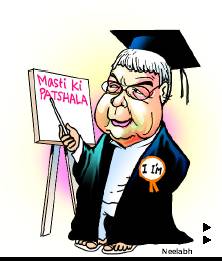
I don’t understand the real intention of IIM-A giving so much importance to Bihar by calling two of the main rival politicians of Bihar to IIM-A to make students of the prestigious institute learn from their experiences as managers in government. Does the institute treat them as successful CEOs of the department or the state they run? How will the rustic management guru will fare and what will the suave one will offer, as he is still to prove in his new role?

Would not a better option would have been to discuss the questions arising out of the case study prepared by the IIM-A professor under the chairmanship of the two stalwarts- one who is claiming the whole credit himself and the other who was the boss before the later took over and carried the legacy?

Is it really the Railway minister Lulu Parsed euphemism such as ”If you do not milk the cow fully, it falls sick,” that improved the performance? I am sure the students and faculty of IIM-A would have got the answer from the horse’s mouth. IIM-A also would have studied the case and come out with its own conclusion. I wish they made it public for the managers of the country to learn the trick if there is one.

However, I have some questions and queries. As we all know Lazuli was too busy with Bihar’s assembly election till last year and the ministry as reported was practically run by the officers there or PMO. Did he really contribute or was it a handiwork of the chairman of Railway Board or some other dedicated heads? Did he create a fear in the railway bureaucracy because of his humiliating way of handling the subordinates and that made them work hard to give performance?

I don’t here mean that a person like Lalu can’t do it. What I only expect that the credit must go to the person who deserve. What I didn’t like was the dogfight reported in media. And there even Nitish appears to be lacking the magnanimity that many expected him to show, when he is reported to have said, “Lalu is reaping the benefits of steps initiated by me during my stint as Railway Minister from 2002 to 2005. I am unable to understand how the media said the Indian railways was running at a loss,” However, here also Lalu is at the worse when he said to the press, “Nitish Kumar is a liar. I knew you would ask me this question, so I have brought with me a copy of his 1999 budget speech in which he had admitted that the railway was in doldrums,”

Has our culture taught only this? Is this the way to behave in public?

Even if I consider this programme organize by IIM-A as one in interest of Bihar, I have two requests to make on behalf of the people of Bihar.

Can IIM-A and other IIMs send its students and faculty members to Bihar to study its problems as project and come out a road map on the line of the one prepared by Mc Kinsey for West Bengal?

Will one of the IIMs open an extension center in Patna or Muzaffarpur to train students from Bihar near at home?

Will Laluji request IIM-A on the behalf of the people of Bihar? May be as remuneration for the presentation made by him, IIM-A agree to the request. I wish when Nitish presents his lecture at IIM-A, he did propose IIM-A to come to Bihar and offer all assistance to have a campus.

Press Reports
Lalu gives management lessons to IIM grads
‘Lalu Yadav a posterboy of the media’
Lalu comes to IIM-A with new image
Lalu Prasad charms IIM-A, announces railways chair
Lalu applies tickle theory – Mutual admiration flows after IIM lecture

When IIM bachchas learnt all about Lalugiri
Subir Roy: Lalu Prasad deserves only two cheers
How Lalu turned the railways around: the IIM-A case studies
The Lalu lesson
How one tonne more became Rs 500 crore annually
Management lessons for CEOs from a new 21st century CEO: Lalu Prasad
Latest ‘Manager Lalu’<

Posted in Uncategorized | Leave a comment