Booming and Bubbling India-II

India vs. China: The eight Indian companies are part of S&P’s list of 300 mid-size companies across 37 countries in the latest S&P Global Challengers List. India ranks seventh in terms of the companies per country that figure in the list. In contrast, China has four companies on the list.

An innovative nation: In a new study, India has emerged as the second best place for business innovation after the US. In a survey of 485 senior executives worldwide carried out by Hong Kong-based Economist Intelligence Unit, Japan has emerged as the world’s most innovative nation in terms of business practices, followed by Switzerland, US and Sweden. India has been ranked at 58th position, ahead of China’s 59th position in a ranking of 82 economies, based on their level of innovation during 2002-06. But the report also concludes that India will give away its lead over China as an innovative country in the next five years.

IT excels: IT services major Wipro Technologies said it has bagged the ‘SAP Pinnacle Award’ in the area of Software Solutions Leadership.

Industrial Manufacturing CorridorAccording to India and Japan, the DMIC (Delhi Mumbai Industrial Corridor) project-to be launched in 2008 and completed by 2015-would entail an investment of $45-50 billion.

Corporate India helps rural poverty alleviation:
HLL will aim to reach 600 million consumers in five-lakh villages through one-lakh entrepreneurs by 2010.

India matters for Airbus and Boeing: Rapidly expanding Indian carriers have ordered close to $40 billion worth of big jets over the past two years. So far, Airbus, has bagged 295 orders from Indian customers since January 2005, vs. 138 for Boeing. The value of Boeing’s order book is close to $20 billion at list prices, while it is roughly $22 billion for Airbus.

Chindia ahead of other BRIC members: According to a survey of 350 international, mainly expatriate investors, mostly belonging to the US, UK and continental Europe by Luxembourg-based broker Internaxx, Chindia make a more compelling proposition than the first half of the BRICs acronym. The survey found that 42 per cent of international investors felt positive about China and 32 per cent about India, while only five and six per cent respectively felt positive about Brazil and Russia.

White Revolution continues: Indian dairy industry will reach Rs5.20 lakh crore by 2011. “Out of the anticipated output of 120 million tonnes, the share of liquid milk will be 97.5 million tonnes, while the remaining 22.5 million tonnes will get converted into milk products.”

Manufacturing Sector Moving in top gear: India’s manufacturing sector registered the highest growth in over a decade at 14.1 per cent in March 2007, up from 10.1 per cent in the same month of the previous year, the commerce and industry ministry said Tuesday. The growth rate of the sector has doubled since 2002-03 from six per cent to 12.3 per cent in 2006-07.

Sky-High Ambitions of Indian Outsourcers: Tata Consultancy Services (TCS) has worked on projects for GE Aviation involving digitally testing the configuration of jet designs and is currently designing the business class portion of a plane for an undisclosed aviation customer. Tata Technologies hopes to leverage the expertise of its parent company to reduce the cost and weight of airline components for international customers. Infosys has designed part of the Airbus A380 super jumbo jet, which is now undergoing test flights. Last year it set up an engineering center to team with Spirit Aerosystems (SPR), a major supplier of structures including fuselage, nose sections, and floor beams.

India’s Global raid continues: Billionaire Vijay Mallya’s distillery group agreed to buy Scottish liquor maker Whyte & Mackay for 595 million pounds ($1.18 billion, Rs4, 700 crore), extending a record year for international takeovers by Indian companies. Mallya formed United Spirits by combining McDowell & Co, Shaw Wallace & Co, Herbertsons and other liquor makers of the group. The company, with 145 brands and 69 factories, became the world’s third largest spirits company after Diageo and Pernod Ricard. Today’s acquisition of Whyte & Mackay promises to enhance Mallaya’s position in the Forbes’ list of billionaires, which placed him 746th in 2006.

Mumbai’s famed diamond district of opera house becoming a global diamond-trading hub:
Indians are becoming integrated global players, involved in the entire supply chain right from sourcing of the gems to retailing finished jewellery. The recent spate of acquisitions by the big players in the business of reputed US brands, and the removal of import duty on polished diamonds are giving big push in the direction of creating a global hub in India. India is already the largest manufacturer of cut and polished diamonds with 10 out of every 11 diamonds being processed here. Diamond and jewellery exports reached $16.6 billion last year, second only to IT-related exports. With London and Antwerp slowly declining in importance, India could soon become the manufacturing as well as trading hub.

India exports cars: The export of passenger cars from India is expected to touch one million by 2010, a shade lower than the last financial year’s total domestic sales of 1.3 million, and nearly a third of the projected production of three million. Last year, the country exported only 198,478 cars – less than 13 per cent of the 1,544,850 produced.

India Attractting global manufacturers: Singapore-based $2.1b IT component major eSys Technologies, with worldwide back office operations is investing Rs 1,000 cr in India. This includes a Rs 250 crore investment in setting up a PC manufacturing plant at Nalagarh, Himachal Pradesh with an annual capacity of 1.2 million units and another Rs 100 crore in global back-office operations in Chandigarh.

India as R&D hub

1.The world’s largest manufacturer of healthcare products, Johnson & Johnson, is making India a global hub of its research and development as it looks to ramp up its pharmaceutical business in the country. The company is investing $17.5 million in its analytical and pharmaceutical development centre in Mumbai, which conducts early-stage drug development. In a few months, the number of professionals working there will rise from 65 to 150.

2.Korean consumer electronics major Samsung would hire about 700 R&D software engineers for its centre at Noida. “Currently, we employ 300 people at Samsung India Software Centre (SISC) and would take the number up to 400 by this year end, eventually we hope to touch 1,000 in the next three years,” Samsung India Electronics Vice President Software Centre Vikram Vij told PTI.

3.Blackberry-maker Research In Motion (RIM) will soon set up its R&D and customer support base in India. The company could in fact look at turning India into a hub for its customer support services eventually.

4.Indian expatriates returning to work on R&D: According to the Society of Indian Automobile Manufacturers (SIAM), there are already over 250 Indian expatriates who have returned to work on R&D in domestic automobile companies Mahindra & Mahindra, Ashok Leyland, Tata Motors and Hindustan Motors. SIAM predicts that their numbers will double in two years. With investments of over Rs 100,000 crore lined up in the Indian automobile industry, and European and US car majors making an aggressive push into India, Indian car companies have begun to understand the significance of R&D.

Textile sector invests tons: India’s textile sector is expected to attract investment of Rs 150,600 crore in the next five years and will achieve the export target of Rs 225,665 crore (55 billion dollars) by 2012. The industry that is growing by 9-10 per cent would increase to 16 per cent in the coming years.

India getting benchmarked: Nissan Motor Co, Japan’s third-largest automaker, is designing a $2,500 car to compete in India with the low-cost model planned by Tata Motors, Chief Executive Officer Carlos Ghosn said. “We are working on how we can make a car for $2,500,” Ghosn told reporters today at a dinner in Versailles, France. A Nissan advance engineering group is doing the study,” he said.

Is not India bubbling?
——————-
How competitive is India? </
Posted in economy, industry | Leave a comment

Why Bureaucracy Enthralls Engineers?

Last month, in my talk with the students and faculty members of IT-BHU , I had emphasized on my dislike for those graduate engineers who prefer the civil services and go for it. Most waste time in its pursuits. Instead they must be going to the enterprises or for entrepreneurship. They can use and build their careers strengthened by the knowledge of the four years or more (for higher degree) in engineering college. Even if they feel like going for a management course, they must do that after working for some years in field.

It was interesting to look at the results of union public service examination this year a little critically. Mutyalaraju Reva, a backward class candidate from Andhra Pradesh, topped the 2006 civil service exams. He is a graduate engineer from Regional Engineering College, Warangal and has completed his M.Tech from Indian Institute of Sciences too. It was his third attempt. Mutyalaraju cleared for IPS (ranked 223) last year and joined the training, but tried once more for the most coveted IAS and got it with flying colours. In his first attempt, Reva couldn’t not even clear the examination. The Reva’s story raises many questions. Why is IAS so prestigious? Why did even after the M.Tech from world famous IISc make Reva pursue a career as engineer or technocrats? Why did Reva not clear the examination in his first attempt? Why didn’t he carry on as IPS? I know that the boss of my cousin in Vadodara is an IIT graduate, who had cleared IPS?

The top 20 lists this year had five more engineers. All those must be brilliant and could have become innovators or the managers in the fields of their expertise. Is not the lust of perks and premium of civil services, that starts from dowry (culminating in some deaths too) and goes to much talked about purses (more popularly known as corruption), make them go for it?

According to a study of recruits between 1998 and 2003, 29.5% of the appointees were graduate engineers, and some were even post-graduates. And with whom these engineers compete throughout the career? Mostly, they compete with graduate and postgraduates in arts who constituted the maximum of 34.1% in the study of the recruits. Why should then they go for engineering at the first instance?

Most of these engineering graduates must be from the tier I and tier II colleges, as IITians and graduates of some few colleges fetch very high salary already or they prefer doing MBA from IIMs or ISB. However, it requires a study to confirm. The rest of engineers going for IAS wasted money and time in making themselves compete the entrance examinations, the years of engineering colleges, and the number of years they kept on attempting to get finally selected as IAS. I remember during my HM days a mechanical engineering graduate of the reputed Roorkee Engineering College coming to me after six years of graduation when he exhausted all his chances for civil service examination for an interview of graduate engineer trainee. He had not only lost the years wasted in his endeavour but lost the years of seniority and experience in industry too. Even as per the news report, one candidate coming in the top 20 this year took nine attempts to get appointment to the service. There must be many more in the whole lists who would have taken many attempts. Do they deserve the same ranking and remunerations as the ones who clear the examination in the first attempt?

Surprisingly, the number of doctors, lawyers, and MBA appearing for the union services is insignificant. Should we conclude that the glamour of IAS positions don’t attract them?
Should not the engineers with booming Indian economy take lessons from doctors or lawyers? After all they will very soon be part of the same bureaucracy that is considered most corrupt and inefficient only mastering the creation of a virus called ‘red tape’ in the administrative system. Or will the engineers with their educational background help re-engineering the system and structure for fast and innovative implementation of projects to alleviate the poverty of millions in the country?

My Choicest Readings on April 19,2007

1. V V: Scalpel stories
2. Aditi Phadnis: Will Mayawati deliver?
3. A President of our own
4. 17 Indian American students among 141 presidential scholars

Posted in governance | Leave a comment

A Death, Some Lessons, Some Questions

This story may not be of any use to Nitish Kumar, neither it is intended for him. But the story of late Manju Sinha is worth pondering over by all those who like and relish to get themselves branded as workaholic. The life style and the work ethics must remain balanced, otherwise we repent for not enjoying some real nice things and relations bestowed on us by the almighty, if at all He does that. As otherwise too, the demise of the wife of the CM, Bihar leaves behind some unanswered questions in the mind of Biharis and even, the people at large.

Bihar’s CM lost his wife on April 14, 2007. I came to know of the news while surfing the site of Daily Telegraph, Kolkata at around 4AM on April 15. I went to Patna’s news sites that I usually look at regularly. Websites of patnadaily.com and bihartimes.com did carry the sad news. However, I couldn’t trace the news in any of the national newspapers of New Delhi. For them, all other news-matters appeared to be so hot that they never cared to have the news covered even in a corner. After all Manju Devi was not Rabri Devi. Funny, is it not? Media and particularly its reporters who, as I assume, are mostly from the same region, would have been a little more sensitive.

I just can’t understand the way things go for the first family of the state like Bihar, or for that matter any state. While Nitish Kumar might be too busy to provide the attention desired, was there none- servants, assistants, relatives, or sycophants from the party in the chief minister’s residence to take care of the ill health of the first lady of the house there? Is the family not provided with a panel of doctors for regular medical checks and attention? Why was she taken to the nursing home of Kankarbag? Is it the best one? Did the nursing home provide the attention of the best of doctors and right medication? Is it not the minimum the wife of a CM deserves? Couldn’t the doctor attending her diagnose the trouble? People of Bihar have a right to know about it. And the doctors attending her and the nursing home must come out with some of the details. The story will be a black spot on the capability of the doctors of Patna who have earned a name for careless approach to their patients. I have some doubts about the seriousness of the doctors of Patna who attended her. I know neither Late Manju Sinha would have complained because of his humility nor Nitish Kumar will ever come out with any doubt about the doctors. It is perhaps the way the family has built its own culture.

Why was the CM’s wife shifted to Max Hospital in New Delhi and not to other more reputed and established ones? Was that a decision of Nitish Kumar or the doctors of Patna? Why can’t some help from the doctors from the other hospitals in New Delhi or other cities in the country or abroad sought when the condition was so critical? The authority or doctors of Max hospital attending Late Manjuji must issue statement detailing circumstances and reasons that made her succumb to pneumonia. It speaks very poorly about the Max Hospital that wishes to have a big name in healthcare in India. How can a country expect a huge inflow of medical tourists, if its reputed hospital can’t treat a case of pneumonia?

Late Manju Sinha was a teacher in a school in Patna, and remained that even after becoming the wife of the CM of Bihar. Her simplicity and detachment from the perks of a CM wife must be lesson to many and all.

But at the end I shall like to remind the people of Bihar what Laluji spoke in full view on T cameras on news channels when the Yadav family had to leave the official residence of the chief minister. “I am leaving behind one ghost on one of the tree in the complex that will keep on troubling Nitishji.” Most of us come from rural Bihar where we still believe in those forces even after all our education. Why would have he uttered that?

My Choicest Readings April 18, 2007

1. A five trillion dollar market
2. India seeks higher-value work
3. Mayawati and the emergence of Dalit power
4. Diagnosis: Casteism
5. From Ajanta caves to financial waves
6. Divided we stand

Posted in bihar | Leave a comment

Four Enterprising Agro-tycoons

India is booming. It is not true only for urban India. Many from the rural India are becoming part of the big economy. Nasik, Anand, and many regions are the playground of the new millionaires in agro-bussiness. Here are the stories of 4 agro-tycoons of Punjab that must pride every Indian. In their own way, they are bringing about a new revolution. Many can emulate their approach. With more than 60% of the population still in rural India, the job creation must happen there itself. And it can happen in the way these people are doing. The story of these entrepreneurs is based on an article that appeared in ‘India Today’, May 21, 2007 issue.

Malvinder Singh Bhinder is a marine engineer-turned-entrepreneur. His Agro-Dutch Industries Limited (ADIL) is the world’s largest fully-integrated plant, from composting to canning, with an installed air-conditioning capacity of 16,000 tonnes. Spread over 150 acre near Patiala, ADIL produces 60,000 tonnes of processed mushrooms a year. It is the world’s biggest mushroom producer even going ahead of the Pennsylvania-based Georgio Foods. ADIL supplies to international food chains like Unilever, Heinz, and the US Food Service and accounts for 95 per cent of India’s exports, clocking a Rs 200-crore turnover last year. Bhinder has plans to scale up production to one lakh tonne per annum by 2008.

Jitendra Singh, a 44-year-old IIT graduate, has become today India’s biggest producer and exporter of caffeine to global cola and energy drink majors-just in a decade. However, Singh extracts caffeine from sugarcane molasses instead from the leaves and beans of the coffee plant. Jitendra’s company, Kudos Chemie, based in Dera Bassi, has recorded a turnover of Rs 90 crore this year and is now counted among the world’s top five caffeine producers. Singh is expanding capacities to push production to 3,000 tonnes by next year with an additional investment of Rs 80-crore. It would help him garner one fourth of the world’s caffeine market by 2010 and raise the turnover to Rs 500 crore. His next move is to control the raw material through introducing the sweet sorghum crop on at least 40,000 acre through contract farming. The crop will serve as a source for molasses which will go for an in-house distillery to ferment alcohol-the way the Brazilians, traditional caffeine producers, do it.

Jagjit Singh Kapoor, a first generation entrepreneur is now the country’s biggest honey producer-exporter. Kapoor, 55, has mastered the business of honey-from bee-rearing to extraction, packaging and marketing-with incredible results. At present, he exports 10,000 tonnes of honey worth Rs 85 crore to 32 countries. Beginning with five bee colonies, Kapoor now has some 20,000 colonies-India’s biggest migratory bee-keeping enterprise. Kapoor’s company, Kashmir Apiaries, based at Doraha near Ludhiana, also collects 9,000 tonnes of honey from 2,000-odd farmers across the country and processes it at his state-of-the-art plant. With ingeniously developed machines like moisture drier-designed by Kapoor himself-and a state-of-the-art laboratory, the quality standards of foreign particles at 10 parts per billion are high enough to compete with China and Argentina, the two major honey exporters to the world markets. Kapoor is working on increasing his colonies to 50,000 by 2009, and that would make him the world’s biggest bee-keeper, well past the current leader, an Argentine corporate with 35,000 colonies. The company is now expanding exports of organic honey and has supplied 5,000 tonnes in Europe last year. Its brand, Little Bee, is marketed in seven countries. Even China cannot meet Kapoor’s quality standards and Argentina can’t produce organic honey at low rates.

Maninder Pal Singh and Manjit Singh Toor, both 37, have set up Punjab’s first aromatic agri-business by cultivating and processing Bulgarian roses for export to perfume manufacturers. The two friends teamed up for a farming venture on the arid land they had bought in the foothills. The idea came from a visit to the Institute of Himalayan Biosphere and Technology at Palampur in Himachal Pradesh. Starting with five acres in 1998, they have since extended rose plantation to 120 acres. Their firm, R.T. Aromatic Limited, is now the country’s largest rose extract manufacturer. Sensing a big demand for naturally-grown oils in aroma therapy abroad, they switched to organic farming in 2006. Certified by a Swiss company, organic rose cultivation has meant a substantial value addition, as the organic tag fetches better price. By 2008, their plan is to increase rose farming to 150 acre.

At a time when agriculture in Punjab’s pride is on the downswing, these some young, enterprising agro-tycoons are busy in bringing in unique transformation in rural India with their entrepreneurship and innovations. Here is how it’s happening. ADIL employs roughly 5,000 people-mostly rural women-and its massive operations consume 300 tonne of wheat straw, 300 tonnes of paddy husk and 22 tonnes of chicken manure every day. Demand for all these raw materials has benefited local farmers and poultry owners to the tune of Rs 80 crore a year. Kashmir Apiaries provides employment to 1,500 people and has transformed the financial status of 2,000-odd small bee keepers who supply honey to it.

Is it less exhilarating a story than what Reliance, M&M, or Tata Motors are trying to do?

My Choicest Readings April 16, 2007
1. Train stuck? Just shove it
2. After Captain America
3. India’s new Entrepreneurs
4. Indian Outsourcers’ Sky-High Ambitions
5. Life Without Dreams Is Colourless

<

Posted in agriculture | Leave a comment

Dream of Rural Prosperity And Urbanisation

India is marching towards prosperity with GDP tending to grow to double digits, foreign exchange reserve exceeding $200 billion, manufacturing sector growth going beyond targeted 12%, and almost all sectors booming. Is its impact limited to the prosperity only in urban India? Will the rural prosperity remain only in policy papers, wish lists, and dreams of people like our President, PM and some more, and bypass villages?

The latest NSS survey brings hope. Rural India is very much participating in the India’s growth story. Here are some data provided by latest NSS reports. Between 1993-94 and 2004-05:

1. Per capita consumption of edible oils rose by 30% in rural areas, and 18% in urban India.
2. The proportion of rural households using cooking gas rose six-fold, from 2% to 11.7%, while the urban proportion doubled to 59%.
3. The proportion of rural households using electricity rose from 34% to 54%. The urban proportion rose from 74% to 94%.
4. Purchases of readymade garments rose by 75%, and of hosiery products threefold, in both rural and urban areas.
5. Refrigerator use increased from 1% to 4% of rural households, and from 12% to 32% of urban households.
6. Between 1999-00 and 2004-05, the proportion of TV households rose from 19% to 26% in rural areas, and from 59% to 66% in urban.

Growth has not bypassed rural areas. Between 1999-00 and 2004-05, poverty declined from 26% to 22%. That is, 44 million people rose above the poverty line.

The NSSO has data on the poorest of the poor: those who say they go hungry in some or all months of the year. Between 1993-94 and 2004-05, the proportion of rural households hungry at some time in the past year fell from 5.5% to 2.6%. More than half the once-hungry in rural areas ceased to be so. (In urban areas hunger almost vanished: the proportion of hungry households fell from 1.9% to 0.6%.) Surprisingly, the consumption expenditure of rural Bihar stands at Rs 699 per month, higher than the national average of rural consumption expenditure, which is Rs 559 per month.
However, I get the shock of life when I come to know of the performances of certain states that are perceived to be better ones. In 2004-05, the percentage of rural households reporting “not enough food every day in some months” was the highest in West Bengal (10.6%). Orissa (4.8%) came next. How is that West Bengal hungrier than even Bihar?

Of hungry rural households, the saddest are those that were hungry in every single month of the year. West Bengal is this list too, though the worst performance in this respect came from Assam (3.6%) followed by Orissa and West Bengal (1.3% each.) What does it speak for the government, the ruling party and the people of West Bengal? How can the left parties claim the success of their model when they perform so poorly even after the three decades of leftists’ continuous rules in West Bengal? Why do the people fail to realize the inadequacy and inefficiency of Leftist governance?

The rural prosperity is visible too. And I can vouch for it because of my recent cross-country travel through roads in part of UP and Bihar.

However, surprisingly though, any one with whom I talked hardly prefers to live in villages. I found many of the households from my own village building houses in Varanasi and some in Sasaram. Out of all the reasons, perhaps the personal enmity and envious atmosphere are the main. And the reason may be poorer security and threat of kidnapping that has become an industry in itself. But when I went a little more in depth, the switch over to urban living is on count of the two other factors too: to ensure a better medical treatment in case of emergency and to get the children educated. On both the count, the villages are still far behind. And unless the education system at primary and secondary level in rural India wherever the facilities are already existing, is overhauled, and teachers are made to work and effectively involved, the migration will continue and the dream of PURA (Providing Urban facilities in Rural Area) will remain unfulfilled.

My Choicest Readings April 15, 2007
1. When backward is forward by Dipankar Gupta
2. 60,000 IT professionals in US return home
3. Future bleak for MNC-owned BPOs set up for wrong reasons: study
4. The aggressive Indian by Raj Liberhan
5. Eight Indian firms among S&P`s challengers to global majors
6. Ajit Balakrishnan: India`s Grapes of Wrath
7. Want a promotion? Get China on your resume

Posted in agriculture | Leave a comment

Kuer Singh or Kunwar Singh? The Unsung Hero of 1857

I don’t know which one of the two spellings- Kuer Singh and Kunwar Singh used for the Great hero of Uprising of 1857 are correct. Perhaps, as much as I know it should be the later.

It was my teacher in the primary school of Pipra, Late Ganga Dayal Pandey who told us about Kunwar Singh when he was our teacher. As I remember, in some special issue of ‘Yogi’, the weekly that Guruji used to subscribe, we read a poem too about Kunwar Singh that was as popular with us as one by Subhdra Kumari Chouhan on ‘Khub Ladi Mardani Wah to Jhansiwali Rani thi’ in those days. However, I have forgotten the lines that used to be on our lips those days. Many years after that I bought the book by Lt Gen S K Sinha- Veer Kuer Singh: The Great Warrior of 1857, when I came to know of it. The book didn’t impress me much. My main attraction for Kunwar Singh was so intense because he came from our district that used to be known as Shahabad (divided today in 4 districts). In those days of childhood, the most impressive aspects about Kunwar Singh was his valour shown at the age of 80, and the story about his chopping off the wounded hand by his own sword and offering that to Holy River Ganga.

Kunwar Singh became the rallying point for the rebels of the area, although he was almost 80 years old at that time. When on July 25, 1857, the rebellion erupted, the sepoys of the 7th, 8th and 40th regiments of the Native Bengal Infantry stationed in Danapur, near Patna, revolted, and wished Kunwar Singh to provide the leadership. He agreed. On July 27, the rebels decided to lay siege to Ara, a town with a big British cantonment, almost 25 kms away from Jagdishpur. As the story goes, “Kunwar Singh anticipated that the British would soon send a relieving company to the besieged garrison in Ara. Therefore, he laid an ambush for the relieving British column, which soon arrived from Danapur. The British forces were taken by surprise and they suffered a crushing defeat. Their leader, Captain Dunbar, was killed and of the 500 men under his command, only 50 managed to escape alive and reach back to Danapur.”

However, this victory was short-lived. Kunwar Singh had to retreat from Jagdispur and for the next one year, he was on the run, first to Rohtas and then onto Rewah, Banda, Lucknow and, then onwards to Azamgarh, which he soon brought under his control. The British, however, made Kunwar Singh leave Azamgarh. On April 21, 1858, the British forces, under the command of Brigadier Douglas, carried out a surprise attack on Kunwar Singh and his men, some distance away from Azamgarh. Kunwar Singh was severely wounded in the arm. The wound was so deep that Kunwar Singh decided to cut off his arm and place it into the Ganga as an offering to the river. He reached Jagdispur, exhausted and wounded on April 22 but the very next day on April 23, 1858 Kunwar Singh’s forces met the British led by Captain Le Grand at Dullaur, near Jagdispur, though the British were completely routed, the heavy fighting had taken its toll on Kunwar Singh, who died three days later.

This time, we traveled on the road that connects Jagdispur while passing through Ara and Danapur, but couldn’t make it to Jagdispur. As I am told, there is hardly anything that is connected with Kunwar Singh and his time even just 150 years after the uprising of 1857. An unobliged nation led by crooked selfish casteist politicians hardly remembers the real hero.

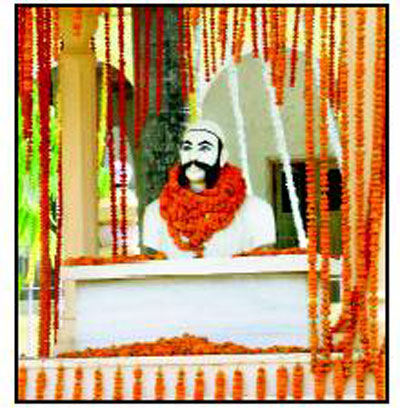
As Atul Sethi reported in Times of India, “Two statues of the old warrior, enclosed behind iron bars, stand in front of a pale yellow-coloured building, which has been declared as Kunwar Singh’s qila. Oldtimers, however, say that the actual qila is long gone. The building which is referred to as the qila was in fact part of a baradari or building complex during Kunwar Singh’s time, meant for male members of his family. Later, when Jagdispur passed into the hands of the British, the land here was sold to an Englishman Ernest Mellon, who became the zamindar of the area. He converted the baradari into a residence for his own use. Today, only two pillars from Kunwar Singh’s time stand in the building. Sometime in the 1920s, when Mellon decided to leave for England, he sold the baradari complex as well as the adjoining lands to Shriniwas Prasad Singh, one of the descendants of Kunwar Singh’s brother. His son, D V Singh, now 82 years old, is the oldest surviving descendant of the family today.” I really appreciate Atul Sethi for this contribution.

Posted in bihar | Leave a comment

Maya the Master, Daya the Devil


Proud Parent

Maya: For the whole day yesterday April 13, 2007 and even today, Maya and Daya occupied the major time of the TV News channels. In this great democracy, Maya is in the topmost chair of governance in UP, the most populous state of the country. They say Mayawati has mastered in the ‘social engineering’, a term that has become very popular recently. She is making the traditional social structure hierarchy to undergo re-engineering. For the first time, the structure is getting reversed. The Dalit is at the top and the Brahmins, Thakurs, and Banias are to work under the Dalit leadership. There is nothing wrong in that, if it serves the nation and brings prosperity to the most deprived ones. It may not be relished by some, though they may not say that openly. However, the caste barriers must break and as the results of this election has shown, it is breaking. It would bring about a great revolution in the social structure and the integration, if Maya uses the opportunities with humility and shrewdness instead of vengeances. Any one watching the oath ceremony yesterday must have realized and appreciated that. The chair is important. The birth based status is not. The subordinates bow respectfully to the boss. It happens always in all private and public enterprises. Why should there be any apprehension in political field? I only wish Mayawati took some lessons from her past performances and shortcomings, and unnecessarily didn’t annoy the bureaucracy.

Daya: While this was happening in North, in South a family feud was asking for the head of a pretty efficient minister, Dayanidhi Maran. Maran in his letter to the PM said if his resignation made the Karunanidhi family happy, he was ready to quit, and quit he did. Neither Karunanidhi nor the PM thought even for a second what all the sane people of the democracy would think of this immense injustice done to a young efficient and performing minister of the central (not state) government. And why was Daya made to resign? Dinakaran, the Tamil daily owned by Daya’s elder brother (not Daya) published an opinion poll on Karunanidhi’s potential successor- M.K.Stalin or M.K.Azhagiri. The survey in Dinakaran showed Azhagiri way less popular than Stalin. Azhagiri supporters in Madurai attacked the offices of the publication that led to three deaths. Daya was made the villain attempting to break the unity of Karunanidhi’s family. But many say that success of Maran brothers in business and their popularity among the central leadership have made Karunanidhi’s sons insecure and perhaps too jealous to go beyond the expected rational approach. Dayanidhi, by the way, is son of Late Murasoli Maran who was Karunanidhi’s nephew and also a central minister.

Are these not the greatest shades of Indian democracy evolving in last sixty years?

My Choicest readings on April 14, 2007
1. Production growth unexpectedly accelerates
2. Global Business: How competitive is India?
3. Is India overheating? Eight myths about inflation
4. Sunanda K Datta-Ray: Exiting a booming India
5. Surjit S Bhalla: Send Rakesh Mohan to China
6. English – advantage India

Posted in indian politics | Leave a comment

1857- Some Interesting Remnants From Great Uprising Days

I had been to Red Fort a number of times. However, I never knew of the most famous feature of Diwa’i am: the pietra dura panels that form the backdrop to the throne platform. I came to have the information from an article by Lahiri, a historian in Delhi University in Hindustan Times.

Italian panels of Red Fort: There are panels of birds and foliage and one representation of a Greek God. Orpheus, the greatest Greek musician of poetry and myth, is shown fiddling under a tree, surrounded by listening animals. These are Italian objects of art, and their presence in a sedate hall of public audience, where Emperor Shah Jahan attended state affairs, quirky. In the widespread loot that followed the reoccupation of Delhi by the British, the Italian panels were pilfered and carried away to England as trophy of conquest, by a captain John Jones. He sold them to the British Government for pound 500. The panels soon became part of the collection of Indian artifacts in what is now known as the Victoria and Albert museum. It was proactive Lord Curzon who could get the panels back for the Durbar to celebrate coronation of King Edward VII as the Emperor of India that was to be held in the Red Fort. Although the panels reached India before the Durbar, they could not be put in place in time for the investiture ceremony, but shortly afterwards they were restored.

Holy Shirt: The story of Bahadur Shah Zafar’s ‘Holy Shirt’ is also interesting. The shirt (presently in the fort’s museum) has verses of the Quran written on it and was apparently sent from Mecca. It was meant to provide immunity against trouble to the wearer. Not surprisingly, the king is said to have worn it continuously for the last few days, prior to his flight. However, for the reasons unknown, the king at the last moment left it behind. It was found by the French nurse of the children of a Colonel Tytler near the gate by which the royal party had fled. The shirt passed into possession of the Tytler family. The Tytlers kept the shirt in a bank vault but, until this became known, they were the victims of several robberies and more than one serious attempt on their lives. As the story goes, during the Coronation Durbar in 1903, Nizam of Hyderabad made an offer of Rs 10,000 for it. Soon after, the Imam of Jama Masjid wanted Mrs. Tytler to allow him to exhibit it in the ground in front of the mosque for some fee that was to be shared by the mosque and Tytler. The exhibition was on the verge of taking place but was vetoed by the Commissioner of Delhi at the last moment, as he ‘could not possibly run the risk of a riot.’ Eventually, the daughter of the late Tytlers sold it to the Archeological survey in 1909 for a sum of Rs 12,000.

And I also came to know of the significance of the names of many islands and landmarks in Andamans from an article in Times of India that appeared recently.

Islands of Andaman: And then it is interesting to note that the British government named or renamed some of the islands of Andaman after the soldiers who had crushed the mutineers of 1857. Hugh Rose was one who defeated Rani Luxmibai. Names such Outram, Havelock, Nicholson, Neill are also associated with the Andaman’s. That was the British wished to glorify the British generals. The recently-created Rani Jhansi Marine National Park now cradles the islands named after Outram, John Lawrence and Henry Lawrence. A tourists’ jewel Havelock, is the name of the general who retook Lucknow from Nana Sahib. Quite incongruously a Subhas Mela is held on Havelock every January.

Netaji Subhas Chandra Bose took symbolic control of Andamans and Nicobar for his Arzi Hukumat Azad Hind, renamed them Shaheed and Swaraj, flew the tricolour at Port Blair and appointed Colonel A D Loganathan of INA as governor of what was called a liberated part of India. However, the old names came back after World War II. The government in Delhi could take a decision to go back to the names given by Netaji.

Why can’t the names of the English generals associated with the islands in Andamans – Havelock, Henry Lawrence, John Lawrence, Neill, Outram, Inglis, Sir Hugh Rose, Paget be replaced by the heroes of the Great Uprising of 1857? Perhaps, that shows what we as a nation lack.

——————–
One man’s fight to save 1857 heroine’s memory

Posted in Uncategorized | Leave a comment

On This Day, 150 years Ago

On this very date in 1857, the sepoys mutinied in Meerut. Sepoys of the 20th Native Infantry went on the rampage, setting bungalows on fire and massacring British families.

The immediate reason for the rebellion and eruption of violence was the court martial and sentencing of 85 sepoys of the 3rd Light Infantry on May 9, 1857 in the presence of all the troops in Meerut.

On April 24, they had refused to use the cartridges of the new Enfield rifle, which they suspected to be greased with the fat of pigs and cows.

After they were stripped of their uniforms and their ankles shackled, they were marched off to prison. Lieutenant Gough said, “As they passed our regiment, carrying their boots which had been taken off for the purpose of fixing their fetters, a number of them threw them at the Colonel, cursing loudly in Hindustani, and calling to their comrades to remember them. There was a good deal of murmuring in our ranks, and had it not been for the presence of the British troops it is impossible to say what might have taken place.”

Over the past few months, there had been signs of unrest across northern India. Sepoys had become increasingly disenchanted with British officers. It was not uncommon for British officers to address Indian soldiers as ‘niggers’ and ‘suar’ (pig).

There is another story too. On the evening of May 9, after 85 sepoys of the 3rd Light Infantry were publicly humiliated and sent to prison, some of their fellow soldiers were seen in the brothels of the Sadar bazaar. It was not uncommon for the sepoys, many of whom spent long periods of time away from their families, to show up at the brothels.

However, the prostitutes refused to entertain the sepoys and sent them packing. One of the prostitutes present there was Dolly, the widow of a British sergeant. She said, “We told the sepoys that we have no kisses for cowards. We asked them if they were really men to allow their comrades to be fitted with anklets of iron and led off to prison? And for what? Because they would not swerve from their creed!”

Another prostitute from Kashmir, Sophie, added that the unanimous cry among the prostitutes was: “Go and rescue your comrades before coming to us for kisses.”

Interestingly, a similar taunt – but by a low caste labourer – could have sparked the unrest in Bengal earlier that year. According to sources, in January 1857, a labourer asked a sepoy for a drink of water from his lota. The sepoy, a Brahmin from Awadh, refused saying he would lose his caste. The labourer then shot back, “You will soon lose your caste altogether. For the Europeans are going to make you bite cartridges soaked in cow and pork fat. And then where will your caste be?”

Naturally, there must be some or many reasons that infuriated the sepoys all over the country, otherwise it couldn’t have that widespread. It was certainly the first war of independence, but without any central leadership and common objective for the country as whole.

We must remember those who gave their lives with gratitude. Without that beginning or protests against the injustices, we would not have moved to the next stage.
———————-
1857 Revisited
Touchy uprising for teachers by AMIT ROY
Google- Sepoy Mutiny
India’s First Independence War
Images

Posted in Uncategorized | Leave a comment

The Uncovered Marriage Ceremony

Basically, we had visited Varanasi and Patna for the marriage of Babloo, the eldest son of Nirmal, my cousin, but it has so happened that I didn’t cover that in my blogging.

As it appeared, the marriage in Bihar and perhaps in all states still remains tied up with dowry. And in the dowry market, the worst is one who lives in village. Every parent wishes to get a bridegroom working in urban area. But I feel bad when a father who has not been able to do anything significant in life, and who has not earned himself demand dowry as if by having a son he has done something great and he must get his price. Nirmal has not done anything in life. He is a PH.D, but couldn’t get himself effectively engaged. In my prime day when he had finished his Master Degree from BHU, I had got him a job in HM taking an obligation from the then President. But very soon, he left the job for a temporary job in a private college. He had to pay some donation too for that job. Some years ago, he had left that job too and now has brought a house in Varanasi. He is so younger to me and does do anything to keep himself engaged. I don’t know why I feel bad about it.


Tilak ceremony was lavishly arranged. Nirmal had a large number of guests too. I kept going back to our young days when the tilak in village used to be a great festive affair. Nirmal’s father and my uncle was famous for his excessive benevolence. The whole village used to be in the courtyard of the village house.


Marriage in Patna was hardly that enjoyable as none from the bride side requested me to bring along Yamuna, who had come with me. Neither Nirmal could understand and appreciate what we wanted. I could go to the marriage courtesy Ashok, my other cousin who works in Railways as ACP at Vadodara. We joined the marriage procession. In the marriage today, everyone of all means are trying to copy the all the functions that are held by the affluent families of metros. The procession include band party with dancing boys and girls and fireworks. Even the rural Bihar also enjoys the dancing, perhaps they get a glimpse of a ‘nauch’ girls that used to be the part of rural marriages in good old days. Garland exchange between bride and bridegroom has come from urban marriages and has become an enjoyable part of the marriage rituals. Hardly anyone attends the actual marriage ceremony that goes on late in night. After the dinner that is all getting arranged buffet style in similar manner everywhere, the guests return. I returned with Ashok to Janardan’s place where we were staying. Jana Dan had to take the trouble. Shook keeps me reminding of the marriage and Norma’s way of treating us as one of the usual guest from the village. My uncle had come all the way from village. He undertakes this risk that he should not. I spent some quality time with him that evening.

And now I realize I must not consider myself an important member of the family that I thought I belong to. That is no more alive. The fragmentation has made the families small, nucleus and selfish.

Posted in Uncategorized | Leave a comment