Booming and Bubbling India-VII

Indians in top ranks of A-level jobs: Indian executives are now in the top ranks of an international multi-racial meritocracy composed of a highly sought-after group of mobile, trans-national, ‘C’-level business leaders ie, CEOs, CFOs and COOs. AGM Transitions had proof of a definite rise in demand for and acceptability of Indians of all sorts, whether schooled and trained in India or abroad.

India creating more jobs than China: According to a study conducted by the Organisation for Economic Cooperation and Development (OECD), India has been generating more jobs than any other BRIC – Brazil, Russia, India, China – country. OECD’s Economic Outlook 2007, has revealed that India generated 11.3 million net new jobs annually between 2000 and 2005, which is over 60% more than the 7 million new jobs created in China every year.

India more stable than China: India has improved it ranking from 93 to 110 in the 2007 Index of Failed States (higher ranking is better) issued by Foreign Policy magazine. The failed state index uses 12 social, economic, political, and military indicators to rank 177 states in order of their vulnerability to violent internal conflict and societal deterioration. The index scores are based on data from more than 12,000 publicly available sources collected from May to December 2006. India is now considered more stable than China and Russia. In 2005, India was ranked below China, at 76. In 2007, both China and Russia are ranked at 62, while India’s social, economic and military metrics have propelled it to 110.

India to be pharma research hub by 2010: Several domestic players have begun developing their own internal research and development programmes and many of them have branched out into offering these discovery services on a contract basis. Within the next 10 to 15 years, 30% of the world’s clinical research will be conducted in India. Frost and Sullivan has pegged the figure on outsourced contract research in India (part of which will be pre-clinical) at $2 billion by 2010.

Pharma exports to surpass retail sales: According to the Indian Pharmaceutical Alliance (IPA), the gap between exports and domestic retail sales will only grow in the future. By 2012 the size of exports will almost double at Rs 112,275 crore growing at 35% against domestic retail market of Rs 58,607 crore with a stable growth of 16%. India has the highest number of USFDA approved manufacturing facility outside the US.

Sony Ericsson to set up R&D unit in India: Mobile phone maker Sony Ericsson is setting up a research and development unit in India to strengthen its position in the world’s fastest-growing mobile market. Sony Ericsson has a production target of 10 million units by 2009.

India’s IT/BPO market to grow at 30%: After registering a CAGR growth rate of 35% in he last two years, India’s IT/BPO industry is expected to continue growing at a healthy 30% plus on a year-to-year basis for at least another four years, according to Assocham.

Kingfisher inks deal to acquire 50 Airbus aircraft: In the single largest order by a private Indian carrier, Vijay Mallya’s Kingfisher Airlines has signed a deal with Airbus Industrie to purchase 50 aircraft at an estimated $7.3 billion.

Mumbai enters world’s top-ten financial flow league: Driven by high trading volumes for equities and good presence of global banking and financial services firms, Mumbai has grabbed a place in the world’s top ten financial flow hubs list, beating Hong Kong and Beijing in China.

India’s Got a Job for US: According to an executive search company, there are now around 1,000 foreigners holding senior positions in India, compared to 143 in 2005. By 2009, the number is expected to double.

Indian animation takes giant leap forward: According to an independent trade survey conducted recently, the Indian animation industry, which is now pegged at $550 million (Rs2200 crore) is expected to grow at 30% annually in the next couple of years and reach a level of $15 billion (Rs60, 000 crore) by 2010.

Manufacturing to create 1.6 mn jobs a year: With the country’s manufacturing sector likely to see an annual growth rate of 12% till 2010, an additional 1.6 million jobs will be created in the segment every year. The manufacturing sector in India is likely to grow by 12% per annum by 2010, which could generate additional 1.6 million jobs every year.

11% growth in service sector pushes employability: The growth in economy is being led by the services sector as also the manufacturing sector, which grew by 11% and 12.3% respectively. IT-ITES sector is the biggest employment generator and has hired a work force of about 1.63 million as of March 2007.

India’s outbound FDI may touch $35 bn: Almost a record of sorts! The country’s total outbound foreign direct investment (FDI) in 2007 may exceed the target of $30 billion for inbound FDI in fiscal 2007-08.

Essar buys Canada’s Algoma: Essar Global has completed the acquisition of Canadian steel maker Algoma Steel Inc for 1.85 billion Canadian dollar (over Rs 7071.33 crore), that will bring new dimension to its marketing operations in North America.

Hyundai to build construction gear unit in Pune: Hyundai Heavy Industries (HHI), a subsidiary company of the Hyundai Group, Korea, will build a construction equipment plant at Pune’s Chakan belt at a cost of Rs 260 crore and will produce hydraulic excavators.

Manufacturing gets an e-boost: The country’s first national manufacturing portal – http://www.nmcc-vikas.in – aiming to link manufacturing clusters, will provide information on them and increase the sector’s productivity, will also provide a common platform for manufacturing units, customers, financial institutes and the government to interact with one another.

E-sales likely to touch Rs 5,500cr: With e-shopping gaining more popularity among netizens, the total value of products and services being sold online is likely to grow by 150% to touch Rs 5,500 crore this fiscal, according to industry body Assocham.

India tops index of retail markets: According to the sixth annual Global Retail Development Index (GRDI), a study of retail investment attractiveness among 30 emerging markets, that ranks emerging countries on a set of 25 variables, including economic and political risk, retail market attractiveness, retail saturation levels, and the difference between gross domestic product growth and retail growth, for the third consecutive year India continued to occupy the top spot in 2007, followed by Russia.

Insurance market to touch $60bn by 2010: Driven by increasing demand of people for larger insurance coverage and growing rural and semi-urban market, the size of Indian insurance market is projected to grow by 500% to reach $60 billion in the next three years, according to Assocham.

Home furnishing products from rural India are set to capture a sizeable portion of the growing 3.92-trillion-yen market in Japan. Under the ongoing scheme of one-village-one-product (OVOP), Japan has begun outsourcing artisan’s products from villages in the Chindwara district in Madhya Pradesh and Periyar PURA in Tamilnadu. The products are being marketed in Japan under the brand name-OVOP from India.

Textile industry to witness 16% growth: The Indian textile industry, which has accelerated to an annual growth of 9-10 per cent, is expected to grow at a rate of 16 per cent in value terms and reach a level of USD 115 billion by 2012.

India Ramps Up Semiconductor Production: According to Gartner, Semiconductor manufacturing in India is currently limited, and although there are no operational wafer fab plants in the country right now, five fab plants have been proposed, with approved ones targeted to go live between 2009 and 2010.

Surprisingly, India’s over 9% GDP growth is widely inclusive too.

Rig Veda among UNESCO heritage list: Thirty Manuscripts of the Rig Veda, in the archives of the Bhandarkar Oriental Research Institute (BORI), Pune, have been added to a UNESCO listing of the most important documents from around the world. Although the Rig Veda was composed over 3,000 years ago, these manuscripts were written much later, in the 15th century.

It is boom all around.

Posted in economy, industry | Leave a comment

Noida- A Little Known Bird Sanctuary

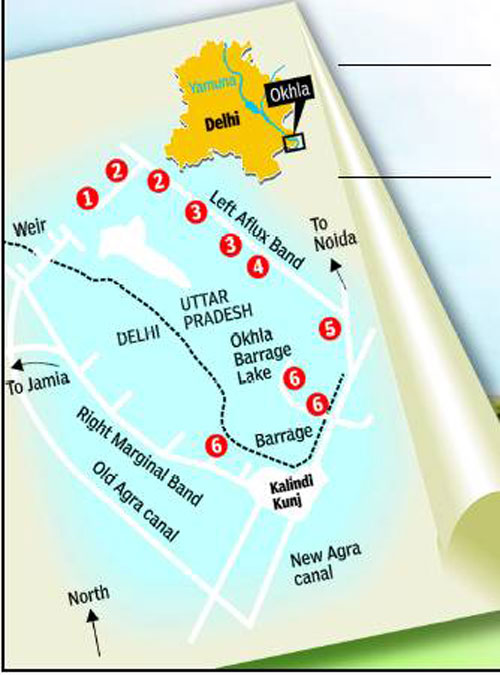
Some months ago, Mr. Arora had taken me to this bird sanctuary on the Noida side of Yamuna- ‘Okhala Pakshi Vihar’. I loved the water body, but I could not realize its significance. However, with news of various constructions to facilitate the 2010 Commonwealth Games in New Delhi and NCR appearing in newspapers almost everyday, this bird sanctuary could have become a great attraction for the visitors from far and near. And this can become a pride of Noida, if Noida Authority and Delhi Government promote it well.

The UP government notified the area on its side in 1990 as a sanctuary and perhaps Delhi government will also do that very soon for the area falling under it. However, it will need combined efforts of many agencies such as DDA, PWD, forest and environment department, and other land owning agencies, to make the place worth its importance.

Okhla Bird Sanctuary, with a spread over 4 sq km, might have come into existence in 1960s or 1950s with the construction of the Okhla Barrage and play host to over 300 bird species. However with continued long neglect by the agencies managing the area over the years, some 50 species had stopped coming. Between September and March the place is really alive with the arrival of the birds from central Asia, north Europe, northeast and the Himalayas.

Frequent visitors are: Bitterns from the northeast and Bangladesh, Eurasian Golden Oriole, various duck varieties like pochards, gadwalls. Tufted ducks and coots, black and brown headed gulls from Central Asia, White-throated kingfisher, Pled kingfisher, rose ringed parakeet, Black kite, and the Great Egret as well as Hume’s Warbler, Great Flamingo, Painted Stork, Green Bee-eater, Spotbilled duck

Agencies concerned must pull all its strength and will to develop both the sides of Yamuna, the river revered by all Indians between ITO bridge to Okhala Barrage and make it a world class water body that can attract birds and so tourists from far and near to watch and enjoy them. Perhaps, the Commonwealth Games 2010 will be the best reason to do that.

I came to know through media that Anand Arya who lives in Noida, is a keen bird watcher. Surprisingly I came to know of Anand because of a marriage function at my Noida residence in which he visited our residence in Noida. His white hair locks were unique and reminded me of Dr.Satyen Bose, the famous scientist in my Presidency College days. Many like him under ‘Delhi Bird’ have taken up the cause of Noida Bird Sanctuary. I wish it came up as a class one.

Posted in Uncategorized | Leave a comment

Seven Wonders- Can Taj be one?

TAJMAHAL


Within a fortnight from now, the voting for a new list of the ‘seven wonders of the world’ will close. It is going to be the people’s choice this time. However, the voters can be only those who are interested lot and who can use cells for SMS or Internet for e-voting. The results will be known in Lisbon on July 7 in perhaps a grand function.

The Taj Mahal in Agra was among the 21 monuments short-listed last year for the global poll. The poll is organised by The ‘New Seven Wonders Foundation‘, a privately funded Switzerland-based organisation.

The inclusion of Taj depends if somehow a lot of SMSs and e-voting in its favour can be managed to reach the organising agency. This may be a test of the nation-based preference of those in the country and abroad with an access to mobile-phone connections and Internet. Why is it not coming? Is it because either they don’t know about Taj, or about this voting or don’t care to vote? SMS voters, incidentally, can vote as many times as they like. Should some with zeal make it a mission and get into sending continuously SMSs in favour of Taj? Unfortunately, those voting on the Net can register their vote only once, and so I can’t help Taj in unscrupulous way. I Media Corp Ltd is trying to galvanise public support for the Taj. And that may be reason that on all the TV channels and print media, you can see the appeal.

At long last, Ambika Soni, the tourism minister has today appealed for vote for the monument. However, it is only some private or NGOs endeavour that too, soon enough and intense one can make Taj win a place. Some nations have taken it as real serious task. While some consider it a disgrace to make its monument compete for a place.

As reported, Brazil’s President Lula de Silva used a radio address to tell people how to vote for Rio’s statue of Christ the Redeemer. The government of Peru has opened computer terminals in public plazas to encourage people to vote for Machu Pichu.

If the Taj gets the ”seven wonder” tag, Taj will get publicity without making any investment. The Taj, as on today, is competing with Greece’s Acropolis, Mexico’s Chichen Itza pyramid, Paris’ Eiffel Tower, Brazil’s Statue of Christ The Redeemer and Jordan’s Petra.

The Great Pyramids of Giza is the only surviving structures from the original seven wonders of the ancient world, and are assured of keeping their status in addition to the new seven. Now, the race is open for all the seven spots with 20 contenders.

07/07/07 decides whether Taj keeps its date with history. And so, why not vote for Taj, if you have not.

I have done that, and wish that all like me should do it (Please SMS or use the link). It’s after all a good cause.

Posted in Uncategorized | Leave a comment

Be Green, Save Mother Earth

When global warming threat is so much a reality, the lead must come from India Inc. And it is coming. All that is done to reduce the global warming does also reduce cost as bonus in many cases.
Better energy efficiency (BEE) has become the top priority particularly in energy-intensive industries such as steel, cement, paper and fertilizer. BEE is a cost reduction step, as the electricity bill is 20-40 per cent of production costs of the sectors. According to the Bureau of Energy Efficiency, corporate India’s savings in this area run into crores of rupees every year:

1. Rashtriya Chemicals & Fertilisers has reduced its power consumption by 60 per cent in the past decade using new technologies.
2. With energy comprising 80 per cent of costs, Indian Farmers Fertiliser Cooperative (IFFCO) reduced consumption by 6-14 per cent, with a Rs 8.3-crore upgradation of its Phulpur urea and ammonia plant helping the company save Rs 1.2 crore every year.
3. Jindal Stainless Ltd (JSL) saved nearly Rs 4 crore through waste reduction in 2005.
4. Chemfab Alkalis invested Rs 36.75 lakh to upgrade and replace inefficient pumps and compressors, and initiated other steps, which led to savings of Rs 82.75 lakh in the last three years.
5. Jubilant Organosys’ energy expenses, as a percentage of total costs, came down from 34.5 per cent in 1997-98 to 21.9 percent last year.

Cement kilns have shifted from wet to dry process; the automobile industry is recycling wastewater and re-using the sedimented heavy metals used in electroplating. Textiles firms are adopting cost-effective technologies. Pulp and paper majors like ITC and Ballarpur Industries have cut water usage by half.

The desire to become a global manufacturing hub has impelled auto majors to reduce pollution. Hero Honda has already switched over to asbestos-free brakes in its motorcycles.

Institutions such as Shriram Institute for Industrial Research (SIIR) and The Energy and Resources Institute (TERI) have started offering sector-specific solutions.
The concept of green buildings that result in huge reductions in power (30-50 per cent) and water (30-50 per cent) usage are getting acceptance among many corporate that have decided to build only green buildings. From just over 50 green buildings now, the number may double by end-2007.

CII-Godrej GBC has also been able to start a voluntary programme, in which corporate members agree to reduce annual consumption of energy by 2-6 per cent, water by 5-10 per cent, and material by 2-6 per cent, and emissions by 2-6 per cent. Inspiration, perhaps, came from China, which, in 2005, asked its top 1,000 enterprises to reduce emissions by 20 per cent by 2015.

In interesting news, two Indian firms Bangalore-based SELCO (Solar Electric light Company) India and Kerala’s Biotech won the Outstanding Achievement category of the Ashden International Awards, more popularly known as ‘Green Oscars’. SELCO has brought reliable, affordable, and environmentally sustainable electricity to 55,000 homes and plans to reach an additional 200,000 customers by 2010. Biotech has till now, built and installed 12,000 domestic, 220 institutional and 17 municipal biogas plants to generate power from waste.

Lighting consumes a fair amount of energy. About 40 per cent of electric energy consumed globally goes for lighting. In India, it is about 17 per cent. A switch over to the fluorescent lamps from the 100-year-old technology of incandescent bulbs will save a huge lot of energy. It was interesting to hear the new CM of UP announcing a plan of the switch over to CFL in all government buildings. LED will be the next target for lighting for energy saving. Unfortunately, I have myself not done 100%, whereas my friend Sirohi has carried out the exercise. Even the household appliances such as refrigerators and airconditioners have got a mandatory standard about the power consumption. India faces a peak hour deficit of 14%. And the switch over to solar lights and CFLs can change India from deficit to surplus even without any additional generation.

It doesn’t, however, mean that India should not expand and expedite its generation capacity. But it is the responsibility of every person as a global citizen of mother earth to save energy and water.

Posted in Uncategorized | Leave a comment

Nalanda International University- India’s Prized Project

I had been following the project of Nalanda international University closely and have some dreams about that. I have written too time and again. I was thrilled to see an editorial-‘Nalanda Redux’ in the ‘Times of India’ today.

The Nitish Kumar government is building a modern university in Nalanda, an ancient seat of learning, as the symbol of a new, resurgent Bihar. Nalanda-in-the-works could be a model for revamping existing universities in India. The proposed Rs 1,000-crore project has international collaboration and will offer courses in subjects like IT, bioinformatics, development studies and applied sciences. A mentor group headed by Amartya Sen, and including representatives from China, Japan and Singapore, will oversee the making of an international campus. A standout feature of the Nalanda blueprint is the suggestion to hire part of the faculty from abroad. Forty-six of 453 teaching staff will be from outside India. They will be paid an average annual salary of $36,000 per person.

According to another report, ‘foreign minister Pranab Mukherjee followed up on the Nalanda University initiative by setting up a Nalanda Mentor Group in Singapore, headed by Nobel laureate Amartya Sen and Singapore foreign minister George Yeo. Nalanda is at the heart of the Indian soft power push. It’s where China’s greatest Buddhist traveller, Hiuen Tsang, came to study Buddhism under a Bengali teacher called Shilabhadra in the 7th century BC.’

I never knew that the project has gone so far. And it is really prudent that the central government is taking keen interest too. I say so because a government change in Patna will not affect the project.

I only wish that Bihar government creates a website proving the updates on some of the key projects of importance such as this. After years of sanction, the AIIMS in Patna is still years away from getting operative. Even the sanctioned project for an IIT in Bihar must move fast. IIT could have been the part of this Nalanda University. And more and more such specialized institutes from all the developed countries could be part of the international campus.

As an old man I am hopeful that in years to come the Nalanda International University will be a showpeice for Bihar and India.

Posted in bihar, education | Leave a comment

Purdah, Veil, Gunghat Creates Problem

‘In Rajasthan, people still practise purdah. The practice came into existence during Mughal rule, when we had to protect our women from men. After that the Mughal rule came to an end, we got Independence but we still continue to practise purdah. We must change with the times.”

The above is from a speech of Pratibha Patil, Governor, Rajasthan and the UPA candidate for the forthcoming Presidential race and the virtual president-designate in Udaipur at a function to commemorate the 467th birth anniversary of Maharana Pratap. Her reference was just to urge for abolition of the practice. However, her opinion that the purdah was introduced in India to “save women from Mughal invaders”, has created a furore among the Muslim leaders, historians and politicians of opposition parties, who wants to cash on this. Jamiat Ulema-i-Hind general secretary Maulana Mehmood Madani said, ‘She has twisted history, she must apologise and withdraw her observations.” It has certainly created a problem for Mrs.Patil.

I don’t know why we Indians have become so much intolerant. It is something strange for our culture of thousands of years. Why should the people take an opinion so seriously? I personally feel the purdah certainly was to conceal the faces of women from strangers, particularly the strong, brute, uncultured ones. Someone who would have seen Padmini, the queen of Rana Pratap ancestry, narrated about her beauty to Alauddin Khilji who invaded the kingdom to get her as her wife. But it was not only Mughals, it was also true with the Hindu kings and even petty feudal from whom the fear was equally there for women.

Historians say ‘purdah’ originated in India much before Babur heralded the Mughal rule in 1526 AD. Some of them say purdah was a status symbol of the higher classes in medieval India. According to renowned historian Satish Chandra, during the Delhi Sultanate period, beginning in 1206, the practice of keeping women in seclusion and asking them to veil their faces in the presence of outsiders became widespread among the upper class women. It was the Arabs and the Turks brought the custom to India, and consequently, it became widespread in north India. Historian Kegan Paul traces the practice of the custom back to the Vedic period. And anthropologist Patricia Jeffrey also opines its origin before the Muslim invasion. The mediaeval Chittorgarh fort that has separate quarters for women called the ‘jenani deorhi’. Even in our village, we also had a system of ‘janani kitta’ that used to be meant for women. Women will have purdah with all the elders in the family. Yamuna used to have purdah till very late, whenever she used to visit our village. It was absolutely necessary when we used to visit our mother at Bodarhi, my maternal village. It was to convey the message among the neighbours, particularly the women folks that the daughter- in-law is very obedient and abides the traditional things even though she is a wife of an officer. Interestingly, the peasant and working class women did not observe purdah. It was a feature primarily among upper classes. However, very lately they also copied what the women of the farming community did.

However, ”most historians consider the Muslim invasion as a watershed when purdah is said to have become more widespread as a defensive reaction in troubled times among the Rajput royalty trying to protect their women.”

But I feel like narrating some troubles caused by purdah system. Every summer in marriage season in Bihar in good old days we used to read a number of stories how the brides returning with their husbands from the marriage used to get mixed while boarding trains. My grand father has also mentioned about it in his diary. It is certainly something that must stop. The respect can be shown in other ways too.

But I believe, the best against purdah has come from Tulsidas in his Ramcharitmanas. Sita is being brought from Lanka’s captivity after Ram wins the war in ‘palki’ or ‘sivika’. And then Ram instructs, “Kah Raghuvir kahaa mum manahoo, sitahi sakha payade aanahoo, dekhahhoon kapi janani ki nai.” (Let Sita come on her feet, so that all the monkeys can see her as mother.)

A poet talks about the prevailing traditions of the society through his characters. Purdah was not a part of Indian cluttered. I have hardly seen any female statute with veil o the face.

Posted in economy | Leave a comment

Bengal First, Bihar Second

Many a times I don’t understand why don’t the leftists work on improving its performance and if at all they can. In West Bengal, the leftists are running the government for more than three decades. Wasn’t West Bengal was relatively well placed in comparison to other states, when they took over?

West Bengal is the state where I grew, got educated, and spent my whole professional career. I have many friends and a special attachment with the people of the state. I feel really bad that even today Presidency College is not a deemed university. Do the leftists consider education as something of lesser priority?

A report in ‘Times of India’ today tells a sad story. We all know that Bihar is one of the worst in education and other development parameters. For 15 years or more, Bihar was under political leadership that was such that no development happened. West Bengal didn’t have that disadvantages. But as per the report West Bengal is worse than even Bihar.

There are as many as 11 districts in Bihar where out of school children in the age group of 6-14 are more than 50,000. Left run West Bengal has nine such districts. However, the total of out of school children in the 6-14 age group in Bihar is still less than West Bengal’s. While Bihar has a total of 6.96 lakh out of school children, West Bengal tops with a figure of 9.61 lakh.

Overall, there are 24 districts having more than 50,000 out of school children (OOSC). These 24 districts contribute 19.33 lakh OOSC to the total OOSC figure in the country of 70.18 lakh – roughly 27% – as of March 31 this year. More than 70 lakh OOSC comprise 3.5% of the total population of children in the age group of 6-14 which stands at 20.21 crore for the whole country. For a change, male and female children contribute equally to the OOSC figure of 70 lakh.

In Bihar, the 11 districts are West Champaran, East Champaran, Madhubani, Katihar, Madhepura, Samastipur, Begusarai, Patna (rural), Khagaria, Nawada and Gaya.

In West Bengal, nine districts with more than 50,000 children out of school are Malda, South 24 Parganas, North 24 Parganas, Bardhaman, Uttar Dinajpur, Purulia, Bankura, Birbhum and Murshidabad.

Are these data not revealing enough that the leftists including its top leaders such as Jyoti Basu or Buddhadev Bhattacharya or for that matter, the smart faces of CPM Shri Prakash Karat and Sitaram Yechuri be ashamed of this? Should the data not make them feel the shortcomings of their model of development?

Fortunately, the list of districts does not include the district where I was born in Bihar, but it includes the district where I had my schooling in West Bengal. In fact, the leftists in West Bengal have not done anything but perpetuated its rule by its strong party cadre system. And so they have been winning all elections with so much ease for so many years without doing much for education.

Can’t the people of the states understand this? Should not the MLAs be considered accountable for this and defeated?

Posted in Uncategorized | Leave a comment

Father’s Day

Today early morning when Shannon and Puchhu called me from US, it was still the Father’s Day there. Both of them wished me, though they had already sent e-greeting cards. The cards have gone really wonderful with those musical tunes. I go on playing that a number of times and enjoy. Anand provided the link of a wonderful article on Father’s day too.

But what is this Father’s Day. Yesterday Rakesh had called me to wish. I had put this question to him also. As a businessman himself, he had a very realistic reply. ‘Papa! Some says these Mother’s/ Father’s Days are the creations or innovations of greeting cards industry. Actually, it is Thanks Giving Day that is meant for expressing some sort of respect to the ancestors and that is an old practice in American society.’

But as usual I have my own views on these days. On the Father’s Day, the children must remember one incident in their life where they liked the way their father acted. And the best will be if they narrate the story to the father or write to him. I am sure the father will get the maximum happiness that way.

Unfortunately, when the kids are in growing stage the parents, particularly fathers, but now mothers too, are very busy in their professional engagements. Many a times, they fail to give the desired time for the children that they miss for the whole of life. Many of the parental actions even though in the interests of the children get misunderstood.

I feel myself the guilty of the same today. I came from an ordinary rural background and wanted to make a name for myself and thereby for the family. I used to work like a madman for twelve-fourteen hours for many years for a private company that I considered as my own. As a fool, I used to think that I was the best and so indispensable. I get a shock of my life when Yamuna tells me that we could go out on a holiday for only once in the whole of my professional career. Naturally, the children missed many things that were their due.

But as a father, why should I repent? The greater Father looked after them, all are today in US, married with a family of their own and are doing fine. However, June is a great month for us. While June 10, is Rakesh’s birthday, June 14, is our marraige anniversary too.

I am sure they all will be better father.

Posted in Uncategorized | Leave a comment

Booming and Bubbling India-VI

I had just finished my entry last week when I got a mail from Anand in US giving me a link that was on India’s automobile sector. And within seconds, I had another mail from Mithilesh Jha who is an IITian (Kanpur) from Bihar. After working in many companies, Jha has now his own start-up ‘Masamb Electronics Systems Pvt. Ltd.‘ His area of activity will be chip design. I have requested him to involve the engineering colleges of Bihar and he has promised me to do that soon. All over the country the entrepreneurs of all sorts are busy in pushing ahead the economy in their own way, while politicians are busy in creating speedbreakers to the growth. Here are the boom stories. Some may be bubbles.

10% GDP this fiscal: Union Finance Minister P Chidambaram is confident of GDP growth to touch 10 per cent in the current fiscal.

Billion-dollar Indian companies: India has today 71 Indian companies that are in the billion-dollar club league. Interestingly, the Gujarat Co-operative Milk Marketing Federation (GCMMF), the makers of the Amul brand of dairy products, has joined the club, as its revenues for 2006-07 revenues stood at Rs 4,277.84 crore or $1.04 billion. Amul, in contrast, is the achievement of the pooled efforts of 26 lakh dairy farmers across 13 districts of Gujarat.

Vodafone to invest $2 bn in India: Having constituted a new board to administer India’s third-largest mobile firm Hutch-Essar, Vodafone announced its plan to invest two billion dollars in the country this year.

Retail design emerges as hot career:
The retail industry is booming. And retail design, as seemingly niche career is in demand with students across the country.

Biotechnology exports up 47%: The Indian biotechnology industry grew by 30.9% during 2006-07 to reach Rs 8,541 crore and upped exports by a massive 47% to Rs 4,937 crore. At the current exchange rate, the industry’s topline works out to be $2 billion and exports $1.2 billion. The industry is confident to reach a topline of $5 billion for 2010.
‘
Engineering exports are the largest foreign exchange earners and account for 20% of the country’s total exports. Of India’s total exports of $125 billion for 2006-07, engineering exports stood at over $26 billion.

Attrition rate: Because of increasing opportunities and employee aspirations induced by robust economic growth, the attrition rate at 40% is alarming in the services sector, while the same in manufacturing was 20%.

One PC for every 50 Indians: About fifty Indians now share a single personal computer (PC). IDC, the research firm’s India Quarterly PC Tracker for the first quarter of 2007-08 (Q1FY08) pegs the Indian client PC (desktops and notebooks combined) base at 22 million – a figure that has more than doubled from 9.5 million in 2003. By 2015, two out of every seven people in the world will have a personal computer, with India, China, Russia and Brazil emerging among the fastest growing markets.

Robust performance by the manfacturing sector propelled the overall industrial output of the country during April 2007 to a growth of 13.6% as against 9.9% in the corresponding month a year ago. Manufacturing sector grew 15.1% this April, as compared to 11% in April 2006.

India far ahead of China: China is far behind India in the software sector and India should focus its efforts towards leveraging this lead to move ahead in the global market.

Acquisitions:
: OVL to buyout Exxon Mobil stake in Brazil: The Government has allowed ONGC’s overseas arm, OVL late last week to invest US $ 820 million to pick up 30 percent participating stake in Brazil’s oil field held by international oil major, Exxon Mobil in the BC-10 project in Brazil. Patni Computer Systems is close to acquiring an European IT in the next two months. Carborundum Universal (CUMI) has entered into a memorandum of understanding to pick up 84.14 per cent stake in Volzhsky Abrasives Works (VAW) located in Volzhsky of Volgograd region in Russia. Reliance Industries is eyeing acquisition of oil refineries in the United States and Middle East. The Mukesh Ambani-run firm looks at expanding its overseas portfolio. ICICI Venture – the private equity arm of ICICI Bank- has acquired majority control in USbased clinical research company Radiant Research. Radiant has 26 other clinical centres. The current deal led by ICICI Venture could have been valued at $150 million plus. Mahindra Systems and Automotive Technologies (MSAT), the auto components arm of Mahindra and Mahindra (M&M), is in an advanced stage of negotiations for acquisition of at least four overseas companies in the areas it operates – stamping, composites, forging and gear box. The total acquisition cost may be around Rs 1,000 crore.

R&D: :Motorola India: India will be the hot spot for the $42.7 billion telecom giant Motorola for coming out with new technologies suited for the emerging markets from Motorola India Research Labs situated in Bangalore, which was set up in 2005. Agilent Technologies, a $5 billion measurement solutions provider, plans to ramp up its R&D presence in the country significantly in the next two years, tripling the R&D headcount in the country from the present 150 to more than 450 by 2009. India will launch its first dedicated military satellite in August this year providing it the capability to monitor missile launches in its neighbourhood. India is likely to capture 15 per cent of the over $54 billion market in the upcoming Knowledge Processing Outsourcing (KPO) industry by 2010. The average expenditure of pharmaceutical companies on research and development has increased four times in the last five years. “There are at least 20 R&D heads with leading pharmaceutical companies and clinical research organisations (CROs) in India earning salaries of over Rs 1 crore a year.” India has emerged as the largest R&D centre for Cambridge Silicon Radio (CSR), a provider of personal wireless technology, including Bluetooth and FM receivers, outside the UK. ‘Renault to design $3,000 car in India’ French car manufacturer Renault is to create a USD 3,000 car in India within three years, French newspaper Le Figaro reported on Wednesday. Renault planed to open a third “techno centre” in India and hire 1,000 engineers to create a super low-cost model that would not be sold in Europe.

Manufaturing: Hero Motors prefers to call itself an “integrated engineering solutions” provider and is already a major component supplier to companies in Europe and the US. It recently got an order for gears to be fitted on 800-cc BMW transmission units.

FII inflow hits $4 bn mark: Foreign institutional investments this year has crossed the four billion dollar mark.

Pulses production: India is expecting to reverse a decline and actually record a 14% jump in pulses production to 17 million tonnes (mt) in 2008-09, as the high-yielding, hybrid variety of pigeon-peas (arhar) is expected to push up their yields by 25%.

India starts producing ethanol from sweet sorghum: The country’s first plant for commercial production of ethanol from sweet sorghum, a rainfed multi-benefit crop, has gone on stream at Mohammed Shapur village in Andhra Pradesh. Sweet sorghum is like any ordinary sorghum but with a high content of sweet juice in its stalks. While the juice is used to produce ethanol biofuel, the grains can be used as food or feed.

India’s AIDS not epidemic: India, which has been repeatedly accused of denying the size of its AIDS epidemic, probably has millions fewer victims than has been widely believed, according to a new but unreleased survey.

Biotechnology starts to sprint: In two years (2005-07) the biotechnology industry has virtually doubled in size to reach $2 billion and is confidently looking forward to a $5 billion benchmark by 2009-10. India has now overtaken China in acreage under Bt cotton.

Railways in topgear: By 2015, passenger trains will move at an average of 100 kilometres per hour from 55 kmph currently, slow-moving goods trains will ratchet up their speed from 24 kmph to 60 kmph; and passenger traffic will soar from 6 billion annually to 10 billion.

Speed Post from home: To compete better with private courier companies, the Department of Posts has decided to set up call centres in eight cities – Delhi, Mumbai, Kolkata, Chennai, Pune, Bangalore, Hyderabad and Ahmedabad – with toll-free numbers that customers can ring and get their packets picked up from home.

WB clears Salt Lake to Howrah Metro project: The much touted East-West Metro, the Rs 5,000-odd crore project, to connect Kolkata’s twin city Howrah in the west with IT hub Salt Lake in the east, was cleared by the West Bengal cabinet today. It would require a tunnel under the Ganges. Will I be able to see this project running?

Renewables contribution increasing: The share of renewables in the 10th Plan power generating capacity addition is 20%, double the initial target of 10%. The capacity addition during 2006-07 has been 1,191 mw of which wind power 933 mw, biopower 199 mw; small hydro power 69 mw. Renewable power capacity addition in 2007-08 is expected to be 2,000 mw.

Captive power supply delicensed: The Centre has delicensed the supply of power produced by captive power producers to overcome peak shortages through an amendment to the Electricity Act, 2003 via the Electricity (Amendment) Act, 2007 coming into effect from June 15. Power shortage is only holding the GDP growth below 10%.

India may stage Formula-1 Grand Prix: The Indian Olympic Association has reached an agreement with Formula One boss Bernie Ecclestone to stage a Grand Prix in New Delhi by 2009.

Indian excels: Subra Suresh, an IIT Chennai alumnus, who is currently the Ford Professor of Engineering in the Department of Materials Science and Engineering at MIT, will succeed Institute Professor Thomas Magnanti as the next dean of the School of Engineering, MIT provost Rafael Reif announced Thursday on July 23. Knighthood for Rushdie Salman Rushdie, whose Midnight’s Children won the Booker Prize, will be knighted while Indian-origin rights campaigner Shami Chakrabarti also figures in the Queen’s honours list this year.

Indians hiring in America: Now Infosys and other Indian outfits are hiring aggressively in the U.S. Wipro Ltd. is scouting U.S. locations for two big software centers that eventually could employ hundreds of programmers each. “The Indians are doing to the world’s IT processes what the Japanese did to manufacturing,” says analyst John McCarthy of Forrester Research Inc. And now, like Japan’s carmakers before them, the Indians are becoming major employers in the U.S. as well.

Is not the going is great?

Posted in Uncategorized | Leave a comment

Manmohan@3-III- an Evaluation

Many a times, one reads news such as DMK’s Karunanidhi, or Prakash Karat of CPM meeting Manmohan Singh on some issues such as inflation, disinvestments or the presidential candidate of UPA. Does Manmohan Singh play any role in these decisions? How hollow it appears when the whole of the country knows that Sonia Gandhi makes all these decisions? Both Shivraj Patil and Pratibha Patil were Sonia’s selection. Why is the government making so much of effort to make it appear that Manmohan Singh is effective? Let me confess I don’t have any grievance from the learned PM on this issue. He is not at all a political heavyweight in Congress that can affect a decision. He serves only as an intelligent and knowledgeable adviser.

However, Manmohan Singh could have certainly brought about some changes in administration that would have saved a lot of money for the nation. ‘India Today’ in its June 18, 2007 issue has come out with a cover story ‘White Elephants’ about the useless ministries- ‘using coalition compulsions as a fig leaf, political parties have kept alive 20 useless ministries costing the government over Rs 74,000 crore.’ With all his knowledge of applied economics from Delhi/ London School of economics, Manmohan Singh could certainly have persuaded Sonia and his other colleagues to do at least some reforms about the national wastages by restructuring the cabinet in a more effective manner that could have made implementation of any project of national interest more efficient. And the money thus saved could have financed education or healthcare.

Manmohan Singh has today 79 ministers-33 cabinet, seven ministers of state (MoS) with independent charge, and 39 MoS in his cabinet. (On average, each minister carries excess baggage of 20 direct administrative staff and depending on the ministry, 20 civil servants with their additional support staff.) And this too, as the 91st Constitutional Amendment notified in January 2004 sets a ceiling of 15 per cent of Lok Sabha seats as the maximum size of the Council of Ministers.

Manmohan Singh could have sold the idea of a smaller cabinet, perhaps not more than 15 or 18. Bibek Debroy, Professor, International Management Institute, and Research Professor, Centre for Policy Research in guest column ‘Elephantine Problem’ of the same issue of ‘India Today’ suggest a cabinet of 12 ministries-PMO, External Affairs, Rural Development, Home Affairs, Energy, Finance, Social Justice, Commerce and Industry, Physical Infrastructure, Defence, Law and Justice (including Company Affairs) and Environment. At best, one can add one more on Space, Atomic Energy, Science and Technology. When US, UK, and France can effectively run with about 20 ministers or secretaries, why should India a poorer country requiring resources urgently for some basic infrastructures or for social services waste money on such a large cabinet. Who knows it better than him that each cabinet minister costs the country Rs 4 crore a year and each MoS costs Rs 2 crore that in itself a very conservative figure?

Every Indian had a great expectation from Manmohan Singh because of his successful tenure as Finance minister in 1990s. But it seems the country has not given the due credit to the then PM who backed his policies.

Manmohan Singh would have left an impression of his personality in government working if he would have made some changes of performance evaluation. Why should a performance be judged by the expenditure made and not by work done?

Manmohan Singh could have given a solution to the wasteful system whereby the center spends Rs 3.65 to provide a subsidized food grain worth Re 1 to a person living below poverty line.

Instead Manmohan Singh has started a new tradition of coming out with a policy for every sector that one can imagine. And then he sets up a GoM with Pranab Mukherji invariably as its head.

1.Manmohan Singh would have certainly made all chief ministers sit together and come out with an agreeable solution to the problem of land acquisition and compensation for the land required for the projects of national importance. He could have also taken initiative so that Gujarat would not have occurred again anywhere in the country. But the recent troubles related to Dera and Gurdwara in Punjab, Gujjar and Meena in Rajasthan, he has not come out with some innovative solution.

2.With leftists in his government Manmohan Singh could have come out with a definition of democratic protests. How much of the protests come under democratic right? How can the people are not inconvenienced by flash strikes and agitations, as it was caused by the employees of aviation sector that are very highly paid?

3.Manmohan Singh is his three years in chair could have got a lot of irrigation projects that are pending for decades completed. He could have certainly solved the issue such as Sutlej Canal where the country has invested so much of money but because of the adamancy of a state the facility can’t be brought in use.

I feel bad that this model of putting the best economist as PM of the country that I praised has failed.

Posted in economy, governance | Leave a comment