NHAI vs. Delhi Metro

NH-2 Delhi to Kolkata

I have been following the two projects for a long time. I see Delhi Metro working in Noida, and get convinced of its world-class professionalism. Hardly one can assess the amount of confidence it would have given to the technocrats and project managers of the country. I don’t know if it has created some intellectual properties in form of patented technologies. However, Sreedharan has certainly become one of the best CEO managers in the world, and interestingly with his age in 70s, when American management gurus have made experienced managers beyond 60 or even younger ones all over the world retire and replaced by younger ones in 40s.

At the same time, the progress of NHAI projects has been dismal, particularly in last four years. Everywhere I go, I make it a point to go by road to see the progress and quality of the construction work going on almost in every part of the country. I have been writing on the issue quite often too. I cherish a wish to drive all along the GQ and NS and EW corridor expressways during my lifetime and see my country. However, the NHAI is missing all the time schedules promised. Why is this difference? Perhaps its remaining strictly under the minister’s control is the main reason. NHAI head might not be having the same autonomy. But with a proven model of Delhi Metro, why couldn’t Mr. Man Mohan Singh go for the similar operation management and/or appoint a CEO of the caliber of Sreedharan for NHAI?

I have judged performance of NHAI through a different tool. NHAI under UPA made one change in its web content that clearly indicates its intention and the officer responsible for doing that should be named. In its chain diagrams, it removed the estimated dates of completion of various segments that were designed and followed till NDA ruled. It was done so that no one can point out at NHAI’s failure to meet the time frame. It hardly bothers about the anomalies that its information on the web provides. The map of the expressway connecting New Delhi to Kolkata as on April 30, 2008 gives a figure of only 34 kms as incomplete or under implementation. However, when I go to its chainage diagram for the Delhi-Kolkata on NH-2, I find hundreds of kms and many segments still shown ‘under implementation’. Why is it so? Can some one responsible in NHAI and the transport ministry, explain?

I wish some one goes along the expressways and write a book for people who shall like to see India following the routes. Perhaps, the speed of progress confirms that at least my wish to do that will remain unfulfilled. After Satyendra Dubey murder, it became known that NHAI projects suffer from blatant corruption and even the quality of the construction is far from the world-class standard that it claimed once to achieve. It would have worked hard to make it more transparent and involved institutes such as IITs or CRRI more intensively.

I feel bad, as just this one single infrastructure project, if properly executed, would have taken India pretty ahead and added to sustainable overall growth. I call it a project of national importance but the government doesn’t think so, nor treat so. It is still not late for the government to see that the timeframe is not sacrificed.

Posted in Uncategorized | Leave a comment

India Vs China: Some Exciting Aspects

I don’t why, but every time I come across news where India is ahead of China, I get immense pleasure. Even a higher production of menthol mint oil excites me. Here are some more:

1.According to ‘World Wealth Report’, an annual survey by Capegemini SA and Merril Lynch, the number of people with over $1 million to invest, not including the value of their homes or consumable goods rose by 23% in India over last year posting the biggest gains in millionaires, when China posted 20%.

2.India receives the highest remittances of about $ 27 billion from Indian national working abroad followed by China’s 25.7 billion.

3.According to the third Annual Synovate Young Asians study, Hapiness Rating for the respondents aged between age 8-24 for India was 98% as against 76% for China.

4.India has become the largest producer of menthol mint oil in the world, overtaking China with a production of about 17,000 tonnes, 78 per cent share of the annual global output of menthol mint oil.

5.Movies and guru: As Tarun Khanna writes, ” The Indian film market is twice as large as that of China. India produces more than 800 Hindi movies a year, and its film industry has an estimated annual turnover of nearly $1.3 billion, employing 6 million people. In 2006, revenues of the Chinese film market were approximately $737 million… While traditional Chinese medicine and martial arts have plenty of followers in the west, no single ambassador has achieved the fame and influence of Vivekanand or (Deepak) Chopra today… Eight percent of Americans report having tried yoga in some form, whereas only 3 % have tried tai chi. In an attempt to popularize tai chi, one enterprising instructor reports choreographing tai chi movements with yoga postures.”

6.English writers: Indians writing in English are making their marks better in West than Chinese. Recently, Manil Suri’s first novel, The Death of Vishnu, published by WW Norton and Co. in the US, was excerpted in The New Yorker and had a $350,000 (Rs1.5 crore) advance.

7.India closely follows China among the most popular countries for sourcing foreign talent, according to a Manpower Inc survey titled ‘Borderless Workforce’.It has better potential to lead.

8. One is not surprised when the Global Competitiveness Report (2006-2007) ranks China 6th in terms of macroeconomic performance, whereas India is ranked lowly 88th out of 125 countries. However, the same report ranks India higher than China in terms of overall rankings. It ranked India 43rd in Global Competitiveness Index, whereas China is ranked 54th. At various other factors at micro-level, apart from macroeconomic performance, to calculate the Index, India performs much better than China on almost all parameters. On the Innovation Index, India is ranked 23rd, whereas China is ranked 57th. On the Institutions Index, India is ranked 25th, against China’s rank of 80th. In terms of Market Efficiency also, India performs much better with rank of 21 compared to China’s rank of 56.

9.India is ahead of China in exploiting technology: The World Economic Forum, which assessed 127 countries based on their ability to exploit available information and communication technology has ranked India at the 50th place, when China is at the 57th position this year.

10.India had vis-à-vis China much higher skill level among its women population. However, Chinese women are much more likely to be in the workforce despite that country’s lower percentage of skilled women in the total population. While Indian women represent 38 per cent of enrolment in higher education in 2004, the workforce participation rate for women remains very low, at about 18 per cent in urban areas. According to latest government figures, less than 9% of all women in Delhi are earning members of their families. Are the women listening?

11.Immobility of labour in China: While there are no restrictions on mobility of talent in India, China still follows the “Hukoku” system that discourages graduates and skilled or semi-skilled labour based in remote provinces from working in more developed areas. For example, a graduate from a second-tier city who wants to work in Shanghai will have to overcome considerable obstacles, including mobility restrictions. The government works as Raj Thackray there.

12.Low proportion of Chinese students returning from study abroad: While the pace of Indian students returning home after higher studies abroad has been increasing due to better opportunities, it’s exactly the opposite in China.

13. Poor English skills will continue to be one the biggest obstacles to China’s becoming the premier offshoring location for MNCs. If you take the mean scores of the Test of English as a Foreign Language (TOEFL), China’s results are lower than India’s in all subjects (although higher than worldwide averages), especially in listening comprehension.

14.China, followed by India will be a top destination for sourcing for the retail and the consumer sectors in the coming years. While cost is still the key driver of global sourcing activities, mature companies are shifting focus to gain greater efficiency in the competitive market, with focus on better quality products and collaborative supplier relationships, according to a PricewaterhouseCoopers survey.

“There are many other factors that weigh heavily in favour of India, including the demographic profile of its population, its superior banking system, its more sensible approach towards environmental issues, its lead in IT and other knowledge-based industries, its vibrant domestic private sector and, above all, its fully matured democracy, which is more basic to sustainable economic growth than most realize.”-Source: India and China – Comparing the Incomparable

India must build on its own stronger areas, and innovate new ways to improve its yields in agriculture, where with larger arable land, it can leave China behind. It must also focus on manufacturing sector to provide employment to the large population that is getting released from agriculture sector in rural India.

Posted in Uncategorized | Leave a comment

Ranbaxy Deal Shames India

Years ago when I heard of Hindustan Motors handing over its earth moving machine division in Chennai to caterpillar, I got shock of my life. That was the best manufacturing plant of the CK Birla group of companies. CK Birla might have gone richer or wealthier or got rid of some debts, but in the general perception of all the employees as well as the people who knew the group, it was the decline of the business house. Many rumours went around including the personal ones. My shock was perhaps because of my rural upbringing where a sale of the inherited property brings bad name for a person selling it.

After hearing the sale of controlling stake of Ranbaxy laboratories to Daiichi Sanko for nearly $4.6 billion, or $17.14 per share, a 31% premium over Ranbaxy’s current share price, I got a similar feeling. Perhaps many in India might not have taken the deal as a good move by the grandsons when the founder grandfather was alive. It might be a good business deal as many pink papers reported, but it must have tarnished the perception about the young men who owned Ranbaxy.

Business Week called it ‘India’s Shocker Pharma Deal’. Why would Ranbaxy Managing Director Malvinder Singh bail out of a company set up by his grandfather Bhai Mohan Singh and built by his visionary father, the late Parvinder Singh?

Am I getting unnecessarily sentimental? Are these deals not connected with the nation’s pride? Is it just a business strategy to earn the best from what one owns at the right time? But then why should we grumble when Europeans or Americans expressed similar views when Mittal took over Arcelor, or Tata acquired Corus? Why should those acquisitions got so much of hype in Indian corporate houses and even in the political circles? It is interesting that none of the biggies in corporate India made any remark on the Ranbaxy deal, though Ranbaxy for years was the exemplary success story of Indian pharma sector almost similar to Infosys and Wipro for IT sector. Even among the political leaders I read only Advani making some remarks against the deal.

What a shame! Malvinder Singh is happy to remain the CEO of the new group. It is difficult to understand what Singh meant his statement, “The deal would “allow us to transform and go to the next level.” I consider such deal reflects poorly on the management talent of the enterprise that gets acquired. Should India take note of it? Couldn’t some Indian business houses, such as Ambani brothers, buy the company and run it better?

Posted in Uncategorized | Leave a comment

Bihar Under Transformation

Saibal Gupta, member secretary, Asian Development Research Institute (ADRI), Patna is pretty optimistic about Bihar and so am I. In a recent column in Indian Express, Mr. Gupta writes, “The grammar of politics is changing in Bihar. Election hereafter cannot be fought on the basis of the earlier benchmarks of muscle and firepower. The most under-governed and underdeveloped state of the country, for the first time after -Independence, is working out new development architecture. The discourse on development and its social or political matrix has changed in the state. The prophets of doom, quick to write Bihar’s epitaphs earlier, are now revising their script. Now Nitish Kumar, with the mandate of the ‘coalition of extremes’ and with an eye for detail, is using the same state structures in scripting an inclusive delivery system. In future, any political party that wants to make an electoral breakthrough in the state will have to do some introspection. Without a cohesive agenda and a cadre-building exercise, political parties would run the risk of electoral obsolence.”

With the news appearing in media, the prediction of Mr. Gupta seems to be right. However, perhaps Bihar at grassroots level needs some change in the mindsets of its people. The incident connected with cabinet minister Narendra Singh and legislator Phalguni Yadav or the post cabinet-reshuffle bickering for the head of Sushil Modi was the manifestation of the same old mindset connected with the caste bias. It can’t come without education and employability. New institutes such as Chandra Gupta Institute of management, or Chanakya Law University or for that matter IIT in Patna will certainly bring respectability. But Bihar must focus on creating more and more of its soft power, be it its school of art, yoga, or its cuisines. Simultaneously, the existing institutions and its faculty must work to bring honours through its research works, so that the students from all over India hanker for getting entry into those institutions. Again, Bihar must get the professional institutes in hundreds allover the state.

But here is one more story that again appeared in Indian Express. Can you relish it?

“How is the number of a polling booth related to the Ministry of Social Justice and Empowerment headed by Meira Kumar? Well, without it a voter from the Congress leader’s constituency, Sasaram in Bihar, cannot hope to meet the minister and plead for help. Recently a young chap who had come all the way from Sasaram to Delhi to meet the minister was flabbergasted when the minister’s aide asked him the number of the booth where he casts his vote. “I have never voted. I am less than 18,” he mumbled. “You don’t look underage,” observed the aide. “Anyway, without the booth number you can’t meet the minister.” There was a typically Bihar solution to the whole problem, however. “State any number. Is he going to check it?” said someone there. Well, this is one poll booth strategy that may not work any longer.”

If it is not true, will Meira Kumar say so in media? I was going to write a letter to her for two things: I wish Meira Kumar with Mrs Ambika Soni could get Sasaram a status of heritage city. Unfortunately, neither she nor her illustrious father JagJivan Ram did anything for Sasaram. I also wanted to request her for getting electricity for my village Pipra (mardan Rai ka Pipra). Now I dare not write that letter. I don’t vote there. Can someone help me?

Posted in Uncategorized | Leave a comment

Winning Manufacturing Strategy and Indian Manufacturers

The latest issue of Strategy and Business has an article by William J. Holstein ‘Six Keys to a Winning Manufacturing Strategy’ I wish Indian manufacturing sector took some lessons and go global in scale and profitability without raising constant alarm of the Chinese wolf and looking to the government to provide relief. I would have loved to see M&M agricultural equipment division as the largest in the world. It must focus on the need of agricultural equipment of the Indian farmers who look for robust simple products, easy finance and ‘Nano’-price. With many from the rural area moving to urban workplaces, the farming will require more mechanization, even if some may keep on talking against it. Many a rural households will very soon not be having the manpower to milk the cows and buffalos. Simple equipment designed to meet local requirement will be essential. Trained technocrats to design and develop the equipment needed must support grassroots innovations.

Deere & Company, Caterpillar, Honeywell, and United Technologies are just some of the companies in US that have defied long-held nostrums about the death of American manufacturing by achieving double-digit sales increases. Deere has major plants in Brazil, India, and China, as well as in Mexico, France, and Germany. With 50,000 employees, nearly half located outside the United States, Deere manufactures its John Deere agricultural and construction equipment in 15 countries. Its total sales in 2007 were US$24 billion, with net income of $1.8 billion, far higher than that of the Detroit auto manufacturers. Six main components of its manufacturing strategy are:

1.Strong links with the market. Deere’s factories maintain a robust feedback loop with the design, engineering, and research and development functions. Nurturing market sensitivity can be a problem for manufacturers that shift production offshore in pursuit of cost savings.

2.Rigorous financial discipline. Deere follows a system called shareholder value added (SVA) that measures the difference between operating profit and the company’s cost of capital. And compensation for everyone from top management to unionized labor is based in some respect on SVA. “Everything is a ratio of what we earn over what we invest.” It gives the whole organization an incentive to drive down costs. “For 30 consecutive quarters, it has reduced inventory and the ratio of receivables to sales,” It has meant “getting faster and faster at providing the right products to the right customers at the right time.”

3.Balanced investment approach. Deere uses “a balanced investment approach that includes a substantial reinvestment in the United States.” Deere shifted production to Waterloo, Iowa, and to Mexico in order to improve SVA and boost efficiency. It has been investing heavily in bringing the most modern, advanced productivity tools to factories. By moving engines to existing plants in Waterloo and Mexico, the company improved the economies of scale of those operations. Deere also manufacturers diesel engines in France that suggests that the company is not interested only in low-cost locations.

4.Multiple “home markets” plus export strategy. Some companies may locate manufacturing in a particular country to satisfy demand there, but Deere embraces a dual approach, considering the demand in major markets, which it calls “home markets,” and also factoring in possible exports from those markets. Deere “builds diesel engines, transmissions, and tractors in India that serves the Indian market and at the same time it exports from India to 52 countries, including the United States. Deere facilities in China are exporting to a limited number of countries. What Deere builds in China primarily stays in China.” Most of Deere’s tractors built in China have fewer features and meet lower specifications than farmers in many other markets are demanding. Those products are right for China because its level of mechanization of agriculture is lower.

5.Labor flexibility. Until very recently, U.S. auto manufacturers hadn’t done much to modernize their manufacturing techniques because of resistance from the United Auto Workers (UAW). Deere has a different sort of relationship with the union. In exchange for greater flexibility in work practices, Deere offers its UAW employees profit-sharing schemes based on SVA and productivity. That kind of collegiality has built a relationship that can handle even tough calls, like closing down production.

6. Lean production. Deere embraced lean production. It manufactures different products – planters, sprayers, combines, tractors – all of them quite different. Deere Production System is tailored to low-volume, high-quality production.”
DPS is based on “pull system.” Deere bases its manufacturing on customer demand, and products are made only after a customer has ordered them. The approach lets Deere adapt to cyclical and seasonal factors much better than in the past.
Another element of DPS is a constant push to update machine tools, eliminate waste, and enhance flow-through. It has resulted in ending up with significant productivity gains – close to double digits every year.”

William J. Holstein has referred to the Deere’s competition with M&M. Unfortunately, M&M is still to grow as big as Deere, though it has potential to become one soon. Whatever, Deere has been doing is known to the executives and managers of Mahindra and Mahindra. Can someone pinpoint the reasons for M&M not attaining what Deere has been able to do?

Posted in industry, management, manufacturing | Leave a comment

They also Serve India

In 2005, when I was in USA, I found the bookshop displaying many books related to China. I went through many. Anand bought few too. The books on India were rare. However, Thomas Friedman’s bestseller ‘The World is Flat’ came on shelves in those days, that marketed India excellently. In 2008, I find many books on India in the bookshops. I have written about some earlier.

I have been reading two books these days. I started with Tarun Khanna’s ‘Billions of Entrepreneurs– How China and India are reshaping their futures- and yours’. And then I moved to ‘The new Age of Innovation– driving co-created value through global networks’ jointly written by CK Prahalad and MS Krishnan, that is more about a new management concept of co-creation for innovation. While going through the books of these categories, I would have always loved to read them as e-books, however with some more features integrated in present technology of e-books. My e-book reader must have a provision to customize the book in such a manner that I could change or rather update the data provided in the book on real time as well as it must have provision to integrate my views wherever I wish to do that. I don’t know if any such gadget is commercially available on date.

Khanna and Prahalad both have used quite a good number of case examples from Indian industries and mentioned of many Indian managers. So the books go a long way to sell and promote India and Indian industries globally. Both the authors have earned a lot of reputation, frequently travel abroad and keep on speaking on different forums of the world. I see in them Deming and Zuran of yesteryears who were traveling to Japan and bringing a new revolution there through their quality management lectures. The case histories of Indian enterprises, entrepreneurs, and managers would make India known better and in right light.

Prahalad talks extensively about the innovative approaches of ICICI, ITC’s e- Choupal, TCS, Infosys, Wipro, and Satyam that are becoming new MNCs. ‘Satyam is experimenting in leveraging resources from Indian villages to improve its efficiency of its recruitment process. With manpower cost of less than a dollar a day, Satyam is also experimenting with doing some traditional accounting business processes in the villages.’ One can imagine the cost benefit leverage it can provide with competition. Prahalad has mentioned in this new book about even innovative business model of startups such as TutorVista in the business of providing customized tutoring and Nirvana, an emerging BPO company in Bangalore. Tutor Vista currently has over 10,000 paying students, and is expanding its tutor base of over 5,000 tutors to countries outside India, including the United States. Nirvana serves global financial services clients in customer support and other backoffice processes.The company through its unique applications of analytics and process discipline constantly is improving its understanding of customers and deliver value through global resource leverage.’ Meritrack is another startup in India ‘that has developed methods for providing a testing service for the quantittive and reasoning skills of people.’ It got a mention in Prahalad’s book.

Prahalad also refers to the simple gadgets of $30 cell phones that Madras Cement provides to all delivery truck drivers to improve efficiency and delivery. “To date, the simple, innovative solution has led to recurring annual savings of more than $4 million.” Prahald talks about the organisational revolution and various process inovations at Madras Cements that resulted in a recurring $8.5 million increase in annual profits- an increase of 21% in 2001.

Taruun Khanna has many success stories of Indian corporates and institutions in his book. In each of the chapters, he has dealt with Chinese enterprises with Indian ones, such as Infosys with TCL in ‘Unshackling Indigenous Enterprise’ or Microsoft with Metro Cash and Carry in ‘Views from the World’s Corner Offices’. While writing on DLF story, Khanna emphaises, “Here (Gurgaon), a private-sector entrepreneur has achieved-albiet much more slowly-what the state achieved in Shanghai.” He writes equally lucidly about the wonderful work of SEWA and Dr. Devi Shetty and his “Wal-Martization’ of healthcare. The book mentions many Indian enterprises and the entrepreneurs.

Bookshops are today flooded with many books on the rising India. They tell the stories of the indian enterprises small and big for the readers in all English speaking countries of the world and help in brand building for India.

CK Prahalad and MS Krishnana are professors in Ross School of Business, University of Michigan. Tarun Khanna teaches in Harvard Business School. Prahlad, Krishnan, Khanna and other writers are serving and selling Incredible India to the world. Many a times I wonder why do I not come across the such books by any such professors from India’s so famed IIMs. Are they all introvert and don’t wish to write about Rising India? Are they not sure if India is on its way of becoming the superpower one day very soon?Are they banned by the rules of the institutes that are government aided from writing books that help in creating the image of the instituions and the country?

I wish some one writes some authoritative book on ‘Manufacturing India’.

Posted in Uncategorized | Leave a comment

Sonia -The Unhappiest Woman

Many a reputed foreign magazines have elected and put Sonia as one of the most powerful women of the world. I wonder if she is one of the happiest one too. In normal course, she would have been one with her two children- a beautiful daughter and a young son. But the task of heading one of the two major political parties of a country of billion plus populations with infinite number of diversity must be killing for her. In her moment of solitude, she must be finding herself very much helpless, totally agonized and tormented.

Perhaps, her denunciation of the primeministership in 2004 was her first mistake. With a party that wishes to have only a member of Nehru as head, it was still a poor decision. Even if she wished she couldn’t give total autonomy to Man Mohan, as many feels she has been wrong. If she had done, her party men would have disintegrated. As many of the power seekers could access her, the system is working. But this system of informal governance can’t give the result expected today. Expectations of people have gone high. It requires accountability of governances for providing the expected best response time for delivery. The model created by her emotional zeal in 2004 has failed.

Jemima Khan, the glamorous ex-wife of Pakistan’s cricketer-turned-politician Imran Khan, might have a deep fascination for rising India and may adore Sonia Gandhi and wonder about the political future of her children Rahul and Priyanka. But it can hardly make Sonia happy. With her preference for Rahul over Priyanka, she followed the traditional inheritance system. But will the transition from Sonia to Rahul be so smooth and a source of happiness for Sonia as well as Rahul? For instance, when Rahul becomes the prime minister, will he like to operate as Man Mohan who has been clearly subordinating to Sonia? And for a moment think of a married Rahul. Will the wife of Rahul be having the same wavelength with Sonia that Sonia maintained with Indira Gandhi?

Curtsey Times of India

The controversial Indo-US Nuclear Deal is one example of her many issues to torment. What should she do is the question for her? She is the only who could have helped Man Mohan Singh and saved the Deal that has support of almost all outside the politics in India, be it Barjesh Misra, K. Subramamanayam, Meghnad Desai, or RK Pachouri. US and it leadership, be it Bush or Obama or McCain, was never so eager to assist India. And let Sonia Gandhi understand that it is not because of leftists assisted UPA. USA is bending forward for the rising and unstoppable India of billion plus people and not one of Karat or Yachuri. Pranab Mukherji has tried his bets to sell it to leftists. National security adviser MK Narayanan tried to appeal too. But Prakash Karat is the boss and he is as tough (and even rough) as Mao with his how-does-it-matter mindset. Even the news of almost all nuclear plants running below capacity, the Chinese collusion with Pakistan, and its prickly incursions on the border, hardly disturb the leftists. Naturally, the leaders of other smaller parties, regional in nature hardly wish to go against the cat with the required vengeance. Why should they? The fear of early election and the lack of confidence to face the people are deterrents. Can Sonia be apolitical and favour Man Mohan? It will be only her physical and personal performance that will be on test in he next election. Does she like the situation year after year, though that may be her own creation? Why could not she create the second line of political leaders that can win election for her? Why does she want as mother only her son to succeed her instead of allowing the bests in billion to come in forefront? Can she depend on Rahul (or Priyanka) to take off her burden? How much unhappy she may be finding herself sometimes with the pressure of leftists on hand and none to take on them? How miserable she must be finding herself with the party infighting, sometimes even the violent one even in her presence? Can she enjoy such an incident? Doesn’t she get extremely unhappy? Will she be able to take a decision in favour of the Deal even after some allied parties supporting it?

Sonia’s stand on the Deal is the manifestation of her confidence in the issue of national priorities over short-term politics. More than anyone else Sonia Gandhi is on test. And this must be making her the unhappiest woman of the world, if she is even minimally emotional at heart.

Posted in Uncategorized | Leave a comment

10 Top Challenges and India

When I was documenting ‘Unstoppable India’, I came across a report of the economists Jim O’Neill and Tushar Poddar of Goldman Sachs* and Co.that recommends 10 things India needs to do to achieve a per capita GDP of at least $20,000 (Rs8.58 lakh today) by 2050. India could be 40 times bigger by 2050, and may also have the potential to be larger than the US by that time. It’s a must reading for everyone with a dream to see India developed or a giant economy and may be, superpower. The 10 top challenges are:

1) Improve governance
Better governance, delivery systems and effective implementation will be essential to educate its citizens, build its infrastructure, increase agricultural productivity and ensure best result of economic growth. A large gap between physical access to services and the quality of services provided is leading to a citizen satisfaction gap.

2) Raise educational achievement

Raising India’s educational achievement is a major requirement to help achieve the nation’s potential. A vast number of India’s young people receive no education. A number of initiatives, such as a continued expansion of Pratham and the introduction of Teach First, for example, should be pursued.

3) Increase quality and quantity of universities

At the other end of the spectrum, India should also have a more defined plan to raise the number and the quality of top universities. The likely numbers seeking higher education can be expected to grow by three of four times by 2020 from the current number of around 10 million. The National Knowledge Commission recommended an increase in the number of universities from 350 today to 1,500 by 2016. 15% of the18-24 age group must be educated to university level from 7 to 15 per cent.

4) Control inflation

India’s currently rising in inflation is a worry and challenge. A formal adoption of Inflation Targeting (IT) would be a very sensible move to help India persuade its huge population of the (permanent) benefits of price stability. Greater independence for the Reserve Bank of India and the abolishment of all FX controls are recommended.

5) Introduce a credible fiscal policy

India should introduce a more credible medium-term plan for fiscal policy. Targeting low and stable inflation is not easy if fiscal policy is poorly maintained. It would be helpful to develop some ‘rules’ for spending over cycles. India’s gross fiscal deficit remains one of the highest in the world and, recently, government liabilities have been increasing at an alarming rate. The situation will further accentuate due to a large debt-waiver for farmers, a big wage hike for civil servants, increasing fertiliser and oil subsidies, and higher exemptions on income tax. At such high levels, government borrowing crowds out private-sector credit, keeps interest rates high, adds to already high government debt, and becomes a key source of macro vulnerability. Expenditures must be directed towards much-needed areas such as health, education and infrastructure, which could enhance growth-but rather on wages and subsidies. A medium-term strategy for fiscal policy, which reduces the overall deficit to a sustainable level, is critical for India.

6) Liberalise financial markets

India’s financial sector is dominated by the state, holding 70 per cent of banking assets, a majority of insurance funds and the entire pension sector. Total credit, at 50 per cent of GDP remains well below that of its Asian neighbours (an average of over 100% of GDP) and especially compared with China (111% of GDP). Within this, consumer credit remains abysmally low (at 11% of GDP) compared with an Asian average of over 40% of GDP. Household savings tend to be in physical assets and gold, and risk diversification channels are not available. India needs to pursue financial reforms to channel savings effectively into investment, meet funding requirements for infrastructure and enhance financial stability.

7) Increase trade with neighbours

India currently accounts for no more than 1.5% of global trade. India still ranks below the average of all developing countries. India takes just 1.93% of China’s exports and provides just 1.46% of its imports. Total trade with the US in 2007 was just $42bn. For comparison, total US trade with China in 2007 was $405bn. Similarly, total Indian trade with China was just $37bn.If India can be encouraged to think increasingly ‘global’, the virtuous benefits of trade with other emerging giants with large populations could be a source of considerable upside surprise for India.

8) Increase agricultural productivity

Increasing agricultural growth is critical. Currently, 60% of the labour force is employed in agriculture, which contributes less than 1% of overall growth. India’s agricultural yields are a fraction of those of its more dynamic Asian neighbours. For instance, rice yields are a third of China’s and half of Vietnam’s. Agriculture must be treated as a great opportunity for India. Better specific and defined plans for increasing productivity in agriculture are essential.

9) Improve infrastructure

India’s constraints in infrastructure are well known, be it the clogged airports, poor roads, inadequate power, delays in ports. Indian companies on average lose 30 days in obtaining an electricity connection, 15 days in clearing exports through customs, and lose 7% of the value of their sales due to power outages. Incremental demand for infrastructure will continue to increase due to economic growth and urbanisation. India needs almost to double its ports, roads, power, airports and telecom in the next five years to sustain growth.

10) Improve environmental quality

India’s high population density, extreme climate and economic dependence on its natural resource base make environmental sustainability critical in maintaining its development path. India must move to take care of the effect of urbanisation, industrialisation and ongoing global climate change on India’s environment. Achieving greater energy efficiencies and boosting the cleanliness of energy and water usage would increase the likelihood of a sustainable stronger growth path for India.

It is not that nothing is being done, but the speed is slow and irritating. It is not happening in all regions. South is racing ahead, but the North is still not development- oriented. While Delhi Metro completes project ahead of time, NHAI has gone laggard and is still years behind in completing its expressways- GQ and NSEW corridors. Taj Expressway is still at land acquisition stage. Bihar has done wonderful in reducing the number of children out of school in 6-14 age group, but UP is slow. Few IAS officers are performing excellent, but many still work for self. While IT and telecom is racing ahead, many sectors are slow to emulate. 8 IITs may start operating by next year, but why should not the state review the performance of many of its existing educational institutions that have gone abysmal? Gujarat has made India the largest producer of milk, why can’t other states follow the same? What stops the states make its agriculture universities reach villages and improve the productivity that requires only change in practices? Can all politicians and the babus make these 10 challenges their priorities?
*Goldman Sachs Global Economics paper no 169: Ten Things for India to Achieve its 2050 Potentials
———
Read “The I in BRIC”

Posted in Uncategorized | Leave a comment

Unstoppable India

The global slowdown fear is on horizon. US economy is indicating trends of impending recession. Inflation is causing a concern all over the world, at least for all the middle class and below. However, I have my reasons to believe that Indian growth story will be unstoppable. Inflation in India is not due to supply constraints but because the traders wish to make their cut in the disposable money available with the people at large. My conviction is also based on the rising India and the stories of the aspiring Indian entrepreneurship. It is not because Tata, Birla, or Reliance is thinking big with expansion in domestic domains and global acquisitions. But the urge to excel and create wealth has spread quite widely in entrepreneurs in different fields all over the country. And that is behind Ramakrishna Karuturi becoming the world’s largest rose producer. By December 2009, his ‘Karuturi Global’ will be thrice as big as the second-largest rose producer. It is the same aspiration that makes Mukund Choudhury’s Spentex, with 5.70 lakh spindles, the world’s largest yarn manufacturer. Sylvania today is the fourth-largest lighting company with manufacturing facilities across the world. Even smaller companies, be it Coimbatore-based compressor manufacturer Elgi Equipments or textile machinery maker Lakshmi Machine Works are aspiring to go global including setting up facilities in China. As reported, over two-thirds of the M&A transactions involving Indian businesses were by SMEs in 2007. According to a M&A report by consulting firm Avendus, in 2007, there were 79 outbound transactions totaling €13.7 billion (Rs 89,100 crore, excluding the Tata-Corus deal), while the 72 inbound transactions totaled €15.2 billion (Rs 98,800, excluding the Vodafone transaction). Is this not a Rising India?

And it is happening even in the fields and farms, plains and hills. Leaving the leisurely life of good old days behind, ‘one finds farmers in Himachal tending terraces of zucchini and swathes of red lettuce interspersed with fennel.’ Himachal Pradesh is fast becoming a hub for gourmet foods production to the immense potential, which the state’s temperate climate and geography offers. In the nondescript town Paonta Sahib, Manmohan Singh Malik is making tonnes of mozzarella cheese in the authentic Italian way from high fat buffalo milk and exporting all to the US and European markets. With an Italian mozzarella cheese-maker, named Raffaele Cioffi to supervise operations, his Himalayan International Ltd now produces 600 tonnes of mozzarella annually. Simultaneously, he also grows vegetables like red cabbage, jalapenos, broccoli and herbs on around 150 acres of land through contract farming. Among his export list are hugely popular herbal samosas stuffed with herbs and mozzarella, jalapenos also stuffed with cheese, and baby potatoes in jackets, boiled, stuffed and frozen for US supermarkets. In addition, some 2,000 tonnes of frozen mushrooms too are exported annually. Today, almost 500 farmers spread across dozens of villages grow asparagus, pakchoi, joichoi, snowpeas, leeks, cherry tomatoes, fennel, celery, coloured bell peppers, zucchini, broccoli, and a variety of lettuces such as lollorosa, radicchio and romaine. And more and more farmers are joining the aspiring group.

A similar endeavour in Uttar Pradesh is helping India to become the largest producer of menthol mint oil in the world, overtaking China. With a production of about 17,000 tonnes, the country now commands a 78 per cent share of the annual global output of menthol mint oil. About 300,000 farmers in Uttar Pradesh, Uttaranchal, Punjab, Haryana, Bihar, and a few other states are working hard over three-to-four months every year to grow the herb, that brings additional Rs 30,000 or more per acre without sacrificing the main crop. As I wrote earlier, it is becoming very popular with the farmers around Madhukarpur in my district that is Yamuna’s village. Her nephew, Rinkoo tells me it is all because of Barabanki.

And the wasteland is getting used to grow a shrub-like tree called jatropha to produce the alternative oil that is the fuel for all the cars of government officials (including the Chief Minister) in Chhattisgarh. India is trying to launch one of the world’s biggest jatropha bio-fuel projects in order to bolster its energy security.

And there are many reasons to believe India will keep on growing its GDP at a good rate around 9.5%. According to CMIE CapEx Service, projects worth Rs 340,000 crore (Rs 3400 billion) are scheduled for commissioning in FY’09 that would be the highest ever completion of investments in the Indian history.

It is difficult to predict what will take India ahead and who will ride India’s next wave. At least, one programme can give a useful hint. In February this year, some 250,000 students across 360 educational institutes took part in National Entrepreneurship Network’s EWeek (entrepreneurship week) where they took part in group discussions and met investors and successful entrepreneurs. They also spent three days on an “Rs 50” game, where they had to devise out-of-the-box businesses (with an investment of Rs 50) in three days and prove their viability. These businesses ranged from dog washing to salsa classes, printed T-shirts and costume jewellery. At Bangalore’s Mount Carmel College, students baked a cake for Rs 50 and sold one slice of that cake for Rs 20 and used the surplus to bake more products and make a handsome profit.

The entrepreneurs in million and their innovations will make India unstoppable.

Posted in economy | Leave a comment

Chinese Invading, Leftists Colluding, and Traders Enjoying

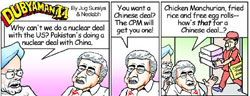
Pakistan may again come closer to India and the people may start living as they were in pre-independence united India, but China will always remain headache. It will compete, challenge, prick, bark, and if necessary in their interest bite India too. Even reports from the border suggest that. Many a times I strongly feel most of the problems of Maoists (Nepal) or terrorists (Bangla Desh) in the neighbouring countries have been there because of instigation and financial support from China to keep India engaged. China with vast financial resources and meanness of one party authoritarian rule can easily maneuver small countries and its corrupt leadership that matters. However, the worst for India is its own leftists that lobby and work in China’s interest. Even the leftists’ governments are encouraging China to enter in India in industry and trade forgetting its own opposition to free trade and globalization. Can there be a better and loyal internal ally than the leftists and that too with all the clout of supporting the government and the best possible relationship with the defacto ruler, Sonia Gandhi?

While the people of India prefer close relation with USA, the leftists are fighting tooth and nail so that India doesn’t go nearer to US as in Indo-US Nuclear Deal that is so vital. After many years, US have understood the importance of India. And so Rice writes in an article in the latest issue of Foreign Affairs magazine published by Council on Foreign Relations, a Washington think-tank so favourably about India. “…The United States has a vital stake in India’s rise to global power and prosperity, and relations between the two countries have never been stronger or broader.”

Unfortunately, leftists don’t like this closeness. And the reason is clear. G Parthasarathy opines very rightly, ‘the communist parties appear determined to make India a client state of China.‘ The real reasons for Chinese opposition to the Indo-US nuclear agreement were voiced in an article in the August 2007 issue of the influential Renmin Jiabao magazine, which stated: “The US-India nuclear agreement has strong symbolic significance (for) India achieving its dream of becoming a powerful nation…In fact, the purpose of the US to sign a civilian nuclear agreement with India is to enclose India into its global partners’ camp. This fits in with India’s wishes”. ‘The CPM finds fault with the India-US nuclear agreement for precisely the same reasons as China. The CPM joins the Chinese in expressing opposition to missile defence systems. Does the party want Indian population centres to be defenceless against attacks of nuclear-tipped missiles? Have CPM leaders ever voiced concern about the Pakistan-China nuclear and missile nexus to their Chinese comrades during their visits to the Middle Kingdom?’ ‘What our communist comrades fail to realise is that wittingly or unwittingly, their recipes for foreign policy and national security fit in beautifully with Chinese long-term objectives of isolating India by strengthening their own growing ties with the US, while getting others to undermine India’s relations with the United States.”

Leftist states are promoting Chinese import even through clandestine route and encouraging the state’s industrial units and the government department to have better tie-ups with Chinese enterprises knowing full well about the Chinese quality problems. And the Chinese are well versed in using the weakness of corrupt officers to get their interest served. It is not that the Chinese are not ahead in manufacturing, but the Chinese blatant subsidy also creates an advantageous condition for its manufacturers. Why can’t leftists come out with encouragement to India’s own manufacturing sector?

For instance, some of the West Bengal power plants have gone to Chinese suppliers instead of BHEL. BHEL is having its problem of capacity, but the quality of the Chinese manufacturers in many sectors including power equipment as well as cement machinery have been poorer. Some experts with many years of experiences from the sector allege about the poor quality of power generation equipment supplied by Chinese manufacturers such as Dongfang Electric Corp., Shanghai Electric and Harbin Power Equipment Co. Ltd. The Central Electricity Authority (CEA) has formed an internal group to conduct a technical audit of such equipment. With the support of some champions of globalization and free economy, and a tacit backing pf the leftist state government and some new, may be unscrupulous, private companies entering power sector, it will be difficult to stop the Chinese, though the problem is known to the Chinese authority too.

China will have its own problems. But India must concentrate on its growth story, particularly of its manufacturing sector. If we go by media, there is an effort but India is to go many miles to do a catch up. It is only the economic, technical and physical strength of India that can even keep China’s irritants on borders in check.

Posted in Uncategorized | Leave a comment