Airtel: Traumatic Telecom Service Provider

While I keep on writing about the advantage of privatization in the country on my blog, my experiences over the years about the deteriorating private companies are just unbearable. Private banks both domestic and foreign ones have gone totally irresponsible. I lost almost Rs 10,000 and more because of the poor advices and intra-bank communication failures from the so-called personal banker that I have got because of my all superannuated money in its fixed deposits.

My experience with Airtel that has provided my land line telephone and broadband at my Noida residence is equally horrible. Even after my payment in advance of the amount suggested by them in last October-November 2008 before going to US, when I returned my services were not restored for almost 4days that I took to convince its many call centre’s personals.

The latest story is just appalling. I came to Kolkata on January 30 from Noida after paying all my dues that was due to be paid in February. In March, I went to an Airtel franchise in Salt Lake near swimming pool in CF Block to find out if it can let me know my bill and take the payment. They expressed their inability. I got a shock that Airtel doesn’t provide this service. When I expressed my desire to pay Rs 1200 as some adhoc advance against my Airtel a/c 11252325 for my phone number 0120-4358743, they directed me to put the cheque in their box outside. I did. When I checked my ICICI Bank a/c on line, I found Rs 1200 was debited from my account for Airtel on March 10. I was happy. But then the real harassment started. In last five days I have received calls from at least 20 different persons of Airtel on my mobile phone telling that a bill of Rs 800 plus awaits payment. I have kept on explaining to them. Today I had to call one of my friends in Noida who is also an Airtel subscriber to talk with the customer care of Airtel 01204444121 and sort out. I have also requested my personal banker at ICICI Noida sector 50 to help me out. Both of them talked to the Airtel. But the telephone calls for the payment have kept coming. I got one while I am typing this letter in Salt Lake. I have been told in the morning by my helping hand at Noida that he received a phone warning that the phone services will be disconnected if the bill is not paid.

Can there be a better story of Sunil Mittal’s Airtel who claims to run one of the best private companies of the country? Is it the efficiency of the telecom sector that we boast? Can the management of these services not find a way to find how the customers are getting cheated and harassed?

At one time I discontinued BSNL services for similar reason. Should I discontinue Airtel services? I don’t think the private sector with booming bottom line bother any way.

Posted in Uncategorized | Leave a comment

A Day in e-Registration Office

March 12, 2009, Kolkata: We were ready by 10AM as Upesh was to come to pick us up for the registration of the Yamuna’s 28 Kathas landed property of Konnagar. I was feeling feverish and had a mind for not accompanying Yamuna for registration, but suddenly I changed my mind. It appeared I would be first hand learning something. Another incentive was the plan of Yamuna to go up to Hind Motor. It was only on arrival of Pappu Singh, the lead buyer and Upesh who also had managed to get some share; I knew that the registration office selected was one near the Governor’s House, Raj Bhawan. I was delighted that we could be back in few hours and take our regular lunch.

Callcutta has changed not only in its ‘Kolkata’ name. I used to follow the same route that we took today to go to my office on the tenth floor of Birla Building for years while working in the corporate project planning of Hindustan Motors. The area called esplanade has changed and gone much cleaner and attractively greener. The registration office is in an old building of Raj days with typical high roofs, wide staircases and those huge wooden windows. But unlike the old registration offices, quite considerable facelifts with computers behind the glass partitions were pretty much visible. Unfortunately, the toilets are horribly smelly and dirty. I don’t know when the nation would learn to have good rest houses as essential part of any facilities for public. We could find some place to sit. Yamuna went with the wives of the buyers including Upesh’s wife. But waiting became longer and longer. A professional was readying the papers, photographs, drafts and documents for the five buyers. Yamuna had to get 10 passport size photographs in Park Street. Upesh had already got Anand’s photos from e-mail. Yamuna was made to sign in full on at least hundreds of pages, and to put impressions of all the ten fingertips. With no proper table, it was real arduous for her. However, she remained brave and maintained her cool. My coming became helpful as I assisted her in placing the fingers’ impressions in right places. Additionally I became the first identifier. Only by around 2PM, we found ourselves near the registrar presentation counter. After some annoyance and perhaps some price, the officer behind the glass partition agreed to consider the registration documents after a break. I was really feeling very much uncomfortable. It was getting late. I was hungry and thirsty too. I went back and bought some sweets from a local vendor that was really good. I gave one to Yamuna too. But then Upesh brought lot many biscuits.

With something in belly, I went back again inside where Yamuna was waiting. Fortunately, she could get a chair. Otherwise, perhaps it would have been difficult for her to continue. And then only my eyes could see a big poster about the e-registration office and the steps. It had all- presentation, data entry, scanning of documents, photo and biometric. At least I noticed three very awkward things. Data entry person was playing game on computers. Man at photo and biometric counter was an old man entering each letter on the computer with one of his fingers taking unnecessary time till he got his Rs 50 for each deed openly before my eyes. I felt like slapping him, but could one do that? The man at cash counter was calculating the state tax by a simple manual calculator taking a lot of time. Surprisingly, I could not see the chief registrar anywhere. I had a mind to talk to him. This is the story of an e-registration office. Who can make them efficient? Who can bring in them a sense of service for the people? Perhaps, I will have to take another birth to see the change, as it requires a mindset change. Computers and mechanizations can facilitate, but it can’t dictate people using it to work fast. The country and its people will keep on seeing the inefficiency and lethargies of the babus helplessly. How can we talk of innovation coming from these government employees for improving their performance for the benefits of the people they serve, if they keep on getting about Rs 1000 per registration as facilitation fee to be shared by all from top to bottom in the office? Any error in any document even a typographical error means more underhand money for the officer. With money, everything can be done easily and fast.

Amazingly to my query over the improvement with e-registration over the earlier manual system, one elderly man told me.” It takes more time now.”

It was only at 6 PM that we could return back to Salt Lake residence though after a very good belated lunch at Lime light near the Telephone Bhawan, courtesy Pappu Singh.

Before going to bed, I was going through my old dairies. I could get a mention of one such day in Sasaram. It was a Monday July 31, 1995. I was there for registration. For safety Yamuna had sent Bhagwandas along with me. I was to sign on the registration deeds for the properties of Bodarhi that I inherited from my mother and sold out of frustration and anger against the rogue relatives of that rogue village. The registration could not be completed even after all the influences of my maternal uncle and brother who were advocates there. I visited the village of my maternal uncle next day, as the court was closed.

What a coincidence! The land that Yamuna disposed off was bought out of money of Bodarhi’s deals. Bhagwandas inspired or rather instigated Yamuna to buy the land that was sold today. The same Bhagwandas and his sons tried all their means so that we could not sell the property. Interestingly, Bhagwandas had bought a land for himself also in strategic position around Yamuna’s land out of her money. Neither she nor I went even to see the land that he had bought. Bhagwandas and his sons wanted to capture the land for free.

Posted in Uncategorized | Leave a comment

Projects of National Importance:Between Failure and Success

Recent stories of India’s capability in product development may make one hopeful about India emerging as a major manufacturing nation. However, some of the failures make even the most optimistic ones skeptics too.

The success story of DRDO’s third interceptor test to provide the country with Ballistic Missile Defence System, BMD, is one such case. It is all indigenous effort, designed and developed by Indian scientists and technocrats.

India has some unscrupulously unreliable and politically unpredictable neighbours in China and Pakistan with nuclear capable ballistic missiles that can create havocs in India. The BMD system can only provide India with an effective defence shield against the wide variety of nuclear-capable ballistic missiles with the enemy countries.

DRDO is engaged in developing BMD system, capable of tracking and destroying hostile missiles both inside (endo) and outside (exo) the earth’s atmosphere. DRDO has already conducted tests successfully. The exo-atmospheric test at 48-km altitude on November 27, 2006, and the endo-atmospheric at 15-km on December 6, 2007, were the part of the same game plan. The Defence Research and Development Organisation (DRDO) has also flight tested third Ballistic Missile Interceptor from Integrated Test Range (ITR) at Wheeler Island successfully achieving the mission objectives set. The two-stage Interceptor Missile fitted with advanced systems has neutralized the target, enemy missile at 75 Kms altitude. The incoming enemy’s Dhanush missile was launched from ship about 100 km away from Coast. The Interceptor missile was launched using mobile launcher located on Wheeler Island Launch Complex and damaged Dhanush hitting accurately.

It was certainly a great achievement and got noticed by the defence scientists world over. However, I am afraid if with the record of the inductions of indigenously developed defence products in services are encouraging. The people in operations are skeptical about their performance standard and the reliability, as its serves their vested interest. And so a natural question is to be answered. Will the officers who matter prefer one from among US (Patriot Advanced Capability-3), Russia (S-300V) and Israel (Arrow-2) that are hawking their systems to India over the home grown ones from DRDO arsenals?

However, the story of another prestigious project, the 14-seater Saras, a multi-role light transport aircraft, aimed at meeting the requirements of executive transport, air ambulance and other community services, was totally different. A Saras aircraft, the second prototype, crashed during a test flight killing three IAF pilots of the Aircraft Systems and Testing Establishment (ASTE). It is shocking. Though the Council of Scientific and Industrial Research (CSIR) has announced its resolve to go ahead with its development of the aircraft despite the crash, many like me feel something seriously wrong with its management and success. Something has constrained putting the right talents required to get such projects through all stages. It is unfortunate while some government organizations perform wonderfully well others keep on surviving with regularly failing lots because of the lack of accountability. Remember Saras project was initiated as early as 1996.

I wish the next government brings in reform in this regards. It is serous as it demoralizing for a nation with so much of recognized capability. India needs the right CEO of such projects of national importance and that makes the difference between the success and failure of the stories.

Posted in economy, governance | Leave a comment

Will India Get into Clean car Business?

The Geneva Motor Show 2009 has opened with the emphasis put on showcasing green technologies.

The world is trying to find a solution to the global warning. As claimed by the environmentalists, emissions from the fossil fuel driven vehicles’ exhaust are one of the main causes. Hybrid and battery powered electric vehicles can reduce the emissions in atmosphere by the vehicles that have become a necessity today. One can’t dream of a world without these means of transportation. Perhaps the optimum and practical solution to reduce the use of fossil fuel is with hybrid or electric cars. Some of these green cars have become more popular ones among many available today. India also produces one, Reva, though its population is small enough. It is hardly noticed. Even the government subsidy hasn’t created its noticeable great acceptance by Indian consumers. However, Thomas Friedman of ‘The World is Flat’ fame referred about Reva, retrofitted with longer-life batteries that could travel 90 miles on a single six-hour charge – and to lay on a solar roof that would extend them farther, in a recent column in New York Times.

Some Green Cars of World

FORD: As claimed, New Fusion hybrid sedan has already made waves because it gets better mileage than Toyota’s Camry hybrid. Ford wanted to create a driving experience that might set the car apart. Palo Alto (Calif.) design firm IDEO and Ford surveyed consumers and discovered that many drivers are obsessed with fuel economy. Smart Design designed a dashboard screen that rewards drivers with green leaf icons that grow when they manage to squeeze out more miles per gallon.

TOYOTA: Prius has been the most popular among the hybrid till date. Toyota is going for its all-new Prius with a bigger gasoline engine that generates-in tandem with the electric motor-more power. Even with those extra horses and a larger cabin, fuel economy will be better than the current model’s 48 mpg. Toyota also will improve upon its hybrid-only luxury car, the Lexus HS250h with fuel economy pushed to push 40 mpg.

HONDA: The company aims to out-Prius the Prius with its new Insight. Honda’s differentiating factor will be by making its hybrid affordable to even the thriftiest buyers. The car will sell for about $19,000, about $2,500 less than a Prius and the fuel economy attaining 40 -plus mpg.

MERCEDES-BENZ: The German luxury automaker has been also working on a pure electric car and one that runs on hydrogen.

BYD AUTO: The Chinese upstart with its F3DM and F6DM plug-in hybrids to be sold only in China for the time being is ready to compete in the technology race.

However, it’s hardly lists all the greenest and cleanest cars of the world. Perhaps every car manufacturer worth name is working for a greener world.

While the news of Nano’s launch on March 23 in India is making the car-enthusiasts mad, Ratan Tata has announced to launch the Nano Europa in 2010-11. As reported, “Tata Motors has been working hard on developing electric versions of its current lineup for the European market. The company last year bought a majority stake in Miljo Grenland Innovasjon, a Norwegian company specializing in electric car technology.” Can Nano go clean too as India’s answer for cleaner car? It is essential as it dreams to sell in millions and reach every home of the country. Will Reva be produced in big way boosting the manufacturing sector with a green future? Will India’s R&D in clean technologies be sought for by the developed nations?

I am only a car enthusiast at the best not a green car advisor.

Posted in manufacturing | Leave a comment

Tamal- A Destiny Destitute

>He came on Friday afternoon. He had informed me but I had forgotten. I came out, saw him, and got shocked to see his extraordinarily short hairs and masked face, Later on, he informed that the mask is to avoid infection. His body has lost immunity.

Tamal made me cry somewhere deep. Tamal came to me as a fresh draughtsman sometime in early 80s and worked for me when I was in corporate project planning in Hindustan Motors. He was tall, young, well-built, enthusiastic and innovative. To some extent, he was forthright or blunt bordering to be easily conceived as rough by some. Over some period, Tamal came closer. One reason may be my special weakness for the children of the old factory employee. His father was a supervisor in the factory where I had spent my best time. Tamal got married. His wife was smart and a school teacher. Pretty soon, they got a son who is now in the second year of a private engineering college.

I was again shifted to the operation activities of the Hind Motor factory to head all technical services. I had a selfish reason to agree for that. I bargained it for something for my dear one. Tamal remained in touch with me. I had to come back again to corporate planning because of my principled attitude to work. Some branded me as obstinate. The managing director wanted me to be a vice-president, manufacturing for mechanical division. I had done that many years ago as manufacturing manager. I was not ready and refused, as I considered the shift as demotion though with a high sounding position. The relation with Tamal became closer again. But then I left HM in 1997 after completing my inning. He kept in communication. Whenever we came to Salt Lake, Tamal used to visit us at least once. My visit to Salt Lake became rare after I took retirement as professional.

One day in Noida I got a telephone call. Tamal was on the other side after many years. I heard him sobbing badly. He had undergone major surgical operation for a serious brain tumour. He survived but only after spending all his savings and that of her wife. The family stood by him solidly. The wife sold all her ornaments to meet the costly treatment. His mother got the shock of her life and couldn’t survive long. HM unfortunately hadn’t come out generously for his treatment. Perhaps, it was because of totally aliens holding responsible offices in higher management. Perks in private firms depend mostly on personal relations with the effective superiors. While in office, I got some opportunities to help my known ones by going out of the way that gave me a real satisfaction in life.

Sometimes, Tamal used to call me at Noida. He once wanted me to request someone who had worked once as my subordinate for a job for him too. I did that. But it didn’t work. He kept on working with HM till 2007 and then perhaps was forced to take volunteered retirement.

When I informed Tamal that I have come to Salt Lake, he expressed his willingness to visit me. I told if he was having any trouble, he should not do that, instead I might like to come to his place so that I could meet the family members too. But he came and narrated the whole story in details. What a role the destiny has played with him!

Tamal had come after a medication schedule at his dispensary in Phool Bagan. As the regular medication is unaffordable, he has searched a doctor who does it as part of the some clinical research of some global pharmaceutical company. After his wife talked to him on phone, I could learn that she was waiting for him for lunch and he mightn’t have taken his lunch. We had just finished our lunch, but offered to get something prepared by Bharati. He kept on refusing. Yamuna then offered some curd and rice flakes, and then some sweets. His body has lost its resistance against infection. As he told, he had severe rashes on the side of his thighs that required very costly medication. A small wound on a foot took a lot of medication and time to heal. He has a small cancerous clot in lungs still that was the reason of the brain tumour too. He is taking the therapy for the clot that according to his doctor will reduce, but not get vanished. I found Tamal fighting with destiny. He still drives the motor cycle, as without that the transportation to various places will be difficult rather too costly. HM has not yet handed over his provident fund that would have helped him immensely. He says it is because of a change in system. Perhaps the privately held provident fund of HM has gone into government hand. I wished I would have been of some more help to Tamal and his family personally or through some agencies..

Before leaving, Tamal said, “Sir, I have some names including yours saved in my cell phone. I have told my son to inform all of them when I die.” It touched me badly.

While seeing him off, I gave a sandal wood Ganesha to Tamal and wished Him to make him hale and hearty. Will He do that and change the destiny of Tamal?

Posted in Uncategorized | Leave a comment

Waste: Challenge or Opportunity

My morning walk in Salt Lake through central park shocks me. The litter created by the natural phenomenon of falling tree leaves, withered flowers as well as those left by the visitors must be a big problem for those who manage it. And the issue is a universal one. I saw a similar situation while in Pleasanton during fall. The footpaths used to be full with the fallen leaves of the trees. That must be a big challenge for the municipal authority. Can the agriculture scientists develop trees for human habitations that will not undergo fall? Alternatively can all the natural litter be collected easily and used a raw material for some other products or services required by the human beings living on the Mother Earth? The answer is only yes. The scientists and innovators must work on reusing the waste that the nature or its inhabitants create. Before deciding the use of a material and process of its assembly or manufacturing for creating the products, the scientists and technocrats must devise a way of its disassembly and reuse through cost effective recycling. It must be universally accepted too. This is the biggest challenge as well as opportunity for those who matter in creating the products and services.

Believe it, Americans are the champions of trash. On average Americans jettison over 700kg each a year of trash. For India and China, the corresponding figures are not available. But ‘by 2030, Indians will be producing twice as much as they are now; Chinese people three times as much’.
Waste if not disposed and treated effectively is not only eyesore but also becomes hazardous too. As reported, ‘in the city of Dzerzhinsk, in Russia, decades of slapdash handling of chemical waste has reduced male life expectancy to just 42 years’. Rotting waste produces methane and thus contributes to global warming.

The Economist has a special report on the waste business in this week’s issue: ‘Environmental concerns have spurred dramatic improvements in the way waste is managed in many countries. Recycling is becoming ever more common. Entrepreneurs are brimming with schemes to turn rubbish into electricity or fuel or fertilizer. Environmentalists dream of a world in which almost nothing is wasted.’

Even the plastics used for different throwaway purposes that are the biggest culprit may and must soon become biodegradable. The industry generating a lot of unmanageable and damaging waste such cement or metal industry or power plant must incorporate the effective use of the waste it generates. It requires a change of mindset.

Even in India media keeps on reporting the biomass projects for power generations. Organic wastes can and must become natural manures replacing chemical and harmful fertilizers. However, the work has not been undertaken on the scale it is necessary to save from the menace aspects of the waste.

The biggest trouble in the task will be from the global MNCs that over years have developed the products and will not like to lose the profits it generates.

Can the scientific community and the government take up the challenge and convert into opportunities to develop technologies based on using waste to create products and utilities for mass consumption.

And lastly, can every responsible citizen avoid doing what has given rise to the easy engagement for the deprived children as ragpickers or slumdogs?

Posted in economy | Leave a comment

Sher Shah Provides Path

In last fortnight, I saw the name of Sher Shah mentioned many times, though in different contexts. Lalu Prasad compared Sonia with Sher Shah. What a sycophancy! But I excuse Lalu for his statement, as I don’t expect anything better. Lalu and for that matter all politicians must get some intensive tuition at home after getting elected. Another mention of Sher Shah came from JD (U) general secretary Shivanand Tiwary, who was once sycophant of Lalu and now, has come in Nitish camp: “Nitish is similar to Sher Shah as he has build infrastructure in his state.” Tiwary has gone a step ahead and compares Lalu Prasad with Shah Jahan: “Lalu has groomed his wife, a political rookie, to rule the state and has developed the Indian Railways around her Selarkala village. Thus, he is our Shah Jahan, who built the Taj Mahal to immortalize his wife Mumtaz.” Is this digestible by the people of Bihar? I am sure both the gentlemen and some other politician will bring the name of other great sons of Bihar to compare their godfathers and godmothers.

However, Amertya Sen also referred to Sher Shah while addressing the intellectuals and administrators of Bihar in Patna recently when he had visited Nalanda as mentor of Nalanda International University. “Bihar led the country in many areas including spreading the idea of democracy during the Ashoka period when the concept of democracy was not known in other parts of the world. Furthermore, it was Sher Shah in Bihar and Bengal that first embarked on the massive project of building roads and bridges to connect large cities.” However, interestingly and very rightly Dr. Sen warned people to not continue to dwell in the past but to use it to learn lessons from it.
Let me provide certain basic historical information.

Sher Shah could rule the nation for a very short spell of five years. He ascended the throne of Delhi in 1540 AD after driving away Humayun, the Mughal emperor and ruled till he met an accidental death in the fort of Kalinjar on 10th day of Rabi’ul Awwal, A.H. 952 or the 13th May 1545 AD.

Sher Shah’s most brilliant achievements were in administrative reforms. He carried out extensive agrarian and administrative restructuring laying the foundation for the administration which helped Akbar.
To check undue influence of the officers in their respective jurisdictions, the Sher Shah devised the plan of transferring them every two or three years.

Sher Shah also instituted the Subcontinent’s first effective law and order force. It is said about his rule that “a woman could travel with all her jewelry in his empire without being afraid of getting looted.”

Sher Shah’s greatest legacy is the modern Grand Trunk road which ran from Bengal to Attock. However some claim it ran right up to Kabul with “Baulis” and “Sarais”, the equivalent of Modern day Service stations all along the road. According to some, ‘Sher Shah only restored the old imperial road from Calcutta to Peshawar, built a road from Agra to Jodhpur and Chittor linking up with the road to Gujrat seaports and a third road from Lahore to Multan, the window for caravans going to West and Central Asia.’

However, Sher Shah was a brave and valiant soldier. He kept on expanding the empire by defeating smaller rulers to integrate the country. He died while leading from front. Will Lalu and even Nitish show some acts of brave and aggressive decisions that pull up the governance and get all the projects of the state implemented in time? We will expect them to fight with a ‘sher’ to save the weak and deprived. They can surely cut down the CAT force that keeps them guarded and engage them against criminals.

Sher Shah’s performance is to be emulated by all the administrators who keep on living on false promises by announcing projects or laying foundation stones. Sher did everything in five years (granted by the Almighty) and left an ever lasting impression on the Indian history for the posterity to judge. Why can’t the present politicians when in chair promise only what they can do in the five years granted to them by the constitution and facilitated by the people of India?

Posted in Uncategorized | Leave a comment

Salt Lake -I Love and I Hate

I am in Salt Lake for almost a month now. I sit in my balcony on the second floor sometimes. I enjoy the quietness and solitude and sometimes the real and rare beauty of the rising sun. Rarely, any car passes by. I hear almost everything that the passersby are arguing for while going to their destinations. There is hardly any smog. The tall trees lining the avenues present serene surroundings, but for the time when you receive something obnoxious from little birds on the trees without my knowledge. Some roads are bad but mostly the internal roads are smooth and clean. Even with the sand used as filling materials, the dust in atmosphere is less. May be it is because of the number of vehicles and lack of construction work.

But there are many reasons to hate Salt Lake. As I walk down the second avenue and then to the first one for my morning walk, the pungent smoke in the air from the oil fired stoves used by the roadside shabby snack shops sickens me. All along the administrative buildings, be it Unnayan Bhawan housing Kolkata Metropolitan Development Authority, or Bikash Bhawan, these eyesores to help poor way of creating employment pains me. Why can’t the government create well done Kiosks and hand over to the deserving vendors? Why should we, as residents of the area tolerate these mushrooming and chaos of these stalls? Perhaps India has such has not developed the right way of doing things that provides the delight of a better ambience. Perhaps all the citizens require a compulsory training in good housekeeping and Japanese workplace management tools Five S.

The political unrest over land acquisition that forced the West Bengal government to withdraw plans of a massive chemical hub in Nandigram and Tata Motors to relocate its main ‘Nano’-manufacturing plant from Singur to Gujarat has certainly taken its toll on wider scale including the development work in Salt Lake too. The stopped construction work of the school complex in front of my house or the rusting columns of the project on the way to central park with growing plantations around it shock me. I am sure the government could have developed the central park of the Salt Lake as a showpiece like Hyde Park. A huge plot of land around it is still lying idle. May be one day some project of commercial importance will get preference over the greenery. A cricket academy has already come up using a lot of land and the bus stand and stalls around it are already an eyesore. I hate the slow or no changing city. I used to tell my friends in other city that even after years when I visited Salt Lake, I could remember the brick left by some and lying on the walking route in the same place. In January 2008, I found Salt Lake changing fast, but surprisingly Salt Lake development but for the Sector V has frozen again. It is disturbing. I hate it. Even the much talked about Sector V needs a lot of work. The roads must get it footpaths. Shabby stalls must go. It must go Bangalore class, if it wishes to compete. I was surprised to find a traffic jam at the entrance to Sector V from the Karunamoyee side. Perhaps, a flyover under construction may ease the problem.

From Telegraph

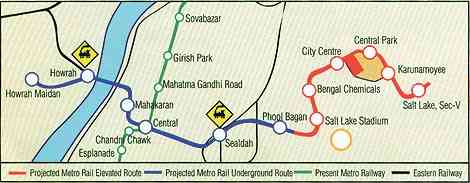
But before I could complete this writing on Salt Lake, I found a good reason to be happy. Yesterday, the chief minister along with the strong man of Congress, Pranab Mukherji laid the foundation of the 13.77 kilometer (km) long East-West Metro corridor that would run from Salt Lake Sector V up to Howrah Maidan. I wish West Bengal to prove that it can work under a promised time frame of completing it by 2014.

I and my sons who were born and brought up in West Bengal shall love to ride on it from Howrah to Karunamoyee that will be my station, according to the announcement.

I wish the authority would have shown a more futuristic insight and extended it to the new township of Rajarahaat and the Kolkata Airport.

Posted in Uncategorized | Leave a comment

HM: Mythological Motown

I could never think that HM would be news material worth a place as the main headline on the front page of Telegraph. Only yesterday, a worker from HM visited me hearing that we were here in Salt Lake. I got the information of the headline from him. But he was just surprised rather annoyed why the company is deducting Rs 400 from all the permanent workers. He is still temporary after working for more than 12 years. He still hopes that if the company executes the agreement with the union, he will be become permanent. And he gets work hardly for 15 days a month.

In January 2008, we visited the residential zone of HM. I saw it dying and barren. Whatever had been constructed with lot of fanfare is decaying in the ghost township. When I remember of 60s and 70s, I feel anguished. For the facilities for employees and their children such as the dispensary and the high school, the present workmen are to pay. Teachers in school are on contract and paid nominally. I wanted to go in the factory and take some photographs of the places where I worked for so many years. I talked with a senior executive of our time who still holds an important position. He, a civil engineer by profession, is local with political connections working as administrator is the main executer of the management’s labour related issues. However, I didn’t get a favorable response about my visiting HM. And I didn’t want to do that without permission that I could have.

With forced VRS, the employees were made to leave. Those who refused to accept VRS were transferred to far distant places to make them leave. The largest manufacturing unit in West Bengal has become unrecognizable. Heavy engineering division has been sold out. However, the company still produces some Ambassadors. Other products such as Contessa, Trekker and Hindustan Trucks have gone in history. I don’t know why the pundits in CII still talk of the labour reform. With militant unions in India, the only beneficiaries are the officeholders in union.

I don’t know but perhaps today’s story of the workers at Hindustan Motors (HM) having responded to a management appeal to join executives in accepting a pay cut is that of the reporter or planted by the management. Unfortunately, the reporter does talk about the pay inequity between the executives and workers. Most of the executives including the CEO with almost no responsibility because of no work going on inside the factory are very highly paid are all from the South. For long the CEO has started believing that the local executives can’t be that rough and tough with workmen. The union office bearers have colluded with the management to damage this industrial giant of the state. And the promoters have squeezed the best from it.

I feel bad only as the story has tried to paint the executives pay cut as exemplary to please Pranab Mukherji and the government that suggested the preference of pay cut over the layoffs. Even the name of Vikram Pundit of Citi Bank has been referred in the report. I don’t think there was any dialogue with the workmen at large with an appeal of pay cut, which is very much possible with the dwindled numbers of workmen now employed in the factory.

I don’t know why the media play in the hand of unscrupulous business houses.

Posted in Uncategorized | Leave a comment

Business Competitiveness, Bihar and Politics

Last issue of Business World was a special on the business competitiveness of the states of India. Maharashtra leads followed with Tamil Nadu, Gujarat, Punjab, Karnataka, Andhdra Pradesh, and Haryana among the larger states following it. Even among the prosperity level of the states, India has a huge gap. Interestingly, the per capita income of Maharashtra (Rs 48,171) is almost four times that of Bihar (Rs 10,286). However, I doubt if the per capita is based on truthfully provided data, and it has considered the contributions of migrant population of the state that one can find in every corner of the country perhaps more rightly the globe today, from Fiji to West Indies.

One clear cut reason for the gap appears to be the gross neglect of education by the state such as Bihar as it will be clear from the box below. Over the years, the state didn’t make any endeavour to create educational facilities as some of the other states, particularly of South did or today even UP at least in Western region is doing. A spark of hope appeared with many proposals for engineering and medical colleges appearing in the lists of investors, when the Nitish came to rule but nothing much has materialized. I don’t know why the investors are shy to invest in education in Bihar when the students from Bihar form a good percentage of the student population of the educational institutes in almost all states. Will some educationists of Bihar and its education ministry enquire into the reasons and the state take steps to remove the barriers for investment? I still feel the state must do serious and sincere introspection in the subject. Without creating sufficiently excessive capacity for professional education, the state can’t even dream of growth in per capita income. As I know most of the people from Bihar having acquired education get employment also outside the state and settle down there contributing to the domiciled state’s GDP.

I can understand Nitish Kumar’s agony when he expressed his displeasure for NRIs not investing in the state even after all the efforts made by him and his deputy. “The state government, as claimed, had spent millions of rupees on trying to attract NRIs for investments in the state, and also set up an NRI cell to facilitate investment in Bihar from expatriates. But till date, the state has not got a single big NRI investment.” Nitish must not lose heart. Indians are not the Chinese. Very few Indians are big entrepreneurs with sufficient cash to invest in India. The people of Bihar are mostly salary earners. With the breaking up of the joint family, the younger generation is not ready to part with their earnings even with family what for the state.

GDP per capita: Bihar’s GDP per capita is Rs 10, 286, the lowest among all the states of the country below even Orissa, Jharkhand, UP, and Chhatishgarh and the population is 91.63 million, the third highest after UP and Maharashtra.

Engineering graduates: Bihar produces hardly 6,376 engineering graduates per year that is lower than all the major states. Tamil Nadu produces the highest at 329,271 and even Orissa producing 45,357. Uttar Pradesh turns out 1, 03,573.

Road networks: Bihar has 81,655 kms, whereas UP has 248,481kms and Orissa 238,000kms.

Nitish Kumar has taken a lot many steps to pull up the brand image of Bihar against all odds, be it Lok Shahi (Rule of the People), by making public the mobile phone numbers of the chief secretary and a clutch of other top officials to make the officers more accessible to the people. But it goes to the officers how effectively they take it and make it effectively useful for the people. His scheme of loan to each agriculture graduate for setting up agriclinics and agribusiness centres is a great endeavour in right direction. But how will he motivate them to be master the subject that they are expected to advise the farmers with? The culture of getting certificate by any fair and foul means to prove once education standard and knowledge and getting the right for a job must improve if not end some day. Unfortunately, most of the employees in government consider getting job as their right once they get it and don’t consider taking the responsibility of the position as essential. Nitish must build in stick in the system and not provide only the carrot. Similarly, the idea of ‘the constructions of the so-called ‘e-bhawans’ at block levels in an attempt to improve the flow of information between the farmers and the government officials while offering other facilities to the growers including a soil test laboratory, conference room, phones and fax availability, internet connection and an information center’ is a wonderful one with lot of potential. I am sure Internet will reach each of the villages through some schemes such as e-Choupal. It will certainly make the technologies serve people.

Nitish Kumar has also announced the setting up at an agricultural university in Bhagalpur at an estimated cost of Rs. 350 crore to develop a vital research center in the state providing the farmers the kind of information that would help increase the production while at the same time raising the quality of the farm products. I only wonder it is not a political announcement for political gain in coming election.
Politics of development already has done a lot of harm to the state. Can the three biggies of the state politics shun that for some years? Let the people understand the close relationship between politics and economic outcomes.

I only wish the India Inc. or may be, the central governments don’t perpetuate the development apartheid of Bihar. The people of Bihar will not forgive that.

Posted in bihar, economy | Leave a comment