India- China’s Envy

“Chinese are big smugglers… suppliers of small arms. I am sure that the Maoists also get them.”
G K Pillai, home secretary.

Any reference to China annoys me since 1962. China went a little too far and that was not expected from it when both the countries were in rebuilding mode. By being good to each other, both would have gained. The decision of China to invade India in 1962 was terrible. For all those like me who did face the humiliation, it is difficult to forget its unpredictability and get into ‘support and friendship’ mode. The relation can only be formal one. China is basically envy of India today for many reasons. Any media reports putting India along with China or above it trouble China. Here are some:

India is the home to 422 recognized think tanks. According to a study by the Think Tanks and Civil Societies Program at the University of Pennsylvania, India is second only to the US, which is home to over 2,000 such institutions that research and analyze important public issues. China would have been envy of these think tanks in India.

The Legatum Prosperity Index ranks 104 countries (covering 90 per cent of the world’s population), based on a definition of prosperity that combines economic growth together with measures of happiness and quality of life.

Though China outperforms India on several economic indicators, India’s overall ranking, according to the Legatum Prosperity Index, is superior. India performs superior in the critical non-economic factors such as personal freedom which encompasses freedom of speech and religion, national tolerance for immigrants and ethnic and racial minorities. India also ranks highly on measures of social capital, reflected in the percentage of citizens who volunteer, give to charity, help strangers, and who feel they can rely on family and friends. In this area, India ranks fifth in the world, ahead of the United States, the United Kingdom and Finland.

(Blue line is for China and the green for India)
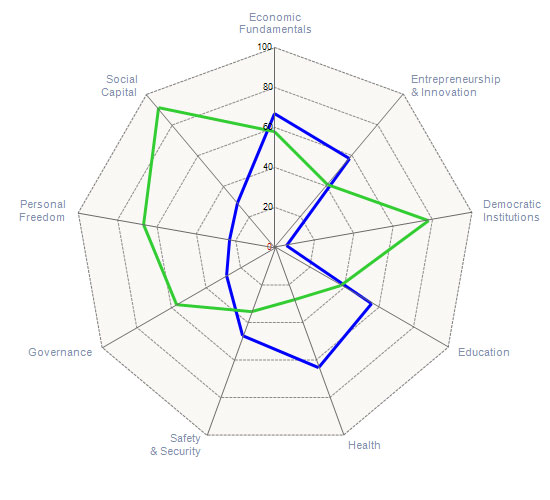
In overall ranking in the Legatum Prosperity Index 2009, India is at 45, while China is placed at 75: Why India beats China. Is it not something for China to be envy of India?

Some more worrying reports are troubling China. According to one report, India currently has the lead over China in terms of foreign OEMs’ wholly-owned R&D activities. India for many years has been – and currently still is – cheaper than China for R&D in terms of wages and operational costs.

Further, according to one recent report, ‘India’s exports of minicars and hatchbacks gained 44% between January and July to 201,138. Total exports of cars, including vans, sport-utility vehicles and trucks, rose 18% to 229,809. In contrast, China’s exports slumped 60% to 164,800 between January and July, according to government data.’

India must and can develop fast, if it focus on its strengths, be it pharma or IT, auto or R&D and try to get into manufacturing in big way both for domestic consumptions and exports as many OEMs are on look out for a second source because of the trouble due to making China the sole vendor. With India’s indigenous capability in areas such as space, atomic energy, and missiles, India can be significant player in high tech manufacturing too. India must go for it.

India with its strength and prosperity can make China go for sustainable good relationship.

Posted in economy | Tagged | 1 Comment

ITC and Future of Farming in Rural India

ITC through its rural initiatives such as e-Choupal network has provided a way out to bring prosperity for the farmers that interestingly must be one of the main priorities of any government.

ITC’s e-Choupals today serve 40,000 villages and 4 million farmers, making it the world’s largest rural digital infrastructure. Each e-Choupal serves as information centre through its real time connectivity with the market with help of Internet and the computer.

ITC through e-Choupals sources commodity from farmers directly and perhaps provides a better price too because of the absence of the intermediaries.

Choupal Saagars are the one-stop shops catering to all the needs of the rural community.

ITC rural initiatives, be it e-Choupal or Choupal Saagars, provide a significant boost to farm productivity through extension services and research based agri-inputs-best farming practices, the optimum fertilizers and insecticides based on soil testing besides the competitive prices in different markets.

The e-Choupal Infrastructure also enables an efficient two-way flow of goods in and out of the villages. Apart from ITC’s FMCG products, almost 70 other companies also ride this unique channel to offer rural consumers a wide spectrum of choice in a cost-effective manner.

ITC’s initiatives like the ‘Choupal Pradarshan Khet’ bring sustainable agricultural best practices to farmers and have demonstrated significant productivity gains.

Recognizing the growing role of chemical free fertilizers in sustainable agriculture, ITC has launched organic based farm inputs for integrated farm management. The neem-based branded Organic manures such as ‘Wellgro Soil’, ‘Wellgro Crops’ and ‘Wellgro Grains’ have already gained wide acceptance for their superior efficacy in soil nutrition and crop management.

ITC has set up a dedicated state-of-the-art R&D Centre in Hyderabad with a focus on agri-sciences.

ITC’s Integrated Watershed Development initiative has helped create freshwater potential in water-stressed areas. ITC has also provided integrated animal husbandry services have reached out to over 3, 00,000 milch animals creating avenues for non-farm based livelihoods.

May be, it would have been on much larger scales and in many regions of the country that really remain in dark age, but ITC has provided a business model that if supported by the government and other companies can in real sense bring prosperity to the rural India. I wish the company focuses more to the goal and I pray some evil forces in the society and government don’t upset the dream,
http://www.itcportal.com/chairman_speaks/chairman-2009.html

Tele-farming: ITC plans to bring out e-Choupals Version 3.0 to add mobile phones to the existing channels of net-based computers and Choupal Saagaras to expand its reach to deliver personalized agri-services to individual farmers via the exploding population of mobile phones in rural India. ITC is tie-ing up with Nokia that has already ‘Life Tools’ meant for one way dissemination of farmer-related information from Nokia to the farmers. ITC aims to make the information flow two-way. May be, the idea is on the line of the process used for the tele-medicine. With expanding capability of the mobile phones, a farmer will provide information, say, the photograph or video of the soil or the crop, the date of sowing, the seed used to the company directly or through e-Choupals. The company experts process the information and provide the specific advice. And with all the best information available, why can’t the today’s farmers improve the productivity and get into an era of prosperity?

I wonder why the agriculture universities, its faculty and researchers can’t join the move of providing the best information to the farmers. Why can’t each institute reorganize itself to assist the farmers for whom they work and have a call centre to provide such services that he needs? What is the use of the hard work of these scientists if it can’t make the farmers produce more and be prosperous?

Either the government-funded universities and research organizations change themselves or many private enterprises will do their jobs.

I wonder the scope of tele-farming will bring about hundreds of innovations in mobile technologies that can change the farming all over the world. Will the scientists take the challenge?

Posted in industry, management | Leave a comment

India’s Scientific Heritage and Mathematics

Justice Markandey Katju, Judge, Supreme Court has deliberated wonderfully on ‘Sanskrit-Language of Science‘ providing a real insight into India’s scientific heritage and the great scientific achievements of our ancestors. I appeal every English-knowing Indian to read it and so I wish the readers of my blog to go through it. I am quoting below what he says about the contribution of our ancestors to mathematics:

The decimal system was perhaps the most revolutionary and greatest scientific achievement in the ancient world in mathematics. The numbers in the decimal system were called Arabic numerals by the Europeans, but surprisingly the Arab scholars called them Hindu numerals. Were they really Arabic or Hindu? In this connection it may be mentioned that the languages Urdu, Persian and Arabic are written from right to left but if you ask any speaker of these languages to write any number e.g. 257 he will write the number from left to right. This shows that these numbers were taken from a language which was written from left to right and not from right to left. It is accepted now that these numbers came from India and they were copied by the Arabs from us.

I would like to illustrate the revolutionary significance of the decimal system. As we all know, ancient Rome was a great civilization, but if one would have asked an ancient Roman to write the number one million he would have almost gone crazy because to write one million he would have to write the letter M which stands for millennium (or one thousand) one thousand times. In the Roman numerals there is no single number greater than M, which stands for one thousand. To write 2000 we have to write MM, to write 3000 we have to write MMM, and to write one million one has to write M one thousand times.

On the other hand, under our system to express one million we have just to write the number one followed by six zeros.

In the Roman numerals there is no zero. Zero was an invention of ancient India and progress was not possible without this invention.

One can read about the great contributions of our great mathematicians like Aryabhatta, Brahamgupta, Bhaskar, Varahamihira etc. by using Google. However, I may just give two simple illustrations in this connection.

The number 1, 00,000 is called a lakh in the Indian numeral system. 100 lacs is called one crore, 100 crores is called one arab, 100 arabs is called one kharab, 100 kharabs is called one neel, 100 neels is called one padma, 100 padmas is called one shankh, 100 shankh is called one mahashankh, etc. Thus one mahashankh will be the number 1 followed by 19 zeros (for further details you may see V.S. Apte’s Sanskrit English Dictionary on the internet by using Google). On the other hand the ancient Romans could not express any number larger than one thousand except by repeating M and the other numerals again and again.

Take another illustration. According to the Agni Purana, the Kaliyuga in which we are living consists of 4, 32, 000 years. The preceding Yuga is known as the Dwapar Yuga and is twice as long as the Kaliyuga. Preceding the Dwapar Yuga, is the Treta Yuga which is thrice the duration of the Kaliyuga. The Yuga preceding Treta Yuga is the Satyuga which was said to be four times longer than the Kaliyuga. One Kaliyuga, one Dwapar Yuga, one Treta Yuga and one Satyuga are collectively known as one Chaturyugi (or 43 lacs 20 thousand years). Fifty Six Chaturyugis are known as one Manovantar. Fourteen Manovantars is known as one Kalpa. Twelve Kalpas make one day of Brahma. Brahma is believed to have lived for billions or trillions of years.

When our people do the sankalp, which is to be done everyday by orthodox people, they have to mention the exact day, month and year of the Kaliyuga as well as the Chaturyugi, Manovantar and kalpa in which we are living. It is said that we are living today in the 28th Chaturyugi in our present Manovantar, that is to say half the Manovantar of our Kalpa is over, but the remaining Manovantar is yet to be completed. We are living presently in the Vaivasvata Manuvantar.

One may or may not believe the above system, but one can only marvel at the flight of imagination of our ancestors who could conceive of billions or trillions of years in history.

Aryabhatta in his famous book called the Aryabhatiya wrote about algebra, arithmetic, trigonometry, quadratic equations and the sine table. He calculated the value of Pi at 3.1416, which is close to the actual value which is about 3.14159. Aryabhatta’s works were later adopted by the Greeks and then the Arabs.

Is not it great reading? My knowledge of the subject is limited and I can’t even figure out if Honourable Justice Katju has been biased in providing the information. However, the information may help some Indians to shake off their inferiority complex and will also inspire some to repeat some to come out with their great performances in academic achievements such as Nobles that has become the ultimate ambitions of the present era.

Posted in education | Leave a comment

Bihar Science Congress: A Letter to Vikrmaditya

Dear Vikramaditya,

In the Bihar Science Congress perhaps a significant number of academics, intellectuals and other celebrities of the state will deliberate. With politicians engaged almost more than 100% in vote politics and in making themselves rich, can those at conference ponder over, deliberate and resolve how they improve the condition of Bihar in spite of the desired amount of support from the government? I firmly believe that it can be done. Can you get my views circulated and deliberated?

Can the educational institutes worth some name in Bihar take some more responsibilities without looking to the government? Each of the educational institute must aim to become Nalanda and Vikramshila on its own through its alumni and donations from the people and the rich. I am sure that many in Bihar still will like to donate for education that was the practice in good old days. I do also believe that like many other social movements, another social reform movement is a necessity. The movement must propagate to channel all donation and charity to temples and priests or expenditures for rituals to the educational institutes and that will provide the similar benefits and blessings from Gods and Goddesses. Further, can the institutes take up the following tasks on priority?

1.Can each educational institute have a very good website of its own providing all information and their researches, the video lectures of its best teachers, PhDs thesis, and other papers?

2.Will the institute make education more employment focused, have language lab, and computer based science courses. Will the institutes focus on honours courses in all applied science subjects, as it will be equivalent to engineering? Will the institutes encourage effectively the teachers and students with aptitude and interest to research?

3.Let every institute have an active association with its alumni and use the successful ones for guest lectures at whenever they visit the home state. Let a fund be created with their donation totally dedicated to advance education.

4.Will the educational institutes grow its interactions with rural India, make the rural issues as subject of study at post graduate and PhD level and propagate the need of education among the rural masses including the deprived classes?

5.Will the educational institutes encourage entrepreneurship and innovation in its curricula of all levels, focus on researches on new areas such as indigenous green technologies and rural use?

6.Can the educational institutes shun politics at least for next 10years?

7.Will the educational institutes at all levels build essential ethics, values, and soft skill essential for building a sound happy society?

8.Will the teaching community rethink on building its respectability in the people as the olden days where guru was respected more than even gods and goddesses?

9.Will the educational institutes go out of the way to focus more on the education of the girl students, adopt villages to eliminate illiteracy among the women?

10.Can some of the intellectuals help converting every temple of the state into a good school?

I am sure you and your core organizing group may further fine tune the issues mentioned in my list above. But you all will certainly agree that my appeal and request may make some impact on the state of education in Bihar. My only request to you is to get this circulated in all the educationists. They may be asked to contribute to make the list universally acceptable.
I wish the conference a great success.

Posted in education | Leave a comment

मधुर यादें

हर रोज सबेरा हंसता है
और शाम सदा मुस्काती है
जीवन तट पर अब खड़े हुए
कुछ मधुर याद आ जाती हैं

परदादी का गा गाकर
मुझे खिलाना
कभी बुलाना चंदा मामा.
ननिहाल की उस महरी का
बार बार सभलायक कहना.
फिर दादा की पीठ सवारी
फिर उनकी बांहों पर सोना.
फिर आते कुछ दृश्य मधुरत्तम
बिद्यालय के गलियारे में
एक किसी के दिख जाने की
आशा करना और दिख जाना
कितनी कोमल आकाक्षाएं थी
कितने बालसुलभ सपने थे.
जब कोई पास न होता है
बर्षों पहले की यादों में
अच्छा लगता है खो जाना
फिर कुछ यादें भी ऐसी हैं
जो शाम सबेरे आ आकर
जीते जाने को कहतीं है.

Posted in Uncategorized | Leave a comment

Oct 31, 1984-As I remember

I vividly remember the darkest day of modern India. I was in corporate project planning and was responsible for deciding the equipment and machinery for the two new plants that Hindustan Motors was setting with collaboration of Isuzu Motors for manufacturing transmission and engine for ‘Contessa’ at Pithampur near Indore and for manufacturing the Isuzu trucks at Halol near Vadodara. I was to leave for Tokyo to visit JIMTOF, the machine tools fair. Yamuna was away to Birlapur some 40 km away with my aunty to join my aunty in Chhath puja. But she returned in time to accompany me to airport. JPN, one of my acquaintances, who worked in the plant at Hind Motors, was with us in the car carrying me to the Dum Dum airport. All my three sons had bunked their classes of their Calcutta based school to watch some cricket match on TV at home. I complained to Yamuna about their decision, but perhaps the destiny had us from a nightmare. Very while driving towards the airport, we started getting obstructions on various roads but the driver was knowledgeable of various alternative routes. We could reach Dum Dum well in time. I went for my immigration and then security and Yamuna went to terrace to see my flight taking off. As soon as I came to know of the Indira’s assassination and the troubles all over the country inside the emigration area, I tried to come out and ask Yamuna to return immediately to Hind Motors. But I failed to find her or JPN. I was morose but could do anything. That was not the ‘cell-phones’ era. In the plane, I met Ajoy das of Machine Tools India, who gave some information. In Bangkok Airport’s business lounge, we could get the news about Indira’s assassination by her body guards and the riots all over the country.

Only after reaching Tokyo, I could contact Yamuna and got the details. Yamuna had to face a lot of trouble, but could get Mukherji in the airport who had come to see off some foreigner. Mukherji took her to his house which was near the airport. Yamuna as she narrated later got special attention from the Mukherji family. Next day, my brother-in-law took the factory ambulance and fetched Yamuna from Mukherji’s house. Calcutta was in chaos. Congress volunteers had called strikes and there were riots also in some areas.

Yamuna had seen Rajiv and Pranab Mukherji taking the plane to Delhi. It was an end of Indira Era. India can always take pride has not seen such a brave lady.

The day was a shameful one for all. How can one whole community be made responsible for the two treacherous villains just as they belong to the community? I wish it’s never repeated.

Many have written about the day. I dared to write my own experience. I don’t know how I would have acted or reacted if the kids would have gone to Calcutta and I would have been in Hind Motor with Yamuna in Calcutta.

Posted in personal | Leave a comment

Gandhi: Did You Answer Everything?

Pravat Pandeyji from Kolkata sent me the letter that goes as follows:

Appended is an excerpt from the article ‘In the name of the Mahatma …’ written by Santosh Desai and published in Times of India of 21.10.2009 –

In an interview, Arun Gandhi, Mahatma Gandhi’s grandson, reportedly told this story about his grandfather.

One day when he was coming back from school, he threw away a small pencil that had almost been used up and asked his grandfather for a new one. Instead of giving him one, Gandhi asked him a lot of searching questions. He wanted to know how the pencil became small, where he threw it away and finally asked him – to his utter disbelief – to go out and look for it in the dark, equipping him with a flashlight. After two hours, the pencil stub was found and the Mahatma was satisfied.

His point to his grandson – throwing away natural resources was tantamount to violence against nature and over-consuming resources when there are so many deprived people in the world, violence against humanity.

I thought sharing this with you.
I think you would love thinking over the story.
I hope you will not hesitate sharing your thoughts with me.

I replied as follows:

For health reasons, I didn’t respond to your mail in time. Mahatma was different quite unlike many others among the Indian leaders. He was disciplinarian. I don’t think what Mahatma did with his grand child was absolutely right. Many a times it doesn’t build the expected values in the child. Sometimes, it is taken even in negative by a child. I think that was the reason of the rebellion of one of his sons.

I was myself a disciplinarian with my children in their school days. But now I feel that was not right on my part. I would have been softer.

Perhaps Mahatma would not have made the child search the small pencil butt in darkness of the night. He could have got the same result with a good conversation with him.

His grand child will be the best to tell if he did require that unpleasant task for changing his attitude to the unnecessary wastage or irresponsible work.

I hope I have put my views properly.

Thanking you for asking for my views.

PS: Why should we try to find answers for all our problems from Mahatma’s life and what he did or said? It was amazing to read Amartya Sen’s remark on Gandhi, globalization and climate problem.

Posted in Uncategorized | Leave a comment

IIT Entry and Media

Somehow, every news coming from IIT is becoming one of national importance. Sibal announced the hiking of the qualifying marks of the examination of class XII for being allowed for IIT-JEE. The protests from CMs and political leaders such as Mayawati and Lalu made Sibal withdraw his proposal.

Sibal did also wish to have a common board for all states. Many and I too will back Sibal. Why should each state have a board of its own not only for secondary and higher secondary education, but also separate agencies for the control of admission examinations for engineering and management institutes. The states are trying to have hold on the education so that the interests of local politicians get served. It adds only to corruption in education sector and no way helps the student community. Only with one common curricula and examination can eliminate the differential in standards of students from various boards. Only in that case, the IIT-JEE can be based on the same curricula and will be justifying for the students completing class XII from anywhere in the country.

As reported, Sibal wishes to discourage the coaching industry. I don’t know if the faculty and IITs are interested in getting coaching industry eliminated. As I understand many former IITians are running the coaching institutes. We had an open examination system in IIT, Kharagpur. The students were allowed to carry all books and notes. I have seen many carrying huge lots of those books, but that hardly helped them. Only those who understood the subject that was taught did well. Why the faculty of IITs, who set the papers, can’t innovate the way of examination and devising questions on the subjects in a manner that make coaching defunct?

Is it not surprising that some teachers in some of these coaching institutes make even Rs 2 crore a year? Does the coaching only make the understanding of the subjects among the students better that the normal teaching in the schools does because of the poor quality in teaching? If the teachers of coaching institutes can teach the subjects to succeed in IIT-JEE, why can’t the teachers of the schools?

And here is the news related to RTI about the score in entrance examination IIT-JEE: “IITs find novel way to block transparency. It will provide RTI data as hard copy, which would run to thousands of pages, not on CDs. According to IIT Guwahati director, it’s to prevent misuse of electronic data.”

Why can’t the score of each candidate be placed on IIT’s IIT-JEE site? Why should it be kept secret? I am sure the IIT system doesn’t wish to manipulate anything in selection of the successful students.

Posted in education | Tagged , | Leave a comment

परम पिता से एक शिकायत

हे परम पिता !
जीवन की आपाधापी में
दुःख सुख चाहे जो हम पायें
सह लेंगे सब तेरे बल पर.
मन श्रांत ब्यथित होकर
पर जब
सो जाये करे बिश्राम जरा
तुम सपनों से ना तंग करो
और दुखित हमे कुछ और करो.
सपने गर नहीं रोक सकते
तो कम से कम
तुम उनको मीठे हीं कर दो
जीने का तुम कुछ रस दे दो
सपनों का दुःख तो तुम हर लो.
सपनों में सब चाहत दे दो
कुछ क्षण हम को जी लेने दो .
गर व्यवसायिक हो बात करें
कुछ भी तो नहीं नुकशान तुम्हें.
इसलिए इसे स्वीकार करो
न मेरी नींद ख़राब करो,

Posted in Uncategorized | Leave a comment

India through Foreigners’ Eyes

Last week I happen to read reviews of two new books written by foreigners. One made me morose. The other one was exciting.

I further went through an interview published in Outlook by Internationally acclaimed Sanskrit scholar and author Wendy Doniger who has writen a 780-page book, ‘The Hindus: An Alternative History’. I quote some from the interview:

Is it in Valmiki’s version that Rama thinks his father, Dasaratha, is a sex-addict?
Lakshman is the one who actually says it. He says the king is hopelessly attached to sensual objects. But Rama himself says (at 2.47.8) that the king is kama-atma, entirely consumed by kama.

You also suggest that because Rama is afraid of turning into a sex addict like his father, he throws Sita out after enjoying sex with her?
You have a chapter in Valmiki’s Ramayana where Rama was so happy with Sita, they drank wine together, they were alone, enjoying themselves in every way, indulging in various ways, not just the sexual act. And in the very next chapter he says I’ve got to throw you out. So I’m suggesting: what is the connection between those two things? And what does it mean that Rama knows that Dasaratha, his father, disgraced himself because of his attachment to his young and beautiful wife. So I’m taking pieces of the Ramayana and putting them together and saying these are not disconnected.

So you are saying his fear of following in his father’s footsteps is making him betray his own sexuality?
Yes, I am. Or even of being perceived that way. Remember he keeps repeating: “People will say….” Maybe he knows that his love for Sita is much purer than Dasaratha’s love for Kaikeyi. But even so, he is afraid that people who noticed Dasaratha’s love for Ram will say that like his father, he too is keeping a woman he should not because he’s so crazy about her. So he fears public opinion will connect him with his father. Yes, I think that’s there — but it’s not the only thing there is in the Ramayana. It’s just something others haven’t pointed out, so I thought I’d better point it out.

It is a sexy interview and may be in line with Western way of expressing one’s view about the character of any person at whatever high social status he might be. It’s unIndian. I don’t say which the right way is. Perhaps each way is right in right place.

I read Tulsidas’ Ramcharitmanas everyday for many years. I have gone through the Hindi version of Valmiki Ramayan too published by Gita Press. In my childhood, Radhesyam Ramayan was my favourite. I had gone through some books published by Sahitya Akademi detailing different versions of Ramayanas from different countries. I have also read perhaps the best book on Ramayan written by Father Camille Bulcke‘s ‘Ram Katha Ki Utapati’. Ram’s story or Ramayan evolved over years or rather centuries. Perhaps, Valmiki was the first to get into epic. The character of Ram made many thinkers write on it over centuries. And each author, be it Kalidas, Bhavbhuti, Tulsidas, Keshav, and even Maithilisaran Gupta wrote it emphasizing the aspects and character as they perceived and as they wished. The story of Ram got into early Buddhists and Jain literature too with many variations. And with time it went to almost every country of south-east Asia and took shapes with some local twists.

Over the period Ram became the Almighty and highly revered for a large section of Indians to get into their temples, hearts and minds. And many will not like to hear or read these sexy remarks and may go to any extent to oppose it. Persons such as Wendy Doniger must respect the feelings of the people who are today huge in number though not very well educated and affluent as westerners. I hardly find anything new or a real research in her views. She has all the right on earth to say what she has done as I have the right to be morose and feel sympathetic about her. I strongly believe persons such as Wendy Doniger read each of the books on Ram separating it from the other. And that will be the right way. Ram may not be a historical person, but perhaps unique to continue being the hero of many authors for centuries that itself makes him respectable.

However, I went through the review of William Dalrymple’s compelling new book, Nine Lives. William Dalrymple is an acclaimed travel writer, historian and observer of this country for the past 25 years. In this book, he delves into the lives of nine seemingly ordinary but remarkable individuals. The stories are simple but touching. He understands and appreciates the inner feelings of simple Indians so well that only few great Indian authors can do.

Unfortunately, Wendy Doniger has gone sexy to maket her so-called alternative history, but in process has hurt the feelings of many unnecessarily. It is a violence of a sort.
—-
PS If you wish to read another good review of the book, it is here.

Posted in Uncategorized | Leave a comment