Nalanda International University: Brawl over VC

I have been writing about NIU for a long time. My only wish was that Bihar would get an international university grand and academically excellent enough to attract the best brains of the world both as teachers and students as the ancient Nalanda did.

I expected NIU to have schools of many contemporary subjects along with some dealing with the ancient philosophy, culture and religion. I never expected that the university will focus and specialize on the Buddhist studies that even other institutes existing in India can do. The ancient Nalanda was also the seat of studies of various branches of humanity, science and mathematics.

The news of the controversy raising question about the qualification and suitability of the Vice=Chancellor Gopa Sabharwal and her associates was just shocking and disturbing. It may delay the project and tarnish its image. As I could understand, Ram Chandra Guha and Bhanu Pratap Mehta didn’t join the university simply because it would have demanded a hard long hours of work and that too in a remote place such as Nalanda that may not have all the basic infrastructures for them to keep in touch with the type of lifestyle they are used to. I get reminded of Sir JC Ghosh, the first director of IIT, Kharagpur and the sacrifice he would have done to station himself in Kharagpur, far away from Calcutta.

I was amazed to know about the salary drawn by the new Vice Chancellor and even her associate. I am sure that the remuneration fixed for the Vice Chancellor by the Nalanda Mentor Group could not have been deterrent to attract the best available candidate. As reported, Dr Gopa Sabharwal draws a salary of Rs 5,06,513 per month as Vice chancellor and Dr Anjana Sharma, an Associate Professor in Delhi University, who has been picked up as the Officer-on-Special Duty (OSD) draws Rs 3.30 lakhs.

A blogger questions, “How come Dr Gopa Sabharwal, a Reader of Sociology in the Lady Shri Ram College (Delhi University), who heads a department of three teachers, and has two published books to her credit got catapulted to the position of Vice Chancellor is a secret best known to the Nalanda Mentor Group (NMG) or its head viz. Amartya Sen.” A website of Bihar has also raised the issue.

I could not understand why the Nalanda Mentor Group did not explore the possibility of finding the right candidate from participating Asian countries or from the institutions abroad, if it failed to get one in the country, and also why Nitish Kumar and his man in the Mentor group couldn’t notice the drawback in the selection of the present Vice Chancellor if it was not right as now claimed by some today. It hurts me and so must it many who wanted to see a great institution taking shape to commemorate the past glory of Nalanda and Bihar. Instead, media smell a scam right at start. The refusal of Kalam who was one of the initiator of the idea of establishment of the NIU, to be associated any more with the university makes one like me suspicious.

I myself don’t know about the Vice chancellor much beyond what is available in public domain. She was a head of the sociology department of a college in Delhi. Has the controversy been born of personal envy of some individuals with vested interest or is it a real serious issue requiring consideration and solution? As reported, ‘the governing council of the Nalanda International University has given a “free hand” to vice-chancellor Gopa Sabharwal in making the institution operational by next year’.

I wish Amartya Sen, the head of the Mentor Group, clarifies on the controversies. It is again unfortunate that he is associated with many projects of importance including one of Presidency University, Kolkata.

But I appeal to the intellectuals living in Patna and New Delhi or anywhere in the world to take interest in NIU and facilitate in getting the dream project take shape with positive contributions.
Posted in Uncategorized | Leave a comment

Braj Bhusan Pandey: IIT, Kharagpur, Distinguished Alumnus

I was surfing few days ago and suddenly came across a news item on website of Times of India: ‘Bihar teacher gets award from PM’. The news was from Patna. I never knew that it was about my friend, Braj Bhusan Pandey.

‘A Bihar professor, B B Pandey, received Distinguished IIT (Kharagpur) Alumnus Award 2011 from PM Manmohan Singh for his contribution to innovation in transport infrastructure development.’

Interestingly, Pandeyji must be the first from our batch of 1961as much as I know to receive the distinguished alumnus award. It’s something worth appreciating.

Braj Bhusan Pandey and I came on the same day in IIT, Kharagpur for the interview in 1957. He was with his father and me with my grandfather. They were staying in the room next to ours that night. His father was at that time the principal of Teachers Training School in Sasaram. With that first meeting, Braj became and remained friend for the whole life.

Braj had come to Birlapur once and came to know a secret of mine. I requested him not to reveal that. And he did. After Kharagpur, Braj though civil engineer decided for teaching instead of joining lucrative government jobs such as one in PWD. After a brief spell at Bihar College of Engineering (now NIT-Patna), Braj came back to IIT, Kharagpur and is still continuing as Emeritus Professor.

Braj had come once to HM with his wife. Thereafter in one Durga Puja when we were going to Orissa for holidaying for a week with all our kids, we stayed for a night with Pandeys.

In 1989, I with Yamuna went to Kharagpur again. Rakesh was to undergo his counseling at IIT, Kharagpur. Interestingly, Manish, the son of BBPandey too entered IIT, Kharagpur the same year.

Braj has developed low cost technology for maintenance-free roads for villages and design guidelines for concrete and asphalt roads. At one time I suggested Bihar government to use the experience of Braj in building rural roads of the state and use his expertise to ensure the quality of the state road building. As usual, Bihar government didn’t respond.

There is something unique with Braj. He has remained the same in every respect even after more than five decades. His simplicity is just exemplary.

I still wish Bihar with an engineer as chief minister could have used and honoured the persons of the state better.

Unfortunately, Pandey lost his wife this year. I really feel bad about it. However, nothing much can be done about it. IIT, Kharagpur can retain his services for longhand perhaps that will be the best award for a person like BB Pandey.

I still have anguish. Even the institutes like IITs and IIMs are not able to detect and squeeze the best out of the dedicated lot of teachers and researchers. Further, the institutes hardly try to make the distinguished teachers known to the people of the country. How little we know about the best teachers in the higher education field?

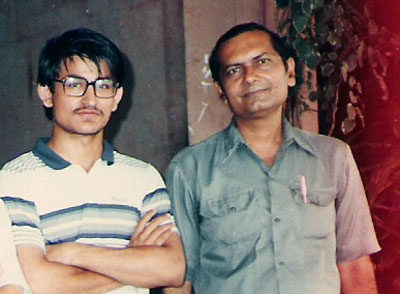
PS: I was searching for a photograph of Pandeyji, as I addressed him all these years. I got one from 1989 with Rakesh.

Posted in education | Tagged , | 1 Comment

Hindustan Motors: Auto Maker or Realtor

Hindustan Motors has become a non-player in auto sector since long. Long back again, its management gave up the lead of one time or its pioneer role with entry of Maruti Udyog. It would have at least tried to remain a major player. The management never wanted to do that rather it decided to give a walk over. It believed in making money out of other incomes as a typical old time business house rather than surviving with innovations and risk taking. It kept on investing but without a long term strategy. It would have preferred a small car from Mitsubishi rather a compact bigger car. No manufacturer can think of remaining in that sector without the capability to go on changing the model.

Uttarpara plant could have been restructured in separate companies that could have become three four independent separate units supplying the major components for all the major automakers.

Years ago, a friend of mine in Noida enquired if the WB government would permit Hindustan Motors to sell its land. My friend, as I came to know later on, had some shares of the company and he wanted to sell them, but was told by his broker to wait till the government permitted to sell the land. The broker expected the share price to rise after the permission.

The management of Hindustan Motors had long been working as Real Estate Company rather an automobile manufacturer. We were very happy when HM went for a 50:50 venture with General Motors when General Motors set up its Halol plant. Hindustan Motors perhaps got its share in equity out of cost of the land and building facilities that it had created in mid 90s for a truck plant in collaboration with Isuzu Motors of Japan. Later on, Hindustan Motors also sold its manufacturing plants in Hosur and Chennai, naturally along with its land.

Hindustan Motors also had a plant in Pithampur with a lot of land. The major part of the plant also has changed hand.

The news in ‘Business Standard’ didn’t surprise me and confirmed my proposition. The company had approached the state government in 2003 to raise funds by selling the excess 314 acres so it could revive it, as its plant is built on 427 acres of land out of the total 741acres or it possessed once. How could a company which didn’t use the land for five or more decades sell it to survive?

BS reports, “In 2006, the company got an approval from the Left Front government to sell the land. HM declared Rs 85-crore projected revenue for the sale of this excess land. However, an internal audit done by the state government last November found that HM had sold the land to Bangalore-based Shriram Properties for the development of an integrated IT township at a price of Rs 285 crore in 2007. The state believes that, as the money was not ploughed back into the company, it should be returned to the government as it was the owner of the plot.”

As reported, the net profit of Rs 17.20 crore in the first quarter of the current financial year came from selling of land in Gujarat’s Halol that generated an earning of Rs 47.63 crore. Naturally, one can question even that sell, as the state agency offered the land for setting up the plant and not for selling it as real estate at any later date.

It hurts me when I hear that the company has already sold most of the machinery and equipment. Many of its empty sheds have tattered ceilings. Hardly a little more than thousand workers are left with almost no engineering staffs. It manufactures few thousands Ambassadors. But the company keeps on coming in press with tall plans of some foreign company proposing to buy stake in it, or its plan for introducing new models or to increase production by five fold.

Is it not an intentional misdemenour of a company and a business house that the company can afford with the politicians and bureaucrats with it? Should it not be considered as corruption or does it not involve corruption?

Usually all land deals involve corruption? Does the nation require an n Anna Hazare for this type for activities of responsible business house? What percentage of the business houses are involved in such unscrupulous deals”

I feel bad as I had decided to work for such a company early in my life and I remained there for whole of my life. It was too late when I realized my fault.

Posted in industry, management | Leave a comment

Auto Sector: India Still Attractive

Indian auto sector faces rough ride today. Reasons are many but naturally the rise in the fuel prices and the interest rates are the major ones. Rising inflation is another moral deterrent.

Recent monthly sale figures for almost all manufacturers are going down. However, the domestic manufacturers are performing worse. ‘Tata Motors witnessed the steepest fall, with numbers crashing by 33%. The company sold 16,829 units in the month against 25,212 units in the same month last year. Alarmingly, the cheapest car, Nano could manage sales of only 1,202 units, 85% lower compared to August last year.’ All the companies are offering heavy discounts to push sales. With festival seasons drawing nearer, will the sales improve?

A New Manufacturing Hub: Surprisingly, the bad news of slowing economy, particularly the auto sector is not dissuading the foreign auto majors to enter India. Left outs are rushing. Sanand, the unknown to any one even in India before the decision to relocate Nano plant from Singur in West Bengal, is rapidly growing as a new manufacturing hub for automobiles.
http://www.business-standard.com/india/news/psa-peugeot-re-enters-india/447828/ French automobile major, PSA Peugeot Citroen has recently announced its plan to set up a vehicle manufacturing facility near Sanand at an investment of Rs 4,000 crore ($650 million) with an initial capacity of 165,000 vehicles a year, that can be expanded to 340,000 units. Ford India had earlier announced investment of Rs 4,000 crore to locate its second plant in Sanand with a capacity to produce 240,000 units a year initially and an engine plant with an initial annual capacity of 270,000 engines. Is it an encouraging indication?

Nissan Motor Co that was late to join the race, has already launched its Micra and has started producing Sunny sedan too in its Chennai based manufacturing plant. The good news is that Nissan will source as much as 85% of the parts for the Sunny from vendors in India. Interestingly, Renault Nissan Alliance India is credited with producing one lakh petrol engines in a record period of 15 months.

I am of an opinion that the government now starts discouraging any left out global entrants to make the already manufacturing ones to stabilize the facilities and grow for domestic as well as export market so that indigenization increases.

Maruti Suzuki India Ltd (MSIL) has found a way out to cut down the cost through increasing the overall indigenization level from 75% at present to 90 per cent in two years. A strong auto component sector goes as advantage for the foreign auto majors to find India attractive besides its big enough market.

Maruti- Suzuki at one stage was not ready to indigenize gears has a diesel engine and transmission-producing joint venture company, Suzuki Powertrain India. It’s working to develop an all-new diesel engine range, the technology where Suzuki is not strong. Suzuki Powertrain India exports engines to Suzuki’s European operation, had recently expanded its capacity by 25 per cent to 300,000 engines per annum. It certainly improves the potential for manufacturing.

Additionally, India has its auto component industry growing significantly that was by 34 per cent last financial year taking the total turnover to $39.9 billion. Unfortunately, while exports grew by a robust 54 per cent to $5.2 billion, imports increased by 30 per cent to $8.5 billion. I wish the OEMs would have encouraged the auto component sector with R&D support. Still major complex components such as one for automatic transmission remain on import list. The component industry invested close to $2-2.5 billion on capacity expansion projects in 2010-11. As estimated, the auto component industry is expected to double its workforce to four million workers over the next two years.

I get pleasantly surprised and excited to know that a minor company Amul has already entered the Business of 5’Cs namely Connecting rods, Crank Shafts, Cylinder Blocks, Cylinder Heads, and Cam Shafts for the Automotive & Engineering Industry.
The presence of a mature auto component industry in India makes its more attractive for OEMs to come to India without much hesitation.

However, the labour unions have started troubling the auto manufacturers. The state governments as well as the central government must intervene to get a positive way out to avoid the layoffs and lockouts. It’s must be taken seriously on proactive manner, otherwise all the dreams of developing India as global hub of small compact cars will remain dream only. Particularly, the HR heads of the MNCs will be on test to match the management policies of the parent companies with the local conditions without creating abrasions.

Posted in economy, management, manufacturing | Leave a comment

Anpadh, Ganwar and Nalayak

Om Puri called MPs ‘anpadh’, ‘ganwaar’, ‘nalayak’. Angry parliamentarians moved privilege motion. Speaker has admitted. Are these words unparliamentarian?

Anpadh is one who is not educated. According to Lalu, ‘bidya se buddhi nahin aati, buddhi se bidya aati hai’, that means intelligence does not come out of education, education comes out of intelligence. And all MPs have the intelligence, where as the highly educated Anna team are only educated. Unfortunately, Lalu doesn’t practise the famous Sanskrit sloka that says ‘bidya dadati binayam’ that means ‘education must give humility’.

Ganwaar is one with traits of the villagers. It, in English, can only mean those who don’t know the urban manners.

Nalayak is one who is not conformist.

Why did the two stalwarts from Bihar got so excited. Moreover, the parliamentarians must understand the anger and perception of the people at Ramlila and change themselves by their deeds.

Saturday August 27, was a special historic day for the country. Both houses were discussing a very serious issue that was to decide if Anna Hazare on a hunger strike for 12 days would break his fast. The whole country, for a change, was watching Lok Sabha and Rajya Sabha TV channels that day. Both, the leader of the house, Pranab Babu and the leader of opposition delivered one of the best speeches. The others also followed almost with the same gusto.

But when Sharad Yadav came to speak, he decided to play jester for the MPs. He mocked in his typical rustic manner Anna Team members even naming some. He didn’t spare even digital media. Lalu followed Sharad Yadav and kept on entertaining MPs. Many of MPs kept on asking for more.

I give below some samples:

“One former police officer is lampooning us…. She will teach us politics…. She has enjoyed the benefits of government service while we have been on the streets and struggled.” Everyone can guess the person he referred. Can he be compared with her?

“People here roam around India Gate with their dogs, eat ice creams and then decide to go to Ramlila.” Will Sharad still hold to his perception?

And in his further exasperation, Sharad attacked at small screen, “Ye dabba has robbed us of our night sleep. Please do something and shut them.”

And look at the Lalu’s advice.

Sab khela NGO ka hai (NGOs are behind everything). Keep NGOs out of Lokpal and the agitation will end.”

At least the actors from the Anna’s stage didn’t say anything so clearly against a particular MP.

Why do the trio of Bihar- Sharad, Lalu, and Ram Bilash keep on self- aggrandizing or play the same divisive cards of injustice to the minority, dalit and reservation every time and every where? Has corruption anything to do with that. Why can’t Lalu and Ram Bilash reconcile that they are failed leaders even in their own state and getting more and more into as historical figures with no contemporary relevance?

And it is not only me who thought so poorly of these two stalwarts from Bihar. Why should they keep on tarnishing the image of Bihar?

I wish the parliamentarians give up the idea of taking up the priviledge motion.

Posted in indian politics | Tagged , , | Leave a comment

Manmohan’s Credibility Loss and Alternative

Anna’s win certainly has exposed Manmohan and his total ineffective governance. Rahul Gandhi not only proved himself poor in assisting Manmohan to salvage the damage done in making multiple mistakes in handling Anna’s hurricane. Rather the way Rahul tried to get into the issue through his speech after a long silence stunned the youth and those who thought him as capable enough to handle the responsibility of the country. Perhaps Rahul wants to wait. And even if the party wished, Rahul perhaps is not having that self confidence that is necessary, otherwise he would not have abstained totally from the Saturday deliberations in parliament when a new history was getting written. He would have become a main character of the story but he didn’t try for it and for many such as the students of IIT, he became a minor villain.

Manmohan with a little proactive initiative could have stolen the show that went perfect with his saluting Anna but there after he allowed the role to slip out to Pranab Mukherji again and Pranab played with all elegance and statesmanship.

And the question and justification of the continuance of Manmohan has become a subject of wise speculation. India Today has written, “The sheer absence of leadership has ripped apart the credibility of the Government and raised questions about whether the prime minister can continue.”

I wonder why Manmohan and more so Rahul could hear the voice of millions of Indians and particularly of the crowd of young men and women from middle class, business community and even technocrats that kept on swelling from day one.

Manmohan couldn’t live up to the legacy as the prime minister of a billion plus nation even when the absence of Sonia provided him with the golden opportunity to prove the nation otherwise. The total management of the confrontation with Anna Hazare and every act of the government since August 16, be it the arrest and Tihar, was the Manmohan’s responsibility. I wonder he was too confident with Kapil Sibal and Chidambaram who could make Ramdev look pigmy.

Manmohan Singh in the process did not only lose his middle-class constituency but also fallen in the eyes of young MPs. The old guards were already loath to accept him as prime minister anyway.

As Dipankar Gupta writes, ‘Quite clearly, the youth appear to have forgotten Manmohan Singh’s academic past. Instead, they tend to see him today as just another politician. If Manmohan Singh appears to have lost his intellectual starch it is because he has repeatedly aligned his actions with the logic of politics (worse, coalition politics).

It is unfortunate that Manmohan has aged and is difficult to make him change to suddenly become effective and proactive. For example, why should it take seven months to appoint the head of NHAI, the vital for building roads? How many years will be needed to bring a suitable Land Acquisition Bill so that a company like POSCO ready to pour in $ 12 billion of investment would not be waiting for six years? How many Annas will be required to bring change in the governance of the country?

And it is the right time that Congress and Sonia interest of the nation decode for a change at the top, perhaps with Pranab Mukherji at least up to the time Congress wins again and Rahul dares to sit in the hot chair.

Posted in indian politics | Leave a comment

Nano Sales: Case of Market Research or Marketing

Images-Nano Cars

I wonder if Tata Motors had undertaken a detail market research for Nano before deciding to set up a plant for it or it was totally unilateral initiative, decision or wish of Ratan Tata as expressed by him publicly that was carried out by the technocrats and managers of the company as was the practice in good old days. Even I myself experienced similar imposition of the CEOs or the private owner.

All along I have been expecting and promoting for the generation of a big volume for this car to become a globally accepted entry car.Nano sales in this July are just dismal. The number slipped to 3,260 units from 9,000 units in the corresponding month last year.

Tata Motors, as reported, have planned to set up plants in Latin America, Africa as well as South=East Asia. It has plans to promote and sell Nanos to the employees of the companies of Tata Group. Can it keep the production of Nanos growing and reaching the scale expected by the company?

Rural India could have provided a good market for it. But as all the roads that its rural owners are to use in course of their routine outings are not good enough, its large scale rural penetration will take time.

However, perhaps there are other sectors with good potentials where Tata Motors could have targeted to sell Nanos.

In every family that is having one or bigger cars must have one Nano too. It can be used for taking kids to the schools, coaching classes or tutors or to send the driver to buy few loafs of bread or vegetables. It can always be a kitty car unless the owner needs to show off her status through a huge car.

For the Gen Y entering job market with many with financial constraints, Nano can be made an attractive buy as the first car.

For, old men like me, living in a quiet little town or NCR with gradually reducing outside engagements, Nano can certainly be a choice. Unfortunately, I have not found any one to approach me or any of my friends to sell Nano. Tata Motors missed on marketing Nano initially with a hope of automatic queuing up of its dealers by its buyers. It must go for marketing now to generate a consistently growing volume.

Nano’s launch created a wave of India’s arrival in product design. The product was born out of a dream of Ratan Tata.

Will Tata Motors make his dream coming true, and realized?

Can the professors of IIMs and other top management schools of India and abroad make this a case study or a subject of a research project?

Posted in industry, management, manufacturing | Leave a comment

Government Playing Smart

If the country believes the doctors attending on Anna, the situation is really becoming grim. But somehow it has become equally difficult to trust Manmohan or for that matter even the leadership of BJP. I don’t know why Manmohan is not taking a respectful exit and why Rahul and Sonia are not appreciating the need and agreeing for it. Why the other old man of BJP, LK Advani, is not hanging his boots and leaving the affairs to the leadership at the next levels, that doesn’t seem to relish his initiatives?

Manmohan has dropped his close aid Kapil Sibal and selected Pranab Mukharji to negotiate. And Pranab seems to be avoiding direct involvement and using Khurshid as intermediary that is causing misunderstanding and increasing the suspicion about the intention of the Party and the government.

Why are they negotiating in a way used for bargaining with the trade unionists?

One, who watched the proceedings of both houses of the parliament on August 24, the ninth day of Anna’s fast and read the opening statement made by the prime minister, can easily get confused. Why are the government and the prime minister playing smart with Anna?

On one hand it declared that it had sent the Jan Lokpal Bill to the standing committee. The other hand the prime minster statement says, it has requested the standing committee to consider Jan Lokpal Bill along with one from Aruna Ray.

“Accordingly, I wrote to him requesting him to end his fast and reiterated Government’s intention to pass the best possible Lokpal legislation with inputs from civil society and on the basis of the broadest possible consensus. I said that the matter was with the Standing Committee and the Committee was entitled to consider not only the Bill introduced by the Government but the Jan Lokpal Bill and other versions like those prepared by Shrimati Aruna Roy as well.”

I don’t understand why Jan Lokpal Bill as such can’t be the lone base to come out with the final bill? I don’t know why it can’t be introduced straight in the parliament for debate. Is it because of no precedence or the constitution prohibits it?

Different headlines in media are just emphasizing the Prime minister’s wish phrase of a strong and effective Lokpal with no breakthrough move to show that it really means that.

All the parties are singing their own tunes and there is hardly anyone to evolve a common tune in the interest of the old man and the nation. Perhaps they all are waiting when the health of Anna goes critical.

It’s unfortunate; the government appears to be directionless, the country doesn’t have a prime minister with guts and following to take a clear decision.

Posted in governance, indian politics | Tagged , , | Leave a comment

Anna: Lessons for Gen Y

I pray that Anna doesn’t fast unto death against the insensitive and adamant leadership in the government. But the elite of the country and particularly younger generation must take some lessons from him, and vow to something more than only rocking to Anna’s beat. He is just one ordinary person with his root rural India intact. His honesty of purpose is weighing heavier than the intelligent and highly educated prime minister and ministers who are very good in the art of talking. Today, his call for making a corruption free India is resonating all over the world. I wish he succeeds. The battle for his version of Lokpal Bill is symbolic. If God provides a long life to him as all the people of India wish and must look for, he will go for eradicating many equally difficult bottlenecks to the country’s real development.

A lot of credit, if Anna succeeds, will certainly go to the overwhelming and exhilarating support of the Gen Next. And the older generation is looking for more from the Gen Next.

Fast is part of the Indian culture and the younger generation should appreciate that. It is not only for a cause but for self improvement too. It doesn’t weaken, it makes one stronger. It was interesting to learn that many students of IITs and IIMs have taken a vow of taking one meal a day till Anna fasts. Perhaps the whole country would have gone for that.

However, there is one more aspect from Anna’s life that one must learn. His contribution to make his small village, Ralegan Siddhi (Images), a model village to be followed by all coming from rural India and succeeding in life much more materialistically than what Anna achieved.

Anna after his army career came to his village. Anna’s first task was to uproot alcoholism. He could succeed in that and then went for establishing a Grain bank with the objective of providing food security to needful farmers during times of drought or crop failure. And his next target was the water management. With his various endeavours, he could completely transform the economy of the village. Why can’t this one aspect be emulated by all of us with successful careers in private or government sector or the entrepreneurs? Why do we forget about the villages where we were born? Why do we become one of those urbanites who look down upon the villagers?

As reported, “when Hazare came in Ralegan Siddhi in 1975 only 70 acres (28 ha) of land was irrigated, Hazare converted it into about 2,500 acres (1,000 ha). Earlier only 300 liters of milk was sold from the village. Now the milk production has gone up to 4000 liters. The per capita income of the villagers has increased from Rs. 225 to Rs. 2500.”

Even after 64 years of independence. 90% or more of Indian villages have neither the faculties of quality education for the children nor healthcare for the population. The same politician clan with different names in the system, be it village heads, MLA or MP are happy and content by enhancing the number of the people under poverty line, BPL and claiming for more doles from the government so that they and their men can become richer.

Can more and more of the countrymen and those who retire from defence forces follow the path of Anna to serve their village and help in transforming it?

Posted in governance, indian politics, social issues | Leave a comment

Anna Wave: Dissenting Voices and Worries

I got a funny idea last night. Would Manmohan Singh go for a fast for three days to appreciate what a fast means, if he really believes rationally that his Lokpal Bill will create an effective and strong Lokpal to fight the cancer of corruption or is better than one drafted by Anna’s team? After all, Manmohan and Anna are in the same age bracket, equally fit and equally emotional about their views.

Why could he call Anna on phone and talk with him? What is the ego? Alternatively, if Manmohan really means his readiness for ‘some give and take; and open discussion or negotiations, why can’t he depute someone who can sit with Anna and thrash out the differences?

Why does he or Congress try to test the sustainability of the movement including the number of days Anna can fast and the strength of Anna’s following by the number of people coming to Ramlila ground or parading or demonstrating in the streets and parks of the metros and towns?

Why can’t Manmohan appreciate the risks involved in postponing his engagement for long enough to see some major mishaps to happen besides the long term consequential damages to the interests of the country?

Is he not pained by seeing people putting a caste and community colour to issues of national importance such as corruption and black money?

Manmohan could have certainly influenced the members of the Sonia Gandhi-headed National Advisory Council not to press ahead with their version of Lokpal bill at this critical time with so much of media publicity that made many think that as one done on the government encouragement.

Aruna Roy, Harsh Mander, and even Arundhati Roy may have some reasonable points but now the Anna movement have gone beyond reasons. It’s with a large mass of people, their aspirations on one side and anger for the ineffective governance of the governments that they got in last few decades.

I really wonder why activist Shabnam Hashmi sees a threat of the communal forces taking over Hazare’s movement. I could also not appreciate the prominent dalit activists, intellectuals as well as the writers severely castigating Anna’s movement as casteist in nature.

Does a corrupt official give certain concession for someone from minority or dalit community?

While the media’s over involvement and the exuberance of the younger generation and middle class provides hope, its continuance for long makes me fearful. It must not affect the economy negatively.

Posted in indian politics, social issues | Leave a comment