India 2010

It all started with the BRICs report. It predicted that India and three others -China, Russia and Brazil – would be giant economic forces in the coming century. Surprisingly, the Indian economy is moving much faster than the BRICs assumed GDP growth figure of 6.5 per cent. India is growing at more than 8% and may soon get into a growth rate of double digit. Even the conservative NCAER agrees for 8.5%(?), though it fears that the Planning Commission’s ambitious nine per cent growth target for the 11th plan may not be achievable.

What will be scenario of the Indian economy by 2010, the year India will hold Commonwealth Games, barely 39 months away?

GDP: GDP climbed to about $690 billion in 2005 up from about $600 billion in 2003. With the current rate of 8 per cent of growth, GDP will touch $1 trillion slightly before 2010. But with the higher growth rate expected, the GDP may be better.

Passenger cars: India is expected to produce 1.1 million cars this year, and over 2 million by 2010.

Two-wheelers that keep middle-class Indians on the roads: India’s two-wheeler industry is the world’s second largest and will turn out 7 million vehicles this year. That can easily go up to about 12 million by 2010.

Colour televisions, usually one of the first electronic purchases that every Indian household makes: India will make about 11 million television sets this year and the production is likely to climb to about 20 million by 2010.

Hi-tech outsourcing, the sector that has built India a brand: Outsourcing is climbing at a steady 30 per cent annually and exports are slated to hit $60 billion by 2010. Some say it to grow to $100 billion.

Steel: Ram Vilas Paswan says that production of steel is set to overtake all the earlier targets and will touch 80 million tonnes (mt) by 2011-12, a 23 per cent jump over the earlier projection of 65 mt.

Manufacturing:
Tata Motors plans to roll out its small car by early 2008, perhaps from its Singur, West Bengal plant. And Tata Motors expects to reach a production figure of 5,00,000, or may be million. Tata Motors is building another Rs 2,500-crore plant for its super-hit mini-truck, the Ace that created a history of a sort. Tata Motors began rather modestly in mid-2005 with plans to produce 30,000 of these ‘last mile’ vehicles at its Pune factory. It ended up selling about 60,000 in the first year. The Uttaranchal factory is expected to turn out about 250,000 vehicles once it is ready in less than a year.

Maruti Udyog
is investing almost $2 billion (Rs 9,000 crore) in the next five years, pushing up production from 600,000 to 900,000 in about three years. Maruti has many plans such as diesel engine manufacturing as well as contract manufacturing up to 4,00,000 cars annually for export. Auto sector has reasons for this optimism- very low auto penetration of huge market of India and low cost (at least 35% cheaper than US) quality manufacturing in India. Auto sector is over-enthusiastic, as India’s per capita income will reach about $1,000 roughly around 2010. As established, the number of people buying cars jumps dramatically when per capita income touches about $1,000.

Hyundai Motors and M&M are other companies that are having big plans in auto sectors.

By 2010, the Indian auto industry may actually become a hub for sourcing components and for the manufacture of small cars for export. Estimates indicate that the four-wheeler auto industry is projected to grow at a CAGR of 9% between 2005-2014 and the two-wheeler industry at 16% in the same period. Auto component export may reach about 20 billion by 2010.

Retail: Kishore Biyani’s recently re-named company Future Group is shopping to push up store space in malls and plazas across India from 4 million sq. ft to about 8 million sq. ft this year; and aims to touch about 30 million sq. ft by 2010. Biyani hopes that his group will grow from its current $1 billion turnover to anywhere between $6 billion and $7 billion by 2010. The Retailers Association of India (RAI) expects that organised retail will climb from about 18 million sq. ft currently to almost 60 million sq. ft by 2010. Reliance Industries’ Mukesh Ambani plans to spend about Rs 25,000 crore (that’s roughly $5 billion if that helps to bring all those zeroes into perspective) over the next five years. The Aditya Birla group has readied a blueprint for India’s second-largest retail rollout with Rs 15,000-crore investment in over 6,000 stores in three years.

Telecom: Ambitious Maran, the young minister is now talking about having 500 million phones by 2010. India has become world-beaters in telecom with about 170 million phones ringing already. After clocking a world record by adding over 6 million subscribers in September, surpassing China, India is expected to have added another 7 million in October. India is claiming the ‘fastest growth’ crown from the Chinese. Some Other market research companies have estimated that India will, in fact, overtake China when it comes to selling mobile instruments by around 2009. Nokia, LG and Motorola have put up factories to manufacture mobile phones after years of saying that the Indian market was better supplied from abroad.

By 2010, India, once being hopelessly outclassed by China, will be the second largest manufacturing nation of the world. Engineering outsourcing is another potentially great sector that can suck all the technically competent Indians.

Both high-tech sector as well as manufacturing will require huge lot of skilled technocrats. This year IT sector plans to employ 1,00,000 freshers (expected shortage 5,00,000 by 2010). The main challenge will be for the educational institutes. While Maruti’s Jagdish Khattar demands a port tailored specially for car exports, Karnik requires the creation of six ‘knowledge cities’ from where InfoTech giants can reach out to the world.

And may be we can sort out our ways to reach bilateral trade target of US$ 50 billion by 2010 between Chindia.

PS: T N Ninan: All in a week’s work

Renault to Make Autos With Indian Company
Reliance ripple: Retail rivals ramp up

Posted in Uncategorized | Leave a comment

8%, 10%, or 13%- What’s India’s GDP Growth Rate?<

Swaminathan S Anklesaria Aiyar in his usual column in Sunday Times of India referred to the arguments of Professor Arvind Panagariya of Columbia University that in dollar terms India is having a growth of 13% in is GDP annually. However, as we all know growth has averaged 8% in the last three years, and as predicted, it will be above 8% this fiscal too. Should Indian managers of its economy be given the credit for this third best growth rate of the world? Here are some results that can’t come only because of external reasons. And these are the results of certain prudent strategies and major structural changes even with huge lot of inefficient expenditures on popular programmes as we are the largest democracy.

India has surprisingly doubled its merchandise exports in just three years, from $52.7 billion in 2002-03 to $102.7 billion in 2005-06. And it is without previous instance of rapid export growth that was because of sharp falls in the rupee making exports temporarily competitive. During last three years, exports have boomed despite the rupee actually rising 9.3% against the dollar. So, for the first time, India is exporting on the basis of rising productivity, not unsustainable price cuts.

Service exports have more than doubled in the last two years, mainly to computer software. India now accounts for a respectable 2.5% of world service exports, against only 1% of world merchandise exports, and the share seems set to keep rising.

The share of exports of goods plus services in GDP has virtually tripled from 7.9% in 1990-91 to 20.5% last year. At this rate, India will catch up with China’s current ratio of 26% in three years.

Even with modest foreign direct investment into India, foreign portfolio investment has skyrocketed. So, total foreign investment has risen from almost zero when reforms began to $20 billion last year.

India tops today globally in remittances from overseas Indians that have risen to over $24 billion. And this explains why India’s forex reserves have risen to $165 billion, despite record oil prices and a record trade deficit.

Phone lines have increased from barely five million in 1990 to 140 million. Last month alone, six million new mobile phones were added. The telecom revolution is now set to penetrate rural areas too.

The share of agriculture in GDP has fallen from over half at Independence to just 21%. Food grains now account for only half of agriculture. Animal husbandry, fisheries fruits and vegetables are growing much faster. So the Indian economy is not heavily dependent on the monsoon. (like the one in 2002).

The maximum import tariff, once well over 100%, is now down to 12.5% , except for a short list of manufactured and agricultural produce. Import duty collections average only 5% of total imports, close to China’s rate of 3%. India can claim to be a fairly open economy.
Indian companies have the confidence of global financiers, who now rate Reliance Industries and Tata Steel as credit-worthier than Ford or General Motors.

GDP is measured in constant rupees (that is, rupees adjusted for inflation).

For global comparisons, GDP must be measured in dollars. World Bank data show that India’s GDP has shot up by a phenomenal 16.4% per year in the last three years (2003-06). Adjusting for the US inflation rate of 3%, India has been growing by 13.4% per year in inflation-adjusted dollars.

At this rate, Panagariya calculates, India will reach the current US GDP of $11.5 trillion in 2005 in just 22 years!

However, Panagariya says this is only hypothetical, and is not possible since the rupee cannot keep appreciating so fast against the dollar. This year, the rupee has dropped over 2% against the dollar.

But what about the BRIC (Brazil, Russia, India, China) report of Goldman Sachs that assumes, the rupee will in fact appreciate by an average of 2% per year against the dollar in coming decades.

And then comes the argument from another economists Sujit Bhalla, “Almost all the factors are in place to sustain more than 10 per cent economic growth annually, as the investment level in 2006-07 is over 40 per cent of GDP, a jump from the 25 per cent levels, just five years ago. At a 40% investment rate and at an ICOR of 3.5, the sustainable growth rate possible is 11.4%. This is one of the fastest jumps in history. If India achieves 10 per cent growth today, then it is likely to cross Chinese growth rate of 10.5 per cent by 2010.”

Should we say whatever the figures, those are just great? Let us keep it up without getting complacent. Let our Leftists friends should help India to further the growth by not being whimsical. And let us go by what Chidambaram says, ‘Now, fire up all engines’.

India can get all what it wishes, be it Nuclear pacts, Permanent membership of Security Councils, or other world organization or with unprecedented growth rate and after we can say goodbye to the poverty of our people. And all that can with sustainable higher growth rates at last for next few decades. It demands discipline and efficiency of all, by all, and for all.

Posted in economy | Leave a comment

Corruption Perception Index- Can it be relied?

It was early morning 3.30 a.m. I thought it is going to be good day after I completed reading few ‘slokas’ of Gita before I started surfing news. The first news itself enthralled me.

Transparency International (TI), the Berlin-based anti-corruption watchdog, has brought a good news this year. India ranks now No. 70 on its Corruption Perception Index (CPI) out of 163 nations, a distinct improvement over last year, when India was at No 88.

And there are already people to give the credit of this reversal of its downward slide on the CPI, to the Right to Information (RTI) Act.

However, Vice-Admiral (retd.) RH Tahiliani, president of TI-India appeared pessimist. “Indians give Rs 21,000 crore every year as bribes,” he said.

US is ranked at No.20 (7.3). India shares the 70th rank with nine other countries including China, Brazil and Egypt, all of whom have scored the same (3.3). Lesser score implies more corruption. Should the nationalists be happier that Pakistan is ranked at 142 (2.2)?

TI’s Corruption Perception Index draws its conclusion from multiple expert opinion survey polls that compiled perceptions of public sector corruption from across 163 countries. It involves a total of 12 agencies as source to the survey, which includes World Bank, Political and Economic Risk Consultancy, UN Economic Commissions for Africa, World Economic Forum and World Markets Research Centre as source to survey. The survey in India covered 11 public departments that included police and judiciary as well as education and hospitals.

Should Indians take some solace that thing are improving though slowly? I personally go by R H Tahiliani, Chairman, Transparency International India that “corruption would only go down if people refuse to pay bribe”

I was pretty delighted and as usual I left for my morning walk after Yamuna returned. In my third round, my acquaintance Gehlot joined me. He is still a superintending engineer in PWD, UP. Gehlot respects me and discusses things pretty frankly. I wanted to have his views on a recent incident in nearby Ghaziabad in which some 17,000 aspirants of police jobs went on rampant destruction of property including molestation of women. As Gehlot knows the region for many years with number of relatives in the area, I thought he would be better informed. I was shocked by his version of the reasons for the incident.
“Sir, what can these people do if they can’t get the job for which each of them had already paid Rs 4 lakh?”

“How do, you know that?”
” Sir, I had gone myself for the appointment of the son of my driver to the people representative of the area who could get that done. He told me curtly that I was a little too late.”

I was reminded of what Pathak one of my office assistants of HM days told me, when I was in Kolkata last time. He has got his only son in navy. He had to pay Rs50, 000. I never believed that there is so much of corruption in appointment to so low category a job.

On enquiry, he further added that 90% of the contracts for development work that are in abundance these days, are going to one community Yadav in UP. None can raise his voice. All these contractors pay 10% of the contract value in advance to the minister, who happens to be the brother of the CM. Should I be happy or morose after hearing the story from Gehlot?

I remember my PhD friend and rice mill owner at Kichha telling me that 60 % of the output of the mill are to be given to FCI and for that a fixed 26% of the value must be paid to the officer of FCI(Food Corporation of India).

What should I think about the improved Corruption Perception Index of India?

I shall keep my hope. I further read the text of a cryptic SMS that Bihar DGP Ashish Ranjan Sinha sent to senior police officers, including district SPs, over the past few days

”Ask your officers to be honest. Trap cases against police on the rise. It’s denting the image…”: DGP

As report comes from Bihar, the most corrupt of the states, the raids against bribe takers have jolted the state police headquarters to cause enough worry about image. Even Bihar CM seems buoyed by the success.

Posted in Uncategorized | Leave a comment

States Can Emulate ‘Shrujan’Handicrafts Initiatives

Shrujan, a Gujarat-based women’s organisation is one success story that can be emulated by some missionary entrepreneurs or NGOs to provide employment and save traditional crafts. It is a case study for Indian handicraft makers trying to compete in the global marketplace.

Chandra Shroff, the housewife of a factory owner, by a chance, pitched in with the relief work of Ramakrishna Mission in her hometown, drought-hit Dhaneti in Kutch in 1969. The traditional embroidery on the clothes of the women there struck her. She thought of using the unique craft to generate regular income for those women. Shroff started Shrujan. A group of 30 women got together to earn a living from the only skill they knew- traditional hand embroidery. About 16 kinds of embroideries prevalent in Kutch reflect the culture of the region. Shroff thought of and packaged the local, hand-embroidered textiles into garments and life-style products for urban domestic and international markets. She succeeded. Today over 3,000 women spread over 114 villages are part of the Shrujan family and another 22,000 have been benefited. Efforts are on to train local craftswomen to assume roles of designers, saleswomen and teachers.

And Shroff 73 now, became the first Indian to win the Rolex Award for Enterprise. It is a distinction that came with a $100,000 cash prize and personally inscribed gold Rolex chronometer, and its share of international attention.

Shrujan has created employment for those women who could have never thought of it. It helped in conservation and spread of regional art. Shroff began ”Pride and Enterprise” initiative to inspire younger craftswomen to recognise richness of their craft and created 1,200 hand-embroidered display panels representing work of 600 rural craftswomen. In 1995, Shroff setup a mobile resource centres that houses a design bank and takes the panels to educate and develop skilled artisans and craftswomen in far-flung villages. The idea is to empower them financially to ensure a better standard of living. With the money of the award, Shroff can endeveour to fulfill many of her plans, such a setting up a living and learning design center, a handicraft museum, workshop, school and library in the region.

Rural India has huge population of talented and needy women folks in every part of the country with lot of skills in their hands and very innovative mind. I remember my own grandmother, mother, and then Yamuna with mastery in stitching art and knitting marvels. Madhubani art in Bihar, Chikkan stitching in UP, Kantha of West Bengal, and similar traditional crafts in other regions too have potential to get globally accepted, packaged well and marketed smartly. Everyone coming from the rural India will agree with me. But there are very few Chandra Shroffs.

I wish our IIMs and the students of the fairer sex in particular take some special interests and initiatives for setting up the production centers based on the skill available so cheaply in rural India that can be marketed well in global market place. Only these endeavours and empowerment where the rural India gets into production of marketable products can create mass employment that can take most of the households out of the curse of poverty and sufferings. I wonder why our administrators are not working on these ideas proven by dedicated workers like Shroff, and allowing the traders and middlemen, be it in Varanasi or Lucknow in UP, Madhubani in Bihar, or Pippali in Orissa to take the maximum monetary advantages of the hard work and skillful crafts of the people engaged in traditional creative professions.

Posted in economy | Leave a comment

Tajmahal- Some Revelations

Tajmahal has always allured me. I can’t forget the fullmoon night of 1965, when I got its first glimpse the whole profile emerging from darkness with the moonlight gradually increasing. I have not missed any chance to visit it. Every time it has been fascinating. Here is a story that appeared in ‘Outlook’, but I wish to share it though in brief.

Some newer findings

 Shah Jahan picked the site for Taj for its great view from Raja Jai Singh of Amber, in exchange for four mansions
 Mumtaz Mahal’s body was moved thrice: from Zainabad garden to the Taj complex and finally inside the Taj
 Mumtaz shares the Taj complex with two begums Shah Jahan married after her death
 When finished, Shah Jahan visited Taj only twice. His own burial was not grand-he was taken quietly by two men by boat and laid beside Mumtaz.

The French physician Francois Bernier wrote in his ‘Voyages’ wayback in 1699, “I decidedly think that this monument deserves much more to be numbered among the wonders of the world than the pyramids of Egypt, those unshapen masses which when I had seen them twice yielded me no satisfaction.” And Bernier also mentions that he went to see the Taj with a merchant from France “who, like myself, did not tire of looking at it”.

However, Austrian art historian Ebba Koch has some revealing facts about it in her new book, The Complete Taj Mahal.

According to Koch, the building-obsessed emperor had wanted to create: a monument that would be unrivalled in beauty and grandeur for all generations to come.” It will,” in the words of his court historian Muhammad Amin Qazwini, “be a masterpiece for ages to come, increasing the amazement of all humanity.”

The emperor brought Mumtaz’s body from Berhanpur where she was originally buried to the site of Taj. She was buried for a third time in her final resting place, nearly 12 years later when the Taj was completed. And what was the real passion? It perhaps, was Shah Jahan’s ambition to go down in history as the world’s best builder. His biography, Padshahnama-written by a series of carefully chosen historians-goes into extraordinary detail about the emperor’s broken heart, including how his beard turned white overnight. But that did not stop the emperor from marrying twice after her. Both these later wives-Akbarabadi Mahal and Fatehbadi Begum-ended up sharing not only the emperor’s heart but also Mumtaz Mahal in Taj too.

Shah Jahan set about constructing Taj, Koch says, with utmost deliberation.

Just the selection of the site, for instance, took him nearly six months.

“Shah Jahan knew nothing makes an impression stronger than sheer size, so he decided to build a complex that was almost a kilometre long.,”

The emperor got enshrined through the daily meetings with his team of architects the classical symmetry in Taj.

Shah Jahan also took great pains to ensure that his Taj would last forever. Contemporary sources have recorded how wooden wells were sunk into the ground to replace the sand with gravel and concrete to reinforce the foundations of the building. He succeeded in erecting a building that could withstand earthquakes and floods that conservationists today are awestruck at its extraordinary stability.

And then the white marble used creates the ultimate impression of its magnificance.. Koch says she stood at the gate of the Taj and took photographs every hour to document the change of light. She understood the feeling that it aroused in Bernier that he could look at it without ever tiring. “It was meant to make a powerful impression at any point of the day,” says Koch.

But, Koch’s vote for Taj as the top wonder of the world is because of its seamless fusion of many different architectural traditions.

1.There is the Hindu concept adapted from the vaastu shastras of using only two colours: brahmanical white and Kshatriya red. “With this Shah Jahan was declaring that the Mughals were the new Brahmins and kshatriyas of India,” Koch says.
2.Then there’s the European pietra dura work that surpasses in its ingenious crafting the original from Italy.
3.And, of course, the Islamic elements are also there.

This incredible fusion of so many styles has given birth to innumerable claims about its origins: the early myths about how the architect was an Italian goldsmith named Geronimo Veroneo and how in the eighteenth century a Brahmin priest in Suraj Mal’s court suggested converting the Taj into a temple, not to speak of P.N. Oak’s more recent claim that the tomb is really Tejo-Mahalaya, a Shiva temple.

But the most startling revelation Koch has unearthed is a caravenserai- four open-air squares, where travellers could pitch their tents and unhitch their animals-edged with shopping arcades. “I don’t think there is a monument anywhere in the world of its age or even later which had these tourist facilities.” The idea was to finance the upkeep of the Taj with the revenue from the shops and provide shelter for travellers who would come to admire his masterpiece. When Shah Jahan decided to build a monument of love, it’s anyone’s guess who he really had in mind: Mumtaz Mahal or the tourists of the 21st century, or ever after.

Taj Mahal is a finalist among 21 other sites in the biggest global poll ever, spanning seven years and 20 million voters to pick the world’s New Seven Wonders. The Swiss non-profit organisation, New7Wonders launched the campaign in 2000. The final result will come only in next July in Lisbon. Will Taj be among New Seven Wonders? Will Indians and Taj lovers allover the world, make it find a place?

Posted in Uncategorized | Leave a comment

Indian MNCs with Overseas Acquisitions

In last few months, the domestic as well as foreign media are full with many stories about the arrival of India and its MNCs on global scene. Latest ‘India Today’ in November 4, issue published the cover story ‘Indian MNCs’ featuring how Indian companies of all sectors are hunting for assets abroad to acquire global scale. Madhukar Sabnavis’s article ‘The Indians are coming’ in Business Standard. And the other big news magazine ‘Outlook’ published ‘The Elephant’s Hungry’ in November 6, issue. Even ‘Business Week’ published on September 10, “India Companies: Shopping Abroad”.

Naturally all the stories start with the recent major Tata steel acquisition of Corus that has pushed Tata as the fifth largest steel manufacturer of the world. At $8.23 billion (Rs 37,858 crore), the recent Tata Steel’s Corus acquisition is the biggest cross-border deal for an Indian company was twice the FDI India received last year. But soon thereafter, Videocon $750 million bid for Daewoo Electronics too got materialized; (This was Dhoot’s second big bid after his takeover of electronics giant Thomson’s colour picture tube plants spread across four continents in 2005) and United Group’s Vijay Mallya had bid an undisclosed sum for Scottish giant Whyte & Mackay. And here are some prominent ones among many in global acquisition race:

TATA SONS: Since February 2000, companies across the group have bagged 21 overseas targets for over Rs 50,000 crore, many for undisclosed amounts. International Income amounts to Rs 29,017 cr. about 30% of the total income of the group.

VIDEOCON: has bid for Daewoo at $750 million. Bagged three manufacturing facilities abroad for Rs 4,643 cr since 2005. International Income is Rs 6,000 cr (50%).

M&M: has acquired assets in China, Europe and the US, where it is the fourth largest tractor maker. This year too, it is in the midst of bidding for a German company. International income is nearly Rs 4,000 cr, about 25% of the total income.

A.V. BIRLA: clinched five deals for undisclosed amounts last fiscal including a paper mill in Canada, copper mines in Australia and a VSF plant in China. International Income is Rs 8,500 cr (22% of the total)

RANBAXY: India’s largest pharma company has popped 14 companies for over $500 million since 2004 to enter the league of top eight global generic drug makers. International Income is Rs 3,907 cr (75%)

WIPRO: has bought nine companies for Rs 1,490.8 crore which have helped boost the company’s scale and income

WOCKHARDT: After it snapped up four foreign drug companies for $209 million, half of its sales come from Europe. International Income today is Rs 840 cr (60%)

DR REDDY’S: has been on the prowl right from Europe to North and South Americas where it has bought out four companies for $654 million. International income amounts to Rs 1,600 cr (66%)

BHARAT FORGE: has been buying assets overseas at a hectic pace. Has invested in five companies across Germany, the US, China and Sweden to gain both capacities and market access. Amtek Auto and Sona Koyo are another auto component companies that in buying spree abroad.

UB GROUP: After the no-show for champagne maker Tattinger, the drinks-to-airline conglomerate acquired a French wine maker for Rs 66 crore this year. UB has now bid to acquire Scottish whisky major Whyte and Mackay. International Income is Rs 1,500 cr (20%)

ASIAN PAINTS: Shopped from Sri Lanka to Australia and Fiji to Egypt having spent over Rs 100 crore for six companies over the last seven years. International income is Rs 3,021 cr (20%)

And the list is increasing fast. As was writing this story, I came to know of the global ambitions of Reliance Industries. As reported recently, Reliance Industries Limited (RIL) is all set make India’s first major acquisitions in the exploration and production, and the petrochemical sectors in Europe. And as usual, it will be big one.

Will those pessimists who were so vocal some months back after Lenovo of China acquired IBM business be happy now?

However, I still think all these companies particularly the ones from the manufacturing sector must have organic growth too. I keep giving the examples of the Japanese and South Koreans who have gone global after stabilizing their manufacturing in domestic market. Birlas were perhaps among the first few who set up manufacturing bases in African countries such as Nigeria and Kenya. I had a chance to visit some companies of Birla group in Thailand too.

These big business houses must also invest and expand in India in big way. And there I find Reliance doing the best. With the addition of the huge refining capacity at Jamnagar, perhaps the biggest in the world and all meant for export, Reliance is serving the nation in better way. I wish Tata Steel and Videocon must also invest in India in big way too along with competing the global race in its sector.

Reliance’s endeavour in retail sector is another big thing. It, as it promises, will provide better price for the farmers and sell at the most reasonable price to consumers too. And the huge employment at a better salary than those neighbourhood shops will serve the aspirations of the country’s large number of young men who fail to go for higher professional education.


PS Another Indian MNC in making: Suzlon targets 80% of income from abroad by ’10

India’s success story in global buyouts

Posted in economy, industry | Leave a comment

Train To Kashmir Valley

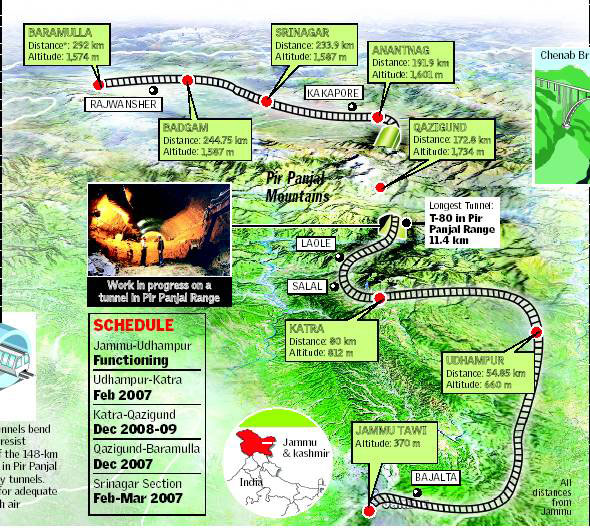
As reported byManeesh Pandey & M Saleem Pandit in ‘Times of India’, Indian Railway is in process of connecting the Kashmir Valley with the rest of India. A train will traverse the spectacular Pir Panjals and take tourists into the Chinar-lined getaways. Will that not be a great day for the lucky ones in the first train? The project faced many odds, even attacks of terrorists and also many a civil engineering challenges. Many expressed doubts of its viability in an earthquake prone area. However, as claimed, the design is good enough to withstand any seismological disturbances up to the magnitude of 8.5 on the Richter scale.
The powerful earthquake of October 2005, with epi-centre in PoK, was of the same intensity as the Gujarat quake of 2001, but “the construction sites and various installations completed till that time remained unmoved.” As claimed, with the latest quake-resistant technologies incorporated design and construction, the rail link will be robust to meet the geological demands and contingencies.

About 5,000 personnel are working on the project covering a route length of 292kms, with 1048 bridges (169 major ones), 84 tunnels covering 123 kms. The project cost will be Rs 2,500 crore. The highest altitude in the route will be 1,734 metres, and the highest Chenab bridge will be 383 metres.

5,000 more people will man the running of trains, maintenance of tracks, tunnels, bridges and commercial activities

The Jammu-Baramulla journey that will be entirely of broad gauge will take 8-10 hours to complete

The tracks are designed to take speeds of 110-120 km/hr subject to terrain

First-ever heated coaches will run on Indian tracks as at many places, the temperature is sub-zero

Around 40 trains can run both ways on this section daily

For communication in the hilly terrain, optic fibre network are being installed

Bridge columns are powered by encasing them in steel jackets or fibre mesh. Scientific tests are being conducted on Chenab Bridge to check if it can withstand high-speed winds. Flexible joints will let tunnels bend with quake motion and resist breaking. About 83% of the 148-km Katra-Qazigund section in Pir Panjal Range will be covered through tunnels with adequate ventilation to let in fresh air.
Jammu-Udhampur line has been in operation since April 2005.

Starting February, the train will begin its run through the harsh terrain from Kakapore to Rajwansher, via Srinagar. And within little more than a year, the entire stretch between Jammu to Baramulla will be ready. The first train – from Qazigund in Anantnag to Baramulla is scheduled in February 2007. Katra-Qazigund is expected in December 2008-09.

Kashmiris are upbeat. For many, “it’s a train to economic prosperity.” “We eagerly await the arrival of the first train which will bring employment opportunities.” ”The train link will facilitate easy movement of commercial goods even in harsh cold weather when roads get blocked due to heavy snow.”

However, the terror threats will remain something to be watched. Can the railway link embolden the hearts of Kashmiris to face the threats from those encouraged to create troubles from across the border?

I wish the design of the rail-link would add some uniqueness and grandeur as architectural showpieces and wonders of civil engineering that will further improve the attraction of the heaven on earth.

I fully believe that with good governance, employment creation, careful handling, and mass education, the terrorists can be won over. Will Laluji be able to take credit of the project by completing it within his tenure as Railway Minister?

PS: Latest
Rail rivalry in Kashmir by C Raja Mohan

Posted in Uncategorized | Leave a comment

They Come, They Go, But We Live

They arrive. It gives me a reason to live, perhaps a long life. Everything appears so good and normal.

/


But then my young friends expect me to participate in some active fun games. They want entertainment and some thrill after coming away from their home land that have all available so easily. I start feeling weak first and incapable and old too gradually. I wonder if I can do something to upgrade or refurbish myself. Is it possible? Perhaps, the answer may be affirmative, but it requires a will; and I am lacking that perhaps more than anything else. And then sometimes the gout or colloid of the heart surgery or the psoriases of scalp make me feel more miserable. I get in extreme pain. I try to keep all that with myself, but sometimes my face tells everything, and the dear ones can read that. They get unhappy about my state of affair, and I feel more miserable and guilty too. All these are because of my own weaknesses to over torture the body in my prime days running after mirages or false bigness.

And the day of departure came; I became emotional and weak that I never was. This is the life, perhaps more so for those who have come from a traditional rural India. Nothing can be done about it.

Posted in personal | Leave a comment

A Break That Was Overdue

For last few days, I had not put in any entry, as we were away in hills. I couldn’t have used my cellular way of reaching Internet. Reliance doesn’t cover the western UP and Uttaranchal. We have a reliable friend Shri Sirohi who is as enthusiastic to go for such an outing as Yamuna. We started on last Saturday and drove unto Corbett Park. On Sunday night we were in Nainital. On Monday, we went to Sattal, but didn’t find the place spending the night. We moved to Bhimtal, but didn’t stay there too. Finally, we spent our night at Haldwani. I wanted to see Pantnagar Agriculture University, where my very close friend of IIT days, Dr. Kailash has settled. We spent Tuesday night at Lambart Square guesthouse of the university; and returned back to Noida yesterday night.

Some photographs

A 5-star hotel at Moradabad, just 100 km from Noida that has come up in last one year and symbolizes the way the country is developing.


Nainital, the lake and Himalayan range

Posted in Uncategorized | Leave a comment

Uttaranchal Sojourn: Some Experiences, Some Views

When I travel I don’t only enjoy; mainly I learn and experience. I couldn’t have imagined the presence of a world-class hotel- Holiday Regency in Mooradabad, the town famous for its metalwork- brassware and handicrafts. It is the proximity of Mooradabad with New Delhi and NCR that is driving the growth. The new by-pass of the highway makes the connectivity better. Town has a ‘New’ Mooradabad with real estates, professional colleges, and shopping malls. Gajraula is another tidy township with lot of industrial possibility. But as one moves inside UP, it appears as if the development process has slowed, and sometimes even it seems, it has stopped. How can the roads of UP be so bad nearing Lalu’s Bihar standard? Why is the speed of road construction on Delhi- Lucknow highway 4-laning so slow, if the state government would have been taking interest? As one enters Uttaranchal, the difference becomes very obvious. The roads on Uttaranchal side are very well maintained all the way up to Nainital or even further to small places like Sattal, Bhimtal, Hardoi, Pantnagar, and Rudrapur.

At Ramnagar, the town that receives all the tourists for Corbett National Park, I got an experience of affluence that tourism can create even in small places. And the people are making money in quick way. How can 3-hours trip of a portion of the Park on a jeep cost Rs1100? Why should one has to get up at 4.30 Am to register himself for the trip, as it allows only 30 vehicles? Why can’t some senior person of Corbett Foundation look into these inconveniences? I was also amazed to experience the ambience of a camp resort. I don’t know how one can sleep in that sort of tent. Have I grown too old to appreciate the fun of younger life?

And all these days I was thinking that the tele-connectivity of the country has reached a significantly good level. But as a subscriber of Reliance, we found ourselves out of reach from the acquaintances and family during our stay in Uttaranchal. I felt miserable at Pantnagar Lombart Square guesthouse, when I developed some breathlessness and was badly in need of a doctor, the network of my Reliance cell was dead. Why can’t all the players in cellular telecom sector group together to expand and mutually share the infrastructure facilities to provide services to the consumers of different companies in all areas?

Mr. Sirohi was in driver’s seat of his Maruti Wagon R for this trip. I had promised that I would assist him sometimes, but I could not dare to drive in hilly area. I have never been a good driver. I feel bad about it, but perhaps it is too late to be smart driver. Mr. Sirohi has a remote locking for his vehicle. In Ramnagar, he found it inoperative. He thought it was because of the battery in it. But the battery was found right. Finally, he disconnected a wire going to the battery to eliminate the alarm sound. But as we were nearing Nainital, we found a noise coming from the engine side. The coolant was boiling. The fan was not working. Neither Sirohi nor myself knew to fix that up. Fortunately, we could reach up to Garhwal Rest House where finally we stayed for the night. An electrician helped to fix up the fan. And perhaps I thought our auto-manufacturers must train the users a little more in handling their products to face some unique problems that may crop up based on their customer feedback information.

Uttaranchal has setup an industrial park in Rudrapur as a unit of SIDCUL. GB Pant University of Agriculture and Technology has parted with some land. All big companies such as Tata Motors, Bajaj Auto, and Ashok Leyland are setting up manufacturing plants on huge plots of very fertile agriculture farmland. I felt sorry to see these plants coming up there. Why can’t these manufacturers locate the plant in other areas? Except for the tax concessions that the state governments are offering, there are no technical reasons and factors that have allured them to misuse this fertile land. And with this sort of approach too, these industrial houses call themselves socially conscious and responsible. I feel some attitudinal changes are required at national level. A policy for industrial land must be in place.


And then be an industrial unit or the expressway, the country need urgently a national construction policy. For the highways and expressways passing through habitations, bypasses have been built to avoid congestion caused by unauthorized constructions. After few years, the bypass again gets congested as the varieties of unauthorized constructions of all shapes and sizes come up. The policy must bar any construction up to 200 metres from the centerline of the road on both sides. The road building must incorporate link roads on both sides to an area where all the parking and various service facilities such as fuel station, food plaza, toilets, and shops must be located. The policy must bar any road-facing construction, as all the space in front becomes private property. And the policy must make standard for housing of all type so that it doesn’t appear to be eye shore.

My interactions with some professors and naturally with friend like Dr. Kailash Narayan and his son Jayant who is associate professor at Pantnagar were lively. I could see some good work being done by the agricultural engineers and researchers. However, GB Pant Agriculture University could easily become one of the world’s best ones. With whatever interactions I had, I found lack of enthusiasm that makes an institute great. Even the maintenance standard of Lombart Square Guest House gave the same impression.

Dr. Kailash Narayan is my IIT day’s friend. He graduated and post graduated from IIT, Kharagpur in agricultural engineering and then got his PhD too, perhaps from US. We both came from from farmer’s families. We spoke the same language. Kailash remained in teaching and reached the highest possible level till he retired from GB Pant Agriculture University, Pantnagar. He acquired some farmland in Kichha near Pantnagar itself. And he has setup a rice mill now. Even at this age, I saw him working so hard all the day that I envy him. Normally, we don’t find a person from teaching profession getting into business. But he has done it and done it successfully. Kailash is an example of entrepreneurship zeal of India. Kailash has many dreams regarding some more enterprises- a warehouse, a hotel, or a good school. I can only wish him to succeed.

Posted in Uncategorized | Leave a comment