Rama and Krishna- Epic Characters or Historical Greats

Atul Sethi had a feature in Sunday Times of India last week- ‘True Legends?’ For many years, I faced the questions and asked too: Were Rama and Krishna just the legendary characters of the epics credited to Valmiki and Ved Vyas or historical figures?

Atul has come out with the opinions of known historians and writers on the subject. Did the events mentioned in the epics actually happen? Did the characters described in them actually exist? How much of the epics is fiction and how much history?

Some don’t believe about their historicity.

Historian K M Shrimali: ”Historically speaking, I have apprehensions about subscribing to the view that Rama was a historical figure. The scale of the event described as the Mahabharata war and its historicity is also suspect.”

R S Sharma, professor emeritus of the department of history at Patna University: ”Although Krishna plays an important role in the Mahabharata, inscriptions and sculptural pieces found in Mathura dating back to 200 BC and 300 AD do not attest to his presence. Because of this, ideas of an epic age based on the Ramayana and Mahabharata have to be discarded.”

But many others believe they are historical figures.

N S Rajaram, author of ‘Search for the Historical Krishna‘: ”There is sufficient evidence available now to suggest that Krishna was indeed a historical figure, who lived about 5000 years ago. This evidence is not just literary but also archaeological, geographical as well as astronomical.”

Pushkar Bhatnagar, author of ‘Dating the era of Lord Ram‘: ”Valmiki, who wrote the Ramayana, was a contemporary of Rama. While narrating the events of the epic, he has mentioned the position of planets in the sky at several places. Using recent planetary software, it has been possible to verify that these planetary positions actually took place precisely as specified in the Ramayana. Not just a stray event but also the entire sequence of the planetary positions as described by Valmiki at various stages of Rama’s life can be verified today as having taken place. This information is significant, since these configurations do not repeat for lakhs of years and cannot be manipulated or imagined so accurately, without the help of sophisticated software. The inference that one can draw is that someone was present there to witness the actual happening of these configurations, which got recorded in the story of Rama.”

According Rajaram, ancient authors have taken enormous pains to preserve accounts of Krishna’s life, times and philosophy. ”If we look beyond the myths accumulated over millennia, Krishna actually emerges as a human figure – a practical philosopher par excellence – who moved away from the ritualistic practices of the Vedic religion of his time to the action-oriented Sankhya philosophy, embodied in his philosophy of karma yoga – of the Bhagavad Gita, which till date remains his transcendent legacy. Contrary to popular imagination, which portrays him as a romantic hero, the image of Krishna that we get from ancient sources is that of an impeccable statesman. He was an austere and studious man, whose main concerns were political stability and ethical and religious reform.”

A number of non-sectarian, secular works like Panini’s grammar and the Chandogya Upanishad mention Krishna and provide independent support for his historicity.

Interestingly, the contemporary Buddhist works like Sutrapitaka and Lalitavistara refer Krishna as an asura. The Buddhists of the time viewed Krishna’s teachings of nishkama karma (detached action) as inimical to their own teachings, emphasising renunciation, and found it necessary to try to discredit him by referring to him as an asura.

Many geographical references like Rameshwaram, Kishkindha, Kurukshetra, Hastinapura etc connected with Rama and Krishna has survived over the centuries and still exist. How could for thousands of years, the authors kept the same locations for their story?

Rajaram puts forward his argument about the period of the epics. ”In all probability, the society described in the Mahabharata corresponded to the early Harappan period, before 3000 BC, since this period was a rich one with numerous urban centres, while the society described in the Ramayana was less urbanised and more agrarian. Most scholars today place the Mahabharata war around 3100 BC. According to Mahabharata, Arjuna’s son, Abhimanyu, killed Brihadbala, 32nd in descent from Rama. So we may tentatively place Rama 650 to 750 years before the war.”

However, Bhatnagar thinks, a period of at least 2000 years separates the two personalities. ”This is because on the basis of astronomical dating, we can now say that Rama lived during the 5th century BC, while Krishna is believed by scholars like Aryabhatta to have belonged to the 3rd century BC.”

But, why is there not much archaeological evidence that points towards their existence? It is perhaps because systematic excavations have never been carried out, says historian Nandita Krishnan. ”Nobody believed that Homer’s Iliad was a true story till Troy was discovered after extensive archaeology. Unfortunately, the sites of the Ramayana and Mahabharata have now been built over many times and it may never be possible to excavate extensively either at Ayodhya or Mathura.”

We don’t have much of the archeological proofs of even Buddha and Mahavir era. Even the palaces of Chandra Gupta Maurya and Ashok are nonexistent today in any form. We have not kept the historical evidences of even Kalidas and Tulsidas. Perhaps, Indians are very poor in preparing, and preserving their history. After few years, we shall be saying the same for Gandhiji too.

Posted in Uncategorized | Leave a comment

Organized Retail Sector And Manufacturing

It was shocking and sometimes, humiliatingly depressing to read a news item such as ‘Forget batteries & toys, it’s now Chinese kirpan’ that was put in by Alokparna Das in ‘The Times of India’ of March 13.

Immaculate in its shape, in a neat packet, and fetching sheath, the kirpans (one of Sikhism’s five symbols) in the market of Amritsar, are mostly ‘Made-in-China’ stock today.

China is invading India’s market of traditionally indigenous items too. As reported, Mintai, a Chinese brand from is doing particularly well. Local kirpan manufacturers are worried. Amritsar’s kirpan market, estimated at Rs 50 crore is slipping in Chinese hands. The Chinese kirpans are also denting the overseas market served till date by Amritsar manufacturers. One reputed exporter is reported to have said, “Our exports have come down by 80%-90%.”

Local manufacturers blame it to the cheap labour of China, and are leaving the turf to be easily own by the Chinese. It is certainly not the cheap labour only. The Chinese labour cost today is higher than that of India. It must be investigated. Are the Chinese manufacturers using the same material? Are our manufacturers not wasting too much in the process or taking too much time to complete the task?

Who are behind this invasion of Chinese products in Indian market? It can be the initiative of our traders or the Chinese business groups visiting India to explore and identify the items that they can make and sell. It is mostly the former.

Our big traders visit China, knowing that they can get the supply from the Chinese manufacturers at the price they ask them because of many reasons- even the government subsidy for all exports.

This is the effect of globalisation. Unfortunately, our big retailers even in organized retail sector are not helping rather guiding the local small manufacturers and craftsmen to cut down the cost and improve the quality to compete with the Chinese manufacturers. With single point agenda of making quick money, the traders are following the route to approach the Chinese to get the items in demand in India.

And our manufacturers are too small without required resources to compete with the Chinese, and so they leave turf for the Chinese, and switch over to some other business. As reported, one of the manufacturers said, ” with kirpan exports facing a slump, I decided to venture into the hotel business.”

Outside all gurdwaras, even in smaller places, shacks selling kirpans and other religious symbols are stacked up with the foreign daggers.

Indians preference for the cheapness in purchases is another reason for the Chinese win in all these items. One manufacturers laments, ”A well-crafted medium sized Chinese kirpan costs Rs 50-100. A similar local kirpan is priced at Rs 150-300. Also, youngsters prefer the foreign variety.” But why can’t he benchmark the Chinese kirpans and try to manufacture at their cost?

As reported, many of the Chinese kirpan brands find their way into the country via importers based in Delhi’s Chandni Chowk. The importers bring them under the ‘toys’ and ‘decorative items’ categories, without paying the duty for a kirpan that will be higher. Importers pay ”better commission” to wholesalers than those dealing in local kirpans to ensure Chinese kirpans reaching all Sikh centers in nooks and corners of the country.

Once a Swiss knife-making company failed to get a foothold in kirpan market, but Chinese are taking over from the local manufacturers.

Can something be done about it? Can the unscrupulous importers be punished heavily? Can the local manufacturers be made competitive? Can the NMCC come out with some intelligent business solutions? Perhaps, one way to compete will be if the big retailers coming in market support the local manufacturers technically to cut the cost, and help them to make the innovations to differentiate the products from the Chinese ones. It shall be true for all the household items on the racks of the big shopping complexes.

If the big retailers don’t develop and support local manufacturers and producers, India will never be able to compete on low-tech mass consumption items that can create a lot of employment and bring prosperity to many of the craftsmen and small manufacturers that are from rural India.

Posted in manufacturing | Leave a comment

Ministers Promise, Bureaucrats Obstruct, Media Collaborate

The finance promised to upgrade ITIs. He also promised to repair and renovate all the water bodies spread all over the country in his first budget in 2004. He promises again for the same two items in this budget without telling the people of India how many of the promised water bodies have already been renovated or how many of ITIs have been upgraded in last three years. Why can’t he appreciate that the country need 5,000 or perhaps 20,000 ITIs to cater to all the students who after class XII don’t go for higher education in specific subjects? He also promised to cut down the time delays in procedures for doing business to make India attractive for businessmen from abroad. He never gives what he and his government have been able to achieve. The finance minister keeps on promising on outcome against outlay such as Rs 10,671 crore for Sarva Shiksha Aviyan, Rs 288 or more for teacher training, or Rs 7,324 crore for mid-day meals, but never practise it himself. He has, however, promised this year to give employment to two lakh more teachers, to build five lakh additional classrooms, and to provide 1,00,000 new annual National Means-cum-Merit scholarships. Will it ensure that the over 1.3 crore children who are still out of school will attend school, 31,468 habitations that do not have a school will have one, and 6,647 schools that have no teachers will get at least one teacher? Will he report on the achievements against this year promises while presenting the next year budget?

And let us see how the railway and its minister, who has mastered the management tricks to become expert to deliver advices to the students of IIM-A and IIT-KGP as well as those from Wharton and Harvard, keep on coming in media with promises. According to the media report, the railway signed some agreement with ICICI Bank to issue tickets from the branches of the bank and also talked of providing ticketing facilities at all the petrol pumps and post offices. Nothing has come till date. This year he promises to have 6,000 automatic ticket vending machines in metros, and to provide lower births for senior citizens and women above 45 years of age. Why doesn’t the on-line e-ticketing faculty of the railway function properly? Why can’t the software system be more robust and fast? Just last week, after failing to get my ticket booked through broadband Internet even after getting the ticket money debited from my account, I had to go to Brahmaputra to get the tickets for Varanasi for a date in April. Being senior citizen, I asked for lower birth, but couldn’t get it. One can go to the reservation center at Brahamaputra market complex in Noida and see the teeming crowd at the counters fighting to each other. Why can’t this work be outsourced to a private agency? Why should any person wait for more than 15 minutes for his ticketing? Can’t the system be put in place in a month time? And the same minister promises to transform 200 railway stations to world class standard. Why has he not been able to bring that transformation to railway stations in Delhi or in his hometown Patna?

And now look at the most critical of the infrastructures, power situation of the country without which no progress is possible, particularly in manufacturing sector. Energy-hungry India will become an electricity surplus country in next four-five years, Power Minister Sushilkumar Shinde promises Rajya Sabha on Monday. Can any one take this seriously?

Bureaucrats sit complacent in their offices and keep on planning for perfecting the delaying tactics for the execution of the promises. And the result becomes devastating. Let us look at one example of the infrastructure that affects agriculture sector so critical for 60% of the population. “Cost overruns due to delayed irrigation projects have cost the Centre and states over Rs 1 lakh crore. A total of 205 irrigation projects, whose original estimated cost was Rs 20,000 crore, would now cost Rs 1,16,242 crore, according to the ministry of water resources data. The delays range from one to six years. The projects include 62 large and 49 medium scale projects. Many of these were started in the 5th and 6th Plan periods.” Will the proposed hike in the outlay for the Accelerated Irrigation Benefit Programme (AIBP) in this year budget make any difference?

Bureaucrats themselves and the inter-ministerial and the center-state battles further delay the executions. The Dadri power project announced by the political bosses of UP as the largest single location power project that would have been on the way to completion by now, has not yet started construction. Why can’t the bureaucrats be paid and promoted based on the performance? Why can’t they move out of their offices to see what have they planned and why is it not getting implemented?

And then the media of the country is too happy with Nithari, Nitin, Jessica, and Matoo covering all details in pages after pages with coloutful photographs. Why should not it put its reporters in rural India where more than 60% of the people are toiling, and where the major allocation of the government is going in the name of inclusive growth? Why should not it reserve at least 10% coverage for the rural India, if not 50%? Why should it not cover the educational institutes for work being done in science and technology?

NewYork Times, Business Week, Newsweek, and The Economists may be covering the issues of India better. ‘Business Week’ has a special issue this week on the infrastructure of India- ‘The Trouble With India’ with an interesting cover page. It is revealing with number of features- ‘India’s Infrastructure Challenges’,Building Opportunity in India‘, ‘Building The Future‘, ‘A Long And Winding Road’, ‘The Miracle-Worker of the Delhi Metro‘, and ‘India: Where Shipping Is Shaky‘.

It is strange that the media abroad can come out with such an analytical issue whereas our own media are shy of it.

Why should we require Ravi Bhatia to come out with his infrastructure prescription for the double-digit growth? It will be interesting to know what he said. Ravi Bhatia, Editor, Economist Intelligence Unit said while making a presentation on ‘India 2010: What the future holds,’ “The Indian plane is flying high, but one plane is flying even higher and that is the Chinese plane. Indian economic world is growing because the term ’emerging markets’ has become redundant. India, Japan and China have together overtaken the US economy. India and China are playing a big role. India ranks third after USA and China in the economic field. But this growth is held back by lack of infrastructure,”

Even Gajendra Haldea, an adviser to the federal Planning Commission, says, “Economic losses from congestion and poor roads alone are as high as $6 billion a year.” Jagdish N. Bhagwati, a professor at Columbia University, figures gross domestic product growth would run two percentage points higher if the country had decent roads, railways, and power.

Why can’t that be expedited when there is no crunch on financial resources at least for road? Why are the GQ and NSEW corridors running years behind the schedule? Why shouldn’t the electorate ask these questions? When will the electorate be enlightened enough to put these questions? Why can’t the bureaucrats responsible for the projects be sacked?

Alas! We are to live with and tolerate the ministers, bureaucrats, and media that we have.

Posted in governance | Leave a comment

Champaner- The World Heritage

I was uncomfortable physically after returning to Vadodara from the planned pilgrimage. But with two days in waiting to return after Holi, I made it a point to accompany Yamuna, Bibha, and Ashok to Pavagadh. They were interested in Mahakalika temple, but my attraction was to see Champaner-Pavagadh after its enlisting on World heritage list by UNESCO. I wanted to see the change after the status upgradation.


As a small brochure says, ‘ the name, Champaner, is said to be derived from the Champak tree, while some sources assign it to Champa or Champraj, a minister of Vanaraja, the Chavada ruler of Anhilwada (746-806AD). However, few Maitraka coins discovered indicate that the place was under Maitraka rulers during 470-788AD. However, Mahmood Begda, the Sultan of Gujarat defeated the last Hindu Kichhi ruler, Patai Rawal in 1484AD. Begda made Champaner as his second capital and named it “Muhammadabad” and “Sahar-I-Mukkarram”. During his reign, Champaner was a prosperous city. But after the attack of Mughal Emperor Humayun in 1534AD, the capital shifted to Ahmedabad, and Champaner gradually declined.

In 90s, I had visited the most important monument here, the Jami Masjid with some foreign visitors to Hindustan Motors new Isuzu truck plant that was coming up at Halol. But I had no idea of the Kichhi Rajput hill fortress with three lines of defence with number of gates, palaces, and storehouses.

A smooth surface 4-lane tolled road from Vadodara to Halol has replaced the old single lane pot-holed road. We went up to the entrance of the ropeway built and managed by Usha Breco of Jhavar group of Kolkata. We were late but because of Ashok and his men there, we could manage go up for visiting Mahakalika. I didn’t dare to climb the 400 stairs to reach the temple. Yamuna stayed with me. From the top of the hill, we could get a wonderful view of the Champaner.

Going through the Champaner town in the precinct of the World Heritage Fort, one gets a poor impression of the people living there. It is filthy all over. But naturally, the history can’t make people prosperous unless they endeavour. For a heritage site, a lot of effort is required to involve the people to upgrade the overall living conditions.

</

Posted in Uncategorized | Leave a comment

Grand Canyon- An Interesting Addition


We visited Grand Canyon while in US in 2005. It excited me. The nature with time has created this fascinating wonder that can keep alluring the people visiting it. I just loved to just have the wonderful views in the evening and the morning of the day.

The news of the creation of a massive glass-bottomed walkway to the edge of the Grand Canyon is a great for the tourists.

A private developer has constructed the $30 million Skywalk in hopes of luring tourists to the region. It will open to the public later this month, charging $25 per person in addition to other entry fees. I really envy those who shall get this opportunity to see the bottom from the Skywalk. Some of the engineering aspects of the project are interesting too.

“At 490,000 kg the Skywalk is about as heavy as four Boeing 757 jets stacked on top of each other. It was perched at the canyon’s edge using an elaborate system of pulleys connected to four tractor-trailers.

Underneath, hydraulic “shoes” lifted it above a cement track, rolled it across a bed of metal rods, and set it onto four steel anchors that were drilled deep into the canyon rock. Workers then welded the walkway to the anchors.

While it was pushed out, the walkway was not anchored to the canyon wall. To keep it from tipping over the side, engineers loaded the back end with a half-million pounds of steel cubes as counterweight.

The Skywalk extends about 70 feet over the rim and about 4,000 feet over the canyon floor. It is designed to withstand 160 kph winds and has shock absorbers to keep the walkway from wobbling.”

I don’t know if the Skywalk is an encroachment on the natural creations at Grand Canyon, but it will certainly provide the visitors another attraction to visit it.

Posted in Uncategorized | Leave a comment

Engagement and Employment- We Must Emulate

The Story of Mariam Ram

Edward Luce in his recently published bestseller ‘In Spite of the Gods’ has this story.

“Mariam Ram is the wife of N. Ram, the editor and owner of ‘The Hindu’. Her company TNQ typesets, formats, stylises and edits some of the world’s most complex scientific journals and other, non-scientific, academic publications. Mariam began from scratch in 1998 with fifteen employees, now she has more than six hundred. In 2005 TNQ produced 300,000 pages; her target is a million pages a year. Apart from some of the university publishers in the United States, which still tend to keep their editing in-house, Mariam and her competitors are hovering up the academic-journal work that used to be done on site in Europe and elsewhere. TNQ edits at about three dollars a page, compared to the going rate of at least ten dollars in Europe. Mariam’s company requires its employees too have at least a post-graduate degree in their respective subject field. About a tenth of her employees have Ph.D.s. Publications such as Cell, Tetrahydron, Semantics Today, Medieval History and Polymer sit on the shelves of the company’s office in Chennai.
The business model looks robust, and India still seems to be in the relatively early stages of offshoring revolution in services.

Wherever possible, Mariam hires women- about half of her workforce is female- and she favours people from lower castes and other minorities. Most were in their mid-twenties, and majority were the first women in their families to have formal jobs.”

And the story of Lal Muni Devi is on the web. She has become famous by now with a very good coverage in media. It convinces me that land or no land, if a skill is imparted and there is a will to work hard for improving the living condition, one can do that today easily.

The Story of Lal Muni Devi

Lal Muni Devi the poor, uneducated woman from Azad Nagar village in Patna district used her dank, thatched house to grow mushrooms. A photograph of Lal Muni and the story of her achievement have been put on the website of CIMMYT, a well-known Mexican institute engaged in research for improvement of maize and wheat crop.

Lal Muni Devi finds mention as an inspirational farmer among 25 from seven Asian countries. Till four years back, Lal Muni used to work for other farmers as a daily labourer. Then instructors from Indian Institute for Agricultural Research (ICAR) brought together 25 women from the village and taught them how to grow mushrooms. Lal Muni says what made her happy was that she did not need any land to grow mushrooms, a plant she had never even heard of till the ICRA training. It also helped that market was easily available in nearby Patna city.

The Story of ladies behind Lijjat Papads

The story of the entrepreneurs behind the hot and crispy ‘Lijjat’ papads roasted or fried in many Indian kitchens every night is another such that requires to be emulated to take the millions of the families out of poverty?

It all started on a bright sunny day on the terrace of one of the chawls of Girgaum, Mumbai in 1959, when seven middle-aged Gujarati housewives gathered, to roll out ‘papads’ for their families. ‘Jashwantiben Popat, Parvatiben Thobani, Navalben Kundaliya, Bhanuben Tanna, Labhuben Gokani, Jayaben Vithlani and Ujamben Lakhani decided to use their skills to start a business on a borrowed capital of merely Rs 80.’
In 1966, the Shri Mahila Gruh Udyog was born that has grown into an organisation for women, of women and by women with 42,000 members across India rolling out papads, khakhras, rotis, and other products. Its annual turnover today is Rs 350 crore that includes exports worth Rs 15 crore to the UK, US, Middle East, Thailand, Singapore, Hong Kong, Holland, Japan and Australia. Lijjat products include spices, ‘wadi’, detergent powder, cakes and other bakery goods prepared in 69 branches across India.

The unique management system has become the subject matter of the case study at the best management school of the world. It has many laurels in its kitty: the Economic Times ‘Businesswomen of the year 2001-02’ and ‘Best Brand Equity Award’; and ‘Best village industries award’.

There must be many more known and unknown stories of the individual’s or group’s enterprises to get inspiration. I wish, the school started telling these stories to the younger generations. With limited job creations by the organized sector, these initiatives can only bring engagement and prosperity to millions.

I request my readers to contribute the stories known to them through the comments.

Posted in Uncategorized | Leave a comment

Can Organised-Retail Sector Control Inflation?

All these days, I had been writing about how the organized retail enterprises, particularly the one of bigger business houses such as Reliance and Bharati or MNCs such as Wal-Mart will improve the things for the both- the producers as well as the consumers. As indicated in the mission statements of the Reliance Retails and others, farmers were to get the fairest price and other technical and financial support for farming inputs from the retail enterprises, and the consumers were to get the commodities at the lowest prices with the many intermediaries in the system getting eliminated. If the mission truly gets translated in real business model, the inflation can be in check. However, in the present system, the traders and the other intermediaries (and their godfathers who may be politicians or mafia dons) are getting all the benefits. With continuously increasing prices of all the essential commodities of daily use, the majority of the consumers are stressed. The producers of the commodities don’t get any share of the extra price charged from the consumers.

If the big retailers buy vegetables and fruits and other agricultural produces from the farmers, they can contain the prices too unless they become too greedy to get the maximum from the consumer to fatten the bottom line. If they pay the farmers the best price, the majority of the ‘aam aadmi’ in rural India could think of a good living. However, I don’t know if it is happening. ITC buys its wheat straight from the farmers through its Choupal network. I don’t know how much they pay to the farmers. But I don’t find the ITC’s ‘Aashribaad’ atta any cheaper than other brands.

Media is talking of the spiraling prices of the essential commodities. Politicians are concerned and so is the government as the ruling party has already lost two states where it was in power. It is to face election in some more states soon.

Normally, the government cuts import duties to facilitate supply improvement at cheaper price, and bans exports to improve the supply. The government has done that. It also has slashed fuel prices this time as it is considered as the major reason of high transportation cost. And yet the price of almost every commodity has risen.

Naturally, it becomes difficult for a democratically run government to contain inflation if the trading community and the organized producers become unscrupulous. Unfortunately, many a times, one gets that perception in this country.

How can the price of onion go on increasing in Delhi (around Rs 20 per kilo) where most of the people can’t have satisfaction of a good meal without onion, when the farmers producing the onion in Nasik are hardly paid a remunerative price (as low as Rs 2 per kilo)? Can the transpiration and the margin for business cost so high to account for the difference? Every now and then, I find the rates of Azadpur mandi of New Delhi published in media. However, as consumer, I find the retail price of each of the vegetables from local vendors at least three times more that that of the mandi. Why is it so? Is it not because of the cartel of the petty traders?

And the reality of the price rises for some of the essential items, as reported, are: “the price of moong dal have shot up 118 per cent from Rs 22.50 to Rs 49 and those of urad are up 82 per cent. Wheat is up 33 per cent while atta is up 44 per cent. The onion prices shot up 186 per cent. In urban homes, the expenditure on just food and groceries has gone up by as much as 25 to 40 per cent.”

If I go by what Reliance Retails and Shubhiksha promised, the prices could have been in check without causing such a worrying situation. Nothing has happened in last one year to cause the steep price rise of the commodities mentioned above.
——————————————-
Read ‘Runaway inflation’

Posted in economy, governance | Leave a comment

Somnath- Fascinating History

Somnath- Fascinating History>r this place to get rid of the curse of his father-in-law that made him suffer from leprosy. But more horrifying were

In my school days, I had read the famous novel- ‘Jai Somnath’ written by Shri KM Munsi. The story of the loot of Somnath by Mahmood Gaznavi was also in the school history. It left a lasting impression on my mind somewhere. I had a desire to see the temple reconstructed because of the initiative of Sardar Patel, the Iron man of the country. It materialized during this visit to Gujarat.

From Dwarka, we reached straight into the premises of Somnath via Porbandar. Unlike all other Hindu pilgrimage, The Somnath Temple is a modern one without the pandas. Its location right on the seashore adds to its grandeur. Unfortunately, photography is not allowed. After attending the evening aarati, while we were going around the temple we saw the platform created out of the remnants of the old temples that were destructed. It reminds the past. I came to know from the light and sound programme later, that the first temple, as per mythology and Skand Puraan was constructed by God Moon who worshipped Lord Shiva somewhere nea the stories of the various destructions that the temple underwent. The first one was by Mahamood Gazanvi 1026 AD. Why couldn’t he get satisfied by the huge booty of the loot of the time and spared the temple? Every time the temple got destructed and the Shivalinga damaged, the people of the country rebuilt it. Alluding Khijli destroyed Somnath again in 1298AD. Mahmood Tughlak again enacted the destruction. Jaffer Khan did the destruction next time. Mahmood Begda destroyed Somnath again in 1490 AD. Aurangzeb also issued the order to demolish Somnath in 1704 AD, but unfortunately died before his orders could be executed. What a sad story of a shrine that may not be having another parallel!

Somnath appears to me a memorial of the endevours of the people, who believed in reconstructing it after destruction everytime by some evil minds. It is also a reminder of India that became weak because of fragmentation. Somnath also tells the nation to remain united and strong to safeguard our cultural heritage.
———————————————————
HABITS DIE HARD
India has more billionaires than Japan

Posted in Uncategorized | Leave a comment

Mahatma Gandhi- Kirti Mandir to Sabarmati Ashram

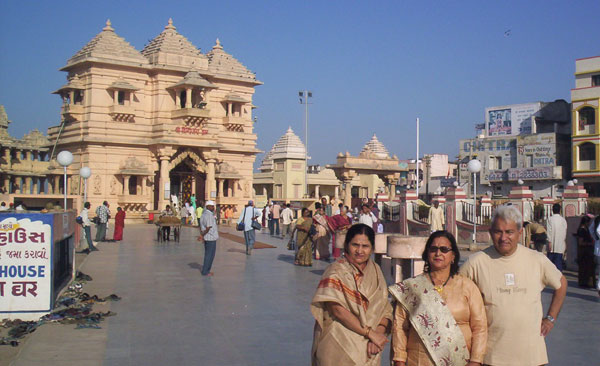
From Dwarka, we drove to Somnath. Earlier we had a plan to have a night halt at Porbandar- the birthplace of Mahatma Gandhi. But when we found that except for the ancestral house of Gandhiji, we drop the idea and decided to have the stop over in Somnath.


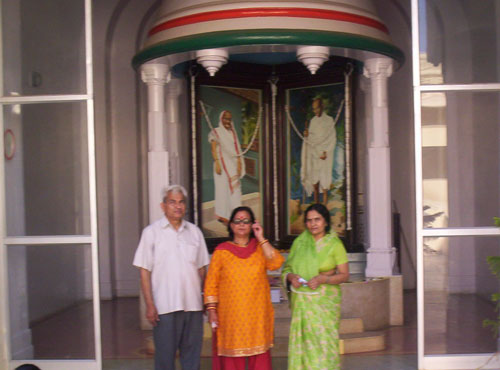
Mahatma’s great grandfather, Shri Harjeevanji Raidas Gandhi, had purchased the house, where Mahatma Gandhi was born from a local lady about 200 years ago. Kirti Mandir has been built as a memorial keeping the old house intact. While going through the small plain empty rooms in the house, one gets a nostalgic feeling. Nothing of those days is there, unlike you see in the houses of Western celebrities such as William Shakespeare at Stanford-on-Avon that I visited in 1982. But the very thought that the great Fakir spent his childhood in these rooms is exciting. It was the great effort of Shri Nanjibhai Kalidas Mehta and his wife that Kirti Mandir could be built. The property was bought from the members of the Gandhi family who were living in that house at that time. And even Gandhiji sold and registered the property to Shri Nanjibhai. We moved in and out many times. I was trying to evaluate if this was the best that the nation could have done for the place that it is. In the lane outside, it is just the typical of a small town in the region.

The memorial is a national heritage. I wish Indian government had set up a monument suited to the stature of the greatest human being and leader that the country and the world has produced in the last few centuries.

While in Porbandar we also visited the temple named after Sudama, the famous friend of Krishna. Perhaps the temple appeared to me as the anti-climax of the golden palace of Sudama that was built by Viswakarma on the instruction of Lord Krishna overnight, while Sudama was enjoying the hospitality of his friend in his palace in Dwarka.

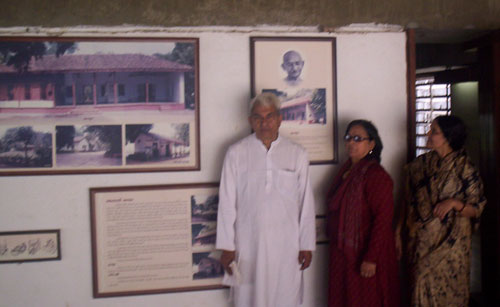
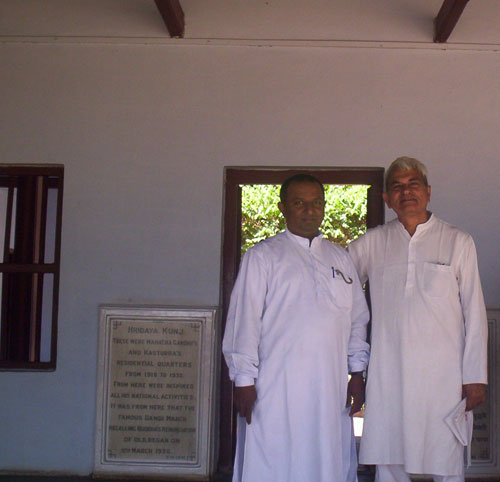
In Ahmedabad, on the last leg of the tour we went to Sabarmati Asharma, the place from where Mahatma Gandhi led his Dandi March for salt making. We would have returned after going through the exhibition hall that has been built without seeing the house where Gandhi and Baa lived, but for the timely appearance of the gentleman in Khadi in the photograph. His great grandfather, as he claimed, trained Mahatma in operating the spinning wheel for Khadi. Three of his family members accompanied Gandhi in Dandi March. He has participated in two of the marches to Dandi. It is nice to hear the stories and ponder over how the sacrifices of some could bring the independence of this country. It is more exciting when you are standing in the courtyard of the place where Gandhi lived for many years and led the national movement. And then you start thinking of all great men of the country and also of the world, who had visited this place during the time Gandhi lived here and thereafter too to pay homage to the great son that the mother earth produces very rarely.


Here again, I wonder why the nation can’t perform better in making this place worth Gandhi’s stature.

Posted in Uncategorized | Leave a comment

Dwarka- The Krishna’s Capital City


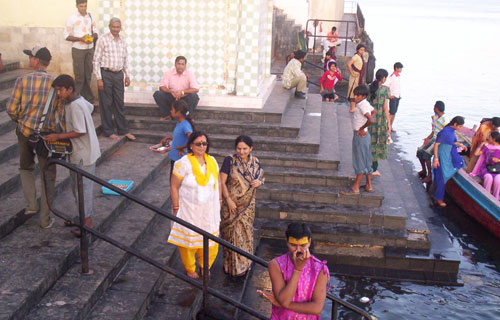
While visiting Dwarka, we heard two clearly different mythological stories that are the two aspects of the regional economy. Each story is unique in itself. All the priests and pandas in Dwarka talk of the curse of Durbasha Muni resulting in the infertility of the land in the region and the resulting poverty of the farmers. They give this story and ask for all sorts of charity from the pilgrims of different categories to help the people, particularly the Brahmins of the region. The higher the charity in cash or kinds, the better will be the gain. It is just the clear exploitation of the poor believers from all parts of the vast country. However, I assume the land has gone infertile because of the salinity of the seawater that floods the region regularly. It requires a specialised R&D initiative from agricultural scientists to help the farmers to plant the right types of plants, trees, and to have special breeds of animals including cows and buffaloes.


I heard the other story too from the police officer accompanying us in ‘Bhent Dwarka’. According to him, Krishna himself came to attend the marriage of the daughter of his devotee Narshi Mehta. When the in-laws of the daughter wished for some dowry, Krishna did a miracle and gold rained from the heaven for an hour. All present could collect the gold as much as they wanted. Though it may not appear to be so from the overall appearance, every womenfolk in the region owns gold worth more than 3-4 lakh at home. Gujaratis in general are pretty rich. Gujaratis have been migrating to all parts of the world from ages. Today, Gujaratis control the majority of hospitality industry in US and the diamond business of Antwerp, Belgium. Migrant Gujaratis have also contributed to tranform the regional economy through their charity and philanthropic work of building schools, hospitals, and other religious institutions.


For ages, the region has been the nerve center of Hindu cultural history. Surprisingly, I was told, 75% of the Bhent Dwarka island population is Muslim. Most of the shopkeepers serving the gods and goddesses of the temples by making their dresses and other utilities are also Muslims.

While returning from Bhent Dwarka, we visited Rukamini Temple. Rukamini was one of the main queens of Krishna. Rukamini had to spend some times living alone away from Krishna because of the curse of Durbasha. The temple is having a lot of vacant land around it. If some individual or institution takes entrepreneurial initiative, the place can easily be transformed into a wonderful tourist destination. Why can’t the BJP-run government do it? Is its love of Hindutva is limited to Ayodhya temple? Perhaps they too wish to decide their all action plans as secular, however necessary it may be for the people or the economy of the region. As I hear Modi has changed the Gujarat in more than one way. However, there is no perceptible change in the conditions of these places of religious importance. His government must take lessons from Tirupati and Vaishno Devi. An imaginative investment in religious tourism can create employment and bring prosperity to the region. And I am sure he will not relish the crowd of the beggars near all these places. I am giving below one that we saw at RukaminiTemple.


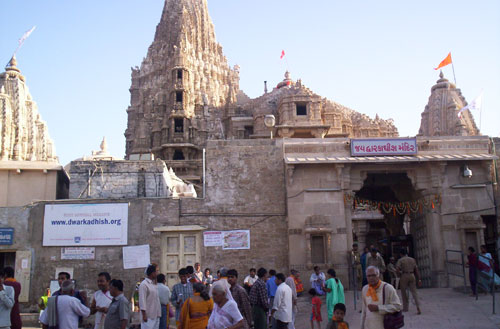
Main Dwarka temple is elegant and a showpiece of architecture too. Its location on seashore further adds to its scenic beauty. It could have attracted all the affluent Hindus from far and near for religious tourism. But encroachment right up to the boundary of the temple conceals the temple to great extent. Perhaps, it can no more be possible. However, the government, the temple trust, or local bodies must do some serious work using some consultants to make the place attractive. Dwarka can earn a lot of revenues from tourism.
—————————–
Read ‘the season for business marriages in India’

Posted in Uncategorized | Leave a comment