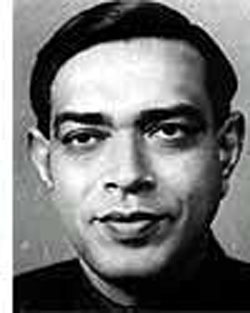
Shashi Tharoor and HM

Hindustan Motors (HM) is in news again though for a reason that I hate. I got the shock of my life when Dr. Puri who happens to be almost my family doctor in Noida talked about HM and its lockout. How could he know this? After all, for the national newspapers, the news was insignificant. Mr. Puri might have come to know of it from the news channels on TV.

Citu- the official union at HM is with the management. But an union- Sangrami Shramik Karmachari Union (SSKU), unknown to me has come up and has been agitating for some demands. It struck work. Thereon the management declared lockout. Buddha’s government is trying to come with some solutions but many of its attempts have failed till date. The management as reported has taken out the components and toolings that belonged to Tata Motors with help of a court order under police protection.

Perhaps HM may be prepared over years to close down the plant if it comes to that. It hardly produces 10-12 thousand cars a year. All other units such as heavy engineering division and steel foundry are already sold. The auto division is having highly dedicated facilities so far the machining side is concerned. It is only with a significant investment that HM could have become real auto component manufacturer. I don’t think the present management has any such strategy. It must be trying to keep the shop open till it can.

The other day the Financial Express published a report ‘Ambassador on the road to extinction?’ I felt bad about it, as I have spent the prime of my life there. HM could have remained a significant player in passenger car sector but for a very poor family management. It had an opportunity to get into small car much before Hyundai and Daewoo started producing Santro, and Matiz (presently Spark from GM India). But the management was not interested in taking a bold step at that time. HM can’t survive with its Mitsubishi Lancer. Perhaps, it is not interested to continue in car business itself.

But the present strike, fight between the unions, and lockout take me down the memory lane and remind me of similar incidents that kept on happening much before I joined HM in 1961 and thereafter too till Citu took the total control. The management thought it better to have peace with Citu at all cost, as the government in the state remained leftists. HM decided to have its new manufacturing facilities at Vadodara for Isuzu trucks (Halol), Indore for power trains (Pithampur), and then Chennai for Mitsubishi Lancer cars. HM could not grow even in the new locations because of extremely shortsighted management policies.

It is breathing its last. Its cars will be extinct. It will be part of history as a company that pioneered car manufacturing in India.

However, whenever I find someone writing or news about HM and Ambassadors, I get a kick. Aft Shashi Tharoor has been writing ‘A glossary of Indianness’ in his column in Sunday Times of India these days. In its first installment, he had included ‘Ambassador’ and in its second ‘Birla’ that I am quoting below.

Ambassador: Ambassador cars are the classic symbol of India’s post-independence industrial development. Outdated even when new, inefficient and clumsy, wasteful of steel and petrol, overpriced and overweight, with a steering-mechanism like an ox-cart’s and a frame like a tank’s, the Ambassador dominated Indian routes for decades, protected and patronised in the name of self-reliance. Foreigners were constantly amazed that this graceless ugliness enjoyed two-year waiting-lists at all the dealers right up to the 1990s. What they didn’t realise is that if they had to drive on Indian roads in Indian traffic-conditions, they’d have preferred Ambassadors too.

Birla: Is a name attached to a number of leading Indian institutions: mandirs, planetariums, trusts, schools, clinics, institutes of technology, all of which have been made possible by a number of other leading institutions to which the Birla name is not attached, like Century Mills and Ambassador cars.

—————————

The Mobile Republic
Stodgy, clumsy, ugly—these are some of the favoured epithets used to describe an enduring symbol of India’s ill-fated flirtation with socialism: the Ambassador car. But critics of the lumbering Amby need to watch their words. As the car that began its journey by rolling out of the Uttarpara plant in Bengal’s Hooghly district in 1957 celebrates its golden jubilee this year, it is transforming itself into a new symbol of retro chic.

<

Posted in Uncategorized | Leave a comment

On The Sideline of Varanasi

Many a places you never plan to go, but it happens. Many people you meet and forget. But some remain on your side without any effort, while many go far away and aloof even after your interest and effort to keep them near to you.

It was April 18, 2007. Babulalji kept his words given on a fine morning in Noida while walking. He is posted in Varanasi. He could have found some excuse for not providing that assistance as usually people do. But he proved to be different. He arranged a car for Vindyachal. I had an inquisitiveness about the place. My uncle organizes some religious function in every ‘navratra’ there. A recent visit of Amitabh Bacchan and family to the temple also enhanced my quest.


The driver tells a story. When Ganga was coming escorted by Bhagirathi, the small temple of Bindhyachal came on the way. Ganga had to stop its journey for two days till the Devi of the temple got the boon to have its respectable place. I was always under impression that the temple must be on a mountain top. It is not. It is only by the words of mouth that the temple has become so popular and visited by millions every year. As in most of the Hindu temple, the management is extremely poor. The small entrance was dangerously difficult for old people like us and the so-called student cum assistants (sevaks) appeared to be more a problem rather help. With time changing, the temple must undergo some changes to make a devotee more congenially accessible to the goddess. I am sure for the Big B, the temple would have been closed down for the public for sometime. How can the place be sold to one and all of the intellectual and affluent class? Can’t it be faith plus conducive ambience?


We returned through Chunar that has many pottery shops on the road. As told, the raw material is available in abundance in vicinity and some small factories in the villages nearby produce these. I am sure this can bring some prosperity to the area, if the industry is expanded further to make the quality and design of the products of world-class standard.
On return, I went with Yamuna to meet the members of the family, particularly my cousin sisters that had collected for the marriage in which we were to participate. It appeared to be a very formal one, but my cousin sisters were just loving.

In evening we went for dinner with Kavindra Rai and met his small happy family. His wife is a professor of history. The daughter Ishita is aiming for engineering. I tried to convince her that she may pursue even a science subject that interests her. Kavindra, his daddy is an example of success following that route. He was from rural eastern UP. He studied and majored in Mathematics. He is today the head of mathematics in IT-BHU, no less an achievement.


This is going to be the last entry based on my trip out of Noida. It was just wonderful trip of almost 10 nights.

Posted in Uncategorized | Leave a comment

Ramachandra Guha and JP- Let There be a Debate

Ramachandra Guha, the writer of ‘India After Gandhi: The History of the World’s Largest Democracy’ has made some reference about JP. In the interview published in Outlook, May 7, 2007, he is quoted to say, ‘Mrs Gandhi had the instruments of state at her command and because she grossly abused them through the Emergency, she would be the greater culprit. But one can’t let JP off the hook either. One placed too much faith in the state, and the other placed too little faith in the state and in representative institutions. One said I am Parliament, I am India, the other said disband Parliament. I’ve tried to provide a psycho-social interpretation of why JP acted the way he did. I’ve talked about the fact that he was growing old, his wife had died, he wanted to recapture the youthful revolutionary impulses that he once had, he felt his mortality was in question and India had to be transformed before he went. I tried to understand why a man who abjured radical politics for 30 years to become a social worker, had become a street agitator. I also quote other mistakes. These are contemporary criticisms – I mention a man called RR Patil, an ICS officer, a friend of JP’s, who visits Bihar, studies the movement, and says, the genie is out of the bottle, and you can’t control it. You may have unleashed forces that will destroy institutions. There were other critics, like Acharya Ramamurthi, he talks about the RSS taking over the movement. JP was naïve, he was irresponsible, and of course Indira Gandhi over-reacted.’

As I remember Indira Gandhi and her coterie kept on blaming JP for the emergency in the same language in those days that Guha has used. Media used to sing the song in the same tune. But was JP within the norms of the democratic expression or beyond? If at all it was, was it not because Indira Gandhi had only one agenda and that to establish herself firmly in Indian politics taking advantage of her pedigree? Were her all moves of nationalization of banks and Bangladesh war not with the same desperations? Was the frustration of the senior leaders of the country who had made sacrifices more than the great lady for the nation not justified?

I do also remember reading somewhere about Ramdhari Singh ‘Dinkar’, Hindi poet of reputation making an offering of his life to God publicly in a speech in a meeting on Marina Beach, Chennai to save the life of JP who was very sick and in hospital at that time. Could a person whom Dinkarji adored be ‘naïve, and irresponsible’?

I am sure many of the intellectuals who were associated with JP’s movement were also from Bihar. Many of them may be alive. Will it not be in public interest to discuss this controversial statement that many of the followers and friends of JP may not be able to digest? Will it not be prudent for those connected with JP closely to come out with their views if they think otherwise?

Since last so many years, the political leadership in Bihar has been claiming themselves as the disciples of JP, it becomes their duty to do a justice to JP who is no more there to fend his side.

I wish the issue is taken up by the intellectuals in right spirit, if Guha has wrongly come to his conclusion.

Posted in Uncategorized | Leave a comment

Nalanda: Ever Exciting


Nalanda is the symbol of the knowledge focus of Indian cultural history and a place of national pride. Its history proves that India had been attracting the intellectuals of many countries who wished to get updated with the latest in knowledge in good old days. Think of Hiuen Tsang. How did he hear about Nalanda in those days in remote China? How did he travel thousands of kilometers to reach Nalanda? How hard did he work to learn and master the language of India? How much pain he took to live in Nalanda, so far away from his home town for long many years first as student and then as teacher?

I visited Nalanda in December 1966. I had only a faint memory of that visit. Recently I had been writing about Nalanda and the proposed dream project of Nalanda International University. Twice when we were in Patna for the marriages some years ago, I wanted to visit Nalanda again, but it didn’t happen. I had an intense interest in visiting Nalanda this time too. The heat of the summer was dissuading. Janardan, my host also was discouraging me to take the arduous traveling by car, though it takes about 2 hours from Patna. Kamlesh failed to arrange the driver for his Maruti 800. It proved to be a boon, as Janardan then arranged a better comfortable air-conditioned ‘Indica’ (Tata Motors). I could also persuade Janardan to join us in the trip. Yamuna could see Nalanda for the first time.

The driver took Phatua route to Biharsarif for saving time, but he didn’t know that the road is under construction for widening and upgradation. When we entered the imposing entrance of Nalanda, the unauthorised and unregulated hutments, shops, and residences pained me. However, this is the condition everywhere in India. We reached the excavation site. The place has undergone total transformation . The garden and lawn all around are well done and well maintained. The guides expected us to take their assistance to understand Nalanda’s story. But I was interested in getting the authentic information through the publication of the archeological department, and fortunately, I could get one. However, when we went inside, one of the guides was just concluding with a family of Sri Lanka. I decided to take him along with us. He claimed himself to be a postgraduate in history knowing number of languages and trained by archeological department to work as guide. I found him satisfied with his earning as guide. He earns about Rs 1 lakh a year. Perhaps, he has mastered the art of satisfying his clients.

Rajgriha was the older city, capital of Vimbashar and his son Ajatshatru, and associated very closely with both Buddha and Mahavir. Nalanda is near that, and the place of birth of Sariputra, one of the main disciples of Buddha. Nalanda means ‘charity without intermission’. Asoka erected a temple here, that may be the Nalanda Vihar. Nagarjuna studied at Nalanda and became its high priest too. Dinnaga, a southerner, founded the mediaeval school of logic here. Mahayana philosophers, Aryadeva, Asanga, and Vasbandhu were also among the high priests of Nalanda. Gupta kings furthered the institution. Hiuen Tsang saw a 24.4 metre high copper image of Buddha. Harshavardhana (606-647) was constructing a monastery of brass, when Hiuen Tsang visited Nalanda. Hiuen Tsang has mentioned the details of the different monasteries, the working of the institution, and the courses of study that included besides the Buddhists scriptures, hetu-vidya (Logic), sabda-vidya (grammar) and chikitsa-vidya (medicine), as well as such purely Brahmanical texts as the Vedas including the Atharva-veda. Hiuen Tsang studied under Silabhadra. The foreign visitors continued coming. Within 30 years of Hiuen Tsang departure, no less than eleven Chinese and Korean travelers are known to have visited Nalanda. And in 673 came I-Tsing whose work records the minute details about Nalanda. He has extensively written about Nalanda, and mentions of the daily life of the monks regulated by a water-clock.

The end of Nalanda was disastrous and shocking. Buddhism slowly decayed. Kumarila and Sankaracharya re-established the glory of Brahamanical philosophy. Muslim invaders, according to their own accounts destroyed monasteries. Muhammad Bakhtiyar Khalji destroyed Nalanda. Another attack on Nalanda came in the summer of 1235. A Tibetan Dharmasvamin has left an eye-witness account of the attack. As per one another Tibetan text, Ratnodadhi, one of the libraries of Nalanda as consumed by the rage of two very indignant Brahamanical mendicants.

Nalanda got lost in history. The civilized world got an account of Nalanda only in the first quarter of nineteenth century when Buchanon-Hamilton visited the place and found some Hindu and Buddhists images. Alexander Cunningham identified the ancient Nalanda and after few years AM Broadley carried out some excavation. Nalanda is still not fully discovered.


It was hot and difficult for Yamuna and Janardan to live up to my expectation. But I wanted to know as much more and see as much more it was possible. If Yamuna would not have been there, I would have taken the guide to all the corners of the excavated sites, even the latest ones. Nalanda was cluster of temples and monasteries. Monasteries served the purpose of hostels as well as lecture theatres.

We finished the visit sooner than I expected. But thereafter we visited the museum that has some wonderful artifacts. Before leaving for Rajgrih, we visited the recently inaugurated Hiuen Tsang Temple too that has been built in a separate area, China contributing the most. A month back some Chinese had tracked the route traveled by Hiuen Tsang and reached Nalanda to participate in inauguration.

I would have loved to see the site that will have Nalanda International University. A bill has been enacted by the Bihar assembly. Amartya Sen has agreed to be the head of the advisory body of the university. Nitish Kumar wishes to see the project through. Will it come up?

While returning from Rajgrih that is in absolute ruins, we stopped to buy the original ‘Khajhha’ of Silaw for the friends of Yamuna in Noida. We visited Pawapuri too where Mahavir got cremated after Mahanirvan. The temple is in a big water tank. Did Afgan Emperor took inspiration from it for his tomb at Sasaram?

Time and again, a dream haunts me. Can some government soon enough stop any further unplanned construction in these places of India’s heritage history that are mushrooming and becoming eyesores for visitors?

Posted in bihar, education | Leave a comment

Bihar Hardly Cares About Its Great Sons


Since I reached Patna I wanted to go to the Kumbhrar site- the Patliputra of Ashoka that I had seen briefly some 15 years ago. When I expressed my wish to my host Janardan Sharma, he informed that the place was very near to his house in Kankarbagh. But finally we could make it only on April 23, while returning from Nalanda. I wish I would have not gone there. We bought the entry ticket. Yamuna was tired. We made her sit on a bench in the park. I frantically searched for the hall with many pillars that I had seen, but I failed to find that. I could see only some newly constructed structure that appeared to me the foundation of a new house. As per information provided by the archeological department, it was Gupta-era ruins of Arogya Vihar (“hospital-monastery”) of the noted physician Dhanvantri. I never saw that last time.

What happened to that hall and the numerous pillars that formed the part of the palace? We came near the entrance and asked the person there. He informed that that the archeological department has buried the pillars with sand to protect it from the flooding during rainy season. What a shame! Is this the way to save and respect the remnants of a great civilization? Why couldn’t the department recreate the palace with those pillars?

The Chinese travelers have written vivid and extensive description of Patliputra of the time. Patliputra is a historic city and is not like mythological Ayodhya. It was Patliputra where Chanakya (Kautilya) and Patanjali lived, and wherefrom Chandragupta Maurya and the Ashoka, the Great established the empire covering most of India of today for the first time. Why couldn’t the archeological department do serious work to excavate and protect whatever was discovered about the great city of Patliputra? Is that because of the Buddha’s curse?

The people of Bihar do neither protect nor respect their ancestors and their heritages that they leave behind. I was shocked. Surprisingly, the archeological department charges Rs 5 per Indian and Rs 100 per foreign visitor to see an ordinary park that is presently used by young boys and girls to pass their happy time.


Upendra Prasad, the brother-in-law of Janardan had informed me that the residences of the reputed Hindi poet, Ramdhari Singh Dinkar is also nearby and so are the residences of Dr. Rajendra Prasad, Jai Prakash Narayan, and Jagjivan Ram.

On April 24, when I went for my morning walk, I could reach the house of Ramdhari Singh ‘Dinkar’. I had walked along the road on Rajendra Nagar overbridge towards Ashok Path. When I enquired some persons they told me about the statue of Dinkarji. I, for the first time, mistook it as one of some BSP leader because of its shabby colour combination. I was surprised that even though there was no nameplate or other sign, at least three to whom I enquired about Dinkar Bhawan could tell me the exact place. The people still remember Dinkarji. But neither the government nor the literary elites of Patna could do something to make the house presentable to the fans of the poet who was once called national poet. The house of the poet is in bad shape. Half of it is occupied by some doctor. Why can’t the government acquisition the whole of it and make it a memorial of Dinkarji?

I kept on enquiring and reached to the house of Jai Praksh Narayan too through a narrow lane of Kadam Kuaon. While I was standing in front of the Jai Prakash Narayan house enquiring about it, a student of the school nearby came running to show me the entrance. He had heard me enquiring about it. I felt happy that younger generation of Bihar and perhaps ‘aam adami’ remembers the great sons of Bihar, but the politicians are busy talking big about themselves only. The people are to keep on hearing that and clap too. Recent claim of Railway Minister Lalu Prasad Yadav that the ’70s total revolution against Indira Gandhi government was in fact his brain child that he ‘handed over’ to the Loknayak, is one example of the meanness of the present politicians. Can even a beginner of the political history of India believe such a false claim?

I entered in the house. In some slum like structures in Pravavati- Jai Prakash Smiriti Sanshthan, some families live. One elderly lady helped me to get one of the employees of the Sanshthan with whom I could enquire about one Jagdish Singh who was a personal assistant to JP for many years. J. Singh had visited us too with his adopted daughter who was married SK Singh, one of my subordinates at Hindustan Motors. I have some books presented to JP by the writers that came to me through SK Singh.

I could get some information about the houses of others too: The houses of Dr. Rajendra Prasad and Jagjivan Ram had been sold out, and there is nothing there. I heard abut the poorly maintained Sadakat Asharam and the samadhi of Dr Rajendra Prasad in Patna. His fault was that he decided to move to Patna to live in Sadakat Ashram instead of asking for a government residance in New Delhi.

Perhaps one of the main reasons for apathy towards the great sons of Bihar is the caste-based bias in everything that has taken deep root over the years in Bihar. During my stay in Patna, I came to know of a function to celebrate Babu Kuer Singh’s role in India’s first Independence movement of 1857 being organized, led, and also attended by mostly Rajputs. I can never think that Kuer Singh belongs to only Rajputs, Dr. Rajendra Prasad and JP Narayan to Kayastha, Babu Jagjivan Ram to Chamars, and Ramdhari Singh Dinkar to Bhumihar Brahmins. But I experienced it happening in Patna.

I was amazed when Dr. Sinha, a famous plastic surgeon and a Bhumihar Brahmin himself told me that they were there to garland the statue of Ramdhari Singh Dinkar that morning as it happened to be his death anniversary. They might have been there just after I had left the place. And it appeared it was all Bhumihar Brahmins gathering.

How can Bihar even dream of getting developed with such narrow a thinking in the elite class of the state? Bihar and its people must respect its great sons without any bias of the caste in which they were born. There must be an effort to protect the memories of those sons through well-kept memorials and museums in the houses they occupied.

Posted in bihar | Leave a comment

A Feel of Resurging Bihar

I was in Bihar for almost five days. We entered Bihar on April 20 and left on April 24, 2007. The reports in local newspapers were full with news and happenings that confirms the arrival of a resurging Bihar. I could feel the change.

On April 20, the newspapers carried the news of the government embarking on a mammoth project to interlink the major rivers within Bihar to address the dual problems of flood and draught. If executed, the project will increase Bihar’s assured irrigation coverage potential by over 2 million hectares, an increase of huge 80%. The projects are already identified. Consulting firms are short-listed. Ganga water will get transferred to South Bihar; Kosi water to Mahananda basin; Burhi Gandak, Baya and Gandak waters to the existing Gandak Canal System; and Sone basin water to Punpun-Harobar-Kiul basin through barrages, pumps, and canals.

I couldn’t understand if this river interlinking project will get the financial support from the center or it is only the state initiated one. The UPA government has not shown any enthusiasm in river interlinking projects just because it was initiated by the former NDA government, even though the judiciary asked for a timeframe. Only President Kalam have been talking about it regularly. Bihar government must also go in big way in renovation of existing ones and construction of water bodies in thousands in north Bihar to store flood water using NREG programme. Finance Minister Chidambaram has been talking about water bodies since UPA’s first budget.

News from many fronts are equally exciting. Patna- Gaya railway track is getting doubled, and Patna-Gaya section of NH-83 is getting six-laned under NHDP-III. While Gaya airport is getting upgraded, a Buddha Memorial Park is going to come up on 26 acres of old jail campus close to Patna Junction.

More than 2000 villages in 7 districts of Bihar have achieved universal enrolment of children with appointment of over 1,20,000 teachers, construction of about 1,00,000 new class rooms, and opening of 15,000 new schools. Projects such as Sankalp supported by UNICEF and Pratham are making thee focused education happen. Through extensive community mobilization,3,70,000 children out of 5,50,000 identified ones were enrolled.

I wish Bihar abolishes Bihar boards for secondary, higher secondary, and technical education and switch over to CBSE and hands over inspection to NGOs such as Pratham and Premji Foundation.

The Religious Trust Board under the leadership of Acharya Kishore Kunal are going to construct five major hospitals and one medical college in Bihar. With an innovative funding, the 80-crore medical college cum hospital will come up at Begusarai. The project additionally includes a terminal care center in Hazipur, a Vatsalya (child and maternity) hospital in Sitamarhi, a heart hospital in Muzaffarpur and a general hospital in Gaya.

Nearly 40 villages in Bihar will have a cultural center, roads and healthcare facilities to commemorate the long ties of Bihar with Mauritius.

On April 23, 2007 Patna saw ‘Who’s who’ of India Inc came to Patna promising to assist Bihar in getting back its past glory. Twelve groups have been formed to come out (name of the head of the group in bracket) with their ideas on harnessing agriculture (Anand Mahindra, M&M), easing credit flows (KV Kamath, ICICI), urban design for emerging Bihar (Hafeez Contractor, reputed architect of Mumbai), harnessing private sector (Kumar Mangalam Birla, Aditya Birla group), empowering through IT (S. Ramadorai, TCS), meeting energy concerns (Sanjiv Goenka, CESC), new heath paradigm(Analjit Singh, Max Hospitals), skill multiplier (Tarun Das, CII), alleviating poverty and keeping growth engines going (B. Muthuraman, Tata Steel), building Bihar brand (Shobhana Bharatia, Hindustan Times), mainstreaming the rural economy (Sunil Bharati, Airtel), and importance of tourism, travel and employment (Priya Paul, Park Hotel group).

Nitish Kumar sought their assistance in three ways: at individual level, by persuading their friends to whom they have better reach, and fine tuning of policies.

Are these not the indicators of resurging Bihar? If not what else can be the indicators?

Unfortunately, the national newspapers that I get in Noida or available on web hardly cover the news from Bihar or for that matter any other state. All these are interesting readings.

I don’t doubt the sincerity of Nitish Kumar or NK Singh, but I doubt if the Bihar ministry has sufficient number of enthusiastic and missionary ministers and bureaucrats to support the projects that can take Bihar ahead with speed of implementation fast enough to make up the lost years of stagnations.

I do also wish that opposition must play a mature role. Let Laluji and his brothers-in-law restrain themselves in creating bad news every other day. Let Raghubans Prasadji use his doctoral arguments to get Bharat Nirman implemented in at least the constituencies of RJD MPs and legislators.

Posted in bihar | Leave a comment

BHU: A Great Experience


From April 16 to April 18, I stayed with my wife in theIT-BHU guest house. It was a great experience when I talked to the students and faculty members of IT-BHU’s mechanical engineering department on April 17. I had handed over my write-up to Dr. Sudarshan Sharma, the head of the department in advance. I tried to be informal and emphasised on certain relevant points.

My main thrust was to enhance the interaction between the educational institutes and the industry to make the professional education relevant, and re-engineer the curricula with a bias to inculcate entrepreneurship and innovativeness. Mechanical engineering department of IT-BHU must have an effective arrangement with units such as Railway’s Diesel Locomotive Plant in Varanasi, and get associated with its R&D activities. Why can’t such manufacturing facilities in India be global leader of its products?

The course of mechanical engineering must emphasise on design and development of new products and tools for manufacturing systems. And for making the design cost competitive and delighting, the knowledge of manufacturability, assembility, and serviceability is equally essential.

Tendency of students to get addicted to work on computers must change. Computers are nothing but the advanced aids such as log tables, slide rules, and scientific calculators of yester years. They must get better exposure to the latest in domain knowledge, analytical skills, and soft skills such as bench-marking, brainstorming that are essential to make them effective team workers.

As an old man, I did provide some tips from my professional career:
1. There is no substitute to hard work.
2. Keep learning on, particularly about your domain knowledge.
3. Create a transparent system in management
4. Keep on educating your own people
5. Tell subordinates and peers ‘Why?’ clearly.
6. Have holistic approach
7. Keep ethics

I also expressed some of my disliking:

1. Fresh engineering graduates aiming for IIMs and IAS. India needs more of engineers in every field rather managers.
2. Indifference in industry about the capability of the people in the professional educational institutes and a similar approach among the teachers to keep themselves away from the latest industrial innovation. I could get my notion confirmed after the interactions with the heads of many departments who were present in the dinner organized by the director that evening in the guest house itself.
I did also suggested the professors to do something to sell some of the research works going on in the university that can be market its capability. Why are our professors not known to even people like me? Why media is indifferent to the activities in the educational campuses of national importance?

Surprisingly, all the professors agreed. But will some take initiatives?

Some reporters from local language press interviewed me and I found all of them covering my speech pretty well on April,18. And I was elated to get a replica of the bust of Malviyaji as a gift from the head of the department.

The gift from the head of mechanical engineering department after my talk

Banaras Hindu University (BHU) founded by Pandit Madan Mohan Malviya is a live example what an individual can achieve. It is huge with educational facilities in almost all possible areas such as technology, law, medical science, pure science, agriculture, social science, and other subjects. It could have easily ranked in the least of top universities of the world.

I wish the government at center could have the ambitions to make it one and the institute could get some missionary vice-chancellor to make it get in the global best rank.
———————-
Coaching Factories Are Dumbing Down The IITs

Posted in education | Leave a comment

Pipra (Mardan Rai Ka) -My Village, My People

What would have been the right headline of this entry? I thought of making it ‘Pipra on Nitish’s Roadmap’ and even ‘India meets Bharat’. However, perhaps my village is great to me and with age my love of it is getting enhanced with many sweet simple memory of the childhood with which it was associated. My main objective was to have some photographs as I was not having any recent ones of my village and its people. I had requested Anand once to create a website of our village. May be with these photographs, it will be easier for him, if he is still interested.

Almost after five years I got the chance to go back to my village, my birthplace. I decided to go to Patna to attend the family marriage from Varanasi where I attended the Tilak ceremony by road. It was my interest to see myself the progress in Golden Quadrilateral (GQ) in Bihar region that I traveled to Sasaram on GQ. I was to leave Sasaram for Patna in early morning on the April 20, 2007. I had some hours only as we reached Sasaram by 11 AM on April 19, in almost 3 hours from Varanasi, as some portion of the road near Karamnasa was still under construction. Very soon after checking in Hotel at Sasaram, Alok returned after booking two seats for the air-conditioned Sumo with another Sumo to go to Pipra. For the first time, we left Sasaram-Arrah road at Agarer and passed through the villages Panjar, Mahooli, Tenuan before moving on the bank of the irrigation canal whose one bank is getting metallic as a regular road to connect our village.


I found work on rural road under Prime Minister’s Gramin Sarak Yojana going on all over. However, the contractors have engaged only limited resources and so I could hardly appreciate the urgency. Bihar has lost many decades because of the horrendous ineffective politicians. We have an honest and sincerely dedicated engineer leading the state for the first time. but still as usual my expectations are higher.

Perhaps very soon, Pipra will get electrified too. I could see the infrastructure for placing transformer near Panchayat Bhawan. While talking to the people, I heard of coming up of a health center too very soon.

After a wash and some exchange of greeting with my uncle, I went in and took the lunch prepared by my aunty, as my cousin has informed her on cellular phone before starting from Sasaram. I relished the simple but very tasty lunch. For many years, it was the same aunty who had been feeding me in my village as well as Birlapur in West Bengal before I went for college.


And then I moved in the village to meet the oldest man of the village who has crossed the century mark and is still very fit physically. He was sitting under the shade near the temple. Thereafter I moved towards the ‘Kalimai’ in the eastern side through the lane that passes through Chamtoli. Most of the houses are better today. However, the people as usual are least concerned about the basic hygiene. Even if one explains, they hardly get convinced. Someone must set example of a better living in rural Bihar (or India). Perhaps that only can bring change for an improved life style.


I also met with the fathers of two cousins who had graduated in engineering from BHU and REC Warangal, because of the seer will power of their fathers. However, while talking to these old men, one could understand easily that expectations proved short-lived and now over.

We left for Sasaram by 4PM. My uncle accompanied us.

This short visit of Pipra will remain alive in memory disc.

Posted in Uncategorized | Leave a comment

On Nitish Kumar’s Roads, Down the Memory Lanes

We entered Bihar through the prestigious Golden Quadrilateral (GQ) from Varanasi on April 19. However, between Karamnasa and Sasaram, some stretches are still not complete. The bypass Sasaram is still not ready, though we would not have used it. Internal roads in Sasaram remain as bad as it used to be. Can’t Nitish Kumar’s government do something out of the box to improve its condition? Sasaram, being an old town deserving a heritage status, could have attracted a lot of tourists. But basically, nothing has come up during these years to make the stay in Sasaram possible, neither some hotels nor any eating houses.

The rural roads as I mentioned in my earlier entry are under construction and perhaps are being given priority and rightly so, as there live the majority of the vote banks. Early morning on April 20, we started for Patna by road. The road from Sasaram to Bikramgunj is horrible. In many places, it is not even good enough for bullock carts. I couldn’t understand if it is because of so many rice mills that has come up all along this rice bowl of the state. Some innovative entrepreneurs could come up with new enterprises based on the byproducts of the agricultural outputs of the area that is fertile for all sorts of vegetables and cereals such as rice and wheat. A railway track has been laid between Sasaram and Bikramgunj that will connect Arrah on the main line in time. It reminded me of the private light railways of the yester years that used to connect Sasaram to Arrah. In my childhood I had used the same many times. Many a times, my grandfather had accompanied me.

From Bikramgunj, our vehicle followed the road through Dawath upto ‘Malia-ka-Bag’. While traveling on the road, I got a nostalgic feeling. It was the road that I traveled many times since my early childhood. My maternal village Bodarhi is just half a kilometer west off Dawath. We built a new house here when I was working in HM. My parents were living here- my mother since my childhood and my father joined her when my maternal grandfather died. But after the death of my mother, we found it difficult to manage the landed property effectively. The neighbours and so-called relatives were just rogues. It was impossible to live under that condition of fear and tension.

After Malia-Ka-Bag, the driver turned towards Jagdishpur of Kuer Singh, the hero of 1857 war of freedom to reach Arrah. Surprisingly, the road is in much better. It is only when we were nearing Arrah, we found the road surface deteriorated requiring repair. It is a part of national highway joining GQ at Mohania.

The taxi-operators don’t take the old straight road between Bikramgunj and Arrah as it may be more time taking because of its poor surface condition. Otherwise that would have been a shorter route to Patna.

The driver was not very friendly, though the owner was known to my cousin, Surendra and perhaps his neighbour. We had started at 5.30 AM for this five and a half hours drive, and didn’t get even the morning tea that early. He finally stopped only at a place after we crossed Arrah. And there was hardly anything at the stall, but a cup of tea. Perhaps for security reason, the vehicle crawled slowly through the Danapur cantonment area. We had visited Danapur twice when Ashok, my cousin was here in Railways before moving to Vadodara.

To take story of Nitish Kumar’s roads in Bihar, we traveled to Nalanda, Rajgrih, Pawapuri going through a short route from Phatua. But that road up to Biharsarif was in bad shape for the most of the stretch and is getting widened. The driver could realize his mistake late. So we decided to return via Bakhatiarpur. The road is in excellent shape.

But the route followed gave me chance passing through Noorsarai, a small town near Biharsarif, where I had spent some 15 days working with Peace Mission volunteers in December 1966. I was deputed by Jai Prakash Narayan’s Bihar Draught Relief Programme of the year when Bihar faced an unprecedant draught. I had volunteered to work for him, while I was on my annual holidays in Bodarhi. My wife was expecting Rakesh. She remained with my mother at Bodarhi.

While at Noorsarai in that cold December of 1966, we had to sleep on the benches of a primary school of the village. We used to take the food at the road side stalls. It was unpalatable, but there was no way out. After the 10-12 days of working with those foreigners on re-boring of dried wells, I fell ill. I got unique assistance from the sarpanch, headmaster, and the doctor of the village (trio). Dr. Sinha was a Bengali living in the village and practicing. It proved that I was not fit for the hard way of living that is required for the type of life one is to live if one wishes to do something for the society.

We drove past the high school where the trio organized a dinner for us. I remember that dinner vividly that was laid on the huge conference table made out of finely finished mosaic concrete surface. They had arranged many courses- veg and nonveg with many types of drinks. I didn’t know how they managed that. It was beyond my imagination in those days.

With whomsoever I talked during my five nights stay in Bihar, it was a 100% positive response regarding the Nitish Kumar’s honest effort in bringing Bihar back in lime light with work on road and rural electrification all around the state.

Posted in bihar | Leave a comment

Sarnath- Under Buddha’s Shadow


While in Varanasi, I never missed the opportunity of visiting Sarnath. While I look at the constructions all around and right up to the main Stupa, I wonder why can’t the government impose a ban on all odd constructions that will anyway hurt the age-old cultural history of the country. I saw for the first time the Japanese Temple too.


Presently, another a high Stupa is under construction but I hardly found the space around that which could have been developed to provide the right ambience.

Sarnath Stupa must be visible from all around. And the city as such may be a world heritage city with support from Buddhists countries.


And I visited a Varanasi Saree center for the first time. They have engaged a weaver too in a very unhygienic condition. Why can’t the demonstration be of a good quality to attract the tourists from countries all around? We, Indians are very poor in marketing and selling the wonderful works of our skilled craftsmen. A design center with latest technology can develop many contemporary products for the global market. Only through technology, we can face the Chinese onslaught on Varanasi saree.
——————-
Rue De Sarnath

Posted in Uncategorized | Leave a comment