‘Green India’, ‘Green Noida’, But Black Administration

It used to be heartening when the former President Kalam pleaded regularly to take to mass planting of trees all over the country. Our scriptures say that planting trees are surest way to get rid of one’s sins and reach heaven. It was exciting news to find that the UPA government is set to launch the ‘Green India project, that aims to afforest more than 6 million hectares – around 2% of the country’s total area – with the help of people in the villages.’ In Noida one can see ‘Green Noida, Clean Noida’ slogan written all over the township.

With all this background, it was shocking experience to have received a shocking letter ref: Noida/PE (M) III/2007- 1286 dated 29.08.2007 from the office of project engineer, Noida Authority (NA) on September 1. (All residents of houses in sector 41 that face the road between sector 41 and sector 39 received almost similar letter or with one with little variation through speed post.) The letter says we have made encroachment by planting saplings in front of our houses. The NA attached a nice photograph of the respective houses too. The letter ordered to remove the encroachment in three days. If we didn’t remove, the authority would remove it and charge the cost.

We came to live in this house in sector 41 of Noida in June 1998. There was hardly any house in our row. The land in front up to the road was lying barren. We had a facing of a huge ground in Sector 39 that was the public defecating ground of all construction workers in this part of Noida. (It remained so till the Noida Authority built a huge prison like boundary wall.) With wind, the plastics and other rubbish used to come up to our houses, and with the foul smell, it was difficult to keep the main door open or to sit outside. And the vehicles on the road further added to the dust generation. We kept on complaining and suggesting for creating fencing and planting trees to conceal the horrendous scene every morning. It was much later that with the help of the horticulture department of the authority, I got planted trees all along the road on the side of Sector 41 A and B blocks. Later on the Noida Authority fenced the side with barbed wire and planted Bougainvillea. However, it didn’t do the same on the side of sector 39.


As we got some inspiration from the mission ‘Green and Clean Noida’, we planted some trees and shrubs too, as clear from the photographs. The idea was to see some greenery when we sit in our balcony and restrict the dirt from the roadside. We don’t consider planting of trees was and is a crime and encroachment by any definition rather it is a national necessity. We have certainly not encroached on Noida Authority land by this act of ours. We don’t claim any right on the trees that we have planted.

In the meantime, some years ago the road was widened. We never objected to that even though we lost some trees in the process and Yamuna, my wife who does take care of the plants, felt really bad about it.

We wonder why should the project engineer issue a letter such as one mentioned above. Why should the Noida authority not encourage the residents to get trees planted wherever it is possible without causing any problem to the community at large instead of threatening those who have done that?

And now a new threat has come. We hear that a wall will soon come up passing through the middle of the greenery that we have created. We don’t know if we will be able to save our trees. Unfortunately, NA and its officers don’t bother to inform the residents of its plan in the manner they sent encroachment notice. And a rumour says, someone who envies the location advantage of our residences that has an open space in front, is behind the erection of wall.

We wish someone saved our greenery and the trees.

PS: Some young residents from Block B approached me today morning. We, almost 20 men and women, went to CEO, Noida Authority and requested him to stop raising the wall. Even though he was too busy, he listened and assured to do something. We wish he could order the suspension of construction of wall that will be second prison wall within 40 ft in front of our houses.

Posted in Uncategorized | Leave a comment

Kidnappings in Bihar: Law and order or Social problem?

Farzand Ahmed’s The Missing Kids in the latest ‘India Today’ presents a dismal picture of the law and order situation, related to kidnappings in Bihar. I may ignore Rabri Devi’s concern for “sushasan” (good governance). But if I go by media and information that I keep on getting from my own sources in Bihar, the menace of kidnappings of the children in particular is showing no sign of ending. It is not that it is not there in other states but in Bihar it has become a trade and means of taking revenge and making quick money.

A month ago, I received an email from one whom I have come to know because of my blog http://www.drishtikona.com, with an attachment from a vernacular newspaper giving a story of kidnapping related to someone in my village. I called my brother who lives there. It appeared he was really concerned and excited about the incident as it happened in my village. After going through Farzand story, I contacted my brother again and heard the whole story of the kidnapping of the village. It ran like a novel. As it is now known, the news of the kidnapping was a made-up one that never happened but created. It originated in the enmity of two closely related but warring families for vested interest out of hurt egos.

Yesterday I came across good news of the ‘abducted boy rescued within 24 hours in Bihar’. With the help of a common friend, two employees of a private firm had abducted Chhotu, a 6-year old son of a jawan to make a fast buck and realize heir dream to own a sleek motorcycles. The police had acted fast and smart and could put one of the abductors behind the bar.

And then to make the menace more complicated, Farzand provides another interesting aspect of Bihar’s kidnapping story. “According to an independent study conducted by the Crime Branch of the state police, more young girls and boys are kidnapped for marriage than for ransom. Such marriages, common in some north Bihar districts including Muzaffarpur, Begusarai and Samastipur, are called pakadua shaadi. Out of the total cases of kidnapping recorded between January and June this year, says the Crime Branch analysis, 419 were for marriage and only 48 were executed for ransom.” While I do believe that the police in Bihar have failed to solve the menace of kidnappings, but can the police solve it, if it continues the way the people of all categories and classes in Bihar are using it as tool? Don’t the people of Bihar require something more?

But it doesn’t mean that kidnapping is not a serious law and order issue in Bihar. “An ‘updated status report’ on the action taken on the cases of abduction of children makes a sensational reading: between 2001 and June 23, 2007, a total of 2,068 children were kidnapped in Bihar. While the police succeeded in recovering 1,690 children from the clutches of kidnappers, 304 are still not traceable. The report also highlights the macabre fact that over 74 victims were slain by kidnappers. The state capital tops with 36 killings, followed by Bhagalpur (16), Muzaffarpur (13) and Darbhanga (nine).” How can a government call it an improvement in its performance?

The whole story is just a gory tale of poor law and order situation in Bihar. Farzand says, “A number of mafia dons, who have entered politics, control a well-knit ‘syndicate’ to carry out abductions. Of all the crimes, kidnapping-for-ransom is the safest as the victim’s family does not normally involve the police. The gangs earlier used to target only wealthy farmers but then found that kidnapping and extortion of professionals like doctors, engineers as well as contractors, businessmen and the children of the wealthy was far more lucrative.”

And I again say it requires a tough mindset to hit at the root of the law and order problems. Just as terrorists don’t belong to any caste and community, these kidnappers-for-ransom and murderers don’t belong to any political party or community. The society, the community in particular must disown them. Nitish Kumar must not be content with his ‘a good, honest man’ image. He must be ruthless and follow the steps of Chanakya whose chair he is occupying. With majority in the assembly, Nitish must come out with a POTA like act for kidnapping industry of Bihar or get some really good outsiders as his police chiefs who can work without a caste bias. And the judiciary too must also come out to punish the culprits fast and in the severest manner to eliminate the menace. Bihar doesn’t have a future without a total restructuring of the police administration.

Simultaneously, the state must work really hard to improve upon the human development index with better education, healthcare, and employment that is very basic to get rid of many social problems.

Posted in Uncategorized | Leave a comment

Booming and Bubbling India- XVII

I have gone through a wonderful story in Fortune, ‘On the Road: Why India can win on some points against China’:

M.V. Kotwal, a director of Larsen & Toubro (L&T), India’s largest and most international heavy engineering group, said that China is a “regulated economy which means suppression of independent thinking, and that limits entrepreneurial activity.” Kotwal knows the market – L&T has sold ten coal gasification plants totaling $350 million to China in the past three years. By contrast, in India “there is a lot of freedom of thought which means that talent is available, and people come out with solutions whenever they are given a chance.”

A similar view came from someone else with direct China experience – Anand Mahindra, managing director of Mahindra & Mahindra, a tractors-to-cars company that has bought a tractor plant there. He said that though Chinese workers on machine tools could beat deadlines, they did not have the flexibility to switch instantly to a different machine. “The Indian mind is not fazed by confusion and apparent disorder,” he said, “If there is a wrinkle on a dye, an Indian engineer will sort it, but a Chinese will want to fly in an expert.”

And see now how India is booming and bubbling too.

Outsourcing Britain’s elderly to India? “I’m looking for a suitable site to set up a home for the elderly in Delhi or Noida,” said Ajit Prasad, who owns five nursing homes in Britain, three of them in high-end Surrey area. “My estimate is that it would cost people around 700 pounds per month.” Staying in a home of a similar quality in Britain would cost around 1600 pounds.

Change IST, save energy: A team of scientists in Bangalore wants that the IST be advanced by half an hour – to be six hours ahead of the Greenwich Mean Time (GMT) or the Universal Coordinated Time – to save 16 per cent peak evening electricity and about Rs 1,000 crore per year.

Intel to provide content to 1800 schools: Intel Technology India will provide internet-based content to over 1,800 higher secondary schools for student learning and training of teachers, according to a MoU signed between the Tamil Nadu government and Intel. Tamil Nadu has over 1800 higher secondary schools provided with computer lab infrastructure.

India’s software to join hands with Taiwan’s hardware: Ten industry experts and government representatives are in Taiwan that has more than 90% of the world’s market share in computers (desktop and notebooks), 70% in semiconductors, 50% in liquid crystal display (LCD) and 44% in integrated circuit (IC) design on an Invest India Mission and exploring investment opportunities.

Kalyani Group buys German engg firm RSB: The $2.1 billion Kalyani Group announced the acquisition of RSBconsult (RSB), Germany as a strategic step towards boosting its presence in the wind energy sector.

UK firm buys Apollo stake for $100 mn: British private equity firm, Apax Partners, is investing USD 100 million for an 11 per cent stake in India’s Apollo Hospitals Enterprises to take advantage of the fast-growing healthcare industry.

Exports show resilience against rupee effect: India’s exports grew at a slower pace of 18.52 per cent in July 2007 as against 40.67 per cent a year ago, but showed resilience to the appreciating rupee hitting exporters’ margins. Exports for July this year increased to $12.49 billion from $10.54 billion in the same month last year.

India to add 10 mn mobiles a month: “We are already creating record by adding upto seven million subscriber every month now and we are absolutely sure to achieve the 10-million mark by December 2007.”

Israel’s Plaza to invest Rs5, 000 cr in 50 malls: Israeli mall developer Plaza Center NV will invest Rs5, 000 crore over the next five-seven years to set up 50 malls in India.
According to the India Retail Report 2007, organized retail in India accounted for 4.6% of the $270 billion (Rs11.07 trillion) retail market in India in 2006 and is growing at around 40% a year.

Posco suggests fish and pickle deal for land-losers: Korean steel giant Posco that is setting up Rs 52,000 crore, 12 million tonne steel plant in Orissa’s Jagatsinghpur district, is offering the 140-odd fisher families displaced by India’s largest greenfield steel plant an assured market for dried fish and mango pickle in South Korea, apart from monetary compensation for the land.

Reliance buys east African oil retailer: Reliance Industries had bought a majority stake and management control of east African oil retailer Gulf Africa Petroleum Corp (GAPCO) which would give it access to the rapidly growing economies of east Africa, where demand for petroleum products is rising.

Paramount Communications buys UK’s AEI Cables: Cabling solutions provider Paramount Communications has acquired UK-based AEI Cables in an all-cash deal, to strengthen its product range for core segments and facilitate expansion in international markets that would make Paramount Communications the largest listed Indian company in the cable industry with an annual turnover of over Rs1, 100 crore.

India would have 700 TV channels: More than 100 new TV channels are scheduled for launch in India over the next 12 months, and the total number of channels on air is set to hit 700 by 2009.

New mantra for Indian BPO firms: The back-office arms of India’s leading software service firms such as Wipro Ltd and HCL Technologies Ltd plan to acquire the business process divisions, including employees, of large US and European corporations as a means to acquire business following examples set by larger peers Tata Consultancy Services Ltd (TCS) and Infosys Technologies Ltd.

Click and contact: Now, police stations, officers on web: The contact details of the police stations and officials across the country are now just a click away, the first time in the history of policing in the country. The Bureau of Police Research and Development (BPRD) has already uploaded contact details of police stations of six states and four union territories on its website http://www.bprd.gov.in.

India ranks 69th in global economies freedom index: India improved its ranking in providing freedom to do business in terms of personal choice and competition since it launched economic reforms in 1991 but still remains at 69 among 141 countries. The rating on a scale of 10 improved from 4.9 to 6.6. “This is one of the largest increases in the last 15 years of any country.

India numero uno travel destination: India has now emerged as the numero uno travel destination, trailing beauties of Italy, Thailand, Australia and New Zealand, according to survey by a widely read British magazine Conde Nest Traveller.

ICICI confident of leveraging up to $75 bn: India’s largest private sector lender ICICI Bank can mobilise up to USD 75 billion in the next three to five years to meet the growing economy’s credit requirement by leveraging the bank’s just concluded USD 5 billion public offer.

Great Indian job factory: In a clear reversal of jobless growth witnessed in the 1990s, the National Sample Survey Organisation’s 61st round of report on employment says that employment has grown at a faster rate than the population during 2000-05.

Ansaldo to set up boiler facility in TN: AnsaldoCaldaie Boilers India Pvt. Ltd, a joint venture between AnsaldoCaldaie of Italy and GB Engineering of India, plans to set up a power generation equipment manufacturing facility in Tamil Nadu for boilers with capacities up to 660MW.

India to build a constellation of 7 navigation satellites: India will invest Rs1, 600 crore to build a constellation of seven satellites for navigation in the subcontinent, joining countries such as the US, China and Russia that have their own systems that help in accurately giving directions for vehicles and aircraft.

Small Is Now Global: Medium-sized companies, many of whom are little known, are leading the pack in cherry-picking companies in US and EU – and not just in IT, IT-enabled services and pharma, but also in chemicals, health care, gems and jewellery, irrigation technologies and automotives.

TCS in multi-million dollar deal with Swiss firm: Tata Consultancy Services (TCS) has entered into a multi-year collaboration with Swiss healthcare giant Roche to provide services related to drug development processes.

1.5 lakh PSU bank jobs up for grabs: Public sector banks in the country are likely to recruit over 1.5 lakh personnel in various cadres over the next three years.

‘Technology Review’sTR35: Tapan Parikh, Sanjit Biswas, Partha Ranganathan and Dr Shetal Shah are among the 35 young Innovators from across the world to be chosen this year.

NTPC to add renewable energy capacity: NTPC Ltd, the country’s biggest power generation utility, plans to add 1,000 MW of renewable energy capacity, including 650 MW from wind energy, over the next few years as part of its diversification drive.

India remains world’s favourite outsourcing destination: “At present outsourcing business in India is increasing at a rate four times more than any other country and the county has the resource and margin to meet the competition.” According to the study, growing at a rate of 40% annually, India is the lead player in this sector followed by China at the second spot with a growth rate of 25%.

Gold consumption may cross 1,000tn this year: Gold consumption in India is likely to cross the 1,000-tonne mark for the first time if prices remain stable or grow steadily, according to World Gold Council (WGC). The consumption was a little over 700 tonne in 2006.

India still on priority list for manufacturing: “Manufacturing in India is important for Intel, but the government was slow in coming out with its semiconductor manufacturing proposal and missed the window. We had to commit ourselves to options like Vietnam and China,” said Craig Barrett, chairman, Intel who was in India visit recently. The digital transformation of Tindivanam, a small town about 140 km from Chennai, is expected to improve the healthcare of its 210,000 population. While chipmaker Intel conceptualised the telemedicine project, it is working on it with partners such as Tata Consultancy Services (TCS), Chennai-based Microsense and SN Informatics.

India to receive $20 bn FDI a year till 2011: India is likely to receive foreign direct investment of $20.4 billion every year during 2007-11, even as executives around the world see developing countries as having “heightened political risk”.

Wartsila to manufacture controllable pitch propellers in India: Finnish equipment-maker Wartsila Corporation will manufacture controllable pitch propellers (CPP) in India to create an important and sizeable production capacity increase for the CPP business at the existing 100% Export Oriented Unit at Wartsila’s factory at Khopoli near Mumbai with an investment of about €5 million.

Wipro Ltd unveils plan to tutor 10,000: Wipro Ltd, has begun a structured learning programme for over 10,000 teachers (to be covered over four years) to impart soft skills and methods to help increase employability of the engineering students graduating out of colleges.

VW launches first car in India: Germany’s Volkswagen, Europe’s largest car manufacturer and the maker of Beetle launched its first locally-assembled car in India, Passat at the Aurangabad plant of Skoda, a VW subsidiary, until its own Rs 2,450 crore plant coming up in Pune is ready.

Pharma sector on move: Ranbaxy has completed the second phase of the clinical trial of a revolutionary anti-malarial drug that could enable it to be the nation’s first pharmaceutical company to launch a New Chemical Entity (NCE) globally. Dr. Reddy’s Laboratories has been granted the final approval to sell 150 mg anti-ulcer ranitidine tablet in the US market, according to the US Food and Drug Administration.

Indian Inc on top in Forbes’ list: A total of 12 Indian companies made it to the third annual ‘Forbes Asia Fabulous 50 List’, followed by Taiwan with 10 and China with seven, Forbes Asia said in a press release.

Renault Nissan alliance to set up new center: The Renault Nissan alliance announced the creation of new business centre by the name of ‘The Renault Nissan Technology and Business Centre India Private Ltd´ in Chennai. “When completed, the new business centre will provide services including product and manufacturing engineering, purchasing, design, cost management and information systems development.”

Indo-US Task Force on Global Innovation: Ficci and the Los Angeles-based Pacific Council on International Policy have joined hands in establishing a Task Force of business leaders on both sides on “Shaping global innovation economy: enhancing cooperation in India-US relations” It is not only Nuclear Deal.
.
Labour intensive manufacturing: Labour intensive manufacturing sectors registered over 52 per cent growth in investment during the last financial year, resulting in an outstanding investment of Rs 19,14,246 crore as on March 31, 2007, according to CMIE.

Triumph setting up facility near Chennai: Triumph International is setting up a womenswear manufacturing facility near Chennai, with a seating capacity for over 1,300 people.

TCS to open third centre in China: Tata Consultancy Services plans to open its third IT centre in China in the current fiscal and increase its headcount five-fold to 5,000 by 2010, in China, where the company currently has a workforce of 1,000.

Corus working on cost-saving technology: Corus is developing an alternative technology for steel making to use iron ore fines and coal which will result in significant cost reduction. And Tata Steel has gone ahead of Reliance Industries.

Daimler Chrysler to build new India plant: Daimler Chrysler AG is setting up a new plant in Pune at a cost of 50 million euros which will be commissioned by 2009.

Aviation sector to attract $150 bn in 10 years: India’s civil aviation industry will attract investments worth $150 billion in the next 10 years. India will be the fourth country in the world, which will have a satellite-based navigation system in the aviation sector. Indian Airlines and Air India jointly require 200 aircraft by 2011. Air India has already ordered 111 aircraft, of which 11 have already been ordered so far.

While politics in India is bubbling over Indo-US Nuclear Deal, India Inc. is really flying high and fast.

Posted in economy, industry, management, manufacturing | Leave a comment

New Zealand Objection to Chinese Textiles vs. Ayurvedic Burqas in S Arabia

The Chinese manufacturing miracle is showing its real face. It is clear from many recalls such as those of toxic toys in millions. I wrote about this earlier. In many cases, it is only due to very poor business ethics. Our manufacturers must learn lessons and must prevent something like that to happen for Indian goods. Those who are only contract manufacturers such as auto component manufacturers must understand the total product specifications of the OEM or have the responsibility of the quality control with OEM.

Chinese are also not sitting idle. They have stepped up efforts to cleanse reputation. However, two news reports that appeared recently in print media are interesting for its contrasting approaches.

New Zealand is confronted with a controversy on excessive levels of chemical formaldehyde in children’s clothes imported from China. Formaldehyde is a chemical preservative that gives a permanent press effect to clothes can cause problems ranging from skin rashes to cancer. A lot of controversies, accusations, and finding faults are appearing in newspapers.

From India, a story of Ayurvedic textiles appeared in press. Burqas made in the Ayurvedic way are the latest export from Balaramapuram, a tiny village on the outskirts of Thiruvananthapuram, and a craze in Saudi Arabia. In the past few months, Rajan whose family has been in the trade for 600 years, has exported about 4,000 burqas to Saudi Arabia. Last year, Handloom Weavers Cooperative Society exported clothes worth Rs 2 crore to the US, UK, France, Mexico, South Africa and Japan. The struggling Kerala handloom weavers have rediscovered the ancient art of weaving organic clothes.

Here is the story in Rajan’s own words:

”In Ayurveda, these fabrics are called Ayurvastra. Only natural cotton and colouring is used so that they are free of toxic irritants. These are also treated with medicinal herbs as prescribed by Ayurvedic texts to improve the healing value.”

As claimed, clinical trials at the Government Ayurveda College Hospital, Thiruvananthapuram showed that the fabric was quite effective, especially in cases of skin ailments and arthritis. As part of the test, patients were constantly exposed to Ayurvedic herbs through Ayurvastra for 30 days. Even the curtains in the room, linen and mattresses were made as prescribed in the ancient Indian treatise, Charaka Samhita.

Ayurvastra can cure ailments ranging from dermatitis to arthritis, from blood pressure to diabetes.

The manufacturing is tedious and demands 100% purity. Only firewood is used, that too different one for different medicines, natural spring or ground water and organic cotton. The gum for fixing the colours, too, is natural and varies depending on the medicine. After dyeing, the clothes are dried in the herbal garden. Even the factory building is organic – to avoid radiation on the clothes – and uses lime and gum extracts from wild trees in place of cement and sand.

Rajan says, ”Ayurvastra can spell a revival for us. But there is little help. The Vajpayee regime helped us. Even the Japanese government recognised our efforts and gave us Rs 20 lakh assistance. But there’s been no help from the state government.”

”The demand for Ayurvastra is increasing. But there are impediments like lack of organic cotton. Japan and France demand a certificate that it is organic.”

Why should the Kearla government not help these weavers? Is its secularism coming on the way? India has a great history of textiles. Just as the ayurvastra of Kerala, there are many special and unique textiles from different regions. India can easily be the second largest, if not the largest exporter. It can excel, if it innovates to make it contemporary and safe and acceptable in every manner to the targeted customers.

Posted in industry, manufacturing | Leave a comment

Concept of Corporate Farming and India

MS Swaminathan has rightly expressed his concern in the lead article ‘Not a grain to spare‘ in Hindustan times today.

“How can we achieve the desired growth rate in agricultural production? The growth rate in the production of cereals declined from 4.13 per cent in the period 1984-85 to 1994-95 to 1.09 per cent between 1994-95 and 2004-05. Annual growth rate in the agriculture sector as a whole declined from 3.69 per cent in the period 1990-96 to 1.65 per cent during 1996-2005. Net sown area, gross cropped area, fertiliser use and electricity consumption all declined. Growth rate of terms of trade for agriculture declined from 0.95 per cent per annum during 1990-96 to -1.63 percent during 1996-2005. In Punjab, even farmers with over 3.00 hectares are unable to earn an income comparable to that of a class IV employee of the Government of India. 84% of all the farmer households are the small and marginal ones. Fifty seven per cent of India’s total employment and 73 per cent of total rural employment come from farm sector. Farming in our country is the backbone of the livelihood security system for a majority of our population.”


How many of us know about the corporate farming that is going to come up sooner than expected in India? Punjab is taking the lead again. It will spread awareness and knowledge of the modern farming technologies and management practices too. This includes deploying latest technological equipments and upgrading the existing agricultural process. I only wish India remained more with organic products-fertilisers and insecticides to protect the crop from various insects and diseases and avoid what west do, blindly.

A visit to FieldFresh’s ‘Agricultural Centre of Excellence’ (ACE) in Ludhiana can tell what is going to come. It is a project of Bharti Enterprises (supported by the Rothschild) venture with Rothschild. One can see fields full of baby corns, chillies and bitter gourds; and meet technicians from South Africa and New Zealand who supervises and teaches local hands. Many a times it reminds me of the good days when Brishers and then Americans used to work in the automobile company to which I was attached.

Very soon all the good practices will be in place. Farmers across the country will gradually start following that to better manage, produce and also build an efficient cold-chain, which will allow consumers both in India and abroad access to good, fresh produce. Even smaller land holding as vendor to bigger farm can be viable

Very soon the work on the main processing unit will be complete. It will have four lines, capable of processing 16 tonnes of fresh produce every hour, once it starts functioning.

It’s a 300-acre facility. The company has already set up a temporary small processing unit to manage the baby corn crop in one side. In this sanitised unit, some 100 women are working in a production line, opening, cleaning, and cutting, sorting and packing baby corn for both the domestic market and for export.

A row of greenhouses is under construction. One can look into a couple of functional enclosures. The first one is growing cherry tomatoes, and it seems that farmers have taken soil out of the equation altogether by growing the vines out of ‘grow bags’-polythene bags packed with a growing medium, primarily coconut husk, with three plants growing out of each bag. The bags are fed with an Israeli-designed micro-irrigation system and in turn feed water and fertiliser to each plant.

Cherry tomatoes offer excellent return. While setting up a covered greenhouse and micro-irrigation system can cost up to Rs 15 lakh an acre; the return in a year can reach Rs 40 lakh. Returns are better if farmers invest in coloured capsicums. ACE is growing that in the adjoining greenhouse.

Technicians at ACE are developing crops that can be grown in other parts of the country-Himachal Pradesh, Madhya Pradesh and Rajasthan-where FieldFresh is setting up shop. The company has even taken up cold storage at Amritsar airport so that it can export the produce fast. It could take only a day to get produce from the field to a shelf 5,000 km away.

This provides a glimpse of new farming that India will resort too to make the farmers as prosperous as those in West. However, will the corporate farming provide the answer to all the difficulties of Indian farmers that MS Swaminathan mentions in his article?

Posted in agriculture, economy | Leave a comment

Mayawati Missions in Her Fourth Inning

I had great hope from Mayawati when she returned this time to form the government in UP, my home state now, with clear majority. I rather developed a respect for her political strategies and social engineering that won her the election. I thought she would be concentrating on UP development instead of wasting time and resources in political gimmickry or on whimsical personal agenda.

I was afraid that she would suspend the power plant of Anil Ambani, because of his political affiliation with Mulayam and party. But very soon Mayawati cleared all hurdles for the project to go ahead. It was a great surprise but gave me a lot of pleasure. If the project gets going, it will bring a hope of better UP on power front, more so for Noida. My hope got strengthened, when Mayawati also announced use of energy saving CFL lights in all government buildings in the state. And in quick succession came the agricultural policy with contract farming. I thought some good advisers are around her.

Like Bihar, UP had been unfortunate to miss the bus of development for some decades now because of poor political leadership with misplaced priorities. UP had been sliding down on the development and overall growth- in infrastructure, agriculture, as well as in industry.

I have mentally prepared a wish list with some important projects for UP that can change the state’s economy and image too:

Airport: The civil aviation ministry has finally approved the setting up of a new international airport at Jewar, near Noida. It can come up by 2010. And the state government must push for it. It will certainly add to the prosperity of the area.

Taj Express: I got excited when Mayawati in her earlier term as Chief Minister came up with this ambitious 150 km-long Taj Corridor expressway from Greater Noida to Agra. I was really morose when Mulayam government put the project in cold bag through legal hurdles along with the flyovers of Noida. I have not heard very lately about the progress, but I am sure the project will get expedited. And perhaps I can drive on that expressway in my lifetime itself. I get my confidence from the announcement of another ambitious road project that will take me to my village home much faster and open the avenues for prosperity of the region through which it will pass.

Ganga Expressway: Mayawati announced a 1,000-km modern eight-lane access-controlled Ganga Expressway from Noida to Ballia, on the left bank of the Ganga at a cost about Rs 40,000 crore. Mayawati promises, ‘While normally such projects take five to seven years to be completed, the UP government intends to finish it in three years.’ Can this expressway be developed on the line of Delhi Mumbai Industrial Corridor (DMIC) project? Though there are not many in central government to back it, Mayawati with her clout can certainly do that, if so wishes.

Noida-Greater Noida- Ghaziabad Education Hub: Mayawati must make Noida-Greater Noida- Ghaziabad grow as the largest education hub of the country. The region already has a large number of private medical and engineering colleges, as well as management schools I wish the institutes come well on the quality of education that it impart to the students. And with a little support on infrastructure from the government, the region can become the world-class hub of knowledge sector too with enterprises of IT, ITeS, and high end BPO such as LBO and R&D.

To add to the above list, I have some more ambitious project in my suggestion box: Ghaziabad has all the potential to become a hub for heavy engineering industries. Lucknow-Kanpur- Allahabad can grow positively as knowledge as well as manufacturing hub with a large number of world-class professional institutes (IITs and IIMs) and laboratories already present. Mirzapur- Varanasi-Chunar can be developed as a hub for handicrafts such as pottery, carpets, silk textiles, and stone sculptures.

However, one gets hurt when media reports keep on detailing Mayawati’s ‘acquisition’ spree and demolition drives:

“Plans are on to take over all of the plush Mall Avenue in Lucknow’s VIP area. The UP chief minister already has a huge fortress-like house here, courtesy her earlier reign (all ex-CMs in UP are entitled to homes). But now she’s ordered the building of another “ex-CM’s bungalow” on a 1,00,000 sq ft plot nearby. A sum of Rs 10 crore has been earmarked for it. Her party trust has purchased a 55,000 sq ft plot across the road and two more bungalows-allotted to ministers who will be shifted elsewhere-are also going into her kitty. The only property in the area that isn’t hers yet belongs to an industrialist-and reports say he’s been made an offer he can’t refuse. If things go to plan, Mall Avenue will soon become Maya Avenue. (Meanwhile, renovations at her official bungalow, 4, Kalidas Marg, which Mulayam Singh Yadav had “dirtied”, is complete. Cost: a mere Rs 4 crore!)”-(From Outlook).


And then comes another news: “Mayawati plans to raze a nursery school that falls in the security zone around CM’s residence. The CM’s grandiose plans for erecting gigantic statues of Dalit leaders saw government bulldozers chipping away at Lucknow’s Ambedkar Stadium until a high court bench slammed the brakes on the demolition. On the same excuse of her security, officials plan to take the hammer to Lucknow’s oldest Municipal Nursery School, established on 122 Mahatma Gandhi Marg on May 14, 1951.” (From Times of India)

I wish the reports are just media meddling.

People will have no objection if she comes with a plan to build special schools and hostels so that 100% children from the underprivileged classes can get good education. But at least I find no prudence in building huge memorials of Kansiram and Ambedakar in all the district headquarters. Let Mayawati realize that it would be just waste of money that could and must be used for the benefits of the people. Let her use all that money in building houses for the needy people. I shall have no complaint or objection. I wish God gave Mayawati moral strength and maturity to amend her way so that posterity remembers her for good reason. But we have noticed her mercurial character when she withdrew the agricultural policy declared by her only few days ago under pressure of traders and middlemen and without serious consideration on the advantages. All that makes me feel bad. But I still hope she will soon be different and put her government on development as the top priority.

Posted in Uncategorized | Leave a comment

Priorities , Political Patries, and Productivity

Why is our political leadership so much away from the priorities for the nation? Why the left is creating so much of hue and cry when many important needs are not getting any attention? What is more important- the timely assistance to the flood victims, a well-established disaster planning or a protest against joint navy exercises of 5 nations– India, US, Japan, Australia and Singapore? And what a comfortable way of protest or picnic! The Volvo buses are carrying 81 comrades in temperature-controlled air-conditioned comfort, riding on air suspension and cruising at speeds of over 100km per hour from Kolkata to Visakhapatnam to protest.

Dipankar Gupta in an article ‘Fission in Empty Water’ in Hindustan Times says, “The UPA has so far been unable to make any significant dent on the conditions of poverty or improve on the delivery of public goods, particularly to the rural poor. This, rather than beating our chest about our right to test nuclear bombs, should have been the principal concern of the left. Unless the definition of socialism has changed in recent times, their ideology was all about raising the living standards of citizens, particularly those of the poor.”

BJP had initiated some projects of national importance. It hardly talks about them now and protest for unwanted delay. One such project was the transformation of roads to an international standard starting with GQ and E-W and S-W Corridors. GQ is still some kms away, but NHAI has hardly made any progress on corridors. Time and again, UPA has been announcing various phases of road building projects that keep the people happy. How one feels like when a world-class truck manufacturers blames the road condition? Volvo, who has started manufacturing heavy trucks in India has said, “Higher horse-power Volvo trucks could not be adequately optimised in India as average running speeds on highways were very low due to poor road infrastructure and congestion.” How can the inefficiency and cost of transportation change? Should this not be the subject of performance appraisal on which the government must put its priority and the opposition must protest? BJP has all time to waste for holding Parliament on N-Deal, blocking the Sethusamudram project and in pacifying Patel for Modi in Gujarat, but not for these road projects. Unless it comes out heavily on the development politics, it has no political future.

As reported, the productivity gap between the US and most other economies has continued to widen. In the US, the value added per person employed in 2006 was $63,885, while it was $6,587 in India. Why don’t the political parties ask CII and FICCI to find a solution for this productivity gap and press the government to assist? But then how can the politicians do it? They are too busy in settling their personal scores and priorities.

What a shame! The Delhi High Court had to direct Union health minister Anbumani Ramadoss to sign the degree certificates of AIIMS students within 24 hours – the very same certificates that the minister was refusing to sign. Does Anbumani not have any thing else to do but fight with just one director of AIIMS? Ramadoss – according to agency reports – has signed the certificates. Was it not a sordid instance of the continuing turf war between the minister and AIIMS director P Venugopal that was threatening the careers of young doctors who have laboured to earn their degrees?

While our parliamentarians are busy in protests, when the Chinese are planning to learn English from Indians and go ahead to the top position in IT/ITeS sector too.

I am sure they would have seen ‘Chak De! India’ by now. If not, let the I&B ministry arrange a free show of the film for the parliamentarians with their party bosses too with heavy snacks and drinks too, so that they can take some lessons.

Chak De! India.

Posted in economy, governance, indian politics | Leave a comment

Powering India-5 Hydropower

In 2005, we were in USA. One of the most impressive places that we visited was Hoover Dam. I was amazed with the number of tourists visiting the site and the amount of revenues that must be getting generated along with significant employment through various service providers.

During our school/college days, we heard of Pandit Nehru’s Bhakra Nangal. Maithon and Tillaiya of DVC were in West Bengal itself. We visited Maithon from IIT. We could have visited Bhakara Nangal too during out last trips to Manali but for Sirohis. I don’t know if Bhakra has some basic infrastructure to interest tourists. Unfortunately, the tourism has never been the part of initial design of these huge manmade projects.

When we were visiting Hoover, I thought of Bhakra a number of times. Perhaps I mentioned too in my writing at that time. Interestingly, the Bhakra Nangal plant, now more than 40 years old, has operating costs of only Rs 0.10 or US$ 0.002 per unit. DVC units will be costing similarly. What can be a better and cheaper (too) way for power generation? A hydropower plant neither wastes the water it uses, nor pollutes it.

But then something went wrong at national level. Shockingly, from about 46% in 1970, the share of hydroelectric power dropped to 40% in 1980, 29% in 1990 and, again, to just about 24.8% in June 2007. Project like Sardar Sarovar kept getting dragged. Medha Patkar, Arudhanti Ray, protest rallies and court cases became the hot news in media for years to obstruct hydroelectric projects. India could not cash on its huge potential of hydropower. Interestingly, the oldest Hydropower power plant in Darjeeling District in West Bengal with installed capacity is 130KW was commissioned in the year 1897 and is still in operation.

As against the estimated 150,000 MW of hydroelectric power potential in the country, the installed capacity is only 33,486 MW. Work on another 15,000 mw is in progress. But 80% of the potential still remains to be realised.

Countries like Canada and Norway have exploited 48% and 58% of its hydro potential respectively. Brazil has attained 31%. As estimated, hydropower supplies at least 50% of electricity production in 66 countries and at least 90% in 24 countries.

Interestingly, three gauges project in China on Yang-Yang River is the largest power station in the world having installed capacity of around 18,200 MW. Earlier the world’s largest operating hydroelectric power station is ITAIPU with installed capacity of 12600 MW located at the Border of Brazil and Paraguay.

While the media is flooded with debate on the Nuclear Deal with US and its importance for the energy demand of the country, an aggressive policy and execution of hydropower projects could have solved the power shortage to a great extent.

Many more have also come in operation in last decade, and many are in planning stages. We saw the Tehri Dam in Uttarakhand while in construction when we went for Chardham of Uttarakhand. That was commissioned in 2006. The Nathpa Jhakri and Koyna IV projects were completed in 2002 and 1998 respectively. Two hydropower projects — the Rampur Hydropower Project downstream from Nathpa Jhakri on the River Satluj in Himachal Pradesh and the Vishnugad Pipalkoti Hydropower Project on the River Alaknanda in Uttarakhand are under progress. Image below will show the various locations and progress.

One of my friends is in the business of small hydropower projects. He has completed one near Manali against all odds and obstacles because of the administrative inefficiency and carelessness. The whole of the northern India along the Himalayan range from J&K to Arunachal Pradesh has huge potential for hydropower projects. Naturally the hydro projects may be the big ones such as Sardar Sarovar that involves environmental concerns emanating from submergence of large areas involving forest, rehabilitation and resettlement of the people and safety of dams. The state government must go for smaller hydropower projects at least on faster track, as it hardly has the rehabilitation problem that is holding up the bigger projects.

Interestingly, hydropower projects up to 25mw capacity are eligible for substantial cash subsidy from the ministry of non-conventional energy sources. A project income is exempt from tax for ten years and has a long concession period of about 40 years while providing a perennial stream of revenue to the investors. The construction may take hardly 2-3 year.

As reported, Himachal Pradesh had allotted almost 400 small hydropower sites to various potential developers since 1997 and has also invited applications for allotting another 200 sites. Surprisingly, just 15 hydropower projects came up in Himachal in last decade. Is not something strange and drastically wrong?

NHPC is the major player in bigger hydroporojects. Even NTPC, Tata Power, Reliance Energy, Lanco and GMR are planning investments to tap the hydro resource. Possibility to get carbon credits under Kyoto Protocol is more for hydro projects.

Will the administration take the challenge to get to the target? Will all the hydro project sites be made places of tourists’ interest too? Will the water reservoir of bigger projects be made a source for soft water fishes and provide employment to willing people?

The country policy document on hydropower intends “to increase the hydropower share in overall generation to 40%.” India’s minister of power claims to make India power surplus by 2012. He has plans to do that and had set a target too. But he may miss the target that has happened time and again for last few decades.

Posted in economy, industry | Leave a comment

Krishna and His Relevance


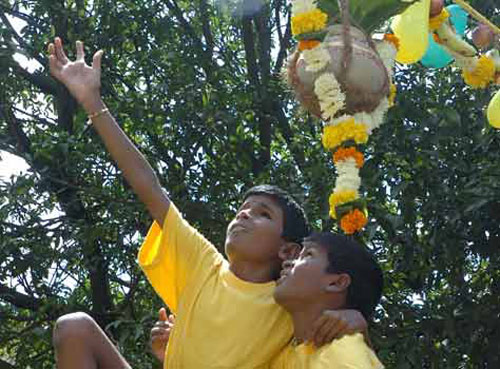
Today is Krishna Janamashatami. At 12 in the night, all the temples will declare the birth of Krishna and the fasting public will take ‘prasad’ and food. Surprisingly, the north India celebrates the occasion in temples with dances, songs and rituals, while west, Maharashtra and Mumbai in particular, celebrates it in its lanes, roads, and other public places with Gobindas and dhahi-handi competitions offering prizes up to Rs 10 million.

I was surprised to see an opinion poll on NDTV-India on the programme Khabardar. Which Krishna is relevant in today’s context- ‘makhan chor’ (butter thief), Divine dancer with gopis and Radha with music of his flute, or destructor of devils? More than 95% voted for the last option suggested. However, among the celebration that is getting telecast on all news channels, the whole nation in busy in the first two ways of remembering him. Is it not contradictory?

Krishna is one of the most colourful characters from our mythologies. Many believe him as historical figure too. I have been to Mathura where he was born in a prison of his maternal uncle, Kansa, Gokul where he grew and Vrindavan where he played his flute and danced with gopis in his divine dance. I had been to Kurukshetra too where Mahabharat was fought and where he recited the wonderful Gita. Delhi itself was Indraprashtha. Hastinapur is also near by in Uttarpradesh. He kept on shifting between Indraprastha and Hastinapur before the Great War Mahabharat carrying out the negotiation to avoid the war.And then Krishna retreated to Dwarka to ddistance the clan from the enemies. Last February, we visited Dwarka.

Krishna has three clear characters. As a child, he was brave and skilled enough to kill many who were sent to kill him. The kids of the country can emulate the child Krishna. He can be a good character for animations film such Hanuman or Ganesh. As a young man, he set an ideal model of romancing and enjoying the divine music and dance through flute and ras. And a matured adult, Krishna is great strategist who gets the respect of even the intelligentsias of the time. In one way he is the hero of Mahabharat. Without using any weapon, he led Pandavas to the final victory in the war. Gita remains the inspiration for the whole world. He is very much relevant even today, perhaps more than even Gandhi. India can’t win the war on terror following Gandhi. Perhaps Krishna and his Gita have answer to deal with the terror and the terrorists.

Krishna is relevant, as each age group can find in Him an inspiration, if it seeks that with positive approach. India needs a Krishna for its police community too. A Krishna only can eliminate the rampant corruption and criminality in the political class that is holding back the country to become prosperous and poverty free.

Posted in Uncategorized | Leave a comment

Booming and Bubbling India- XVI

India’s growth story remains intact. According to Subir Gokarn, chief economist, Standard & Poor, Asia Pacific, “I don’t see any surprises. The momentum of industrial growth in 2006-07 has continued.” “JP Morgan is likely to revise up the full year growth forecast for the year 2007-08 to 8.6 per cent from 8 per cent earlier,”

India’s economy in the April-June quarter grew a faster-than-expected 9.3 per cent from a year earlier, led by robust manufacturing and services. India’s wholesale price index rose 3.94 per cent in the 12 months to Aug. 18, lower than the previous week’s 4.10 per cent due to a decline in some manufactured product prices. Economic growth is changing caste-based deprivation logic.

Domestic companies outsmart MNC peers in profits: Indian companies have performed better than their multinational counterparts in India in the first quarter of FY08.

Breakthrough in bio-diesel process: Researchers at the Indian Institute of Chemical Technology (IICT) in Hyderabad have discovered a way of using a well-known fungus to “substantially” accelerate the process and thereby reduce the cost of producing bio-diesel.

DRDO to take industry aboard unmanned flight: DRDO is in talks with several companies such as Larsen &Toubro Ltd, Godrej and Boyce Ltd, the Tata group and state-owned Hindustan Aeronautics Ltd (HAL), India’s defence aircraft maker, to design and develop the MALE (short for medium altitude long endurance) UAV in five years.

Samsung to commission Chennai plant: Samsung India Electronics Private Limited is all set to commission its Sriperumbudur plant near Chennai built on a 50-acre plot in the SIPCOT Sriperumbudur Industrial Park that will initially manufacture colour televisions and monitors. It has a capacity to make 1.5 million TV sets and 1 million thin film transistor (TFT) monitors.

Fortis plans 40 hospitals by 2010: Ranbaxy promoter group company Fortis Healthcare is planning to invest Rs 1,800 crore for setting up a medicity in Gurgaon and intend to have 40 hospitals under the Fortis group across 14 states by 2010. As reported in TOI, the Mukesh Ambani group is working with his A-team on a plan to put into place at least 1,400 hospitals.

Tata Consultancy bags deal with Hawaiian Airlines: Tata Consultancy Services had signed a multi-year contract with Hawaiian Airlines to provide IT, business process outsourcing and infrastructure services of approx $40 million to provide maintenance and support services to the airline’s revenue accounting application.

At 100, Tata Steel aims to double output: India’s Tata Steel, the world’s sixth largest steel maker since its purchase of Britain’s Corus group, aims to more than double production by 2015 as it celebrated the 100th anniversary of its founding on Sunday, 26 August. By 2015, Tata Steel hopes to add another 35 million tonnes to boost its worldwide annual production to 61.1 million tonnes. Tata Steel though signed the memorandum of understanding (MoU) with Orissa government on November 17, 2004, aims to commission the Kalinga Nagar plant by 2010.

Nod for Noida: The civil aviation ministry has approved the setting up of a spanking new international airport at Jewar, a two-hour drive east from Delhi that will come up by 2010. Greater Noida to Varanasi in less than 10 hrs: 8-lane road project set to roll.

MNCs still bullish on India R&D: At least a dozen large-scale companies including Allergan, Eisai Pharma, Dupont, Astra Zeneca, Johnson & Johnson, Bristol-Myers Squibb, Pliva, Ratiopharm, Nektar Therapeutics, Sigma Aldrich and Teva-have chosen the country as a safe haven for investment in drug research and development (R&D) since January 2005, when the Indian Patent Act was amended.

Now, TV on Shatabdi Express: The railway ministry plans a major upgrade of entertainment in its Shatabdi Express coaches that will soon have flat-panel television touch-screens on each seat, equipped with head-phones offering passengers options of “live” and pre-recorded entertainment and movie channels. It is because of the competition from the aviation sector.

Mysore CAD firm to up headcount: iCAD Engineering Pvt Ltd, the Mysore-headquartered civil engineering services company specialising in designing and detailing steel structures as per American standards, plans to up headcount to 200 people in Mysore and the overall strength to 300 in the coming year. Interestingly, the SME firm, founded by the two alumni of the Jayachamarajendra College of Engineering, has been instrumental in hiring physically challenged people to its workforce. It is a success story with humane face.

Government to upgrade ITIs: The government would upgrade as many as 500 ITIs in the government sector and another 1,400 ITIs that function with private sector participation, to global standards. Can’t the number increase tenfold?

India set to overtake UK in VC investments: According to the report, “India’s VC market with a growth rate of around 90% is likely to overtake the UK by 2009.”

JSW Steel to up capacity ten-fold: JSW Steel plans to export 10 million tonnes of steel in the next 10 years. This is part of its plans to scale up its steel-making capacity nearly 10 times in the next ten years.

EIH plans Rs 4,500 crore expansion: The Oberoi Group, which owns or manages the Oberoi Hotels and Resorts and Trident Hilton brands, plans to invest Rs 4,500 crore to increase its room capacity in the super-premium segment by over 60 per cent over the next five years, from a room capacity of 4,100 to 6,800, through new hotels in India and abroad. And all the hotel tariffs will be now in Rupees for even the foreigners.

Indian executives get behind MNC wheel: Many MNCs such as Sapient, Xansa, Aricent, and Cognizant, have been hiring people aggressively in India and now have more than 50% of their workforce working out of this country. Will it not make the market of graduates hot and the middle class bulge?

Govt sure of meeting $160bn export target: “We are confident of meeting the export target of $160 billion set for 2007-08 if the rupee remains at 40-41 to a dollar.” Ensure quality, improve productivity, and be innovative. Who can stop India?

HRD Ministry for first virtual technical university: The HRD Ministry is working on proposal to put in place India’s first virtual IIT Technical University, where students who have appeared in JEE and have taken admission in engineering colleges, can opt for this course along with the regular engineering course.

10% ethanol blending in fuel to be mandated: While blending-at 5%-is currently optional for individual states, the 10% blending of ethanol will be made mandatory by October 2008. And let us start calculating the savings to national exchequer.

Creating The Farmer’s Convenience: Farmers will be able to use WRs from accredited warehouses after delivering their produce as collateral for short-term borrowing for working capital. Farmers can hope to maximize profits by selling when prices are favourable.

Govt invites $10-bn global tenders for 126 aircraft: Though it could be six years before the first planes start arriving, 18 of the medium multi-role combat aircraft (MMRCA) will be purchased in flyaway condition and the remaining 108 manufactured in the country under a ToT agreement. The Indian defense sector keeps Western countries tempted.

Ashok Leyland, Nissan ink pact: Japan’s Nissan Motor Co. has tied up with Indian truck and bus maker Ashok Leyland Ltd to jointly manufacture small trucks and other light commercial vehicles in India. I wish the venture to bloom and blast the competition.

Indian movies likely to earn $213 million: Indian movies are gaining popularity in the overseas market and are expected to fetch Rs8.5 billion this year with the market growing by 18% annually, mainly because of the growing Indian diasporas around the world. Chak De! India.

Pvt firms invest record $3.8 bn in India: Global private equity firms, including Blackstone and Carlyle Group, have made an investment of USD 3.8 billion in 2007 so far in the country, up 50 per cent from the year-ago period.

NSE becomes world’s 2nd fastest growing stock exchange: The National Stock Exchange has become the world’s second fastest-growing bourse in terms of number of listed companies, while Bombay Stock Exchange has consolidated its position as the biggest bourse. NSE recorded a 16.6 per cent jump in the number of listings to 1,274 during one-year period ended July 2007, while BSE has become home to a total of 4,853 companies.

Firstsource acquires MedAssist for $330 mn: Mumbai-based Firstsource Solutions, a pure-play business-process-outsourcing provider, has acquired US-based MedAssist Holding for $330 million (Rs 1,353 crore). It is the second-largest acquisition after Wipro bought out Infocrossing for about $600 million.

Karuturi’s bed of roses in full bloom: Bangalore-based Karuturi Networks has acquired Dutch floriculture major Sher Agencies in a e50-million ($69 million) deal to become the world’s biggest rose producer. After the takeover, the company’s top line will bloom from Rs 100 crore to Rs 400 crore. Karuturi’s rose-producing capacity will also grow from about 150 million stems to around 650 million. It reminds of earlier reports on Andhra floriculturists going in Ethiopia for rose growing.

Apollo Hospitals arm buys US firm Zavata: Apollo Hospitals Enterprise Ltd’s associate firm, Apollo Health Street Ltd, has acquired Atlanta-based Zavata for about $180 million. Zavata is a healthcare-focussed business-process-outsourcing firm with about 1,000 employees. Even the doctors are great entrepreneurs these days.

Now, mid-sized cos on acquisition spree: Of the 126 outbound deals worth of $29.78 billion made during January to June 2007, several transactions were done by mid-sized companies, says a study by PricewaterhouseCoopers.

13 Indian cos in Red Herring top 100 in Asia list: Thirteen Indian technology firms have come among the top 100 in the Asia-Pacific region by global media company Red Herring. The ‘2007 Red Herring 100 Asia´ awards recognise private companies with cutting edge technologies in the Asia-Pacific region.

India-born reign high on innovative start-up list in US: The three companies — Bloom Energy, Expensr and Vanu — have been featured in “The Next Disruptors — 15 companies that will change the world” list of Business 2.0, a magazine published by global media giant CNN-Time Warner group, which also publishes magazines like Fortune. All the three have an Indian-origin US national as the founder.

SAP opens new facility in Bangalore: German software firm SAP opened a new facility in Bangalore with a capacity to seat over 2,000 employees as part of its future strategy. For SAP, “This new facility is both a sign of SAP’s acknowledgement of the breadth and quality of work being delivered by our colleagues in India, and our commitment to deepen our engagement with Indian engineering talent further.” Is it the recognition of the India’s talent pool?

100mn cell phones to be made in India: According to a recent Gartner research, Mobile phone production in India is expected to reach 107 million units by 2011 from 31 million units in 2006 a compound annual growth rate (CAGR) of 28.3%. Mobile phone production revenue is expected to reach $13.6 billion (Rs 55,760 crore) by 2011 from $ 4.9 billion (Rs 20,090 crore) in 2006, a CAGR of 26.6%. And a better-connected India means prosperous India too. It will mean a mobile phone in every pocket.

Indian Americans better off:
In America, the official poverty level for a family of four with two children is $20,444 (over Rs 800,000) per annum, and one in eight Americans is poor. However, Indian American families have an average income of $ 61,322.

Mahindras doing due diligence on Jaguar, Land Rover: Mahindra & Mahindra Ltd is doing due diligence on Ford’s Jaguar and Land Rover units, the Financial Times said on Thursday, citing people close to the situation. Tata Motors also wishes to acquire Ford’s prestigious companies. I don’t know how serious are they.

Tubular, Malaysia’s UMW to form Rs565 crore JV: The promoters of Oil Country Tubular Ltd (OCTL), a specialized Indian pipes and tubes manufacturer for oil and gas industry, are joining hands with UMW Holdings Bhd, a Malaysian oil and gas equipment company, in a Rs565 crore (50:50) joint venture to make so-called “green pipes” that are used to make casings, drill pipes and production tubing.

Emerson sets up design engineering centre in Mohali: Emerson Electric Company inaugurated its Design Engineering Centre at Quark city in Mohali today. This is the second corporate centre of Emerson in India, after the first one set in Pune.

Industrialising India: Last year, Indian manufacturing grew by over 12% and by almost 14% in the last quarter of fiscal 2006-07. Will India make into manufacturing sector as big as in IT/ITeS?

Indian Institute of Space Science & Tech takes off: The Rs 270-crore Indian Institute of Space Science and Technology (IIST) will quietly get going from September 14, according to ISRO Chairman G Madhavan Nair. “IIST is planned to emerge as the world’s biggest space institute.”

PM’s Nuclear Plan: “We have set a modest target of 20,000 MW of nuclear power generation by the year 2020. This can be doubled with the opening up of international cooperation. This cooperation will not be dependent on any one country and we will source supplies from many of the countries in the Nuclear Suppliers Group including the United States, Russia, France and Japan.” I wish the leftists and BJP would agree.

Four more countries to guzzle Kingfisher bear: India’s top-selling beer brand, Kingfisher will be available in markets in France, Finland, Portugal and Canada that is currently available in UK.

Footwear production to touch 1mn pairs: Footwear exports will go up to 300 million pairs in another five years from the present 100 million pairs, thanks to two big investments from Taiwan. Footwear exports increased 16 per cent to $1.2 billion in 2006-07 from $1.04 billion in 2005-06 and has set a target of $4.5 billion in footwear exports from India by 2010-11 when total leather exports are expected to reach about $7 billion.

Praxair to open facility in Coimbatore: Praxair Surface Technologies, which manufactures high-performance industrial coatings for aviation, oil, power generation and printing industries, will establish a facility in Coimbatore by mid-2008 for manufacturing thermal spray coatings for gate valve components used in oil and natural gas production. It will serve the growing high end-manufacturing sector.

Finnish firm plans foray into medical textiles: Ahlstrom Corporation, a Finnish company, is entering India with plans to make medical textiles that provide protection against diseases in operating theatres and external environments and is going to set up a factory at the Mundra SEZ in Gujarat in October. Health care sector is racing forward.

A boom is on: The ISRO launched its latest communication satellite, INSAT-4CR, from Sriharikota and made up for the launch failure of INSAT-4C. Let ISRO be more commercial.

Indian private companies attracting talent from govt establishments: Companies in the steel, oil and gas, telecom, banking, insurance and aviation sectors, in particular, have hired extensively from government-run organizations. Who will be losers?

Air India flies Bangalore-San Francisco direct: Air India will be operating its non-stop silicon route linking Bangalore and San Francisco probably in the first half of 2008, taking off from the new international airport, which is to open at Devanahalli by April next year. When will be a direct flight between Delhi and San Francisco?

Let the Indian industry take some tips from Narayana Murthy and Nandan Nilkeni to keep growing faster than expected and booming under all odds.

Posted in economy | Leave a comment