Tata’s Rs 1 lakh Car: Evolution and Impact

It was a summer of 1959. Five mechanical engineering students from IIT, Kharagpur were on vocational training in TELCO, Jamshedpur. TELCO was its abbreviated name and that is today Tata Motors. I was one of the five. Even at that time, the idea of a people car was very much popular in Indian auto sector and also with politicians. I has seen photograph of the people’s car in TELCO News, the house magazine of the company. But unfortunately TELCO at that time was not at all in passenger car business. It used to produce only perhaps one platform of heavy truck in collaboration with Mercedes Benz that was adapted to Indian road and load conditions in perhaps the best manner. Hindustan Motors’ collaborator Morris Motors had a small car that could very well get into the categories of the people’s car. Some were produced with imported components. But Maruti 800 with its Sanjay Gandhi connection was to become the first people car. Here it meant the cheapest entry car that started perhaps at Rs 10,000.

However, it is Rattan Tata who is credited with Rs 1 lakh car idea.

With the very announcement of Rs 1 lakh car Rattan Tata created a ruffle for passenger car manufacturers. O. Suzuki ruled out the possibility of such a low priced regular car. Media kept on guessing about the Rattan’s dream car. It has helped heightening the expectations about the car. But Rattan has a history of success with his dreams. I still remember his dream of the first real indigenous Indian car Indica: “a car with the Zen’s size, the Ambassador’s internal dimensions, and the price of a Maruti 800”. With Indica Tata Motors entered in passenger car market in big way.

Rs 1-lakh car will not be a toy car built as prototype by the students of engineering schools. It will be well designed, perhaps by Italian stylists, four-door, four-seater with high performance, perhaps turbocharged 700 cc, two-cylinder gasoline/ diesel engine meeting all the international safety and emission standards and fuel efficiency between 26-30 km/lire or better.

Many competitors who took the Tata’s car lightly at the beginning are now seriously trying to emulate his dream. And this goes to the credit of rattan Tata. It was not easy task, but now it is almost clear Tata Motors will be able to meet the price target. It must have meant a lot of innovations and managerial skills. It now is now few months and the car crazy world can see it at Auto Expo 2008. But more importantly this uniquely Indian concept of Rattan Tata has made many automakers change their ideas.

According a report appearing in Times of India on September 13, 2007 from Frankfurt, French car major Renault SA has firmed up plans to compete with Tata Motors’ Rs 1-lakh car in the Indian market. Renault CEO Carlos Ghosn, speaking on the sidelines of the Frankfurt Auto show, is reported to have said, “We are looking for ways to build a car that could sell for no more than $3,000 to tap mass markets in India, China and Brazil. It is certainly possible to profitably build a car at this price.”

However, Renault and its JV partner Nissan of Japan have not yet made up its mind about its local partner in the venture. It is in talks to rope in Bajaj Auto (BAL) to manufacture this car in India.

According legendary Carlos, it is not going to be a stripped-down version of the Renault’s low-cost car Logan that is priced at about $5,000 (that is already in India through another collaboration with M&M). Everything from the car’s basic design to the factories will have to be conceived from scratch. Bajaj Auto has also confirmed the ongoing joint study. Between Bajaj and M&M, Bajaj may have advantage to get into entry car because of its existing huge customer base.

However, Tatas will certainly get the first mover advantage when it launches the car in 2008. But ultimately it will be the product that will decide the win. The most for the value of money, the smarter product will win.

I don’t agree with Jagdish Khattar or Srinivasan. Tata’s Rs 1-lakh car project will certainly cut into the sales of the existing entry car models as well as some models of the two-wheeler.

Another European car manufacturer is seriously trying to enter Indian auto market that name itself means ‘People car’. And one day VW will certainly come out with a car that may be competing with Tata’s car. VW with its ‘Beatle’ has an established history of manufacturing the people car.

However, Andreas Prinz, managing director, VW Group India said, “We are not fighting in the Rs 1-lakh car segment. One has to compromise with the safety standards and quality and we are not doing that.”

However, Volkswagen is already working to launch a totally new small car platform for emerging markets like India, China and South Africa by late 2010 or earlier. It may not be able to match Tata Motors’ Rs 1 lakh car, but could challenge the Maruti’s Alto and Hyundai’s Santro. The new small family with several variations powered by two-cylinder petrol (turbo-charged) and three-cylinder diesel engines, with the displacement ranging from 500cc to 1000cc and power output varying from 70 bhp to 90 bhp will be a highly fuel-efficient car, delivering up to 30 km per litre (kpl) and beyond.

VW has exhibited the ‘UP! Concept’ in Frankfurt Auto show. As reported in media, “In a way, the chosen architecture mirrors what has been disclosed about the Tata 1-Lakh car – not an inconsequential validation of the domestic effort. VW’s Up is unlikely to be priced for less than about 6,000 Euros, considerably north of the Tata target, although at European levels of specification.”

Rattan Tata must get the due credit for the Rs 1 lakh car and if it succeeds commercially, the India’s manufacturing sector in general and passenger car sector in particular will get a big image boost. Is it not the right way of fighting the Chinese aggression of manufactured products?

Posted in industry, management, manufacturing | Leave a comment

Ram integrates, Karunanidhi-Advani Divides

John Kay, in ‘India -a History’, one very good book on Indian history that I have come across till date, says, “No society retains a more rewarding consciousness of the past than India’s. Legend and oral tradition, when credible, may be quite as reliable as authentic contemporary documentation.” If we see this way, Rama is very much a historic figure. All the sites associated with Rama remained almost same in majority of the stories written by many a famous poets starting from Valmiki’s Ramayana, Vyas’s Mahabharat, Kalidas’ Raghubans or even as late as Tulsidas’ Ramcharitmanas. Over the ages of efforts of those poets and philosophers Rama has become one of the most worshipped god as incarnation of Vishnu.

One may not believe the whole of the story, but then why should a person of repute such as Karunanidhi make a remark about Rama that hurts a huge number of Indian citizens who perpetuate the story of Rama as historical as well as religious: “Some say there was a person over 17 lakh years ago. His name was Ram. Do not touch the bridge constructed by him. Who is Ram? From which engineering college did he graduate? Is there any proof for this?” Further Karunanidhi declares Rama as one of the character in his stories. Is he shameless or crazy to have said that? I wish he could have created such a character. To be frank, I don’t know how good Karunanidhi was as a writer, though Cho Ramaswamy has used words such as idiotic and foolish for his remarks on Rama.

I don’t think such a remark can benefit him any way. Perhaps he might not bother about it, as he may not like to have politics at national level. But will his siblings stand by his statement? I am sure it is a statement of an oldman who lives in his own old world and don’t wish to change.

I had written about Ram Setu and advocated against the objections of BJP. But Karunanidhi’s divisive statement certainly hurt me and would have bitterly hurt many others too.

Karunanidhi through his political organ has already done a lot of harm to the national integrity. His younger heirs should dissuade him from doing any further till he is in chair. BJP must also not take political advantage from Karunanidhi’s statement. But will it?

I doubt after hearing its spokesman saying, “The Congress should come clean on Karunanidhi’s remarks, which are even more offensive than the affidavit itself. Raising questions about the college from where Lord Ram had acquired an engineering degree is not only insulting, but also a direct affront to the faith of Hindus. The BJP dares the Congress to clarify whether it approves or disapproves the stand taken by Karunanidhi.” BJP also questioned if Karunanidhi could make similar remarks about the characters of other faiths too. It smells a trouble for people at large and seems election is getting nearer.

Let the countrymen forget and forgive the old man. And Advani must stop creating more trouble.

Posted in indian politics | Leave a comment

Bihar and ‘India Today’

The annual feature ‘State of the States’ survey of ‘India Today’ that claims to provide the definitive ranking of the quality of life across India appeared in its September 24, 2007 issue. I was eagerly waiting for it to see if after almost two years of Nitish Kumar on the chief minister’s chair, Bihar makes some improvement in the rankings of Bihar. However, Shankkar Aiyar in his cover story has clearly pronounced: “The performance measured is that of states, not their chief ministers. All data used in the study is objective and taken from central government sources, as has been in the past four years.” But the survey and its findings can certainly help the state ministers and the bureaucracy working under it to take some lessons and make a roadmap to improve the overall performance of the state. The observations of the study and certain data on Bihar’s state of affairs are painful. It is more so when you see many states that were far behind after the independence coming ahead of Bihar, as Bihar has slipped to the bottom.

Bihar remains being ranked at the bottom among large states on eight parameters for all the five years ‘India Today’ has been publishing this ranking. Worse, the state scores less than one on a scale of 10 on critical parameters like agriculture, health, education and governance. To get an idea of how bad things are, let’s look at some comparative figures.

The average yield per hectare in Bihar is 1,535 kg compared to 3,943 in Punjab. In agriculture, Bihar rank deteriorated from 11 in 2004 to 12 in 2005, and now to 14 since 2006. It is based on the variables such as percentage of cropped area under cash crops, gross state domestic product/rural population, electricity consumption for agriculture/rural population, food grain yield, loans extended to agriculture households cultivating land, net irrigated area/not sown area. Despite being among the most water-rich states, Bihar has only 60% of its cropped area irrigated. Will the chief minister hold the agriculture minister and his bureaucracy accountable to certain extent and come out with some plan to improve it providing a target for the next three years that he will be ruling?

Bihar has just 62 affluent households per 1,000 in rural areas, which means only 62 households per 1,000 are in the Rs 690 to Rs 1155 and more income bracket and 122 households per 1,000 with incomes between Rs 930 and Rs 2,450 or more in urban areas. The comparable figures for Punjab are 509 and 393 households per 1,000 in rural and urban areas, respectively. 37.48% in Bihar live below poverty line (BPL) against the national average of 27% with BPL defined as the availability of at least 2,400 calories per capita per day for rural areas and 2,100 per capita per day for urban areas. Bihar has a per capita income of Rs 6,311 as against Mizoram’s Rs 27,733. Is it not a disgrace?

Bihar’s ownership of TV sets is at the bottom with only 14.97 % households, whereas even Jharkhand’s percentage is 23.94. How can the people know about what is happening in the country all around?

And more depressingly, barely 14% of the households in Bihar report having an electricity connection that is way below even the national average where 55% of the households have electricity. How can the prosperity come in this era where electricity is basic necessity for any manufacturing activity?

Bihar’s literacy rate is 46 per cent and only 37 per cent of 10-plus children have completed primary education. And still some from Bihar keep on boasting about its performance in education sector, heritage and false claims of having maximum numbers from Bihar in administrative services or IITs.

“Sixty years after independence, only 27% of child birth cases are medically assisted in Bihar meaning seven out of ten children are delivered without medical assistance which is the reason why for every 1,000 children born as many as 60 die at child birth.”

The cover story has referred to ‘having a large contingent of Cabinet ministers from Tamil Nadu’ as a help in its better ranking. I am sure Bihar had and has equally good number of cabinet ministers for decades. Why has it not helped the state?

However the study reveals at least one good aspect of the state of economy. Bihar (undivided) stands third best in poverty drop with 12.94 percent after Assam (21.02%) and Himachal Pradesh 18.80). Bihar has shown relative improvement in health too.

Unfortunately, though many good things are happening in Bihar under Nitish Kumar, I feel he is still very conservative. I am amazed with his opposition to SEZs. If SEZs can benefit the whole of country, why is that it will not do so in Bihar? Bihar will have to get urbanize faster and that too in planned manner, if it wishes to be in race. Nitish Kumar may satisfy his constituency but it will not bring development. He will have to be aggressive.

I wish next year the ranking showed improvement.

Posted in Uncategorized | Leave a comment

Digitizing India

Perhaps everyone who had faced the agony of getting the railway tickets reservation would have got excited with the facilities of reservation through Internet. The ticketing service of the world’s largest railway network showed the way. Today the railways’ ticketing site http://www.irctc.co.in is the busiest in the country that had a business of Rs350 crore ticket sales in 2007. Many other services are available today through the Internet.

A bunch of entrepreneurs are trying to replicate the railway tickets initiative in a bigger, and much more fragmented, travel market-long distance bus services. Some nine billion tickets are sold each year, in India, on routes connecting cities, towns and villages-about 50% more than the tickets sold on the railways.

Some NGOs are taking Internet route to help artisans to tap the potential of the global market, and the opportunities are in plenty.

India is trying to get digitized in a big way. With connectivity reaching the rural India, it will provide services and open opportunities for some employment too. It could be more widespread covering almost all services from the government as well as private service providers. Here are some areas where digitizing is taking place.

Police: The contact details of the police stations and officials across the country are now just a click away. The Bureau of Police Research and Development (BPRD has already uploaded contact details such as the postal address of police station with phone and fax numbers and residential phone numbers of station in-charges, the contact details of offices of Assistant Police Commissioners and Deputy Superintendents of Police of respective areas, and even e-mail IDs of some police stations of six states and four union territories on its website http://www.bprd.gov.in.

Gujarat: Gujarat has abolished paper files in 34 departments in the Gandhinagar secretariat. It meant speedier processing, better tracking and greater transparency. Plans are in hand to reach the district-level administration as well. Very soon the whole Gujarat government will be a paperless wonder. Interestingly, Nitish Kumar has taken up the e-governance quite seriously. His resident that was famous in Lalu’s days for the cattle of all varieties, are now the nerve center of the control room for the chief minister to be in contact with all the districts.

Union Ministry of Corporate Affairs: The union ministry of corporate affairs has digitised the records of 700,000 companies and made all filings and data retrieval on-line. Against a target of about 25 per cent of all companies expected to be filing their reports digitally in the first year, the achievement has been 92 per cent. And the site gets over 4 million hits a day. One can now register a company in three days, instead of 30.

VAT Administration: Tata Consultancy Services (TCS) has helped introduce a digital framework for the value-added tax programme in 19 states (including five in the northeast) – with a dramatic increase in revenue collection.

Andhra Pradesh introduced the idea of citizen-service kiosks It has 2,000 of them across the state -and the kiosks record a million transactions every month.

Bangalore has digitised its land records with equally dramatic results, and the programme is now to extend to all of Karnataka.

The Controller General of Accounts (CGA) will within months implement a monitoring system for assessing the expenditure on 27 central schemes entailing a cost of Rs 1 lakh crore annually with all the information regarding expenditure on government schemes in public domain through its website.

According to a survey by online research consultancy firm JuxtConsult India, a majority of 61% of online job seekers come from non-metro towns: 31% belonging to smaller non-metro towns and 30% from the larger non-metros.

RFID:
Another revolution is waiting to happen with the use of RFID (radio frequency identification) technology. The defence ministry uses it to track files.

The Gujarat Co-operative Milk Marketing Federation is using RFID to tag buffaloes.

Remember those stories of the banks giving cattle loans. The banks can now track all the cattle and the cheats will now not be able to use the same cow as security for many loans.RFID will soon track the railway wagons, cooking gas cylinders, trucks and cars and fertiliser bags of fertilizers and grains going to farmers or to the fair price shop.

Naturally, the vested interests that benefit from the status quo resist the new technology. Technology seems as the only answer for dealing with corruption and inefficiency.

Posted in Tecchnology | Leave a comment

Booming and Bubbling India- XVIII

The politicians have been busy obstructing Indo-US Nuclear Deal and Sethusamudram Canal Project. Mayawati and Uma Bharati are creating problems for Mukesh Ambani’s Reliance Fresh. However, India’s economy grows faster than ever; and its newly confident companies are showing their global ambition.

India’s moment is evident in the latest Business Week ranking of Asia’s top 50 companies. There are a dozen Indian outfits in all, ranging from automakers to a mortgage lender to pharmaceutical producers. This diversity is a surprising reversal from just a few years ago, when the entire world knew about corporate India was its software shops. This year, there’s just one tech player on the list, Tata Consultancy Services Ltd. (No. 23). “India is no longer a one-trick pony,” says Subir Gokarn, the chief Asia-Pacific economist for ratings agency Standard & Poor’s.

Here are some stories of the endeavours of the entrepreneuring India from the media.

Automakers racing to crack India’s hot market: FRANKFURT, Germany – Global automakers on the hunt for new and lucrative markets are jostling for a place in India, where the car market is growing at an average of 20 percent a year, outpacing even China.

India leads BRIC’s acquisition spree: In India, a total of 32 outbound deals were recorded in the first half of 2007, “an impressive figure which puts the country well on target to beat the 50 deals which took place during the whole of 2006,” according to the KPMG report. China still has some long way to go to catch up with India – which was easily the most acquisitive of the emerging nations, according to the report.

India’s CMIE raises 2007/08 GDP forecast to 9.1%: India’s Centre for Monitoring Indian Economy (CMIE) revised its estimate of India’s GDP growth to 9.1% in the fiscal year 2007/08, up from its earlier 9%, citing a robust growth in services and industry. The independent think tank expects industry to grow 9.5%, the services sector to rise 10.7%, and its farm output growth estimate to 3.9%, from 3.1% earlier, in the fiscal year ending March 2008.

Indian pharma market to touch $20 bn by 2015: McKinsey: India’s present pharmaceutical market that was estimated at $6.3 billion in 2005, is expected to touch $20 billion by 2015, with an compounded annual growth rate of 12.3 per cent.

BPRL-Videocon combine buys oil blocks in Brazil: A consortium of Bharat PetroResources (BPRL), a wholly-owned subsidiary of Bharat Petroleum Corporation (BPCL), and Videocon Industries, have jointly purchased Encana Brasil Petroleo Limitada (EBPL), a subsidiary of Encana Corporation, Canada for about $165 million, to explore oil blocks in Brazil.

Pharma firms plan R&D hub in Sweden: Indian drug makers Shasun Chemicals and Drugs Ltd and Wockhardt Ltd are looking to set up research and development hubs in Sweden for ‘bio-similars’ or off-patent versions of biotechnology drugs, in a bid to jump-start their global operations in this segment.

13 Indian firms in WEF Global Growth Companies: Thirteen fast-growing Indian firms have joined as founding members of the 125-strong Community of Global Growth Companies, a new initiative of the World Economic Forum (WEF).

KPO sector to be $11.2b by ’10-11:The KPO sector in India will be worth $11.2 billion by 2010-11 and will employ approximately 255,000 professionals.” While in 2000-01 there were nearly 9,000 billable KPO professionals who generated $260 million as revenues, by 2006-07, their numbers had gone up to 75,400 employees and revenues of $3.05 billion.

India to pass Brazil as No.1 sugar producer: India is expected to overtake Brazil as the world’s top sugar producer in 2007/08, according to the International Sugar Organization. The London-based ISO forecast in a monthly report Indian sugar output in 2007/08 (October/September) at an all-time high of 33.15 million tonnes, up 8% year-on-year.

Reliance buys Malaysian polyester firm: Reliance Industries Ltd (RIL) has acquired Hualon Corporation (M) Sdn Bhd of Malaysia, the world’s largest integrated polyester manufacturer. The acquisition will help RIL consolidate its position as the world’s largest polyester manufacturer with a capacity of 2.5 million tonnes, 25 per cent more than its current capacity.

Rs 5 lakh crore to bolster steel sector: The Indian steel industry is poised to witness an investment of more than Rs 5 lakh crore, which is over six times the total money ploughed into the sector since independence to create a production capacity of over 240 million tonnes, nearly five times of what the country has now. According to a steel ministry document on the investment scenario in the country, 193 memoranda of understanding (MoUs) have been signed between investors and state governments as on July 1, to create an additional capacity of 242.9 million tonnes at an investment of Rs 5,14,038 crore. Posco project is on course now and the clouds of uncertainty that loomed large over the Rs 50,000 crore project have drifted away.

NHAI to invest Rs 50,000 crore: The National Highway Authority of India would invest Rs 50,000 crore in the North-East region in the 11th Five Year Plan for increased connectivity with all state capitals.

India ranks 2nd in IPO, 4th in M&As: India ranks second in capital market inflows and fourth in merger and acquisition deals in Asia Pacific (including Japan), as deals worth $65.033 billion were reported in the first eight months of calendar 2007. The data compiled by Thomson Financial revealed that 121 Indian firms mobilised $23.96 billion, while there were 697 M&A deals worth $41.069 billion.

M&M to drive in 1st India-made automatic gearbox: Mahindra & Mahindra (M&M) is all set to join the league of Honda, Toyota, Ford and General Motors by offering automatic transmission in its vehicles. M&M will be the first Indian company to develop an indigenous automatic transmission, which will be initially strapped on its Scorpio SUV.

India can become an MRO hub: India could soon emerge the civil aviation maintenance, repair and operations (MRO) hub for Asia-Pacific.

KPO sector to be $11.2b by ’10-11: India is already the world leader in the Knowledge Process Outsourcing or KPO. Studies by Evalueserve show while the industry is expected to generate $16.7 billion revenues by 2010-11 – an annual growth of 39% in the next four years, – around 350,000 professionals will be employed in this sector. ”The KPO sector in India will be worth $11.2 billion by 2010-11 and will employ approximately 255,000 professionals.”-Source: Career Opportunities in India’s Knowledge Process Outsourcing (KPO) Sector.

Wipro opens new global development centre in Mexico: Wipro Technologies announced the opening of the company’s first development centre in Monterrey, Mexico, where it aims to reach a headcount of 100 in a year’s time. The Aditya Birla Group plans to invest $200 million in Mexico’s carbon black industry over the next five to seven years to increase the capacity of the Mexican business from around 60,000 tons to a quarter of a million tons,

Best paymasters in IT: According to the study, the average salary hike received by software professionals in 2007 was 18.7% compared with 18.3% in 2006; and the average salary of people in the IT industry, across all management levels barring the top management has grown 11% to Rs6.2 lakh per annum.

Indian IT professionals in US returning to homeland: With India becoming a favoured destination of several multi-national companies, thousands of Indian IT professionals in the United States are returning to their homeland with good pay packets, according to a survey, conducted by Indus Entrepreneurs, an association of Indian IT professionals settled in the US. “Around 60,000 professionals have returned to India in recent years.”

Tech firm in global top list: iViz, a network security firm, with its origin in IIT Kharagpur, has made it to the global league of network security companies. iViz is the only Indian company that has made it to the semi-finals of the Global Security Challenge competition.

Software exports up 32% in FY07 at $31.3 billion: India’s software and services export is estimated to have grown at a robust 32% to $31.3 billion (Rs1.41 lakh crore) for 2006-07, as per the official figures of Department of Information Technology.During 2006-07, electronics and IT exports are estimated to be Rs1,53,300 crore, compared to Rs1,13,725 crore in FY05 -06, a growth of about 35%.

Wipro Infotech launches supercomputers in India: Wipro Infotech, the India, Middle East and Asia Pacific IT business unit of Wipro Ltd, on 13 September announced the launch of Wipro Supernova — a range of supercomputers and superstorage in India. Supernova includes a complete range of supercomputers with an entry level configuration delivering one trillion mathematical calculations per second going up to hundred thousand trillions of calculations per second and superstorage scaling to multiple hundred petabytes.

NTPC plugs on to LED lamps manufacture: NTPC Ltd plans to get into manufacturing Light Emitting Diode (LED) lamps, widely considered the future of lighting technology.

Rice that can beat heat: Indian molecular biologist Shital Dixit at the Wageningen University in the Netherlands and her colleagues in Bangalore and five other countries have developed the plant that uses water far more efficiently than existing rice crops. The new rice plant appears to grow well in severe drought-like conditions.

Indian doctor develops enzyme that can destroy HIV: Dr. Indrani Sarkar and a team of scientists have developed an enzyme called Tre, a custom enzyme capable of detecting, recognising and destroying HIV, much like a pair of molecular scissors.

More rural mobiles than fixed-line phones in India: Rural mobile phone connections stood at 39.46 million up to June 2007. With a total subscriber base of 185 million that month, rural subscribers formed a formidable block of 21.31 per cent, or over one-fifth of the total mobile user base in India.

7 Indian firms among top 250 global energy companies: As many as seven Indian companies figure in the list of the world’s 250 top performing energy firms, with Reliance Industries, ONGC and NTPC grabbing the top Asian ranks. In the annual rankings of Platts Top 250 Global Energy, ONGC and Reliance Industries have made into the top 50 with rankings of 23 and 39 respectively. ONGC has also been named as the third best performing energy company in Asia.

Narayana Murthy, Bill Gates bag Indian & American Achiever Awards: Infosys chairperson NR Narayana Murthy, Microsoft chief Bill Gates, music composer AR Rahman, Hollywood actor Richard Gere and the late Dhirubhai Ambani have won the Indian & American Achiever Awards.

India’s forex reserves rises to $230.377 bln: India’s foreign exchange reserves rose to a record $230.377 billion on September 7 from $228.847 billion a week earlier.

Inflation falls to 17-month low: Inflation fell to a 17-month low of 3.52 per cent for the week ended September 1 due to cheaper minerals, fuels and some manufactured products, giving the government positive ammunition to woe investors to revive sluggish industrial production.

India braces for wave of more equal auto parts JVs: JD Power and Associates estimates India will buy 2 million cars annually by 2012, and export another 1 million, making the country a sought after destination for global auto part makers. Besides Indian firms that earlier made nuts, bolts and routine casts, leaning on the west for design, are now one of the lowest cost manufacturers, making them attractive partners.

Ganesh graces Paris: On September 2, Paris was blessed with another year of good luck from Lord Ganesh at the Fete de Ganesh. Well over 10,000 people joined in the procession through the streets of Paris to worship the Hindu god. The ‘exotique’ festival highlighted the widespread interest in Indian spirituality among Europeans, inspired to learn about and experience the rich diversity of religions celebrated in India.

Innovation guru, Robert Tucker who has worked with a wide range of companies which include IBM India, Satyam Computer Systems Ltd, Nokia Oyj, American Express among others. He is also the author of ‘Managing the future’: 10 Driving forces of changes for the new century’, and ‘Driving Growth through Innovation’. He talked of changing India:

“I was here in 2003, and Tata (Tata Group) was a $12billion company, somewhat sleepy. Today Tata is generating $63billion in sales and revenue. They have restructured and embraced innovation and global markets.”

And so say many including the so-called Diaspora who visits India after a gap and sees the bubbling India all around in malls, multiplexes and on expressways.

Posted in economy, industry, management | Leave a comment

Politicians Win, When Country Looses

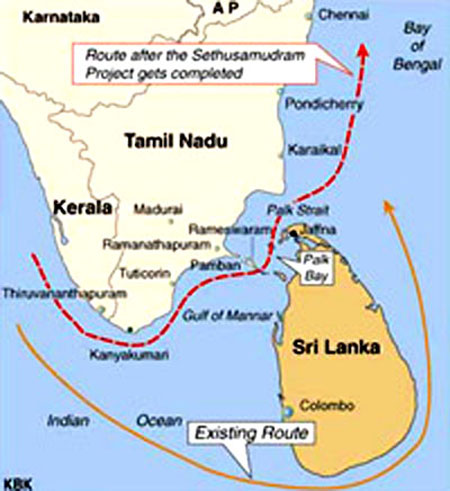
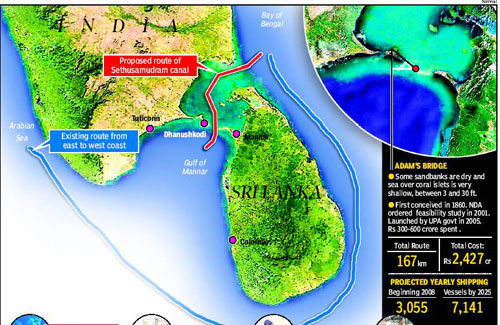
The Supreme Court has suspended the work on the Sethusamudram Canal Project for three months. As reported, the project work was going on in full swing since last one year, and almost 25% of the work is done. The dredging cost per day is about Rs 1.20 core with the five dredgers working for Sethusamudram Corporation Ltd. Five more were to be put in for dredging soon. And what the completion as planned would have meant? 3,055 vessels would have used the shorter route through the canal every year beginning 2008. The route would have saved 36 hours and 460 km for every vessel.

And what the government has done? The government has withdrawn the ASI affidavit, and suspended two erring ASI officials. Ram as the King would not have liked this anti-country, anti-people decision in his Ramrajya.

And what is the news from the BJP side? BJP has proclaimed its win. The grand old man Advani has secured his comeback. He is asking for the head of the Prime Minister and archrival Sonia Gandhi, though none is going to oblige him. BJP has got an issue to keep itself busy. The same BJP when in government got the feasibility study ordered in 2001 for a proposal conceived as early as 1860.

And why is Sonia’s Congress doing all this. Is it part of secularism or development politics? With her action on the affidavit, Sonia can now face the Hindu electorate and Modi boldly. Law Minister has affirmed the historicity of Ram in his attempt at damage control. The country can’t accept anything better from a sycophant. The culture minister, another Sonia’s friend has offered to resign (if Manmohan and Sonia ask her). She agreed to have suggested three changes to the ASI affidavit though one was omitted. She put her finger towards assistant solicitor general as solely responsible for the affidavit that created the stir. She has ordered an enquiry into the affidavit issue and sought a reply from the ASI chief. What more can she do to prove her innocence? As reported, Jairam Ramesh’s remarks in Kolkota that he would have owned up moral responsibility and quit if he had been in the place of the Culture Minister created a controversy in the ruling party. Is it not to divert the attention from the real issue? None talked of the loss to the national exchequer because of the suspension of the work.

It is unfortunate for the country. The politicians exploit and win over the sentiments of the poorly informed people of the country. Even in this 21st century, instead of telling the truth to them, they collect them for protest rallies and agitations for a nonexistent issue that can win their votes. They are the same people who hold up the work on expressways and other infrastructure projects for a temple and a grave turned overnight as a ‘mazar’ that requires to be dismantled for a cost effective alignment.

How does it matter even if the structure for the dredging is Ram built Setu and not a natural structure as so-called experts claim? What will be lost if the Project get through? After all the whole of the length will not be dug. The country can always preserve the rest. The Project can preserve the mythology better using a suitable nomenclature such as Ram Setu Canal for the posterity. Why can’t some grand architectural features built in the project that can make it famous world over?

I get really hurt, when I find the economy trying to boom getting slowed by such actions. One day the politicians hold up the Indo-US Nuclear Deal, the other day it is the suspension of a project such as Sethusamudaram. Everything gets referred to Supreme Court that takes its own time to give decision that again may not be universally accepted solving the problem.

And still we expect that India became a superpower soon and get heard on global forum.

Posted in economy, indian politics | Leave a comment

Ram Setu, Sethusamudram, and Indian Politicians

Indians had been very poor in preserving history. Forget Valmiki, the Aadikavi! There is even controversy over the birth place of Tulsidas, whose Ramcharitmanas happens to be the most popular and respected religious book (by number) in India. The country and its Hindus have not done anything significant to save the places related to him. It is painful to hear and read how every single development project is either delayed or sacrificed because of political or religious reasons.

According to TV channels, from Jammu to Kerala lakhs of VHP workers, joined by Bajrang Dal, RSS, BJP and ABVP activists, blocked road and rail traffic in protest against a project that appears to be one of national importance to an engineer like me and others and inconvenienced the working class. In Indore, the commercial capital of Madhya Pradesh, the protest took a communal turn.

It all happened because an affidavit was not correctly worded: ”Valmiki Ramayana and Ramcharitmanas admittedly form an important part of ancient Indian literature, but these cannot be said to be historical records to incontrovertibly prove the existence of the characters and occurrences of events depicted therein.”

The Sethusamudram project is meant to dredge an 83-km-long canal linking Palk Bay and Gulf of Mannar to reduce shipping distance by almost 600kms. For environmentalists, the project would destroy marine biodiversity and increase the risk of natural disasters. To the politicians trying to keep the so-called Hindu vote in their favours, the project would wipe out Adam’s Bridge or Ram Setu, built by an army of monkeys led by Lord Ram to rescue his wife from Ravana.

I am sure if Valmiki, Tulsidas, or even Ram whose all acts were to keep his people happy and prosperous, appear today incarnated again, will give their verdict in favour of the project.

The Sethu Samudram Ship Canal project will enable vessels to save on time taken to circumnavigate the Sri Lankan island while going from west to east. It is a commercial proposal as other famous canals in the world such as the Suez or Panama. The project will save millions of rupees every year for the country. Why should the politicians obstruct that with a hope that it can get them the vote of a community that is so much divided in thousands of castes? Let them drop their myth.

And if the political parties can make an institution such as the Archealogical Survey of India change its version, how can the people hereafter believe on its inferences?

Unfortunately, the professionals are not trained to be politically prudent.

I was recently reading an article in the economists on nuclear power. It says, “Nuclear power was accepted by politicians and the public alike, so there are few delays due to protests or planning problems.” And France today are having the largest number of nuclear power plants in the world about which the leftists are raising so much hue and cry.

Why can’t the politicians take some lessons from other developed and developing nations and stop exploiting this right of democracy for a wrong antinational cause?

Instead, the project can get a nicely coined name with Rama to keep the memory of His Bridge alive for the centuries to come.

Posted in Uncategorized | Leave a comment

Shocking, Damning, Humiliating, Beastly Bihar

Some 55 years ago, I was in my village in a summer vacation. It was a hot summer. As usual, all the male members of the family and some fellow villagers were in the courtyard of the house that was sprayed with water in the evening to make us sleep comfortably. Suddenly, the whole village was on its feet. Someone had seen a truck going on the bank of the village canal. It was something unusual. He took the truck as one full of thieves going for a robbery to some village nearby. The news spread like wild fire. A huge crowd went ahead and dug the bank of the canal so that while returning the truck would fall in that. And so it happened. When none came out of the truck for sometime, the brave enthusiasts waiting at distance went near the truck. There was no one in that. The driver had run away in darkness.

In the morning, someone came and told us that truck was carrying coal for the village next to ours. I reminded of the incident while reading the recent cases of the mob’s ‘instant justice’ in Bihar.

For quite sometime now, the news from Bihar is becoming more and more shocking, damning, humiliating, and to a great extent beastly.

It started with Bhagalpur. A minor chain snatcher was brutally beaten by the mob. I saw the beastly pleasure on the faces of the scarcely dressed people of all ages in the crowd on TV screen. Even the policemen who came there tried to give some exemplary punishment to the culprit. He tied the alleged thief to his motorcycle and dragged the bare bodied on the road. All that was when a video camera was on.

In another incident, three motorcycle snatchers had their eyes gouged out by an angry mob in Bihar’s Nawada district last Sunday.

On Monday two children were beaten up and paraded in the streets with their heads tonsured in Nawada town, because they allegedly stole few packets of detergent from a shop where they were employed. As reported, ’13-year-old Mochu and 12-year-old Budhan cried and begged forgiveness but to no avail’.

The people are taking law into its hands. “In yet another instance of mob brutality, ten alleged thieves have been beaten to death in Dhelpurva village of Vaishali district in Bihar.” It is an extreme case of instant justice by crowd and failure of police machinery. A CID investigation can’t provide the solution.

Why is it happening? Is it because the people are frustrated and have lost faith in police and judiciary? Is it because the people don’t have any thing to do? Do they try to get some way entertained by these acts? Does it happen because the people are illiterate? Is it because the education today does not emphasise on becoming a good human being with some minimum compassion first? Can any number of police stop this to happen? Does it require some Gandhian mass social reforming approach?

When the Nitish Kumar government started its inning, perhaps the first important visitor to the state was Guru Ramdev. Some other Gurus also visited. As I remember, Nitish Kumar made Ramdev the brand ambassador for Bihar. Perhaps the state requires more of Ramdev and his disciples in all the cities, towns, and villages to conduct the value building programmes as basic requirement. Some value building must be part of education. It is strange that all these are happening in the state of Buddha and Mahavir.

However, the regularity of such incidents is no doubt the indicators of the total failure of the administration at all levels. It got reflected in the statement of even the chief minister when he himself says after hearing Dhelpurva story, “incidents of crime have increased and police are not paying attention.” How can he improve if he doesn’t become aggressive and open to suggestions? Today he is in position to appoint the best policeman of the country (may be Kiran Bedi who recently was superceded by her junior) to head Bihar law and order administration. Why is so keen to keep the men from his own state who are having very poor reputation because of their caste bias. Why can’t he remove the black sheep if he thinks them as hurdle? Is it not getting obvious with as many as 1,600 people turning up at his Janata Durbar to complain against police?

It is unfortunate that all TV channels are making it more difficult for Nitish Kumar. Let us look at the NDTV reporting. “Chief Minister Nitish Kumar may have promised to rid Bihar of crime when he came to power in 2005 but the crime graph in the state seems to be indicating otherwise, especially when it comes to incidents of brutality.” And then NDTV reporter goes to Lalu Yadav who squarely laid the blame for the incident on the Chief Minister. ”There is no law and order in the state of Bihar. The government has failed completely. The police also stand by and watch. There is complete anarchy in Bihar.”

Why should media go to Lalu for a comment on everything that happens in Bihar and publicize his remarks that are never serious? Whatever is happening today are the cumulative results of the years of mishandling of law and order in Bihar. And the Lalu’s clan had ruled then.

Bihar needs some innovative handling of the situation. Only the chief minister and his team can do that. It can’t improve its image without that.

Posted in Uncategorized | Leave a comment

Amritsar- Some Observations

Posted in Uncategorized | Leave a comment

Defence Can Boost Manufacturing Sector

India can get rid of its poverty only if it becomes a major manufacturing power. It will have to manufacture everything that the domestic as well as global consumers demand today and will demand tomorrow. If India is not in manufacturing in a big way, it can’t remain at top in services for long.

Manufacturing can get big boost in two ways: Firstly India’s private sector must enter all the sectors monopolized till date by public sector including defence manufacturing. Secondly, all the public sector enterprises including the defence production companies must encourage outsourcing the parts and subassemblies to local vendors in big way.

Defence production is a huge manufacturing business. As on today, major indigenous defence production remains with government enterprises mostly under defence ministry. On one hand, the defence forces have special liking for the hardwares from Russia, France, Israel, and other foreign sources, perhaps out of selfish interest. It keeps on finding reasons that sometimes appear as excuses, to import. So it doesn’t actively associate itself in indigenising or show interest in using the locally developed and produced products, machinery, arms, ammunition and equipment. Arjun main battle tank is an example. Same must be true with number of other locally developed armaments and equipment. On the other hand, the production enterprises under defence ministry have hardly grown in scale and technology with time. My experiences of some ordnance factories manufacturing guns and vehicles have been real poor. People in the establishments hardly work. The defence production organizations lack efficiency, competitiveness and aggressiveness that are necessary to grow. The existing factories must improve its productivity and cost competitiveness and must produce the contemporary products required by the defence forces. It requires factory based R&D and innovations.

India is spending billions of dollars importing all sorts of major weapons. With capability to manufacture precision mechanical as well as electronics components and highly talented human resources, India has all the potentials to manufacture them in the country. And the local production could have given a big boost to the local economy creating huge employment. And it can’t happen if private enterprises don’t enter the sector.

Why can’t the country see the coming up of an Indian equivalent of the US’s Lockheed Martin or the UK’s BAE Systems in private sector?

As reported, the total sales of the 39 ordnance factories and eight defence PSUs in the country added up to Rs 19,916 crore in 2005-06. That’s about 58 per cent of the country’s arms purchases for that year. India’s private sector defence companies aggregated sales of only Rs 4,606 crore ($1.02 billion) in 2005-06 in the form of raw material, components and sub-assemblies supplied to the ordnance factories and defence PSUs. More importantly, however, the local manufacture does not include sophisticated technology items.

India placed import orders worth $5 billion (Rs 22,500 crore) for all the critical items, according to Stockholm International Peace Research Institute (SIPRI).

As per one estimate, India will spend $45 billion (Rs 1,84,500 crore) on buying arms and equipment for its armed forces over the next five years.

About $30 billion (Rs 1,23,000 crore) of this will be on imports. However, India’s defence industry will get business worth about $9 billion (Rs 36,900 crore) through a new defence offset policy. Under this new policy, foreign suppliers with defence orders of more than Rs 300 crore are required to spend 30 per cent of the order value in investments in Indian defence companies or sourcing defence products and services from Indian defence units. This can’t be the way India can go in manufacturing in big way. India must have many more OEMs.

India’s defence industry has the potential to be 10 times its current size of Rs 20,000 crore within a decade given the current trend of increased arms acquisitions. Why can’t India take a lesson from the US defence industry that had a turnover of $183 billion (Rs 7,50,300 crore) in 2005, and employs more than 2 million people?

Defence production was opened in 2001 for private entrepreneurs. A few companies have already taken significant steps to become serious players.

 L&T has been working for DRDO on many projects, including development of missiles and rocket launchers, torpedo launchers, bridge-laying tanks and submarine hulls. It has now orders for 40 ‘Pinaka’ mobile rocket launchers that it developed along with Tata Power from the Army.

 Tata Power’s Strategic Electronics Division has also specialised in making computers for fire-and-forget weapons and surveillance and tracking systems.

 Mahindra & Mahindra (M&M) is making light combat and armoured vehicles.

 HCL Comnet, Noida has laid satellite and terrestrial communication networks for the Army

 Astra Microwave Products, Hyderabad makes radar components.

 Wipro has set up a cell to tap the offset opportunities in engineering design and software for weapons and aircraft components. WIPRO’s hydraulics division is looking to tie up with aircraft landing gear makers.

Many more big private players must join the defence industry and the government must facilitate that. Defence production can’t remain a government business any more.

A vibrant defence industry is in national interest. It always means a superb technological R&D, and that in turn could also be useful in the civil sector. Historically, military research has yielded many technologies or accelerated technological development. Military needs were behind familiar technologies such as the Internet, computers, satellites, and even high-definition television. Interestingly, in India, one example of military technology put to civil use is ready-to-eat packaged food. DRDO developed it for the troops, but later licensed to MTR Foods.

As reported, the private sector is battling two factions in the Ministry of Defence – one that favours imports in the name of providing the armed forces with the latest and the best in the market, and another that favours the public sector in the name of national security and jobs. And both are harmful for the nation. Defence production must get freed for the highly talented entrepreneurs off the country.

Posted in governance, industry, manufacturing | Leave a comment