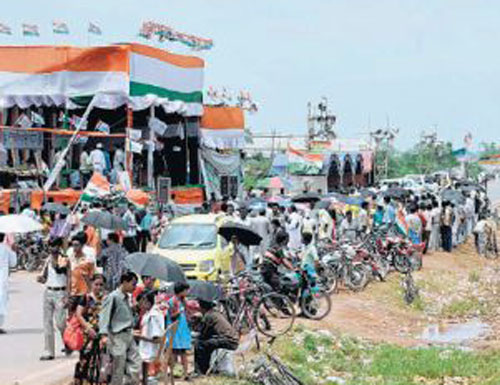
Ma (Mata) Pities People

Work on the Nano project in Singur may again start, though it has not started as on today. Mamata’s agitation has certainly delayed the Nano arrival in the market. Mamata, as reported has softened her stand. “We want immediate solution to the crisis. We are not against the Tatas.” Mamata urged the state Government not to resort to petty politics by influencing the closure of the factory. “The Government should immediately take steps to begin work at the factory.”

Perhaps the people around Mamata and the pressure from all sides against her fight for her cause in a wrong way made her a little soft. However, Mamata still does agree to withdraw her agitation or her camps around Singur’s Nano plant. She insists that the government must follow her solution.

“The government must return 400 acres of land within the factory compound to the farmers. The government can shift the ancillaries to the large patch; about 500 acres available opposite the Tata Motors factory site on the other side of the Durgapur Expressway and link it to the main plant via an underpass.” Let Mamata understand that Tata Motors may require a lot more of land if the Nano clicks well as expected in market.

Mamata must appreciate what Nano project has brought to Singur and for the people of nearby area, and what potential it holds. Can Mamata imagine the future of this plant if the people, the government and the union leadership cooperate with Tata Motors? Can Mamata think of the prosperity of the area when the plant grows to a capacity level of 1 million cars a year? Can she estimate the employment possibility of a global standard auto plant with many ancillaries having mother plants in West Bengal? Let Mamata and the people around Singur and Kolkata start thinking big. No doubt the credit for this must go to Buddha Babu, as Ratan Tata came to West Bengal only after seeing her honest interest. I wish the trade union wing of left parties could appreciate the significance of Nano Project and don’t create the union offices all around to keep on irritating the management with some or the other issues.

Let Mamata be practical and understand the ground reality that a plant of this magnitude brings.

Lives around Singur are already changing fast. The siege has dampened the dreams. For instance, let us hear Mukund Das, a staunch Trinamul supporter, who owns Moumita Electronics, in Singur Bazar, which sells radio sets to cellphone top-up cards: “On an average, I have been selling cash cards worth Rs 6,000 a day for over a year. The growth in business has been phenomenal. Sales have slumped since the siege of the Tata factory. Business is not even Rs 1,000 a day.” According to Das, everything changed in Singur since the arrival of the Tata plant.

Besides a good number of local employees of Nano plant, the Trinamool-dominated contractor syndicates supplying materials to the factory showed its displeasure with the continuing blockade and threatened to start work from Thursday if the Trinamool Congress chief refused to see reason. Someone told me that these contactors bear the expenses of Mamata’s agitations that were about Rs 2.5 lakh daily.

It all made Mamata to yield and soften. Mamata must stop this style of agitation. She can very well do that before the work on a project starts. She must not blackmail when the entrepreneurs has already put in a major part of Rs 1500 crore and it is fighting to launch the product in 2-3 months with all machine tools and equipment at site.

However, I am still of an opinion that industrial plant designers are to ponder over some innovations that can take the advantages of multilevel operations to cut down the land requirement, more so if the land is fertile for agriculture. Preferably, the government must select and create infrastructure in zones that are barren for use of industries. India certainly has a lot of it.
—————————-
Latest
Tata Motors pulls out of Singur

Posted in governance, indian politics, industry | Leave a comment

IITians Go Rural

On occasion of Pan-IIT meet in Chennai, many have talked and written about IITs and IITians that is really informative. IIT-Madras has, for example, recruited over 200 faculty of whom at least a third did their bachelor’s in one of the IITs and had gone abroad to do PhDs. It is estimated that there is a pool of 60,000 PhDs from India in the US.

Surprisingly, IITians are still busy in ‘exploring areas where they can contribute to the larger cause.’ As reported, very soon a new website http://www.alumnet.iitkgpernet.in will electronically link all alumni and provide an effective platform for sharing ideas and contributing together.

Suggestions regarding the expectations from IITians are many. While one calls upon all IIT alumni to work towards evolving a good and low-cost education system, the other pleads to join the village adoption initiative. Nandan Nilekani, as author of his well documented book ‘Imagining India’ wishes IITians help in revamping the education system radically.

An Indian Institute of Technology survey says every IIT-ian has created 100 jobs and that every rupee spent on an IIT-ian has ‘created an economic impact of Rs 50 at the global level, half of which is India’s share’. Many celebrity alumni have given their own opinions on the glorious roles of IITians: ‘IIT-ians have created a global brand‘ ‘IIT-ians have brought glory to the country‘

Interestingly Pan-IIT this time has opted to focus on the India that lives in villages, according to a news report covered in prestigious ‘Business Week‘ too.

The IITs’ old boys will engage in the development of India’s 6 lakh-plus villages where over 70% of the population lives. For all you know, our IIT men may be able to address village-level problems before the truant politician does. And in the bargain, some of them may hopefully take to politics!

I wish both IITs and IITians can look into the ways and means to transform the rural India as priority because of its being away from the media galore. The coverage of rural India in the print and digital is extremely inadequate. While IITs must create technologies such as an extra low cost water filters, room coolers and refrigerators that can help the rural India to improve the quality of life, IITans must help in building and upgrading the existing rural schools with setting up a creativity centre, a library in each school or by getting the school teachers trained in computer and English language. It can start with a simple step of visiting a village school by every IITians and talking with the students there. If IITians focus on the single issue of universalizing the education, a good education, the rest may come automatically. I am sure if each IITian has created 100 jobs, each IITian can also help get a rural school upgraded to the desired standard. I wish the government agrees to name the school after the IITian, if it helps.

While I was going through the Business Week, I found another article in Business World ‘The Real Nation Builders’ that says, ‘As IITians bring global glory, bright engineers from lesser-known institutes build the country.’ The glory is not restricted to IITs and IITians.

Many things are happening in IITs that the IITians of yester years find interesting.

PS: ‘PAN IIT-2008’ – PM’s inaugural address “In the last six decades the IIT system has produced over 170,000 graduates. It is generally estimated that about a third or more of these alumni have found opportunities in other countries where they are universally acknowledged to be leaders in their fields of endeavour.”

Posted in education | Leave a comment

Nano@Singur: Update

It is ninth day of Mamta’s agitation. Barkha Dutt’s ‘We, the People’ on NDTV 24×7 this Sunday could make some of the best people on the subject discuss the Nano and Singur. The crowd included Meghnad Desai, Tarun Das, Harish Salve, Sunita Narayan, Anuradha Talwar, and many invitees some representing next generation from Kolkata too. One thing was almost agreed that Mamata must go for dialogue, and Nano project must come up fast.
In response to West Bengal Governor Gandhi’s bid to end the stalemate, to call off the agitation and hold talk with the state government for ending the agitation, Trinamool chief Mamata Banerjee sent a group to talk to governor and on their report has agreed for talk with the government, but will not withdraw agitation.

According to West Bengal Industry Minister Nirupam Sen said quoting a ruling from the Supreme Court, “Legally, it is not possible to return the land acquired under Land Acquisition Act.”

And Pranab Mukherji, the senior most minister of Man Mohan Singh government from West Bengal said, “Who will invest in which state is a matter between the state government and the investor? It is not possible for the Centre to take any initiative on this issue.’ ”We are opposed to the shift of investment made in Singur and industry to other states,” said PR Dasmunshi reiterating that the Centre would not take any responsibility in bailing out West Bengal on the issue. All these smell as political statements. How can a responsible government at the center be not responsible to take initiative to help solve a problem of national importance?

Buddhadeb Bhattacharjee reiterated again, “When (Mamata) Banerjee has failed to understand that ancillary industries and the mother plant must be together or else Nano cannot roll out from Singur, it’s no point in showing any logic to her.” “Banerjee says the government has illegally acquired land at Singur. But it is she who has put up a dais on the National Highway-2 (NH2), which is illegal, and clogged the entire road.” Why can’t he walk up to Mamta’s camp office in Singur and tell her to withdraw agitation so that work at the Nano’s plant can start immediately? Why are their egos allowed to worry the whole nation?

Work at the factory got stopped since Friday. The employees are not turning up due to threats by the agitators and the blockade. Tatas will not like to start work with agitation on. Let both Mamata and Buddha spare Nano plant from the West Bengal style of labour agitations. Neither Sunita Narayan nor Anuradha Talwar has any experience of the way the union creates disruptions in companies in West Bengal. If Bengal is not ready to change their ways, Ratan Tata must mend his wrong decision to get the mother manufacturing plant of Nano set up in Bengal.

Kolkata’ s Intellectuals that are basically left-leaning have reacted. For instance, Sunil Ganguly, the litterateur says, “I’ve been waking up to this nightmare far too long. Enough is enough. It makes me angry, too.” Author Amit Chaudhuri, the author of Afternoon Raag, and working at University of East Anglia in the UK remarked, “It ought to end next week. Or it will be a pretty bad prognosis for the state’s industrialization. It seems to me that she (Mamta) doesn’t have any clear, workable plan or solution – either short or long term.” Filmmaker Buddhadeb Dasgupta considers the movement as “anti-people.” “I do know it for a fact that the land-losers for whom Mamata is fighting want her to sit across the table and seek a good rehabilitation package for them. Why doesn’t she talk?” Stage personality Chandan Sen, a former Mamata follower sounded worried “What’s going on in Singur? We certainly don’t support it. Doesn’t Mamata realize that the state needs the Tatas and all the investment?” Actor and retired professor N Viswanathan said, “We certainly don’t want the Tatas to go -this state needs a high dose of industrialization. But there is little hope because Mamata isn’t the type to talk. She would rather pace up and down a dharna mancha.” Elocutionist Bratati Bandyopadhyay remarked on Friday, ” An entire generation will suffer if the Tatas go, blackening the image of the state.”

Now people are reacting in usual Bengal’s way that I know. More than 16,000 people have signed up in less than a day for a campaign in the state’s tech hub against Mamata Banerjee’s siege in Singur. “Mamta Didi plz don’t stop Bengal’s development,” read one of the messages on the 100ftX5ft sheet where passersby in Salt Lake’s Sector V were struggling to find space to put in their names this evening. And the messages read as: “We want industrialization and the state’s development.” “One must understand that no industry will come to Bengal in future if the Tatas are driven out.” “We felt it was our duty to take part in the campaign.” “Let us all support Project Nano.” Teachers, housewives and students traveled to Sector V from as far away as Howrah to pen their signatures and comments in support of industrialization.

However, I wish the younger generation of Kolkata and surrounding area including students and housewives in large number on own would have gone to Mamta at Singur on Sunday and appeal to her to withdraw the agitation against Nano’s project immediately. She is putting the whole nation to disgrace.

I appeal Mamata not to let Naxalistes enter the scene and dominate.
<

Posted in indian politics, industry | Leave a comment

Nano: Plan B off Singur

In last fifty plus years West Bengal has not changed, not even a little. At least whatever has happened between yesterday and today proves that. In morning, a group of agitators, some call them naxlites, stopped and threatened the workers and officers going inside the factory of Tata Motors that is coming up in Singur fast to manufacture the most innovative car ‘Nano’. In evening, workers coming out traveling in 4-5 buses were stopped and intimidated. They had to stay inside. Tata decided to suspend the work and to evacuate its manpower from the plant keeping their safety and security in view. Engineers, executives and technocrats including about 500 construction workers didn’t come to work next day. As such the number of workers attending the plant had dropped drastically. Attendance has been gradually decreasing ever since the agitation started. Ultimately, Tata Motors has stopped work in Singur, and are waiting for the settlement between the leadership of agitators and the government.

CII condemned, ‘The Nano project had caught the attention of the world and showcased India’s potential as a small car-manufacturing hub’. Top industry leaders: Mukesh Ambani, Sunil Mittal, Jamshyd Godrej, Gautam Thapar, Venu Srinivasan apart from K V Kamath, President of CII warned that the country would suffer a big setback if Tata Motors was forced to withdraw the small car project from West Bengal.

Buddha is mum waiting in vain to get the problem solved. He has already been reprimanded for his remarks about the right of strike. It has been left for the CPM secretary to appeal Mamta to break the stalemate. The state government is renewing its appeal for a peaceful settlement of the Singur imbroglio. The Centre with help of Amar Singh could have helped, but its ministers are having different opinions with Kamalnath infavour to help resolve the issue and Sibal as well PR DasMunsi against it. And economist turned politician Man Mohan Singh will hardly take any initiative after the recent humiliation by left leadership. For the politicians, unfortunately, Nano project hardly matters.

Mamta reaffirmed her faith in peaceful agitation with no violence, but at the same time she showed her disinclination to take responsibility of individuals who might have threatened. And this is what the leaders fail to appreciate before starting an agitation. In a country with millions without work and many millions not interested in working, the starting an agitation is easy, as it becomes a tamasa. But controlling the violence and intimidation is difficult. Mamta can’t shirk away her responsibility for the individual’s lapses. Why can’t she organize agitation in Kolkata instead of blocking the expressway? Perhaps as usually it happens, she has stopped hearing the call of time or she has gone mad because of her allusive mass support. One can’t hope of any change in her. Perhaps, even Mayawati is better than her.

Plan B: Media has started guessing about Plan B for Nano if Singur plant doesn’t start production because of the obstruction caused by the agitation of Mamata and her men and if Leftist government under Buddha can’t find a solution fast.
As reported, Tata Motors have started working on a Plan B for the Nano and is gearing up to roll out a couple of thousand units a month from its Pantnagar plant in Uttarakhand. As reported, the paint shop for ACE can meet the requirement for Nano. Sheet metal panels can come from the other plants of Tata Motors and vendors. I don’t know if Tata Motors has farmed out the main components of power train or is trying to produce in-house. For the volume of Nano, it is normally planned in-house. However, it all depends on the number of dedicated and flexible machine tools and equipment planned in manufacturing process. For the body shop, main jigs are dedicated. Tata Motors will have to build a second one or shift one at Singur. Any shifting of equipment and machinery from Singur will be resisted and make the problem more difficult. Trim and final assembly can easily start at Uttarakhand plant on the same conveyor line. As it appears from the visuals of the plant, a lot of work is still to be done. Most of the vendors might have been planning to supply initially from the existing plants. If Tata Motors decides and manages the shift well, the loss at present will mainly be that of the cost of buildings and land.

As it appears West Bengal is not changing its work culture because of the same old mindsets of the union leaders, be they from any party. It will be much better if Tata Motors decides to shift. The plant at Singur can remain as one of the plants for high volume Nano, but not the mother plant.

Even if somehow the Nano plant comes up in Singur, the so-called union leaders of different hues will keep on creating problems that will not allow the plant to operate at global productivity level. I can’t but get reminded of the days of Hindustan Motors and its labour problems, where I got assaulted as I followed what was right for the workmen and the company. The union representatives will not allow getting a new machine improving production and quality started. It will demand incentive norms without following any industrial engineering norms. It will not allow multi-skilling. If one union will agree, the other will oppose. Perhaps I must write the reminiscences of those days.

I am sure Tata Motors must have a strategy to overcome this shameful situation created by politicians’ ego and well supported by so-called activists. However, Nano must come and come fast.
</font

Posted in indian politics, industry | Leave a comment

R&D: India as global hub

Many opine that India is racing ahead to become a global hub for advanced R&D in several industries. According to Wadhwa’s article, ‘How the disciple became the guru‘ in Harvard International Review, ‘the Indian private sector has found a way to overcome deficiencies in its education system through innovative programs of workforce training and development. These have transformed workers with a weak educational foundation into R&D specialists.’

Based on Wadhwa’s data, China’s performance in creating the manpower for R&D is far superior. China is rapidly graduating more Masters and PhDs in engineering. In 2005, it graduated 63,514 Masters and 9427 PhDs in engineering, exceeding corresponding US numbers: 53,549 and 7,720, respectively.

India’s graduation numbers is comapratively unimpressive: 18,439 Masters and fewer than 1,000 PhDs in engineering. In fact, India wasn’t graduating enough PhDs to meet the growing staff requirements of its universities.

If workforce training can take the output of an education system as weak as India’s and turn its graduates into world-class engineers and scientists, imagine what could be done with a worker base that has received the best education comparable to USA too.

Many things are happening in education sector, particularly in education for engineering and technologies.

The number of IITs is getting doubled with Patna and Punjab already started this year.

IITs are trying to add more and more Ph.Ds. In 2007-08, the IIT-Powai (Mumbai) is expecting at least 210 doctoral students to graduate as against 152 doctoral students received PhDs a year ago. Interestingly, of the 1,351 PhD fellows on the rolls at IIT-B, 209 are working professionals.

Even IIT-Delhi saw 140 PhD degrees this year. The current enrolment for IIT-D for undergraduate programmes is 2,407 while for post-graduate programmes, it is 1514, 216 for MBA and 1171 for PhD programmes.

Other IITs and institutes of excellence must be putting in similar increasing number of PhDs.

Quantitatively, the number of engineering colleges has reached the desired level, but the quality of education and thus the employability of the graduatuing students must improve. Efforts are on for the same.

Pete Engardio in his article ‘India: R&D Stronghold‘ in ‘Business Week’ confirms that India’s offshore R&D centers are booming, despite spiraling wages.

According to a study by Zinnov, a consulting firm that helps multinationals craft global product-development strategies, India’s R&D scene is not only still gaining momentum, it’s also becoming more strategically important. This is happening even though the average cost per employee rose 16.2% annually in the past three years.

Offshore R&D has mushroomed into a $9.35 billion annual industry, Zinnov reports, and is growing at a 23% annual clip. By 2012, the firm predicts, this business will reach $21.4 billion. The findings are based on interviews with senior managers of 120 India-based R&D centers of foreign companies.

The key drivers are multinationals. Roughly two-thirds of the work is done at R&D centers owned by tech giants such as Cisco, Motorola, General Electric, and Hewlett-Packard, as well as a growing number of small- and midsize U.S. companies. The number of such foreign-owned centers has surged from 180 in 2000 to 594 this year.

What’s more, the India R&D bases of multinationals increasingly are becoming the leading sites for developing particular products sold globally, whether they be new chips, software packages, or telecom devices. That means they often are responsible for all of the engineering, strategic direction, and even the profits and losses of a product line. Currently, 10% of offshore centers have “full ownership” of product lines, Zinnov estimates. By 2012, that will reach 30%.

Since 2000, U.S. patents awarded to inventors filing from India rose more than fivefold, to around 550 a year.

India’s R&D workforce is steadily gaining the experience to produce innovation.

As I understand from the Google alert on R&D in India, every day, some thing new is happening. Microsoft inaugurated its new India Development Centre (MSIDC) in Hyderabad that is its largest outside of USA. US slow down is becoming boon for India.

And it is happening in many areas. According to VG Ramakrishnan, director, automotive & transportation practice, Frost & Sullivan, “the Indian automotive engineering services outsourcing industry is expected to grow at a compounded annual growth rate of 32% (CAGR) by 2012-13. The industry has generated revenues to the tune of $500-600 million last year and there is $2.2 billion potential outsourcing opportunity in the next two years,”

And look at the potentials. The top 15 OEMs and system providers taken together spent close to $60 billion on engineering, and research and development (R&D) last year. Globally, the spent on research and development (R&D) in the automotive sector spent is about $130-140 billion.

Are the engineers-in-making listening? They needn’t go for MBA, if they have engineering aptitude. A bright future awaits them.

India might not be at the top of medals list at Olympics, but why can’t it at the top in R&D and innovations?

Posted in education | Leave a comment

Sun and Rivers Powering India

India must cross through the Indo-US Nuclear Deal through NSG and US Senate fast. But nuclear power plants will take time to come up. India will have to live with coal-based power plants. It must make it as much cleaner as possible with technology upgradation. With all seriousness, India must also explore every possible avenue to get over its power shortages. Alternatively, it must stop dreaming to become globally important economy.

India has two other resources in plenty that can meet its power requirement easily, if executed intelligently. Both have one unique advantage that it doesn’t create waste in process of electricity generation. First is naturally sunlight. The second to me is smaller (3-10 MW) hydel power plant that will not require dislocation of people living in hinterland, and so will n’t have the usual objections from local people.

“Scientists long ago calculated that an hour’s worth of the sunlight bathing the planet held far more energy than humans worldwide could use in a year.” Though ‘the first practical devices for converting light to electricity were designed more than half a century ago’, the challenge for the scientists and technocrats remains alive. The technology requires some real revolutionary breakthrough to make it substitute for fossil fuel generated electricity. Can India prove its low-cost innovation skills by using its solar and river potentials to the best?

Anand Mahindra, CEO, Mahindra &Mahindra in the leader article ‘Harvest The Sun‘ in Times of India on 23 Aug 2008 raises certain queries and expects India to think big in fixing the target for solar power generation.

The National Action Plan on Energy recently released by the prime minister sets a goal to increase production of photovoltaics to 1,000 MW per year. The solar mission targets 10,000 MW installed capacity by 2020. Why can’t India think bigger?
According to expert’s estimate, dedicating just 0.3 per cent of India’s land area for solar power through Solar Thermal Electricity Generation (STEG) could meet our entire electricity needs. A one-megawatt solar plant running continuously at full capacity can power 778 households each year, according to the U.S. Department of Energy.

According to Mr. Mahindra, STEG technology consists of curved mirrors that concentrate sunlight onto a receiver tube to heat a working fluid flowing through it. The remaining part of the plant is very similar to a conventional power plant.

Solar energy payback is merely five months compared to a useful life of more than 25 years. Most importantly, STEG technology is the only solar technology that provides “firm” power and allows plants to dispatch power when demanded.
But STEG costs between Rs 7.50 and Rs 17 per kWh compared to Rs 1.40 for certain coal-based plants. In India, many consumers have to use captive power plants to back for outages. The installed capacity of captive power plants in India is more than 20,000 MW, approximately 40 per cent of which are based on diesel generator (DG) sets. The real cost of generation of diesel power comes to around Rs 17/kWh adding the subsidy component. So while STEG may cost more compared to conventionally generated power, these costs are competitive with peak load power costs generated by DG sets.

However, with ongoing researches, the US Department of Energy estimates the cost of STEG power generation to come down to Rs 1.50-2.50/kWh in the next 15 years, which would be comparable to conventional power. Research priority in India must include solar power technologies. Mr. Mahindra suggests India to put all plans on the fast track, and become STEG technology leaders and suppliers to the world.

India is gifted with plenty of water resources from Kashmir to Arunachal Pradesh that can generate electricity. Other states have also many rivers. The estimated potential of small hydropower- micro-mini and small hydro schemes up to three-mw capacity, in India is about 15000 MW or more. Unfortunately, India is moving very slow on small hydel power projects. One of my friends was behind one such project near Manali that is now in operation. As I foresee one can create many small power generation facilities on a single water stream. Some are already being set up. Dharmshala Hydro Power Ltd is setting up two mini hydel power plants in Kangra district of Himachal Pradesh. In the first project, a 7.7-mw and another 5-mw.

Prof V.K. Damodaran, an energy consultant on UNIDO (United Nations Industrial Development Organisation) Mission suggests India to take small hydropower sector seriously and to emulate China’s policies of small hydropower units. China, according to him, adds up to 6,000 MW of small hydropower capacity every year and the total installed capacity from this source should be about 50,000 MW. From 2010, the country hopes to add 10,000 MW of small hydropower capacity every year. It has estimated its potential at 1,50,000 MW of which it believes it can realise at least 1-lakh MW.

Why should India talk of only big huge projects, when a number of successful small hydropower units are operative even in a backward state of Bihar on Sone Eastern Main Canal? Why is India hesitating in taking this course? As my friend told me, ‘the private sector and small entrepreneurs can help building the small hydropower plants. However, the bureaucratic delay and corruption takes away all the charm.’

Posted in economy, industry | Tagged , | Leave a comment

Farmers or Mamta: Voices from Singur

Who says Mamta represents the farmers’ voice? As reported, farmers said,

“Didi should have agreed to (Buddhadeb Bhattacharjee’s) talks proposal. She made a mistake – there is no harm in holding talks.”

“If the government can provide a job for my son, we can think about its proposal. How long can we live in uncertainty?”

Who says Mamta bothers about the people at large? Why should an expressway serving as bloodstream of the country’s economy be blocked causing problem and loss for truckers and drivers and ultimately inflation when she is not ready to talk with the government?

Let us hear what the truck drivers say,

“Nearly 80,000 drivers and cleaners in 20,000 trucks have been spending sleepless nights without food and water on the road since August 24. We will incur a loss of Rs 200 crore as goods in the trucks have already perished.”
“We will request the leadership to open at least one lane of the expressway.”

“HM needs 2,800 machine parts to manufacture a car. Many trucks carrying these machine parts are held up in Durgapur and Asansol areas. We will keep two of our business units closed tomorrow. We hope the Durgapur Expressway will be open to traffic soon.” The factory of Hindustan Motors near Uttarpara has suspended work and has asked its employees not to come.

But Mamta is authoritarian and autocrat. Her lone voice is supreme. She threw out Ajit Panja and others who wished to raise independent voice. And people support her and all this because of their disenchantment with leftists. Mamata is resorting to same way of getting her demand as leftists did in past. She is still not showing any hint of yielding:

“We will put up road blocks across the state for two hours from 3pm on Friday. This is our way of protesting against the government’s refusal to return 400 acres to farmers.” “The entire state should know what sort of suffering the unwilling farmers of Singur are being put through by the state government.”

“Either Nano rolls out and agriculture stays or Nano stops rolling but agriculture stays.” “I have pointed out that I am ready for talks, provided 400 acres are returned to the unwilling farmers.” http://www.indianexpress.com/story/353584.html
Buddha is ready to negotiate and give everything but the 400 acres of land.

Buddha is still hopeful. “We are ready to give a package to those who have no livelihood.” “It is not possible to bypass political parties. A good number of them (landowners) are absentee landlords. Some of them don’t have papers. But a few of them are opposing politically. So it has to be resolved politically.”

The work at the construction site of Tata Motors has slowed down significantly and there is hardly any chance of getting the plant operative by September end or before Durga Puja as announced earlier. Workers and also officers are scary to enter the plant. Those inside are afraid of revenge action in future by Mamta’s party men or goons. For the spectators from far and near, it is a big Indian Tamasa. However, many domestic or MNC competitors must be happy seeing Nano getting delayed right at birth as inauspicious beginning. Media abroad is full with this news. Business Week has covered the story.

Mukesh Ambani is the only who have come out against the Mamta’s agitation as harmful for India. Mukesh boldly and very rightly considers ‘Nano’ Project as one of national importance.

I have only one question if the state police can handle the protesters in Kashmir or Jammu and treat their action of law and order as serious, why can’t Mamta’s action be treated as anti-national, obstructive and against the interest of the country? Why can’t she be put behind bar for getting the supply line of the country choked? And what Buddha is afraid of? At least Singur will not bring any sympathy even from the voters for Mamta.

Now perhaps the people of the country must understand and appreciate that this old way of protest will not only make big FDI in India unattractive but it will also lead to investment drain with most of the Indian industrial houses going abroad in the era of globalization for investment. Let people decide if India is ready for a big role in world economy with its brand of politicians?
—

Singur Total

Posted in indian politics, industry | Leave a comment

Demoralizing Democracy

Buddhadeb Bhattacharjee again invited Trinamool Congress chief Mamata Banerjee for direct talks with him to discuss any issue on the deadlock concerning the Tata Motors small car project. “I am ready to discuss everything. We can’t let Tatas move out of West Bengal.” Mamta, holding an indefinite protest in Singur rejected the request and is adamantly sticking to her demand for the return of 400 acre taken from “unwilling farmers” for the Tata plant. Nothing better can be expected from a politician who says, “If other states are inviting you, please go there.… But can you leave with Tata Centre? Can you leave with Tata Indicom?” And there is an Amar Singh, an opportunist of the first order to back, “”If others are calling, please go. West Bengal will say, goodbye, ta-ta.” Perhaps Tata was better advised not to meet her.

Is it a democratic protest? Perhaps, by the definition it is. But can the politicians appreciate and answer how should the country develop itself with such so-called democratic protests? Many and me too mightn’t have agreed with the selection of location in Singur. But once the government has agreed, the work has gone so far, a tight schedule for starting the production has firmed up, the vendors, many of them pretty small ones, have invested and deployed it scarce resources to start supply and the whole lot of customers are waiting for the product, no one must have any right to carry on with such protests. It is entirely an anti-national act and terrorists’ approach against development. It just called be called a democratic protest.

Tata Motors have done a wonderful job to complete the major construction of a complicated high-tech capital-intensive manufacturing facility for large scale automobile manufacturing in a short time of less than two years against the natural disturbances such as water logging as well as human problem created by regularly organized protests near around the plant and many physical damages to obstruct the progress too. Can the people at large appreciate the mental torture of those working inside the boundary wall under the threat of the protesters? Let me tell from my experiences that under the threatening clouds of such protests and agitations, the rumours reign, people deployed get demoralized, the cost escalates, the productivity deteriorates, and creativity vanishes, problem solving becomes difficult, and the quality of work being undertaken becomes causality and doubtful. How can a country aspiring to be a powerful global economy operate under this political system? Should this be tolerated? And if yes, for how long! Should the next generation not take the stage and throw these unscrupulous politicians out in the Bay of Bengal?

Work at the Tata Motors small-car project remained affected with majority of contract workers staying away because of the siege. With hardly a month for Vijya Dasami, there is hardly any hope that Nano will get into the hands of customers?

But I am ashamed that Bengal and its people can’t find an answer for this chaos created by individualist egos and the resulting adventurous ways of creating hold up for projects. It is the same rotten system that has caused hold up for Posco, Tatas and many others in Orissa, Chhatisgarh, and Jharkhand.

I have another question. Where are the 1000 odd unwilling and affected people of Singur? Why is Mamta projecting her own demand as their wish? As reported by many, most of the farmers of Singur don’t want the project to be obstructed. But their voices are insignificant in present political system.

I still pray for a miracle to see the project starting production fast. Is it not a black spot on the country and its system that Nano, a globally recognized purely Indian innovation is to face this fate? But perhaps in India any thing can happen.

It is bad luck India.
——
Ref:Full Singur Stories

Posted in indian politics, industry | Tagged | Leave a comment

Privatization and Education

Every sector of Noida around my residence has good private schools for up to Class XII- Kothari International, Khaitan, Ramagya, Ryan International, Millennium, and many more such as Amity, DPS, Cambridge, Bal Bharati, DAV, Army, Lotus Valley in sectors at some distance. Whenever I drive around Noida to Haridwar, Bulandsahar, or Agra, I find scores of private professional colleges on both sides of the highways. According to Dr. Kavindra Rai of BHU who visited me recently after admitting Ishita, his daughter in mechanical engineering of IEC College of Engineering, Greater Noida has 200 private professional institutes. Almost all over India, one can notice this development. As estimated, India in private sector has 140 medical colleges with a total students’ capacity of 70,000, 1,200 engineering colleges with 1,440,000 students capacity and 300 schools of business management with students’ capacity of 90,000.

Here are some data on private education sector:

·India’s 75,000 private schools account for just 7 per cent of total institutions and enroll 90 million students. About 129 million go to public schools. 142 million students are still not in the system. Is it not a great challenge and potential business?

·India has nearly 370 universities and 18,000 colleges, 500,000 teachers and the third-largest system in terms of enrolment with more than 10 million students. India certainly needs more as Japan with its nearly 128 million people, has 684 universities, and USA with 300 million people has 2,364 universities. NKC has recommended 1500 universities.

·According to analysts estimate, the education industry-Kindergarten up to Standard XII (called K-12, for short), coaching classes, business schools, etc.- to be worth $40 billion, with a potential 16 per cent fiveyear CAGR as per the CLSA report.

···1. The marker size of the pre-school level (i.e., for children aged between two years and four years) is estimated at around $900 million.
···2. The primary education business is valued at $20 billion.
···3. At least 20 million children take some form of tuition outside the classroom.

·As per an estimate, the demand for the paraphernalia around education is huge: textbooks (worth $2 billion annually), stationery ($1.3 billion) and learning aids such as CD-ROMs ($120 million) all recording exponential growth.

·As the wired classroom is going to transform education in the years ahead, analysts estimate its market to worth $30 million at present and with the potential to be an $800-million market. Interactive whiteboards, appliances for assessment, laptops, Internet, and related accessories are in huge demand. Business houses, startups, NGOs, and many are trying to cash on the rise of education.

·The preparation institutes for students wanting admission in IITs, MBAs, medical colleges and civil services are pulling in $1.7 billion a year.

·The market for vocational training soar is estimated to be worth $1.4 billion a year.

·Training for BPOs is another area of demand with a $40 million potential.

·PE and VCs last year invested more than $90 million in Indian education companies, against the $17.5 million they invested in 2006.

·According to the CLSA report estimates that over the next four years (i.e., 2012), the entire education space would be worth nearly $70 billion (some predict it to be of $170 billion), with nearly 40 per cent of the urban children going to pre-schools and some 90,000 private K-12 schools. Among colleges, there would be an addition of 800 engineering, 300 MBA and 60 medical schools in the country.

Education is big market. Many private companies have come up to fill the gaps in education sector and going is so good that many aspire to be at least a billion dollar big in the next few years. StudyPlaces, Tutor Vista, Brainvisa, Career Launcher, New Horizons, India and Everonn systems are some of them. Manipal Group, Amity, Rai University and many have become mass scale graduate manufacturing companies. Fund raising is no problem. And these companies are investing impressively. Educomp Solutions is looking to invest around Rs 800 crore. New Horizons is aiming to put in Rs 100 crore.

All good teachers with a little entrepreneurship mindset can go for tutoring on line. Tutor Vista, set up in 2005 has now 800 teachers across 29 Indian cities and has over 10,000 students on board.

Established companies such as Infosys, HCL, and many are having huge facilities to train the employees. Some are tying up with ITIs and colleges to provide specialized skill training. But professional skills development companies are also emerging perhaps mushrooming.

Technology is assisting education in many ways to deliver better education to the children. NGOs are helping to improve the quality of teaching in schools away from the metros.

The whole task of educating and skilling India’s human resources presents huge potentials for teachers, scientists, technocrats and entrepreneurs. But the numbers at the bottom of the pyramid being largest, the solutions are to be innovative and affordable, IIT and IISc are working on a Rs 400 or $10 laptop beside Anil Ambani Group getting into ‘one laptop for every child’ initiative. The wave must cover all habitations, and also include those in higher age group who had not been lucky enough in their childhood.

There is hope of brighter days- Tamaso maa jyotirgamaya

Posted in education | Leave a comment

Nano Episode: A Shame for the People of West Bengal

“I’ve made a major investment here … to move will be at a great cost to Tata Motors and to shareholders.” “(But) there is a concern about our people, a definite concern about not being wanted.”

“It is for Calcutta (Kolkata) to decide if we want to be an unwanted resident or a good corporate citizen of West Bengal.” “We cannot operate in this environment.” “If West Bengal wants us, we will be very very happy to stay and be part of the state’s development.”

“I have a very soft corner for West Bengal. But now I have the feeling that Tatas are unwanted in West Bengal for whatsoever reason.”

“If anybody is under the impression that since we have made the investment, we will not move – then we will move to protect our people.”

“I cannot bring our people and family to West Bengal if they are going to be beaten, if there is going to be violence.”

Ratan Tata has made all these remarks to answer the questions from the press while he was in Kolkata today about Nano. Singur is certainly the bone in the neck for Tata. But what is happening today in Singur is nothing new to me. All my life in Hind Motor I saw the same happening. And that’s why I had wondered when Tata decided to locate this plant for a new car that can revolutionize the manufacturing sector and particularly auto manufacturing globally in West Bengal. Perhaps he wouldn’t have imagined the nuisance value of Mamta with Buddha totally sold for the project.

Mamta unfortunately is obstinate. She has refused to budge. She wants ‘Ratan Tata to concede her demand for return of 400 acre forcibly taken away from unwilling farmers.’ She doesn’t loose anything. Bengal will loose. But it hardly matters for her. She calls Tata’s statements as blackmail when for even a layman it must clear that it is she who is blackmailing. She knows with so much of investment (Rs.15 billion i.e. $375 million) already gone in the project and a timeframe for the start of commercial production announced, it would be tough for Tata to withdraw and go to some other plant. Most of the facilities are dedicated to Nano. Other manufacturing facilities are already short of capacity.

Mamta would have asked for whatever she thought as a good compensation for the farmers instead of sticking to one point agenda of giving back the land to the farmers. I am sure it is not the wish of the farmers too. If Mamta withdraws and Tata deals directly with the farmers, the issue can be resolved in just five minutes. But Mamta will not allow that to happen. Unfortunately, it is the battle with CPM that she wishes to win to rule the state. It’s Chanakya type resolve to take revenge from Buddha more so from CPM that humiliated her many a time in the past. Unfortunately, CPM because of its dreaded cadre force has become unpopular. And Congress is trying to take advantage of Mamta’s popularity by going on her side after the leftists withdrew the support for its government at the centre.

For years, even when she was with Congress, I considered Mamta always a fickle minded and immature politician, perhaps no better than Uma Bharati. Perhaps lately she is nurturing the ambition of Mayawati. I wish with time she would have been a mature politician to think a little more about Sonar West Bengal. A project of Nano’s importance must have been a welcome at cost of the sentiments of 400 individuals.

Why the sane people of West Bengal are deaf and dumb? Why can’t they tell Mamta that they are not with her obstinacy in this case at least?

I feel ashamed to see this downfall of West Bengal and its intelligent people who were strong willed to protest against a right cause. Should I assume that the people of West Bengal don’t want Nano to be produced from West Bengal and the district of Hooghly becoming a Detroit of a sort?

Will soft-spoken Tata meet Mamta and try once more to salvage the situation? May be, the meeting can soften her. I pray to Saraswati (Goddess of Learning) to change Dr. Mamta’s mind. Will Brahma help us as he used to do in good old days?

Posted in indian politics, industry | Leave a comment