IITians’ Lust to Join Unscrupulous Gangs

Years ago while working for the HM projects at Pithampur near Indore and Vadodara, I had to work with Mukherji. Mukherji was a graduate from IIT, Kharagpur. He had done his MBA in finance and was working with IFC-Washington. He confessed that he has forgotten everything of engineering. The other day I got amazed when Anand told me how his senior of REC, Kurukshetra and Arizona State University went to MBA. I had already known Sanjay who graduated from IIT, Kharagpur in Chemical engineering and is now working in US with an MNC entertainment company after his MBA in finance.

Most of the IITians rather engineering graduates from all types of colleges in India are hankering to get MBA with specialization in finance, as it offers the best money. As the jobs in financial institutions and enterprises offer the best packages, it attracts the best brains too.

As such following the American management practices, the top few in any enterprise try to grab the most of the advantages out of the outstanding performance of a company. Remunerations of the CEOs are better than the Kings and head of the states of the countries. And among them, the CEOs of the financial institutions are the best paid. Naturally these CEOs have nothing else to do but to innovate ways and means, right or wrong ways to make money for the company even at the cost of the people at large or the country’s interest in which they operate.
The recent US financial catastrophe is the burning example of the end results of the innovations of the so-called CEOs and experts in finance. Even out of the bailout packages from the taxpayer’s money, instead of working overtime to correct the messy situation, these executives try to entertain themselves in Spa to get a break from their routine and monotonous work. And that is the reason that both the presidential candidates have come out so heavily against these executives and their pay packages.

It is unfortunate that IITs have not included an aptitude test in JEE. Is the qualification of engineering just a graduation degree? Is the expenditure on educating and training the engineers intensively and extensively justified, if they join financial services in hordes?

Founders of IITs never intended that. Engineers must basically be working in engineering and technology sector. Engineers must help in making country produce the best and globally competitive products. They must excel in designing products and processes that could claim world recognition. Even the corporates, the society, and the government must create climate and provide remuneration incentive to use these best creative brains in areas of engineering and technologies instead of using them to devise lucrative financial products complex enough for the majority of the people to understand before getting into the traps. Are these schools of management, and financial companies not involved in a social sin by attracting the graduate engineers in their folds? Who were the brains behind the design of the fast and loose mortgage product that has caused the mess that has now blown into a perilous global crisis of confidence? Is the Americn financial catastrophe not the result of such products? Why should the engineers become part of this machination? Is it not simple greed, greed, and greed? Why is this lust to join unscrupulous gangs in banks, financial institutions and companies?

IITs are gradually getting into the business of breeding the entrepreneurs through incubators and other programmes. It will enhance the entrepreneurship among the fresh engineers. I only wish some industries group together to create fund for entrepreneurship in manufacturing too. The entrepreneurial endeavours in design and engineering services will be just like IT and can easily find investment. Industries are still hesitant to get into collaborating with IITs for technology related innovations or problem solutions in big way. Industries must come out with specific areas with business prospects, where they require assistance from institutes and its graduates and organize exhibitions. NGOs and other bodies can provide a list of requirements in the market. Engineers must take the opportunity available today to manufacture and market for the billions of middle class consumers globally instead of only robots and gliders. Salary packages in manufacturing too are improving fast. Engineers need not join the unscrupulous gangs.
————-
Please look at this comment:
Former U.S. Federal Reserve Chairman Paul Volcker articulated one such observation during a recent chat he had with PBS’s Charlie Rose. “It seems to me what our nation needs is more civil engineers and electrical engineers and fewer financial engineers,” Volcker said.

Posted in education | Leave a comment

America-The Superpower

Fareed Zakaria’s book ‘The Post-American World’ has a chapter on ‘American Power’. It is interesting to know about some statistics about the power of America. It may serve a roadmap for the other prospective emerging economies to firm up its road map to reach the so-craved super power status.

The US economy has been the world’s largest since the middle of 1880s, and it remains so today.

The US has accounted for roughly a quarter of world output for over a century (32% in 1913, 26% in 1960, 22% in 1980, 27%in 2000, and 26% in 2007), while in the late 1940s and 1950s, America’s share rose to 50%.

The American military spends more than the next fourteen countries put together, accounting for almost 50 % of global defense spending.

The US spends more on defense research and development than the rest of the world put together.

GDP growth, the bottom line, has averaged over 3% for 25 years, significantly higher than Europe (Japan averaged 2.3%).

Productivity growth, the elixir of modern economics, has been over 2.5% for a decade now, again a full percentage point more than the European average.

The US is currently ranked as the most competitive economy in the world by the World Economic Forum and has remained constant since 1979, the year the ranking started.

The US has issued more patents for nano-technology than the rest of the world combined, highlighting America’s unusual strength in turning abstract theory into practical products. A full 85% of the venture capital investments in nano-technology went to US companies.

In biotechnology, American companies performed similarly and excelled at turning ideas into marketable and lucrative products. US biotech revenues approached $50 billion in 2005, five times greater than those in Europe and representing 76% of global revenues.

Even in manufacturing, for many branded products, USA gets the maximum share of the price that the consumers pay, though some of the activities including the actual manufacturing might have been outside the country. For instance, iPod is manufactured mostly outside the US, but Apple, Inc. in California captures the majority of value-added. Apple made $80 in gross profit on a 30-gigabyte video iPod retailed for $299 in late 2007. Its gross profit was 36% of the estimated wholesale price of $224. The total cost of parts was $144, and Chinese manufacturers, by contrast have margins of a few percent on their products.

Higher education is America’s best industry. With 5% of the world’s population, the US absolutely dominates higher education having about half or more of the world’s top fifty universities. US invests 2.5% of its GDP in higher education that is more than Europe (1.2%) and Japan (1.1%). A list of where the world’s 1,000 best computer scientists were educated shows that the top ten schools are all American. US spending on R&D remains higher than Europe’s, and its collaborations between business and educational institutions are unmatched anywhere in the world. For instance, in India, universities graduate between 35 and 50 Ph.D.’s in computer science each year; in America, the figure is 1,000.

Chinese are racing fast to go ahead of US. It is to be seen how soon China does it. Many Indians as well as India sympathizers do also consider India to be on the road of becoming a superpower.

However, India will have to transform or upgrade the standard of its politicians who decide the destiny of the country. It will be difficult to be a super power with disruptive politics such as one observed recently against setting up of the Nano project in Singur. Even petty politicians and activists are holding up many huge projects that could have brought prosperity in many regions of the most backward states such as Orissa and Jharkhand. The protest and agitation in name of democratic rights are proving to be test of perseverance for many entrepreneurs. India will have to establish hundreds and thousands of manufacturing units for creating employment.

India has another route of knowledge sector to excel globally. And every day, I see a ray of hope when I read news of one or the other company from developed countries opening an R&D center in India in my Google alert. The increasing number of institutes of higher professional education is also the inspiring feature of the country’s economic strength. However, India is to sustain the growth. The recent turmoil in financial market and prospect of slowdown raise doubt about the sustainability.

Posted in Uncategorized | Leave a comment

Ratan Tata and His Open Letter

After making a decision to move Nano project out of West Bengal, Ratan Tata had come out with a very strong statement naming Mamta Banerji responsible for pull out. I had considered Ratan Tata as one of the most mature industrialists of the country. I couldn’t understand why Ratan Tata named her. Once Tata moved out and courted Modi, what was the need of talking about a ‘good-M’ and ‘bad-M’ (“I hope there is a bad-M and a good-M”). And now Ratan Tata has come out with an open letter. What is the purpose of the open letter in some newspapers of West Bengal appealing to the youth of West Bengal and bringing the same name in that again? Many thought it sponsored or worded by CPM party. Does Tata wish to side with Buddha or to give a clean cheat to CPM in Singur episode? Tata would have also taken note of Modi’s letter addressed to the people of West Bengal. All these may create problem for the unfortunate ‘Nano’. Who can predict if no insane of Gujarat may get himself incarnated as saviour of Sanand and induce the people there to take the maximum advantage from the newborn golden goose?

Many intellectuals have already appealed those youth who can be swayed by such appeals. But these youths don’t control the politics in West Bengal. Neither are they interested nor bold enough to do that. They are not the part of the crowd that emboldens the politicians for agitations and protests.

Right from the beginning of Tata’s decision to come to West Bengal, I have been writing about the person who is advising Tata wrongly about West Bengal. Tata had all the information, but still he plunged in setting up the Nano factory in Singur. He would have known that one single person, even if he chief minister in India, can’t run a state, and a police force can’t get a manufacturing plant running. HM had similar support from Dr. BC Roy in early 60s, but couldn’t run HM till its CEO took all union men in his hand at a cost. Ratan Tata must keep his image apolitical and keep himself unattached with politicians. He must leave politics for other businessmen to do. Ratan Tata, through his latest open letter, has unnecessarily given Mamta an opportunity to show as if she can take head-on even Tata. Mamta has threatened to legal action against Ratan Tata for making “defamatory comments” against her*. She will try to politically cash the open letter in her favour. Even without the open letter, the youth of West Bengal knew what Tata wished to tell. All this could have been avoided.

Tata may be having a fancy for Buddha, but Buddha is not above CPM, the cadre-based party that completely spoiled the work culture of West Bengal. Mamta perhaps wrongly has decided to follow the route devised by CPM and its wings to come to power and be in power. Many a times it appeared that Mamta days are over, but it never happened. She has been lucky as well as strong enough to survive till this date. I am a sympathizer of Mamta for her solo fight against leftists; though she is another Mayawati who doesn’t want to get a second man grow in her party.

I wish Tata avoided any more naming of politicians with big mouth-Mamta, Mayawati, Amar, Modi or Yechury.

*Excerpts from Tata’s open letter

“Unfortunately, the confrontative actions by the Trinamool Congress led by Ms Mamata Banerjee and supported by vested interests and certain political parties… have caused serious disruption to the progress of the Nano plant…”

“Would they like to support the present government of Mr Buddhadeb Bhattacharjee to build a prosperous state with the rule of law, modern infrastructure and industrial growth, supporting a harmonious investment in the agricultural sector to give the people in the state a better life? Or would they like to see the state consumed by a destructive political environment of confrontation, agitation, violence and lawlessness? ”

—-
Another viewpoint
Is Ratan Tata a Marxist?

Posted in governance, industry | Leave a comment

Bihar- why do I get morose and angry?

For quite some time I have not written about Bihar. Basically, there has been nothing that could excite me to write. But a news item in Times of India made me convinced that the present government in Bihar has hardly any aggressive plans to change the State. It has a bunch of intellectually poor minister and totally sycophants as secretaries. Bihar has a glorious past with an established culture. In any book of history of India, Bihar comes first because of Chandra Gupta, Chanakya, and Ashok, who established one of the most prosperous empires of the sub-continent, perhaps the world in those days. However, today one of its minister and secretary has nothing in their agenda but to promote rat meat and establish that rat meat is healthy. It appears the government wishes to compete with Lalu in everything that he does or did. I remember his promoting ‘litti and chokha’ became a news in those days.

News such as one given above, pains me. It tells the poor standard of the people who are in the charge of building the destiny of an unfortunate state whose people are so good and hardworking, and whose potentials are immense. According to some experts in agriculture, Bihar is the sleeping giant with water in plenty (Over 1,000 tonnes of water is required to produce one tonne of grain.), and its fertile land.

As usual I try to find some solace through the story of some good work that is being done by some individuals in Bihar. One such story appeared in Outlook Business recently about Satyajit Kumar Singh and how he won over hesitant farmers, and intrusive traders to make ‘makhana’ farming a means of honest and sustainable livelihoods. Singh offered around Rs 100 a kg directly to the farmers as against Rs 50-60 a kg offered by unscrupulous traders, and recently he hiked the prices to Rs 140 a kg. I got really impressed with his business model. His firm ‘Shakti Sudha’s turnover is nudging Rs 50 crore. Singh hopes to expand to 126 blocks, reach 40,000 farmers and touch a turnover of Rs 100 crore by 2012.’

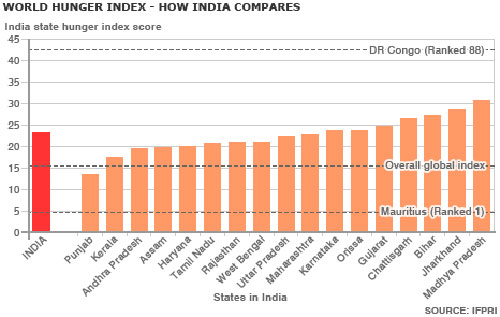
Should I not, here in US, be happy with this news rather than brooding about the ministers who keep on giving big figures and does nothing in field, and most of the administration doing overtime in sycophancy business? However, I feel pity about them and angry too when I find the position of Bihar in recently published hunger Index at the bottom among the Indian states. Isn’t my anger justified?

Posted in bihar | Leave a comment

Final Presidential Debate and Education

I got amazed with the concerns of US about the education in US. I liked the responses of the presidential candidates the best on the issue yesterday evening. It will be interesting for the people and politicians in India to appreciate education. That is the reason I had been writing to concentrate totally in one Five-Year Plan only on education. The sooner we do, thebetter it will be. Here is the relevant portion from the debate:

SCHIEFFER: The U.S. spends more per capita than any other country on education. Yet, by every international measurement, in math and science competence, from kindergarten through the 12th grade, we trail most of the countries of the world. The implications of this are clearly obvious. Some even say it poses a threat to our national security. Do you feel that way and what do you intend to do about it?

OBAMA: This probably has more to do with our economic future than anything and that means it also has a national security implication, because there’s never been a nation on earth that saw its economy decline and continued to maintain its primacy as a military power. So we’ve got to get our education system right. There’s been a debate between more money or reform, and I think we need both. Early childhood education, which closes the achievement gap, so that every child is prepared for school, every dollar we invest in that, we end up getting huge benefits with improved reading scores, reduced dropout rates, reduced delinquency rates.

I think it’s going to be critically important for us to recruit a generation of new teachers, an army of new teachers, especially in math and science, give them higher pay, give them more professional development and support in exchange for higher standards and accountability.

And I think it’s important for us to make college affordable. Right now, I meet young people all across the country who either have decided not to go to college or if they’re going to college, they are taking on $20,000, $30,000, $50,000, $60,000 worth of debt, and it’s very difficult for them to go into some fields, like basic research in science, for example, thinking to themselves that they’re going to have a mortgage before they even buy a house. And that’s why I’ve proposed a $4,000 tuition credit, every student, every year, in exchange for some form of community service, whether it’s military service, whether it’s Peace Corps, whether it’s working in a community. If we do those things, then I believe that we can create a better school system. But there’s one last ingredient and that’s parents. We can’t do it just in the schools. Parents are going to have to show more responsibility. They’ve got to turn off the TV set, put away the video games, and, finally, start instilling that thirst for knowledge that our students need.

MCCAIN: It’s the civil rights issue of the 21st century. There’s no doubt that we have achieved equal access to schools in America after a long and difficult and terrible struggle. But what is the advantage in a low-income area of sending a child to a failed school and that being your only choice? So choice and competition amongst schools is one of the key elements that’s already been proven in places in like New Orleans and New York City and other places, where we have charter schools, where we take good teachers and we reward them and promote them. And we find bad teachers another line of work. And we have to be able to give parents the same choice, frankly, that Senator Obama and Mrs. Obama had and Cindy and I had to send our kids to the school — their kids to the school of their choice. Charter schools aren’t the only answer, but they’re providing competition. They are providing the kind of competitions that have upgraded both schools — types of schools. Now, throwing money at the problem is not the answer. You will find that some of the worst school systems in America get the most money per student. So I believe that we need to reward these good teachers.

MCCAIN: We need to encourage programs such as Teach for America and Troops to Teachers where people, after having served in the military, can go right to teaching and not have to take these examinations which — or have the certification that some are required in some states. As far as college education is concerned, we need to make those student loans available. We need to give them a repayment schedule that they can meet. We need to have full student loan program for in-state tuition. And we certainly need to adjust the certain loan eligibility to inflation.

SCHIEFFER: Do you think the federal government should play a larger role in the schools? And I mean, more federal money?

OBAMA: Well, we have a tradition of local control of the schools and that’s a tradition that has served us well. But I do think that it is important for the federal government to step up and help local school districts do some of the things they need to do. So what I want to do is focus on early childhood education, providing teachers higher salaries in exchange for more support. I doubled the number of charter schools in Illinois despite some reservations from teachers unions. I think it’s important to foster competition inside the public schools. And I also agree on the need for making sure that if we have bad teachers that they are swiftly — after given an opportunity to prove themselves, if they can’t hack it, then we need to move on because our kids have to have their best future.

MCCAIN: Now as far as the No Child Left Behind is concerned, it was a great first beginning in my view. It had its flaws, it had its problems, the first time we had looked at the issue of education in America from a nationwide perspective. And we need to fix a lot of the problems. We need to sit down and reauthorize it. But, again, spending more money isn’t always the answer. I think the Head Start program is a great program. A lot of people, including me, said, look, it’s not doing what it should do. By the third grade many times children who were in the Head Start program aren’t any better off than the others. Let’s reform it and fund it. We need to have transparency. We need to have rewards. It’s a system that cries out for accountability and transparency and the adequate funding. And I just said to you earlier, town hall meeting after town hall meeting, parents come with kids, children — precious children who have autism. And we’ll find and we’ll spend the money, research, to find the cause of autism. And we’ll care for these young children. And all Americans will open their wallets and their hearts to do so. But to have a situation, as you mentioned in our earlier comments, that the most expensive education in the world is in the United States of America also means that it cries out for reform, as well. And I will support those reforms, and I will fund the ones that are reformed. But I’m not going to continue to throw money at a problem.

With all the problems and issues of education debated, US still remains the best for education, particularly for higher education and R&D. Even the school education system has produced the best result so far. Fareed Zakaria in his book ‘The post-American World’ mentions: “While the American system is too lax on rigor and memorization- whether in math or poetry-it is much better at developing the critical faculties of the mind; which is what you need to succeed in life. Other education systems teach you to take tests; the American system teaches you to think.”

Will we in India- politicians, education managers, and even the parents try to learn from the different issues raised in the debate and contribute in improving the education and taking it to every child of the country? This is the only reason India is behind in competition. This is the only way India can win the competition.
—————————
PS: They can also laugh- McCain, Obama Compete for Laughs at Traditional Political ‘Roast’ -a unique feature of presidential election

Posted in education | Leave a comment

R&D- Some Priority Areas for India

Abdul Kalam, the former president, is the most visible and respected among the scientists and technocrats in India today. Some of the future tasks for the scientists and technocrat that Kalam suggested recently are:

· Evolution of a Unified Field Theory, which may be the ultimate of physics, by revealing how the universe is born and how we are born;
· Evolution of an alternate habitat for mankind by the scientific community of today and tomorrow;
· Evolution of an Earth-Moon-Mars complex to bring to the earth new material like Helium-3 for the generation of solar power;
· Evolution of a clean atmosphere by replacing fossil fuel with cost-effective renewable energy systems, leading to energy independence;
· Exploring the human body, particularly gene characterization through the proteomics project for developing gene-based drugs;
· Enhancing the foodgrain output from the present nearly 230 million tonnes to 380 million tonnes with reduced land, water and number of people working in farms through the use of technology;
· In the area of communication, a big revolution is setting in. High-bandwidth mobile wireless is in the offing. This will result in mobile phones becoming a convergent system for multimedia applications for meeting the needs of communication in office, home and on the move.
· Rural development through the provision of urban amenities in rural areas (science and technology as the focus);
· Generation of nuclear energy through Thorium-based reactors.

While there is nothing to disagree to Kalam’s list, I think India must take up the innovations as a means to be competitive globally. There must be clear-cut emphasis for a large number of researchers in India to help out with designing and developing products that some entrepreneurs can easily manufacture and sell to billions of the consumers of the world. If India is to be in competition with China, it must think in that way. Even with $1 or Re 1 as margin for some unique product that is essential for each household, one can imagine the business with billion or more who would buy it in the world. Can India’s innovators and or entrepreneurs take such challenge?

Some priorities may be:

· Biodegradable plastics or finding a eco-friendly substitute to do away with the plastic bags popularly used that is damaging the environment and causing damage to many living beings too.
· Anything to enhance the efficiency of the renewable energy-solar, wind, biomass: very large scale solar thermal to steam as the answer to coal fired plants for generating electricity, and storage to keep providing electricity at night.
· Add-on clean technologies to remove pollutions for existing plants
· To cut down energy requirement in appliances used by the households, be it computers, water purifiers, air conditioners, heaters, or microwave ovens or electric ovens.
· Improving fuel efficiency of all the engine driven mechanical prime movers used, be it diesel pumps, tractors, cars, commercial vehicles, a lawn mower, or diesel generators used for domestic or industrial requirement including railway engines.
· Washing machines, dish cleaners, toilets that consume minimum or no water.
· Battery technology to replace fossil fuel effectively in cars and two-wheelers

There can be many areas for innovations. For instance, rural women get exposed to hazardous toxic emissions and smoke from burning biomass like wood, crop waste and animal dung during cooking. As reported, Envirofit International, a US-based non-profit organization, has introduced a range of clean burning biomass cook stoves that reduce toxic emissions by as much as 80%, while using 50% less fuel and reducing cooking cycle time by 40%. The stoves are now being made available in more than 700 villages in Karnataka and 300 villages in Tamil Nadu. Should it not be considered a great innovation?
As Thoman Friedman says in his new book- ‘Hot, Flat, and Crowded‘, the country that can innovate the most in the areas for clean energy can lead the world. With a total of $148.4bn investment in clean energy companies and projects worldwide during 2007, it is but very true. Indian innovators do have this opportunity to establish their leadership globally, if they can come out with breakthroughs.

Another area for innovation is the waste elimination or reduction in every thing that we produce and consume. Innovators are to make a breakthrough with some nanotechnolgies that can produce parts from reconfigurable atomic parts that can be easily recycled or transformed to some other products if so wished.

The list of the products that received ‘Popular Mechanics’ Breakthrough Awards are the examples of what are being wished by the consumers and the society at large. Thousands of Indian researchers working in colleges, workshops, and laboratories will have to emulate such an innovative instincts and interests.

· The M-Spector Digital Inspection Camera, from Milwaukee Tools, is designed to give people trying to do home repairs a way to see behind walls without cutting holes first. It costs $259.
· The Livescribe Pulse Smartpen allows its owner to take notes on special paper while simultaneously recording audio. By tapping on a specific section of notes on the paper, users can get a playback of that section of audio. It can also perform simple language translation as well as other functions.
· Potenco’s PCG1 power generator allows anyone to power up small devices like mobile phones with their hands. Pulling on the unit’s cord for two minutes provides 40 minutes of power-up.
· Intel’s Atom processor with a low-power chip that is designed to give high-performance capabilities to mobile devices and light laptop computers.
· The Craftsman Nextec Multi-saw gives buyers a combination jigsaw and reciprocating saw. A 12-volt lithium-ion battery that can drive the unit to cut in a variety of places difficult to reach by any single tool, powers it.
· Microsoft’s Photosyth, free software from Microsoft that allows users to create a browsable 3D model based on a series of related photographs. The software stitches the pictures together, creating the model based on overlapping elements of the images.
· Amazon’s Kindle, the e-book reader from the famous online bookseller, the Kindle allows users to read books, newspapers and other documents on a thin, light digital device. It is sparking innovation in e-readers.
· Infiniti’s Around View monitor, designed to give drivers a 360-degree view around their cars while parking. The system features a series of ultra-wide-angle high-resolution cameras that produced images that are aggregated to give the driver a top view of the car and the area around it.
· The Caroma Profile dual flush toilet that pipes gray water from a bathroom’s sink into the toilet’s tank, cutting down on water wastage.

Two of the individual awards have gone for real useful works of innovation for the deprived class. Amy Smith, a senior lecturer at MIT won the Breakthrough Leadership Award for research into water purification and both boosting the quality of medical care and reducing daily work burdens of rural women. According to Popular Mechanics, “she is leading a movement to tackle complex problems with simple technology.” I wish more and more professors in engineering and management institutions devoted significant time on research and development that helps the majority of the people in society to improve their quality of living. Water purification is certainly one such item. An affordable appliance must be available in every household in India that provides safe water.

Rudy Roy, Ben Sexon, Daniel Oliver, and Charles Pyott, the co-winners of the Next Generation award are the graduates of Caltech and the Art Center College of Design. The four have made names for themselves with a technique that makes wheelchairs for residents of third world countries out of inexpensive bicycles. One major benefit of their innovation is that the wheelchairs can be repaired in any bike shop, unlike normal chairs.

I end this story with two simple mechanical household implements that I find in Anand’s house. One is the toilet cleaning brush and the other a picker for Bart’s shit. I find them innovative and useful for every household. Hundreds and thousands of simple mechanical and electrical appliances and other products are being developed and sold all over the world that makes good business. For winning the game of global competition, Indian in thousands, may be millions, must be entrepreneurs and innovators. Indians will have to be manufacturers. India must manufacture and not go for importing everything from China-the global factory, as US is doing. If China can do, India can also do with the advantage of similar huge domestic market. And the education at all levels must help Indians to go that way.

R&D for ‘Create no waste, reduce waste, use waste’.

Posted in education, governance | Leave a comment

Indian Farming Remembered

Food security is going to be more serious threat and so agenda to the nations than even the terrorism. As reported, India too is talking to countries like Myanmar and Paraguay to grow pulses and oilseeds. I remember once telling Anand while driving through California that Man Mohan should request Bush to lease out land in US for farming to India farmers.

Based on the International Assessment on Agricultural Science and Technology for Development (IAASTD), sponsored by the UN, the World Bank and the Global Environment Facility (GEF) involving about 400 global experts over three years, India needs to synthesize the old and the new, and focus on the economics of the small farm. The International Food Policy Research Institute (IFPRI), headed by Ashok Gulati in India suggests the directional shift with the focus to high-value agriculture, followed by commercial crops, based on consumption patterns that suggest that the typical Indian is eating less of cereals and more of fruits, vegetables, milk, eggs and poultry, across “all income classes.” A 10% decline in cereals and pulses expenditure as a proportion to the total food expenditure has been recorded in “both urban and rural areas.” Food grains will no longer drive Indian agriculture. An accelerated and more pronounced shift towards high-value agriculture can only help yank a bulk of India’s farming population out of poverty.

Many farmers in India, small and big, illiterate and educated, with NGOs are pushing for newer crops and techniques, better yields and fresher, more remunerative methods of selling. Here are some stories from the latest ‘Outlook Business’ that is a special issue on farming.

1.Urban Farming
Kolkata’s wetlands and garbage farms near around Dhapa produce fish and vegetables estimated at Rs 86 crore. The Dhapa has ribbons of wastewater canals for irrigation, and on the plots of garbage-enriched land between these water bodies, over 10,000 urban farmers grow vegetables. 279 fisheries that operate in these waters produce enough fish, around 13,000 tonnes a year, to meet 15% of the fish requirement of Kolkata. The yields from these garbage farms are around 370 tonnes per hectare a year. Aquaculture and vegetable farming secure the livelihoods of over 26,000 people in the city. Each family farming on these wetlands earns around Rs 3,875 a month. The government doesn’t charge any lease rent.

2. Crop intensification technique in Uttarakhand
Intensification is popular with paddy cultivation. Adapted to wheat, this method promises to at once triple output despite using just one-third of the seeds needed in the conventional method. It’s practiced in cultivating other crops such as sugarcane, and finger millet too.

3. Biotechnology, or Bt cotton in Gujarat
The farmers of Gujarat have adopted Bt cotton farming and so spend less on insecticides and pesticides-a reduction in input costs. Bt cotton does not adversely affect the fertility of the soil. The productivity is higher, rising by 74% between 2002 and 2007. The prices of Bt cottonseeds have also gone down. A recent study by the Maharashtra Hybrid Seed Company, or Mahyco, has shown that India could benefit to the tune of Rs 22,000 crore by using Bt cotton.

4.Hybrid maize or corn
Today 42% of the country’s maize production comes from hybrid seeds. Conventionally, an acre of land requires over 20 kg of desi seeds, costing Rs 40 per kg. On the other hand, the same area requires only 10 kg of hybrid seeds. Though its cost is Rs 100 per kg-or 25% more, the returns justify the higher outgo. Beyond the quantity of output, the quality too is distinctly visible. The hybrid crop is highly responsive to inputs and is disease-resistant.

India is the world’s largest producer of mango, banana, litchi, papaya and pomegranate, but the farmers continue to lead a life of penury with little or no ability to tap the lucrative export market. A 2007 World Bank study shows that the farmer receives only 12-15% of the price at which produce is sold to the consumer at a retail outlet. Nearly 30-35% of the fruits and vegetables produced in the country are destroyed or damaged in transit owing to the woeful absence of proper transportation, warehousing and cold chain facilities, as well as processing units and organized retail.

5. The story of Makhana
Makhana, a ready-to-eat snack grows in the ponds and lakes of northern Bihar. Satyajit Kumar Singh and his Patna-based company Shakti Sudha Industries have done pioneer work for getting a successful business model out of it. Singh made the government agree to a nine-year lease period instead of usual 11 months. He persuaded a public sector bank to get involved too. Makhana payments are now credited directly to the farmers’ accounts and the bank has promised Kisan Credit Cards. Singh has set up office-collection centre-godown in each of the panchayats. This functioned like a one-stop window for all issues on makhana. CFTRI, Mysore is developing Makhana popping machines. Shakti Sudha’s turnover is nudging Rs 50 crore. Singh hopes to expand to 126 blocks, reach 40,000 farmers and touch a turnover of Rs 100 crore by 2012.

6. Tamil Nadu government’s Uzhavar Sandhai
Uzhavar Sandhai is Tamil for ‘farmer market’. The market cuts out the middleman in the trade of vegetables, bringing the seller face to face with the consumer. Interestingly, the registered farmers can transport their produce free of cost on government buses. Also, they don’t have to pay rent or money for the scales. A small farmer with even one kilo of vegetable can come there and sell. And he gets paid instantly-something that’s not guaranteed in wholesale markets. 68% of the sellers at farmer markets were small and marginal farmers (those holding between 2 and 5 acres of land). The Agricultural Marketing Officer at Hosur has to be up early to find out the prevailing wholesale and retail prices of all fruits and vegetables. Prices are fixed at 20% above the wholesale rate and 15% below the retail market rate. That is a conscious strategy to lure farmers away from wholesalers. By 9 am, the rates are up on its website, http://www.uzhavarsanthaihosur.in

7. Safal- India’s oldest food and vegetable supply chain
Safal with 400-odd exclusive retail outlets across India is a unit of Mother Dairy Foods Processing, a wholly owned company of Mother Diary Fruit & Vegetables. Safal’s turnover has grown from Rs 2.7 crore to over Rs 300 crore at present. Almost 85% of its revenues come from the sale of fresh fruit and vegetables, while the rest is from processed foodstuff. Safal is also expanding its portfolio of frozen, packed and cut vegetables. Its entire supply chain that has been online since inception is now being upgraded with a new enterprise resource planning software. It will connect Safal’s various units; and the village collection centres. Safal claims to offer the best prices-lower than market rates for customers and higher than mandi rates for farmers. Safal sells over 125 fruit and vegetable varieties with 735 direct procurement sources, 12,000 associate growers and more than 100,000 footfalls at its outlets everyday,

8. Outsourced contract farming
A growing tribe of 4,000-odd farmers across Punjab and Rajasthan sell their produce directly to buyers, at competitive market rates. It means prompt payments and the absence of middlemen for the farmers. For instance, UB Group is offering them a 75-80% premium (over the government-mandated minimum support price) for growing barley for the brewing industry. Pepsi has 23,000 acres under paddy cultivation in Punjab and Rajasthan, and plans to add another 4,000 acres, with a major thrust on the direct-seeding method (Read Experimental grain). Bharti Del Monte is working with over 200 farmers in Punjab, Rajasthan, UP and Maharashtra for baby corn and sweet corn cultivation. Mahindra Subhlabh Services is playing a key role in offering extension support and marketing services that help grape growers tap the European markets.

9. Empowering Adivasis
The Dhruva programme, implemented by the BAIF Foundation, has helped adivasis in Valsad, Navsari and Dang districts to transform their wadis (backyards) into a steady source of income. Among other things, the Dhruva project has been providing land-owners with mango and cashew saplings, and assisting them with advice on sowing patterns, use of fertilisers, intercropping and so on. Each family cultivates these fruits on the wadis, which ranges in size from 0.4 to 1.4 acres. Wadis produce cashews and mangoes, as well as the vegetables and paddy grown between the trees. It takes four to five years for the trees to bear fruit, and in the interim, the wadi owners derive their income from vegetable intercrops. Across many states, tribals numbering in excess of 100,000 have the means to earn Rs 25,000-30,000 a year.

Many individuals and groups are putting their entrepreneuring skills to uplift the rural India. India Inc. is also participating in their endeavours. But many more must emulate the ways following which the other succeeds to contribute in the growth story of the country and to make India great. India Inc and IIMs must use the rural villages to experiment their ideas and innovate ways to make it prosperous and look beautiful too.

Posted in agriculture | Leave a comment

Presidential Debate- Something to Emulate

Perhaps the most important aspect of my US visit this time is my exposure to presidential election process. With Anand and Shannon very positively involved in politics, it has become more interesting and informative.

I am just sold on the importance of the debates of the presidential candidates that is the one important feature and watched with interest globally. I have watched 3 of the four till now. Every one of it has enhanced my interest and deepened my faith in its necessity to reach to so vast a number of electorate.

Senators John McCain and Barack Obama debated for 90 minutes last Tuesday night before a nation in economic crisis, each promising anxious Americans that he had the better plan and vision to lead the country through the most dire financial situation since the Great Depression.

While Obama wishes to go for regulations to control the malaise created by those in Wall Street, McCain still is votary of deregulation. McCain proposes more rebates on the health insurance, while Obama wishes to provide more for whatever is being paid as premium and make it easy for the rest to join the insurance net. Obama will go to tax the top business enterprises and give tax cuts for the small ones and middle class that constitutes the 95% of the total. Obama wants go for action against Iran via a dialogue. McCain outright rejects any talking with Iran.

At least some aspects were revealing. The moderator was at his best, brief but sharp and to the point remarks intermixed with good humour. The love for the numbers appears to be intensive. Let us see some: Obama: “What McCain doesn’t mention is he’s been there 26 of them and during that time he voted 23 times against alternative fuels.”

Another interesting feature of the debate was the way the candidates talked about Wall Street and multinational companies and their executives. It is missing in Indian politics.
McCain: “Fannie and Freddie were the catalyst, the match that started this forest fire.”

Obama: “And that means strong oversight. It means that we are cracking down on CEOs and making sure that they’re not getting bonuses or golden parachutes as a consequence of this package. And, in fact, we just found out that AIG, a company that got a bailout, just a week after they got help went on a $400,000 junket. And I’ll tell you what, the Treasury should demand that money back and those executives should be fired.”

Both want to help for homeowners so that they can stay in their homes and to help state and local governments set up road projects and bridge projects that keep people in their jobs.
Can LK Advani or Sonia Gandhi name their finance minister during debate if any? See what McCain replied: “I like Meg Whitman [former CEO of eBay and current McCain campaign adviser], she knows what it’s like to be out there in the marketplace. She knows how to create jobs. Meg Whitman was CEO of a company that started with 12 people and is now 1.3 million people in America make their living off eBay.”

I wish Indian politicians talked so emphatically about the national priorities such as the health care, energy, and education as well as land policy that is holding back so many projects.

Can the media or the intellectuals induce or encourage to the prime-ministrial candidates to a debating platform in India? Can the TV channels shun commercial advetising during a serious debate? Will the moderators in India interfere and talk a little less?

Posted in governance | Leave a comment

Deepawali in US

It was my first Deepawali in US and unique in some respects. After perhaps two decades or more, we were with our three sons on this day that celebrates the win of righteousness over devil powers. The last one must be in some year around 1988 when the three were in high school and living with us in Hind Motors. The family now has grown to thirteen.

Shannon had invited Rakesh, the eldest and Rajesh, with their family. Only Shephali couldn’t join us. She had gone to New York for her externship at Jamaica Medical Center. However, the digitally she got in touch. Every one in family could exchange greetings and talk. Anand’s laptop and web camera was the medium.

With a large number of Indians living in US, some in Pleasanton too, Yamuna could get all that she wished for rituals of worshipping the Goddess of wealth. Some of the items such as the sweets were even better packed that what we use in Noida. Shannon had taken the services of a company with expertise in home cleaning. Its three women workers that were Mexicans took less that two hours in cleaning and wiping the whole house and billed $175. Yamuna thought it to be too costly. I think in this busy life style this can be the best solution.


We had our Puja as usual and then the dinner and sweets, but the most important were the memories of the yester years that kept my mind busy and excited. Perhaps we at the fag end of life can no more think of living together in a typical joint family style. It is perhaps neither practical nor desirable, even if all would have been in India. But such meetings, once in a year or two are possible. Rajesh came out with suggestion to have it outside somewhere. It reminded me of one of my old days wishes that I used to talk quite often. Shannon suggested New Zealand. Perhaps they took it lightly.


I only expressed my one wish to all the elder members of the family. They must take an initiative and organize once a function in India, preferably in our village near Sasaram, in which they invite all the close relatives too and meet them. I don’t know if it would happen.

Posted in Uncategorized | Leave a comment

Maha-ashatami in US

Having spent the majority of the life in West Bengal, it is but natural to feel bad to miss Durga Puja and visiting pandals. It started at Birlapur in West Bengal, where I had my schooling since 1948. What I remember of those days of Durga Puja was the yatras, the open stage theatre that used to go on for a fortnight or more. Yatras based on good historical and social subjects in those days were good entertainment. With school closed in a long vacation, I with my uncle used to enjoy the yatras. It used to start late in evening and go up to almost early morning. We had learned good enough Bengali by then to appreciate the dialogues and story.

At Hind Motor, Durga Puja again became interesting when we had our sons. I remember of at least two Durga Pujas. In one, Seshar Singh, my Hanuman managed a car from Mathews, one of my colleagues in Hindustan Motors, and who was a senior from IIT itself. We started around 10 PM and went to many good Puja pandals in Calcutta with all the three kids. My main task was to manage the kids in the crowd, particularly with separate queues for men and women. Calcutta is still at its best during Puja. I wish India and West Bengal had marketed it to attract foreign tourists. We remember one of the Pujas’ days, when a servant of one of the neighbours took Rajesh, my second son who was about five-six years old then, to see Puja pandals outside our residential area and we got worried. Those were the turbulent days of the factory. I had a bad name as production manager and had many enemies in unionized workers. We went on a search and even got the cinema show at Deepak stopped to find him out. But very soon we found Rajesh coming with the servant on the road. The servant got some thrashing from me.

At Salt Lake, with sons away, the Puja became a routine affair with community Puja getting organized in the park of our CJ block. We had to pay huge subscriptions, as I used to work for a reputed company. I hardly went out and visited any other pandal.

In Noida now, Yamuna organizes a ‘kumari puja’ on Ashatami, and we go to either the pandal in Sector 26 or that in Sector 50 where Bengali community organizes Puja.


This year we are in US during Puja and it was a unique opportunity to visit a Durga Puja pandal in US on Maha-ashatami. Anand took us to Livermore Hindu Temple. We had been to this temple in our last visit to US too in 2005. It is a special place for Anand and Shannon, as they got married here. Anand had also proposed Shannon in front of goddess of wealth in the temple. Last week also we visited the temple. Its large number of mini-temples, under the main roof, presents a great example of integrating the Hindu Gods and goddesses.


According to the wishes of Yamuna for this Ashatami on Tuesday, Shannon had made the packets of candies to be given to girls as the part of ‘kumari puja’. Yamuna was very happy to find her in a totally Bengali surrounding there. She blew the conch shell and mixed with the Bengali ladies. Shannon was all the time with her and then Anand also joined, when I came out to look after the two kids-Emma and Krish. It was difficult to keep the kids inside because of the smoke screen created by the burning of essence that is seen in photo. More than hundred people- men, women, and kids, mostly Bengalis constituted the crowd in the hall where the priest was carrying out rituals of worshipping Durga in traditional Bengali manners including some ‘ulur dhwani’. Tuesday being a working day, young men were few in number. Quite a large number in the crowd appeared to be those visiting their children in US. A gentleman who was from Tollygunze, Kolkata started talking to me. He has come to his son who works in San Francisco somewhere. They had driven to come to Temple on this auspicious day. Shannon and Anand had some ‘prasad’ that is available here on all days. Yamuna and myself were on fast.

It is a very fascinating experience of Maha-ashatami of Durga Puja in US for us, so far away from home.

Posted in personal | Leave a comment