Can China be relied?

The ‘Times of India’ on October 23, 2006 had shocking news for India. It is a warning bell for all bad things to come from a rogue neighbours. And unfortunately one can’t change one’s neighbours. You are to find a way to live with the rogue ones too. You will have to develop all strength, both physical as well intellectual, to demand respect. The news runs as follows:

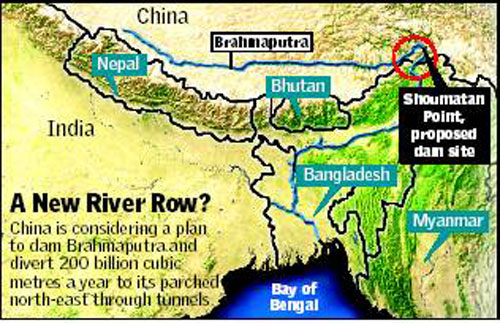
The Chinese are planning to dam the Brahmaputra River, known as Yarlung Tsangpo in Tibet, at the Shuomatan point (also known as the big U turn) in China and diverting 200 billion cubic metres of water annually to feed the aging Yellow river through a series of tunnels. The project presents an enormous engineering challenge, but with technology available today, it is doable. China has been known to undertake, and complete, seemingly impossible engineering feats – the Lhasa railway and Three Gorges Dam instantly.

As reported, the plan has the blessings of Chinese president Hu Jintao, a hydro engineer by profession. The project plans to take the diverted water to the country’s northeast – Shaanxi, Hebei, Beijing and Tianjin. If the project goes through, it could strangle one of India and Bangladesh’s biggest sources of water.

The proposed project, called the ‘Greater Western Water Diversion Project’, is part of the gigantic South-North water project that has already been started by China. In August, the Chinese government sanctioned 300 billion yuan to divert water from the upper reaches of the Yangtze river in the Qinghai-Tibet plateau to the upper reaches of the Yellow river in north-western China. It will bring water from the Yalong, Dadu and Jinsha rivers, which are tributaries of the Yangtze, to the upper reaches of the Yellow river.

China today has all the economic and political clout to carry out the project once it decides to go ahead and if that is the way to save the Yellow river. India can only present its case, but it is to be seen if China agrees and drops the project for the sake of Bangladesh and India. And again even if China agrees, what is the guarantee that it would abide by its agreement.

Recently China had built a dam on the Sutlej River. The Chinese foreign ministry acknowledged the dam in Zhada in Tibetan Autonomous Region (TAR), and confirmed to have “considered fully the impact on lower reaches.” India and China even signed an agreement on sharing information on Sutlej, yet during the 2005 Pareechu lake crisis, India drew little comfort from the pact.

Surprisingly, India has not yet talked on the issue with China? Will India take it up with Hu during his impending visit to New Delhi or remain quiet to be known as a good neighbour till the project gets completed? Unfortunately, even after the report in the media, the government doesn’t think it necessary to come out with some clarification to take fear out of the mind of the people of India. As reported, the Indian security officials opine that the prospects of geological disturbances alone may be a big enough challenge to make the project impossible. Why can’t some authentic experts from the Geological Survey of India come out with their views?

Sometimes, I feel miserable when I find leftists of India talking and behaving as the spokesmen of China. I expect some media person to approach Yechuri for an answer to this threat. With his recent study tour of China for SEZs, Yechury might be able to throw some light in favour of the Chinese project. I can’t expect him to talk anything against his faith gurus and their country.

I am surprised why can’t there be a right of representation of such issues some world body.
PS: News
Beijing’s message via CPM: let border wait, push for trade first

And I do also realize why Tibet would have been independent of China. Perhaps, it would have been prudent for Pandit Nehru if he had not agreed that Tibet was part of Mainland China.

PS: Latest News

No plans to divert Brahmaputra: China

Beijing: China has denied media reports that it was planning to divert waters of Brahmaputra river to its Yellow river to feed the parched northern regions.
“China has no such plans to build a dam and divert water from Yarlung Zangbo (Brahmaputra) to the Yellow river,” Chinese foreign ministry spokesman, Liu Jianchao said here when asked to comment on the issue. Liu said he did not have further information on the issue.

On Monday, the external affairs ministry said in a statement.
“We have understandings with the Chinese side under which they provide hydrological information in respect of Brahmaputra and Sutlej rivers during the flood season for flood control and disaster mitigation in downstream areas. We are discussing with the Chinese side the expansion of this cooperation.” PTI

Can India rely Chinese? But, perhaps, there is nothing that India can do.

Posted in Uncategorized | Leave a comment

NHAI and My Dream ‘Bharat Tirthayatra’

I liked to travel by road. I continued to use my car for driving up to my hometown Sasaram once a year from Calcutta where I worked. Once I met with an accident in which the whole family was involved. Though we escaped clearly by providence will, I discontinued those ventures by road. However, I still love to travel by road; railway is the next best, but air travel is certainly not my choicest preference.

Since the day Atal Bihar Bajpai announced his dream GQ project, I am excited and wish to cover the GQ once. Last year, I was so happy to see the great coverage of the project both in ‘The New York Times’ and ‘Fortune’.

NHAI had a good website with maps, details of the sectors, kms, builder as well as the estimated month/year of completion. I used to visit it to find how far it had gone. After reading about the present PM’s emphasis on infrastructure recently, I thought NHAI would have improved the content of the site too. But I find only one change, perhaps on the direction of the great boss, the transport minister Balu, the column of estimated month/year of completion has disappeared. Perhaps it was embarrassing for him. And even today the GQ that had a target of December 2003, changed to 2004 and then to 2005 for completion, appears to be under implementation as per the chainage chart without any further promise date for completion. That pained me.

As mentioned in a recent feature on national highways in ‘India Today’, Balu might not agree, however, ‘the NHDP has slowed down since the change of guard at the Centre in 2004. More than half of the GQ and close to three-fourth of the NSEW corridors that stand completed today were built under the NDA.’ 418 km of the 5,800 km GQ still remain incomplete after three years of its deadline. 840 km (11.5%) of the 7,300km NSEW is ready after three years after launch.

I and many like me, don’t bother what NDA or UPA did. Honourable minister Balu may keep on taking credit of expediting the work on road. India is to go miles before the two phases of this dream project still come in use as it was planned. It’s a shame. The project kicked off in 2000. Six year down the lane, a country like India can’t complete a project of consensually agreed project of national importance for building some 16,000 km of roads that can change the face of India. The reasons and excuses might be many but nothing has been insurmountable if there would have been the will among our politicians and bureaucrats to do it. How do METRO projects get completed before time? It looks laughable when, after this dismal a performance, instead of solving the root causes of the delay, the Prime Minister keeps on announcing projects after projects, phases after phase for the road building. Phase III is for four-lane highways connecting state capitals with tourists and economic centers; V for six-laning of GQ; VI for Expressways such as Mumbai- Vadodara and Delhi-Agra. Surprisingly, one Expressway from Noida to Agra was already in construction. But with the fall of Mayawati, it got shelved. Every one knows what could have been the reasons.

UPA’s additions of 38,600km will cost Rs 2,20,00 crore. As I understand with the cess and so many agencies to assist, the finance will create bottleneck. But will it be there to see it completion? Will the babus of NHAI carry out the plans or come out with only excuses? Will the bureaucrats of the region through which the road passes take care of the bottlenecks, be it a case of law and order, or acquisition-related legal battles? Don’t they know the benchmark figures of the speed of road construction in developed and developing countries that they visit so often on every little pretext?

How can’t the well known facts on its advantages on and during execution make the executives tick? Is it not a shame that commercial vehicles in India cover an average of 250-400 km a day against the standard of 600-800 km a day even on all Asian highways? After all, every km of highway construction provides employment to 40 persons every day. Reduction in travel time for commercial vehicles reduces inventory cost.and affects overall competitivenes of our manufacturing sector. It also means saving on fuel costs, and maintenance.

I am worried if my dream of covering India by the GQ and NSEW would get fulfilled. I know many of my dream destinations such Dwarka, Ajanta-Ellora, Hampi, Bijapur, or Sanchi will not be on the GQ and NSEW, but still whatsoever would be approachable will be good enough to quench my thirst as eternal traveler.

PS: Progress- Kolkata- New Delhi, New Delhi-Mumbai, Mumbai- Chennai, Chennai-Kolkata
News:
National Highway crawls, contracts stuck as Ministries play blame game
Highway crawl
New path or alleyway

Posted in economy, governance | Leave a comment

Jagdish Bhagwati Speaks on Indian SEZs

Some views of Jagdish Bhagwati on SEZs (Special Economic Zones) are here as told to Dinesh Narayanan & Anil G Nair of ‘Times of India’.

Columbia University’s Jagdish Bhagwati opposes India setting up special economic zones, “SEZs are a sort of scaffolding with which you climb into more openness. Hopefully, that demonstration (of openness in SEZs) will show that it is worth having these policies. But now that you have the building, why do you need the scaffolding? Already the policies have changed. So, I think it’s a backward step,”

Bhagwati is one of the world’s most ardent advocates of globalisation. He was shortlisted even this year for Nobel economics prize, but missed.

India needs only clear policies that will integrate the country into the world market. ”We don’t need to learn lessons from China anymore, because the main lesson was outward-orientation. We should concentrate on making the additional reforms for reducing trade barriers.”

China needed SEZs because it had an export-oriented strategy, which relied on its eastern seaboard with four provinces and 700 million workers as a platform to experiment with the policy while the rest of the country remained closed.

”Basically, what they did was to take an export-oriented strategy, which was married into investment as well, because investment was more or less geared to export promotion. We did not cash in on that, partly because we were too scared of foreign investment.”

”And the way it (the SEZs in India) is being managed, you know the politicians are getting their hands on it and ultimately you have to take land. There is nothing wrong with it as long as people pay for it. And if you get politicians to assign it, then you can be sure there is a rent, and clearly when you have something like that, you are offering a temptation to the politicians or bureaucrats or whoever. That is also when you build resentment, when peoples’ lands are taken. But we are a democratic system. ”Similar things are happening in China, which is experiencing land grab. There they have no recourse at all. They don’t have any NGOs to go to, they don’t have a free press, no independent judiciary, and no opposition parties. So, what do they do? At least here it’s being discussed. But as I said, we don’t need the damn thing.”

Somehow, I do not agree with Bhagawati’s damning of India’s SEZs policy. SEZs are coming up almost like the big PSUs such as HMT, BHEL, Steel Plants at Bhillai, Rourkela, Bokaro, and Durgapur, and before that, even private companies in almost new locations- Tata’s TISCO and TELCO at Jamshedpur, Birla’s Jute Mills at Birlapur or Hindustan Motors at Hind Motors. The whole lot of facilities developed and townships grew all around. Presently, no one sets up plants with all the infrastructure such as a township, hospital, and educational institution as the cost of the plant increases, making a new project unviable.

SEZs perhaps are the business solutions to make industrialization of the country viable where the real estate portion of the area will be generating revenues as those will be owned by different users. However, the two things are very important. Promoters of the SEZs must not grab the land without proper compensation to the owners of the land. The owner farmers must get integrated in the project so that they become stakeholders and their future is safe and protected. And secondly, the SEZs must have clear roadmap of the industrial activities so that the creation of employment potential is part of the major primary objectives. Unfortunately, the allocation of SEZs till date doesn’t give a confidence that the manufacturing sector will get a significant boost once those are in place.


I think in all the SEZs, the provision of the professional educational institutions from trade training institutes to specialized engineering and management colleges that provide the required talent for the industrial activities of the zones, must exist. For example, the SEZs of auto components must have trade schools and engineering college specializing in design and manufacturing, a tool room catering to the tooling requirements, and engineering service provider to cater the maintenance and process planning necessity for the units. Similarly, one SEZ for textile manufacturing must have all the infrastructure facilities including a fashion design institute, a research and development laboratory and a machinery-manufacturing unit that will be of use to all the units.

SEZs can be a success, if it is an honest means to get India ahead and not only to provide the easy route to make money.

News

Yechury asks Nath to study Chinese SEZ model

Posted in Uncategorized | Leave a comment

Chinese Lights Dim My Deepawali

We have left behind those oil lamps that used to light up our Deepawali nights. I still cherish the most vivid memory of lighting competition between halls of residences at IIT, Kharagpur in late 50s. It used be with oil lamps. Now we use just few earthen lamps only for inside near the little home temple. My wife, Yamuna goes for 21 of them.

As desired by Yamuna after seeing the lighting arrangement being made at neighbour’s house, I also went to my electrical shop. The owner is young man. I have been buying all my routine requirements from him. He also arranges for regular maintenance of domestic electrical systems. I asked him to send his electrician with some 10 lighting strings for external decoration as well as one for the temple inside too. As usual, I queried about the source. “Uncle, everything in market this year is Chinese including ‘Ganesh and Lakshmi’ statues that we buy to worship on this day.”

There was nothing to be surprised. Chinese have invaded the Indian market in big way. Earlier it used to be through smuggling, now globalisation and free trade had opened the floodgate for these small little things too. However, I asked about the quality.

” It is fine, Sir. Moreover, you shall not find the Indian ones anywhere.”

“Will you guarantee about the quality?”

” Sir, That I can’t, but then none has complained.”

Gaurav, the owner sent his electrician a day before Dhanteras. He fixed up the lighting and went. The night after Dhanteras, it rained. In evening, I found some of the strings have gone dead. Next day, it was Deepawali. I tried to contact the electrician on his cell phone. He assured to come for a check in the morning. On the day of Deepawali, I contacted Gaurav too. First time he was busy in worship of Goddess Lakshmi. The second time, he did respond but just assured to send his electrician if he came. I knew he was telling a lie. By that time, Yamuna informed that even the one inside on temple has gone off. She was very angry and morose as she thought it to be inauspicious. I kept on trying for the electrician. He came. He tried. He failed to correct the trouble and left blaming the Chinese profusely for the poor quality. Yamuna as usual was very angry on me, as I was not cautious enough to ensure the quality of the purchase. It was in real bad taste. As found out later, Gaurav had many customers complaining on the Deepawali day. He closed his shop and left for home.

Who is at fault? The Indian SSIs can’t compete on price with the Chinese. It is easier for the unscrupulous Indian traders to get the Chinese stuffs in bulk, and get it packed here in individual plastic bags. They hardly bother about the quality. As I understand they never demand it. May be the trade itself is through illegally managed route. The same is the case with the fireworks from China that are available in plenty in market. The traders charge high prices, because they fix up the prices based on opportunity to sell at that price. I call it opportunity price. Who can control it? We can’t leave everything to the government.

India must find a way to assist the small manufacturers to produce all that are being brought in from China for our consumers. As our market itself is huge enough so it becomes quite a good commercially viable business objective to produce these things cheap in our country itself.

I lost my money on the purchase, but more importantly I felt miserable on this auspicious day with this incident because of the poor quality of the Chinese who wish to rule the world. I am sure I shall not be buying anything Chinese hereafter if I could afford.

Posted in Uncategorized | Leave a comment

Tata Corus Ltd. on A Fabulous Friday

/

Pre-Diwali Friday became fabulous, a great day for those Indians, who keep track of the Indian Industry moving global that also in big deal. Tata Steel with Corus in league will become the fifth largest steel makers of the world. Tata Steels, as such on its own, has unique strength, its lowest cost of steel production. Tata steel makes primary steel at its Jamshedpur plant at $ 160 a tonne, whereas Corus makes the same at $540 a tonne.

As Ratan Tata confirmed, the acquisition, at $8.1 billion, would get the maximum advantage, as the companies would compliment each other. If complimented properly, the acquisition will make the company strategically very well positioned in steel business. As I understand, Corus has steel for industries such as automobiles, electrical, and engineering’s special sector (aeroplanes). With supply of steel slabs from Jamshedpur, Corus can produce its present products at much cheaper cost. As per one thumb rule estimate, at the current selling price of primary steel in UK, Tata Steel, Jamshedpur will make a clean profit of $120 and Corus will save $130 for very tonne of steel used.

Tata Steel has another overseas steel project, and is close to signing of a MOU with the Iranian government to set up a 5 million tonne steel unit. The project will make Tata access to cheap iron ore and low cost power of Iran. All are great happenings for the company.

Steel sector in India is very much in media with appearance of Posco of South Korea on the scene through its Orissa project. Even Mittal-Acelor is also in fray to set up plant in India. Tata has MOUs for setting up Greenfield projects of steel production in Orissa as well as Jharkhand.

Historically, Tata Steel was the first Indian steel company in India and very soon it will be completing its century. As Tata Steel didn’t expand its capacity, and other private entrepreneurs didn’t enter the sector, it was left to PSU SAIL to meet the country’s steel requirements. SAIL gradually added many plants, but because of government control couldn’t reach the heights that it could have, if it would have been a private company. Tata Steel took advantages of all the concessions granted to PSUs, but failed to expand as other private companies in the world were doing it. Even today, Tata Steel remains at position 56 globally by capacity. I feel bad today because of this, and so must be many. India will not have the world’s largest steel plant in India that it had the potential. Tata with its own energy wing for power production and cheap access to India’s iron ores could have built the capacity in India. That is my agony as Indian. I don’t know if with financial pressure of the huge acquisition, even those MOUs signed by Tatas would materialize or not. Acquisitions are great, but having production facilities provide many other benefits to the nation and its people; and that must be important for business house such as Tatas too.

With changes in industrial policy in favour of globalisation, Tata Steel has found the logically easier route of acquisition to come in the first ten steel manufacturers of the world. Now it is fifth. With Mittal, first and Tata, now, as every one says, India Inc. has arrived.

How Business World Reacts:
Corus Agrees to $8B Tata Steel Offer
Indian Steel Maker Is Ready to Acquire Much Larger British Rival
Tata-Corus
World’s 5th Largest Steel Co
Steeling for the future
Crowning glory: Tata buys up big chunk of UK ‘jewels’
Announced steel projects on course
See what a great media response

What Next
What’s next for Tata Group: An interview with its chairman: Ratan Tata explains how the company is expanding abroad while cultivating an emerging mass market at home.BY Ranjit V. Pandit

Posted in Uncategorized | Leave a comment

Happy Diwali

Happy Diwali

All lights on in power corridors round the world
Latest
Indian Conglomerate Looks Beyond Purchase of Corus

Posted in Uncategorized | Leave a comment

Sarva Siksha Abhiyan- Mission, Issues and Innovations

Many a times, I feel like agreeing to one opinion of a rebel friend of mine. He thought Nehru’s five year plans would have concentrated only on education at least for few decades.

Perhaps Sharva Shiksha Abhiyan (SSA) was a path correction. It came a little late with a mission for attaining universalisation of elementary minimum education; but it was always better late than never. The SSA had all the potentials to change the destiny of India in fastest way. 2005 was the deadline for putting 3.4 crore children in the 6-14 age group in school. And by 2010, every child would have received eight years of education. Resources could not have been the problem with the Centre, states, and many external agencies like World Bank, Department for International Development (DFID) and European Commission participating. However, it didn’t happen, and as usual the excuses were many. And that appears in its performance report.

40 per cent of the eligible age group (13.6 million) are still out of school, the drop-out rate across the country is 39 per cent, 75,884 schools in the country have a single teacher and another 6,647 have no teacher at all, and the country is short of at least 50,000 upper primary schools and 31,648 habitations do not have school

And one of the major reasons is the indifference of the politician masters for whom SSA is hardly a necessity. Rs 100 cr sanctioned under the drive got diverted to other activities or schemes. 2,369 non-existent schools got Rs 50 lakh in Jharkhand alone. Rs 100 cr worth of textbooks distributed to non-eligible children in MP, Chhattisgarh & Assam. The teacher-student ratio in Bihar remained t 1:93 because of no recruitment perhaps for years. Only 3.29 lakh have been recruited so far ageist the sanctioned 5.96 lakh posts of teachers. Most states have gone for the less-qualified temporary Shiksha Karmi as a teacher, perhaps because of some selfish motives of bureaucrats in collusion with politicians. Add to that some more bad news. 5 per cent of the schools run in kutcha premises, 33 per cent schools do not have toilets and nearly 50,000 schools do not even have a blackboard.

But there is some good news too. Almost allover India, some unique innovative methods to achieve universalisation of elementary education are under experimentation with quite a significant success.
Fishing Boat schools of Andhra Pradesh in East Godavari district were introduced for migrated fishermen’s children who didn’t have any one to look after them, once the parents sailed into the sea with their boats for fishing. The family had little scope of education for the children. 310 children were taken out on another boat. Started for joyrides, it became play school with teaching tools and play kits. After some months, all but 57 joined regular schools.

West Bengal has come out with Rabindra Mukta Vidyalaya for children who could not go to upper primary schools. Gujarat has come out with some unique innovations for girls’ education that are: Diwali camp, Ujasbhani and Dikari Mare Bhanvu Chhe (Daughter, I want to study). While Diwali camp gave girls an opportunity for all round personality development and empowering them, Dikari Mare aims to take help of daughters to teach illiterate mothers.

UP came out with Meena Manch geared towards increasing enrolment, and retention of girl child. From a kit of 13 books, stories are discussed linking them with issues arising in the girl’s daily life. Haryana provides free bicycles to girl who does not have a school in her own village with the rider that she has to appear for the class VIII exam to fully own the cycle. And panchayats who achieve 100% girl enrolment are given a prize of Rs 1 lakh. Jagruthi Shibhira, Karnataka provides awareness about pitfalls of early marriage, low status of women. Pratibha Karanji, Karnataka provides platform for girls to showcase thelatent talent such as singing, and dancing

With all the shortcomings, the story of SSA programme will be presented in a world meet in Manila. The Department for International Development, World Bank and Asian Development Bank has selected SSA as a case study. It is a rare honour to government -run SSA. The agencies consider the programme as “an excellent example of a government-led, highly effective development partnership in elementary education that is enabling millions of previously excluded children to go to school.”

But, India has many miles to go. You feel really shocked to hear when some crazy ones from higher castes don’t allow the underprivileged children to study in the school meant also for them. Perhaps, one the SSA will also solve this social cynicism too.

PS: India near full enrolment at primary school level

Posted in education | Leave a comment

India and Indians Crackling

There are big news and variety of achievements appearing almost daily in media. India is on go. We pray this Diwali that it continues.

‘The Nasdaq is all lit up in New York. The world’s most cited market index is celebrating Diwali by lighting up its building in Indian colours amid the razzle-dazzle of Times Square, part of the increasing attention towards India and its economic and cultural advance in this part of the world.’

On a single day, October 18, 2006, many things happened.

In the biggest overseas acquisition attempt by an Indian company, Tata Steel offered $7.64 billion (around Rs 34,500 crore) in cash for buying Corus, the UK’s largest steel company with a production capacity of 18 million tonnes a year. If the acquisition materialises, Tata Steel can become the world’s sixth largest steel company from its existing ranking of 56.

The Videocon led-consortium agreed to pay Daewoo’s creditors $700 million (around Rs 3,220 crore) for the ailing company. RHJ International is the holding company of the US buyout fund Ripplewood. Daewoo has access to high-end technology for LCD and plasma televisions, which are fast replacing cathode-tube televisions in most countries. Daewoo operates six plants in South Korea and 18 overseas units. Its assets totalled 1.65 trillion won ($1.7 billion) at the end of 2005.

Glenmark Pharmaceuticals licensed the German major Merck to develop a diabetes drug. The deal earns ¤190 million (Rs 1,077.5 crore. More than the earning, the deal is a significant milestone of India’s pharmaceutical sector. Is it not an achievement of the R&D capability of the Indian company?

Nokia, convinced of the huge telecom market of India may soon have a second manufacturing facility in Kolkata after thee first one in production in Chennai. Nokia Siemens Networks, a 50:50 joint venture between Finnish multinational Nokia Corporation and diversified conglomerate Siemens of Germany will set up the facility and invest close to Rs 1,600 crore in stepping up all operations in Kolkata.

National Knowledge Commission (NKC) proposed to connect 5,000 entities -universities, academic institutes, research and development labs and libraries, under the project, titled ‘Knowledge Network’.
And finally a news item from US heartens me, as it symbolizes the grit of Indians who can excel in all odds.


Gujaratis, mainly Patels, own 21,000 of the 53,000 hotels and motels (more popularly known as Potels) in the US. It makes for a staggering 42% of the US hospitality market, with a combined worth of $40 billion. Asian American Hotel Owners Association, which has 9,000 members and 90% of whom are Gujaratis, says Indian-American hoteliers pay $700 million in taxes every year and create a million jobs.

PS: Latest
Corus Board proposes Tatas’ takeover offer

DUBAI, OCTOBER 19: Indians are among the top property investors among non-Arabs in Dubai following the British nationals who top the list.

Unit of India’s IFGL Refractories buys Goricon
Jindals set to aquire Thai steel major
Indian Steel Maker Is Ready to Acquire Much Larger British Rival
Tatas to pay $1 bn cash, Corus backs bid
TATA-CORUS

Posted in Uncategorized | Leave a comment

An Open Letter To MD, Tata Motors

Dear Mr. Ravikant,

I saw on one of the TV news channels today a group of women demonstrating in front of Tata Centre, Kolkata against the land acquisitions from the farmers of Singur for your project. You may take it a mad Mamta’s move, but as a technocrat we must give a serious thought to the issue. As I know, you are also from IIT, I think you can understand and appreciate the feelings of another alumnus. My reasoning is entirely technical based on industrial engineering practices with no political bias.

I am myself an IITian of Kharagpur (1957 Mechanical Engineering). I spent whole of my life learning manufacturing and management of automobile industry only. While working for Hindustan Motors, for your information, I did carried out an educational programme too for general manufacturing and then on gear cutting for your managers at Tata Motors’ Jamshedpur plant in 1993 that was well appreciated.

I am amazed by the decision of Tata Motors to locate its prestigious Rs 1 lakh- car project at Singur (interestingly, the place is very near to the plant of Hindustan Motors, Hind Motor (Uttarpara), Dist Hooghly.

Further, I was shocked the news of Tata Motors’ requirement and then demand of 1000 acres of mullt-icrop fertile land of the farmers from the state that is in hurry to make up the damage caused by its own follies for housing the new plant.

Why should Tata Motors need so big a plot for assembling only 1lakh cars a year? I have seen car assembly plants in UK, Germany as well as in Japan manufacturing many times more cars and that also bigger ones in fraction of Tata Motors’ demanded land area.

Why can’t Tata Motors think of multistoried assembly plant construction, as the land is very precious, fertile and cultivable in its selected location?

Further, why should Tata Motors not locate the plant in marshy land lying all around? Hindustan Motors was built in early 1950s on a marshy land offered by Dr. BC Roy. Perhaps, Tata Motors would have negotiated for the unused land lying at the plant site of Hindustan Motors that it is now interested in selling for real estate to make money. Tata Motors could have taken assistance of the affable present West Bengal government to get the deal made.

Further, I learnt from a report in media today that Tatas are already holding huge land area in vicinity of Tata bearings in Kharagpur. The land is being offered to Bhushan Steel for a steel plant. Why can’t that land area be used to locate this new project of Tata Motors? Tata Motors could have many location advantages because of Tata Bearings as well as IIT, Kharagpur in proximity such as outsourcing of some of R&D activities to IIT, Kharagpur and the sources of required talent bank.

Further, Tata Motors could also think of locating the new project in Durgapur where many plants and premises are lying deserted because of the menace of leftist unions. Durgapur of today can provide many other advantages too.

Lastly, is Tata Motors convinced that work culture of West Bengal, particularly of the region around Singur and the manufacturing sector, has changed to be favourable and is conducive enough to make the location of a plant of so important project of Tata Motors justified? Is it someone so much sold to the leftist government behind the project location?

The government of West Bengal will acquire the land for Tata Motors, as it has the brute power of its party cadres, but as socially conscious business house, should not Tata rethink over the issue if there is so much of opposition?

I expect Tata Motors to put its replies to my technical queries to my email address: irsharma@gmail.com.

Indra

PS. A media reply by Ravikant

Posted in industry, management, manufacturing | Leave a comment

Can Hiuen Tsang Link China India Better?


I read about Hiuen Tsang who came from China to India in 7th century in our history course as student for school final examination. And with a little interest in history of Bihar, I kept on reading whatever and whenever I got about him and his account of Nalanda University.

It was in December1966 that I visited Nalanda as tourist after my adventurous social service work with Jai Prakash Narayan’s Bihar Draught Relief at Noorsarai along with some foreign volunteers. It is interesting to know from media that 2006 has been declared as India-China friendship year. A temple dedicated to the Chinese traveler Hiuen Tsang, lying in ruins for long at the university town of Nalanda has been reconstructed through a joint India-China effort. As reported, various craftspersons, artists and technicians from India as well as China are working in Nalanda to complete the renovation by October 31. Murals from Luoyang near Xiang, Hiuen Tsang’s birthplace, have been flown. A mammoth, gleaming and impressive monastery-like structure-over 56 feet tall-is being readied. Care has been taken to keep the architecture as authentic as possible. A statue of Hiuen Tsang, cast in bronze and weighing 750 kg, stands guard at the entrance. The temple will also house ancient manuscripts from Thailand, Sri Lanka and China. Once the temple is ready after renovation, Hiuen Tsang’s mortal remains, currently housed in Patna Museum, will be formally moved to Nalanda.

The temple will add to the tourist attraction of Nalanda. There is also an ambitious plan to restore some of Nalanda’s lost glory. A new cultural village that can add to visitor’s attraction is on the drawing board

As it appears Nalanda has and can provide a lasting link between the intellectuals of China and India. It is Nalanda where Hiuen Tsang spent almost 12 years in the company of several thousand scholar-monks. Hiuen Tsang studied logic, grammar, Sanskrit and the Yogacara school of Buddhism, and returned with 650-odd Sanskrit texts.

Plans are also afoot to replicate the ancient Nalanda University, where Hiuen Tsang spent considerable time in the 7th century AD. Nitish Kumar is taking a keen interest. Interestingly, Nalanda is his home constituency too. The plan is afoot to set up an international university of Nalanda spread over 500 acres. As reported, Korea, Japan, and Thailand have shown interest to pitch in with the funds. Singapore and Japan officials have already met with CM to discuss the project.

I dream of a University of Nalanda, that can academically compete with the best of the universities in the world in thousands of acres properly landscaped with all academic facilities better than the best of the universities in the world. Let each of the participating country build one college of specific branches of knowledge. Let there be American Institute of Advanced Sciences, German College of Engineering, Italian Institute of Fashion Design, French Institutes of Fine Arts, Russian College of Aeronautical Engineering, Indian Institutes of Applied Philosophy, International Management Institute funded by Switzerland, Asian Agricultural Institute, and many more from different countries but at the same time the best in its core domain knowledge with all the best infrastructure for learning, libraries, auditorium, playgrounds as well as the township. All institutes in the university must be open to all countries based on merit with no quota of any type.

I don’t know if Nitish can take the project as a mission of his life and build something that can be remembered in the same way as old Nalanda University is remembered even today after thousands of years. It is possible if he decides to request either Singapore or Japan to get the project executed.
————————————————————————————————-
PS: PS: Please use the ads below if they interest you.

Posted in Uncategorized | Leave a comment