BHU: A Great Experience


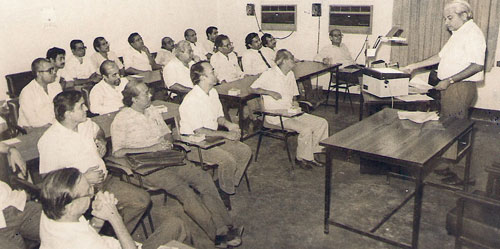
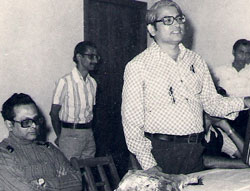
From April 16 to April 18, I stayed with my wife in theIT-BHU guest house. It was a great experience when I talked to the students and faculty members of IT-BHU’s mechanical engineering department on April 17. I had handed over my write-up to Dr. Sudarshan Sharma, the head of the department in advance. I tried to be informal and emphasised on certain relevant points.

My main thrust was to enhance the interaction between the educational institutes and the industry to make the professional education relevant, and re-engineer the curricula with a bias to inculcate entrepreneurship and innovativeness. Mechanical engineering department of IT-BHU must have an effective arrangement with units such as Railway’s Diesel Locomotive Plant in Varanasi, and get associated with its R&D activities. Why can’t such manufacturing facilities in India be global leader of its products?

The course of mechanical engineering must emphasise on design and development of new products and tools for manufacturing systems. And for making the design cost competitive and delighting, the knowledge of manufacturability, assembility, and serviceability is equally essential.

Tendency of students to get addicted to work on computers must change. Computers are nothing but the advanced aids such as log tables, slide rules, and scientific calculators of yester years. They must get better exposure to the latest in domain knowledge, analytical skills, and soft skills such as bench-marking, brainstorming that are essential to make them effective team workers.

As an old man, I did provide some tips from my professional career:
1. There is no substitute to hard work.
2. Keep learning on, particularly about your domain knowledge.
3. Create a transparent system in management
4. Keep on educating your own people
5. Tell subordinates and peers ‘Why?’ clearly.
6. Have holistic approach
7. Keep ethics

I also expressed some of my disliking:

1. Fresh engineering graduates aiming for IIMs and IAS. India needs more of engineers in every field rather managers.
2. Indifference in industry about the capability of the people in the professional educational institutes and a similar approach among the teachers to keep themselves away from the latest industrial innovation. I could get my notion confirmed after the interactions with the heads of many departments who were present in the dinner organized by the director that evening in the guest house itself.
I did also suggested the professors to do something to sell some of the research works going on in the university that can be market its capability. Why are our professors not known to even people like me? Why media is indifferent to the activities in the educational campuses of national importance?

Surprisingly, all the professors agreed. But will some take initiatives?

Some reporters from local language press interviewed me and I found all of them covering my speech pretty well on April,18. And I was elated to get a replica of the bust of Malviyaji as a gift from the head of the department.

The gift from the head of mechanical engineering department after my talk

Banaras Hindu University (BHU) founded by Pandit Madan Mohan Malviya is a live example what an individual can achieve. It is huge with educational facilities in almost all possible areas such as technology, law, medical science, pure science, agriculture, social science, and other subjects. It could have easily ranked in the least of top universities of the world.

I wish the government at center could have the ambitions to make it one and the institute could get some missionary vice-chancellor to make it get in the global best rank.
———————-
Coaching Factories Are Dumbing Down The IITs

Posted in education | Leave a comment

Pipra (Mardan Rai Ka) -My Village, My People

What would have been the right headline of this entry? I thought of making it ‘Pipra on Nitish’s Roadmap’ and even ‘India meets Bharat’. However, perhaps my village is great to me and with age my love of it is getting enhanced with many sweet simple memory of the childhood with which it was associated. My main objective was to have some photographs as I was not having any recent ones of my village and its people. I had requested Anand once to create a website of our village. May be with these photographs, it will be easier for him, if he is still interested.

Almost after five years I got the chance to go back to my village, my birthplace. I decided to go to Patna to attend the family marriage from Varanasi where I attended the Tilak ceremony by road. It was my interest to see myself the progress in Golden Quadrilateral (GQ) in Bihar region that I traveled to Sasaram on GQ. I was to leave Sasaram for Patna in early morning on the April 20, 2007. I had some hours only as we reached Sasaram by 11 AM on April 19, in almost 3 hours from Varanasi, as some portion of the road near Karamnasa was still under construction. Very soon after checking in Hotel at Sasaram, Alok returned after booking two seats for the air-conditioned Sumo with another Sumo to go to Pipra. For the first time, we left Sasaram-Arrah road at Agarer and passed through the villages Panjar, Mahooli, Tenuan before moving on the bank of the irrigation canal whose one bank is getting metallic as a regular road to connect our village.


I found work on rural road under Prime Minister’s Gramin Sarak Yojana going on all over. However, the contractors have engaged only limited resources and so I could hardly appreciate the urgency. Bihar has lost many decades because of the horrendous ineffective politicians. We have an honest and sincerely dedicated engineer leading the state for the first time. but still as usual my expectations are higher.

Perhaps very soon, Pipra will get electrified too. I could see the infrastructure for placing transformer near Panchayat Bhawan. While talking to the people, I heard of coming up of a health center too very soon.

After a wash and some exchange of greeting with my uncle, I went in and took the lunch prepared by my aunty, as my cousin has informed her on cellular phone before starting from Sasaram. I relished the simple but very tasty lunch. For many years, it was the same aunty who had been feeding me in my village as well as Birlapur in West Bengal before I went for college.


And then I moved in the village to meet the oldest man of the village who has crossed the century mark and is still very fit physically. He was sitting under the shade near the temple. Thereafter I moved towards the ‘Kalimai’ in the eastern side through the lane that passes through Chamtoli. Most of the houses are better today. However, the people as usual are least concerned about the basic hygiene. Even if one explains, they hardly get convinced. Someone must set example of a better living in rural Bihar (or India). Perhaps that only can bring change for an improved life style.


I also met with the fathers of two cousins who had graduated in engineering from BHU and REC Warangal, because of the seer will power of their fathers. However, while talking to these old men, one could understand easily that expectations proved short-lived and now over.

We left for Sasaram by 4PM. My uncle accompanied us.

This short visit of Pipra will remain alive in memory disc.

Posted in Uncategorized | Leave a comment

On Nitish Kumar’s Roads, Down the Memory Lanes

We entered Bihar through the prestigious Golden Quadrilateral (GQ) from Varanasi on April 19. However, between Karamnasa and Sasaram, some stretches are still not complete. The bypass Sasaram is still not ready, though we would not have used it. Internal roads in Sasaram remain as bad as it used to be. Can’t Nitish Kumar’s government do something out of the box to improve its condition? Sasaram, being an old town deserving a heritage status, could have attracted a lot of tourists. But basically, nothing has come up during these years to make the stay in Sasaram possible, neither some hotels nor any eating houses.

The rural roads as I mentioned in my earlier entry are under construction and perhaps are being given priority and rightly so, as there live the majority of the vote banks. Early morning on April 20, we started for Patna by road. The road from Sasaram to Bikramgunj is horrible. In many places, it is not even good enough for bullock carts. I couldn’t understand if it is because of so many rice mills that has come up all along this rice bowl of the state. Some innovative entrepreneurs could come up with new enterprises based on the byproducts of the agricultural outputs of the area that is fertile for all sorts of vegetables and cereals such as rice and wheat. A railway track has been laid between Sasaram and Bikramgunj that will connect Arrah on the main line in time. It reminded me of the private light railways of the yester years that used to connect Sasaram to Arrah. In my childhood I had used the same many times. Many a times, my grandfather had accompanied me.

From Bikramgunj, our vehicle followed the road through Dawath upto ‘Malia-ka-Bag’. While traveling on the road, I got a nostalgic feeling. It was the road that I traveled many times since my early childhood. My maternal village Bodarhi is just half a kilometer west off Dawath. We built a new house here when I was working in HM. My parents were living here- my mother since my childhood and my father joined her when my maternal grandfather died. But after the death of my mother, we found it difficult to manage the landed property effectively. The neighbours and so-called relatives were just rogues. It was impossible to live under that condition of fear and tension.

After Malia-Ka-Bag, the driver turned towards Jagdishpur of Kuer Singh, the hero of 1857 war of freedom to reach Arrah. Surprisingly, the road is in much better. It is only when we were nearing Arrah, we found the road surface deteriorated requiring repair. It is a part of national highway joining GQ at Mohania.

The taxi-operators don’t take the old straight road between Bikramgunj and Arrah as it may be more time taking because of its poor surface condition. Otherwise that would have been a shorter route to Patna.

The driver was not very friendly, though the owner was known to my cousin, Surendra and perhaps his neighbour. We had started at 5.30 AM for this five and a half hours drive, and didn’t get even the morning tea that early. He finally stopped only at a place after we crossed Arrah. And there was hardly anything at the stall, but a cup of tea. Perhaps for security reason, the vehicle crawled slowly through the Danapur cantonment area. We had visited Danapur twice when Ashok, my cousin was here in Railways before moving to Vadodara.

To take story of Nitish Kumar’s roads in Bihar, we traveled to Nalanda, Rajgrih, Pawapuri going through a short route from Phatua. But that road up to Biharsarif was in bad shape for the most of the stretch and is getting widened. The driver could realize his mistake late. So we decided to return via Bakhatiarpur. The road is in excellent shape.

But the route followed gave me chance passing through Noorsarai, a small town near Biharsarif, where I had spent some 15 days working with Peace Mission volunteers in December 1966. I was deputed by Jai Prakash Narayan’s Bihar Draught Relief Programme of the year when Bihar faced an unprecedant draught. I had volunteered to work for him, while I was on my annual holidays in Bodarhi. My wife was expecting Rakesh. She remained with my mother at Bodarhi.

While at Noorsarai in that cold December of 1966, we had to sleep on the benches of a primary school of the village. We used to take the food at the road side stalls. It was unpalatable, but there was no way out. After the 10-12 days of working with those foreigners on re-boring of dried wells, I fell ill. I got unique assistance from the sarpanch, headmaster, and the doctor of the village (trio). Dr. Sinha was a Bengali living in the village and practicing. It proved that I was not fit for the hard way of living that is required for the type of life one is to live if one wishes to do something for the society.

We drove past the high school where the trio organized a dinner for us. I remember that dinner vividly that was laid on the huge conference table made out of finely finished mosaic concrete surface. They had arranged many courses- veg and nonveg with many types of drinks. I didn’t know how they managed that. It was beyond my imagination in those days.

With whomsoever I talked during my five nights stay in Bihar, it was a 100% positive response regarding the Nitish Kumar’s honest effort in bringing Bihar back in lime light with work on road and rural electrification all around the state.

Posted in bihar | Leave a comment

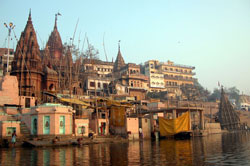
Sarnath- Under Buddha’s Shadow


While in Varanasi, I never missed the opportunity of visiting Sarnath. While I look at the constructions all around and right up to the main Stupa, I wonder why can’t the government impose a ban on all odd constructions that will anyway hurt the age-old cultural history of the country. I saw for the first time the Japanese Temple too.


Presently, another a high Stupa is under construction but I hardly found the space around that which could have been developed to provide the right ambience.

Sarnath Stupa must be visible from all around. And the city as such may be a world heritage city with support from Buddhists countries.


And I visited a Varanasi Saree center for the first time. They have engaged a weaver too in a very unhygienic condition. Why can’t the demonstration be of a good quality to attract the tourists from countries all around? We, Indians are very poor in marketing and selling the wonderful works of our skilled craftsmen. A design center with latest technology can develop many contemporary products for the global market. Only through technology, we can face the Chinese onslaught on Varanasi saree.
——————-
Rue De Sarnath

Posted in Uncategorized | Leave a comment

Sasaram – A Heritage City

Sasaram has been fortunate enough to be associated with many big names. The names of Shershah and Jagjivan Ram are at the top.

It is the place where Shershah, one of the most reformist emperors of India lies buried under a tomb erected in an equally unique water reservoir. As we know, a unique land settlement reform came under his rule in India before Akbar, the great. Shershah is also credited with building the Grand Trunk Road that covered all the way from Dacca to Peshawar or Kabul.


One from Bihar and that too from a village, Pipra (Mardan Rai ka) near Sasaram, its historical association with Shershah inspired me since my childhood. My grandfather narrated a miracle story of the tank in which the Shershah tomb has been built. According to my grandfather, he used to have his lodging in Sasaram, when he was one of the few students from our village in its only high school. At that time, the tank was the main source of drinking water for the residents of Sasaram. The women of Kanhar or Kamkar caste used to carry the multi-layers of pitchers with water in it drawn from the tank from the bank without getting into it in morning and evening. Bathing in the tank was strictly prohibited.

One hot summer evening, an old hermit came wandering and got into the tank to cool himself. After getting the information, a constable came in and took him to police station. It was British rule at its best. The inspector couldn’t take him to court for bail, as the court was having summer timing working up to noon only. The hermit pleaded a lot, but the inspector was scared to take the law in his hand. The hermit got angry, and cursed, ‘ You are punishing me for my crime of entering the water body used for drinking. But hereafter none will be able to use the water in the tank for drinking.’ The inspector didn’t take that seriously. Next day, the hermit was presented to the English magistrate. He warned but freed him after hearing the honest statement of the hermit. The hermit went out and disappeared. Very soon the water got greenish and undrinkable. The magistrate ordered for cleaning the tank and filling with fresh water from the incoming canal. But the trouble couldn’t be cured. The women and men shifted to other tanks. My grandfather believed in the story and recorded the same in his diary too. I don’t know if I should believe the story.

Every time I have passed through Sasaram, I try to visit the tomb. It is so gigantic. Perhaps, my grandfather had shown me this tomb for the first time, when we were going to Calcutta from the village. He impressed upon me how at the time of construction some four hundred or more years ago, the huge stone pieces forming the walls would have been lifted so high in its places during construction. Over the years, the government’s tourism or the archeological department has not done anything worth the monument deserves. The surrounding all around the tomb and tank could have been developed in a manner that could have enhanced the utility of the place for the locals as well as for the tourists. We keep on talking about ‘the shining India’ and ‘Incredible India’, but don’t do anything. I got a chance to go around and take some photographs of the Shershah’s tomb this time too when I reached Sasaram from Varanasi by road on April 20 en route to Patna where we were going to attend a family marriage. The driver of ‘Indica’ that I had courtesy Gehlot my friend from Noida agreed to take me around before going to the hotel. Before Advocate brother, Surendra Tiwari could reach the hotel we had made the trip. It was the first time that I was staying overnight in a hotel room because of my wife Yamuna’s physical problems. Bypass for the Golden Quadrilateral passing through Sasaram is still not ready. The traffic moves through the old GT Road going through the town, and the road must be nightmare for the crawling vehicles of all sorts.


Sasaram was the constituency of Babu Jagjivan Ram and now his daughter, Meira Kumar. I don’t know ‘why’ but none of them has done anything for furthering this historical town and this great monument. They visited the place and the region only for getting elected as MP and managed the win through local agents with shellfish motives or goons. Some fanatics have built a temple in one corner. The road around the tomb is in poor shape and full with filth. The tank cools now many a street urchins in the hot summer. While going around this huge monument, perhaps the most attractive one after Taj Mahal from Mediaeval India, many a times has to put a handkerchief on one’s nose.


Why can’t Sasaram be taken up for status of a world heritage town with many important historical and mythological sites in near vicinity all-round and its great history?

Why can’t Meira Kumar request her colleague of her own part and minister, Ambika Soni to take care of this unique monument through tourism ministry? Why can’t she use some her MP fund to develop the headquarter of her constituency?

Can Sasaram expect some improvements through its local bodies, and through the DM and SP who are the kings of this sleepy district headquarter?

Posted in bihar | Leave a comment

Varanasi, Sasaram, and Patna- Social Commitment or Outing

>


We are moving out today in the evening for Varanasi. On April 16 we shall attend the ‘Tilak’ ceremony of Babloo- the eldest son of Nirmal, my cousin brother. We are staying at the guesthouse of IT-BHU courtesy Dr. Kavindra Rai, presently head of Mathematics department, while in Varanasi. I know Dr. Rai, when he was doing his Ph.D. He visited us at Hind Motor. He is the youngest brother of Laljee Rai and uncle of Ashok Rai who worked for me in HM. Tilak is basically the most important function at the house of the bridegroom side in villages in a marriage in Bihar. If it had been arranged in our village, almost every one in village would have attended. I get reminded of my uncle and his spendthrift on such occasions. But perhaps, as Nirmal has shifted to Varanasi, it was perhaps quite inconvenient for him and unnecessary too. Life in villages without electricity gets really torturous. As I hope, it will be smaller and simpler function in his house in Varanasi.

We have some more acquaintances in Varanasi that is considered the holiest and ancient most of the cities for Hindus. I shall like to show some important places to Yamuna too. We shall certainly visit Vishwanath Temple and Sankat Mochan. Both places got extensively covered in media recently because of the visit of Bachhan family. However, I have a personal liking for Sarnath, where Buddha gave his sermon after enlightenment at Boddha Gaya. I was there in year ’59 while returning from Meerrut NCC camp. It was almost a wide barren place with the ancient stupa and some built by other Southeast Asia’s Buddhist countries. But the whole place was impressive. When I visited some five years ago, I got the shock of my life. The constructions have come up to the main stupa. And that conceal its full panoramic view. My shock was similar to one when I saw constructions surrounding the Raja Rani Temple of Bhuvaneswar that I had seen in rice fields. We, Indians and our government, can’t respect and protect our heritages.

I am supposed to address the students and faculty members of mechanical engineering department and visit its facilities. I wish it helped me to know more about the younger generation going for engineering education. I shall be giving some tips from the experiences of my professional life.

We shall like to visit Vindhyachal while going to Sasaram. Big B also visited the temple recently. My uncle goes there twice a year in Navaratra. If the Goddess so wishes, we may make it. At Sasaram, for the first time, we shall be staying at hotel for the reason of our old age. It may hurt our elders in the family, specially my Mamaji who is in his eighties now. And I shall certainly like to take photographs of Shershah tombs and other places of historical importance. However, mamaji has discouraged me from visiting Rohtasgarh. As per him, it has become Naxlite-infested and is not safe according to his information. We may visit our village Pipra for a day and meet uncle and aunty returning to Sasaram in night before moving to Patna. As Yamuna is not keeping well and the climate will be a big deterrent, I can’t be there for more time though I would have liked to do that.


We shall be reaching Patna on April 21 in the afternoon, perhaps for the first time by road. The marriage ceremony of Babloo will be in the night same day. I hope to meet many of known people from the village and other relations. That is my attraction to attend this marriage. In Patna, we shall be troubling Mrs. and Mr. Janardan, my friend of IIT days as well as the father-in-law of Rajesh, my second son, as we shall be staying with them. Both are as old as we are and perhaps equally lonely and sick. However, I have a plan to show Yamuna around Patna this time including Ashoka’s Palace and Nalanda, about which I had been writing in my blog frequently.

On April 24, we are boarding Rajdhani at Patna for return to Noida reaching here on April 25.

All these days I shall be using my camera and notebook to collect exciting things, if any, of the places and people for you. However, my eyes need some rest, I am not carrying my laptop. I shall contain myself and avoid putting any entry before April 25 perhaps, unless I get really pushed by inner urge to do that. I shall be having my own cell all the time. Any one can contact me if needed, except when and wherever the Reliance Network is weak or absent

Posted in Uncategorized | Leave a comment

India vs. China in Aviation: Why should India compete?

It is not only piracy; China is far ahead of India in every area.

India might have begun work on building India’s spacecraft to the moon. But the Chinese have done that already.

India invested in many units of HAL in billion in building latest technologies and capacities, but India will take at least a decade longer to develop the country’s own passenger jet. It looks silly to read that in the 11th Plan (2007-12), Indian government and aerospace scientists want to return to the drawing board to design a 70-seat passenger jet that can fly up to 2,000 km, say from Mumbai to Kolkata. India’s first indigenous light transport aircraft, the 14-18-seater Saras, is still undergoing test flights, after over a decade in development amid criticism over its excess weight and fuel consumption. As reported, ‘the plan for a ‘Made-in-India’ commercial jet has received a thumbs up from a panel of India’s top scientists in the steering committee on science and technology for the 11th Plan. Their report to the Planning Commission, submitted in December 2006, estimated the aircraft project would cost around Rs2, 035 crore over a decade. http://www.livemint.com/2007/04/10014501/MadeinIndia-passenger-jet-ge.html

As reported in Business week, China expects to start making homegrown large commercial aircraft by 2020 raising the possibility of future competition for Boeing and Airbus in the country’s booming market for new planes.

And then India has now successfully tested the 3,500-km range Agni-III ballistic missile last Thursday, taking an important step towards building a minimum credible nuclear deterrence against China. However, Agni-III still falls well short of the ICBMs (intercontinental ballistic missiles) that China has. It looks awful to read report about Agni-III providing India the option to strike even Beijing and Shanghai. Why should one think like that? In stead perhaps, it is better to have tie up with some developed country for this and use our resources for commercial jets and fighters of our own that drain our resources in billion.

As reported, China has a plethora of nuclear-capable ballistic missiles, ranging from the fully operational 8,500-km CSS-4 ICBM to the new road-mobile 11,270-km DF-31A ICBM, which even sends shivers down US spines. China also has SLBMs (submarine launched ballistic missiles) like JL-1 and the under-development JL-2 (8,000-km range). Consequently, every major city in India is within the strike envelope of Chinese missiles.

I find the competitive edge of China in these areas because of their aggressiveness in attempting whatever is necessary for the nation and getting that attained. Unfortunately Indian leadership has been lacking on that count since Nehru’s days. A culture of timely completion of all national projects must come first.
—————————-
FDI touches $15 bn in 06-07
‘From Boeings to laptops, it’s all in India’

Posted in Uncategorized | Leave a comment

Hope and Disenchantment

I was hopeful for a speedy change with the coronation of Nitish Kumar on the throne of Chanakya. But after almost 16 months or more, I am getting disenchanted and restively worried for the state. I wish others were not so sensitive as I am. For how many more years will the state have to remain at the bottom of the development parameters?

Bihar chief minister Nitish Kumar announced that his government was not going to develop the Special Economic Zones (SEZs) in the state. The industries will come up only on plots, which the people will give on their own will and volition. I don’t believe that many companies on its own will be able to acquire land for any big industry. Just with the rumour of coming up of an industry in an area, many vested interests get born like mushrooms and demand all sorts of facilities, favours, and compensations. I don’t know why Nitish Kumar is to come out so strongly against SEZs. It may be politically prudent, but sends a very poor signal for the prospective sincere investors.

If I am to believe that rebuilding Bihar tops Chief Minister Nitish Kumar’s agenda, he must talk and take some fast track actions to change the perception. In the neighbouring state, Buddha had to take some unpleasant decisions but he succeeded in changing the poor perception about his state in the minds of all the big investors of the country. And that matters most for the state, and the sincere investors are queuing for his chambers in hordes even with all the bad publicity out of Nandigram episode and extremely difficult unions in the state. Recent happenings in even the dieing plant of Hindustan Motors has not deterred Tatas to change their mind about the car project that is coming up almost in the vicinity after all protests.

Similar news came about the education sector. Bihar government has expressed its inability to provide land for Kendriya Vidyalays (KVs) in the state. Bihar must keep its doors open for all sorts of educational institutes without having any egoistic compulsions. Every district and sub divisional headquarters requires good number of schools.

I keep on visiting the official sites of the government of Bihar, and its updated information on ‘Approved List of Investment Proposals’. It does not have many serious investors in it. I find number increasing but almost no further status information about progress even after 16-month-old ones too. Why can’t the department responsible keep the people informed about the progress?

The chief minister may be a good person and visionary, but it will be only the projects’ implementation that will show his success and bring the confidence of the people who will, in turn, bring him back in power. The whole state must be humming with activities of constructions, small and big. Let him understand that the opposition is not dead it may be dormant. It will be only the development touching the majority that can establish him for a longer period to fulfill his vision of Bihar.

However, I congratulate Nitish Kumar for legislating the creation of Nalanda International University and roping great economist Amartya Sen to head a panel of experts to oversee the setting up of the proposed international university at Nalanda. This single project if handled with a wider vision and faster implementation such as starting infrastructure work, can bring Bihar on the map of the world again in big way. His government has got maximum number of proposals on educational institutes and sugar mills, ethanol, and cogeneration projects. Why can’t the chief minister himself and his office see that the work on the projects gets started and facilitate to expedite that?

On a similar line, his deputy can take up the task of clearing the mesh in Patna and making it attractive enough to investors. In a recent 18 city survey done by AC Neilson-ORG Marg on 11 parameters including drainage, greenery, cleanliness and garbage disposal on the basis of citizens satisfaction levels, Patna remained in the bottom five, while Kolkata that was so poorly placed could come in the first five.

I shall go by NK Singh tips that he recommends in his article- ‘What’s good for Bihar is good for India’ in Financial Express: “Learn from others’ experience. There’s no need to re-invent the wheel in all cases. The world is full of relevant experiences, both successes and failures, to learn from.” There are many success stories for both the rural and urban development from other states that can be emulated. The government and people of Bihar must not keep on doing what others don’t like. Bihar must build on some soft power of its own.

I request Bihar’s senior ministers of central cabinet and of the state to shun fighting in public and media for petty political advantages. Don’t spoil the image of Bihar any more. As an oldman, I expect every person from Bihar to realize and appreciate this and to behave at his work in Bihar or outside in a manner that builds the positive aspect of Bihar brand.

Posted in bihar | Leave a comment

Hindustan Motors- Down the Memory Lanes

Since yesterday evening when we saw the news of lockout at Hindustan Motors (HM), Uttarpara plant on NDTV channel, we have been talking about the bad and good days of our life there. We lived in the factory premises known as Hind Motor for almost 35 years. When I passed on the message today in morning to Anand my youngest son in USA, he expressed his worry if he could show the place, where he was born and brought up, to Shannon, his wife. In evening, Mrs. SP Dey who was one of our neighbours there, called for inviting us to the marriage of her son Soumitra that is going to be in May. But besides talking about the bride, it was more about the situation at Hindustan Motors and its officers whom we knew. Under threat from the arrogant union activists, they have shifted to safe locations in Kolkata.

I joined HM in 1961 just after finishing IIT. The same year in October, the company had a bad labour strike and then also the company had to declare lock out. None was allowed to go in even when the lockout was lifted on insistence of the then Dr. BC Roy’s government. I went to my native place for few days and then returned. But we were signing our attendance at the registered office in Calcutta. The company started sending the employees to the plant by special trains arranged and under police protection. Fortunately, we were not asked to go in, as we were newly recruited executive trainees. The union then was of CPM and the government was of Congress. The union activists were violent and obstructed employees and managers, even assaulted some of them. After a number of attempts too, the company couldn’t get the factory in operation with all the assistance from the Congress government. Citu had developed its strength. After some days, the company yielded on some demands.

Over 37 years, I had to bear with all the unreasonable demands and demonstrations of Citu, as I was named one of the toughest managers in the history of HM even in Citu era. I was inflexible and never compromised for unreasonable demands. When we joined, the production was hardly 8-10 cars a day. In 1980s, the maximum was about 120 cars a day. But union activism had killed the discipline among the working population that is an essential factor for a quality production. The management had lost hope for resurrecting the company’s health.

In 80s again, HM had to face the strikes by Citu, and lockouts by the management a number of times. On one such an occasion that I vividly remember, the whole company premises was under floodwater, the residents were having tough time because of the shortage of essential items such as milk and vegetables, the Citu had struck work, and as usual the company declared lock out.

Today the situation is totally different. HM has lost its prestigious position of being the premier company in car production. It hardly produces 40 cars a day for taxi market and some government departments who are not allowed to buy any other make. Employees’ strength has reduced to around 4,000 from about 15,000 or more. It is just managing to run the plant, though it talks of getting into auto components. Many of the other manufacturing units such as heavy engineering and steel foundry divisions have been sold out to other companies. A bad management can’t revive a sick unit. It talks of losses, but surprisingly even in the best of years it didn’t declare any profit nor dividend. I don’t know how the promoters survive under these conditions.

The leftist union CITU is with the company today and is fighting on behalf of the company with the opposing union activists to allow the employees in, but failing to make any breakthrough. But the protesting union activists have created panic among the employees living in the residential areas just as Citu used to do in good old days of ours. Could Buddha make the union activists unlearn what they picked from their counterparts affiliated with CPM?

Few weeks back I saw an insertion in ‘Business India’.”Money is Money… And AN ASSET IS ASSET. So how does it matter whether your car plant makes money by building cars or developing real estate? It carried a photograph of CK Birla, who, as reported, has signed a deal with Bangalore based Shriram properties to redevelop 314 acres at Uttarpara Plant. The deal will fetch Rs 290 crore, and will be ploughed back into the plant on “rejuvenating and expanding the product line”.

It is difficult for me to digest the intention of the deal. The HM plant had a spread in 748 acres or more. Some of the land must have come free.

Today, Hindustan Motors declared a lockout at its Uttarpara plant following the month long labour unrest that saw repeated violence as Citu (of ruling CPM) tried to break the strike by sneaking in workers and clashed with the other plant union- Sangrami Shramik Karamchari Union (SSKU).

I am sure the stalemate will be over, but HM is almost dead. There is no point in repenting for that, as I spent the best of my life there and contributed my best. I only wish it remains running and worth visiting till Anand fulfills his wishes.
———————–
Tripartite meet on HM impasse today
Citu drive to unlock HM

Posted in Uncategorized | Leave a comment

Shipbuilding- A sector with huge employment potential

Even in 1950s when India established its first IIT at Kharagpur, it happened to have a department of naval architecture, though with an intake of a dozen or two students. I used to wonder where we they be usefully employed. To my query, my seniors told me that best ones go in shipyards abroad.

Nehru had big dreams even about shipbuilding and the shipping as such and rightly so. But over the years, the government couldn’t encourage private sectors to get into the business in big way. A few private sector shipyards were only allowed or on their own, they managed to keep on building ships, but only small vessels. And like many other heavy industries, shipbuilding grew only in public sector. Even some private ones also were nationalized. Today, the major shipyards in India, about seven or so, are all state-owned, inefficient, inambitiously managed, lossmaking, and surviving on budgetary support. While the three neighbouring countries of Asia- Korea, Japan, and China today control roughly 86% of the global market size of $109 billion (2006), Indian shipbuilders have a share of 0.35%. While the trio delivered ships with 60 million tonne-capacity in 2006, India could do a piffling 0.5 million tones. The world capacity of ships in 2005 was 966.5 million tones. One can imagine the addition because of booming shipping industry because of many factors such a replacement of single hull ships by now mandatory double hull ships, race for energy security by creating huge emergency oil reserves, demand of increasing transportation of steel, iron ores and coal.

Shipbuilding is a highly labour-intensive industry and ship repairing is even more so. Major skills required for shipbuilding are conventional welding, fitting, electricals and plumbing, and Indian has plenty of it.

When liberalization abolished industrial licensing in 90s, some such as Bharti Shipyard and ABG Shipyard came up, but couldn’t grow big because of the Asian financial crisis resulting the collapse of demand for ships. However, presently the demand for ships is booming. Indian shipbuilders don’t have capacity to cash on the global demand.

But several companies have come out with plans on construction of big shipyards:

ABG has set up a major shipyard costing Rs 1,600 crore at Dahej, Gujarat, to build up to 25 ships a year.

Sea King is setting up a shipyard at Pipavav, Gujarat, to build ships of up to 300,000 deadweight tonnage (dwt). As claimed, Pipavav Shipyard will be among the ten biggest in the world. The company has already bagged two advance orders worth $720 million to manufacture ships for Z Schifenbau of Germany and B F Shipping of Cyprus.

Bharati Shipyard is investing Rs 450 crore in a Greenfield shipbuilding unit at Mangalore.

PK Ruia group now proposes a mammoth shipyard at Haldia costing over Rs 3,000 crore, that will be among the biggest in the world, building 12 ships a year of Panamax size (the maximum size that can go through the Panama Canal). The project will employ as many as 16,000 workers.

The Adani groups have announced investments in shipbuilding facilities which total over Rs 5,500 crore at Mundra in Kutch, adjacent to its new deep-water port there.

Tata Steel plans a shipyard at its new coast-based plant in Orissa. Tata Steel has just formed a joint shipping line with NYK of Japan, and the shipyard will be a link between its steel and shipping business.

The ministry of defence (navy) has very lately and rightly decided to source the bulk of its requirement from the private sector.

L&T is expanding its shipbuilding business, which includes warships. L&T manufactures already parts of submarines and soon plans to build entire submarines. Other private sector defence suppliers may conceivably get into naval vessels and equipment.

Even the government has woken up and has plans to set up two global size ship building yards one each on the east and west coast in public-private partnership.

But India’s ship components industry is hardly developed necessitating the import of nearly 80% of the ship components from developed countries annually. It may require a special encouragement from the government for the existing ones to expand and new ones to enter, instead of making import duty-free. Many heavy engineering enterprises lying idle can diversify and get into the ship components business. It is essential technically for logistic cost advantages. For example, Japan gets 97.85% of the ship components from domestic plants.

As reported, currently the designs are purchased from overseas. Where have our own naval architects gone? Some entrepreneurs must set up a ship design center of world class that can cater to the ship builders with latest technologies. That must be aimed at as India’s differentiating and winning factor.

With globally reputed marine engineers, naval architects, and managers India can easily have a globally competitive shipbuilding in its private sector with huge employment potential. Many believe that India may target a shipbuilding industry to around $20 billion by 2020.

Shipbuilding dominated by Europe and North America till early 20th centuries lost to Japan by ’60s to become the top ship-builder. And then emerged South Korea, Taiwan and Singapore as major builders. However, as in other manufacturing shipbuilding too is shifting to China. Why can’t it now shift to India?

Posted in industry, manufacturing | Leave a comment