Shah Jahan’s Passion for Masterpieces

Shah Jahan’s TajMahal is already doing a hot round in media to get the votes to be in the list of ‘new seven wonders’ through SMSs and e-mails. The news of another masterpiece from Shah Jahan was exhilarating. Perhaps, He was one emperor who had a passion to create something unique for the posterity to become immortal. Taj Mahal, Lal Killa (Red Fort), Jama Masjid, and many other things such as the lost Takhat-e- toush and Kohinoor through which the people will keep on remembering Shah Jahan for years to come even today.

As per a media report, Emperor Shah Jahan got created another masterpiece, a 1.1 kg coin as large as a quarter plate, made of solid gold. It is now the property of the University of Mumbai courtesy stockbroker Dinesh Mody. Mody is donating this coin and 25,000 other heritage coins, currency notes, seals and medals from countries all over the world to the university for use in its new master’s degree in numismatics and archaeology.

The Shah Jahan coin dates back to the era between 1628 and 1658. In the 1980s, it was auctioned in London, when Mody bought it for a small fortune. But it carries a fascinating tale.

According to the story, the massive coin was issued to placate the Khalifa, the head of the Muslim sect. Islamic kings were forbidden from issuing coins with Kalima (aayat from the Koran) or images of humans or other living beings. However, Akbar, Jahangir and Shah Jahan frequently issued coins engraved with birds, animals and their own visages. When the Khalifa, who migrated from Baghdad to Morocco, learnt of this practice, he sent out a stern warning to Shah Jahan that if he continued in this vainglorious manner, he would be excommunicated.

Dilip Rajgor, a scholar and the author of several books on numismatics, says ”He (Shah Jahan) not eat for a day and then one of his advisors came up with a solution, which was to mint a large coin from pure gold and call it Shahenshah.” The coin was sent to the Khalifa with a message that read, ”the Shahenshah (Emperor) is at your feet asking for forgiveness”. On it was inscribed in Persian, ”There is only one God, and he is Allah, and Mohammed is his Prophet.”

The Khalifa’s daughter, who married an Afghan prince, took this coin with her. The couple’s daughter married the prince of Bahawalpur and the coin was sent with her as dowry.

Will the diamonds possessed by Mayawati be one day a similar object of history for the posterity?

Posted in Uncategorized | Leave a comment

Indian Poor and Crorepati Rulers

People of India has now access of the assets, at least of the white portion, of the rulers of India courtesy the rules of Election Commission. Every candidate for both the houses at the center and the state are to file an affidavit giving one’s asset and its worth, beside his educational qualification and some other details. Since last two days, Mayawati’s wealth is on the front page of a national daily that claims to have the largest circulation. I don’t know the motive of giving importance to the news. . Mayawati, 51, who swept Mulayam Singh Yadav out of power recently had not contested the assembly election. As per the law, she is now seeking a berth in the Upper House, as she is CM and wishes to continue too. And Mayawati’s declaration of her latest assets came in affidavit that is accessible to the people.

According to the affidavit, she does not own a car, agricultural or non-agricultural land. But she owns ”commercial and residential space”. The CM’s assets, are: Cash: Rs 50.27 lakh; Deposits in banks, financial institutions and non-banking financial companies: Rs 12.88 lakh; Jewellery: Rs 50.87 lakh; Diamonds: 380.17 carat: Rs 49.75 lakh; a 18.5-kg silver dinner set costing Rs 1.12 lakh; murals worth Rs 15 lakh; two commercial establishments in Connaught Place, New Delhi, priced at Rs 2.05 crore and Rs 1.27 crore and another commercial establishment at Okhla which is priced at Rs 15.50 crore. Lucknow residence is shown at Nehru Road in the Cantonment priced Rs 97.42 lakh; Delhi residence on Sardar Patel Marg priced Rs 18.02 crore. Mayawati today clarified that all her assets have come from small donations from the thousands of her party members. She has also paid the required taxes, so this is all legal. Is it not a lucrative way of becoming crorepati? Should she become the model for our young Dalit friends and emulated? It will be interesting to now what the top judiciary opines.

For record, the other crorepati politicians, as reported in media based on their affidavits with the Election Commission, are Manmohan Singh (Rs 4 crore), Sarad Pawar (1.3 crore plus 1.6 crore of wife), L. K. Advani (1.1 crore plus 17.7 lakh of wife), Chandrababu Naidu (1.6 crore plus 19.3 crore of wife), O. P. Chautala, the former CM of Haryana (4.8 crore plus 1.32 crore of wife), Vilasrao Deshmukh (Rs. 3.3 crore), M. Karunanidhi (Rs 26.5 crore), and Jayalalithaa (Rs 24.6 crore). Mulayam Yadav is worth only Rs 3 crore plus additional Rs 77 lakh with his wife Sadhana), though Rajat Sharma in his popular ‘Aapki Adalat’ used to talk of very huge amount. As already reported, the present CM of Punjab Barnala’s assets are huge some claiming as high as Rs 1000 crore or more. Surprisingly, Sonia Gandhi (81 Lakh), Lalu Prasad (23.8 lakh plus Rs 37 of wife Rabri Devi plus Rs 29 lakh for children), Atal Bihari Bajpayee are all sort of a crore. Should the figure provided to EC be believed? Will their actual worth be very much more than the figures provided in affidavits? I don’t know what are the value of the assets owned by Nitish Kumar and Budhadev Bhattacharya. Are they the Kamraj and Lal Bahadur Shastri class?

Except for perhaps Manmohan Singh none might have earned through their professional career. Mawayati started her career as a teacher in a Delhi administration school, and then she did her law too, but she has grown rich through politics. Mayawati at least openly confesses. Again hardly, these politicians have inherited the assets that have grown. Mayawati’s father worked in the department of post, and has retired as a senior clerk. The family lives in Inderpuri in Delhi. To be frank, I don’t know about other political leaders. Neither have I researched.

Many TV channels made the news an important one today. But will it carry any negative message to the masses who vote them to power. As some thinkers feel, at least the followers of Mayawati take it as an achievement of a Dalit?

Perhaps, the news will certainly make the others in business of politics greedier and more corrupt.

Posted in economy | Leave a comment

Emerging Entrepreneuring India

I was watching the award giving function to the winners of CNBC-TV18 ‘Emerging India Awards 2007‘ initiated by ICICI Bank and CNBC TV18. I was amazed to learn that the winners were selected from about 1,25,378 SMEs that made entry. KV Kamath, managing director & CEO of ICICI Bank too hoped the number of entries to reach 5 lakh next year that started with 5,000 in 2005.The winner SMEs had a maximum net worth of Rs 50 crore. The winners are:
IndoAsian Fusegear Limited (auto, ancillaries and engineering), Venus Remedies Limited (pharma & chemicals), Freshtrop Fruits Limited (FMCG, Food & Agri-Business), Kama Jewellery (gems & jewellery), Indus Fila (textiles & apparel), Value Labs (IT, communications and entertainment (ICE), ITES), Techpro Systems Limited (Infrastructure), Diana Hotels Limited (travel & tourism), Today’s Writing Products (retail trade). Speck Systems Limited (non retail), Mother’s Pride Education Persona Private Limited, and S Jhaveri & Co.

And one can see such enthusiastic entrepreneurs in all part of the country. Each story is unique and exciting. The story of SELCO is of one such entrepreneur. Harish Hande 37, an IIT Kharagpur alumnus founded SELCO, India 12 years ago. This solar energy company has recently won the prestigious ‘Green Oscar’ for the second time. And a report in this Sunday Times of India tells how the company is transforming the lives of ordinary people making an auto driver an entrepreneur:

The solar panel installed above R Vijaya Kumar’s small house on the outskirts of Bangalore made the difference. Every day at 4 pm, Vijay Kumar drives to the Bomanahalli market on the outskirts of Bangalore with 50 batteries that he hires out to street vendors for Rs 15 per battery per night. He returns at 11 pm to take them back, having made thrice what he could earn as an auto driver. It gets Kumar enough money to repay the loan he took to buy the SELCO’s solar panels with which he recharges the batteries everyday.’ In Gujarat, SELCO has helped midwives to deliver children with the aid of a solar lighting kits, and in Karnataka, SELCO has given rose-pickers outside Bangalore solar-powered headlamps so that they can work in the pre-dawn darkness with their hands free. This customized design has made the difference. But Harish went step further and convinced banks to come out with a product for the poor. Initially, it was still difficult to convince the poor to shell out anywhere between Rs 18,000 and Rs 20,000 for a standard 40-watt solar light system that can light several 7-watt bulbs and charge batteries which can be used after dark. For daily wagers, that’s a stiff financial commitment. It is possible through micro finance. Initially most banks were reluctant to lend money to those who earned less than Rs 100 pm. Harish suggested the innovative financing. ”While some found repaying Rs 300 a month difficult, they found it easy to put away Rs 10 a day.” The answer lay in ensuring a collection mechanism that would work on a daily rather than monthly basis.

Kearala’s Biotech and Karnataka’s SKG Sangha also won the ‘Green Oscar’ awards. Biotech won it for developing and installing biogas plants in Kerala that use food waste to generate gas for cooking. SKG Sangha has bagged the second prize for improving the lives of rural communities in the state by supplying them with both dung-based biogas plants for cooking and a specially-designed unit that turns the slurry from the biogas plant into high quality fertiliser.Why can’t the states such as Bihar and Orissa emulate it?

And what has it meant. The vendors give up their polluting lamps for a cleaner and cheaper energy alternative. A few extra hours of work after sundown, less fumes from lamps and more study time for kids – it’s all these things that make a difference to people hampered by electricity outages and the reliance on a few expensive litres of kerosene. Many entrepreneurs can take some lessons from the stories above. And this can be the only way to win the race with China that many think we should not even dream because of our democratic system and corrupt politicians and bureaucrats.

Posted in Uncategorized | Leave a comment

Emerging Entrepreneuring India

I was watching the award giving function to the winners of CNBC-TV18 ‘Emerging India Awards 2007‘ initiated by ICICI Bank and CNBC TV18. I was amazed to learn that the winners were selected from about 1,25,378 SMEs that made entry. KV Kamath, managing director & CEO of ICICI Bank too hoped the number of entries to reach 5 lakh next year that started with 5,000 in 2005.The winner SMEs had a maximum net worth of Rs 50 crore. The winners are:
IndoAsian Fusegear Limited (auto, ancillaries and engineering), Venus Remedies Limited (pharma & chemicals), Freshtrop Fruits Limited (FMCG, Food & Agri-Business), Kama Jewellery (gems & jewellery), Indus Fila (textiles & apparel), Value Labs (IT, communications and entertainment (ICE), ITES), Techpro Systems Limited (Infrastructure), Diana Hotels Limited (travel & tourism), Today’s Writing Products (retail trade). Speck Systems Limited (non retail), Mother’s Pride Education Persona Private Limited, and S Jhaveri & Co.

And one can see such enthusiastic entrepreneurs in all part of the country. Each story is unique and exciting. The story of SELCO is of one such entrepreneur. Harish Hande 37, an IIT Kharagpur alumnus founded SELCO, India 12 years ago. This solar energy company has recently won the prestigious ‘Green Oscar’ for the second time. And a report in this Sunday Times of India tells how the company is transforming the lives of ordinary people making an auto driver an entrepreneur:

The solar panel installed above R Vijaya Kumar’s small house on the outskirts of Bangalore made the difference. Every day at 4 pm, Vijay Kumar drives to the Bomanahalli market on the outskirts of Bangalore with 50 batteries that he hires out to street vendors for Rs 15 per battery per night. He returns at 11 pm to take them back, having made thrice what he could earn as an auto driver. It gets Kumar enough money to repay the loan he took to buy the SELCO’s solar panels with which he recharges the batteries everyday.’ In Gujarat, SELCO has helped midwives to deliver children with the aid of a solar lighting kits, and in Karnataka, SELCO has given rose-pickers outside Bangalore solar-powered headlamps so that they can work in the pre-dawn darkness with their hands free. This customized design has made the difference. But Harish went step further and convinced banks to come out with a product for the poor. Initially, it was still difficult to convince the poor to shell out anywhere between Rs 18,000 and Rs 20,000 for a standard 40-watt solar light system that can light several 7-watt bulbs and charge batteries which can be used after dark. For daily wagers, that’s a stiff financial commitment. It is possible through micro finance. Initially most banks were reluctant to lend money to those who earned less than Rs 100 pm. Harish suggested the innovative financing. ”While some found repaying Rs 300 a month difficult, they found it easy to put away Rs 10 a day.” The answer lay in ensuring a collection mechanism that would work on a daily rather than monthly basis.

Kearala’s Biotech and Karnataka’s SKG Sangha also won the ‘Green Oscar’ awards. Biotech won it for developing and installing biogas plants in Kerala that use food waste to generate gas for cooking. SKG Sangha has bagged the second prize for improving the lives of rural communities in the state by supplying them with both dung-based biogas plants for cooking and a specially-designed unit that turns the slurry from the biogas plant into high quality fertiliser.Why can’t the states such as Bihar and Orissa emulate it?

And what has it meant. The vendors give up their polluting lamps for a cleaner and cheaper energy alternative. A few extra hours of work after sundown, less fumes from lamps and more study time for kids – it’s all these things that make a difference to people hampered by electricity outages and the reliance on a few expensive litres of kerosene. Many entrepreneurs can take some lessons from the stories above. And this can be the only way to win the race with China that many think we should not even dream because of our democratic system and corrupt politicians and bureaucrats.

PS: PM gave away the awards, and in his speech he said, “The winners of these awards will be viewed as the new icons of Indian industry. I am sure they will inspire others to better effort. We need national icons in all walks of life. The icons of big industry who have become symbols of creativity and enterprise in India are inspiring others to greater effort. Similarly, the new heroes in the SME sector some of who are present here must inspire professionalism and enterprise by their solid example. They should be symbols of good corporate governance. They should emerge, and it is my prayer, as respected leaders and members of society. I hope these awards will help in contributing to that process. I wish you all success in your noble endeavour..”

Posted in economy | Leave a comment

Booming and Bubbling India-VII

Indians in top ranks of A-level jobs: Indian executives are now in the top ranks of an international multi-racial meritocracy composed of a highly sought-after group of mobile, trans-national, ‘C’-level business leaders ie, CEOs, CFOs and COOs. AGM Transitions had proof of a definite rise in demand for and acceptability of Indians of all sorts, whether schooled and trained in India or abroad.

India creating more jobs than China: According to a study conducted by the Organisation for Economic Cooperation and Development (OECD), India has been generating more jobs than any other BRIC – Brazil, Russia, India, China – country. OECD’s Economic Outlook 2007, has revealed that India generated 11.3 million net new jobs annually between 2000 and 2005, which is over 60% more than the 7 million new jobs created in China every year.

India more stable than China: India has improved it ranking from 93 to 110 in the 2007 Index of Failed States (higher ranking is better) issued by Foreign Policy magazine. The failed state index uses 12 social, economic, political, and military indicators to rank 177 states in order of their vulnerability to violent internal conflict and societal deterioration. The index scores are based on data from more than 12,000 publicly available sources collected from May to December 2006. India is now considered more stable than China and Russia. In 2005, India was ranked below China, at 76. In 2007, both China and Russia are ranked at 62, while India’s social, economic and military metrics have propelled it to 110.

India to be pharma research hub by 2010: Several domestic players have begun developing their own internal research and development programmes and many of them have branched out into offering these discovery services on a contract basis. Within the next 10 to 15 years, 30% of the world’s clinical research will be conducted in India. Frost and Sullivan has pegged the figure on outsourced contract research in India (part of which will be pre-clinical) at $2 billion by 2010.

Pharma exports to surpass retail sales: According to the Indian Pharmaceutical Alliance (IPA), the gap between exports and domestic retail sales will only grow in the future. By 2012 the size of exports will almost double at Rs 112,275 crore growing at 35% against domestic retail market of Rs 58,607 crore with a stable growth of 16%. India has the highest number of USFDA approved manufacturing facility outside the US.

Sony Ericsson to set up R&D unit in India: Mobile phone maker Sony Ericsson is setting up a research and development unit in India to strengthen its position in the world’s fastest-growing mobile market. Sony Ericsson has a production target of 10 million units by 2009.

India’s IT/BPO market to grow at 30%: After registering a CAGR growth rate of 35% in he last two years, India’s IT/BPO industry is expected to continue growing at a healthy 30% plus on a year-to-year basis for at least another four years, according to Assocham.

Kingfisher inks deal to acquire 50 Airbus aircraft: In the single largest order by a private Indian carrier, Vijay Mallya’s Kingfisher Airlines has signed a deal with Airbus Industrie to purchase 50 aircraft at an estimated $7.3 billion.

Mumbai enters world’s top-ten financial flow league: Driven by high trading volumes for equities and good presence of global banking and financial services firms, Mumbai has grabbed a place in the world’s top ten financial flow hubs list, beating Hong Kong and Beijing in China.

India’s Got a Job for US: According to an executive search company, there are now around 1,000 foreigners holding senior positions in India, compared to 143 in 2005. By 2009, the number is expected to double.

Indian animation takes giant leap forward: According to an independent trade survey conducted recently, the Indian animation industry, which is now pegged at $550 million (Rs2200 crore) is expected to grow at 30% annually in the next couple of years and reach a level of $15 billion (Rs60, 000 crore) by 2010.

Manufacturing to create 1.6 mn jobs a year: With the country’s manufacturing sector likely to see an annual growth rate of 12% till 2010, an additional 1.6 million jobs will be created in the segment every year. The manufacturing sector in India is likely to grow by 12% per annum by 2010, which could generate additional 1.6 million jobs every year.

11% growth in service sector pushes employability: The growth in economy is being led by the services sector as also the manufacturing sector, which grew by 11% and 12.3% respectively. IT-ITES sector is the biggest employment generator and has hired a work force of about 1.63 million as of March 2007.

India’s outbound FDI may touch $35 bn: Almost a record of sorts! The country’s total outbound foreign direct investment (FDI) in 2007 may exceed the target of $30 billion for inbound FDI in fiscal 2007-08.

Essar buys Canada’s Algoma: Essar Global has completed the acquisition of Canadian steel maker Algoma Steel Inc for 1.85 billion Canadian dollar (over Rs 7071.33 crore), that will bring new dimension to its marketing operations in North America.

Hyundai to build construction gear unit in Pune: Hyundai Heavy Industries (HHI), a subsidiary company of the Hyundai Group, Korea, will build a construction equipment plant at Pune’s Chakan belt at a cost of Rs 260 crore and will produce hydraulic excavators.

Manufacturing gets an e-boost: The country’s first national manufacturing portalhttp://www.nmcc-vikas.in – aiming to link manufacturing clusters, will provide information on them and increase the sector’s productivity, will also provide a common platform for manufacturing units, customers, financial institutes and the government to interact with one another.

E-sales likely to touch Rs 5,500cr: With e-shopping gaining more popularity among netizens, the total value of products and services being sold online is likely to grow by 150% to touch Rs 5,500 crore this fiscal, according to industry body Assocham.

India tops index of retail markets: According to the sixth annual Global Retail Development Index (GRDI), a study of retail investment attractiveness among 30 emerging markets, that ranks emerging countries on a set of 25 variables, including economic and political risk, retail market attractiveness, retail saturation levels, and the difference between gross domestic product growth and retail growth, for the third consecutive year India continued to occupy the top spot in 2007, followed by Russia.

Insurance market to touch $60bn by 2010: Driven by increasing demand of people for larger insurance coverage and growing rural and semi-urban market, the size of Indian insurance market is projected to grow by 500% to reach $60 billion in the next three years, according to Assocham.

Home furnishing products from rural India are set to capture a sizeable portion of the growing 3.92-trillion-yen market in Japan. Under the ongoing scheme of one-village-one-product (OVOP), Japan has begun outsourcing artisan’s products from villages in the Chindwara district in Madhya Pradesh and Periyar PURA in Tamilnadu. The products are being marketed in Japan under the brand name-OVOP from India.

Textile industry to witness 16% growth: The Indian textile industry, which has accelerated to an annual growth of 9-10 per cent, is expected to grow at a rate of 16 per cent in value terms and reach a level of USD 115 billion by 2012.

India Ramps Up Semiconductor Production: According to Gartner, Semiconductor manufacturing in India is currently limited, and although there are no operational wafer fab plants in the country right now, five fab plants have been proposed, with approved ones targeted to go live between 2009 and 2010.

Surprisingly, India’s over 9% GDP growth is widely inclusive too.

Rig Veda among UNESCO heritage list: Thirty Manuscripts of the Rig Veda, in the archives of the Bhandarkar Oriental Research Institute (BORI), Pune, have been added to a UNESCO listing of the most important documents from around the world. Although the Rig Veda was composed over 3,000 years ago, these manuscripts were written much later, in the 15th century.

It is boom all around.

Posted in economy, industry | Leave a comment

Noida- A Little Known Bird Sanctuary

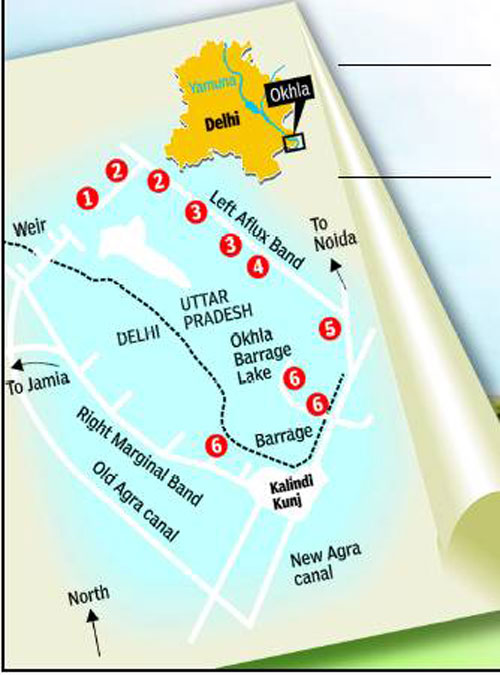
Some months ago, Mr. Arora had taken me to this bird sanctuary on the Noida side of Yamuna- ‘Okhala Pakshi Vihar’. I loved the water body, but I could not realize its significance. However, with news of various constructions to facilitate the 2010 Commonwealth Games in New Delhi and NCR appearing in newspapers almost everyday, this bird sanctuary could have become a great attraction for the visitors from far and near. And this can become a pride of Noida, if Noida Authority and Delhi Government promote it well.

The UP government notified the area on its side in 1990 as a sanctuary and perhaps Delhi government will also do that very soon for the area falling under it. However, it will need combined efforts of many agencies such as DDA, PWD, forest and environment department, and other land owning agencies, to make the place worth its importance.

Okhla Bird Sanctuary, with a spread over 4 sq km, might have come into existence in 1960s or 1950s with the construction of the Okhla Barrage and play host to over 300 bird species. However with continued long neglect by the agencies managing the area over the years, some 50 species had stopped coming. Between September and March the place is really alive with the arrival of the birds from central Asia, north Europe, northeast and the Himalayas.

Frequent visitors are: Bitterns from the northeast and Bangladesh, Eurasian Golden Oriole, various duck varieties like pochards, gadwalls. Tufted ducks and coots, black and brown headed gulls from Central Asia, White-throated kingfisher, Pled kingfisher, rose ringed parakeet, Black kite, and the Great Egret as well as Hume’s Warbler, Great Flamingo, Painted Stork, Green Bee-eater, Spotbilled duck

Agencies concerned must pull all its strength and will to develop both the sides of Yamuna, the river revered by all Indians between ITO bridge to Okhala Barrage and make it a world class water body that can attract birds and so tourists from far and near to watch and enjoy them. Perhaps, the Commonwealth Games 2010 will be the best reason to do that.

I came to know through media that Anand Arya who lives in Noida, is a keen bird watcher. Surprisingly I came to know of Anand because of a marriage function at my Noida residence in which he visited our residence in Noida. His white hair locks were unique and reminded me of Dr.Satyen Bose, the famous scientist in my Presidency College days. Many like him under ‘Delhi Bird’ have taken up the cause of Noida Bird Sanctuary. I wish it came up as a class one.

Posted in Uncategorized | Leave a comment

Seven Wonders- Can Taj be one?

TAJMAHAL


Within a fortnight from now, the voting for a new list of the ‘seven wonders of the world’ will close. It is going to be the people’s choice this time. However, the voters can be only those who are interested lot and who can use cells for SMS or Internet for e-voting. The results will be known in Lisbon on July 7 in perhaps a grand function.

The Taj Mahal in Agra was among the 21 monuments short-listed last year for the global poll. The poll is organised by The ‘New Seven Wonders Foundation‘, a privately funded Switzerland-based organisation.

The inclusion of Taj depends if somehow a lot of SMSs and e-voting in its favour can be managed to reach the organising agency. This may be a test of the nation-based preference of those in the country and abroad with an access to mobile-phone connections and Internet. Why is it not coming? Is it because either they don’t know about Taj, or about this voting or don’t care to vote? SMS voters, incidentally, can vote as many times as they like. Should some with zeal make it a mission and get into sending continuously SMSs in favour of Taj? Unfortunately, those voting on the Net can register their vote only once, and so I can’t help Taj in unscrupulous way. I Media Corp Ltd is trying to galvanise public support for the Taj. And that may be reason that on all the TV channels and print media, you can see the appeal.

At long last, Ambika Soni, the tourism minister has today appealed for vote for the monument. However, it is only some private or NGOs endeavour that too, soon enough and intense one can make Taj win a place. Some nations have taken it as real serious task. While some consider it a disgrace to make its monument compete for a place.

As reported, Brazil’s President Lula de Silva used a radio address to tell people how to vote for Rio’s statue of Christ the Redeemer. The government of Peru has opened computer terminals in public plazas to encourage people to vote for Machu Pichu.

If the Taj gets the ”seven wonder” tag, Taj will get publicity without making any investment. The Taj, as on today, is competing with Greece’s Acropolis, Mexico’s Chichen Itza pyramid, Paris’ Eiffel Tower, Brazil’s Statue of Christ The Redeemer and Jordan’s Petra.

The Great Pyramids of Giza is the only surviving structures from the original seven wonders of the ancient world, and are assured of keeping their status in addition to the new seven. Now, the race is open for all the seven spots with 20 contenders.

07/07/07 decides whether Taj keeps its date with history. And so, why not vote for Taj, if you have not.

I have done that, and wish that all like me should do it (Please SMS or use the link). It’s after all a good cause.

Posted in Uncategorized | Leave a comment

Be Green, Save Mother Earth

When global warming threat is so much a reality, the lead must come from India Inc. And it is coming. All that is done to reduce the global warming does also reduce cost as bonus in many cases.
Better energy efficiency (BEE) has become the top priority particularly in energy-intensive industries such as steel, cement, paper and fertilizer. BEE is a cost reduction step, as the electricity bill is 20-40 per cent of production costs of the sectors. According to the Bureau of Energy Efficiency, corporate India’s savings in this area run into crores of rupees every year:

1. Rashtriya Chemicals & Fertilisers has reduced its power consumption by 60 per cent in the past decade using new technologies.
2. With energy comprising 80 per cent of costs, Indian Farmers Fertiliser Cooperative (IFFCO) reduced consumption by 6-14 per cent, with a Rs 8.3-crore upgradation of its Phulpur urea and ammonia plant helping the company save Rs 1.2 crore every year.
3. Jindal Stainless Ltd (JSL) saved nearly Rs 4 crore through waste reduction in 2005.
4. Chemfab Alkalis invested Rs 36.75 lakh to upgrade and replace inefficient pumps and compressors, and initiated other steps, which led to savings of Rs 82.75 lakh in the last three years.
5. Jubilant Organosys’ energy expenses, as a percentage of total costs, came down from 34.5 per cent in 1997-98 to 21.9 percent last year.

Cement kilns have shifted from wet to dry process; the automobile industry is recycling wastewater and re-using the sedimented heavy metals used in electroplating. Textiles firms are adopting cost-effective technologies. Pulp and paper majors like ITC and Ballarpur Industries have cut water usage by half.

The desire to become a global manufacturing hub has impelled auto majors to reduce pollution. Hero Honda has already switched over to asbestos-free brakes in its motorcycles.

Institutions such as Shriram Institute for Industrial Research (SIIR) and The Energy and Resources Institute (TERI) have started offering sector-specific solutions.
The concept of green buildings that result in huge reductions in power (30-50 per cent) and water (30-50 per cent) usage are getting acceptance among many corporate that have decided to build only green buildings. From just over 50 green buildings now, the number may double by end-2007.

CII-Godrej GBC has also been able to start a voluntary programme, in which corporate members agree to reduce annual consumption of energy by 2-6 per cent, water by 5-10 per cent, and material by 2-6 per cent, and emissions by 2-6 per cent. Inspiration, perhaps, came from China, which, in 2005, asked its top 1,000 enterprises to reduce emissions by 20 per cent by 2015.

In interesting news, two Indian firms Bangalore-based SELCO (Solar Electric light Company) India and Kerala’s Biotech won the Outstanding Achievement category of the Ashden International Awards, more popularly known as ‘Green Oscars’. SELCO has brought reliable, affordable, and environmentally sustainable electricity to 55,000 homes and plans to reach an additional 200,000 customers by 2010. Biotech has till now, built and installed 12,000 domestic, 220 institutional and 17 municipal biogas plants to generate power from waste.

Lighting consumes a fair amount of energy. About 40 per cent of electric energy consumed globally goes for lighting. In India, it is about 17 per cent. A switch over to the fluorescent lamps from the 100-year-old technology of incandescent bulbs will save a huge lot of energy. It was interesting to hear the new CM of UP announcing a plan of the switch over to CFL in all government buildings. LED will be the next target for lighting for energy saving. Unfortunately, I have myself not done 100%, whereas my friend Sirohi has carried out the exercise. Even the household appliances such as refrigerators and airconditioners have got a mandatory standard about the power consumption. India faces a peak hour deficit of 14%. And the switch over to solar lights and CFLs can change India from deficit to surplus even without any additional generation.

It doesn’t, however, mean that India should not expand and expedite its generation capacity. But it is the responsibility of every person as a global citizen of mother earth to save energy and water.

Posted in Uncategorized | Leave a comment

Nalanda International University- India’s Prized Project

I had been following the project of Nalanda international University closely and have some dreams about that. I have written too time and again. I was thrilled to see an editorial-‘Nalanda Redux’ in the ‘Times of India’ today.

The Nitish Kumar government is building a modern university in Nalanda, an ancient seat of learning, as the symbol of a new, resurgent Bihar. Nalanda-in-the-works could be a model for revamping existing universities in India. The proposed Rs 1,000-crore project has international collaboration and will offer courses in subjects like IT, bioinformatics, development studies and applied sciences. A mentor group headed by Amartya Sen, and including representatives from China, Japan and Singapore, will oversee the making of an international campus. A standout feature of the Nalanda blueprint is the suggestion to hire part of the faculty from abroad. Forty-six of 453 teaching staff will be from outside India. They will be paid an average annual salary of $36,000 per person.

According to another report, ‘foreign minister Pranab Mukherjee followed up on the Nalanda University initiative by setting up a Nalanda Mentor Group in Singapore, headed by Nobel laureate Amartya Sen and Singapore foreign minister George Yeo. Nalanda is at the heart of the Indian soft power push. It’s where China’s greatest Buddhist traveller, Hiuen Tsang, came to study Buddhism under a Bengali teacher called Shilabhadra in the 7th century BC.’

I never knew that the project has gone so far. And it is really prudent that the central government is taking keen interest too. I say so because a government change in Patna will not affect the project.

I only wish that Bihar government creates a website proving the updates on some of the key projects of importance such as this. After years of sanction, the AIIMS in Patna is still years away from getting operative. Even the sanctioned project for an IIT in Bihar must move fast. IIT could have been the part of this Nalanda University. And more and more such specialized institutes from all the developed countries could be part of the international campus.

As an old man I am hopeful that in years to come the Nalanda International University will be a showpeice for Bihar and India.

Posted in bihar, education | Leave a comment

Purdah, Veil, Gunghat Creates Problem

‘In Rajasthan, people still practise purdah. The practice came into existence during Mughal rule, when we had to protect our women from men. After that the Mughal rule came to an end, we got Independence but we still continue to practise purdah. We must change with the times.”

The above is from a speech of Pratibha Patil, Governor, Rajasthan and the UPA candidate for the forthcoming Presidential race and the virtual president-designate in Udaipur at a function to commemorate the 467th birth anniversary of Maharana Pratap. Her reference was just to urge for abolition of the practice. However, her opinion that the purdah was introduced in India to “save women from Mughal invaders”, has created a furore among the Muslim leaders, historians and politicians of opposition parties, who wants to cash on this. Jamiat Ulema-i-Hind general secretary Maulana Mehmood Madani said, ‘She has twisted history, she must apologise and withdraw her observations.” It has certainly created a problem for Mrs.Patil.

I don’t know why we Indians have become so much intolerant. It is something strange for our culture of thousands of years. Why should the people take an opinion so seriously? I personally feel the purdah certainly was to conceal the faces of women from strangers, particularly the strong, brute, uncultured ones. Someone who would have seen Padmini, the queen of Rana Pratap ancestry, narrated about her beauty to Alauddin Khilji who invaded the kingdom to get her as her wife. But it was not only Mughals, it was also true with the Hindu kings and even petty feudal from whom the fear was equally there for women.

Historians say ‘purdah’ originated in India much before Babur heralded the Mughal rule in 1526 AD. Some of them say purdah was a status symbol of the higher classes in medieval India. According to renowned historian Satish Chandra, during the Delhi Sultanate period, beginning in 1206, the practice of keeping women in seclusion and asking them to veil their faces in the presence of outsiders became widespread among the upper class women. It was the Arabs and the Turks brought the custom to India, and consequently, it became widespread in north India. Historian Kegan Paul traces the practice of the custom back to the Vedic period. And anthropologist Patricia Jeffrey also opines its origin before the Muslim invasion. The mediaeval Chittorgarh fort that has separate quarters for women called the ‘jenani deorhi’. Even in our village, we also had a system of ‘janani kitta’ that used to be meant for women. Women will have purdah with all the elders in the family. Yamuna used to have purdah till very late, whenever she used to visit our village. It was absolutely necessary when we used to visit our mother at Bodarhi, my maternal village. It was to convey the message among the neighbours, particularly the women folks that the daughter- in-law is very obedient and abides the traditional things even though she is a wife of an officer. Interestingly, the peasant and working class women did not observe purdah. It was a feature primarily among upper classes. However, very lately they also copied what the women of the farming community did.

However, ”most historians consider the Muslim invasion as a watershed when purdah is said to have become more widespread as a defensive reaction in troubled times among the Rajput royalty trying to protect their women.”

But I feel like narrating some troubles caused by purdah system. Every summer in marriage season in Bihar in good old days we used to read a number of stories how the brides returning with their husbands from the marriage used to get mixed while boarding trains. My grand father has also mentioned about it in his diary. It is certainly something that must stop. The respect can be shown in other ways too.

But I believe, the best against purdah has come from Tulsidas in his Ramcharitmanas. Sita is being brought from Lanka’s captivity after Ram wins the war in ‘palki’ or ‘sivika’. And then Ram instructs, “Kah Raghuvir kahaa mum manahoo, sitahi sakha payade aanahoo, dekhahhoon kapi janani ki nai.” (Let Sita come on her feet, so that all the monkeys can see her as mother.)

A poet talks about the prevailing traditions of the society through his characters. Purdah was not a part of Indian cluttered. I have hardly seen any female statute with veil o the face.

Posted in economy | Leave a comment