A Spokesman or Business Prophet of Surging India- C.K. Prahalad

Here is a portion of an article by Pete Engardio in ‘Business Week’ about an Indian management Guru based in US, but helping in building an image of surging India. I keep a track of what he writes and tells. The ideas are fresh and interesting providing a lot of hope for India and for that matter for all developing countries:

You must have seen Bombay: raggedly dressed homeless families sprawled on blankets amid shacks. Traffic hopelessly clogged with every manner of soot-belching vehicle and wooden cart. Gaunt hawkers and beggars tapping on your window at red lights.

View the same streets through the eyes of C.K. Prahalad, however, and they become a beehive of entrepreneurialism and creativity. “I see the positives inside the muck.” As the ‘Indica’ sedan that he hired moves on, he notes that virtually every individual is engaged in a business of some kind — whether it is selling single cloves of garlic, squeezing sugar cane juice for pennies a glass, or hauling TVs.

On every block he points out the intriguing enterprises tucked into the nooks and crannies. With the world’s cheapest telecom rates, “all you need here is a phone and a $20 card to start a business,” he explains in his measured baritone. He notices a busy closet-sized shop charging a few pennies per page to send faxes. “That guy probably started with a single phone and then added a fax and printer. Now he has a self-contained communications center offering extremely low prices.” Such entrepreneurs, he contends, pioneered cheap pay-per-use services long before they became a fad in the West. The car stops at a small dry-goods shop. Prahalad bounds out and asks the owner to let him behind the counter. Tiny 5 cents single-serve containers of shampoo, soap, toothpaste, and other household goods dangle from the walls and ceiling. He notes the brands: Head & Shoulders, Lifebuoy, Pears, Colgate, Lux. “Low quality won’t sell,” he says.

The University of Michigan professor’s knack for being able to change people’s perceptions of the world around them has made Prahalad an incredibly influential corporate strategist. Prahalad and colleague Gary Hamel helped spark a management revolution in the 1990s with their idea of “core competence,” which says that companies must identify and focus on their competitive strengths. Their 1994 book, Competing for the Future, is regarded as a classic. A decade later he co-wrote The Future of Competition, which argued that the traditional “company-centric” approach to product innovation is giving way to a world in which companies “co-create” products with consumers. That book gave Prahalad a reputation among designers. At the same time, he has been working to convince executives that today’s needy masses, so often dismissed as subsisting largely outside of the global economy, are actually its future. Prahalad’s 2004 work on that topic, The Fortune at the Bottom of the Pyramid, has been hailed as one of the most important business books in recent years and turned Prahalad into a celebrity in the field of international development.

Street-smart innovation
One of the management world’s most creative thinkers believes that the entrepreneurial ingenuity at work amid such poverty, where success depends on squeezing the most out of minimal resources to furnish quality products at rock-bottom prices, has cosmic implications for executives and consumers everywhere. Some of the most interesting companies of the future won’t emerge from Silicon Valley or other places of abundant means, he says. They will come from places many executives don’t even think about because they have been considered too marginal. They won’t have that excuse for much longer, though.

In the world according to C.K. (Coimbatore Krishnarao) — poor nations are incubating new business models and innovative uses of technology that in the coming decade will begin to transform the competitive landscape of entire global industries, from financial and telecom services to health care and car making. Globalization, outsourcing, the Internet, and the spread of cheap wireless telecom are accelerating dramatic change. Few Western corporations fully harness these forces, Prahalad warns. And that puts them in danger of being usurped by a new breed of supercompetitive multinationals completely off their radar.

For his next book, Prahalad is assembling case studies of Indian companies that could spawn entirely new ways to think about conducting business. Fast-growing telecom operators such as Bharti, Reliance, and Tata, for example, are profitably selling cellular service for as little as 2 cents a minute “even though they must buy the same hardware as Western companies,” he says. Now they’re preparing to launch broadband TV, data, and voice for around $30 a month — about a third of the cost of such packages in the U.S. Bangalore’s Narayana Hrudayalaya hospital charges a flat fee of only $1,500 for heart bypass surgery that would cost 50 times that in the U.S. and operates on hundreds of infants each year for free. Yet it is highly profitable, has no debt, and claims a higher success rate than most U.S. hospitals. Narayana also profitably insures 2.5 million poor Indians against serious illness for 11 cents a month per person.

Low wages alone can’t account for such price gaps with the West, Prahalad contends. The real secret is ingenious cost-cutting practices, such as extreme reliance on outsourcing, novel use of technology, and making the most of capital investment. “These are radical innovations,” Prahalad says, many of which can be adapted to the U.S. Just look at the info tech industry: Long dominated by giants IBM, EDS, and Accenture, it has already been transformed by Indian companies such as Infosys and Wipro that supply top-quality services at lower prices. That, says Prahalad, is just the beginning of the revolution.

Here is one NRI that is doing more than many more Indians to build a brand image of Surging India. I wish he is approached or on his own he volunteers to study the case of Bihar and suggests some innovative way out to move ahead fast.

Posted in Uncategorized | Leave a comment

Around Central Park- Salt Lake, Kolkata

There can’t be better place for my morning walk of 5 km anywhere that I find in Salt Lake, Kolkata. A round of Central Park (Ban Bitan) was always interesting. But in last two years, some new structures have come up along the avenue encircling the Park. That indicates the speed with which Kolkata has come in competitive mode. When I started from Karunamayee side, the new building of HSBC near the Bidyut Bhawan impressed me. As according to my neighbour, HSBC will carry on its outsourcing business from here.

As I moved along the avenue, just behind the Dr. Bidhan Chandra Roy’s life size impressive statue, another private company is constructing its office. I had seen him while studying in Presidency, as his residence was nearby. Unlike today’s practice, this chief minister never lived in official residence. He was just a legendry doctor. Even when he was the chief minister, he used to keep a day in week for free medical consultation to poor. His date of birth and demise is same, the First July. While in IIT, I had read his biography written by an English doctor and that made him my hero. I feel sorry, as the statue of this founder of Salt Lake, and one who did the maximum in the development of West Bengal, will lose its locational grandeur.

>
Bidhannagar Sports Complex is now ready with its own building. Basically, it is for football, but as it seems, training for Judo and Karate is also undertaken. Unfortunately, the sidewalk still lies neglected.

The residence of the former chief minister, Jyoti Basu who ruled Bengal for more than two decades, perhaps a record of a sort, is lifeless. He still lives here. He single-handedly could have developed the state as the best state of the country. But he had some different priorities. I don’t know how an independent historian will judge his contributions to pre-independence West Bengal.
And then comes the City Centre- an impressive one with everything- the shopping complex, multiplex as well as some residential provisions too. Unfortunately, it is right in vicinity of the residential areas, and some residents express their annoyance over it. Even yesterday news report talked of some scuffle between some temporary vendors and a resident. I feel the planning could have separated the City Centre better. Knowing Bengal for so many years, I am sure a better law and order management would be essential in future.

This state respects its leading figures. Vivekananda statue is the latest addition. The surrounding area is still under development.

Municipality building across the avenue is equally impressive, though I don’t know how good is the service that it provides. At least the overall facilities that it provides are very poor. The quality of water has gone worse. Roads are not regularly repaired. However, there are no electricity outages here unlike Noida.

Next one sees the other Park with Netaji Subhash Chandra Bose statue standing in same elegant manner in his Bengali attire.

While moving towards Karunamayee crossing, I found a new Videocon Cricket Academy has come up. I am sure my three sons would have loved it. None of them are here. And I don’t know what Keshav and Svanik would like, perhaps basketball or American football.

Salt lake is adding fast to its attraction. But unfortunately, it is not having a good library nor a bookstore of Border standard. I wish it to have these. At least in West Bengal, one can always hope for these to be part of attractions.

Posted in Uncategorized | Leave a comment

Indian Bureaucracy Shows its Face

Recent differences between the IIMs and the Ministry of Human Resources are just shocking. Why shouldn’t the bureaucrats behave rationally? Why should they think that they are the only preservers of the interest of the country’s interest?

The prestigious older IIMs- Ahmedabad, Calcutta, and Bangalore are trying to go global. IIM-B wished to open a campus in Singapore. As Singapore is better placed globally in education sector, it would have got an exposure of global business issues- problems, solutions, and practices through interactions with the participants in its courses and the institute’s faculty. It could have judged its performance among the best schools of the world that are opening education centers in Singapore. That would help them in training successful global managers of tomorrow because of the fast moving globalisation drive in every sector. That will also assist in becoming one in top few management schools of the world. It was planning to start with the short-term executive education courses. But bureaucracy will not allow it. They want to keep these institutes of importance under their thumbs.

On one hand the government talks of allowing full autonomy to these institutes, on the other they want them not to go ahead with their expansion plans to have its bases in countries abroad. The same government branded the policy of reduction of fee wished by now infamous former NDA minister MM Joshi in larger interest of the Indian middle class students as authoritarian. As first thing after coming in power, it allowed these institutes to keep the fee as they wanted. IIMs felt elated as the government openly talked of full autonomy of these institutes, based on the images and brands that they have created globally. And any good and sensible government would have done that. After all, the best managerial brains of the country head these institutes. They know what will be good for the institute and the country and its people. How and why do these bureaucrats backed by the politicians think that they are only nationalist and others are anti-nationals in their actions?

However, as reported on JANUARY 11 in media, the Centre denied permission to IIM-Bangalore for a campus in Singapore. With the premises chosen, IIM-B had already announced a string of programmes for its Singapore Research and Management Education Center. But it can’t proceed. And to the global management community, it will be a case of India’s still remaining a close country. Human Resource Development Ministry officials are showing the way they work. As per the existing Memorandum of Association (MoA) of IIMs, overseas branches are not allowed. The Ministry wants IIMs to first cater to the demand at home, given the huge demand-supply gap in IIM seats. “We would like to see them opening more centres within India first.”

IIM-B was all set to start its campus in Singapore. It hired a place at Bhavan’s India International School Campus, Mei Chin, Singapore- comprising lecture halls, seminar and conference rooms, a library and a computer centre. Courses were to start next session. Similar plans were at hand by IIM- A too. But all that will be dropped or at least postponed till the government permits.
The remarks of a senior minister of Singapore, Goh Chok Tong, on Sunday January 15, 2005 summarises the effects of this decision. “Singapore is a hub for education and the institute (IIM-B) has a good reputation, so we are happy to welcome the institute. It is their (India’s) loss. They could have made some money as well.”

I feel India, time and again, misses the bus to go ahead as global leader in many areas because of government interference based on some old and obsolete policies and thinking. Why can’t the government allow the institutes to be free? After all, unlike politicians and bureaucrats, the institute heads don’t have any vested interest in setting the campuses abroad?

However, can’t these institutes of importance go and expand in both the ways- increasing the capacity in the domestic campuses and also establishing campuses in strategically global locations simultaneously?

Surprisingly, we have over 700 management schools in India. However, only 10-12 of them beside IIMs are the darlings of the corporate houses when they select for employment. And the main deficiency in the large number of B-schools is that of good teaching faculty. Perhaps, India needs one or more world class Management Teachers Training Institute on priority.
<

Posted in Uncategorized | Leave a comment

Bihar: Some Bright Spots

Whenever we talk about Bihar, we mention only of its lowest rank on any of the indicators of development. However, some data below will provide some hope and naturally with the effort that the new government is putting for an allout improvement, things will be much better:

 Bihar’s infant mortality rate is 62 per 1,000, which is below the national average of 66 per 1,000. It is better than not just states like Uttar Pradesh (83) and Orissa (91), but better than even states like Andhra Pradesh and Haryana (both 66).

 In terms of life expectancy, the average Bihari male lives a year longer (63.6 years) than his average Indian male counterpart (62.4 yrs) and the state’s performance in increasing life spans has been better than most during the past three years.

 Bihar has 7.04 million hectares under cultivation and its yield of 1,679 kgs per hectare, while less than the national average of 1,739 kgs per hectare is better than that of six other states, which include some big agricultural states like Karnataka and Maharashtra.

 Patna has the lowest proportion of slum dwellers at only0.3%.

And then comes the questions of the latent strength on which Bihar can build itself.

  Patna has the country’s seventh oldest university as well as some of its premier colleges such as the Patna Science College. Many teachers of the college have made meritorious contributions to research in their respective fields in the past for which they received national and international recognition. This healthy trend continues even to this day.
1.The research works carried out by emeritus scientist and renowned chemist J N Chatterjea, including synthesis of oxygen containing natural products and production of shellac-based colours for internal decoration are known throughout the world.
2.The works carried out by the late R P Roy in the field of Cytogenetics are also widely acknowledged.
3.R C Sinha, The father of Indian geochemistry established the Geochemical Society of India in 1965 and started publication of a research journal.
4.The department of zoology has been doing commendable work in the fields of environmental biology, especially Ganga river Dolphin, biodiversity and water quality monitoring.
5.The department of botany has undertaken a multi-institutional project entitled “Microbial Biodiversity Consortium Network of Bihar”. Another collaborative research project is entitled “Assessment of Microbial Load of Herbal Drug Triphala” thst has been taken up by the department in collaboration with the Bhabha Atomic Research Centre.
6.The department of geology has undertaken an ambitious project on rainwater and artificial recharge to groundwater.

Patna, Bhagalpur, and Muzaffarpur engineering colleges are old and distinguished. Iknow about Bhagalpur, as Dr. Gopal Sinha presently the director of central Mechanical Engineering research Institute graduated in mechanical engineering. Dr. BBPandey, Emiritus Professor in Civil Engineering IIT Kharagpur taught at Patna Engineering College for sometime.

I have heard of Khudabux library and about number of reputed historians.

With all this why can’t Bihar move fast? The present government must use the synergy of the talent available with it. With whom so ever I have talked here or in US, every one is expecting the government to succeed. But it must know how to do it.

Posted in Uncategorized | Leave a comment

Universal Education- People’s Responsibility

Today morning I went to Sector 50 Park instead of the usual one in Sector40 of Noida. As suggested, I go out a little late at around 9AM in winter because I am heart patient. It is comfortable temperature wise by that time. The walking track is about 700 metres across the periphery of the park. Plantations have still not grown to its heights. On one side there is one school for tiny kids and a huge residential housing complex is coming up nearby. On my first round, I found two boys coming to go their school well loaded with bagful books. I talked with them and encouraged them to work hard and study seriously, as that will make them own houses like one their parents are helping to build. The elder one told they have come from village recently. The younger was crying. Perhaps he was not willing to go to school. The older one also on his own told me that he is dumb. I requested him to take care of the young one more lovingly.

I moved on. When I was approaching the other side of the park, I found four kids well dressed in school uniforms with sweaters playing in the ground. I could guess they have bunked off the school. I moved on in that round. But in my next round I went to them to find out why are they playing and talked with them to find out why have they not gone to their school. Their parents must be thinking that they are in school, but they were wasting their time here. I talked with them for a while to tell them why they must go to school. They didn’t answer to my query first, but ultimately they picked up their heavy school bags and started moving out. I threatened to come to their shanties to meet their parents and complain. On my next round, I found them again outside the boundary wall, but they were not going to school. After I threatened again, they moved towards their school. I am sure they will not go to school, but play in some different place. And there will be hundreds and thousands of such kids.

How can this situation be avoided? How can the kids be made interested to go to school regularly? Are the teachers making the teaching interesting enough? One incentive for attracting them has been the mid day meal. However, I don’t know if it is strong enough incentive. How the parents can be convinced that schooling is necessary? How can they start taking interest in school activities? Many questions troubled me. Unfortunately, the parents in shanties are hardly interested. My wife got daughters of our maid admitted, but they never went to school. My wife keeps on telling Anandoo, the guard next door to send his son to school but he never did it. The government is doing its best to have universal education through different education schemes. The most publicized is the Sarb Shiksha Aviyaan. But still unless the parents of such children that I met in the park today get interested in educating their children, and teachers go out of the conventional way to make the teaching interesting enough and relation close to parental level, the scheme can’t succeed. Perhaps the country needs a scheme to educate parents more than that for the children. These parents must not think that the responsibility of education is that of the government.

Every now and then some volunteers visit our residences to find out if there is any child for polio drops in our knowledge. Perhaps the same volunteers can also enquire about the children that are not going to school. Our Resident welfare Associations or other similar associations can also have some drive to help universal education. Doctors can have some camps to tell the kids about the necessity of sanitation and hygiene. The senior people in locality can visit the schools and provide some moral boosting advices. On the whole, the society will have to take this responsibility at least for one generation to make the universal education drive a success.

It was interesting to read in an article by Vijay Kelkar, former finance secretary that ‘the total spending of the government of India on education, summing across Centre and states, divided by the number of children between ages 4 and 15, works out to roughly Rs 4000 per child per year. Any one in education profession will agree that it is feasible to get good quality schooling if you are willing to pay fees of Rs 4000 per child per year.

It can’t be just a government initiative.

Posted in Uncategorized | Leave a comment

New Cars and New Technologies

As I spent almost whole of my professional career in automotive industry along with quite wide exposures of automotive industry in developing countries of both- west and east, any development allures me to write about it. So I wrote on hybrid cars and hydrogen cars. It was great news for me when I read a recommendation of a panel with Ratan Tata as head about hydrogen cars of India. As it appears, India is getting ready for fuel cell cars where hydrogen will be the fuel. With not much of internal fossil oil resource, the country will have to go for the new initiatives. But for the strong lobby of oil companies in US, hydrogen cars would have been reality by now. The middle course is hybrid vehicles where along with the petrol (gasoline) or diesel engine, electric motor and batteries are also incorporated to let vehicle run on electricity at low speeds. Mahindra and Mahindra will exhibit a hybrid Scorpio at the Auto Expo that is starting tomorrow. M&M has already developed the prototype that is undergoing test. As reported, the hybrid Scorpio can deliver about 30-80% more fuel economy. The engine shuts off as soon as the vehicle stops at traffic light, and starts off again with almost no idling that saves fuel.

Congratulations! Pawan Goenka, Good job done.

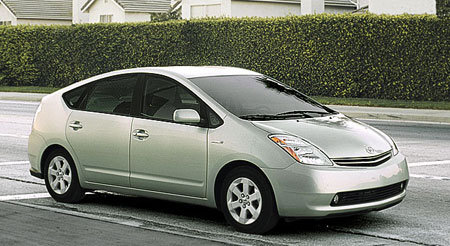
In US I had seen Toyota Prius commercially marketed and pretty popular with Americans. Naturally, hybrids are costlier. I had suggested in my earlier write-up that our government must give all tax concessions to Toyota and other to manufacture proven hybrid cars in India. It would have been a precious fuel saving and the most contemporary technology for the country. Chinese persuaded rather forced Toyota to manufacture hybrids. The car in coming days will have many new features that we could not have even imagined. Anand, my youngest son was describing his driving experience of Toyota Highlander, and just by hearing the whole thing I was getting excited. That had a GPS to guide the vehicle in a pitch dark snowy night, beside providing all other information like hotels of their choice and restaurant to make the long journey a pleasure of its kind. Here are some more developments that you may look for while visiting Auto Expo 2006 in next few days.

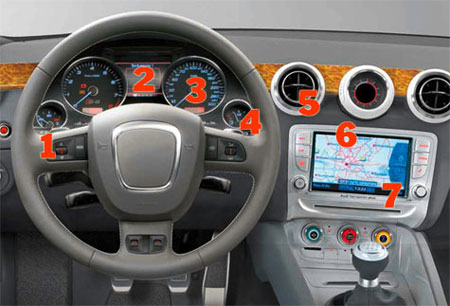
1.Sensors

Sensors will light up an icon on the instrument panel or sound a warning drone when drivers are veering out of their lane or are heading toward a possible accident
.
2.Horsepower

Even though fuel economy is hot, the horsepower war rages on. Amateur drivers still love to punch the gas pedal, and many newer cars are both responsive and efficient.

3.Air Quality
Germophobes will love new plasma-based technologies that release charged ions to filter out mold and bacteria. The result: Cleaner air inside than out.

4.Diagnostics
Carmakers are offering systems than can run self-diagnostic tests on cars, telling owners when the brakes, engine, or air bags need to be fixed.

5.Sound System
Soon you’ll be able to plug in your iPod or a memory card loaded with your favorite tunes and toggle from track to track using controls located right on the steering wheel. And ISRO is going to provide
easy access to TV channels.

6.Fuel Economy
Hybrid-electric vehicles, transmissions with up to eight gears, and high-tech gasoline engines are slowly but surely delivering the fuel economy gains that were promised back in the ’70s.

7.Navigation Systems
Navigation systems will tell you more than how to get there-soon they’ll tell you how not to get there. They will know where the traffic jams and accidents are, and they’ll eventually be able to tell you to slow down when coming up on a hairpin turn.

Are these not amazing things getting in your cars when you go for buying tomorrow?

P.S. Here comes Mahindra`s wonder car
For global carmakers, India is destination design
READ MORE ABOUT HYBRIDS
Hybrids or Diesels? Probably Both</POST

Posted in Uncategorized | Leave a comment

Is it India Shining, Incredible, or Unleashed?

It has never been so good.
More than 400 M&A deals (over $18 billion in value)
 

Vodafone pays $1.5 billion for a 10 per cent stake in Bharti Tele-Ventures.
 Essar and Hutch take over BPL Mobile and BPL Communication for $2.1 billion.

 Videocon buys out CPT business of MNC Thomson US for $290 million.

 Matrix takes over Belgian company Docpharma NV for $263 million.

 Oracle buys out Citicorp’s controlling stake in i-flex for $593 million.

 Ratnagiri Gas and Power buys GE and Bechtel stakes of Dabhol Power for $305 million.

 Tatas spent Rs 4,500 crore to acquire global businesses. Tata Chemicals takes over Egyptian fertiliser firm SAE for $519 million. Tata Steel acquires Thai Millennium Steel for $400 million.VSNL buys Teleglobe Holdings for $254 million. TCS bags Australian FNS for $26 million.

 Essar Steel buys INI Steel for $100 million and Hy-Grade Pellets and Gujarat Steel for $450 million.

 Vijay Mallya’s McDowell takes over Shaw Wallace for $320 million.

Virtually every week an Indian company is acquiring a company abroad. Mahindra & Mahindra, Bharat Forge, or Wipro are perhaps in a hurry for going global in real sense of the term.

Sales and Profits 2004-5
 A sample of 1,765 companies shows that net profits for the first quarter of 2005-6 has jumped by 46.02 per cent, while sales clocked a 15.01 per cent growth.

Investments and investment intentions

 Foreign institutional investors pumped in a record $10 billion this year.

 The Centre for Monitoring Indian Economy reports that during the quarter ended October 2005, 564 projects with investments of Rs 2,11,054 crore were announced-the highest in a decade. Since March, IT and telecom companies have announced investments worth over $9 billion.

 An AT Kearney survey has ranked India the second most favoured destination for FDI, behind China, relegating the US to the third spot.

 The UN Conference on Trade and Development sees India among the “dominant host countries” for FDI in Asia and the Pacific.


Global tech titans’ investments of over $8 billion in the telecom and IT Sectors.

 Advanced Micro Devices signs a “milestone agreement” with SemIndia to bring semiconductor manufacturing facilities to India. The move envisages an investment of $3 billion over four years.

 Bill Gates, on his fourth visit in two years, announced that Microsoft Corp will invest $1.7 billion in India over four years and employ 3,000 more people to strengthen its presence in India.

 INTEL -the tech giant will invest more than $1 billion in five years. Plans include $250 million to be invested in a venture capital fund to help stimulate technological innovation in India and drive the growth of the country’s it industry.

 CISCO- the networking behemoth will invest $1.1 billion, including $750 million for an R&D centre.
Nokia, LG, Samsung and Alcatel are setting up manufacturing units in India to tap into the booming cellular services business.

IT Sector

The Indian IT industry has leapfrogged crossing of the Rs 1,00,000-crore mark in revenues and the direct employment of over 10 lakh personnel in software and services, with indirect employment being two to three times that number. Software and services exports grew by as much as 34 per cent in 2004-5, grossing over $17 billion (about Rs 76,500 crore). The forecast for the year 2005-6 is a further growth of 30-32 per cent. The national market too has seen vigorous expansion of about 25 per cent. The recent NASSCOM-McKinsey study projects a $60 billion (about Rs 2,70,000 crore) export figure in 2010 for the Indian software and services sector.

Consumers’ Economy

While all the information above shows the health of producers’ economy, here are some glimpses of consumers’ economy:

Number of new mobile users added till November 2005 is 23.41 million-highest in a year. Roughly a mobile phone is being sold every second.

45 million PCs have been sold this year that is the maximum in a year. Mutual funds raised Rs 53,982 crore in the first 11 months. And average increment in salaries in private sector was 14% the highest since 1990s.

And GDP

Even the PM is no more hesitant in talking about 8%+ GDP growth. India is huge mass flywheel. It has started moving- from the Hindu growth rate to 6% average, and then 7% for last few years, and now 8%+. Even with a slight increase in productivity of inspired individuals who contribute to the overall GDP, and perhaps by bringing in some innovations in all the individual assignments, the flywheel will get into speed that will be difficult to be stopped.

And finally, a late-year survey of Transparency International showed that corruption actually decreased in India. That itself can boost GDP by several points.

Posted in Uncategorized | Leave a comment

ARUN FIRODIA’s Views on Rural Transformation

Arun Firodia, chairman, Kinetic Group keeps on expressing his views on rural transformation. It interests me. I am sure his ideas carry some freshness to bring out revolutionary changes in the quality of life in Indian villages even for governments with limited resources. I have met him once, but I don’t know if he has some root in village and first hand experience or he is just a thinker of the subject only. Here is the gist of some key points mentioned in his latest lead article in ‘Times of India’ editorial page:

World trade in food products, seafood, herbal products and flowers is about $395 billion. India ought to have a 20% share in this market, since India possess 20% of world’s irrigated land. Fortunately, nature has provided India with large tracts of fertile land, nine to 10 months of sunshine, average rainfall of over 1,000 mm and great biodiversity. India must leverage this to focus on export of a variety of processed food, seafood, herbal products and flowers. Rural India can become the world’s agribusiness powerhouse.

Banks can provide such finance and insurance companies the necessary cover. The government should exempt agribusiness units from income tax, sales tax and excise duty.

More than 25% of the farm produce is lost in storage and transportation. A chain of cold storages can be of great help. As I know government in many villages in Bihar got constructed ‘godowns’ in 70s or 80s that had never been used and are now depilated. I wish all the future rural projects in a village get developed in a cluster. Going by my own village or as I have seen in villages around mine, all the government owned buildings such as schools, panchayat, and godown are in different locations away from the main habitation. If they would have been one single cluster, it could have better use as well as supervision of their status by villagers.

Food Bank
Mr. Firodia proposes a new arm of the banks that are having some 68,000 branches all over the country called ‘food bank’. A food bank would own a cold storage unit and function like a safe deposit vault. A farmer could deposit his produce (or milk) in a food bank when he needs to and withdraw it whenever he chooses. A food bank should give him a loan against this security to help him buy seeds and fertiliser for his next crop.

Electronically wired food banks can act as commodity exchanges and help the farmer in deciding the right time and the right destination to sell his produce.
A food bank can lend to agribusiness units to help them modernise to international standards. It can even open a retail counter. A food bank can provide all these services at a much lower rate than the middlemen. That would increase farmers’ take-home sharply which he can then invest in his agribusiness.

Rural Bio-energy Cluster

Oil companies in the country could help create a bioenergy cluster in each village that uses locally available feedstock to produce biogas, biodiesel and ethanol.
India has 1250 million cattle. Cow dung coupled with other farm residue like rice husk can be a source to generate enough biogas. And the rural population can use it for cooking, running agricultural pumps, energising cold storages and powering transport vehicles. Biogas can also help in producing electricity, bio-fertilisers and bio-pesticides. Waste heat from the generating set can help in generating safe drinking water too.

Every village is having a lot of wasteland- a total of 41.5 million hectares in India. Rural population requires empowering to plant some 400 different types of bio-diesel trees like jatropha, neem and karanji. Seeds from these plants can produce enough bio-diesel to meet their requirement of diesel. Bio-diesel and ethanol can be sold to oil companies for further processing and blending with diesel and petrol. Carbon credits under Kyoto Protocol will improve the clusters’ economic viability.
India has 108 million hectares of non-irrigated farmland where farmers can grow sweet sorghum, corn or similar energy-rich plants or grass that can be the source for ethanol to meet our petrol needs.

The Agriculture Finance Corporation has estimated that an agriculture-led strategy can generate 7.5 lakh jobs in Pune district alone. If we implement this strategy in 350 districts we can create 270 million jobs. Banks and insurance companies will do a great social service if they encourage this concept.

With a liberal but responsible rather accountable credit policy and some rural level leadership, every village on its own can become prosperous. The major national political parties, both ruling and those in opposition that claim to believe in developmental politics must have post-election campaign to rebuild the country side on its on resources and must start using its cadre at village level for the projects such as those suggested by Mr. Firodia or other innovative ideas suggested by the grass root levels for improving the local conditions.

Posted in Uncategorized | Leave a comment

Manufacturing Must Move Faster

Prime Minister Manmohan Singh exhorts India Inc to brace up for a sustained 14% growth in manufacturing sector. The marginal improvement in the share of manufacturing in national income from 15.8% in 1991 to 17% in 2003 is of concern. PM wants it to be in the range of 25% to 35%. This requires manufacturing to keep growing at 12% – 14% in the next decade. PM emphasized, “Manufacturing has to be the sponge, which absorbs people who need to move out of agriculture in pursuit of higher incomes. I do not accept the proposition that India can skip the manufacturing stage of development and go from being an agrarian society directly to becoming a services and knowledge-based society. This is a mistaken view. A substantial manufacturing base is essential to absorb the workforce and ensure sustainable growth of the economy.”

As suggested by many consultants, India can be a major player in many sectors, such as in agro-processing, in textiles and garments, in automobiles and components, in pharmaceuticals, in chemicals and petrochemicals and in leather and footwear. PM urged industry ‘to have faith and take the plunge.’

The global auto giants are reeling under increasing cost pressure to outsource components. And what a huge potential! Global auto components consumption is expected to grow from $1.2 trillion in 2004 to $1.6 trillion by 2015. India is also catching attention for some of its unique advantages. India is also becoming a destination for outsourcing automobile R&D.

Why are we not getting a major growth in manufacturing sector? Indian firms are innovative too. Nearly 70 per cent of the companies, which were recently surveyed by Boston Consulting Group and Confederation of Indian Industry, stated that they were hiking innovation spend in 2006. Among the major rapidly developing economies, Indian firms were the most active innovators with over 1,000 patents filed out of a total 5,401 patents. There seems to resurgence in manufacturing sector. Many Indian companies are going global.

As Kanika Dutta in Business Standard points out, “Despite all its deficiencies, India has not only become the world’s back office, it is increasingly being eyed for its manufacturing capabilities as well. If Indian management has anything to be proud of, it is the ability to succeed and achieve global standards in what are still undoubtedly and unabashedly Third World conditions.”

Almost every one agrees that a high growth in manufacturing is necessary to generate greater employment opportunities. As every agency had done recently, CII points out to “constraints in five areas such as infrastructure, labour laws, cost and access to credit, technology and skill development need to be addressed.”

CII suggested setting up of Technology Upgrade Funds Schemes for all manufacturing sectors and making provision of a weighted deduction of 150 per cent for all in-house research and development expenditure and R&D commissioned by private firms to academic institutions and public sector laboratories. CII’s other demands are:
  Restoration of 100 per cent rate of depreciation for energy saving devices, pollution control equipment, alternative energy producing devices, computers and devices for water conservation.
  Total dismantling of the inspector raj
  Permission for contract labour to be allowed in non-core sectors
  Making the IDS Act applicable to only units with more than 1000 workers
  Complete de-licensing and decontrol of all segments of the education sector, establishment of multiple private sector accreditation agencies and fiscal incentives for corporate investments in skill formation and education

Unfortunately, CII does not come out what they plan to do themselves, particularly for their shop floor employees, their training, their compensations, and improvements of their quality of life. In many SMEs the compensation to the workforce is dismal, when the labour cost in India might be very low. CII must not overlook its social responsibility for improving the working conditions of workforce in unorganized sectors. Manufacturers must not neglect these aspects. Its member companies must not keep on talking about labour reforms without having an effective grievance handling system in place.

And then many times I start wondering if we are serious to do something in manufacturing that can amaze the world as Chinese do. Why can’t India be the top auto components suppliers in world? Why can’t with the best ores and the history as amazing as Iron Pillar, India become the largest producers of steel or aluminium, or for that matter the largest exporters of precision castings and forgings? What holds India from becoming the largest exporter of engineering goods? And of all the things why can’t India match China in exports of textiles, when India has the history of its excellence in textile trade since Harrappa era?

India planners must select some areas of strength and try to reach the top position in manufacturing and producing them.

Posted in Uncategorized | Leave a comment

Figures Confirms India Shining Story

The number of domestic airtravellers will touch 24 million by March 2006, growing 30% and international air travelers will touch 20 million, growing at 18% annually, as per data from the ministry of civil aviation.

In the eight months between April and November 2005, an estimated 19 million mobile subscribers were added to the networks. For the last one year, the average run rate of new subscriber additions is at 2.5 million. With Motorola, Siemens, and Nokia promising to drive down costs to under Rs 1000, and reliance bringing down STD charges all over India at Re 1 per minute, the additions will be faster.

Thera are today 16 million credit cardholders and 30 million debit cardholders in India. In 2006, an estimated 450 malls are likely to be added in the top six cities, and the retail market has been valued at 4330 billion for 2005, growing at 10% for the last five years. And as per the estimate, the new malls to multiplexes ratio is about 2:1.

Office space demand in 2006 will be about 22 million square feet in India’s top nine cities as compared to 15 million sq. ft. in 2005. Over a million cars will be sold in 2004-05.

Total Internet connections stood at 38.5 millions as of November 2005 and is expected to reach 100 million in two years. Between 2000 and 2005, the number of Internet users has grown eight times from 5 millions to almost 40 millions, mobile phones by nineteen times from 2.3 millions to 45 millions, personal credit offtakes from$10 billions to over $ 30 billions, and cyber cafes grew six times from 18,000 in 2000 to 105,350 in 2005. Broadband connections took off in 2005 with a 7.5lakh score between April and November.

Investor wealth grew by nearly 50% from Rs 16.8 lakh crore to Rs 24.6 lakh crore during 2005. By the end of 2006, it is estimated that there will be one million dollar millionaires in India. Studies show it’s the lesser-known cities where the millionaires are now concentrated. According a National Council of Applied Economic Research study, millionaire households or households with an annual income of over Rs 10 lakh have been growing at a whopping 850% in Nagpur. Between 1996 and 2002, the citty saw their numbers rise from 1,199 to as many as 10,417. Ahmedabad is at number two position.

Are these figures not confirming the India shining? All of you can help me in making the list could much longer by adding some more data. But then are we happier too, as many ask me when I put forward these figures? I do’have any answer that satisfies me, before I put forward to my friends.

Posted in Uncategorized | Leave a comment