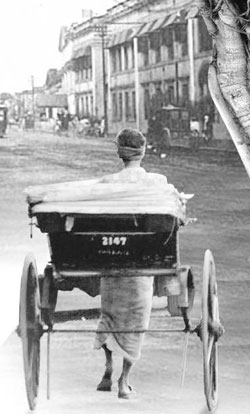
Handpulled Rickshaw Becoming Part of Kolkata History

I came to Birlapur, a small industrial jute mill town near Kolkata as a child in 1946 at the age of six for schooling. But my regular schooling started in 1950 from class VI at Birlapur Vidyalaya. Whenever my grandfather took me to Kolkata, we used to have a difference of opinion on one thing whether we should ride a man pulled rickshaw. While my grandfather took it as a normal transpiration means, I thought its use as shameful act- a human riding human. After almost 50 years of independence, only few days back the United Front government of West Bengal could get the state assembly pass ‘The Calcutta Hackney-Carriage (Amendment) Bill, 2006′, to phase out hand pulled rickshaws. The rickshaws will become part of the history of the city. The bill, when enacted, will undo what Chinese traders did for Kolkata’s transportation in the late 19th century by introducing this eco-friendly transport. That was years after Shimla boasted of it in 1888. And now after Bengal’s Marxist lawmakers handed the death sentence to it, the screen travails will fortunately assure the carriage at least lives in reel life.

Be it films, Parineeta, Do Bigha Zameen, Amar Prem or City of Joy or be it filmmakers, Satyajit Ray or Rituparno Ghosh, the hand-pulled rickshaw represented Kolkata in its elements.
Kolkatans have different views. ”It may be seen as a form of slavery, but the hand pulled rickshaws should be preserved as part of our heritage. There can be certain routes on which they can still be allowed to ply.” ”But it is one of the non-polluting vehicles the city must ever have.” ”When there is flooding in Kolkata, hand pulled rickshaws are the only solace. They are symbolic to the City of Joy.” “In a city sparsed with narrow lanes and bylanes, rickshaw-wallahs meet a very important transport need. They are Kolkatans’ friends through thick and thin. Come floods or riots, the rickshaw puller is only a hail away. Ever heard of a rickshaw-puller betraying his passengers’ trust.” “Every great city has an USP. Kolkata’s USP – whether we like it or not – is the rickshaw. No other great city can boast of it.”

While piloting the bill, CM Buddhadeb Bhattacharjee reiterated what he had said earlier. ”We must agree on one point that in the 21st century it is not right for a human being to pull another human being. Wherever I go, be it Delhi, Mumbai or abroad, people ask me how long Kolkata will have hand-pulled rickshaws? This is a shame for our city. We should have done this much earlier.” The CM promised rehabilitation for rickshaw-pullers. Some crude facts are:

Most of the rickshaw-pullers were from Bihar who leave their families at home and spend 10 months of the year in Kolkata

24,000 rickshaw-wallahs were enrolled with the All Bengal (hand-pulled) Rickshaw Union

Only Rs 30 was all a rickshaw-wallah would need to renew his license.

The number of licensed hand-pulled rickshaws was 5,937.

Most probably all these rikhshapullers, particularly the younger ones, will try to do something else and the elders may move to their villages. Perhaps the worst affected will be the union leaders who used to live on the collections from the poormen to support their causes.

I don’t think I can forget the memory of aged, thin rikhshawallas carrying the excessively obese ladies and gentlemen of business community in Burrabazar that I hated. Most of those families, as such have now switched over to cars.

Posted in Uncategorized | Leave a comment

Some Indian Achievers

In last week, I came across some Indian achievers who brought laurels to the country. Though not any way very close, many like me feel equally elated with their achievements

Technology Pioneers 2007: Indian companies Strand Life Sciences and Drishtee are among 47 ‘visionary’ firms worldwide that were selected by the World Economic Forum as ‘Technology Pioneers 2007’ for their life-changing innovations. Their innovations have been considered to have the potential for long-term impact on business and society.

Global Indus Technovators Awards: The ten young under-40 innovators and entrepreneurs recognised by the Indian Business Club at Massachusetts Institute of Technology for their outstanding contributions to biotechnology, information technology and grassroots technology, are:

Biotechnology/medicine/healthcare– Anita Goel (Nanobiosym Inc), Krishna Kumar (Tufts University) and Shiladitya Sengupta (MIT)

Materials and Devices: Aref Chowdhury (Bell Labs), Rajeev V Ram (MIT) and Adam Rasheed (GE)

Information technology: Anuj Batra (TI) and Rajit Manohar (Achronix Semiconductor).

Indian entrepreneurs Vikram Akula, founder of SKS Microfinance, and Sameer Sawarkar of Neurosynaptic Comm are the winners in the Grassroots category. Akula, founder of SKS Microfinance – one of the fastest growing microfinance organisations in the world, has provided over $33 million in loans and helped over 300,000 people in becoming economically self-reliant.Sawarkar, founder Neurosynaptic Communications Pvt, Ltd, who works in the areas of remote medical diagnostics and telemedicine, has developed ReMeDiV solution for rural telemedicine.

‘Scientific American’ 50 achievers: ‘The ‘Scientific American’, said to be the oldest published magazine in the US named two Indian Americans Pulickell Ajayan and Prabhakar R. Bandaru in the list of 50 achievers in the field of science and technology.

Ajayan is an assistant professor at the material science and engineering department at Rensselaer Polytechnic Institute in Troy, New York and was recognized for his research on carbon nanotubes by the Materials Research Society.Ajayan’s research work involved creating super-resilient springs from thin carbon tubes that could one day be used to create artificial joints. Ajayan graduated in metallurgical engineering from BHU and got his doctorate in materials science and engineering in 1989 from Northwest University in Illinois.

Bandaru is a professor in the Jacobs School of Engineering’s materials science program at the University of California, San Diego. Bandaru and his colleagues demonstrated a radical nanotube-based transistor. Scientific American described graphitic structures, the area of Bandaru’s research as ‘Chicken Wire’. Bandaru received his doctorate from the material sciences and engineering department at the University of California, Berkeley, in1998, with a master’s thesis in the thermodynamic phase transformation issues in magneto-optic media.

Right from our great President every one down the line are talking of encouraging science education and making it more lucrative. Our universities must work on basic research. The country that produced Jagdish Chandra Bose, CV Raman, Satyen Bose and Meghnad Saha with very little facilities available in the pre-independence era seems to have lost the race of scientific research.

I am sure many in our national research laboratories, IITs, IISc and many universities too must be doing outstanding research work, but the country is so little informed about them. Why is it so? Is it because of the irresponsible media that are too busy to cover our crooked politicians and hot and marketable news or because of institutional restrictions to write about the research work?

Posted in Uncategorized | Leave a comment

Bihar Development and Investment Council

Bihar has now Bihar Development and Investment Council (BDIC) and Bihar Foundation to help develop Bihar.

As reported, “Headed by the Chief Minister, the BDIC will comprise top shots from the India Inc, including Anand Mahindra of Mahindra and Mahindra, Sunil Bharti Mittal of Bharti Telecom, Kumar Mangalam Birla, B Muthuram (MD of Tata Steel) Rajshri Pathy of Rajshri Sugar and Sanjeev Goenka. Deputy chairman of State Planning Board NK Singh will be its deputy chairman and former economic advisor of the Government of India Shankar Acharya a prominent member.”

It is surprising and unfortunate that CM’s council (BDIC) doesn’t include any IT biggies. No state today can think of significant development without IT/ ITeS/ BPO/ESO/KPO. It is the need of hour. With huge number younger people of the state studying outside the state preparing for the sector, the main input for the sector that is the major deciding factor, is readily available. At least after education, the young men could have come to the cities of the state and work there. It could have as elsewhere changed the economy of the cities. It can bring out the potential of intelligent Biharis. I don’t know if CM or his men didn’t try to contact any of them or they didn’t agree .I further fail to understand why the government is not taking lessons form even smaller places such Bhuwaneswar, Bhopal, Mohali, Jaipur, and Kochi are developing fast as IT centers. IT sector doesn’t need much investment too. However, the government must have to ensure the infrastructure necessary for IT and the law and order around the location.

Deputy Chief Minister Sushil Kumar Modi heads ‘Bihar Foundation’ that aims “to bring all Biharis settled in different parts of the world to partner in their state’s endeavour to develop.” I wish the government opened ‘Assistance Center for NRBs’ that can help them in the way ‘your man in India’ does. Some one from Mauritius approached me to know a place in Rohtas that was the place from where her ancestors went to Mauritius. I tried my best but I could not. I am sure if there was a center for NRB, she could have got the information.

I shall also wish BDIC and Bihar Foundation to have its websites that are regularly updated and queries answered. Unfortunately, as per the Bihar government website, none of the ministers except for the CM and DCM have e-mail address so that people can contact them. But the worse is that even the CM and DCM do never acknowledge even with one that can be done automatically.

Surprisingly, CM and his party JD (U) chief, Sarad Yadav have outright opposed the policy of SEZs and closed the door for the aspirant investors in SEZs. It would have been better to remain non-committal for CM as shrewd statesman. This has unnecessarily made them anti-investors. CM should leave the subject open for discussion at BDIC.

CM and DCM must encourage ‘one education hub’ at the headquarters of every district for higher secondary and professional education, and see that all the existing professional colleges of engineering, medicines and sciences compete in quality with the best in India. This will lay foundation for bringing in BPO and enterprises in high-end knowledge sector. Perhaps, Bihar Foundation can help accelerating the knowledge sector. The story of the efforts of Ravi Verma, a Silicon Valley entrepreneur at a small town of Katihar is precursor of the things to come. Verma’s Telecommand, started in Dec, 2005, provides IT consulting and support to both public and private sectors in Sacramento county and wider northern California areas. Verma, in his 30’s, is proud of running a successful software development centre in Katihar. Verma has hired software engineers belonging to the town who had gone to cities like Bangalore and Mumbai in search of work. Bihar can move forward only with such an innovative entrepreneurships of NRBs.

Posted in Uncategorized | Leave a comment

The Antikythera- the first analog ancient computer

Have you come across this unique discovery? Scientists in ancient days too worked on some sort of mechanical devices that could make their arduous calculations a little easier with no chance of human error.

Divers found the Antikythera Mechanism, an ancient computer, in 1901 off the coast of Antikythera, a Greek island 18 miles north of Crete. Greek divers, exploring the Roman shipwreck at a depth of 42 metres actually came across 82 curious bronze fragments. At first, these pieces, thickly encrusted and jammed together after lying more two millennia on the sea floor, lay forgotten. But a closer look showed them to be exquisitely made, hand-cut, toothed gearwheels. It was clear that, within this find, 29 gearwheels fitted together, possibly making some sort of astronomical calendar. A rough replica of the device was eventually constructed and archeologists guessed that it was an astronomical calculator. But the inner workings and the device’s true nature remained unknown for 100 years.

A group of scientists from the U.K. and Greece led by Mike Edmunds, an astronomer from the University of Cardiff has deciphered the Antikythera Mechanism. According to the group’s findings published in the November 30, 2006, issue of Nature, several physical factors and the device’s reference to Hipparchos, place the mechanism between 140-200 B.C. And a complete computer model of the device has been constructed,

The Antikythera could be considered the first analog computer. The team of experts from the U.K. and Greece discovered that its system of dials and more than 30 gears is more complex than those found in medieval clocks. It suggests that the Hellenic people were much farther along technologically than scientists, historians and archeologists had assumed. The device is at least 1,000 years ahead of its time.
The inscriptions on the Antikythera Mechanism have been deciphered to reveal theories for ancient planetary positions. The mechanism was used to predict and calculate lunar and solar eclipses on the basis of Babylonian arithmetic-progression cycles. The mechanism also calculates lunar positions based on theories by the famous Greek astronomer Hipparchos for deciphering the Moon’s elliptical orbit. The machine’s ability to calculate sophisticated astronomical knowledge of the Moon’s unusual orbit surprised the scientists.

The original device is likely to have comprised 37 gear-wheels and comprised two clock-like faces, one front and one back, which would have fitted into a slim wooden box measuring 31.5 x 19 cm and a thickness of 10cms. The machine was a 365-day calendar, which ingeniously factored in the leap year every four years. It could also predict lunar and solar eclipses under the Saros cycle, a 223-month repetitive interplay of the Sun, Earth and Moon. The Machine was also a star almanac, showing the times when the major stars and constellations of the Greek zodiac would rise or set and, speculatively, may also have shown the positions of the planets. (Credit: Copyright of the Antikythera Mechanism Research Project)

I wonder how little we know about what all our ancestors achieved, but the evidences of their achievements disappeared or lost because of human conflicts or natural disasters. Can’t someone some day find the remnants of vimanas used by some of our ancestors or a similar computer used by Aryabhatt or some of the weaponry that Arjun or Karna used?

Posted in Uncategorized | Leave a comment

A Billion On The Move

India is on the radar screens of international corporations as well as media for many good things happening here. Many are appreciative of what is happening in India but many are skeptical too. To the Paris-based daily, ‘International Herald Tribune’, India is consumed with the idea of becoming a superpower, ”an obsessive conviction that India is destined for international supremacy is spreading fast.”

However, Arun Maira of Boston Consulting Group in a recent article ‘A Billion On The Move’ in Times of India presents a story that appears to be more rational.

Earlier this month, 450 strategy advisors to boards of companies in 50 countries arrived in Delhi to check out the India story for their clients. Last year they had visited China.

China makes a much better first impression. Indian airports and roads are chaotic in comparison to the marvels of Chinese infrastructure. The next impression of India for the consultants was further chaos. The morning papers were filled with stories of demolitions in Delhi, traders’ protests and the ongoing tussle between the courts and government.

Nevertheless, further encounters during the week, beginning with a candid meeting with the finance minister, changed their minds. By the end of the week, they said they were truly impressed, and would recommend to their clients that India may be emerging as a better long-term bet than China.

The FM had admitted that the infrastructure was falling short of the booming economy’s requirements, and that democratic political process made progress less orderly than in China. However, he pointed out that India, with its enormous diversity, could not work without democracy. A delegate pointed out the loss in economic efficiency by the clumsy diversion he saw of an Indian highway to avoid a small Muslim tomb that came in its path – something not seen on China’s super highways. The minister replied that if the tomb was sacred to some people, then it had to be respected, regardless of the inconvenience to others. That, he said, was the Indian way – the international audience applauded.

It might have impressed the visitors, but irritates the Indian people at large, and a sense of demoralizing helplessness dawns. Why can’t the local authority effectively take the people concerned in confidence and impress upon them the national importance of giving up the traditional views in all such cases of tomb or temple? It may appear difficult, but not impossible to reach an amicable and quick solution to avoid the excuse for delays in the projects.

During the week, the consultants broke up into smaller groups and visited manufacturing companies and numerous service companies around Delhi. They returned from these visits convinced that Indian manufacturing companies are equal to the best in the world, and that Indian service companies are ahead of the best, creating new business models and setting new standards.
However, even after getting convinced with the capabilty of Indian manufacturers and service sector, will the report of the delegates make a big difference to tilt the scale of FDI in favour of India? But then why should India bother so much about it? Perhaps India must have a business model that can move the billion ahead.

And here Mr. Maira gives the success story of Andhra Pradesh self-help group.

In Andhra Pradesh, 8 million women are members of self-help groups at the grass-roots level. The groups function autonomously. They determine what help they need from a level of organisation above them. In turn that level, in the village or mandal, determines what it needs from a level above it to fulfil its own role. Thus, from the bottom-up, empowered women are scaling up an organisation that presently engages 8 million women, which is many times larger than Singapore’s total population.

In the minds of the delegates, the picture of the nation went beyond physical impressions; it went beneath the numbers of economic growth; and looked behind international rankings of competitiveness in which India does not do well. By going deeper, India’s real strengths could be touched. A nation is not merely an economy, and the well being of its citizens cannot be improved only with better infrastructure.

India is a story of a billion people on the move. Mr. Maira concludes:

First, large and complex systems can be, and perhaps must be, moved bottom-up rather than top-down for the movement to be sustainable.

Second, if components of the system are human beings who seek dignity and freedom, then they must be agents of change and not merely beneficiaries of change produced by people above.

Third, the question to ask is not merely what people want as consumers, but what they want as citizens.

Finally, the foundations of a democracy must not be built only upon people spiritedly defending their own rights – which in individualistic societies is often the case – but as the FM eloquently explained in his answer to the query about the highway, it lies in respect for the rights of others.

All’s well for MNCs, barring infrastructure

Posted in Uncategorized | Leave a comment

‘Samudramanthan’ at Suvarnabhumi Airport, Bangkok

For many years, I have not visited Bangkok that used to be almost a regular stop for our visits to Isuzu Motors or Mitsubishi Motors, Japan from our Calcutta base. I was going through the photographs that Rakesh downloaded on my laptop.

The photograph of the depiction of ‘Samudramanthan’ scene at Suvarnabhumi Airport, Bangkok attracted me. How exhilarating must be this piece of artistic creativity? It perhaps matches with the grandeur created by the Thai builders of its new International Airport that ultimately is designed to handle 100 million passengers.

But can India put something such as the one above at one of its new airports? No, we can’t, as we a secular state.

HM King Bhumibol Adulyadej chose the name Suvarnabhumi that means “The Golden Land”, specifically referring to the continental Indochina. “Golden Peninsula”or “Golden Land” is a traditional name for the Thailand-Cambodia-Laos-Burma region.

We are to learn so many things from all over.

Posted in Uncategorized | Leave a comment

‘Made in India’ Story

There was a tool making company in Kolkata in my days. It used to go to each Hanover EMO fair. Mr. Chatterji, the owner told me that he exported the sophisticated products to some German company that put its own brand on it with ‘Made in Germany’ stamp and supplied to OEMs. In one of my visit to UK, I saw a similar thing with Alfred Herbert capstan and turret lathes that the parent company was importing from India, getting some final touch up done and selling as ‘Made in UK’. Till very late, the West had an allergy for the “Made in India” tag.

However, a lot of water has gone down the holy Ganga. Today, India is no more untouchable even in manufacturing items. India boasts of 16 companies that have won the Deming Award from the Japanese Union of Scientists and Engineers, 92 companies that have been awarded TPM (total productivity management) certificates from the Japan Institute of Plant Maintenance, and 21,313 ISO-certified companies. And most of the reputed global auto manufacturers and even white goods and brown goods manufacturers have set up its manufacturing plants in India. Many have even its R&D centers in India.

In some sectors, India is better in manufacturing. As Surinder Kapur, chairman and managing director, Sona Koyo Steering Systems claims, “In the auto components industry, amongst China, India and Thailand, India is No. 1 on the quality of products supplied and multinational companies have begun to see the benefits of sourcing from India.”

General Motors and Caterpillar source radiator caps from Sundram Fasteners – the company has won GM’s best-supplier award for three years. GM sources light equipment from Lumax. Mitsubishi of Japan sources front-axle beams from Bharat Forge and Federal Mogul of the US sources components through a tie-up with the Anand group.

It all happened, because many Indian manufacturing companies learnt and adopted Japanese manufacturing practices. In late eighties, almost all major Japanese auto-manufacturers tried to come in India through collaborations with the local companies. Many of those joint ventures didn’t succeed, but Indians manufacturing sector, particularly the auto and auto components got exposed to the best practices of the Japanese industry.

Indians tried hand with quality circles, 5S, seven tools, TQC and then TQM. CII launched Total Quality Movement as early as in 1988 and also invited quality gurus such as Yoshikazu Tsuda and Shoji Shiba to train the key persons in the implementation of quality initiatives. Most of the Tier I and Tier II manufacturing companies in India today are practicing TQM and TPM.

CII has taken up the task of spreading the Kaizen (continuous improvement) movement among all the Indian manufacturing firms, both big and small to achieve global excellence. CII is also trying to compile the Kaizens (incremental changes) case stories. In January 2006, Surinder Kapur presented to PM, India’s 1,000 Kaizens that have been implemented. CII has committed to present 100,000 Kaizens to the Prime Minister over the next one year, thus building a knowledge base that will facilitate India’s journey to becoming the global factory. Indian manufacturing sector has also learnt to operate on lean manufacturing principle pioneered by Toyota Motors, and six sigma of GE, US.

Individual organisations are trying to build abilities not only to acquire but also innovate new technologies to reduce production costs, and to cut down delivery time to be globally competitive. Interestingly at least high end, manufacturing sector such as auto components, and auto are no more afraid of Chinese onslaught.

After all, achieving high levels of competitiveness and quality standards in manufacturing isn’t rocket science. What is required fundamentally is management’s decision to adopt good manufacturing practices. And Indian manufacturers have now the confidence to win the race lost once to Chinese, but it will not allow that to happen again. However, there is no room for complacence and six-sigma is quite far away.

Posted in industry, management, manufacturing | Leave a comment

Some Outstanding Aspects of Indian Story

GDP: As reported by the Central Statistical Organisation, the Indian economy grew at a healthy 9.2% in the second quarter of the current fiscal as against the first quarter (April-June), when the gross domestic product (GDP) grew 8.9%. But some are still not happy as though India’s second quarter GDP growth rate is higher than that of Russia and Brazil, it is still lower than China’s, which grew at 10.4%. Many of us are difficult lot. We don’t celebrate the achievements. We try to get into analysis. Can we sustain it? Why is our inflation too high? How can we be happy if the agriculture, which is almost a quarter of economic activity, was so laggard? Is it not great that manufacturing grew at its strongest annual pace since India began publishing quarterly growth rates in 1997? And then the services sector where India has come up in dramatic manner, India is performing excellent. Services are employing maximum number of unemployed and educated youth from the middle class and providing cash in the households to improve the purchasing power.The manufacturing sector, accounting for 15% of GDP, expanded 11.9% over a year earlier. Services grew 10.9% from a year earlier, accelerating from annual growth of 10.6% in the previous period.

Salary Increase: According to the annual Asia-Pacific Salary Increase Survey conducted by Hewitt Associates, a global human resources services company, India’s average salary increase was the highest in the region despite being marginally lower than 14.1 per cent in 2005 (as against 8% in China). And the average overall salary increase for 2007 could be anywhere between 12.3 to 15 per cent. Employees at professional, supervisor, technical level received the highest average increase of 15 per cent and would predictably receive it again next year. Should we bother unnecessarily of a ghost of ‘loss in competitiveness’ of the Indian industry very soon because of the labour cost? What is the fun if the employees don’t get the share and benefited in the process of growth?

PC Sales: In terms of unit shipments, over Q3 2005, the PC sector recorded an impressive growth to exceed the 1.4-million-shipment-mark in a single quarter. The notebook market grew 79% year-on-year in July-August-September (JAS. The consumer notebook PC category witnessed an 18% sequential growth and a 137% year-on-year growth. In terms of total notebook PC shipments, HP retained the top slot with a market share of 41% in JAS 2006. And HCL was the second. Are Indians becoming more computer literate and more dependent on computers to support their living?

Forbes Asia Named Nilekani: A news from Beijing says, ” Forbes Asia named Infosys CEO Nandan Nilekani as “Businessman of the Year” for 2006 for his “nimble” stewardship in keeping the company ahead of peers in the global outsourcing phenomenon.”

And to add to our pleasure, my friend of good old days presently living in Gurgaon adds, ” Gurgaon, the Millenium City will soon enter the skyscraper map of the world. By 2010, it hopes to complete a world class Golden Triangle City Centre (GTCC) in Sector 29 with as many as four tallest buildings in the world- each with 140 floors, taller than Taipei 101 that currently is the highest manmade structure on the planet.” I congratulate him. People, thereafter will see 4-towers on every brochure of India or New Delhi, as we see the twin Towers of Malaysia today. Should India not celebrate?.

Posted in Uncategorized | Leave a comment

Unemployables And Skilled Manpower Shortages

Headhunters for IT and ITES firms are sounding the alarm over the quality of fresh graduates applying for jobs. Employers from technology firms to financial services in India have started to complain of talent shortages, and rising vacancies, when the number of unemployed graduates is also on increase. Universities, institutes, and schools must get their act right

Kiran Karnik, president, National Association of Software and Services Companies (NASSCOM) president Kiran Karnik pointed out in an address to vice-chancellors from across the country that the entry selection average for engineers hardly stood anywhere between 20% and 25% and dipped further to as low as 10-15% for ordinary graduates.

The candidates have degrees, but are just not employable. They lack technical and soft skills. The universities and institutes are carrying on with outdated curriculum mostly and the students keep on using the equipment, say, computers and accessories or lathes and milling machines or pillar drills that have gone obsolete. Further, many of the students hardly work independently on the machines, because of weak background and lack of even the foundation knowledge from the school level. They hardly pick up the new skills expected out of them.

For IT/ITeS sector, the biggest shortcomings come from the inability of the students to discuss, present and articulate, and to work effectively as team members- naturally known as soft skills presently. Those administrating the education perhaps have failed to appreciate these problems that are making even a graduate with degree unemployable.

Most companies do have an orientation and training schemes, but the companies consider the time and resources for training as something that can easily be avoided if the institutes keep their curriculum oriented to the industry’s need. After all, the companies never like training its fresh employees in basic communication skills, but that is the necessity today. Companies will certainly provide skills specific and specialized for the sector.

IT sector is on threshold of creating 2 million direct job opportunities with exports expected to rise to $64 billion or more by 2010 from $24 billion this year. IT sector and BPO are moving to highly technical services requiring different types of domain knowledge. Graduates from all specializations might get employed easily, but the education system must integrate the soft skills as compulsory requirement for employability in its curriculum.

Is it difficult to prepare our graduates both from professional courses as well as general ‘honours’, be it be geography, physics, chemistry, mathematics/statistics, geology, or economics, streams as employable with the soft skills such as globally competitive communication skills and presentation in English, team working, and general problem handling and solving techniques?

I have some viewpoints on the issue of skill manpower shortages and suggestions to meet the situation.

1. All institutes can invite private institutions (even individuals) to conduct simultaneous and parallel courses for developing the communication skills in English. Similar short time courses for other soft skills also can be arranged. Naturally, the initiatives must come from the administration of the educational institutes. Even though it may not be officially incorporated in curricula immediately, the students can be provided with the facilities with immediate effect.

2. All institutes must have compulsorily an active advisory council comprising of senior executives from the different sectors of the industry that can keep the institutes abreast with the needs of the industry. Regular interactions of the students with the people of industry can make them feel their shortcomings better and get themselves prepared well to become employable.

3. A scheme for all the existing teachers to refresh and update their specialised domain knowledge must be in place. It is a necessity today with exponential rise in knowledge in every field.

4. An annual appraisal system for teachers based on their academic performance both teaching, research, and publication of original papers must replace the present system of treating every one on a fixed scale what the leftists are famous for. Teachers must have all opportunities to earn more and equal to others in industry.

How can a country that produces 4,00,000 or so of graduate engineers every year and many times more diploma holders and graduates in honours courses, have shortage of skilled people for the industry?

Read
How India can be the global KPO king by Kandathil K Jacob
Bill to allow foreign institutes on anvil: FM<

Posted in Uncategorized | Leave a comment

Religion Thriving, Happiness Follows

After I came to Noida and settled down, I thought people here are too materialistic compared to West Bengal where I lived for the best part of my life. But I also found people here more religious. In West Bengal, the atmosphere becomes religious only during (Durga) Puja months. While going or returning from my morning walk, I see people visiting temple right in the morning, students bowing to deity before going to schools, and office goers getting into temple and I get a real pleasure.

Indians of all communities are really religious. An exclusive opinion poll conducted for The Times of India by TNS, a leading market research agency, shows some revealing aspects of Indians.

Three fourths of Indians are strong believers. God is perceived by many more as a source of energy rather than someone to be feared. Asked to respond to the statement, ‘I think I fear God’, only 41% said they completely agreed and another 33% said they mostly agreed. On the other hand, in response to the statement that ‘God is a source of energy in my life’, 56% completely agreed and a further 32% mostly agreed.

Indians are not convinced that God is a micromanager, that is, someone who controls our actions on a day-to-day basis.

A high 54% were against the broadcast of prayers, hymns or bhajans over loudspeakers.

The number of people who said they are more religious now than they used to be was considerably larger than those who felt they had become less religious.

A good 54% said God answers all prayers and another 41% said some prayers are answered.

And more surprises come from the younger persons. Contrary to what many of us (elders) believe, the young in India are no less religious than their elders, though their faith appears to be on the whole just a little more abstract and less ritualistic.

72% of those in their twenties strongly believe in God, which is only slightly lower than the overall average of 75%, and another 19% “somewhat believe”.

The young are less inclined to see God as present in places of worship, idols, spiritual gurus or holy books.

The young were less inclined to fear God than their elders.

The young are also less convinced that God will punish them for their sins.

However, surprisingly the young were less open to the idea of people converting from one religion to another, though the difference between age groups on this question is fairly small.

Does it not give a great hope and happiness for the traditional elders?

And then comes the result of another survey of youths of India that says Young Indians are amongst the happiest. MTV Networks International (MTVNI)’s brand new Wellbeing Index, based on the six-month survey of more than 5,400 young people in 14 countries, found that nearly 60% of Indians between 16- to 34-years is both religious and happy. And interestingly, the MTVNI index found developed and well-provided Japanese young utterly miserable with only 8% claiming to be happy and a whopping 76% admitting to no religious compass at all. As per the survey, the great happiness divide marks the planet’s young, with fewer than 30% in the US and 50% in the UK accepting they are happy with the way things were.

The survey is certainly invaluable from a sociological point of view because it “challenges the usual assumptions that today’s young people are rebellious, looking for fun and to look cool”. They are not. Instead, “today’s young people are obsessed with security and their future and they’re hard-working, not rebellious at all.”

And news comes from Bangalore about the Morelove campaigners. Nearly 2,400 students across the city have affixed their signatures on a pledge card the size of a small cell phone avowing to remain chaste until they get married. Today’s youth wants to go back to scriptural values.

I wish our youth would learn to maintain their cool and happiness under all circumstances and challenges of competitive life, and keep on believing in the Almighty that said, “Yogah Karmashu Kaushalam”.

Posted in Uncategorized | Leave a comment