Congress Strategies-Popular but Anti-nation

Unfortunately, over the years India and its government have not done anything that makes the country a nation and does not divide the people. British handed over the power to Congress and left. But this Congress was not the same one that had been fighting for the independence of India and its people. India had already disintegrated in two nations based on religion. Over the years, the number of power hungry opportunists in the Congress went on increasing. The party leaders went on putting all the energy in finding ways to win elections and to be in power to get the maximum benefits for themselves and their clans. The party learnt the trick-‘divide and rule’ from British who ruled the country for almost two centuries or more by following the policy in India. The constitutional guarantee through reservations for 10 or 15 years for SC/ST got perpetuated with maximum benefits going to some top affluent families and the political leaders of the castes.

VP Singh did further damage to the nation with the Mandal, as he had learnt the trick when in the Congress party. After returning in power again in 2004, every sane Indian thought the new Congress will go whole hog for development. But the Congress has worked on a single point agenda to do everything to remain in power. Arjun Singh, Man Mohan Singh, and naturally Sonia Gandhi directly or indirectly have been trying to keep the society divided and its peace disturbed in name of equity through reservations. Reservations for OBC in state-run higher educational institutions, in private sector, and now for the minority community- are all attempts in the same direction.

Muslims are really in miserable conditions. With a dropout rate of 25% and only 17% as matriculates, is there a surprise that only 6% Muslims are graduates? What is so strange if only one in 25 undergraduate students in a premier college is a Muslim and mere 63 Muslims are in 4,743 IIM students?

But why has it happened? Some blame it to the community attachment to Madarassa education system. But the Sachhar committee says, “Muslim parents are not averse to mainstream education or to send their children to affordable government schools.” I can’t but agree with Pratap Bhanu Mehta, former member of knowledge Commission and president of Centre for Policy Research. ” A cocktail of political forces has kept the Muslims backward. It suited the Congress to have them as supplicants, the moderate and progressive Muslims has been too meek,..”. None of the political leaders, be it Lalu Yadav, Ram Vilash Paswan, Shabuddin, or Sonia Gandhi appeal to the community and the parents to send their children to the schools, once the nation has taken up Sarv Shikhsha Aviyan as mission.

Instead of talking about the reservation, why can’t the government and its machinery work for improving the implementation of the unique programmes – Sarv Sikhsa Aviyan, Bharat Nirman, and NREG of the government has devised? If that is done efficiently and effectively and expanded to the whole of the country, automatically the destiny of the people of all the underprivileged will change for better even without any reservation. If Sarva Shiksha Abhiyan can cover all the people, if the quality of education to the children is improved to make their employability better, if every one is made to learn a skill that can sustain him, will there be any thing such as reservation needed? Why can’t it encourage the private sector to participate in the task of the affirmative actions to educate the people and for providing basic healthcare for all 100% needy without any consideration for caste and community?

As I heard the Hyderabad MP claiming that there are no government schools in many Muslim majority localities. The government must provide that and even private initiatives for setting up modern schools there must come. We all understand that the nation can’t live and prosper with Muslims living lives of destitute. I do believe that community has many skills. The boys and girls must get full opportunities to fine tune the skills and become entrepreneurs. Why do we keep on pointing out to them that they are backward or minority as they belong to a caste or community? Instead why can’t we educate and empower?

And why should our learned PM bring confusion with his statement, “We will have to devise innovative plans to ensure that minorities, particularly the Muslim minority, are empowered to share equitably in the fruits of development. They must have the first claim on resources.”?

For a Prime Minister all the needy citizens of the country must be same. Let the people stop using the divisive statements to make the nation one and integrated.

PM being misread, says Montek, adds look at Sachar too
If only PM had called us, said it was a slip: Jaswant
Left to UPA: Nuclear Bill is contrary to PM’s speech, need to work out a CMP

Posted in Uncategorized | Leave a comment

Where Man Mohan Singh Could Have Helped?

How should we assess our PM, when he has completed half of his tenure? As per one report based on the data available on March 31, 2006, out of the 742 ongoing projects of the government of India, only 91 were actually completed, though 273 projects were due for completion. The total anticipated cost of the 742 projects is slated to rise steeply by Rs 48,483 crore from Rs 2,79,081 crore to Rs 3,27,564 crore, reflecting a jump of 17.37 per cent in the overall. Surprisingly, the time overrun ranged from three to 252 months. With all the projects completed as per schedule, the exchequer would have got nearly Rs 50,000 crore, and it would have added to the GDP tidy two or three percentiles in the form of the multiplier effect of goods and services flowing from the projects.

India expects its efficient economist prime minister and his team to improve on the implementation of the dream projects rather than bombarding the people and mesmerizing them with the announcements of mind-boggling values. Let him see that all the dream projects such as Bharat Nirman, Sarv Shiksha Aviyan get implemented in the time frame planned.

As reported, after an almost one-year lull, the National Highway Authority of India (NHAI) has awarded three contracts for national highway sections. Ministry officials, on their part, have been blaming the public-private partnership appraisal committee (PPPAC) for the delays in awarding the contracts. The Golden Quadrilateral (GQ) is still not complete. NHAI has already extended it twice from December 2004 to December 2005. Perhaps, it may finish only by mid-2007. With so much of criticism from every quarter, particularly the prospective investors, the Prime minister would have taken some personal interest and pushed the ministry and NHAI to perform instead of discovering the excuses. If transportation minister is inefficient, why can’t he be changed? And if necessary, why can’t the prime minister talk about it confidentially to DMK chief? I am sure DMK must have some better substitute.

Let us look at the situation of power. Every one knows that no progress can even be dreamt without electricity. Now the minister discovers that BHEL is not having sufficient capacity to supply the equipment in time. BHEL currently has an order book of about Rs 45,000 crore. And this becomes the excuse for achieving only 75 per cent of the targeted capacity addition of 41,000 mw during Tenth Five Year Plan (2002-07). And after so many years, the power minister of the country says, “the power capacity addition in China stands at 3 lakh mega watts and there were at least five to six manufacturing companies meeting the annual capacity addition of nearly 60,000 mw. We need to learn from the China experience and have more manufacturers to support our power programme.” How long will our ministers keep on learning today from China, earlier from Japan, Korea, or US?

People expect the prime minister to get over the situation where the minister keeps on making such excuses instead of finding the solutions. I still expect that the prime minister must bring younger and efficient ministers where the executions are critical for the development of the country.

And there is one another area where I feel our PM would have made his personal contribution that could have facilitated investment in manufacturing sector. He would have concentrated on the actions for starting and doing business in India that is all on measurable, easy and without a hassle. His experience would have helped him. His honesty of purpose would have made bureaucrats respond positively to attain it. And would have been a big achievement of his government. Perhaps, even now the PM can do something in the remaining two years of his tenure as PM.

I only expect our PM to do what he can do the best.

Posted in Uncategorized | Leave a comment

Are West Bengal Lefts Copying China?

Chen Guangcheng, the blind activist, is known for exposing abuses of China’s one-child policy. His case has worked its way through the courts in Shandong’s Yinan County. Potential witnesses have been beaten and evidence suppressed in Chen’s August trial and his retrial by the county court on charges of inciting the public. The charges stemmed from a public protest by his supporters. However, human rights groups have said authorities trumped up those charges to silence Chen after he accused Linyi officials of forcing women to be sterilised and have abortions as late as eight months into their pregnancies. Chen, who has been held for over a year, was sentenced to more than four years in jail recently following the retrial.

Yuan Weijing, the wife of the jailed Chinese activist is in hospital with bruises and “extreme mental distress” after being assaulted by police in Linyi city. Police had dumped Yuan on a street outside the city later that day where she was found crying and dazed. She has bruises to her chest and has not spoken for days. As reported, Yuan was picked up by police seeking “revenge” for her attempts to introduce evidence in the retrial that purportedly exonerates Chen of the charges.

And on Thursday, one Bharati Das, wife of a poor farmer with barely one and a half acre land in Singur, by now famous as the site of Tata Motor’s prestigious Rs one-lakh car project narrated her owes, tears welling up as she spoke about police brutality. She displayed her bandaged hand and narrated how drunken policemen barged into her house, nearly molested her and beat up her young son. And all that was for one-and-a-half acre which has kept her family going for years that now the Buddha Babu’s government wishes to hand over to Tata Motors.

Everyone acquainted with working of West Bengal knows the atrocities of the Marxists against the opposition parties. This time it is happening to acquire the land for Tata Motors in Singur. And the police are with them in name of law and order.

Posted in Uncategorized | Leave a comment

Tata Motors and Singur Haunt Me

I feel morose to find Medha and Arundhati Roy on my side of the fence in Singur case. To be more blunt, I just hate them. I call them celebrity protesters, who carry on that as profession. I wrote my viewpoints on their protest against raising the height of the dam in Sardar Sarovar project. Their protest delayed the project completion and caused huge loss to the nation. Moreover, they could have helped the people by facilitating the compensation. But they would have appreciated that the dam can’t be shifted and would have also believed the technical capability of our civil engineers. I oppose Tata Motors locating its project at Singur totally on technical ground. It can very easily be located on land that could have not affected so many farmers.

I don’t blame west Bengal government and Buddha Babu, as in pursuit to bring in industrialist back to West Bengal again and create an investor- friendly image; they are ready to yield to any extent. But why should Tata Motors be so shellfish to stick to Singur? Why can’t the company and its executive voluntarily agree for a change in location to a place that can be strategically equally good or better?
Why should Tata Motors build car factory on a land that can yield three crops around the year, and upto Rs 1 lakh per bigha from potato cultivation, that are scarce in our country?

Why should Tata Motors require 1,000 acres if technically it does not require more than 200 acres? Why can’t Tata Motors build multistoried plant as done in Japan and even Germany? After all Tata Motors are not going to produce heavy-duty commercial vehicles. It is meant for the lightest vehicle in the sector to attain fuel efficiency norm.

Why can’t Tata Motors build the plant in places such as Kharagpur or Durgapur that are well on the GQ or for that matter in other industrial complexes in West Bengal that are lying vacant?

I still think Tata Motors could have bought the unutilised land of Hindustan Motors at Hind Motor that is very near to Singur. With Hindustan Motors closing down its activities, it has publicly gone to ask the permission of the same government to develop the extra land into realty business. Why can’t the government think on that line? The land is not suitable for farming as it is low lying.

The whole story is fishy. But the silence and lack of a farsightedness from the executives of Tata motors are more surprising.

I am not a supporter of Mamata, Medha or Arundhanti. But I oppose the move of Tata Motors to locate its plant on this fertile piece of land, and I am ready to go for a debate with any executive of Tata Motors on the issue. Will they agree? Unfortunately, why are the stalwarts of the industry such as RC Bhargava, Subodh Bhrgava, Tarun Das, and many others so silent? I strongly feel that the regional allurements should not be the criteria for selecting a location. It is going to be harmful and create imbalance in different regions.

Wheels within wheels by Subrata Nagchoudhury
Singur fence set on fire– Lathi lash on media
The Buddha Bludgeon
Resolving Singur’s crisis
Tata Motors MD Kant: Singur supports us

Posted in Uncategorized | Leave a comment

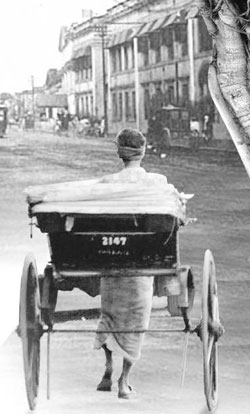
Handpulled Rickshaw Becoming Part of Kolkata History

I came to Birlapur, a small industrial jute mill town near Kolkata as a child in 1946 at the age of six for schooling. But my regular schooling started in 1950 from class VI at Birlapur Vidyalaya. Whenever my grandfather took me to Kolkata, we used to have a difference of opinion on one thing whether we should ride a man pulled rickshaw. While my grandfather took it as a normal transpiration means, I thought its use as shameful act- a human riding human. After almost 50 years of independence, only few days back the United Front government of West Bengal could get the state assembly pass ‘The Calcutta Hackney-Carriage (Amendment) Bill, 2006′, to phase out hand pulled rickshaws. The rickshaws will become part of the history of the city. The bill, when enacted, will undo what Chinese traders did for Kolkata’s transportation in the late 19th century by introducing this eco-friendly transport. That was years after Shimla boasted of it in 1888. And now after Bengal’s Marxist lawmakers handed the death sentence to it, the screen travails will fortunately assure the carriage at least lives in reel life.

Be it films, Parineeta, Do Bigha Zameen, Amar Prem or City of Joy or be it filmmakers, Satyajit Ray or Rituparno Ghosh, the hand-pulled rickshaw represented Kolkata in its elements.
Kolkatans have different views. ”It may be seen as a form of slavery, but the hand pulled rickshaws should be preserved as part of our heritage. There can be certain routes on which they can still be allowed to ply.” ”But it is one of the non-polluting vehicles the city must ever have.” ”When there is flooding in Kolkata, hand pulled rickshaws are the only solace. They are symbolic to the City of Joy.” “In a city sparsed with narrow lanes and bylanes, rickshaw-wallahs meet a very important transport need. They are Kolkatans’ friends through thick and thin. Come floods or riots, the rickshaw puller is only a hail away. Ever heard of a rickshaw-puller betraying his passengers’ trust.” “Every great city has an USP. Kolkata’s USP – whether we like it or not – is the rickshaw. No other great city can boast of it.”

While piloting the bill, CM Buddhadeb Bhattacharjee reiterated what he had said earlier. ”We must agree on one point that in the 21st century it is not right for a human being to pull another human being. Wherever I go, be it Delhi, Mumbai or abroad, people ask me how long Kolkata will have hand-pulled rickshaws? This is a shame for our city. We should have done this much earlier.” The CM promised rehabilitation for rickshaw-pullers. Some crude facts are:

Most of the rickshaw-pullers were from Bihar who leave their families at home and spend 10 months of the year in Kolkata

24,000 rickshaw-wallahs were enrolled with the All Bengal (hand-pulled) Rickshaw Union

Only Rs 30 was all a rickshaw-wallah would need to renew his license.

The number of licensed hand-pulled rickshaws was 5,937.

Most probably all these rikhshapullers, particularly the younger ones, will try to do something else and the elders may move to their villages. Perhaps the worst affected will be the union leaders who used to live on the collections from the poormen to support their causes.

I don’t think I can forget the memory of aged, thin rikhshawallas carrying the excessively obese ladies and gentlemen of business community in Burrabazar that I hated. Most of those families, as such have now switched over to cars.

Posted in Uncategorized | Leave a comment

Some Indian Achievers

In last week, I came across some Indian achievers who brought laurels to the country. Though not any way very close, many like me feel equally elated with their achievements

Technology Pioneers 2007: Indian companies Strand Life Sciences and Drishtee are among 47 ‘visionary’ firms worldwide that were selected by the World Economic Forum as ‘Technology Pioneers 2007’ for their life-changing innovations. Their innovations have been considered to have the potential for long-term impact on business and society.

Global Indus Technovators Awards: The ten young under-40 innovators and entrepreneurs recognised by the Indian Business Club at Massachusetts Institute of Technology for their outstanding contributions to biotechnology, information technology and grassroots technology, are:

Biotechnology/medicine/healthcareAnita Goel (Nanobiosym Inc), Krishna Kumar (Tufts University) and Shiladitya Sengupta (MIT)

Materials and Devices: Aref Chowdhury (Bell Labs), Rajeev V Ram (MIT) and Adam Rasheed (GE)

Information technology: Anuj Batra (TI) and Rajit Manohar (Achronix Semiconductor).

Indian entrepreneurs Vikram Akula, founder of SKS Microfinance, and Sameer Sawarkar of Neurosynaptic Comm are the winners in the Grassroots category. Akula, founder of SKS Microfinance – one of the fastest growing microfinance organisations in the world, has provided over $33 million in loans and helped over 300,000 people in becoming economically self-reliant.Sawarkar, founder Neurosynaptic Communications Pvt, Ltd, who works in the areas of remote medical diagnostics and telemedicine, has developed ReMeDiV solution for rural telemedicine.

Scientific American’ 50 achievers: ‘The ‘Scientific American’, said to be the oldest published magazine in the US named two Indian Americans Pulickell Ajayan and Prabhakar R. Bandaru in the list of 50 achievers in the field of science and technology.

Ajayan is an assistant professor at the material science and engineering department at Rensselaer Polytechnic Institute in Troy, New York and was recognized for his research on carbon nanotubes by the Materials Research Society.Ajayan’s research work involved creating super-resilient springs from thin carbon tubes that could one day be used to create artificial joints. Ajayan graduated in metallurgical engineering from BHU and got his doctorate in materials science and engineering in 1989 from Northwest University in Illinois.

Bandaru is a professor in the Jacobs School of Engineering’s materials science program at the University of California, San Diego. Bandaru and his colleagues demonstrated a radical nanotube-based transistor. Scientific American described graphitic structures, the area of Bandaru’s research as ‘Chicken Wire’. Bandaru received his doctorate from the material sciences and engineering department at the University of California, Berkeley, in1998, with a master’s thesis in the thermodynamic phase transformation issues in magneto-optic media.

Right from our great President every one down the line are talking of encouraging science education and making it more lucrative. Our universities must work on basic research. The country that produced Jagdish Chandra Bose, CV Raman, Satyen Bose and Meghnad Saha with very little facilities available in the pre-independence era seems to have lost the race of scientific research.

I am sure many in our national research laboratories, IITs, IISc and many universities too must be doing outstanding research work, but the country is so little informed about them. Why is it so? Is it because of the irresponsible media that are too busy to cover our crooked politicians and hot and marketable news or because of institutional restrictions to write about the research work?

Posted in Uncategorized | Leave a comment

Bihar Development and Investment Council

Bihar has now Bihar Development and Investment Council (BDIC) and Bihar Foundation to help develop Bihar.

As reported, “Headed by the Chief Minister, the BDIC will comprise top shots from the India Inc, including Anand Mahindra of Mahindra and Mahindra, Sunil Bharti Mittal of Bharti Telecom, Kumar Mangalam Birla, B Muthuram (MD of Tata Steel) Rajshri Pathy of Rajshri Sugar and Sanjeev Goenka. Deputy chairman of State Planning Board NK Singh will be its deputy chairman and former economic advisor of the Government of India Shankar Acharya a prominent member.”

It is surprising and unfortunate that CM’s council (BDIC) doesn’t include any IT biggies. No state today can think of significant development without IT/ ITeS/ BPO/ESO/KPO. It is the need of hour. With huge number younger people of the state studying outside the state preparing for the sector, the main input for the sector that is the major deciding factor, is readily available. At least after education, the young men could have come to the cities of the state and work there. It could have as elsewhere changed the economy of the cities. It can bring out the potential of intelligent Biharis. I don’t know if CM or his men didn’t try to contact any of them or they didn’t agree .I further fail to understand why the government is not taking lessons form even smaller places such Bhuwaneswar, Bhopal, Mohali, Jaipur, and Kochi are developing fast as IT centers. IT sector doesn’t need much investment too. However, the government must have to ensure the infrastructure necessary for IT and the law and order around the location.

Deputy Chief Minister Sushil Kumar Modi heads ‘Bihar Foundation’ that aims “to bring all Biharis settled in different parts of the world to partner in their state’s endeavour to develop.” I wish the government opened ‘Assistance Center for NRBs’ that can help them in the way ‘your man in India’ does. Some one from Mauritius approached me to know a place in Rohtas that was the place from where her ancestors went to Mauritius. I tried my best but I could not. I am sure if there was a center for NRB, she could have got the information.

I shall also wish BDIC and Bihar Foundation to have its websites that are regularly updated and queries answered. Unfortunately, as per the Bihar government website, none of the ministers except for the CM and DCM have e-mail address so that people can contact them. But the worse is that even the CM and DCM do never acknowledge even with one that can be done automatically.

Surprisingly, CM and his party JD (U) chief, Sarad Yadav have outright opposed the policy of SEZs and closed the door for the aspirant investors in SEZs. It would have been better to remain non-committal for CM as shrewd statesman. This has unnecessarily made them anti-investors. CM should leave the subject open for discussion at BDIC.

CM and DCM must encourage ‘one education hub’ at the headquarters of every district for higher secondary and professional education, and see that all the existing professional colleges of engineering, medicines and sciences compete in quality with the best in India. This will lay foundation for bringing in BPO and enterprises in high-end knowledge sector. Perhaps, Bihar Foundation can help accelerating the knowledge sector. The story of the efforts of Ravi Verma, a Silicon Valley entrepreneur at a small town of Katihar is precursor of the things to come. Verma’s Telecommand, started in Dec, 2005, provides IT consulting and support to both public and private sectors in Sacramento county and wider northern California areas. Verma, in his 30’s, is proud of running a successful software development centre in Katihar. Verma has hired software engineers belonging to the town who had gone to cities like Bangalore and Mumbai in search of work. Bihar can move forward only with such an innovative entrepreneurships of NRBs.

Posted in Uncategorized | Leave a comment

The Antikythera- the first analog ancient computer

Have you come across this unique discovery? Scientists in ancient days too worked on some sort of mechanical devices that could make their arduous calculations a little easier with no chance of human error.

Divers found the Antikythera Mechanism, an ancient computer, in 1901 off the coast of Antikythera, a Greek island 18 miles north of Crete. Greek divers, exploring the Roman shipwreck at a depth of 42 metres actually came across 82 curious bronze fragments. At first, these pieces, thickly encrusted and jammed together after lying more two millennia on the sea floor, lay forgotten. But a closer look showed them to be exquisitely made, hand-cut, toothed gearwheels. It was clear that, within this find, 29 gearwheels fitted together, possibly making some sort of astronomical calendar. A rough replica of the device was eventually constructed and archeologists guessed that it was an astronomical calculator. But the inner workings and the device’s true nature remained unknown for 100 years.

A group of scientists from the U.K. and Greece led by Mike Edmunds, an astronomer from the University of Cardiff has deciphered the Antikythera Mechanism. According to the group’s findings published in the November 30, 2006, issue of Nature, several physical factors and the device’s reference to Hipparchos, place the mechanism between 140-200 B.C. And a complete computer model of the device has been constructed,

The Antikythera could be considered the first analog computer. The team of experts from the U.K. and Greece discovered that its system of dials and more than 30 gears is more complex than those found in medieval clocks. It suggests that the Hellenic people were much farther along technologically than scientists, historians and archeologists had assumed. The device is at least 1,000 years ahead of its time.
The inscriptions on the Antikythera Mechanism have been deciphered to reveal theories for ancient planetary positions. The mechanism was used to predict and calculate lunar and solar eclipses on the basis of Babylonian arithmetic-progression cycles. The mechanism also calculates lunar positions based on theories by the famous Greek astronomer Hipparchos for deciphering the Moon’s elliptical orbit. The machine’s ability to calculate sophisticated astronomical knowledge of the Moon’s unusual orbit surprised the scientists.

The original device is likely to have comprised 37 gear-wheels and comprised two clock-like faces, one front and one back, which would have fitted into a slim wooden box measuring 31.5 x 19 cm and a thickness of 10cms. The machine was a 365-day calendar, which ingeniously factored in the leap year every four years. It could also predict lunar and solar eclipses under the Saros cycle, a 223-month repetitive interplay of the Sun, Earth and Moon. The Machine was also a star almanac, showing the times when the major stars and constellations of the Greek zodiac would rise or set and, speculatively, may also have shown the positions of the planets. (Credit: Copyright of the Antikythera Mechanism Research Project)

I wonder how little we know about what all our ancestors achieved, but the evidences of their achievements disappeared or lost because of human conflicts or natural disasters. Can’t someone some day find the remnants of vimanas used by some of our ancestors or a similar computer used by Aryabhatt or some of the weaponry that Arjun or Karna used?

Posted in Uncategorized | Leave a comment

A Billion On The Move

India is on the radar screens of international corporations as well as media for many good things happening here. Many are appreciative of what is happening in India but many are skeptical too. To the Paris-based daily, ‘International Herald Tribune’, India is consumed with the idea of becoming a superpower, ”an obsessive conviction that India is destined for international supremacy is spreading fast.”

However, Arun Maira of Boston Consulting Group in a recent article ‘A Billion On The Move’ in Times of India presents a story that appears to be more rational.

Earlier this month, 450 strategy advisors to boards of companies in 50 countries arrived in Delhi to check out the India story for their clients. Last year they had visited China.

China makes a much better first impression. Indian airports and roads are chaotic in comparison to the marvels of Chinese infrastructure. The next impression of India for the consultants was further chaos. The morning papers were filled with stories of demolitions in Delhi, traders’ protests and the ongoing tussle between the courts and government.

Nevertheless, further encounters during the week, beginning with a candid meeting with the finance minister, changed their minds. By the end of the week, they said they were truly impressed, and would recommend to their clients that India may be emerging as a better long-term bet than China.

The FM had admitted that the infrastructure was falling short of the booming economy’s requirements, and that democratic political process made progress less orderly than in China. However, he pointed out that India, with its enormous diversity, could not work without democracy. A delegate pointed out the loss in economic efficiency by the clumsy diversion he saw of an Indian highway to avoid a small Muslim tomb that came in its path – something not seen on China’s super highways. The minister replied that if the tomb was sacred to some people, then it had to be respected, regardless of the inconvenience to others. That, he said, was the Indian way – the international audience applauded.

It might have impressed the visitors, but irritates the Indian people at large, and a sense of demoralizing helplessness dawns. Why can’t the local authority effectively take the people concerned in confidence and impress upon them the national importance of giving up the traditional views in all such cases of tomb or temple? It may appear difficult, but not impossible to reach an amicable and quick solution to avoid the excuse for delays in the projects.

During the week, the consultants broke up into smaller groups and visited manufacturing companies and numerous service companies around Delhi. They returned from these visits convinced that Indian manufacturing companies are equal to the best in the world, and that Indian service companies are ahead of the best, creating new business models and setting new standards.
However, even after getting convinced with the capabilty of Indian manufacturers and service sector, will the report of the delegates make a big difference to tilt the scale of FDI in favour of India? But then why should India bother so much about it? Perhaps India must have a business model that can move the billion ahead.

And here Mr. Maira gives the success story of Andhra Pradesh self-help group.

In Andhra Pradesh, 8 million women are members of self-help groups at the grass-roots level. The groups function autonomously. They determine what help they need from a level of organisation above them. In turn that level, in the village or mandal, determines what it needs from a level above it to fulfil its own role. Thus, from the bottom-up, empowered women are scaling up an organisation that presently engages 8 million women, which is many times larger than Singapore’s total population.

In the minds of the delegates, the picture of the nation went beyond physical impressions; it went beneath the numbers of economic growth; and looked behind international rankings of competitiveness in which India does not do well. By going deeper, India’s real strengths could be touched. A nation is not merely an economy, and the well being of its citizens cannot be improved only with better infrastructure.

India is a story of a billion people on the move. Mr. Maira concludes:

First, large and complex systems can be, and perhaps must be, moved bottom-up rather than top-down for the movement to be sustainable.

Second, if components of the system are human beings who seek dignity and freedom, then they must be agents of change and not merely beneficiaries of change produced by people above.

Third, the question to ask is not merely what people want as consumers, but what they want as citizens.

Finally, the foundations of a democracy must not be built only upon people spiritedly defending their own rights – which in individualistic societies is often the case – but as the FM eloquently explained in his answer to the query about the highway, it lies in respect for the rights of others.

All’s well for MNCs, barring infrastructure

Posted in Uncategorized | Leave a comment

‘Samudramanthan’ at Suvarnabhumi Airport, Bangkok

For many years, I have not visited Bangkok that used to be almost a regular stop for our visits to Isuzu Motors or Mitsubishi Motors, Japan from our Calcutta base. I was going through the photographs that Rakesh downloaded on my laptop.

The photograph of the depiction of ‘Samudramanthan’ scene at Suvarnabhumi Airport, Bangkok attracted me. How exhilarating must be this piece of artistic creativity? It perhaps matches with the grandeur created by the Thai builders of its new International Airport that ultimately is designed to handle 100 million passengers.

But can India put something such as the one above at one of its new airports? No, we can’t, as we a secular state.

HM King Bhumibol Adulyadej chose the name Suvarnabhumi that means “The Golden Land”, specifically referring to the continental Indochina. “Golden Peninsula”or “Golden Land” is a traditional name for the Thailand-Cambodia-Laos-Burma region.

We are to learn so many things from all over.

Posted in Uncategorized | Leave a comment