‘Nano’- A Great Opportunity and Many Challenges

I was talking to Anand Friday night. They got a new vehicle big enough to accommodate the expanding family. Naturally, it means more on gasoline cost. All the big vehicles consume much more gasoline. It is quite a deterrent for the present gas price in US that has almost doubled in last three years, as Anand informed. Anand excitedly talked about the Tata Motors’ Nano and its low fuel consumption that he has heard and read about in media. Many households in US can think of having a ‘Nano’ in their fleet as an addional vehicle for a short run or single drive for some shopping or routine chores around the residence.

Every automaker in Japan developed and sold small cars for the women in the Japanese households. Bigger cars were for long drive or for use to keep the status in tact. Japanese small cars had all the sophistications unlike India where all the manufacturers did away with all those features to cut down the cost and the price to the consumers. Suzuki in India also did the same with its Maruti 800 model.

Perhaps the festivities of the coming Durga Puja or Dessehara in India will get a booster with the appearance of Nano -the ultra cheap car of Tata Motors that has enhanced the prestige of Indian manufacturing capability globally. The Nano also became a hit at the Geneva Motors Show, and brought admiration for the Tatas to come up with a cost effective product. As I understand millions of people are waiting for Nano’s availability. And why should not they be? The younger generation of a farmer requires sparing the produce of only 2 acres to buy a Nano. With improving rural roads, Tata Motors must cash on at least few potential customers in each of the six-lakh villages of the country and that will run in million.

Tata Motors has taken too much time after it launched Nano in January 2008 at Auto Expo in Delhi for coming out commercially in the market. It could have taken a different strategy to come out with the first 1,00,000 cars in one of its existing plants for faster market entry, if it had a freeze on its design or through simultaneously work on manufacturing facilities. It could have got the first timer advantages. Moreover, the recent spiraling inflation will certainly impact Nano. If Tata Motors keeps the prices even after providing for the vendors as it has promised, it is great job almost like a magician on cost cutting through value engineering and innovations.

I still don’t understand the Nano pricing. Even the depreciation and interest cost on the huge investment of Rs 1700 core that as reported has gone up to Rs 2000 core will be considerably significant. For that matter, Suzuki Maruti with its plant totally depreciated can always cut down its price of Maruti 800 to the level of Nano, though it keeps on brushing aside Nano competition.

Durga Puja is just few months away. But if market accepts Nano warmly, the volume build up must be fast along with the creation of infrastructure for handling the services for rural market. As the market expected, Tata Motors will be using a distributed manufacturing strategy to make Nano available to its prospective customers in every part of the country.

But as it appears, Tata Motors has restricted itself to Singur for manufacturing, perhaps as some sort of commitment to Buddhadeo Bhattacharya. Somehow with my bitter experiences of the work culture with the leftists unions, I am still not sold on Singur as the right choice for Nano manufacturing. Perhaps, Tata Motors might have kept some of the plans secret. In the mean time, according to the media reports, Tata Motors is seeing a huge global interest with enquiries pouring up for setting up plants from countries like the US, Latin America, Europe and South East Asia. What a pride moment!

I wish Nano to set a record performance to boost the image of India’s manufacturing capability on the line of T-model of Ford or Beatle of VW. I dream of many dedicated ships carrying Nanos and its variants to different parts of the globe. Can Tata Motors do it? It will certainly be possible, if Tata Motors can keep the quality of the cars to the global standard and keep on innovating to remain the best in its class. Competition will come for Nano, may be sooner if it succeeds. And it may be not only from Bajaj Renault Nissan combination as reported in press, perhaps the Chinese will be faster with their Nano’s fakes, may be as ‘Bano’.

Let the Indian manufacturing excel through Nano.
—–
PS Latest from Rattan Tata: New Nano model underway to fight fuel price hike
Posted in Uncategorized | Leave a comment

A Father Answers Frustrated Son

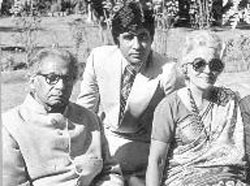
Once one of my teachers Dr. Sahodar Pandey recited the first geet of ‘Nish Nimantran‘: ‘Din jaldi jaldi dhalta hai’. It touched me so much that I became a crazy fan of Senior Bachchan, Late Haribans Rai Bachchan, a popular Hindi poet.

In Sunday Times of India June 29, 2008, I read the following excerpts from http://www.bigb.bigadda.com. I really liked it. Perhaps as a father at the age nearing 70, it suits me. I don’t know when it happened with Amitabh, but with years passing the problems with sons or may be, with parents are getting accentuated. I shall like the younger generation to appreciate the older one that had to travel much more difficult paths.

The avenues and opportunities open to the youth today in an economically liberated India were absent in the late 50s and early 60s. After graduation what? Where to find a job? What job? How? When? And the idealism and debate and the coffee house banter soon converts itself to anger. The anger was because of not knowing what to do with ourselves. Amitabh writes:

Angered, frustrated, strengthened and armed with unreasonable thought, I walked into my father’s study one evening and for the first time in my life, with choked emotion, raised my voice at him and screamed: “Aapne hamme paida kyun kiya?”(“Why did you give birth to me?”)

My father, immersed as he always was in his writing, looked up at me with some initial surprise and then settled down to a more understanding posture and remained so for almost eternity. No one spoke. Not him. Not me. Not a sound. Just the measured clicking of the timepiece on his desk – and my unmeasured breathing! When nothing came across from the parent quarter, I turned and left. It was an uncomfortable night for me. The next morning my father walked into my room, woke me up and handed me a sheet of paper and left. I opened it. It was a poem he had written overnight – titled Nayi Leek or The New Generation.

Zindagi aur zamane ki kashmakash se / Ghabrakar mere ladke mujhse poochte hain, / “Hamme paida kyun kiya tha?” / Aur mere paas iske siwa /Koi jawab nahin hai /Ki mere baap ne bhi mujhse bina pooche / Mujhe paida kiya tha, /Aur mere baap se bina pooche unke baap ne, unhe, / Aur mere baba se bina pooche unke baap ne, unhe…/ Zindagi aur zamane ki kashmakash / Pahle bhi thi Ab bhi hai, shayad zyada, / Aage bhi hogi, shayad aur zyada. / Tumhi nayi leek dharana, / Apne baytoen se poochkar unhe paida karma!

(Pulled and torn by the strains of life and living / My sons ask me / “Why did you give birth to us?”/ And I do not possess an answer to this / That even my father did not ask me before giving birth to me, / Nor my father was asked by his father / Nor my grandfather did ask his father before bringing him. / The trials and tribulations of life and living / Were there before / And are there now too, perhaps more / And shall be there tomorrow, even greater. / Why don’t you make a new beginning, a new thinking, / Ask your sons before giving birth to them!)

How did yoou like it?

Posted in Uncategorized | Leave a comment

Gandhi and Ram

As reported, ‘the Union Government will spend a total of Rs1, 346 crore on the construction of the 385-km-long Dandi Heritage Route between Ahmedabad and Dandi in Surat district where Mahatma Gandhi had defied the British Salt Law after a long march in 1930. If it is not an election stunt, it’s a wonderful project. The National Highway Authority of India (NHAI) will construct a four-lane highway at a cost of Rs 1,200 crore.’ Will NHAI or some other Gandhian institution be trying to retain or reconstruct the places attached to the memories of that journey of the father of the nation so that a tour on the route becomes part of Incredible India for the posterity to come, see, and feel proud?

Grand Heritage Route: For a long time, I have been thinking on a similar journey, rather two journeys undertaken by Lord Rama: the first was with Lakshman and Vishwamitra from Ayodhya to Janakpur and back. The second was a long one from Ayodhya to Lanka, covering almost he whole of India from north to south. Can one not think of creating an Epic Heritage route covering all the important places Pryag, Chitrakoot, Pachwati, Pampapur, Kiskindha, and then Rameshwaram ending on the Ramsethu? It can get into Sri Lanka if it permits. Will it not be a better memorial than the temple BJP has committed to build at Ayodhya?

I can’t say if Rama is a historical figure. But millions of people visit these places. For thousands of years the places have got mentions in the writings of great saints and poets. However, all these places have one thing in common. The places remain unplanned and filthy with no facilities worth name for the people visiting it.

Will it not be a great heritage road, something better than the temple at the birthplace, if created, for millions who go to all these places following different routes and means of transportation?

I appeal to all the religious-minded ones to participate and do their bits in improving the cleanliness of all the religious places, be it Badrinath or Banaras, Gaya or Gangotri. It will also inspire and motivate millions of the people to improve the conditions around their households.

It would have been the Gandhi’s wish too.

Posted in Uncategorized | Leave a comment

A Homage to Nation’s Pride

We were in Hind Motor, when India helped Bangla Desh to become a separate nation out from Pakistan born out of malicious ambitions of the politicians. Those were exciting days. We heard the Indian general asking for the surrender of the Pakistani army and saw the great surrender.

After the Bangla Desh Independence war, Sam Bahadur (images) became an icon. Sam once had refused to let Indira Gandhi into the operations room for the debriefing, as she had not taken the oath to secrecy. It was Pandit Nehru era. Sam had some more skirmishes with Indira Gandhi. But those were the days, when the political leaders were much more magnanimous unlike the present breed.

I was expecting that the morning newspapers would carry the news of the end of a glorious life of a son of India on its front pages with all the stories as special honour to the departed soul. However, the media perhaps look for the news that is hotter that makes more readers, such as all useless details on Arushi murder. Sam got some space only inside pages. But the more horrendous was the news that only an MOS represented the government of India. Even the chiefs of services didn’t join the funeral. Why is there so much of coverage for the politicians by the media? Why are the country’s politicians so mean in giving respect to a person of other fields who has been a national hero? Dr. Man Mohan Singh could have set a precedent by attending the funeral of the first Field Marshal of the independent India, as it can hardly be expected from the present president. However, the former president also couldn’t make it and neither the leader of the opposition.

I expect the government to name some of the institutes of the defence forces such as National Defence Academy after Sam Bahadur. But will it? Perhaps, one day the country would find again the name of some Gandhi-Nehru as prefix.

How can one expect some magnanimous steps from the politicians in hurry to get the vote banks on their sides at all cost even to the great institutions such as IITs?

I am waiting to see if the national weeklies such as India Today, Outlook, or Week or the monthlies come out with some special issue on Sam Bahadur. Even if they don’t Sam Bahadur (pictures) would remain unique and outstanding for generations to come.

Posted in Uncategorized | Leave a comment

NHAI vs. Delhi Metro

NH-2 Delhi to Kolkata

I have been following the two projects for a long time. I see Delhi Metro working in Noida, and get convinced of its world-class professionalism. Hardly one can assess the amount of confidence it would have given to the technocrats and project managers of the country. I don’t know if it has created some intellectual properties in form of patented technologies. However, Sreedharan has certainly become one of the best CEO managers in the world, and interestingly with his age in 70s, when American management gurus have made experienced managers beyond 60 or even younger ones all over the world retire and replaced by younger ones in 40s.

At the same time, the progress of NHAI projects has been dismal, particularly in last four years. Everywhere I go, I make it a point to go by road to see the progress and quality of the construction work going on almost in every part of the country. I have been writing on the issue quite often too. I cherish a wish to drive all along the GQ and NS and EW corridor expressways during my lifetime and see my country. However, the NHAI is missing all the time schedules promised. Why is this difference? Perhaps its remaining strictly under the minister’s control is the main reason. NHAI head might not be having the same autonomy. But with a proven model of Delhi Metro, why couldn’t Mr. Man Mohan Singh go for the similar operation management and/or appoint a CEO of the caliber of Sreedharan for NHAI?

I have judged performance of NHAI through a different tool. NHAI under UPA made one change in its web content that clearly indicates its intention and the officer responsible for doing that should be named. In its chain diagrams, it removed the estimated dates of completion of various segments that were designed and followed till NDA ruled. It was done so that no one can point out at NHAI’s failure to meet the time frame. It hardly bothers about the anomalies that its information on the web provides. The map of the expressway connecting New Delhi to Kolkata as on April 30, 2008 gives a figure of only 34 kms as incomplete or under implementation. However, when I go to its chainage diagram for the Delhi-Kolkata on NH-2, I find hundreds of kms and many segments still shown ‘under implementation’. Why is it so? Can some one responsible in NHAI and the transport ministry, explain?

I wish some one goes along the expressways and write a book for people who shall like to see India following the routes. Perhaps, the speed of progress confirms that at least my wish to do that will remain unfulfilled. After Satyendra Dubey murder, it became known that NHAI projects suffer from blatant corruption and even the quality of the construction is far from the world-class standard that it claimed once to achieve. It would have worked hard to make it more transparent and involved institutes such as IITs or CRRI more intensively.

I feel bad, as just this one single infrastructure project, if properly executed, would have taken India pretty ahead and added to sustainable overall growth. I call it a project of national importance but the government doesn’t think so, nor treat so. It is still not late for the government to see that the timeframe is not sacrificed.

Posted in Uncategorized | Leave a comment

India Vs China: Some Exciting Aspects

I don’t why, but every time I come across news where India is ahead of China, I get immense pleasure. Even a higher production of menthol mint oil excites me. Here are some more:

1.According to ‘World Wealth Report’, an annual survey by Capegemini SA and Merril Lynch, the number of people with over $1 million to invest, not including the value of their homes or consumable goods rose by 23% in India over last year posting the biggest gains in millionaires, when China posted 20%.

2.India receives the highest remittances of about $ 27 billion from Indian national working abroad followed by China’s 25.7 billion.

3.According to the third Annual Synovate Young Asians study, Hapiness Rating for the respondents aged between age 8-24 for India was 98% as against 76% for China.

4.India has become the largest producer of menthol mint oil in the world, overtaking China with a production of about 17,000 tonnes, 78 per cent share of the annual global output of menthol mint oil.

5.Movies and guru: As Tarun Khanna writes, ” The Indian film market is twice as large as that of China. India produces more than 800 Hindi movies a year, and its film industry has an estimated annual turnover of nearly $1.3 billion, employing 6 million people. In 2006, revenues of the Chinese film market were approximately $737 million… While traditional Chinese medicine and martial arts have plenty of followers in the west, no single ambassador has achieved the fame and influence of Vivekanand or (Deepak) Chopra today… Eight percent of Americans report having tried yoga in some form, whereas only 3 % have tried tai chi. In an attempt to popularize tai chi, one enterprising instructor reports choreographing tai chi movements with yoga postures.”

6.English writers: Indians writing in English are making their marks better in West than Chinese. Recently, Manil Suri’s first novel, The Death of Vishnu, published by WW Norton and Co. in the US, was excerpted in The New Yorker and had a $350,000 (Rs1.5 crore) advance.

7.India closely follows China among the most popular countries for sourcing foreign talent, according to a Manpower Inc survey titled ‘Borderless Workforce’.It has better potential to lead.

8. One is not surprised when the Global Competitiveness Report (2006-2007) ranks China 6th in terms of macroeconomic performance, whereas India is ranked lowly 88th out of 125 countries. However, the same report ranks India higher than China in terms of overall rankings. It ranked India 43rd in Global Competitiveness Index, whereas China is ranked 54th. At various other factors at micro-level, apart from macroeconomic performance, to calculate the Index, India performs much better than China on almost all parameters. On the Innovation Index, India is ranked 23rd, whereas China is ranked 57th. On the Institutions Index, India is ranked 25th, against China’s rank of 80th. In terms of Market Efficiency also, India performs much better with rank of 21 compared to China’s rank of 56.

9.India is ahead of China in exploiting technology: The World Economic Forum, which assessed 127 countries based on their ability to exploit available information and communication technology has ranked India at the 50th place, when China is at the 57th position this year.

10.India had vis-à-vis China much higher skill level among its women population. However, Chinese women are much more likely to be in the workforce despite that country’s lower percentage of skilled women in the total population. While Indian women represent 38 per cent of enrolment in higher education in 2004, the workforce participation rate for women remains very low, at about 18 per cent in urban areas. According to latest government figures, less than 9% of all women in Delhi are earning members of their families. Are the women listening?

11.Immobility of labour in China: While there are no restrictions on mobility of talent in India, China still follows the “Hukoku” system that discourages graduates and skilled or semi-skilled labour based in remote provinces from working in more developed areas. For example, a graduate from a second-tier city who wants to work in Shanghai will have to overcome considerable obstacles, including mobility restrictions. The government works as Raj Thackray there.

12.Low proportion of Chinese students returning from study abroad: While the pace of Indian students returning home after higher studies abroad has been increasing due to better opportunities, it’s exactly the opposite in China.

13. Poor English skills will continue to be one the biggest obstacles to China’s becoming the premier offshoring location for MNCs. If you take the mean scores of the Test of English as a Foreign Language (TOEFL), China’s results are lower than India’s in all subjects (although higher than worldwide averages), especially in listening comprehension.

14.China, followed by India will be a top destination for sourcing for the retail and the consumer sectors in the coming years. While cost is still the key driver of global sourcing activities, mature companies are shifting focus to gain greater efficiency in the competitive market, with focus on better quality products and collaborative supplier relationships, according to a PricewaterhouseCoopers survey.

“There are many other factors that weigh heavily in favour of India, including the demographic profile of its population, its superior banking system, its more sensible approach towards environmental issues, its lead in IT and other knowledge-based industries, its vibrant domestic private sector and, above all, its fully matured democracy, which is more basic to sustainable economic growth than most realize.”-Source: India and China – Comparing the Incomparable

India must build on its own stronger areas, and innovate new ways to improve its yields in agriculture, where with larger arable land, it can leave China behind. It must also focus on manufacturing sector to provide employment to the large population that is getting released from agriculture sector in rural India.

Posted in Uncategorized | Leave a comment

Ranbaxy Deal Shames India

Years ago when I heard of Hindustan Motors handing over its earth moving machine division in Chennai to caterpillar, I got shock of my life. That was the best manufacturing plant of the CK Birla group of companies. CK Birla might have gone richer or wealthier or got rid of some debts, but in the general perception of all the employees as well as the people who knew the group, it was the decline of the business house. Many rumours went around including the personal ones. My shock was perhaps because of my rural upbringing where a sale of the inherited property brings bad name for a person selling it.

After hearing the sale of controlling stake of Ranbaxy laboratories to Daiichi Sanko for nearly $4.6 billion, or $17.14 per share, a 31% premium over Ranbaxy’s current share price, I got a similar feeling. Perhaps many in India might not have taken the deal as a good move by the grandsons when the founder grandfather was alive. It might be a good business deal as many pink papers reported, but it must have tarnished the perception about the young men who owned Ranbaxy.

Business Week called it ‘India’s Shocker Pharma Deal’. Why would Ranbaxy Managing Director Malvinder Singh bail out of a company set up by his grandfather Bhai Mohan Singh and built by his visionary father, the late Parvinder Singh?

Am I getting unnecessarily sentimental? Are these deals not connected with the nation’s pride? Is it just a business strategy to earn the best from what one owns at the right time? But then why should we grumble when Europeans or Americans expressed similar views when Mittal took over Arcelor, or Tata acquired Corus? Why should those acquisitions got so much of hype in Indian corporate houses and even in the political circles? It is interesting that none of the biggies in corporate India made any remark on the Ranbaxy deal, though Ranbaxy for years was the exemplary success story of Indian pharma sector almost similar to Infosys and Wipro for IT sector. Even among the political leaders I read only Advani making some remarks against the deal.

What a shame! Malvinder Singh is happy to remain the CEO of the new group. It is difficult to understand what Singh meant his statement, “The deal would “allow us to transform and go to the next level.” I consider such deal reflects poorly on the management talent of the enterprise that gets acquired. Should India take note of it? Couldn’t some Indian business houses, such as Ambani brothers, buy the company and run it better?

Posted in Uncategorized | Leave a comment

Bihar Under Transformation

Saibal Gupta, member secretary, Asian Development Research Institute (ADRI), Patna is pretty optimistic about Bihar and so am I. In a recent column in Indian Express, Mr. Gupta writes, “The grammar of politics is changing in Bihar. Election hereafter cannot be fought on the basis of the earlier benchmarks of muscle and firepower. The most under-governed and underdeveloped state of the country, for the first time after -Independence, is working out new development architecture. The discourse on development and its social or political matrix has changed in the state. The prophets of doom, quick to write Bihar’s epitaphs earlier, are now revising their script. Now Nitish Kumar, with the mandate of the ‘coalition of extremes’ and with an eye for detail, is using the same state structures in scripting an inclusive delivery system. In future, any political party that wants to make an electoral breakthrough in the state will have to do some introspection. Without a cohesive agenda and a cadre-building exercise, political parties would run the risk of electoral obsolence.”

With the news appearing in media, the prediction of Mr. Gupta seems to be right. However, perhaps Bihar at grassroots level needs some change in the mindsets of its people. The incident connected with cabinet minister Narendra Singh and legislator Phalguni Yadav or the post cabinet-reshuffle bickering for the head of Sushil Modi was the manifestation of the same old mindset connected with the caste bias. It can’t come without education and employability. New institutes such as Chandra Gupta Institute of management, or Chanakya Law University or for that matter IIT in Patna will certainly bring respectability. But Bihar must focus on creating more and more of its soft power, be it its school of art, yoga, or its cuisines. Simultaneously, the existing institutions and its faculty must work to bring honours through its research works, so that the students from all over India hanker for getting entry into those institutions. Again, Bihar must get the professional institutes in hundreds allover the state.

But here is one more story that again appeared in Indian Express. Can you relish it?

“How is the number of a polling booth related to the Ministry of Social Justice and Empowerment headed by Meira Kumar? Well, without it a voter from the Congress leader’s constituency, Sasaram in Bihar, cannot hope to meet the minister and plead for help. Recently a young chap who had come all the way from Sasaram to Delhi to meet the minister was flabbergasted when the minister’s aide asked him the number of the booth where he casts his vote. “I have never voted. I am less than 18,” he mumbled. “You don’t look underage,” observed the aide. “Anyway, without the booth number you can’t meet the minister.” There was a typically Bihar solution to the whole problem, however. “State any number. Is he going to check it?” said someone there. Well, this is one poll booth strategy that may not work any longer.”

If it is not true, will Meira Kumar say so in media? I was going to write a letter to her for two things: I wish Meira Kumar with Mrs Ambika Soni could get Sasaram a status of heritage city. Unfortunately, neither she nor her illustrious father JagJivan Ram did anything for Sasaram. I also wanted to request her for getting electricity for my village Pipra (mardan Rai ka Pipra). Now I dare not write that letter. I don’t vote there. Can someone help me?

Posted in Uncategorized | Leave a comment

Winning Manufacturing Strategy and Indian Manufacturers

The latest issue of Strategy and Business has an article by William J. Holstein ‘Six Keys to a Winning Manufacturing Strategy’ I wish Indian manufacturing sector took some lessons and go global in scale and profitability without raising constant alarm of the Chinese wolf and looking to the government to provide relief. I would have loved to see M&M agricultural equipment division as the largest in the world. It must focus on the need of agricultural equipment of the Indian farmers who look for robust simple products, easy finance and ‘Nano’-price. With many from the rural area moving to urban workplaces, the farming will require more mechanization, even if some may keep on talking against it. Many a rural households will very soon not be having the manpower to milk the cows and buffalos. Simple equipment designed to meet local requirement will be essential. Trained technocrats to design and develop the equipment needed must support grassroots innovations.

Deere & Company, Caterpillar, Honeywell, and United Technologies are just some of the companies in US that have defied long-held nostrums about the death of American manufacturing by achieving double-digit sales increases. Deere has major plants in Brazil, India, and China, as well as in Mexico, France, and Germany. With 50,000 employees, nearly half located outside the United States, Deere manufactures its John Deere agricultural and construction equipment in 15 countries. Its total sales in 2007 were US$24 billion, with net income of $1.8 billion, far higher than that of the Detroit auto manufacturers. Six main components of its manufacturing strategy are:

1.Strong links with the market. Deere’s factories maintain a robust feedback loop with the design, engineering, and research and development functions. Nurturing market sensitivity can be a problem for manufacturers that shift production offshore in pursuit of cost savings.

2.Rigorous financial discipline. Deere follows a system called shareholder value added (SVA) that measures the difference between operating profit and the company’s cost of capital. And compensation for everyone from top management to unionized labor is based in some respect on SVA. “Everything is a ratio of what we earn over what we invest.” It gives the whole organization an incentive to drive down costs. “For 30 consecutive quarters, it has reduced inventory and the ratio of receivables to sales,” It has meant “getting faster and faster at providing the right products to the right customers at the right time.”

3.Balanced investment approach. Deere uses “a balanced investment approach that includes a substantial reinvestment in the United States.” Deere shifted production to Waterloo, Iowa, and to Mexico in order to improve SVA and boost efficiency. It has been investing heavily in bringing the most modern, advanced productivity tools to factories. By moving engines to existing plants in Waterloo and Mexico, the company improved the economies of scale of those operations. Deere also manufacturers diesel engines in France that suggests that the company is not interested only in low-cost locations.

4.Multiple “home markets” plus export strategy. Some companies may locate manufacturing in a particular country to satisfy demand there, but Deere embraces a dual approach, considering the demand in major markets, which it calls “home markets,” and also factoring in possible exports from those markets. Deere “builds diesel engines, transmissions, and tractors in India that serves the Indian market and at the same time it exports from India to 52 countries, including the United States. Deere facilities in China are exporting to a limited number of countries. What Deere builds in China primarily stays in China.” Most of Deere’s tractors built in China have fewer features and meet lower specifications than farmers in many other markets are demanding. Those products are right for China because its level of mechanization of agriculture is lower.

5.Labor flexibility. Until very recently, U.S. auto manufacturers hadn’t done much to modernize their manufacturing techniques because of resistance from the United Auto Workers (UAW). Deere has a different sort of relationship with the union. In exchange for greater flexibility in work practices, Deere offers its UAW employees profit-sharing schemes based on SVA and productivity. That kind of collegiality has built a relationship that can handle even tough calls, like closing down production.

6. Lean production. Deere embraced lean production. It manufactures different products – planters, sprayers, combines, tractors – all of them quite different. Deere Production System is tailored to low-volume, high-quality production.”
DPS is based on “pull system.” Deere bases its manufacturing on customer demand, and products are made only after a customer has ordered them. The approach lets Deere adapt to cyclical and seasonal factors much better than in the past.
Another element of DPS is a constant push to update machine tools, eliminate waste, and enhance flow-through. It has resulted in ending up with significant productivity gains – close to double digits every year.”

William J. Holstein has referred to the Deere’s competition with M&M. Unfortunately, M&M is still to grow as big as Deere, though it has potential to become one soon. Whatever, Deere has been doing is known to the executives and managers of Mahindra and Mahindra. Can someone pinpoint the reasons for M&M not attaining what Deere has been able to do?

Posted in industry, management, manufacturing | Leave a comment

They also Serve India

In 2005, when I was in USA, I found the bookshop displaying many books related to China. I went through many. Anand bought few too. The books on India were rare. However, Thomas Friedman’s bestseller ‘The World is Flat’ came on shelves in those days, that marketed India excellently. In 2008, I find many books on India in the bookshops. I have written about some earlier.

I have been reading two books these days. I started with Tarun Khanna’s ‘Billions of Entrepreneurs– How China and India are reshaping their futures- and yours’. And then I moved to ‘The new Age of Innovation– driving co-created value through global networks’ jointly written by CK Prahalad and MS Krishnan, that is more about a new management concept of co-creation for innovation. While going through the books of these categories, I would have always loved to read them as e-books, however with some more features integrated in present technology of e-books. My e-book reader must have a provision to customize the book in such a manner that I could change or rather update the data provided in the book on real time as well as it must have provision to integrate my views wherever I wish to do that. I don’t know if any such gadget is commercially available on date.

Khanna and Prahalad both have used quite a good number of case examples from Indian industries and mentioned of many Indian managers. So the books go a long way to sell and promote India and Indian industries globally. Both the authors have earned a lot of reputation, frequently travel abroad and keep on speaking on different forums of the world. I see in them Deming and Zuran of yesteryears who were traveling to Japan and bringing a new revolution there through their quality management lectures. The case histories of Indian enterprises, entrepreneurs, and managers would make India known better and in right light.

Prahalad talks extensively about the innovative approaches of ICICI, ITC’s e- Choupal, TCS, Infosys, Wipro, and Satyam that are becoming new MNCs. ‘Satyam is experimenting in leveraging resources from Indian villages to improve its efficiency of its recruitment process. With manpower cost of less than a dollar a day, Satyam is also experimenting with doing some traditional accounting business processes in the villages.’ One can imagine the cost benefit leverage it can provide with competition. Prahalad has mentioned in this new book about even innovative business model of startups such as TutorVista in the business of providing customized tutoring and Nirvana, an emerging BPO company in Bangalore. Tutor Vista currently has over 10,000 paying students, and is expanding its tutor base of over 5,000 tutors to countries outside India, including the United States. Nirvana serves global financial services clients in customer support and other backoffice processes.The company through its unique applications of analytics and process discipline constantly is improving its understanding of customers and deliver value through global resource leverage.’ Meritrack is another startup in India ‘that has developed methods for providing a testing service for the quantittive and reasoning skills of people.’ It got a mention in Prahalad’s book.

Prahalad also refers to the simple gadgets of $30 cell phones that Madras Cement provides to all delivery truck drivers to improve efficiency and delivery. “To date, the simple, innovative solution has led to recurring annual savings of more than $4 million.” Prahald talks about the organisational revolution and various process inovations at Madras Cements that resulted in a recurring $8.5 million increase in annual profits- an increase of 21% in 2001.

Taruun Khanna has many success stories of Indian corporates and institutions in his book. In each of the chapters, he has dealt with Chinese enterprises with Indian ones, such as Infosys with TCL in ‘Unshackling Indigenous Enterprise’ or Microsoft with Metro Cash and Carry in ‘Views from the World’s Corner Offices’. While writing on DLF story, Khanna emphaises, “Here (Gurgaon), a private-sector entrepreneur has achieved-albiet much more slowly-what the state achieved in Shanghai.” He writes equally lucidly about the wonderful work of SEWA and Dr. Devi Shetty and his “Wal-Martization’ of healthcare. The book mentions many Indian enterprises and the entrepreneurs.

Bookshops are today flooded with many books on the rising India. They tell the stories of the indian enterprises small and big for the readers in all English speaking countries of the world and help in brand building for India.

CK Prahalad and MS Krishnana are professors in Ross School of Business, University of Michigan. Tarun Khanna teaches in Harvard Business School. Prahlad, Krishnan, Khanna and other writers are serving and selling Incredible India to the world. Many a times I wonder why do I not come across the such books by any such professors from India’s so famed IIMs. Are they all introvert and don’t wish to write about Rising India? Are they not sure if India is on its way of becoming the superpower one day very soon?Are they banned by the rules of the institutes that are government aided from writing books that help in creating the image of the instituions and the country?

I wish some one writes some authoritative book on ‘Manufacturing India’.

Posted in Uncategorized | Leave a comment