In The Wonderful Land Called India

Posco had inked a MoU with the state government of Orissa on June 22, 2005, to set up a huge a steel plant. It is five years now. As reported, the company has been allowed to survey the sight. Normally, any other company would have run away. But Posco remained committed to the project. Is there so much of business advantage or a special love for India? It is unfortunate that for the central government of Man Mohan Singh, the solution to the pernennial problem related to land acquisition is still not in priority list. And there are many projects as Posco still waiting.

Many dream projects of the central or state governments or of private sectors get lost. For example, no one knows the fate of Anil Ambani’s world largest thermal power plant at Dadri (in vicinity of Noida), the picturesque railway lines to Kashmir valley or many AIMS hospital promised.

India is becoming a hub of a new business. I don’t know if Indians should pride or get ashamed. According to Hillary Brenhouse’s article ‘India’s Rent-a-Womb Industry Faces New Restrictions’ in Time magazine dated June 5 “India has become the world capital of outsourced pregnancies, whereby surrogates are implanted with foreign embryos and paid to carry the resultant babies to term. In 2002 the country legalised commercial surrogacy in an effort to promote medical tourism; a sector the Confederation of Indian Industry predicts will generate $2.3 billion annually by 2012. Indian surrogate mothers are readily available and cheap.” It costs around $23,000 — less than one-fifth the expenditure in the US — of which the surrogate mother receives $7,500.

I was shocked to see a report from an ex-CII officer in one of the OP Khanna’s regular mails- ‘Is the nation in a coma?’

In a popular prime-time television discussion in Germany, the panellist, a member of the German Parliament quoting a blog said: “If all the scams of the last five years are added up, they are likely to rival and exceed the British colonial loot of India of about a trillion dollars.”

One German business daily which wrote an editorial on India said: “India is becoming a Banana Republic instead of being an economic superpower. To get the cut motion designated out, assurances are made to political allays. Special treatment is promised at the expense of the people. So, Ms Mayawati who is Chief Minister of the most densely inhabited state, is calmed when an intelligence agency probe is scrapped. The multi-million dollars fodder scam by another former chief minister wielding enormous power is put in cold storage. Prime Minister Manmohan Singh chairs over this kind of unparalleled loot.”

And today morning, Mr. JS Arora passed on another mail that was for him:

Swiss Government has officially written to Indian Government that they are willing to inform the details of holders of 70 lakh crore rupees in their Banks, if Indian Government officially asks them.

As Aesop said, “We hang the petty thieves and appoint the great ones to high office.”

Can any one doubt about the greatness of this wonderland called INDIA? Can everything be excused under the garb of democracy and the freedom of expression?

Posted in governance, industry, management | Tagged | Leave a comment

Bhopal Tragedy: Warren Anderson Hanging or Urgent Actions

While most of the Indian activists want the blood of 90 plus Warren Anderson, I wish to remind our friends few things.

Was it not a great courage and laudable act of Warren Anderson that he visited Bhopal even after knowing that a major catastrophe has happened because of the negligence of design or maintenance of the plant that came under his control? I am sure he would have been advised not to come to Bhopal under that condition. As a good manager, he dared as he wanted to see himself the loss caused.

How many of the Indian company executives would dare to do that under similar condition? In Indian film, some of the factory owners might visit the affected premises where an industrial accident would have caused so many deaths and miseries, and the anger of the people there are at the maximum but in real situation hardly someone will dare.

Even with all the assurances from the Indian government many things causing physical harm to Anderson would have happened.

I wish the present protest would have been directed to some more useful issues.

Why couldn’t the site be cleaned in last two decades or more? Why couldn’t the people affected were rehabilitated? Why can’t the government save its citizens first and then charge the expenses to the party responsible, in this case Dow Chemical that took over the assets of Union carbide after a buyout? Why didn’t the government of India take up the issue at the highest level with the Presidents of US with whom Mr. Man Mohan Singh has a lot of love? Why couldn’t Dow Chemicals be persuaded to clean up the place, as it had the expertise?

A law ministry note in 2008 clearly said that Dow Chemicals is liable for cleaning up the toxic Bhopal site. Despite this, Dow Chemicals claimed that the Indian government gave it an assurance that it is not liable for the clean-up.

What was done to ensure the effective use of the fund sanctioned and provided for the rehabilitation work? How did the centre or state perform? What has been done by NGOs so that the help reaches to those affected and not to unscrupulous ones?

Barkha Dutt’s ‘We, The People’ on NDTV on June 13 was pretty revealing and shocking too. The media, the ruling party and opposition are engaging the people of the country about fixing the responsibility of allowing Warren Anderson to slip away to US.
However, I could come to know of some information that I did not know. And I am sure India and Indians could have done better to mitigate the miseries of thousands of the people.

The site of the major chemical disaster is still not cleaned. And the place is still dangerous for the people living around it. Dow chemical that have acquisitioned Union Carbide is not ready to do the clean up. Why couldn’t the site be closed and cleaned? Why should it wait for Dow chemicals to clean? Why should the offer of Ratan Tata be not taken seriously where he asked India Inc to come forward and clean up the site?

Quite a good number of families, perhaps in thousands, are still living in the area surrounding it that is dangerous for habitation. Why couldn’t they be moved to safer places? Why can’t it be done today?

The underground water being used by the inhabitants there are poisonous and causing many harmful deceases and illness among the people. Why couldn’t the government provide a speedy and assured medical help? Why didn’t the big companies participated in it? Why can’t the MCI appeal their members to help in the task? Why couldn’t the system provide even safe drinking water with all the technologies and resources available in the country?

And those affected by the Bhopal gas leak have hardly got good enough compensation. If the government agencies agree to it, why can’t it provide sufficient compensation to those who are really affected? i again suggest the government to create a ten billion dollar fund for disaster mitigation.

Instead, the country’s prime minister Man Mohan is happy by appointing a GoM and then after certain media pressure he asks GoM to give report in 10 days. Why did he fail to do anything substantial in last six years when he held the top most position of the country?

This is what appears in an article in Outlook:

“Bhopals will happen, but the country has to progress.” Hard to believe, and enraging too. According to Sathyu Sarangi, a member of the Bhopal Group for Information & Action, a voluntary body, this is what Prime Minister Manmohan Singh told him and six of his colleagues when they met him on April 17, 2006, to press for action against Union Carbide Corporation (UCC), a wholly owned subsidiary of the American firm Dow Chemical Company since 2001. “Yes, I remember that clearly. This is what the prime minister said,” Sarangi tells Outlook.

And a senior cabinet minister such as Pranab Mukherji is satisfied by providing protection to Arjun Singh’s action and mollifying the public sentiment by promising to try for Anderson extradition.
—-
PS: Deepak Parekh, Chairman HDFC Bank, who is on the board of several companies and known for his frank and no-nonsense attitude towards most issues pertaining to governance and the corporate sector, has views worth appreciating by all those who talk about the Bhopal Tragedy.

Posted in governance, industry, management | Leave a comment

Nitish! Very Poor of You

I had adored Nitish Kumar till date. I still think he is the best bet for Bihar. But somehow I didn’t like the way he expressed himself on Modi issue. Is it due to some personal frustration? Is he losing his hold of Bihar, and wish to be in power by following all the appeasement prescriptions that some of his caste-biased friends follow?

Was it ethical for him to remain in alliance with BJP, if he so strongly felt about Modi? Should he not behave with Modi as a chief minister of a much more developed state? Is it the way a host state chief behaves with the chief minister of a state that employs large number of Bihar’s immigrants? What happens if the people of Gujarat take it as humiliation for its chief minister and react? How can Nitish deny that the photograph showing “Narendra Modi joining hands with Nitish Kumar in a Ludhiana rally” is really just a reprint? I myself had watched that to happen.

Modi has won election after election in Gujarat and remains chief minster because of his development work and popularity and not only because he is a BJP man. Most of the biggest industrialists adore him for his efficient way of working. Every Indian has seen how fast Tata Motors moved to Sanand in Gujarat after the Mamta’s Singur fiasco. At that time, even Nitish had invited Ratan Tata. Why could Nitish not attract any of the industrialists for any project worth a mention in the whole of his term?

Nitish Kumar cancelled a dinner he was hosting at his official residence for visiting BJP leaders including Modi. I wish Nitish wouldn’t have done that. It’s not a way a mature leader behaves. Rather Nitish would have invited Modi for dinner on one to one basis, as Modi was the visiting chief minister of a state of India.

Nitish’s statement on the Gujarat’s contribution for Kosi flood victims was also in bad taste.

If Muslims of Bihar decides the party to be voted on basis of the hatred shown against Modi, I pity Nitish even if he wins. Nitish must get them in his folds by his own work towards their welfare.

There is something beyond politics too and that is the way one behaves with friends and foes. Perhaps Nitish has gone under the influence of some sycophants in his closer circle.

As it appears Sharad Yadav is trying to save the situation but it will still be prudent if Nitish talks to Modi.

Will Nitish like a similar behavior from Modi when he goes to Gujarat? And Nitish must make a point to visit the state to see how his own men have found shelter there. I wish he learns something from Modi too. Look what Modi said while addressing the people of Bihar in Patna:”People of Bihar have contributed to Gujarat’s progress. I have come here to salute the people of Bihar.”

However, I still think the people of Bihar must re-elect Nitish and wish Nitish to avoid speaking a little too much.

Posted in bihar | Leave a comment

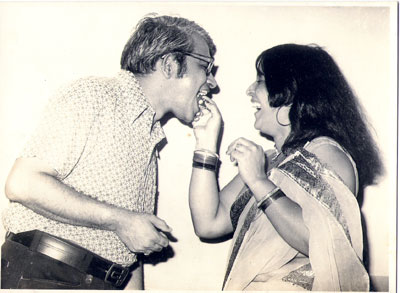
आज के ही दिन

पचपन में मैं
पंद्रह का था |
आज के ही दिन
५५ साल पहले
मैं दूल्हा था
एक गाँव में |
और गाँव के बाल बृद्ध
और महिलाएं
समझ नहीं पा रहीं थी
कौन है दूल्हा |
क्योंकि
साधारण बारातियों की तरह थी भेसभुषा
सादी थी धोती और सादा था कुर्ता|
कर्मकांड हुए सजे मांडो में
कोहबर में
और मैं थक कर था सोया
शायद ही समझता था
बिबाह का अर्थ या इसका अनर्थ |
पर समय की गति से
सम्बन्ध फलता रहा
फूलता रहा
और एक ब्यक्ति से
एक परिवार बनता रहा |
नहीं कोई चित्र उसका
पर मधूर यादें हैं
बहूत मधूर बातें हैं
और है उसका आनंद |
और हे परमपिता
सब तुम्हारी है माया और जाल
और आशीर्बाद |


From Album
Posted in personal | Leave a comment

Bhopal Tragedy and Politics

On Dec 2-3, 1984, poisonous methyl-iso-cyanate gas leaked from the Union Carbide plant in Bhopal in the night, killing thousands immediately and many more over the years and maiming several others. I am sure the Bhopal tragedy was a major industrial accident. No company or its senior most executive will plan it to happen like the politically planned mishaps in which hundreds and thousands of people are killed, be it 1984 Delhi or Gujarat communal riots.

I don’t understand the mess getting created by media about Bhopal tragedy and its purpose. Is it being done to provide the sufficient compensation to the victim families or pinpoint the responsibilities of the accident? Should it not be for creating act and laws and conditions so that such mishaps don’t occur? And even if it occurs in extremely unpredictable cases, how can the human sufferings are reduced with prompt medical care and later on with sufficient compensation for those who survive?

Something must be built into the system to find out if the mishaps are because of lack of robust design and production processes with insufficient quality checks for the plant machinery used or because of not following the preventive maintenance to ensure the health of the industrial equipment and system.

It can certainly be a fault of an individual or group if the set practices are bypassed because of some personal unethical gains.

I personally don’t fix the blame on Warren Anderson just because he happened to be the chief executive of Union carbide at that time or on Keshab Mahindra. However, they would have done their best to mitigate the after-affects. They can be guilty of ignoring the basic human responsibility.

However, the funniest media battle on Bhopal tragedy after the recent judgment of the apex court is nothing but political for interparty and intraparty gains as well as scuffling of the buck between the government, administration, and judiciary too.

Union Law Minister has come out strongly against former Supreme Court Chief Justice who, according to him, reduced the Bhopal gas tragedy into a truck accident. The Minister is also shore about the then principal secretary to Rajiv Gandhi, for hinting that the prime minister might have taken the decision to release the former chairman of Union Carbide Corp Warren Anderson in consultation with Arjun Singh, the then Madhya Pradesh Chief Minister.

Naturally none of the loyal Congress men such as RK Dhawan will like the name of Rajiv Gandhi dragged in the issue and that too when the country is ruled by all powerful Sonia Gandhi, his wife and to certain Rahul Gandhi, his son.

Some of the Congress men such as one former chief minister of MP want to remain in news by making comments in favour or against the case of fleeing operation of Anderson from Bhopal to US. The officers in Administrative services such as the then district collector, the Bhopal police chief or CIB officers are also trying to gain importance by making statements and revelations.

According to the police chief, Warren Anderson was aware of the lacunae in the UCIL plant in Bhopal and knew about the possibility of a disaster like the one which struck on December 2-3, 1984. I wonder why he didn’t come out and presented the evidences in the court.

I fail to understand one thing. Why could not the government and the system ensure a good compensation to the victim that as per report is only $500 per family?

The tragedy must provide an important lesson for the government. The country must have a large enough disaster fund and all the companies must contribute to it in generous manner. Even with all the developments in technologies and its management, there will be some disasters as it happens with in aviation or railways sector.

Along with waiving of lakh of crores of farmers loans, the government can create a fund of Rs 1 lakh crore or more for facing disasters. If a certain portion of the money that oils the hands of politicians and officers in India in getting a clearance of a company to start business is placed in the disaster fund, the after math situation can be more manageable.

Posted in indian politics, industry, management | Leave a comment

Powering India and Equipment Manufacturing

Let me start with good news first. If I go by media, a large number of private entrepreneurs and the big cooperates are rushing into adding power generation capacity in the country. Besides Anil Ambani’s Reliance Power and Tata Power, Hindujas, Birla, Baba Kalyani, GMR, Essar, Adani and many others are lining up huge investment in power plants. Even as reported Mukesh Ambani’s RIL may join the power league. I wonder why private companies took so many years to enter the power sector in big way, when the demand was so high that persists even today. It was because of certain flaws in government policies and the fear of not getting sufficient returns on the huge capital investments that the companies would have made, because of politically backed power large scale theft.

Even today, the country is far behind in creating the additional power capacity required to meet the actual demands. Most of the rural India still lacks light and power. And that has kept the areas backward. The rural entrepreneurs can’t think of starting any manufacturing enterprise that creates employment, as in today’s world nothing works without electricity.

I was stunned when I heard my grocery shop owner Singh complaining that if he would have power available in his home village, he could have started a business there instead of running his shop in Noida so far away from his native village.

However, there is another controversy that is getting a lot of media attention these days. It is about the lack of capacity of the power equipment sector causing undesired delays of the power projects. The Chinese are invading the market and taking away the orders from the sole state owned company BHEL. Both BHEL and L&T are trying to draw the government’s attention against the Chinese and are requesting to place certain restrictions on the Chinese import, because of its suspect quality and unfair trade practices.

All these years I have been questioning the reasons why BHEL couldn’t produce more and meet the requirements of the power sector. What are its constraints to increase the capacity? Why are the other players hesitant to enter?

As most of the power generating companies is in public sector, the system is corrupt. Those with authority to order equipment and contract expect a lot of bribe. BHEL being a government company itself can’t offer any bribes to the executives and officers with power to order. Naturally, the ordering companies create problems adopting different technical specifications, making it difficult for BHEL to deliver in time. One of the tricks is by demanding equipment of varying capacities that are to be custom-designed and manufactured for no reason. Why can’t the companies standardize on the equipment size for 125, 250, 500 MW, and 1000MW instead of asking for odd sizes such as 210 or 600 MW? BHEL or for that matter, any equipment manufacturer can manufacture the standard sizes with ease and faster too.

I came across a report today of a state company. One can see how many sizes are there in its planning of power stations.

I wish the big power generation companies could standardize every bit of its work at the plant site, and can also work with few standard sizes of equipment to build up the plant capacity with the equipment manufacturers that helps in improving the productivity of manufacturing and reduce the cost too.

Fortunately, many equipment manufacturing companies, both domestic as well as foreign, are setting up the shop in the country. South Korean company Doosan Heavy Industries and Construction Co Ltd is planning to set up a power equipment manufacturing facility in India. With Government mulling a safeguard duty on imported equipment, more and more foreign power equipment companies are planning to set up manufacturing facilities in India. Some of them have already tied-up with Indian companies. Mitsubishi of Japan has tied up with L&T, Toshiba with JSW, and Italy’s Ansaldo with GB Engineering, and Alstom with Bharat Forge.

The companies will ultimately taste the advantages of having the manufacturing facilities and then R&D centres in India. Let the Chinese also come and manufacture the equipment in India.

The competition between the private and state owned power generation companies as well as the same in equipment manufacturing will end the various red tapes, corruption and usher a brightly lit future for India pretty soon, when India will be surplus in power.

Posted in industry, management, manufacturing | Leave a comment

AJIRA: Down the Memory Lane

It happened perhaps in 1982. I became the Chief Production Engineer, Mechanical in Hindustan Motors, Uttarpara after working for almost ten years in production shop floor in Engine and Axle Plants. Banerji was working for me in as chief planning engineer. One Banerji asked me to tell Bhattacharya to get allotted a plot of land in Salt Lake for building a residence of my own. Bhattacharya worked as clerk in my office when I was manager in Axle Plant. I never knew that Bhattacharya is so an important person and he had so close contact with the Chief Minister. I called Bhattacharya and expressed my desire. Bhattacharya requested me to put an application requesting for getting a plot of land in Salt Lake to build a house for permanent settlement after retirement and I did. I was surprised when I received a letter dated October 28, 1981, allotting a little more than 4 kathas of land in Salt Lake, sector II on a lease of 999 years at the rate of Rs 100,000 per katha. As I was told, with the salary that I was getting at that time I couldn’t have got bigger plot.

Whatever I had saved since 1961 when I started working for Hindustan Motors, I had spent first in the enterprises of my youngest uncle at Pipra and later on to satisfy the wishes of my mother in building a house in Bodarhi, her village. It ended with a Shiva Yagya at Bodarhi.

However, I wanted to have a shelter in some metro city. I took an Rs 10,000 loan from Provident Fund Account in March ’81for booking a flat in Salt Lake. When I got the allotment of a land in salt lake, there was no other way but to take a non-refundable loan of Rs 50,000 from the Provident Fund Account in November ’81. I deposited a total of Rs 42,959 for the final lease deed of the land. When asked to select a plot, I selected the plot of AJIRA, as it was quiet on a back lane instead of one on the second avenue itself. Later, I requested to refund the advance that I had given for a flat. It became a necessity as I got an opportunity to take Yamuna with me to Europe and UK where I was sent for training cum business trip in 1982. That was the year Rakesh appeared for school final examination.

One day I sent my mother to see the land that I had bought. As I was told, she was very unhappy to see the land and said, “Why did my son select this barren place for building a house. Could not he find a better place?”

But it took almost six long years to start the work of construction of AJIRA because of the constraints of finance. I was also professionally too busy and all the three kids were growing and had gone to engineering colleges increasing the monthly expenditures and parents aging and ailing parents staying with us.

But then one day in my own typical way I agreed with Yamuna to start building work at Salt Lake. I was having my evening walk on the road connecting new flat area of Hind Motor Colony to officers’ flat zone. Yamuna asked me, “How will you manage buying ornaments for the marriages of your daughters-in-law and building the house at Salt Lake?” “Ok, why don’t you start the Salt Lake construction?” I had just Rs, 50,000 or so in my saving. One BANDO was the architect. He got the plan that was of a typical three storied building with 4 bedrooms about 1700 square feet in each storey for each son, sanctioned. Was it not a typical middle class mentality for leaving behind a house for the offspring?

On February 8, 1988, Yamuna went to Salt Lake with Ramji Misra, the family priest, Rita, my cousin sister, and Anand to perform the ritual for starting the construction. It was barren all around. I had appointed a labour contractor. And the foundation was cast on February 25, 1988.

It was in July 1989 that the ground floor got completed. That was the year Rakesh went to Purdue University in USA for his MS. AJIRA made it happen. The second floor took another year. It was in the last quarter of 1992, finally AJIRA was ready for hosting the guests for some of the functions related to the marriage of Rakesh and Alpana. I had organized again a Shiva Yagya with the main priest arranged by my uncle. Raj Kishore Chacha and Chachi did all the rituals and listened to the story from the scripture. The seven day Yagya had finished on the day the relatives of Alpana came and performed the tilak ceremony with a big feast (Brahmbhoj).


AJIRA- UNder Construction


PUJA after completion of ground floor

The construction of AJIRA was slow in bits and pieces but steady. I was almost intoxicated to get it finished. Every roof casting required around Rs 40,000 or so. I had to arrange it through all my savings as well as by disposing off some minor properties in Bodarhi and Pipra. I could also put my relatives to test by asking them for help. I had to face minor troubles with the contractors, the supervisors, and material vendors. But God was great. Anand, Rajesh, Rakesh and Yamuna put their best and worked hard to make the dream realized. While Anand tackled some of the worst contractors that I employed, Rajesh and Shephali could become a savior for me by making the rogue tenant leave the premise. Yamuna provided physical supervision and enthusiasm to arrange the resources to complete the project. AJIRA became a reality.


AJIRA

Today AJIRA has become a part of history, and I can feel the vacuum created. There are many memories good and bad of the AJIRA. How can I forget the nightmarish situation created by the rogue tenant in 1996- 97? AJIRA will live in the memory of all the family members for the whole of life.

AJIRA gave me a respect among the known friends and relatives, a self confidence and security, and a faith in Almighty and destiny.

Posted in personal | Leave a comment

Hindustan Motors- Sick or Dead

Technically Hindustan Motors (HM) is going to BIFR now, as its liabilities have exceeded assets and net worth has become negative. The BIFR has become a mandatory requirement. However, HM has been sick for many years. Perhaps, with the death of BM Birla, one of the pioneers of automobile manufacturing in India and effective takeover of the management by his only grandson CK Birla, the last hope of its survival was dead. The impending end process of HM is typical of a family managed company.

Ashok Desai, Consultant Editor of ‘Businessworld’ has written his column on Hindustan Motors, ‘Steering Into A Dead’ in last week’s issue: ‘If Hindustan Motors continues business as usual, it cannot last more than 5 or 6 years; that is the outer limit’. I think Mr. Desai has not seen HM from nearer quarter. It’s only, perhaps, in India that a company as big as HM survives for so long even with paying dividend to its shareholders only few times so long. I don’t know how the promoters (as the people know them as owners) get the returns on its investment. It must be through unscrupulous means.

I could see the beginning of the end of HM even when I was working on the Mitsubishi projects, that later on came up in Chennai. CK Birla was never serious for remaining in auto business as a leading player with coming competitions after early 80s- Maruti Suzuki, Daewoo, and then Hyundai. HM could have got a very good mini-car in Mitsubishi Minica, that HM also displayed in the Auto expo that year.

With a very good auto part manufacturing at Pithampur near Indore backed by facilities at Hind Motor near Kolkata, HM could have also become a major auto part manufacturer. Mitsubishi tie up would have helped. There were other possibilities too with a great manufacturing facility. But CK Birla had decided to make retreat and go out. He made all that it (or he) could make by selling all the plant and machinery from the Hind Motor plant and as I hear by selling the huge land of the company that the West Bengal government of Dr. BC Roy would have given to HM almost free.

Those who worked for it and put their best of labour and mind in the initial years and brought to a respectable level are bound to feel bad. For many years I worked for the company thinking that I am serving the nation by remaining professionally dedicated. I now realize that that was the biggest of my mistakes in life. I would have moved to other organizations including Tata Motors, where I had conducted many a training courses on technology and management for its technical officers. I am sure I would have contributed and could have been recognized better.

But it’s perhaps my destiny. I still feel bad reading Mr. Desai’s column. HM is dead with no hope of revival. Let us not be morose. I can only write a good obituary. I still remember Late Mr. GC Bansal, the IITian of the first batch and an excellent engineer and my boss for many years, asking me to write about HM once something like ‘HM on a Sunny Day’ on the line of a similar book on GM. Interestingly, that GM is also having the same fate. It’s Obama’s aid that is keeping it going.

HM was a great company at one time and will certainly have place in the history of auto manufacturing in India. Once TELCO (Tata Motors) of those days used to envy HM and sometimes was scared of it. But the professional management of Tatas excelled ultimately and today Tata Motors that got a big boost with initiation of Ratan Tata in it is going to a global Indian company in auto manufacturing. On the other hand, Mr. Birla failed to engage the right people to run HM and to allow the autonomy to the professionals to make it succeed.

Bad Luck HM and those who still remember its golden era! But why should there be any malice? ‘They also serve who stand and wait’.

Posted in industry, management, manufacturing | Tagged | Leave a comment

Rural Education-Islands of Hope

With dismal deterioration in quality of education that the government schools and its irresponsible teachers or shikshamitras are imparting to the children of the parents, who hardly appreciate what his ward is learning and if it will be furthering his career, I find some hope. And I haven’t gone out far away to find that. It has been happening at our village home itself, though I didn’t know. It was again told by Deepak and Prakash when they were here last week. Neither Sulekha nor Alok thought it prudent to let me know, though I keep on talking with them quite frequently.


Sulekha and Alok with Yamuna

Sulekha, Alok’s wife has been teaching the boys and girls of the village for quite some time now. She does it in shifts now for different classes, as the number of her students has gone on increasing. Presently, some 40 and odd are getting tutored. And her quality of tutoring has made the students score better in their examinations. Interestingly, the parents are paying for the tutoring too. I never expected this to happen in my village, as I just couldn’t imagine the farmer families with marginal landholding sparing money for the tuitions. Earlier, I found them hardly interested in educating their children. Paying for tuition that must be done pretty regularly (monthly), was unthinkable in villages with no regular earnings in most families. Has it come because of NAREGA? I doubt at least for my village.

I used to hear about Sulekha’s endeavour. But then I also knew that Alok, my brother didn’t like that neither perhaps my aunty did. I didn’t know about my uncle. But Sulekha has been successful in getting engaged in some useful work besides the household activities. Her education has not gone waste as it happens with many brides coming to the villages. She must be feeling more secure now in the remote village of Bihar; she has a saving account in a bank and has life insurance too. I wish it happens with all the brides with certain skills and training coming in villages.

Sulekha is helping honestly the children by making up their shortcomings of the education they get at school. Interestingly, most of the students are from the deprived families. My aunty has no problem in allowing them in our home, or even if she has reservation, the new generation has rightly snubbed any opposition or found a solution, say, by using another staircase from outside to enter the room that Sulekha uses for teaching.

I myself and Yamuna congratulated Alok for the excellent work being done by Sulekha. He didn’t respond. I am ready to provide all facilities and create a room with books and other accessories, perhaps a computer and internet connection to make the place more attractive for the students. May be that the library proposed in the village school can come up over here. However, I am hesitant to put my proposal. Alok may not like it.

Interestingly, the village has some more tutors other than Sulekha, but she is, as on today, the best engaged in the business. But should not the government and those responsible for providing good education do it in the school itself that is meant for it and for which it is spending so much of the country’s resources? Can the system encourage those who are helping propagating education in rural India as Sulekha is doing?

It also tells about the increasing earning of the farmers from the produce from their fields and that they now have started thinking of educating the children so that they can make a better living that they themselves couldn’t do.

Let the rural India be lighted with education whatever way it comes from, be it from industrial houses such as Shiv Nadar and Sunil Mittal or individuals such as Surekha. It’s really unfortunate the efficiency of the government machinery is using the number of enrollment and the children outside the school or the budgetary allocation or expenditure on the schemes such as SSA and mid-day meals as the gauge for the effectiveness of the expansion of education among the people. There is hardly any measure of the quality of education delivered in the rural schools.

Quality of education will remain more and more with dedicated tutors such as Sulekha, perhaps for many years to come.

Posted in rural india | Leave a comment

Nitish and Bihar: My Views

I keep listening to Yamuna when she talks with someone in her village curtsey cell phones that have become so popular. She mostly talks with Satyabhama, her sister-in-law, the wife of Raj Kishore, the youngest among her brothers who worked in Hindustan Motors and is also now retired.

Early this week I heard in one of these tele- conversations about Priya, the eldest granddaughter of Satyabhama from her eldest daughter Poonam passing Bihar School Final examination in first division. I felt happy, as Priya’s father proved to be a useless character doing nothing for living a decent life. Priya lives with her maternal grandmother for education. Priya has now the bicycle to ride up to the school. She will be getting Rs 1000 as incentive for passing the examination in first division as girl child. It’s Nitish initiative that girl education has got a big boost in Bihar. And all his incentives for girl education are without any reservations for castes. Is it not something uniquely rare for a political leader in Bihar to focus on education? Nitish has done a lot for school education in Bihar. Will even Lalu and Rabri disagree? Did they not kill it in their fifteen years?

Why should not Nitish get the credit for it? Why not voters recognize his contributions to education for all? I might have many expectations regarding improving the quality of education, for adding and encouraging educational institutes for higher education and skill developments in larger number in all the district headquarters of Bihar, but I can’t but agree that Nitish is on right route.

I do also feel that the so-called forward castes will be harming the interests of Bihar and their own too by getting Nitish defeated in the forthcoming assembly election. Leaders such as Lallan or Prabhunath with doubtful integrity can’t match with Nitish as on today. Let the upper castes have first a real tall leader. Till then, the upper castes must vote for the best bet available in Bihar and don’t allow the proven rogues to come in power. Otherwise, they may make Nitish loose, but in real sense it will be Bihar that will loose. I wish the people of upper castes don’t get emotionally exploited by their leaders with their own vested interests.

It’s not that I don’t have grievances with Nitish. I rate his performances till now as average, but the reason is different. My expectations are higher from a chief minister of a laggard state like Bihar. I think Nitish would have focused on some more urgent priorities and would not have talked about many controversial issues. Some are as follows.

Some small entrepreneurs in Bihar have come out with exemplary models of business. Nitish would have encouraged them and the other young men to emulate the models to and to scale it up to cover Bihar as fast as possible. In the process, Bihar government would have helped the likes of Gyanesh Pandey and Ratnesh Yadav, founders of Husk Power Systems (HPS), to expand the business from biomass, a power generation technology which uses anything from agri-residues to wood chips or even coconut shells. HPS’s micro power plants, which burn rice husk to generate gas to run generators, supply electricity to 80 villages. Why couldn’t it have reached 10,000 villages? The novel biomass technology converts rice husk into combustible gases, which then drive a generator to produce electricity at affordable rates. Here is a potential solution that can take power to many more villages of Bihar and with it the prosperity too. If Bihar gets electricity, many petty entrepreneurs of Bihar will like to return to the home state and many new will start hundreds and thousands of small businesses employing a large number of locals.

The successful business model of IIM graduate Kaushalendra linking vegetable growers to the consumers in Patna is another one that could have been expanded to all the major cities of Bihar benefiting many more farmers and vendors.

Nitish would have also encouraged the growth of other cities instead of bringing in every institute near or to Patna.

Nitish would have selected aggressive and performance-oriented ministers. Unfortunately, it’s short in supply because of the system to be followed.

There are many items that can be added in the wish list. And it’s for the people of Bihar to make Nitish focus on them in the coming years by electing him.

I still think that the forward class must not think over the Batai Bill as ghost. They must come out with suggestions that improve the productivity and return on investment of the farms through many other means including diversifications. The limit of ceiling and effective land consolidation needs a relook.

Let the forward class understand that farming is no more an inherited profession of some caste, it requires to be considered as business.

Posted in bihar | Leave a comment